

Introduction
Conservation managers and practitioners must decide on appropriate actions to meet specific objectives. Evidence-based conservation relies on the idea that to inform which conservation actions are effective and which are not, large and robust evidence bases are required and should ideally include studies with high internal and external validity (Sutherland et al. Reference Sutherland, Pullin, Dolman and Knight2004, Christie et al. Reference Christie, Amano, Martin, Petrovan, Shackelford, Simmons, Smith, Williams, Wordley and Sutherland2020). Therefore, a prerequisite to deciding on the most effective actions to conserve endangered species or populations involves understanding the environmental drivers of the demographic parameters shaping the dynamics of target populations (Frederiksen et al. Reference Frederiksen, Lebreton, Pradel, Choquet and Gimenez2014).
Spatial and temporal variation is an essential quality of natural systems and has important implications for the dynamics of animal populations. This heterogeneity creates serious differences in demographic parameters between and within populations (Lescroël et al. Reference Lescroël, Dugger, Ballard and Ainley2009, Oosten et al. Reference Oosten, Van Turnhout, Hallmann, Majoor, Roodbergen, Schekkerman, Versluijs, Waasdorp and Siepel2015). Currently, human activities exert an ever-increasing impact on the environment at all scales (Crutzen Reference Crutzen, Ehlers and Krafft2006) and thus may generate further demographic heterogeneity. Consequently, identifying the environmental determinants of variations in demographic parameters will represent a basic step towards defining the conservation and management actions required to address management goals at population level.
The application of a uniform conservation programme over a large geographical area is a common practice used by policy makers and conservation planners alike (McAlpine et al. Reference McAlpine, Rhodes, Bowen, Lunney, Callaghan, Mitchell and Possingham2008). Nevertheless, this strategy may be inefficient at local scale since demographic parameters differ depending on local conditions (Oosten et al. Reference Oosten, Van Turnhout, Hallmann, Majoor, Roodbergen, Schekkerman, Versluijs, Waasdorp and Siepel2015); thus, different site-specific conservation actions must be implemented. Spatial heterogeneity in demographic performance can be used to identify local-scale conservation actions that will improve a specific demographic parameter and maximize their effectiveness at population level (Rollan et al. Reference Rollan, Hernández-Matías and Real2016).
When an overall population is assumed to be homogeneous, conservation actions are commonly concentrated in areas where available – but often indirect – evidence suggests that a given threat is affecting a management target. Thus, the lack of comprehensive quantitative information on the relationship between environmental stressors and demographic parameters at suitable spatial scales may hamper the implementation and the efficiency of conservation measures. In addition, although modern quantitative methods offer a wide array of robust tools for analysing the relationship between population demography and environmental drivers (Schmidt et al. Reference Schmidt, Schaub and Anholt2002, Sandercock, Reference Sandercock2006, Frederiksen et al. Reference Frederiksen, Lebreton, Pradel, Choquet and Gimenez2014), the effects of environmental stressors able to generate within-population variation in demographic parameters have received relatively little attention in conservation studies. Consequently, even though the main conservation targets are well known, managers and practitioners lack an explicit framework in which to identify the specific conservation problems acting upon local endangered populations.
Top predators are often used for species-based strategies in conservation biology due to a number of intrinsic characteristics (Sergio et al. Reference Sergio, Caro, Brown, Clucas, Hunter, Ketchum, McHugh and Hiraldo2008, Real et al. Reference Real, Bosch, Tintó and Hernández-Matías2016). Firstly, they are indicators of ecosystem status since they occupy a top position in the trophic network and have precise life history traits (low density, low fecundity, extended periods of juvenile dependence, etc.) that make them particularly vulnerable to human-induced alterations of their supporting ecosystems (Sergio et al. Reference Sergio, Newton, Marchesi and Pedrini2006a, Reference Sergio, Caro, Brown, Clucas, Hunter, Ketchum, McHugh and Hiraldo2008). Secondly, these species are regarded as umbrella species whose conservation has implications for other ecosystem elements (Noss, Reference Noss1990, Groom et al. Reference Groom, Meffe and Carroll2006, Real et al. Reference Real, Bosch, Tintó and Hernández-Matías2016). Thirdly, these flagship species represent a very useful tool for conservationists and managers given that they are generally highly appreciated by the local population (Sergio et al. Reference Sergio, Caro, Brown, Clucas, Hunter, Ketchum, McHugh and Hiraldo2008). Additionally, many top predators, in particular raptors, are long-lived species with strong territorial tenacity. Consequently, this means that between-year territory-based monitoring schemes are of great value as they may be affected by environmental impacts and changes. Therefore, identifying the most relevant environmental drivers linked to demographic parameters at local scale that shape the population dynamics of these species is a useful tool on which to base in situ conservation measures for both top predators and their ecosystems.
The aim of our study was to present a framework able to prioritize specific local-scale conservation actions for endangered bird populations. This framework is made up of different steps, based on the application of quantitative methods as a means of understanding the relationship between environmental stressors and demographic parameters, which supposes that the efficiency of the trade-off between the resources invested in the management and conservation of target species and conservation results can be improved. As a case study, we focused on the population of Bonelli’s Eagle Aquila fasciata, an umbrella and flagship species in European Mediterranean ecosystems (Carrete et al. Reference Carrete, Sánchez-Zapata, Martínez, Sánchez and Calvo2002, Real et al. Reference Real, Bosch, Tintó and Hernández-Matías2016) in Catalonia (Spain) and attempted to identify the main local conservation problems negatively affecting this population. Here, we (1) schematically describe our proposed framework and (2) develop the initial steps of the described protocol in our study population. The steps we develop here will allow managers and practitioners to obtain quantitative information on two key aspects of applied conservation: i) which territories present low demographic rates relative to the overall population, and ii) which stressors are more likely driving the observed low performance of these territories. Thanks to this information, managers and practitioners are informed on the conservation actions recommended for each territory. In addition, our protocol includes the implementation and evaluation of conservation actions, which are not developed in our case study, but we discuss the need to include them as key steps of conservation practice.
Materials and methods
Conceptual framework
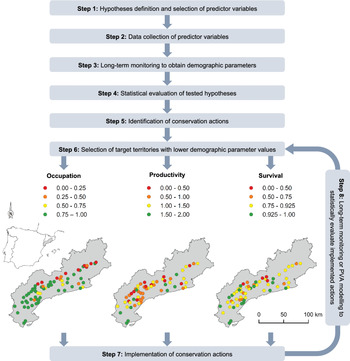
Our proposed framework (Figure 1) consists of the following steps: (1) definition of hypotheses regarding the factors affecting the studied demographic parameters and the selection of predictor variables to validate each hypothesis; (2) data collection of predictor variables; (3) long-term monitoring to obtain information on demographic parameters; (4) statistical evaluation of tested hypotheses; and (5) identification of conservation actions at subpopulation level (i.e. territories). Step 5 may include a description of each territory within the target population, identifying the main conservation issues in each case. In addition, step 5 may also include a population viability analysis (PVA) to stablish a threshold value for each demographic parameter (keeping all other parameters constant) for the target population to be self-sustaining (see Hernández-Matías et al. Reference Hernández-Matías, Real, Moleón, Palma, Sánchez-Zapata, Pradel, Carrete, Gil-Sánchez, Beja, Balbontín, Vincent-Martin, Ravayrol, Benítez, Arroyo, Fernández, Ferreiro and García2013). According to this information, territories with demographic parameter values (territorial occupation, productivity. or survival) below threshold values, or territories with lower ones in case thresholds are not available, can be identified and selected for specific conservation actions (step 6). This is a crucial step when attempting to address conservation efforts and maximize their effectiveness at population level. After implementation of conservation actions (step 7), long-term monitoring is required to evaluate the efficiency of implemented conservation (step 8) and to identify other target territories and actions as part of adaptive management schemes (Rollan et al. Reference Rollan, Hernández-Matías and Real2016). Complementarily, PVA can be used to estimate the expected demographic effect of the conservation actions (see Hernández-Matías et al. Reference Hernández-Matías, Real, Parés and Pradel2015 and 2020). In this study, we focus on developing steps 1–4. Data required to achieve steps 5 and 6 are directly derived from the results we report here, while the importance and implications of including steps 5–8 are addressed in the Discussion section.
Conceptual framework proposed to assess drivers of demographic parameters shaping raptor population dynamics and to prioritize specific local-scale conservation actions. Mean demographic parameter values obtained for the 66 Bonelli’s Eagle territories studied from 1990 to 2008 are displayed for visual examination and identification of target territories where specific conservation actions are required. The 0.925 threshold for territorial survival was stablished according to Rollan et al. (Reference Rollan, Hernández-Matías and Real2016), who estimated that the Catalan population should have an adult survival of approximately 0.925 (keeping all other demographic parameters constant) to be self-sustaining.

Study species and area
Bonelli’s Eagle is a long-lived territorial raptor (Bosch et al. Reference Bosch, Real, Tintó, Zozaya and Castell2010, Hernández-Matías et al. Reference Hernández-Matías, Real and Pradel2011a,Reference Hernández-Matías, Real, Pradel, Ravayrol and Vincent-Martinb, Martínez-Miranzo et al. Reference Martínez-Miranzo, Banda, Gardiazábal, Ferreiro and Aguirre2016) found from South-east Asia through the Middle East to the western Mediterranean (Orta et al. Reference Orta, Kirwan, Christie, Boesman, Marks, Garcia, del Hoyo, Elliott, Sargatal, Christie and Juana2019). The European population is estimated at 1,100–1,200 pairs; this population is classified as ‘Near Threatened’ (Birdlife International 2017) and is included as a priority (Annex I) species by the EU Birds Directive (79/409/EEC). In Spain, which holds ~66% of the European population (Birdlife International 2017), the species is classified as ‘Vulnerable’ (Royal Decree 139/2011) and as ‘Endangered’ on the national Red List due to rapid declines in many areas of its breeding range (Real Reference Real, Madroño, Gonzàlez and Atienza2004).
This study was conducted in the Catalan provinces of Barcelona and Tarragona (NE Iberian Peninsula), where a total of 66 Bonelli’s Eagle territories were studied in 1990–2008 (Figure 1). This population is well studied since long-term territory monitoring has been conducted uninterruptedly since 1980 (Hernández-Matías et al. Reference Hernández-Matías, Real, Pradel, Ravayrol, Vincent-Martin, Bosca and Cheylan2010) and is one of the longest monitoring schemes in the world for this species.
Definition of hypotheses and predictor variables
Four general, non-mutually exclusive hypotheses regarding aspects that might determine three key demographic parameters at territory level (occupation, productivity, and survival) in our Bonelli’s Eagle population were defined:
-
(H1) Species’ ecological requirements: physical, climatic, habitat and trophic requirements determine demographic parameters in the studied population.
-
(H2) Human disturbances: population density, number of buildings and other variables related to human presence determine demographic parameters in the studied population.
-
(H3) Mortality by power lines: unnatural mortality caused by collision and electrocution with power lines determines demographic parameters in the studied population.
-
(H4) Individual and intraspecific characteristics: eagles’ individual characteristics and other variables related to the presence or density of conspecifics determine demographic parameters in the studied population.
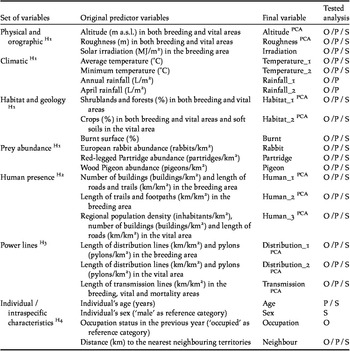
For the sake of simplicity when interpreting the results, the predictions and predictor variables that validate each hypothesis were grouped into seven sets of variables (Table 1). Each variable was calculated using the most suitable available methods and information sources (see Table S1 in the online supplementary materials). To validate a hypothesis, not all predictions had to be fulfilled; hypotheses were refuted if none of the predictions were fulfilled. These requirements were necessary in order to comply with the proposed approach, i.e. taking into account the maximum number of factors that could have an influence on demographic parameters based on prior knowledge (Real et al. Reference Real, Grande, Mañosa and Sánchez-Zapata2001, Gil-Sánchez et al. Reference Gil-Sánchez, Moleón, Otero and Bautista2004, Muñoz et al. Reference Muñoz, Real, Barbosa and Vargas2005, López-López et al. Reference López-López, García-Ripollés, Aguilar, Garcia-López and Verdejo2006, Carrascal and Seoane Reference Carrascal and Seoane2008, Rollan et al. Reference Rollan, Real, Bosch, Tintó and Hernandez-Matias2010, Hernández-Matías et al. Reference Hernández-Matías, Real, Parés and Pradel2015).
Set of variables, original predictor variables and final variables considered to test each hypothesis. Tested analysis indicates whether the predictor variable was considered in the analysis of the effect on territorial occupation (O), productivity (P) or survival (S). PCA indicates that the final variable was obtained by principal component analysis from the original variables; otherwise, it was transformed and standardized from the original variable. Further details on original predictor variables can be found in Table S1 in the online supplementary materials.

Given that territorial demographic parameters may be determined by environmental characteristics occurring at different spatial scales, the selected environmental variables refer to one or more of the following non-mutually exclusive spatial scales: breeding, vital and mortality areas (Table S1). The breeding area within a territory was defined as a 750-m radius around the arithmetical centre (i.e. the nest site). This size radius was chosen because the histogram of hourly locations obtained from 18 Bonelli’s Eagles radio-tracked in 2002–2006 in Catalonia shows a sharp decrease at 750 m, and because it encompasses all the nest- and habitual roost-sites in each territory (see Bosch et al. Reference Bosch, Real, Tintó, Zozaya and Castell2010). The vital area in a territory was defined as a 3,300-m radius around the nest-site since a second sharp decrease is observed at this distance, and delimits the area used primarily for foraging and roosting away from the breeding site. The mortality area in a territory was defined as a 6,000-m radius around the nest-site since 16 individuals (over 80% of casualties) have been found dead (authors’ unpubl. data) within this radius. In both the vital and mortality areas, if the area defined by the specified radius entered the sea, the sea area was excluded, and the radius was extended inland so that the same surface area was obtained for all territories.
Long-term monitoring
Monitoring consisted of repeated visits every year during the breeding season (January–July) to territories. Thus, we obtained the following demographic parameters, considered as binary dependent variables: occupation (territory/year occupied or unoccupied), productivity (territory/year with one or more nestlings or without successful reproduction) and survival (individual/year that survived or did not survive). Occupation was determined by the presence of territorial eagles during the breeding season. We considered a bird to be territorial in a given year when it mated during the breeding season, i.e. it regularly exhibited territorial behaviour such as roosting at the breeding area, flight display, nest-building, courtship or breeding (Hernández-Matías et al. Reference Hernández-Matías, Real and Pradel2011a,Reference Hernández-Matías, Real, Pradel, Ravayrol and Vincent-Martinb). To study the reproductive performance, the presence of eggs, hatching success, number of nestlings present during breeding season, and productivity (number of fledglings per pair and year) were determined. Survival was estimated from the turnover of territorial birds based on age classes (see Hernández-Matías et al. Reference Hernández-Matías, Real and Pradel2011a,Reference Hernández-Matías, Real, Pradel, Ravayrol and Vincent-Martinb).
Statistical analyses
Statistical analyses were conducted in two steps. First, given the high number of original predictor variables (Table 1 and Table S1), we used principal components analysis (PCA) with Varimax rotation (Quinn and Keough Reference Quinn and Keough2002, Faraway Reference Faraway2016) to obtain a reduced set of final predictor variables (Table 1) that were used in the following step. Continuous variables were transformed and standardized before being entered into the principal components analysis. Therefore, for each set of variables (except for the individual or intraspecific characteristics described in Table 1) a PCA was performed and the components with eigenvalues greater than one were extracted (Quinn and Keough Reference Quinn and Keough2002). When the original predictor variable that was best correlated with the studied demographic parameters presented an eigenvalue less than one, the original standardized variables were maintained. In this case, closely correlated variables (e.g. average temperature and minimum temperature) were not considered together in further analyses.
In a second step, generalized linear mixed models (GLMM) with binomial error distribution and logit link function were used to analyse the relationship between demographic parameters (occupation, productivity, and survival) and final predictor variables. Each observation corresponded to a territory/year (occupation and productivity) or an individual/year (survival) and thus the territory’s identity and calendar year were considered as random factors controlling for the possible non-independence of clustered observations. Years in which a certain territory remained unoccupied or only with a single individual were not considered in the territorial productivity analysis. We used an information-theoretic (IT) approach (Burnham and Anderson Reference Burnham and Anderson2002) to obtain a final model for each demographic parameter and proceeded in two stages. Firstly, models considering only one single predictor variable were compared with the null model. Predictor variables were retained in the second phase if their models had AICc value lower than the null model, or if they were considered highly relevant for the parameter under study (habitat and geology, human presence and power lines for occupation; human presence for productivity; and power lines for survival). Secondly, we evaluated all possible models including the main effects of the predictor variables retained in the first stage. When there were several models strongly competing with the best AICc model (those with ΔAICc i < 2), we then performed model-averaging across that set of candidate models (Burnham and Anderson Reference Burnham and Anderson2002). We considered that a predictor variable had a meaningful effect on a specific demographic parameter when the confidence intervals did not include zero. To evaluate the predictive power of the models, the area under curve (AUC) of the receiver operating characteristic curve (ROC) was used under a non-parametric assumption (Fielding and Bell Reference Fielding and Bell1997, Pearce and Ferrier Reference Pearce and Ferrier2000, Manel et al. Reference Manel, Williams and Ormerod2001). Models with AUC ≥ 0.9 were considered excellent, while models with AUC values 0.8–0.9, 0.7–0.8, 0.6–0.7 and ≤ 0.6 were considered good, moderate, poor and mediocre, respectively (Swets Reference Swets1988).
To perform these analyses, we used the R Software for Statistical Computing program (R Development Core Team Reference Development Core Team2017) with ‘lme4’ package for GLMM (Bates et al. Reference Bates, Maechler, Bolker and Walker2015) and SPSS 15.0.1 for Windows (SPSS Inc., Chicago, IL).
Results
Territorial occupation
Mean territorial occupation, considered as the proportion of years that territories were occupied, was 0.774 (± SD 0.348; range 0–1; n = 66 of a total 876 territory/years of observations; Figure 1). Preliminary GLMMs showed that Occupation status in the previous year, Altitude in both breeding and vital areas, Average temperature, Minimum temperature, European rabbit Oryctolagus cuniculus and Wood Pigeon Columba palumbus abundances had lower AICc values than the null model (Table S2). However, only Average temperature was retained for model averaging because, of these two highly correlated variables, it explained the variance of the dependent variable better than Minimum temperature (Spearman correlation: r = 0.570; n = 1254; P <0.001). Shrublands and forests in both breeding and vital areas, Burnt surface, Regional population density, number of buildings and length of roads in the vital area, Number of buildings and length of roads and trails in the breeding area, Length of trails and footpaths in the breeding area, Length of distribution lines and pylons in the vital area, Length of distribution lines and pylons in the breeding area, Length of transmission lines in the breeding, vital and mortality areas, and Distance to the nearest neighbouring territory were also retained for model averaging (Table S2) since they were found to be highly relevant variables for testing the defined hypotheses.
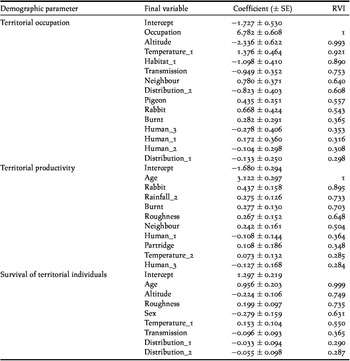
A total of 8,192 models were evaluated and a set of 18 GLMMs examining the effects of predictor variables on occupation was selected (Table S5). The final average model (Table 2) has an excellent discriminatory capacity (AUC = 0.992 ± 0.003). According to this averaged model, predictor variables explaining territorial occupation were Occupation status in the previous year (positive effect), Altitude in both breeding and vital areas (negative), Average temperature (positive), Shrublands and forests in both breeding and vital areas (negative), Length of transmission lines in the breeding, vital and mortality areas (negative), Distance to the nearest neighbouring territory (positive), Length of distribution lines and pylons in the vital area (negative), and Wood Pigeon and European rabbit abundances (positive).
Summary of the final average model examining effect of selected final predictor variables on demographic parameters (occupation, productivity and survival). The table shows each variable, the code, the coefficient and its standard error (± SE), and relative variable importance (RVI).

Territorial productivity
Territorial productivity also had high territorial heterogeneity (mean = 0.994; ± SD 0.512; range 0–1.89; n = 66 of a total 623 territory/years of observations; Figure 1). Preliminary GLMMs showed that Age of the individuals in the territory, Altitude in both breeding and vital areas, Roughness in both breeding and vital areas, Minimum temperature, April rainfall, Burnt surface, European rabbit and Red-legged partridge abundances, Number of buildings and length of roads and trails in the breeding area, and Distance to the nearest neighbouring territory also had lower AICc values than the null model (Table S3). Regional population density, number of buildings and length of roads in the vital area, and Length of trails and footpaths in the breeding area were also retained for model-averaging (Table S3) given their importance for testing the defined hypotheses.
A total of 4,095 models were evaluated and a set of 10 GLMMs examining the effects of predictor variables on territorial productivity was selected (Table S6). The final average model (Table 2) had a good discriminatory capacity (AUC = 0.802 ± 0.019). According to this averaged model, the predictor variables explaining territorial productivity were Age of the individuals of the territory, European rabbit abundance, April rainfall, Burnt surface, Roughness in both breeding and vital areas, and Distance to the nearest neighbouring territory, all of which had a positive effect.
Survival of territorial individuals
The mean survival of territorial individuals was 0.840 (± SD 0.148; range 0.27–1; n = 66 from a total 1,625 territory/years of observations; Figure 1). Preliminary GLMMs showed that Individual’s age, Altitude in both breeding and vital areas, Roughness in both breeding and vital areas, Average temperature and Individual’s sex also had lower AICc values than the null model (Table S4). Length of transmission lines in the breeding, vital and mortality areas, and Length of distribution lines and pylons in both breeding and vital areas were also retained for subsequent model averaging procedures (Table S4) since they were considered to be useful variables for testing the defined hypotheses.
A total of 255 models were evaluated and a set of 10 GLMMs examining the effects of predictor variables on occupation was selected (Table S7). The final average model (Table 2) had a poor discriminatory capacity (AUC = 0.632 ± 0.023). According to this averaged model, predictor variables explaining the survival of territorial individuals were Individual’s age (positive effect), Altitude in both breeding and vital areas (negative), Roughness in both breeding and vital areas (Positive), Individual’s sex (males having a negative effect), Average temperature (positive), and Length of transmission lines in the breeding, vital and mortality areas (negative).
Discussion
Our results support the hypotheses that the occupation of Bonelli’s Eagle territories is determined by the species’ ecological requirements, mortality by power lines, and individual and intraspecific characteristics. Territorial Bonelli’s Eagles are generally faithful to their territories and recruits preferentially select already occupied territories (Hernández-Matías et al. Reference Hernández-Matías, Real, Pradel, Ravayrol, Vincent-Martin, Bosca and Cheylan2010); thus, we found that occupation in a given year was mainly determined by its occupancy status in the previous year, as occurs in other territorial species (León-Ortega et al. Reference León-Ortega, Jiménez-Franco, Martínez and Calvo2017). Bonelli’s Eagle is a thermophilic species (Muñoz et al. Reference Muñoz, Real, Barbosa and Vargas2005, López-López et al. Reference López-López, García-Ripollés, Aguilar, Garcia-López and Verdejo2006, Carrascal and Seoane Reference Carrascal and Seoane2008) and therefore the probability of species occurrence increases at lower altitudes and higher temperatures, as our study confirmed. On the other hand, preliminary GLMMs showed that a greater presence of shrubland and less of forest in both breeding and vital areas had a positive effect on territorial occupation despite having the opposite effect according to the final average model. Real et al. (Reference Real, Bosch, Tintó and Hernández-Matías2016) suggest that shrubland is a key habitat for Bonelli’s Eagle and several other studies (López-López et al. Reference López-López, García-Ripollés, Aguilar, Garcia-López and Verdejo2006, Carrascal and Seoane Reference Carrascal and Seoane2008) have identified a clear relationship between shrubland cover and occupancy. Consequently, we discarded the possibility that shrubland cover might have a negative effect on territorial occupation and so interpret this result as a statistical artefact due to the fact that we considered both shrubland cover and altitude in the final model. As well, it is possible that results were conditioned by the fact that several territories with high shrubland cover were abandoned during the study period, while other territories with low shrubland cover were reoccupied. Our results also indicate that both transmission and distribution lines had a negative effect – more important for transmission lines – on territorial occupation. It is possible that collisions with power lines might be more important than previously thought as a cause of mortality for the species (Rollan et al. Reference Rollan, Real, Bosch, Tintó and Hernandez-Matias2010); indeed, it is known that electrocution threatens the viability of the Bonelli’s Eagle population in Catalonia and accounted for 26% of deaths in territorial individuals (Hernández-Matías et al. Reference Hernández-Matías, Real, Parés and Pradel2015). Regarding the distance to the nearest neighbouring territory, our results are consistent with Sergio et al. (Reference Sergio, Pedrini, Rozzolli and Marchesi2006b), who reported that Golden Eagles Aquila chyrsaetos select ranges that are farther away from conspecifics than if territories were located at random. In turn, territory occupation by Bonelli’s Eagles could be potentially affected by the presence of territorial Golden Eagles, an effect that we have not evaluated. In most cases, though, when appeared a new territory of Golden Eagle in our study area it occurred in already abandoned Bonelli’s Eagle territories. In fact, in the last decade both Golden and Bonelli’s Eagle have increased their populations in our study area suggesting that intraspecific dynamics are more important for the persistence of each species than interspecific ones (Carrete et al. Reference Carrete, Sánchez‐Zapata, Calvo and Lande2005). As expected, our results show that high abundances of the preferred (rabbits) and secondary (Wood Pigeons) prey items increased probabilities of territorial occupation. Wood Pigeon abundance was slightly more relevant in the final average model, suggesting that alternative prey items may allow occupancy when main prey densities are low (Moleón et al. Reference Moleón, Almaraz and Sánchez-Zaplana2008).
Our results support the hypotheses that productivity in Bonelli’s Eagle territories is determined by both the species’ ecological requirements and its individual and intraspecific characteristics. Specifically, we found that replacement by non-adult individuals decreases territorial productivity over the years since non-adults have less experience and lower reproductive capacity (Penteriani et al. Reference Penteriani, Balbontin and Ferrer2003). In addition, European rabbit abundance also appeared as a key factor linked to productivity, in agreement with Resano-Mayor et al. (Reference Resano-Mayor, Real, Moleón, Sánchez-Zapata, Palma and Hernández-Matías2016), who found that productivity increased if more European rabbits were consumed. At the same time, the growth of grasses of high nutritional value for rabbits (Ferreira and Alves Reference Ferreira and Alves2009) after moderate spring rainfall might explain the positive effect of April rainfall on territorial productivity. The positive effect of burnt surface area on productivity might be explained by greater European rabbit abundances after forest fires (Rollan and Real Reference Rollan and Real2010). Roughness also had a positive effect on productivity, possibly because it indirectly reflects less human disturbance (even though factors related to human presence were not relevant according to the final average model). As with territorial occupation, the distance to the nearest neighbouring territory also had a positive effect and reflects the importance of intraspecific competition.
Unlike occupation and productivity, the final average models for the survival of territorial Bonelli’s eagles had poorer predictive power. This result might be expected given the biological strategy of Bonelli’s Eagle since individuals survive in most years, meaning that threat factors that are always present (i.e. power lines) are only reflected in survival rates for a few years. Consequently, the model has no way of detecting the effect of predictors on the response variable. Even so, our results support the hypotheses that the survival of territorial individuals is determined by a species’ ecological requirements, mortality by power lines, and individual and intraspecific characteristics. The main predictor variable affecting survival was the age of the individual (Hernández-Matías et al. Reference Hernández-Matías, Real and Pradel2011a,Reference Hernández-Matías, Real, Pradel, Ravayrol and Vincent-Martinb) and, as previously found, females survived for longer than males. In terms of stressors, our results indicate that transmission lines had a negative effect on survival, suggesting that power line collisions might be more important than previously reported as a cause of mortality in this species (Rollan et al. Reference Rollan, Real, Bosch, Tintó and Hernandez-Matias2010, Hernández-Matías et al. Reference Hernández-Matías, Real, Parés and Pradel2015, Chevalier et al. Reference Chevallier, Hernández‐Matías, Real, Vincent‐Martin, Ravayrol and Besnard2015). In addition, it is worth mentioning that direct persecution was not considered in our study due to the lack of territorial data, despite still being a major cause of mortality in this species (Rollan et al. Reference Rollan, Hernández-Matías and Real2016), and this factor could contribute to the poor predictive power of the final average model.
Thus, in our target population, our results suggest that local-scale conservation actions to mitigate mortality by power lines may increase territorial occupation and the survival of territorial individuals. Additionally, such actions may indirectly increase productivity by preventing the death of adult individuals, which are more experienced than non-adults (Penteriani et al. Reference Penteriani, Balbontin and Ferrer2003, Martinez et al. Reference Martinez, Calvo, Martinez, Zuberogoitia, Zabala and Redpath2008). Furthermore, local-scale conservation actions to improve prey populations may increase territorial occupation and productivity.
In this study, we defined a full protocol to provide managers and practitioners with detailed information on which specific conservation actions are more suitable to implement in local territories. We used our study case on Bonelli’s Eagle to illustrate how to implement the initial steps of our protocol. This included: (1) to define hypothesis and to select predictor variables potentially driving main vital rates; (2) to collect data over a long time span of both predictor variables and (3) demographic parameters; and (4) to statistically evaluate the tested hypothesis. Based on our results, it is straightforward both (5) to identify the required conservation actions at the level of each territory, and (6) to select target territories with lower demographic parameters. To identify the required actions our overall analysis provides us with a full range of possible values of stressors like prey abundance or dangerous power lines; that is, those that are potentially lowering main vital rates and that could be countered by managers and practitioners via conservation actions. In addition, the relationship between stressors and vital rates predicted by the final models should allow managers and practitioners to estimate the expected effect on vital rates of modifying a given stressor to a given level (e.g. increasing the abundance of main prey). In addition, selecting target territories with lower demographic parameters can be achieved by performing population viability analysis as in our study area was done in previous studies (see Hernández-Matías et al. Reference Hernández-Matías, Real, Moleón, Palma, Sánchez-Zapata, Pradel, Carrete, Gil-Sánchez, Beja, Balbontín, Vincent-Martin, Ravayrol, Benítez, Arroyo, Fernández, Ferreiro and García2013, Hernández-Matías et al. Reference Hernández-Matías, Real, Parés and Pradel2015, Rollan et al. Reference Rollan, Hernández-Matías and Real2016). Finally, two important steps of our protocol are (7) to implement conservation actions according to the previous steps and (8) to evaluate their effectiveness in terms of restoration of vital rate levels and population viability. Indeed, the last step should allow managers and practitioners to decide whether further conservation actions will be necessary in the future (Figure 1). The implementation of these two last steps is usually very complex because it may require a high budget and a strong level commitment and coordination between managers in charge of conservation and other stakeholders, as well as wildlife technicians or researchers that would perform the evaluation. In our study population, a recent study by Hernández-Matías et al. (Reference Hernández-Matías, Mañosa, Rollan, Bosch, Tintó and Real2020) offers an example of mitigation of electrocution in three territories of Bonelli’s Eagle and the evaluation of these management actions in terms of population viability.
Even today, there is still an important gap between conservation research and practice (Christie et al. Reference Christie, Amano, Martin, Petrovan, Shackelford, Simmons, Smith, Williams, Wordley and Sutherland2020). Practitioners must decide on appropriate actions to meet specific objectives and, therefore, they have little opportunities to evaluate the effectiveness of alternative management options. Consequently, decisions are often based upon anecdotes or experiences shared by other managers and practitioners who have tackled the same problem, but without access to the best quality evidence. These constraints increase the probability that inappropriate management options will be adopted locally (Pullin and Knight Reference Pullin and Knight2003, Sutherland et al. Reference Sutherland, Pullin, Dolman and Knight2004, Fabian et al. Reference Fabian, Bollmann, Brang, Heiri, Olschewski, Rigling, Stofer and Holderegger2019). Here, we provide a framework aiming to be helpful for managers and practitioners who must decide which specific conservation actions are required at the local scale in the context of the overall population. To do so, our protocol recommends defining relevant hypothesis according to existing evidence to meet conservation objectives, to design properly monitoring schemes and the compilation of relevant stressors and, based on quantitative analyses, to select target local areas and to identify proper conservation actions. In this regard, it is important that the most relevant variables will be gathered; for example, in our case monitoring was intensive and included the sampling of the plumage age of territorial individuals and, in fact, age was detected as a relevant variables to explain variation in the analysis of both productivity and survival. In addition, we stress the importance of the implementation of conservation actions and the evaluation of their effectiveness. Overall, the application of the proposed framework should help practitioners to prioritize more efficiently suitable conservation actions in specific areas where stressors are threatening populations of conservation concern.
Conclusions
Policy-makers and conservation planners usually plan conservation programmes for target species that cover large geographical areas (McAlpine et al. Reference McAlpine, Rhodes, Bowen, Lunney, Callaghan, Mitchell and Possingham2008). However, spatial heterogeneity in demographic parameters is ubiquitous in nature and different conservation actions are required when specific areas within populations’ ranges present different conservation challenges. Therefore, overlooking this heterogeneity may lead to the inefficient application of conservation measures. In addition, practitioners require information on where to implement specific actions locally. Our approach highlights the importance of long-term monitoring for identifying conservation problems acting on populations of conservation concern (Margalida et al. Reference Margalida, Jiménez, Martínez, Sesé, García‐Ferré, Llamas, Razin, Colomer and Arroyo2020), which should be combined with accurate information regarding environmental stressors and suitable statistical methods for testing well-founded hypotheses regarding the threats driving demographic parameters. Overall, our approach provides an explicit framework that can account for the fact that threats act heterogeneously within populations, which we consider to be a prerequisite for providing efficient conservation guidance. Our results with the Bonelli’s Eagle provide an example of how applied research and achievable conservation practice can be exported to other populations of this eagle, as well as to other endangered species. Further steps may require the development of algorithms able to account for the costs of specific conservation actions and their expected benefit in terms of demographic parameters (e.g. Wilson et al. Reference Wilson, Cabeza, Klein, Moilanen, Wilson and Possingham2009), which implies that conservation actions may need to be even more finely prioritized.
Supplementary Materials
To view supplementary material for this article, please visit http://dx.doi.org/10.1017/S0959270920000519.
Acknowledgements
This study was part of the regional planning project ‘SITXELL (2001-2006)’ set up by the Àrea de Territori i Sostenibilitat of the Diputació de Barcelona. The research projects GL2004-03189, CGL2007-64805/BOS, CGL2010-17056 and CGL2013-41565-P run by the Spanish Government, and project 13/38 by MAVA Foundation also contributed to this work. We are greatly grateful to vast number of naturalists and/or scientists, who allowed the collection of field data. We are indebted to B. Heredia and L.M. González (Spanish Ministry of Education and Science) and C. Castell (Diputació de Barcelona) for their institutional support and to Torres Family Winery for financial help with the fieldwork. We would like to thank J. Ruiz, M.J. Vargas, M. Pomarol, X. Parellada and R. Casanovas (Generalitat de Catalunya) for their help with information gathering. Ll. Brotons, D. Sol and the deceased Ll. Jover greatly helped us in the initial conception of the statistical approach.