

One of the most long-standing issues in the study of western North American hunter-gatherer prehistory has been the relative influence of paleoclimatic variation on cultural change. Since at least the 1940s, archaeologists have been interested in the effects of prolonged periods of aridity on foraging populations. Initially focused on the mid-Holocene warm period (known alternately as the Altithermal, Hypsithermal, or Xerothermic; Antevs Reference Antevs1948, Reference Antevs1955; Baumhoff and Heizer Reference Baumhoff, Heizer, Wright and Frey1965; Byrne Reference Byrne1979; Currey and James Reference Currey, James, Madsen and O'Connell1982; Dean et al. Reference Dean, Euler, Gumerman, Plog, Hevly and Karlstrom1985; deMenocal Reference deMenocal2001; Jennings Reference Jennings, Jennings and Norbeck1964; Kennett et al. Reference Kennett, Kennett, Erlandson and Cannariato2007; Moratto Reference Moratto1984:544–547; Moratto et al. Reference Moratto, King and Woolfenden1978), debate has since shifted to the Medieval Climatic Anomaly (MCA) of the late Holocene (Arnold Reference Arnold1992; Basgall Reference Basgall1999; Bettinger Reference Bettinger1999; Boxt et al. Reference Boxt, Raab, Davis and Pope1999; Collins Reference Collins2010; Cook et al. Reference Cook, Woodhouse, Eakin, Meko and Stahle2004; D'Oro Reference D'Oro2009; Fischman Reference Fischman1996; Gamble Reference Gamble2005; Herweijer et al. Reference Herweijer, Seager and Cook2006; Johnson Reference Johnson, Raab and Jones2004; Jones et al. Reference Jones, Brown, Raab, McVickar, Spaulding, Kennett, York and Walker1999; Jones and Brown Reference Jones and Brown1999; Jones and Schwitalla Reference Jones and Schwitalla2008, Reference Jones, Schwitalla, Jones and Perry2012; Kennett Reference Kennett2005; Kennett and Kennett Reference Kennett and Kennett2000; Lambert Reference Lambert1994; Raab and Larson Reference Raab and Larson1997; Schwitalla Reference Schwitalla2012; Walker and Lambert Reference Walker, Lambert and Capasso1989). Stine (Reference Stine1994) defined the MCA as a period of prolonged and severe droughts between ca. 1150 and 600 cal B.P. Originally recognized in the paleoclimatic records of both California and Patagonia, the MCA is now reasonably well accepted as a distinctive climatic interval, with recent studies confirming the occurrence of epic droughts and elevated aridity in North America during medieval times (Cook et al. Reference Cook, Woodhouse, Eakin, Meko and Stahle2004; Graham et al. Reference Graham, Hughes, Ammann, Cobb, Hoerling, Kennett, Kennett, Rein, Stott, Wigand and Xu2007, Reference Graham, Ammann, Fleitmann, Cobb and Luterbacher2011; Graumlich Reference Graumlich1993; Mann et al. Reference Mann, Zhang, Rutherford, Bradley, Hughes, Shindell, Ammann, Faluvegi and Ni2009), as well as correlations with major cultural changes (including large-scale migrations and collapse; e.g., Benson and Berry Reference Benson and Berry2009; Benson et al. Reference Benson, Berry, Jolie, Spangler, Stahle and Hattori2007, Reference Benson, Pauketat and Cook2009; Berry and Benson Reference Berry, Benson, Kohler, Varien and Wright2010; Billman et al. Reference Billman, Lambert and Leonard2000).
In California, the effects of medieval droughts on native foraging populations have been debated intensely for more than two decades (see reviews by Schwitalla Reference Schwitalla2010; Schwitalla and Jones Reference Schwitalla, Jones, Jones and Perry2012). In most of this region, the cultural phase that coincides with the MCA is known as the Middle-Late Transition, dated ca. 950–700 cal B.P. In central and southern California, most scholars accept that changes in exchange (Arnold Reference Arnold1992; Gilreath Reference Gilreath1995; Gilreath and Hildebrandt Reference Gilreath and Hildebrandt1997; Jones et al. Reference Jones, Brown, Raab, McVickar, Spaulding, Kennett, York and Walker1999; Jones and Schwitalla Reference Jones and Schwitalla2008), settlement patterns (Arnold Reference Arnold1992; Kennett Reference Kennett2005), regional abandonments, (Jones and Ferneau Reference Jones, Ferneau, Erlandson and Jones2002; Gardner Reference Gardner2006; Jones and Schwitalla Reference Jones and Schwitalla2008; Whitley et al. Reference Whitley, Simon, Loubser and Kaldenberg2007), and disease and violence (Fischman Reference Fischman1996; Lambert Reference Lambert1994, Reference Lambert, Martin and Frayer1997; Raab and Larson Reference Raab and Larson1997; Walker and Lambert Reference Walker, Lambert and Capasso1989; Weiss Reference Weiss2002) during the Middle-Late Transition can be attributed to demographic stresses caused by prolonged and severe droughts. However, some have argued that the droughts were not severe enough to cause major problems (Basgall Reference Basgall1999, Reference Basgall, Waugh and Basgall2008; Bettinger Reference Bettinger1999) or that Native mechanisms for water storage and resource redistribution were sophisticated enough to mitigate any serious, negative consequences (e.g., Gamble Reference Gamble2005) and that, above all else, Native populations survived (Arnold and Walsh Reference Arnold and Walsh2010:34). In this regard, findings from northern California have been much less compelling in implicating drought as a primary agent of cultural change. Some studies of the skeletal record from San Francisco Bay and the Sacramento-San Joaquin Valley (D'Oro Reference D'Oro2009; Pilloud Reference Pilloud2006; Schwitalla et al. Reference Schwitalla, Jones, Pilloud, Codding and Wiberg2014) have not found the same spike in violence during the MCA/Middle-Late Transition that Lambert (Reference Lambert1994) documented in the Santa Barbara Channel. Analysis of a metadata set of burials from the San Francisco Bay area confirmed a peak in projectile violence during the Middle-Late Transition, but also showed a concurrent peak in dental carious lesions, which was attributed to a heavy reliance on acorn storage and consumption (Schwitalla and Jones Reference Schwitalla, Jones, Jones and Perry2012). The latter indicates viability of the acorn crop during the droughts in central California and some measure of a reliable food base. Subsistence patterns based on faunal remains from San Francisco Bay have also more commonly been attributed to economic intensification (Broughton Reference Broughton1997, Reference Broughton1999) rather than climatically induced cultural change. Most recently, Bettinger (Reference Bettinger2015) suggested that the medieval droughts may have amplified processes that were fundamentally historic/diffusionary in nature, as the introduction of the bow and arrow into California ultimately facilitated more intensive, privatized economic systems.
When Arnold (Reference Arnold1992) first attributed settlement and social transitions on the southern California Islands during the Middle-Late Transition (MLT) to climatic changes, she suggested that the primary problem confronting these maritime hunter-gatherers was warm sea surface temperatures that drastically reduced the productivity of the marine food base. Subsequent studies (Kennett and Kennett Reference Kennett and Kennett2000) showed that sea surface temperatures were in fact cool and productive during the MCA and that subsistence stress was more a product of reduced precipitation and a resource-depleted terrestrial environment. The native response to the latter, which has been further supported by subsequent paleoclimatic studies (Barron et al. Reference Barron, Bukry and Hendy2015), was an increased focus on marine resources during the droughts as well as violent competition for limited resources (Kennett and Kennett Reference Kennett and Kennett2000). The idea of a marine subsistence focus during MCA subsequently became common on the central California coast, and a number of scholars reported evidence for increased exploitation of fish, marine mammals, and/or shellfish during the MLT (e.g., Codding and Jones Reference Codding and Jones2007; Codding et al. Reference Codding, Jones and Porcasi2010; Jones Reference Jones2003; Joslin Reference Joslin2010), but the collective empirical evidence has not necessarily been compelling. Mikkelsen et al. (Reference Mikkelsen, Hildebrandt and Jones2000), for example, hypothesized that Morro Bay, a small estuary on the central coast, may have served as a refugium during the medieval droughts, but support for the idea was not immediately forthcoming. Here we affirm that hypothesis with a robust body of faunal evidence accumulated in the last 15 years that clearly shows a heavy focus on marine resources along the shores of Morro Bay during the MCA. Frequencies of fish and marine bird remains from this setting are significantly higher during the MLT than at any other period in the 8,000-year occupational sequence, which we interpret as evidence for an intense focus on marine foods in the face of reduced terrestrial productivity caused by drought. While the focus on fish and sea birds is logically consistent with a depleted terrestrial biome, the availability of these foods also suggests that, at least in this setting, the effects of drought may not necessarily have been catastrophic. Further, the dietary response evident at Morro Bay shows no obvious consequences from introduction of the bow and arrow, which diffused into the area at about the same time, and has been hypothesized as at least a contributing (Kennett Reference Kennett2005; Kennett and Kennett Reference Kennett and Kennett2000; Kennett et al. Reference Kennett, Lambert, Johnson and Culleton2013; Lambert Reference Lambert1994), if not primary, cause of cultural changes. This is not to say that the bow might not have been used as a weapon in intergroup conflict and that it could have led to increased violence, but it did not contribute to subsistence change at this time.
Setting
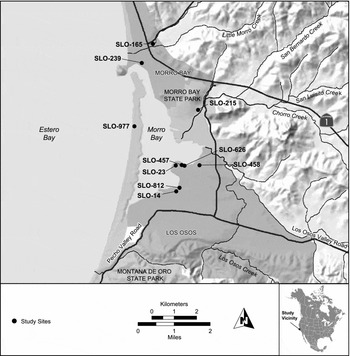
Morro Bay is a shallow 8.1 km2 coastal estuary situated on the central California coast in San Luis Obispo County (Figure 1) that was occupied by speakers of Obispeño or Northern Chumash at the time of historic contact (Golla Reference Golla2011:194). The bay occupies the northern end of a southeastward trending depression that encompasses the Los Osos and San Luis valleys (Cooper Reference Cooper1967:74). Sand dunes surround the bay, and one arm of the dune system is a sand spit that serves as a barrier between the estuary and the outer Estero Bay. Entrance to the bay from the open ocean was significantly improved by construction of breakwaters in the 1940s by the U.S. Army Corp of Engineers. Prior to that construction, the mouth of Morro Bay was open to surf action and was unsuitable for ship portage.
Morro Bay, California, with archaeological sites discussed in text.

Morro Bay's Mediterranean climate is characterized by cool moist winters and warm dry summers, with frequent fog between June and September. Annual average precipitation is 370 mm/yr, with a range from 152 to 610 mm (Gerdes and Browning Reference Gerdes and Browning1974:21). Prior to extensive modern disturbance and development, the natural vegetation fostered by the combination of modest rainfall and dune soils was a coastal sagebrush shrub (Hoover Reference Hoover1970; Kuchler Reference Kuchler, Barbour and Major1977; Ritter Reference Ritter2006). Common species include California sagebrush (Artemesia californica), coyote brush (Baccharis pilularis), poison oak (Toxicodendron diversilobum), and black sage (Salvia mellifera). Coast live oak forest is only a very small component of the vegetative landscape. This differs significantly from the open coast to the south (the Diablo Canyon or Pecho Coast), where oak forest is much more extensive (Codding et al. Reference Codding, Jones and Porcasi2010; Hildebrandt et al. Reference Hildebrandt, McGuire and Rosenthal2010; Jones and Codding Reference Jones and Codding2010; Jones et al. Reference Jones, Porcasi, Gaeta and Codding2008).
Like most estuaries on the California coast, Morro Bay provides habitat for an extensive suite of marine and terrestrial animals. In terms of birds, the bay is an integral part of the Pacific flyway and is visited by a myriad of migratory species, particularly in the winter. California Fish and Game have identified no fewer than 75 species that visit or reside year-round at Morro Bay (Edell Reference Edell2006; Gerdes and Browning Reference Gerdes and Browning1974). The estuary attracts the snowy egret (Egretta thula), the great blue heron (Ardea herodias), and a variety of other waterfowl, shorebirds, and birds of prey. Only four species of marine mammals are known in the bay today: California sea lion (Zalophus californianus), harbor seals (Phoca vitulina), Stellar's sea lion (Eumetopias jubatus), and the sea otter (Enhydra lutris), but the archaeological record indicates that elephant seals (Mirounga angustirostris) (Rick et al. Reference Rick, DeLong, Erlandson, Braje, Jones, Arnold, Lauriers, Hildebrandt, Kennett, Vellanoweth and Wake2012) and northern fur seals (Callorhinus ursinus) (Rick et al. Reference Rick, DeLong, Erlandson, Braje, Jones, Kennett, Wake and Walker2009) were occasionally present nearshore prior to historic times. Twenty-five species of native terrestrial mammals were documented around the shores of Morro Bay in 1974 (Gerdes and Browning Reference Gerdes and Browning1974). These include several small burrowing species that are agents of bioturbation within local archaeological sites. The largest herbivore currently present is the black-tailed deer (Odocoileus hemionus), although tule elk (Cervus elaphus nannodes) remains are represented in small amounts at a few archaeological sites (e.g., Mikkelsen et al. Reference Mikkelsen, Hildebrandt and Jones2000). Cottontail and brush rabbits (Sylvilaus spp.) were common inhabitants of the coastal scrub, along with jack rabbits (Lepus californicus). Historically, local carnivores included brown bears (Ursus horribilis), mountain lions (Felis concolor), bobcats (Lynx rufus), gray foxes (Urocyon cinereoargenteus), coyote (Canis latrans), and long-tailed weasels (Mustela frenata).
With respect to fishes, the California Department of Fish and Game identified 66 species (64 natives) within Morro Bay in 1966, which were subsequently confirmed by Fierstine et al. (Reference Fierstine, Kline and Garman1973). These surveys showed that three species accounted for more than 50 percent of the fish in the bay by number caught: northern anchovy (Engraulis mordax), shiner perch (Cymatogaster aggregata), and black perch (Embiotoca jacksoni). At least 11 species, including black perch, shiner perch, lingcod (Ophiodon elongatus), Pacific staghorn sculpin (Leptocottus armatus), and starry flounder (Platichthys stellatus), are year-round residents of the estuary. As many as 29 other species are seasonal migrants (Gerdes and Browning Reference Gerdes and Browning1974).
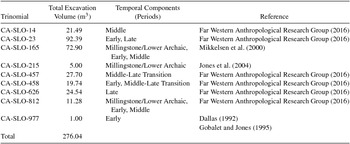
The history of research at Morro Bay reflects the relative isolation of the estuary away from the major centers of archaeological inquiry in California. While the San Francisco Bay shell middens began to be seriously investigated over 100 years ago (Nelson Reference Nelson1909), the first sites at Morro Bay were not recorded until the late 1940s, the first excavation was not completed until 1961 (Clemmer Reference Clemmer1962), and the first radiocarbon dates were not obtained until the late 1970s. Research on the prehistory of Morro Bay has taken place wholly within the Cultural Resource Management (CRM) era. Lands surrounding the bay are held in private (small residential lots) and by California State Parks, and most of the early CRM work on these properties was limited to relatively small-scale survey and testing. As of 2015, at least 50 sites had been tested, and radiocarbon dates are available from 28 of these, but most of these investigations, while accomplishing the conservation objectives for which they were intended, did not produce substantive samples of well-dated faunal remains and/or artifacts. In the last 15 years, there have been several substantial investigations on the shore of the estuary, along with serious attempts at synthesis (e.g., Bertrando Reference Bertrando2000, Reference Bertrando2004a, Reference Bertrando2004b; Jones et al. Reference Jones, Porcasi, Gobalet, Laurie, Bertrando and Levulett2004; Mikkelsen et al. Reference Mikkelsen, Hildebrandt and Jones2000) highlighted by the recent Los Osos Wastewater Project, which yielded substantial artifact and faunal samples from eight sites in the southern portion of the bay (Far Western Anthropological Research Group 2016). The Los Osos findings, in conjunction with other local research, have established an 8,000-year occupational history for Morro Bay marked by a substantial quantity of faunal data. Here we summarize the fish, mammal, bird, and shellfish remains from nine sites investigated over the last two decades (Table 1, Figure 1), representing all periods in this sequence.
Morro Bay Study Sites.

Methods
Field Recovery
The investigated sites were estuarine shell middens marked by combinations of mammal, bird, and fish bone, shellfish remains, fire-affected rock, flaked stone tools and debitage, ground stone, bone and shell tools, and occasional features including human burials. All investigations at these deposits were completed between 1990 and 2013 (Table 1). Two sites, CA-SLO-215 and CA-SLO-977, were subjected to relatively modest testing (1.0–5.0 m3) to evaluate the type and distribution of materials present (Dallas Reference Dallas, Dallas and Breschini1992; Jones et al. Reference Jones, Porcasi, Gobalet, Laurie, Bertrando and Levulett2004). Larger samples were recovered from CA-SLO-165 (Mikkelsen et al. Reference Mikkelsen, Hildebrandt and Jones2000), CA-SLO-14, CA-SLO-23, CA-SLO-457, CA-SLO-458, CA-SLO-626, and CA-SLO-812. Total recovery volume for these nine sites was 276.04 m3 (Table 1). Excavators obtained most samples from these deposits via dry field screening (3 mm mesh) from 1 × 2 m and/or 1 × 1 m units test units or trenches. Excavators collected vertebrate remains in unit-level lots from all manually excavated units except in rapid recovery units employed on a limited basis at one site (CA-SLO-23 in 2013).
The abundance of fish and shell remains in the deposits required a subsampling strategy. Control units and column samples provided the assemblage of fish remains at most sites, while component-associated subsamples provided samples at sites that produced extremely large numbers of fish bones. The latter included a representative sample of control units (processed dry with 1 / 8 -inch mesh) and one-column sample level (representing 20 × 20 × 10 cm) of recovery volume processed in the laboratory with water through nested 1 / 8 - and 1 / 16 -inch mesh.Footnote 1
Shellfish remains were, by far, the most abundant, visible cultural constituents in the deposits. Column samples provided a primary way of recovering a controlled representative sample of shell remains from both feature and non-feature site deposits. The shell column samples were laboratory-processed with water through nested 1 / 4 -, 1 / 8 -, and 1 / 16 -inch mesh, dried, catalogued by screen size and unit provenience, and sorted for cultural and noncultural constituents. Analysts examined the shell remains from 1 / 4 - and 1 / 8 -inch mesh samples.
Analysis
Using reference collections from the Los Angeles County Museum of Natural History and the Zooarchaeology Laboratory at the Cotsen Institute of Archaeology at University of California, Los Angeles, Porcasi identified bird and mammal remains from all but one of the sites.Footnote 2 Jameson and Peeters (Reference Jameson and Peeters1988) and Peterson (Reference Peterson1990) provided the nomenclature and taxonomy for mammals and birds, respectively. Porcasi identified all specimens to the most discrete taxonomic level possible based on diagnostic features. In the absence of such features, she assigned bones to classes (i.e., Mammalia, Aves, etc.) and (for birds and mammals) to size categories (small, medium, or large). In addition, she recorded to the degree possible the element, part of element, side, age, number, weight, and evidence of modification (i.e., burned, gnawed, cut, or worked). The Margalef Index provided a measure of assemblage diversity to evaluate diet breadth and the Berger-Parker index (in reciprocal form) to evaluate evenness or relative specialization (Magurran Reference Magurran1988).
Gobalet identified the element and taxonomic category of each fish specimen using reference materials.Footnote 3 Findings were summarized by the number of identified specimens (NISP). The nomenclature and current taxonomy for fishes follows Page et al. (Reference Page, Espinosa-Perez, Findley, Gilbert, Lea, Mandrake, Mayden and Nelson2013). For this paper, we define “identified” as specimens assigned to at least a family. We excluded specimens that we could classify only as Elasmobrachiomorphi (sharks, skates, rays) or ActinoptergiiFootnote 4 (ray-finned fishes, 16,653 elements). Jones, Gobalet, and Codding (Reference Jones, Gobalet and Codding2016) and Jones, Gobalet, Mikkelsen et al. (Reference Jones, Gobalet, Mikkelsen, Hadick, Hildebrandt and Jones2016) discuss some aspects of the fish assemblages.
D. Jones and Hadick identified the shellfish using reference collections at California Polytechnic State University, San Luis Obispo, and Far Western Anthropological Research Group, recording the weight of shell per species.
Based on these methodological protocols, the sample available from Morro Bay consists of 2,247 bird and mammal bones from an analytical volume of 141.60 m3, and 19,235 fish bones identified to a meaningful taxon (generally family or better) from an analytical volume of 127.1 m3. Shellfish remains represent a total recovery volume of 1.088 m3.
Chronology and Delineation of Temporal Components
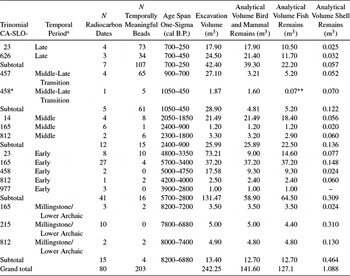
Radiocarbon dates (n = 80) and temporally diagnostic shell beads and projectile points provided vertical and horizontal identification of components (Table 2). Seventy-eight of the dates were from single-shell samples, while the remaining two were from charred plant remains. All dates were corrected for isotopic fractionization and calibrated with Calib version 7.1 (Stuiver et al. Reference Stuiver, Reimer and Reimer2016); a Delta R marine correction value of 290 ± 35 years (Ingram and Southon Reference Ingram and Southon1996) was applied to the shell dates. Components excluded portions of the excavation volume that were disturbed or that exhibited excessive temporal mixing so that the volumes associated with the analytical samples are smaller than the total recovery from the combined site investigations.
Summary of Morro Bay Temporal Components.

a Late = 700–180 cal B.P.; Middle-Late Transition = 950–700 cal B.P.; Middle = 2600–950 cal B.P.; Early = 5500–2600 cal B.P.; Millingstone/Lower Archaic = 10,000–5500 cal B.P.
*Component based more on beads than radiocarbon.
** Wet-screened recovery.
Component Function
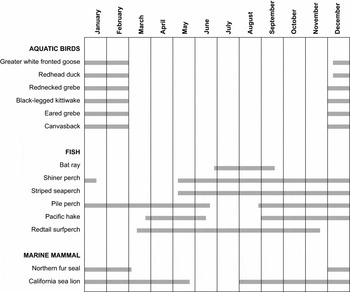
Interpretation of the Morro Bay fauna cannot be disassociated from the role of sites in regional settlement systems, given that any change in the character of site use could contribute to variation in the relative frequency of faunal species (Binford Reference Binford1978, Reference Binford1980). We evaluated settlement function by considering the range and diversity of cultural materials recovered from each component, the presence/absence of burials or other features, the volumetric density of formal and informal artifacts, the ratios of flaked to ground stone, and the evidence for seasonality (remains of migrating animals [Figure 2] and seasonally available plant foods). We evaluated assemblage diversity statistically using the Margolef Diversity Index.
Migratory species with seasonally restricted appearances at Morro Bay.

Results
Analysis identified 15 temporal components from the more substantive earlier excavations at Morro Bay (CA-SLO-165, CA-SLO-215, and CA-SLO-977), and recent investigations for the Los Osos Wastewater project. However, several components lacked adequate samples for certain constituents, as specified below.
Birds and Mammals
Thirteen components provided the sample of bird and mammal remains (Supplemental Table 1). The Middle-period component from CA-SLO-165 produced very few bones, and the large vertebrate remains from CA-SLO-977 are unreported. The total from the remaining 13 components excludes remains of all small burrowing animals (e.g., Botta's pocket gopher [Thomomys bottae] and California ground squirrel [Spermophilus beecheyi]), most of which are probably intrusive. The sample includes 26 species of ducks, geese, and other aquatic birds; 18 species of marine birds; 6 terrestrial birds; 12 terrestrial mammals; and 6 marine mammals. Overall, the birds and mammals are dominated by terrestrial mammals that account for 65.5 percent of NISP. Dominant species are rabbits (Sylvilagus spp.; NISP = 1075; 44.3 percent) and black-tailed jack rabbit (NISP = 196; 8.1 percent). Mule deer (Odocoileus hemionus), which was the most abundant species in the faunal collection from Diablo Canyon and figured prominently in debates about large game hunting strategies along the central coast (Hildebrandt et al. Reference Hildebrandt, McGuire and Rosenthal2010; Jones and Codding Reference Jones and Codding2010), is decidedly less abundant at Morro Bay, representing only seven percent (NISP = 170) of the bird and mammal inventory. The low frequency of deer and the large number of rabbits and hares almost certainly reflect the abundance of sagebrush shrub vegetation at Morro Bay.
The number and diversity of bird remains is a distinguishing feature of the Morro Bay fauna and reflects the importance of the estuary as a bird habitat. Ducks, geese, and other aquatic species make up 19.4 percent (NISP = 446) of the collection, followed by marine birds (NISP = 270; 11.1 percent). Most abundant are grebes (Podiceps spp.; NISP = 144; 6 percent) and brown pelicans (Pelecanus occidentalis; NISP = 78; 3.2 percent). Fewer bird bones with less species diversity were reported from the exposed rocky coast at Diablo Canyon to the south (Jones et al. Reference Jones, Porcasi, Gaeta and Codding2008)
Marine mammals, dominated by sea otter (NISP = 59; 0.4 percent), are relatively unimportant in the Morro Bay collection, making up less than 3 percent of NISP. This too contrasts with the Diablo Canyon open coast, where marine mammals accounted for more than 21 percent of the identified bird and mammal remains.
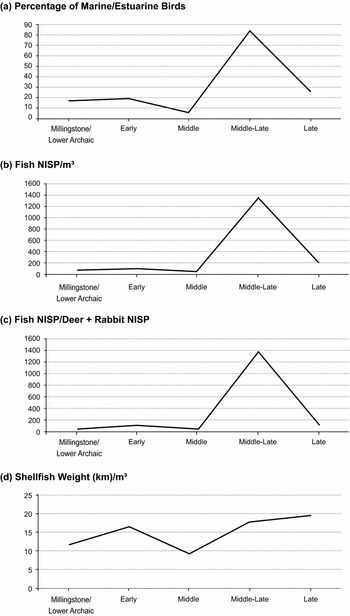
Of paramount importance, however, are patterns across time (Figure 3). Most striking in this regard is variation in the relative importance of terrestrial mammals. Throughout most of the sequence, terrestrial mammals, predominantly rabbits and hares, account for no less than 69 percent of the non-piscine vertebrate fauna. However, during the Middle-Late Transition, this figure plummets to only 14.2 percent, dominated by cottontail rabbits (NISP = 44). At the same time, deer reach a low of 1 percent (NISP = 5). Replacing terrestrial game in importance during this interval are aquatic and marine birds, which together account for 84 percent of the non-piscine assemblage for Middle-Late Transition Period. This dearth of terrestrial mammals, combined with the high frequency of marine birds, represents a profoundly different pattern than that of any other interval in the 8,000-year sequence, with aquatic birds being three times more numerous than at any other time. Although marine mammals remained insignificant (1.5 percent), the non-piscine remains show a striking shift toward marine species during the Middle-Late Transition. Following the end of this period, terrestrial species again dominate (70 percent), and marine/aquatic birds return to the low levels typical for the rest of the sequence (25 percent). The heavy emphasis on aquatic birds and rabbits, which together account for 95 percent of the Middle-Late Transition non-piscine vertebrate remains, suggests little if any reliance on the bow and arrow for hunting, given that these animals, especially the birds, were more likely trapped or snared. Projectile point size profiles indicate, fairly convincingly, that the bow and arrow arrived to the central coast during the Middle-Late Transition or slightly earlier (ca. 1050 cal B.P.). This is confirmed at Morro Bay, where the same components that yielded the rabbit and bird-dominated faunal assemblages also produced arrow-sized projectile points, albeit in very small numbers (Far Western Anthropological Research Group 2016). While the appearance of the bow and arrow might have been associated with increased intergroup conflict (Kennett et al. Reference Kennett, Lambert, Johnson and Culleton2013; Lambert Reference Lambert1994), it initially had little effect on subsistence hunting strategies. This supports an idea advanced by Brill (Reference Brill, Allen and Jones2014) that the technology may have been used more for inter-human conflict than subsistence in southern California. However, there is no complementary burial record from Morro Bay or surrounding areas robust enough to compare the faunal record with skeletal evidence for projectile violence.
Key diachronic trends in faunal remains from Morro Bay, California: (a) percentage of marine/estuarine birds, (b) fish NISP/m3, (c) fish NISP/(deer + rabbit NISP), (d) shellfish weight/m3.

Findings from another recently identified Middle-Late Transition Period component provide some support for the heavy representation of marine animals in faunal assemblages from this interval around Morro Bay. CA-SLO-239, near the current mouth of the bay, was excavated in 1961 (Clemmer Reference Clemmer1962), but its chronology was unclear until the first radiocarbon dates from site materials were recently reported (Jones et al. Reference Jones, Knight and Porcasi2017). Dates and temporal diagnostics show clearly that the site was inhabited during the early Middle and Middle-Late Transition periods. Faunal sampling strategies were not consistent with current standards, and component definition is imprecise, but the faunal collection is nonetheless dominated by marine mammals (NISP = 39; 78 percent), including California sea lions (Zalophus californianus; NISP = 13) and sea otters (Enhydra lutris; NISP = 13). Unfortunately, owing to the era during which the site was investigated, fish bones were not collected, but the marine focus in the large vertebrates is consistent with findings from the other Middle-Late components in the current study.
Fishes
Gobalet identified a total of 19,235 fish bones to a meaningful taxon (generally family or better) from an analytical volume of 127.1 m3 from 15 components (Supplemental Tables 2 and 3). The only sample available for one component (the Middle-Late Transition at CA-SLO-458) was recovered via wet-screening, which typically yields higher frequencies of fish remains than the dry-screening (Jones, Gobalet, and Codding Reference Jones, Gobalet and Codding2016) used at all other sites. Three families/species dominate the record throughout the sequence: surfperches, (Embiotocidae), herrings (Clupeidae), and New World silversides (Atherinopsidae). Not surprisingly, these assemblages vary considerably from those of Diablo Canyon to the south, which was dominated by open rocky coast fishes (Fitch Reference Fitch and Greenwood1972; Jones et al. Reference Jones, Porcasi, Gaeta and Codding2008). Surfperches include species that can be taken either with nets or as individuals with hooks/gorges. Herrings (including sardines) and silversides are small schooling fishes that are much more commonly taken with nets, the former often with the aid of watercraft and the latter from shore (Boone Reference Boone2012; Gause Reference Gause, Jones and Ferneau2002; Love Reference Love2011; Salls Reference Salls1988). The dominance of silversides and surfperches throughout the record suggests that fishing was undertaken with nets throughout the Holocene. This is similar to findings reported by Rick and Erlandson (Reference Rick and Erlandson2000) for the Santa Barbara mainland to the south.
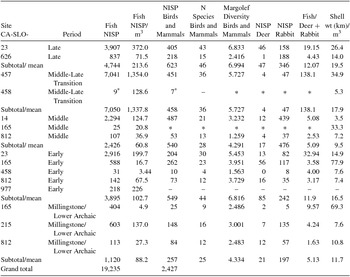
While this singular emphasis on netting small schooling fish is apparent throughout the sequence, there is evidence for variation through time in the relative importance and intensity of fishing—again with a focus on the Middle-Late Transition Period. Volumetric densities of fish bone (NISP/m3) show relatively little change from the Millingstone/Lower Archaic through Middle periods (Table 3), but a major increase can be recognized during the Middle-Late Transition, followed by a decline during the Late period. Ratios of fish/(deer + rabbits) also show an all-time apex during the Middle-Late Transition. Together these indices suggest a major increase in the importance of fish in the diet relative to terrestrial mammals during the Middle-Late Transition. Although the fish remains from one of the two components that marks the Middle-Late Transition Period were recovered via wet-screening, both samples exhibit high densities of fish bones with the dry-screened sample from CA-SLO-457 actually showing the highest density.
Faunal Indices from Morro Bay Temporal Components.

*Recovered via wet-screening.
Not included in the current study are fish remains recovered from 1/16-inch mesh wet-screened column samples. Reported elsewhere in a report exclusively on the piscine faunal remains from Morro Bay, the column findings show consistent recovery of tiny fish bones from all components (Jones, Gobalet, and Codding Reference Jones, Gobalet and Codding2016; Jones et al. Reference Jones, Gobalet and Codding2016). This suggests that taphonomic preservation issues are not a significant problem or influence on the assemblages.
Shellfish
Thirty-three species of shellfish from 14 components represent three habitats: estuary/bay, open rocky coast, and open sandy coast (Supplemental Table 4). Estuarine habitats were immediately adjacent to all sites and required minimal travel to exploit. Open rocky coast environment was available at the mouth (Morro Rock) and outside of the bay and would have required modest trips of 2–6 km (probably in balsa canoes). Open sandy coast habitat was available on the windward side of the sand spit that separates the embayment from the open waters of Estero Bay. In light of these spatial distinctions, all of the components were dominated by estuarine species, specifically clams (littleneck clam [Leukoma spp.], Pacific gaper clam [Tresus nuttallii], Washington clam [Saxidomus nuttalli], and macoma clam [Macoma spp.]), and the California oyster (Ostrea lurida). The relative abundance of oysters within Morro Bay, especially during the late Holocene, is a distinguishing feature of this estuary relative to other similar environments elsewhere in California. Also distinctive is the absence of protected habitat mussels (Mytilus trossulus), which are common in less isolated estuaries to the north and south. Mussel shells were relatively abundant in some components, but all represented the exposed coast species, Mytilus californianus.
The molluscan remains exhibit complex variation that reflects the evolution of the estuary, variation in foraging radii, and shifting importance of shellfish in the diet over time. Millingstone/Lower Archaic–period people collected shellfish in modest amounts from relatively circumscribed foraging areas limited to estuarine habitats immediately adjacent to living sites. In the northern reaches of the bay, where sands had accumulated by 8,100 years ago, collection focused on white sand clams, while to the south at CA-SLO-812, oysters dominated the earliest shell remains. Shellfish collection increased substantially at the onset of the Early period, when Morro Bay was larger than it is today, prior to late Holocene infilling. While the quantity of collected shell increased, oyster declined in importance in the south of the bay, and exploitation of rocky coast species increased. The latter suggests that the foraging radius for shellfish widened, while the decrease in oyster suggests ongoing accumulation of silty/muddy sediments (not favored by oysters) within the bay. Exploitation of shellfish decreased during the Middle period, at which time use of rocky coast species reached an all-time high at the expense of estuarine species, which reached a Holocene nadir. The Middle-Late Transition shows a substantial increase in shellfish harvest, consistent with trends from the vertebrate fauna at that time. Oysters were again important at least in the southern portion of the bay at CA-SLO-457. Unlike the vertebrates, shellfish increased further during the Late period, even though sediments by that time had completely filled in and decreased the size of the estuary. Overall, the marked upturn in shellfish collection during the Middle-Late Transition is consistent with other faunal evidence for increased use of marine foods during the time of the medieval droughts. It is important to recognize, however, that even greater shellfish harvests were made after the MCA during the Late period, suggesting that marine subsistence was not necessarily at its absolute peak during the droughts interval.
Component Function
Sample sizes were too small to draw firm conclusions about the function of the Early-period component at CA-SLO-977 or the Middle-period component at CA-SLO-165, but the 13 remaining components show diverse artifact assemblages with similar frequencies of flaked stone, ground stone, and bone implements (Supplemental Table 5). Flaked stone tool production was evident for all components as well. Projectile points, ground stone, and bone tools show no meaningful variation over time in their volumetric frequency. These similarities suggest that all of the components served as residential bases of some type throughout the sequence, although some variation is apparent in the human burials, shell, and rock features, which were more common at certain sites beginning in the Early period. The presence of these features suggests that some residential sites were occupied for greater portions of the year from this point onward, and that the overall settlement strategy involved long-term and short-term residential sites (Far Western Anthropological Research Group 2016). Nonetheless, the diverse assemblages at all study sites imply that the range of tasks pursued at long-term and short-term residential sites was fairly similar. There is nothing to suggest specialized functions such as processing locations, stations, or caches. This is not to say that such site types were not used locally, as many have suggested (e.g., Bertrando Reference Bertrando2006; Farquhar Reference Farquhar2003), but rather that these specialized functions are not represented in the current sample. Ratios of bifaces/groundstone suggest a modest increase in the importance of the latter late in time but not enough to indicate wholesale change in site function. Beads also show a modest increase beginning in the Middle-Late Transition ca. 1000 cal B.P., but there is little reason to think that this alone represents major change in the residential nature of the occupations. Importantly, the absolute and relative frequencies of ground stone implements, bone tools, shell beads, features, and human burials from the Middle-Late Transition component at CA-SLO-457 demonstrates the residential character of this occupation. In sum, there is every reason to believe that the components were similar enough that functional variation was not a major contributor to diachronic variability in the faunal assemblages.
Habitat Variability
The components with substantive faunal assemblages are situated adjacent to a variety of micro-habitats within and around the Morro Bay estuary. In addition to varied molluscan habitat discussed above, Fierstine et al. (Reference Fierstine, Kline and Garman1973) defined at least four different fish habitats within the bay. Among the fish remains, findings from CA-SLO-977 show frequencies of Pacific staghorn sculpin and jacksmelt higher than any other component in the sample. The prevalence of these fishes almost certainly reflects the unique location of CA-SLO-977 on the Morro Bay sand spit (Jones, Gobalet, and Codding Reference Jones, Gobalet and Codding2016; Jones et al. Reference Jones, Gobalet and Codding2016). The possibility exists that other habitat-related variability could contribute to the diachronic patterns in the faunal remains, particularly in light of the fact that the current sample does not include components associated with all micro-habitats for all time periods. While such a possibility needs consideration in future work, other reasons suggest that the diachronic patterns delineated above reflect response to climate change, not merely spatial variation. Four of the sites that produced key components, CA-SLO-23, CA-SLO-457, CA-SLO-458, and CA-SLO-626 are located within 500 m of one another adjacent to the same part of the bay. CA-SLO-23 and CA-SLO-457 are separated by less than 100 m, and produced similar residential tool assemblages. The three components at these two sites (Early, Middle-Late Transition, and Late) exhibit the strong shift to a marine resource focus that we believe was the general pattern for behavior around the bay during this interval. Furthermore, findings from other components show uniformity across fish habitat zones. For example, the Early-period components from CA-SLO-165 at the mouth of the bay and CA-SLO-812 at the back of the bay are both heavily dominated by surfperches as is the Millingstone/Lower Archaic component at CA-SLO-215, adjacent to a different habitat (Chorro Creek delta).
Seasonality
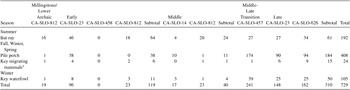
Remains of migratory animals suggest variation generally consistent with component functions. High frequency of bat ray remains from the Millingstone/Lower Archaic component at CA-SLO-812 suggests that the short-term residential occupation here was focused on the summer months (Table 4). Most sites occupied after that period show a broader seasonal range of occupation, although these indicators are absent from CA-SLO-458, even though a relatively robust artifact assemblage was recovered from that site. The Early-period components at CA-SLO-23 and CA-SLO-812 show four of the six winter migratory birds, but in relatively low numbers (NISP = 11; 9.2 percent). Bat rays are still dominant (NISP = 64), but their relative abundance decreases to 53.8 percent. Pile perch and marine mammals increase significantly (NISP = 44), representing 37.0 percent of the assemblage. The combined findings suggest that occupation occurred during all seasons of the year, which is consistent with the more robust nature of the artifact assemblages associated with the Early-period deposits at CA-SLO-23, CA-SLO-458, and CA-SLO-812 and the higher frequency of features and burials. Multi-season occupation is also apparent for the Middle-period components. The critical Middle-Late Transition component at CA-SLO-457 differs from others in that it shows multi-season occupation, but also a very heavy emphasis on fall, winter, and spring species. This is consistent with the greater reliance on marine oriented birds. The Late Period shows modest declines in fall-spring indicators, which is consistent with decreased emphasis on winter-migrating marine birds.
Frequency of Primary Vertebrate Seasonal Indicators over Time from Morro Bay.

*Northern fur seal and California sea lion.
** Greater white-fronted goose, redhead duck, rednecked grebe, black-legged kittiwake, eared grebe, and canvasback.
Conclusions
A robust collection of mammal, bird, fish, and shellfish remains from an 8,000-year residential sequence at Morro Bay shows a decided focus on marine species during the Middle-Late Transition cultural phase (950–700 cal B.P.), which largely coincides with the Medieval Climatic Anomaly. This is consistent with findings from the Santa Barbara Channel 100 km to the south, where research on the droughts has a longer, more extensive history and where a heavy marine subsistence focus was first recognized as an apparent response to medieval drought (Kennett and Kennett Reference Kennett and Kennett2000). Previous faunal studies from central coastal California provide modest evidence for increased fishing (Codding and Jones Reference Codding and Jones2007; Joslin Reference Joslin2010) and a marked increase in rabbit exploitation (relative to deer) during the Middle-Late Transition on the exposed coasts of central mainland California, but the Morro Bay findings indicate that this estuarine setting served as a distinctive marine-focused subsistence refugium during the MCA. Due to a preponderance of shrub vegetation, rabbits dominate the entire 8,000-year Morro Bay sequence, making the deer/rabbit ratio less sensitive in this setting, although deer remains did reach a notable low (NISP = 7; 1.5 percent) during the MCA. More telling is an all-time peak in marine and estuarine birds, which is three-times higher during the Middle Late Transition than any other period in the sequence. Similar apices are apparent in fish NISP/m3 and fish/deer + rabbits, all of which are striking in their degree of variance and abundance during this critical interval of time. All of these indices also show declines in marine focus during the ensuing Late Period, when climate ameliorated during the colder, wetter Little Ice Age.
The heavy reliance on fish, aquatic birds, rabbits, and shellfish during the MCA suggests that use of the bow and arrow had little effect on the pursuit of food, even though small numbers of arrow-sized projectile points appear in local middens for the first time around 1000 cal B.P. The technology might well have been involved in intergroup conflict but, unlike areas to the north (Schwitalla et al. Reference Schwitalla, Jones, Pilloud, Codding and Wiberg2014) and south (Lambert Reference Lambert1994), the Morro Bay area does not have a skeletal record substantive enough to evaluate such a possibility.
Shellfish remains show a decided increase during the Middle-Late Transition, but, unlike the vertebrate fauna, increase further after the MCA during the Late period. This suggests that marine foods were not tapped to the maximum during the Medieval period and is further consistent with a recent evaluation of the regional fishery that showed that it was never significantly impacted by regular Native harvest during the Holocene (Jones, Gobalet, and Codding Reference Jones, Gobalet and Codding2016; Jones et al. Reference Jones, Gobalet and Codding2016). These findings indicate that, while drought influenced decision-making, subsistence economies in this setting had not reached crisis mode, at least not for the relatively large blocks of time that can presently be distinguished in the midden record. Nonetheless, the viability of the food base during the MCA is consistent with the record of dental caries in the San Francisco Bay area (Schwitalla and Jones Reference Schwitalla, Jones, Jones and Perry2012), which suggests that people there weathered the droughts through heavy reliance on stored foods rich in carbohydrates, likely acorns. Continued evaluation of the medieval droughts hypothesis needs to critically examine evidence for the character of actual responses and to sort out on an interregional basis the degree to which the period can be accurately characterized as a time of crisis. Morro Bay, with a productive, sustainable marine food base, was almost certainly not the only such refugium; the presence and extent of others need to be carefully evaluated, as do possible locations where food options were more constrained by drought and problems were more severe.
Acknowledgments
We thank Nicole Birney for preparation of Figures 1 and 2. We also wish to thank Kate Ballantyne for her long, capable oversight of the Los Osos Wastewater archaeological project. The Spanish abstract was checked by Antonio Rodríguez-Hidalgo.
Supplemental Materials
Supplemental materials are linked to the online version of the paper, accessible via the SAA member login at https://doi.org/10.1017/aaq.2016.31.
Supplemental Table 1. Summary of Bird and Mammal Remains from Morro Bay Sites.
Supplemental Table 2. Fish Remains (NISP) from Morro Bay Components, Millingstone/Lower Archaic and Early Periods.
Supplemental Table 3. Fish Remains (NISP) from Morro Bay Components, Middle, Middle-Late Transition, and Late Periods.
Supplemental Table 4. Shell Remains (Weight in grams) from Morro Bay Temporal Components.