


Introduction
The Trustwide Obsessive Compulsive Disorder (OCD) and Body Dysmorphic Disorder (BDD) service is a National Health Service (NHS) tertiary mental health service in Southwest London. In 2014, two therapists devised and piloted a closed cognitive behavioural therapy (CBT) treatment group for people with hoarding disorder (HD), in response to a professional interest in this area, an increase in demand for treatment, and a desire to trial a potentially more effective and efficient delivery of treatment. The intervention outcomes from the initial groups have been published previously, appearing to be the first group of its kind in Britain (Chandler et al., Reference Chandler, Fogg and Smith2019).
In this brief clinical report, we present outcomes pertaining to standardised measures of hoarding symptoms, depression and disability considering all individuals (n = 71) who have participated in group cognitive behavioural therapy (GCBT) to date. This corresponds to 10 different groups, administered annually. We had an approximate 2-year break during the COVID-19 pandemic; we provided individual and remote treatment to people during this time and data from these patients are not included.
Clinical programme and process
Owing to the complexity of presentations for people showing hoarding tendencies and the multi-agency approach needed for people with hoarding disorder, referrals are accepted following a consultation with the referrer which is designed to gain information and ascertain the suitability of GCBT for the individual. The criteria includes a willingness to engage in both the home assessment process and GCBT treatment for hoarding disorder, an ability to independently implement the strategies learned, an ability to tolerate a degree of emotional distress that goes along with behavioural change, and an ability to manage distress in a productive way which is not going to escalate risk and an ability to travel to the group, if offered a place. The exclusion criteria include an absence of alcohol or drug dependency, active psychosis, or organic conditions.
The individual needs to be consenting to the referral. An individual’s level of insight to their difficulties is understood from this point onwards and includes factors such as their consent to referral – acknowledgement of a problem, for which they take a level of responsibility and a desire to engage in a self-help type of therapy (CBT). From assessment onwards, the clinicians aim to enhance insight with a compassionate approach that tests out and promotes potential for taking responsibility for behavioural change. This includes in vivo voiding at assessment of a lower order item, with identification of beliefs about items and supporting the individual to generate alternative beliefs.
Given the nature of the consultation, the acceptance rate for referrals that follows is high. All individuals are offered a home-based assessment, by both clinicians who facilitate the group. The visit can allow for a deep feeling of shame to be expressed by the individual and acknowledged with empathy. The person leads on showing all rooms. They are photographed (with written consent) and rated collaboratively using the Clutter Image Rating Scale; any difference in scoring for this, and the Frost Saving Inventory, is noted as this can indicate low insight. The individual is asked to estimate the percentage of items that they would like to get rid of from each room, with a follow-up question as to how any voiding would take place and where the items would go. Outside spaces, gardens, sheds and garages are also viewed if applicable and accessible. Rented storage spaces are rarely close by, detail of these is noted – alongside cost, size, frequency accessed, use and intention for the storage unit. A risk assessment is undertaken with hazards described and discussed, and an immediate risk management plan may be suggested. Any practical blocks for change such as a physical inability to void items are identified at assessment, along with the start of problem solving.
The duration of each group is 2 hours; in total there are 12 groups and the programme usually lasts 5‒6 months. The first six groups are held weekly, then the frequency reduces to fortnightly and then monthly. Each person is offered a home-based follow up visit after group 11 and prior to the final group. This is conducted by the group facilitators; therefore, a direct comparison from assessment to that date can be made, in addition to feedback provided by the person, and photos they have shared. The person leads on a tour of the property again, and photos from assessment are shown whilst standing in the room, as well as completion of standardised measures. The visit offers the individual an opportunity for reflection of the change process, progress made, specific barriers to change, problem solving and future goal setting.
The group programme is structured, and the plans have developed since inception, but largely remain unchanged in nature and style. It is a closed CBT group using our specific treatment protocol built on the work of Frost and Hartl (Reference Frost and Hartl1996) and Tolin et al. (Reference Tolin, Frost and Steketee2014). A short booklet consisting of all hand-outs and forms needed for the sessions is given to each person at week 1. The concepts have been simplified with ideas repeated over the course as necessary, with the booklet providing a helpful focus. An important clinical role is to maintain the agenda for each group, with timings set, and ensuring each person gets equal ‘airwave time’. The ground rules are made at week 1, which may include permission for the therapist to interrupt and one person to speak at a time, and the discussion around ‘ingredients for success’ in treatment which sets the tone for the course. The ingredients include factors such as commitment to taking responsibility for action-based change, daily practice of new behaviours, and an ability to become aware of hoarding behaviours, which may have been taken for granted for so long, and developing resilience to go against these behaviours in spite of emotional distress, self-praise and managing setbacks. These areas are repeatedly raised throughout treatment. The emphasis is on achieving personal goals for the home that are first expressed by the individual, and imagined, if possible, at assessment. There is a focus on learning strategies and making specific behavioural changes in acquisition and discarding of items, and conveying the benefits of sharing with peers, group problem solving and gaining support, celebrating successes and group problem solving. Out-of-session work is a core part of this treatment.
Each group is structured with elements timed, and from week 2 onwards will to start with detailed goal feedback. Individuals are encouraged to share before and after photographs of areas worked on for their goal. Every group from week 2 onwards asks each person what has ‘come in and gone out’ since the last group, with estimated bags written on the poster. The rationale for a ban on acquisition is suggested at assessment and from then on most seem to rapidly acclimatise to this aim. Then follows a psycho-educational aspect of treatment dedicated to areas such as formulation, cost-benefit analysis, a moratorium on acquisition, process of change, cognitive restructuring beliefs about hoarding and possessions, golden rules for voiding, principles of exposure and response prevention, in vivo voiding (for example digital voiding), skill building in decision making, alternative pleasurable activities, achievement recognition and relapse management; using brainstorms, paired work or individual work. Thought listing is used in a less structured way during the in vivo void – in part due to time, and the individual may be asked to voice their thoughts with the aim of improving the decision-making process in voiding. A fire officer and a previous group member are invited to specific groups to share insight and invite discussion. The group ends with goal setting for the period until the next group, and goals set draw from the individuals’ feedback and experience of the previous week’s goal.
Goals are recorded on posters to aid accountability. Terms such as ‘voiding’ and ‘moratorium’ are used to emphasise the gravity of the disorder and separate these behaviours out conceptually from usual daily activities.
The discharge report includes recommendations for treatment or interventions from other services, such as bereavement counselling, or assessment with possible treatment for co-morbidities such as post-traumatic stress disorder, autism spectrum disorder, attention-deficit/hyperactivity disorder and/or perfectionism from other NHS teams. It also incorporates aspects of the relapse management plan and an update of the risk management plan.
Method
Participants and setting
Referrals are received from a range of primary and secondary care services, both statutory and non-statutory, for adults aged 18 and above living in one of the five designated boroughs in southwest London, with clinically significant hoarding behaviours as the primary presenting problem. Exclusion criteria include an active risk of self-harm or significant (mis)use of alcohol and/or drugs. Clinicians offering the service are cognitive behavioural therapists and work in the Trustwide OCD and BDD Service. All data were collected as part of a Trust-based service evaluation.
Measures
The severity of HD was determined using the Frost Savings Inventory-Revised (SI-R) alongside the Clutter Image Rating Scale. Overall level of functioning was measured using the Sheehan Disability Scale (SDS) and symptoms of depression were measured using the Beck Depression Inventory (BDI).
Statistical analysis
Baseline characteristics of patients were reported as means (SD) while categorical variables were presented as frequency (%). Effectiveness was investigated by fitting linear mixed models (LMMs) to SI-R total and subscale, BDI and SDS scores, performed on an intention-to-treat (ITT) basis (i.e. all patients attending Hoarding Treatment Groups). These models included time (pre-, mid- and post-treatment) as a fixed effect and random intercepts at person (subject-specific) levels and employed autoregressive or factor analytic covariance structures. The criterion for statistical significance was set at p<0.05. Estimates of intervention effects at post-treatment were calculated using Cohen’s d. All statistical analyses were completed with SPSS, version 29.0.
Sample size
Our previous work evaluating the effectiveness of GCBT to treat HD reported within-group (Cohen’s d) effect sizes of >1.0 for SI-R total and subscale scores (and ≈1.0 for measures of disability and depression) and a drop-out rate of 16.7% (Chandler et al., Reference Chandler, Fogg and Smith2019). Assuming a more conservative magnitude of change (d = 0.8) and higher attrition rate (20%), 23 patients were required for the study to have 90% power and a two-sided significance level of 5% (GPower 3.1). As such, the current study sample of n > 70 was sufficient to measure intervention effectiveness.
Results
Sample description
Seventy-one patients who met DSM criteria for HD participated in one of the 10 group treatments, and all participants except one started treatment above cut-off on the SI-R. Two individuals participated in treatment on two occasions; only outcomes from their initial treatment were considered. As such, the study focus was centred on evaluating GCBT-related changes in people with HD participating in GCBT for the first time. Three-quarters (n = 53, 74.6%) of patients were female and the average age was 58.9 years (SD = 10.8). More than four-fifths (n = 58, 81.7%) were White, five (7.0%) were Asian/Asian British, two (2.8%) were Black/Black British, two (2.8%) were mixed heritage, and four (5.6%) were from other ethnic backgrounds. Most participants were single (n = 41, 57.7%) widowed (n = 4, 5.6%) or separated/divorced (n = 16, 22.5%); 10 participants (14.1%) were married or cohabiting. Nineteen (26.8%) were employed, 25 (35.2%) were unemployed or on sick leave, and 27 (38.0%) were retired. Mean duration of hoarding symptoms was 27.6 years (SD = 15.6).
GCBT intervention completion
Thirteen (18.3%) patients dropped out before treatment completion (three provided mid-treatment outcome data and two completed post-treatment measures). The mean number of sessions attended for treatment completers (n = 58) was 10.3 (SD = 1.5). Examination of treatment completers vs drop-outs revealed no difference in gender, age, marital status, employment status, White/non-White status, or pre-treatment SI-R total, BDI and SDS scores (for all, p > 0.09).
Outcomes of GCBT intervention
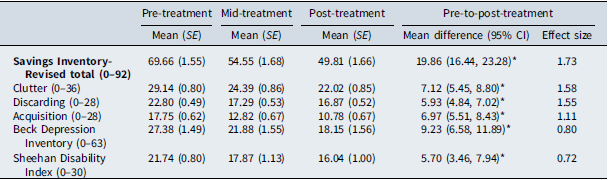
The estimated marginal means (EMM) from LMMs at pre-, mid- and post-treatment assessments for hoarding, depression and disability measures and corresponding post-treatment effect sizes for the GCBT intervention are shown in Table 1. Patients evidenced highly significant benefits at post-treatment across all measured domains, with robust improvements (d > 1.0) observed on SI-R total and constituent subscales, and moderate-to-large effects (d = 0.7‒0.8) for depression and disability.
Estimated marginal means (SE), mean treatment differences (95% CI) and effect sizes for hoarding disorder patients at pre-, mid- and post-treatment (ITT; n = 71)

Table 1. Long description
A table with 7 rows and 5 columns comparing pre-treatment, mid-treatment, and post-treatment means and effects for various measures in hoarding disorder patients. The columns are labeled Pre-treatment, Mid-treatment, Post-treatment, and Pre-to-post-treatment. The rows are labeled Savings Inventory-Revised total (0-92), Clutter (0-36), Discarding (0-28), Acquisition (0-28), Beck Depression Inventory (0-63), and Sheehan Disability Index (0-30). Each row provides the mean (SE) values for pre-treatment, mid-treatment, and post-treatment, along with the mean difference (95% CI) and effect size for pre-to-post-treatment. Row 1: Savings Inventory-Revised total (0-92), Pre-treatment Mean (SE) 69.66 (1.55), Mid-treatment Mean (SE) 54.55 (1.68), Post-treatment Mean (SE) 49.81 (1.66), Pre-to-post-treatment Mean difference (95% CI) 19.86 (16.44, 23.28)*, Effect size 1.73. Row 2: Clutter (0-36), Pre-treatment Mean (SE) 29.14 (0.80), Mid-treatment Mean (SE) 24.39 (0.86), Post-treatment Mean (SE) 22.02 (0.85), Pre-to-post-treatment Mean difference (95% CI) 7.12 (5.45, 8.80)*, Effect size 1.58. Row 3: Discarding (0-28), Pre-treatment Mean (SE) 22.80 (0.49), Mid-treatment Mean (SE) 17.29 (0.53), Post-treatment Mean (SE) 16.87 (0.52), Pre-to-post-treatment Mean difference (95% CI) 5.93 (4.84, 7.02)*, Effect size 1.55. Row 4: Acquisition (0-28), Pre-treatment Mean (SE) 17.75 (0.62), Mid-treatment Mean (SE) 12.82 (0.67), Post-treatment Mean (SE) 10.78 (0.67), Pre-to-post-treatment Mean difference (95% CI) 6.97 (5.51, 8.43)*, Effect size 1.11. Row 5: Beck Depression Inventory (0-63), Pre-treatment Mean (SE) 27.33 (1.49), Mid-treatment Mean (SE) 21.88 (1.55), Post-treatment Mean (SE) 18.15 (1.56), Pre-to-post-treatment Mean difference (95% CI) 9.23 (6.58, 11.89)*, Effect size 0.80. Row 6: Sheehan Disability Index (0-30), Pre-treatment Mean (SE) 21.74 (0.80), Mid-treatment Mean (SE) 17.87 (1.13), Post-treatment Mean (SE) 16.04 (1.00), Pre-to-post-treatment Mean difference (95% CI) 5.70 (3.46, 7.94)*, Effect size 0.72.
SE, standard error; CI, confidence interval; Effect size = Cohen’s d; positive effect sizes represent an improvement in symptoms; *p<0.001.
Discussion
The measures analysed in this paper show that GCBT offered to individuals with HD as part of routine clinical care is effective, in line with previous studies and thus adding to the body of research. The overall reduction in HD symptomatology was substantial (d = 1.73), and larger than the (robust) pooled pre‒post effect size noted in the recent meta-analysis of O’Brien and Laws (Reference O’Brien and Laws2025; g = 1.09). Both O’Brien and Laws (Reference O’Brien and Laws2025) and Tolin et al. (Reference Tolin, Frost, Steketee and Muroff2015) reported that those studies showing reduction in overall hoarding severity predominantly reflected decreased clutter-related behaviour in individuals, and, to a lesser extent, change in acquiring and discarding behaviours. But here, the magnitude of change in discarding behaviour was comparable to that of clutter-related behaviour, suggesting the intervention has potential to impact different HD domains in an equivalent manner. Furthermore, there were improvements in both mood and disability, suggesting GCBT can impact on levels of distress and functional impairment that often accompany HD symptoms.
Factors that may have contributed to the effect sizes include the screening process, which maximises the opportunities for recruiting people to the group who are motivated to engage in a therapeutic process and take responsibility for change. At assessment we assess the practicalities of discarding, for example use of a car, help from a friend, liaising with housing worker or social worker, to ensure that by the time treatment starts these potential hurdles have been overcome. Therapeutic rapport starts at assessment as the same clinicians then facilitate the group. The format of the group itself and the style of clinical facilitation both contribute to the success of the treatment. Each group is structured, with timed agenda points and the emphasis on self-therapy is aided by the spacing of sessions and the loading of psychoeducation at the start of the course (weeks 1‒6). The therapists aim to instil a sense of trust in the group relationships, and hope for achieving goals and confidence in the treatment model. The valuable vehicles for change offered by a group rather than an individual format of treatment delivery are acknowledged and enhanced by the therapists, and these include sharing with peers, peer support ‒ of emotions and problem solving, accountability to the group for goal change and achievement recognition. Any group therapy interfering behaviours are addressed at an early stage and within the group if clinically appropriate. The compassionate stance from the clinicians endorses the importance of the individual deserving to live in the home they wish for, and a belief that this can be achieved. The strategies and concepts are repeated consistently throughout the course to counter long-held behaviours and aid learning of new behaviours.
The area of acquisition is highlighted from assessment and is addressed from the start of treatment. A moratorium on acquisition (aside from ‘daily essentials’ which are defined) is suggested, with rationale, and from week 2 every individual shares their tally of ‘what has come in and gone out’. Each item entering the home (a purchase or free gift) is accounted for in the group discussion, and the goal is to disrupt and reduce the habit of excessive acquisition. The three aspects of hoarding behaviours are formulated and alternative activities, in particular to acquisition, that give as much short-term pleasure are identified by each individual, with the aim of daily practice. The group members seem to rapidly acclimatise to this degree of accountability to the group and curiosity from the group, and it leads to increased awareness of behaviours, along with genuine peer support. The presence of the individual’s end goal (on the poster), for example to sleep safely in my bed, allows for all significant steps towards achieving this to be celebrated within the group.
External factors that support progress in treatment include the availability of emotional and practical support, an ability to access rubbish collections, having any neurodiversity identified and adapting the model as required.
Factors that hinder progress could include physical health illness, an undiagnosed neurodiversity, an undiagnosed personality disorder such as obsessive compulsive personality disorder and a safeguarding referral whereby the expectations for change imposed on the person do not align with their own goals.
There are some limitations to this study. The assessment for HD does not follow a structured interview which could verify diagnosis such as the Structured Interview for Hoarding Disorder ( Nordsletten et al., Reference Nordsletten, de la Cruz, Pertusa and Mataix-Cols2013) but reflects criteria as stated in the DSM-5. There are no follow-up data to these outcomes, and while recent works suggests that symptom reductions associated with CBT are sustained long term (O’Brien and Laws, Reference O’Brien and Laws2025), it is unknown as to whether the progress observed here is sustained over time and how effective treatment is in preventing relapse. We have recently introduced additional measures such as the Autistic Quotient, HOARD and Activities of Daily Living-Hoarding, but do not have enough to report outcomes here. Finally, the sample of patients does not reflect local diversity and widening accessibility to the treatment needs to be considered.
Despite the encouraging outcomes, there remains a need to review and refine the protocol to enhance outcomes for future patients and improve on moving more patients into full recovery. This could include a formal harm reduction plan, set out at assessment, the delivery of a follow-up support group and the inclusion of psycho-education on emotional regulation and distress tolerance (Tolin et al., Reference Tolin, Worden and Levy2025). More generally, the dire need for hoarding disorder to gain broader recognition as a major mental illness, training of staff, more research and more funding within the NHS, are all as urgent as ever.
Data availability statement
The authors confirm that the data supporting the findings of this study are available within the article.
Acknowledgements
We thank Theresa Sobieralska and Kathryn Budd (South West London and St George’s Mental Health NHS Trust) who acted as co-facilitators for some of the groups.
Author contributions
Augusta CHANDLER: Conceptualization (equal), Data curation (supporting), Formal analysis (supporting), Investigation (equal), Methodology (equal), Project administration (lead), Supervision (equal), Visualization (equal), Writing - original draft (lead), Writing - review & editing (equal); Robert John Fogg: Conceptualization (equal), Data curation (supporting), Investigation (equal), Methodology (equal), Supervision (equal), Visualization (equal), Writing - review & editing (supporting); Jared A Smith: Data curation (supporting), Formal analysis (lead), Resources (supporting), Writing - original draft (supporting), Writing - review & editing (supporting); Paulina White: Data curation (lead), Formal analysis (supporting).
Financial support
This research received no specific grant from any funding agency, commercial or not-for-profit sectors.
Competing interests
The authors declare none.
Ethical standards
The authors have abided by the Ethical Principles and Code of Conduct as set out by BABCP. No ethical approval was obtained and governance arrangements were in place via the Trusts’ audit registration process.

 Open access


Comments
No Comments have been published for this article.