The public that occupies the bull ring (in Budapest) has no time to get bored.
The show has not even started and there is already so much to see. …
At eight o'clock the orchestra starts playing the Toreadors' march (from Bizet's Carmen) and the quadrilla comes out to the ring lit by electric lights.
The public becomes more excited. The toreador takes off his splendid mantle folded on his arms and throws it into the box of a beautiful woman.
Now all the binoculars turn in that direction and the honored woman happily rests her elbows on the espada's mantle.
The horns sound again and the gate of the toril opens wide, allowing for a red-brown bull to ragingly rush in …
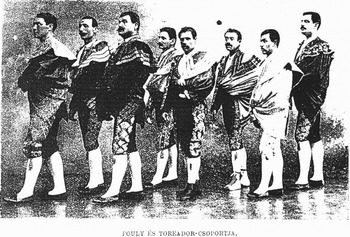
Anonymous Newspaper Article,Budapesti Hírlap, 1904At the beginning of June 1904, the Hungarian capital was in a state of frenzy. The bullfights, starring Pouly fils—a toreador from Nîmes, France—as the matador, and scheduled to take place in a recently built 15,000-seat bullring in the Budapest City Park, attracted everyone's attention.Footnote 1 Reporting a wave of “Spanish fever” spreading among inhabitants of the city, the newspapers highlighted the fact that a large percentage of the population was talking about “toreadors, picadors, matadors, and bulls.”Footnote 2 The toreadors dressed in their “exotic costumes” caused a stir everywhere they went (Figure 1).Footnote 3 As the toreadors visited Budapest's tourist attractions many female passersby noticed their “suntanned faces and muscular bodies.”Footnote 4 The matador's collar ornament, consisting of two studs representing two “miniature diamond bulls,” was a subject of conversation on everyone's lips.Footnote 5 Local tailors proposed “Spanish collars” replicating those worn by Pouly as the ne plus ultra of fashion to their customers. Furniture makers and carpenters witnessed their sales of Spanish dressing-screens skyrocket.Footnote 6 Surfing the wave of public interest, the Uránia, a local association for the popularization of science, scheduled slide shows about Spain.Footnote 7 The Budapest Orpheum hired Tortajada, a well known Spanish female dancer, for several appearances on its stage.Footnote 8 Parodic plays, mimicking a bullfight, were staged throughout June both on the site of Ős Budavára (Ancient Buda Castle), a historical theme park that opened in the City Park in 1896, and on an improvised outdoor stage on the Margaret Island.Footnote 9 Theaters also claimed their share by scheduling operas such as Carmen, the Marriage of Figaro, and the Barber of Seville. Restaurants offered a new cocktail drink called “Krampumpouly.”Footnote 10 Journalists turned into impromtu poets and wrote poems dedicated to the bulls.Footnote 11 Even politicians joined in the popular enthusiasm for the bullfights, declaring in the Budapest parliament, as a journalist sarcastically remarked, that for the local political body from that moment on: “Vox popouly” is “vox dei.”Footnote 12
Pouly and the toreadors. Source: Hungarian National Library.

However, as the bullfights opened, journalistic depictions of popular enthusiasm gave way to nationalist reprimands and anxious reports about their corrupting influence on Budapest's inhabitants. The bullfights were initially intended by their organizer, the Tourism and Travel Company (TTC), a new state-supported marketing agency, to attract more foreign visitors and hence contribute to Budapest's more efficient marketing abroad. The company's import of a foreign form of spectacle increasingly associated with Spanish national identity,Footnote 13 however, engendered a moral panic among nationalist supporters of a distinct Magyar culture and civilization, which—as they argued—was superior to the culture and civilization of non-Magyar ethnic groups living in Hungary. For them, potential comparisons between Hungary and Spain (a country often depicted as barbaric and located at the periphery of Europe) were very worrisome. If the inhabitants of Budapest were to turn into aficionados of bullfights, the civilizing mission Magyar nationalists took upon themselves in regard to the Slovaks, Romanians, Serbs, and other ethnic groups living in Hungary would suffer a powerful blow. As the bullfights proceeded, government officials who had initially supported them also became worried. They believed the bullfights might cause heightened euphoria and disorder among the spectators. Fearing that uncontrolled crowd behavior in the arena might lead to urban riots, these government officials decided in July 1904 to ban the organization of further bullfights.
Together these two concerns, along with the government's switch from a pro- to anti-bullfight stance, worked against the TTC's efforts to turn the bullfights into a local attraction. But there is more to the story. The mere fact that bullfights were organized in Budapest reflected the rise and spread of a transnational and decontextualized global mass culture in the urban areas of Eastern Europe. The bullfights enabled spectators in Budapest to come into close contact with a foreign environment without having to travel to Spain. As Wolfgang Maderthaner and Lutz Musner write in their recent discussion of the emergence of urban mass culture in neighboring turn-of-the-century Vienna, “mass culture is […] a bridge into the distance, insofar as, by way of the new visual power and the use of technically produced pictures and images, foreign worlds are transported into the here and now and previously unbridgeable distances into the proximity.”Footnote 14 Unlike visual, aural, and textual mediums—e.g., photographs, phonographs, films, the sensationalized press, and pulp fiction—the role that turn-of-the-century bullfights played in the globalization and massification of urban entertainmentFootnote 15 is now mostly forgotten. At the time, however, bullfights competed with these type of media and with spectator sports such as soccer and athletic competitions to attract large urban crowds.Footnote 16 The bullfights represented an important episode in Budapest's emerging mass culture, which, as we have seen, the newspapers of the time widely recorded and discussed. However, because other types of sources did not cover bullfights, many scholars neglected their import and impact.
Besides rescuing the bullfights from oblivion, this article attempts to connect them not just to Budapest's mass culture, but also to the history of Hungarian nationalism.Footnote 17 Looking at developments in modern Hungarian politics, historians have often described turn-of-the-century Budapest as being more cosmopolitan and liberal than the rest of the country. According to them, a turn to a conservative and nationalist ideology took place in the city only after 1919, with Horthy's rise to power.Footnote 18 However, the fact that the organization of the bullfights elicited both enthusiastic acceptance and narrow-minded rejection on nationalist terms challenges this interpretation. As I argue here, the reception of the bullfights and disagreements over the content and goals of Budapest's marketing illustrate the existence of a virulent grass-roots nationalism that the press continuously fed and fueled, leading to an erosion of the dominant positions held by liberals in the Hungarian capital long before the interwar period. Footnote 19
Professionalizing Budapest's Marketing Strategy
The 1904 bullfights were not the first instance when the divergent forces of urbanization and globalization celebrated by the liberals and the nation-building efforts of the Magyar nationalists intersected with each other in the Hungarian capital. András Gerő has recently singled out the symbolic importance of the 1896 Millennium festivities both as an expression of Magyar nationalism and a celebration of Budapest's dual coming of age as national capital and world city.Footnote 20 When it opened in the City Park on May 2, 1896, the Millennium Exhibition constituted a huge architectural medley. The neo-Gothic, neoclassic, and baroque facades of its industrial pavilions had their counterpoint in the ethnic and folkish architectural styles of the so-called “Nationality street,” also located within the exhibition's precincts. The official exhibition extolled the achievements of national industry and of the Magyars as an ethnic group. However, reflecting the same duality, the municipality of Budapest and local entrepreneurs added two other venues: the already mentioned Ős-Budavára, an amusement park in the Exhibition Village's immediate vicinity, and the gigantic “Constantinople in Budapest,” a theme park on the right bank of the Danube, in Lágymányos, which reproduced in detail and on several acres of land the cityscape and the most notable buildings of the Ottoman capital.Footnote 21 In addition, the exhibition offered visitors both the opportunity to watch Magyar aristocrats on horseback parading in a huge pageant through the city and to experience international variété shows in the French restaurant that opened on the grounds of Ancient Buda.
Monumental buildings, nationalist pageants, and fairground attractions had a common denominator. According to historian Péter Buza:
The majority of the attractions of the Budapest millennial celebrations capitalized on the grandiosity of the spectacle. This (was) equally valid both for the official ceremonies and the initiatives of the entertainment industry. Gigantic tableaux vivants, huge canvasses, film and variegated scenes. Stage playing and playing betwixt the stages.Footnote 22
With them, Budapest wanted to project to outsiders the image of a city where one can find a large variety of entertainments.Footnote 23
However, in spite of all the grandiose expectations of the organizers, the attractions Budapest sported in 1896 failed to reap the expected benefits.Footnote 24 According to an American press correspondent in Europe, although the coronation of Tsar Nicholas II a year earlier in Moscow “was advertised in every tongue that speaks through a printing-press, and the fame of it was carried by word of mouth from the Persian Gulf to the Mountains of Tibet, from Pekin to Melbourne, and drew four hundred thousand strangers to the city of Moscow,” the Millennium Exhibition was “not advertised at all, and the number of fortunate foreigners who found it out, and who journeyed to Budapest to witness it, could almost have been counted on the fingers of two hands.”Footnote 25 Indeed, according to local statistics, the exhibition attracted only 59,000 foreigners, more than half of whom were from Cisleithania.Footnote 26 Given the size of Budapest and its official status since 1892 as the second capital city of Austria-Hungary (equal in status with Vienna), many Hungarian politicians, public servants, journalists, and statisticians deemed this number insufficient.
The failure of the 1896 exhibition to open Budapest to the world and attract more foreigners from distant lands motivated liberal politicians and local boosters to broach the question of its global marketing once again in 1900. At the initiative of Budapest's mayor, János Halmos, on 16 June 1900, a special committee was called to life within the institutional framework of the municipality.Footnote 27 The task of the committee was to elaborate a strategic plan to market BudapestFootnote 28 (this veritable source of “national wealth” as a commentator put it),Footnote 29 as a desirable tourist destination for western and eastern visitors alike. Besides calls to launch a large propaganda campaign abroad to advertise Budapest's “beauty” and “civilizational achievements” and successive attempts to interest more diverse social groups in the promotion of this venture,Footnote 30 the committee's immediate achievement was the realization of the need to professionalize its work.Footnote 31 This was all the more necessary because among the most urgent tasks, singled out in the course of the committee's debates in 1901, were the creation of a tourist information center, the opening of a Foreigners' Casino affording leisurely intermingling between locals and foreigners,Footnote 32 and the recruitment and training of professional tourist guides.Footnote 33 As many members of the municipal committee emphasized, the success of any plan to boost Budapest's urban tourism depended on the availability of a professional association to deal comprehensively with these issues.Footnote 34
The first step toward the professionalization and unification of these local tourism interests was the creation in January 1902 of the Idegenforgalmi Egylet (Tourism Association—hereafter TA). Serving as an umbrella organization for more than one thousand individuals interested in promoting tourism, the TA benefited from the joint financial support of the municipality, the local streetcar company, the Kassa-Oderberg Railway Company, the Otthon (Home) Writer's Association, the National Industry Association, and that of the Budapest and the Aranysas (The Golden Eagle), two local hotels.Footnote 35 In spite of this impressive patronage, however, the TA was very slow to elaborate and implement a concrete city marketing plan, an inadequacy that various independent supporters of the larger urban tourism promotion movement that had started to blossom in the Hungarian metropolis soon recognized. The creation on 9 September 1902 by Counts Arisztid Dessewffy and Mihály Eszterházy of the already mentioned Idegenforgalmi és Utazási Vállalat Rt. (Tourism and Travel Company, hereafter TTC),Footnote 36 as a separate urban tourism association from the rather ineffective TA, resulted from this recognition.Footnote 37 This new tourism promotion agency was supported financially, among others, by the Hungarian Ministry of Commerce,Footnote 38 the Hungarian State Railways' Travel Office, the aristocratic Park Club, and the newly launched Hungarian Automobile Club. Benefiting at the same time from advantageous contracts concluded with the International Wagon Lits Society and the Thomas Cook & Son Travel Company, the TTC opened its offices in a downtown location and functioned from that moment on as a private stock company.Footnote 39
Unlike the lukewarm and ineffective efforts of earlier groups and agencies to promote urban tourism,Footnote 40 including those of the TA, the TTC turned its plans into concrete actions more successfully. The first project of the new company was to include Budapest in larger European and global traveling networks.Footnote 41 To achieve this goal, the TTC actively lobbied at an important congress of the International Hoteliers' Association, which brought together the managers of a large number of European hotels and restaurants in Budapest in the autumn of 1902.Footnote 42 Leaders of the TTC also worked hard to attract foreign tourists to the Hungarian capital through several other forms of advocacy. According to Kálmán Gálos, the executive secretary of the TTC, Budapest had to be made better known abroad through massive and aggressive advertisement campaigns. Gálos emphasized the important role that posters, brochures, and guidebooks distributed in “hotels, on boats and railway cars” could play. He urged Budapest's city fathers to print a large number of Budapest postcards and issue stamps portraying Budapest vistas. He recommended that leaders of his own company initiate a business agreement with the German Baedeker and the French Hachette publishing houses to improve Budapest's image in the Baedeker and Joanne guidebooks. Furthermore, Gálos proposed flooding the foreign press with information about the Hungarian capital, through paid advertisements about Budapest's “exhibitions, spectacles in preparation, more notable buildings, the opening of new museums, art galleries and artistic collections, the opening of new railway and fluvial lines, including all the new administrative regulations relative to the circulation of foreigners in Hungary.” But what was even more important, according to Gálos, was to publish in the local and international press so-called “Budapest feuilletons,” written with the “golden pen of a Jókai [the most celebrated turn-of-the-century Hungarian writer] and the pragmatic knowledge of a [Thomas] Cook.”Footnote 43
Nonetheless, even this massive textual and visual propaganda seemed insufficient to the leaders of the new city marketing movement. Because Budapest lacked an older artistic and architectural heritage that would allow the city to compete with other European cities that possessed a richer cultural capital,Footnote 44 the TTC soon emphasized the need for more spectacular forms of attraction. As some local boosters had argued before:
where one cannot find pyramids, sphynxes, a Vatican, artistic masterpieces and beautiful natural landscapes, there the foreigner's stay should be turned into an interesting one through artificial means, i.e. he should be offered an appealing and picturesque image (of the place) through means that are (locally) more available.Footnote 45
Hence, in addition to publishing better quality guides and brochures,Footnote 46 the TTC played a crucial role in the opening of the Budapest Jégpalota (Ice Palace), a sports complex housing an exotic combination of a palm tree hothouse and an ice-skating rink.Footnote 47 The association also organized a number of important seasonal events that it hoped would reaffirm Budapest's promotional claim to being a Paris of the East and increase its urban tourism figures.Footnote 48 Indeed, reconnecting with private initiatives made at the end of the nineteenth century to boost local tourism through theme parks such as “Constantinople in Budapest” and “Ancient Buda Castle,” the TTC tried to enhance Budapest's international appeal through spectacles such as the Danube Festival (an event organized consecutively in May 1903 and June 1904, which, through electric illuminations and evening fireworks, contributed to the festive appearance of the Budapest river promenade),Footnote 49 the flower-decorated car pageants organized on Stefánia Avenue in the spring of 1904 (inspired by those earlier held on the French Riviera),Footnote 50 and the already mentioned bullfights.
All these events contributed to the congregation of thousands of locals, provincials, and foreigners in Budapest. The local implantation of transnational attractions such as theme parks, fireworks, bullfights, and car pageants that had succeeded in attracting tourists to other cities, however, raised the politically charged question of how to manage the encounter between national traditions and international forms of mass entertainment. On one hand, the TCC embraced and promoted this transnational culture of spectacle because it appeared to contribute much to Budapest's cosmopolitan ambitions. In a city of nearly 750,000 inhabitants that—as many early-twentieth-century commentators complained—still evoked the provincial spirit of a “small city,”Footnote 51 the mixing of locals and foreigners in consuming the new attractions was seen as a direct proof of Budapest's metropolitan status and its insertion into a global tourist matrix defined to a great extent by these new mass entertainment forms. On the other hand, however, many nationalist commentators viewed the new transnational entertainment culture emanating from Paris and promoted by the TTCFootnote 52 as a threat to the effectiveness of the policies they had developed to promote Budapest as the capital city of a Magyar nation.Footnote 53 The nationalists warned that although the development of “Ancient Buda Castle” into an even bigger amusement park, or that of the Margaret Island into a center for casinos, could make Budapest into a cosmopolitan tourist destination even better known than Paris, such a development would bring all the “garbage and dirt” of the world to the city.Footnote 54 In contrast to the previous generation of national-liberal Hungarian politicians' infatuation with Paris,Footnote 55 turn-of-the-century Magyar nationalists rejected the new Parisian urban culture of aggressive advertisement, the frenetic exchange of money and pleasures, and the primacy of the visual over the written form.Footnote 56 They feared that the transformation of Budapest into an international destination would not only discredit their “civilizing mission” among Hungary's non-Magyar ethnic groups, but also, as the above quotation illustrates, that it would bring con artists and low-class foreigners to the city.
Notwithstanding such fears, by 1900 contact between Budapest and other areas of the world had become customary rather than exceptional.Footnote 57 By the early twentieth century, the continuous interaction between “foreign” and “native” cultural forms swelled into a process too strong to be easily kept at bay. The encounter between the two often led to the birth of culturally hybrid forms in which foreign content and decontextualized meanings were re-interpreted, refashioned, and renegotiated to the point that they could be inserted as “Hungarian” into the local context.
The Organization of the Bullfights
Such a case of cultural hybridization was well illustrated by the bullfights held in the Hungarian capital in June and July 1904. The TTC released its intention to turn Budapest into a venue for corridas to the public during the first half of May.Footnote 58 As we have seen, the bullfights were an important element in the TTC's plan to turn Budapest into a more mainstream tourist destination. Its leaders expected important economic and political returns from the bullfights. As the TTC's official publication pointed out:
From a touristic point of view, no capital city has benefited yet from a spectacle, stirring so much attention abroad as this. The TTC keeps receiving thousands of letters from abroad, in which numerous foreigners inform us about their intention to attend the event, while making hotel and ticket reservations for the corrida. Moreover, travel agencies from Warsaw, Nuremberg, Prague, Vienna, Bucharest, Dresden, Munich, Berlin, Sophia, Belgrade, Trieste, Venice, Milan, etc. plan to organize group tours to Budapest for the bullfights, and the number of those interested to participate in these is everywhere beyond our expectation. A large number of foreign visitors will have the chance to get to know our exceptionally beautiful capital, which is tremendously important (for us) not only from an economic but a political point of view as well.Footnote 59
However, official permission was needed before the agency could proceed with the organization of the event. In response to an application for a permit addressed to the Budapest Municipal Council by Krausz & Bettelheim, a shareholding company the TTC had created to manage the bullfights financially,Footnote 60 council members debated fiercely whether or not to approve the bullfights. In their 19 May meeting, several municipal councillors argued that giving an exclusive three-year concession for the building and maintenance of a bullfight arena within the perimeter of the Municipal Zoo would be tantamount to promoting the decay of Budapest's urban culture. According to municipal councillors Sándor Polacsek, Rezső Havas, and György Pláthy, the corrida was a “barbaric institution.” According to them, bullfights would do nothing to increase urban tourism figures, and they were only good to entertain people with a weak nervous system.Footnote 61 In their opinion, there was not much difference between the bullfights and Ős-Budavára, the amusement park opened by private investors (with the agreement of the municipality) in the City Park in 1896. They forecast that following in the footsteps of the latter, the bullfights would only lead to the “spread of immorality” among Budapest's inhabitants. Sándor Pollacsek summed up the main reason for their opposition to the project: “if we bring a few people here due to the corrida, that still does not constitute urban tourism. Urban tourism should be promoted with cultural institutions, with the boosting of local industry and commerce, and not [with the help of the bullfights].”Footnote 62
Other members of the municipal council such as Artúr Wodianer, Antal Heterés, Béla Simonovics, and Jenő Andreánszky, however, wholeheartedly supported the corrida, claiming that, as Wodianer put it:
the fear of those who think that the Budapest bullfights will turn into a bloody spectacle, or that they might corrupt people's morality, is unfounded. (Everybody agrees) that it is unrealistic to claim that the Parisian public is not civilized enough, and since the impresario who is in charge of the Budapest bullfights, has already organized such spectacles in Paris, their taking place here (is totally justified).Footnote 63
References to Paris such as Wodianer's repeated an old habit of comparing Budapest's urban culture to that of the French capital. Wodianer used the cultural parallel between the two cities to contradict nationalist fears that the bullfights would diminish Budapest's civilized status. In addition, another argument that he and others made was that the Budapest bullfights would deal a serious blow to Viennese tourism. The pro-corrida municipal councillors argued that the bullfights would decrease the Austrian capital's competitive international appeal by attracting more foreign tourists to Budapest. Minimizing the resistance of some of his own colleagues against the bullfights, Béla Simonovics remarked that: “it is only the Viennese newspapers which agitate against the Budapest bullfights, and the reason for this is that they are hurt by the fact that foreigners will come to Budapest, seeing thus [with their own eyes] that it is not the city that the Viennese newspapers enjoy to [negatively] depict.”Footnote 64
Although the arguments of those in favor of the corrida earned the support of a slim majority in the municipal council, the matter was only decided when István Tisza, Hungary's prime minister, gave his benediction to the venture.Footnote 65 His only condition—as the Pesti Hírlap reported—was that just as with the bullfights organized earlier in Paris and Brussels, (and according to the Portuguese system), “blood should not be spilled, horses should not be used, and bulls should not be killed.”Footnote 66
As a result of Tisza's approval, the municipality gave Krausz & Bettelheim Co. exclusive rights to organize the bullfights.Footnote 67 At the same time, however, to appease the internal opposition, the municipality reduced the length of the initial three-year contract requested by the company to only one summer season.Footnote 68 Undeterred, Krausz & Bettelheim immediately hired a subcontractor to build a bullring in the City Park. The firm of Neumann & MannheimFootnote 69 and five hundred seasonal workers were hired during the third week of May to start the construction project.Footnote 70 First, a ring with a 40-meter diameter was traced on an empty plot of the Budapest Zoo.Footnote 71 A large wood and iron structure housing the tribunes was built to circle it. The tribunes were separated from the bullfight arena by a safety corridor made up of a double ring of circular wooden planks. The three story-high large iron structure surrounding the interior ring and supporting the tribunes was inspired by that of the Seville Arena, the biggest bullring in Spain.Footnote 72
To boost international attendance, the TTC soon sent out a large poster painted by a local painter, portraying a generic bullfight scene, to be displayed both on the Morris columns of all of Budapest's major boulevards and on the walls of fifty-two German, Italian, Russian, Romanian, Serbian, Bulgarian, and Austrian railway stations.Footnote 73 Local newspapers reported that members of the Hungarian and Austrian aristocracy bought a considerable number of tickets, not to mention those already purchased by hundreds of tourists heading to Budapest from London, Vienna, Prague, Russia, and several Balkan cities.Footnote 74 The foreign tourists' drawing potential of the Budapest corrida seemed hence to be confirmed. As ticket sales took off among members of the Hungarian and Austrian aristocracy, the bullfights were also expected to become a cosmopolitan Austro-Hungarian event at which both Tout Vienna and Tout Budapest would be represented.Footnote 75
Nationalist Criticism of TTC and the Bullfights
As we have seen, not just the number of sold tickets and the participation of the Austro-Hungarian aristocracy, but also the toreadors attracted a lot of attention in Budapest. Although Pouly's bullfighting business was based in the south of France in Nîmes, he enjoyed international notoriety as a result of having performed more than fifty times at the bullfights organized at the 1897 Brussels Exhibition and the 1900 World's Fair in Paris.Footnote 76 When the young and handsome Pouly arrived in Budapest in early June, he was celebrated as a veritable star.
A score of nationalist journalists, however, did not see his arrival as a welcome development. Notwithstanding the government's official endorsement of the bullfights, they remained skeptical that the bullfights would boost Budapest tourism. Turning their previous civilizational argument against the organization of the bullfights on its head, they now claimed that the Budapest bullfights had a very slim chance to succeed because, instead of “the authentic spectacle of a Spanish corrida,” they were about to offer only a surrogate spectacle and a pale imitation of what real bullfighting was about.Footnote 77 Adding to the corrida's lack of authenticity—as the author of an article published in Magyar Közélet (Magyar Public Life) pointed out—was the fact that the toreadors hired to do the job were not Spanish, but members of a French team.Footnote 78
To further emphasize the inappropriateness of the venture, nationalist commentators pointed out that the corridas organized in 1897 in Brussels and in 1900 in Paris were events directly connected to a world's fair, whereas the Budapest one was not. They warned the public that the TTC was foolishly hoping to attract thousands of foreigners to Budapest simply by offering them bullfights. They pointed out over and over again that foreigners, who would want to watch such a spectacle, would rather go to Spain—where they could witness real bullfights—than come to Budapest to see a bloodless and inauthentic spectacle. They also attacked and criticized the TTC for its business-mindedness and for its interest in cutting, as they put it, “a deep hole” in the pockets of the Hungarian public rather than that of their foreign counterparts.Footnote 79 The 60,000 crowns of annual subvention the TTC was given from the state budget to promote Budapest abroad was called an act of robbery committed against gullible Hungarian taxpayers.Footnote 80 Nationalist commentators emphasized that the government needed to spend money not on bullfights but on national culture. Tisza's government was also criticized for funding and supporting an event that was Austro-Hungarian and international in scope, rather than serving national and domestic interests.
But most importantly, given their earlier description of the bullfights as a “barbaric” mass entertainment, nationalist commentators were also wary about other developments that the event would trigger. As a journalist writing for the newspaper Magyar Szó (Magyar Voice) pointed out, by allowing the bullfights to take place, the Budapest municipality and the government offered a bad example to other cities in the Hungarian kingdom that might emulate the national example provided by the capital.Footnote 81 He and others feared that Budapest's cosmopolitan ambitions, reflected in the organization of the bullfights, would somehow infect other Hungarian cities. The prospect of this was especially worrisome for turn-of-the-century nationalists because they wanted to use Budapest as a base from which to spread the civilizing gospel of Magyar high culture to the rest of the country. They framed the bullfights as a low-brow type of entertainment, the direct antithesis of the high culture for which they claimed to stand.
It is important to note, before we turn to a presentation of the bullfights, that criticism was not limited to articles published in the Magyar Közélet and Magyar Szó. Nationalists mounted a powerful campaign to influence public opinion about the bullfights. Under its impact, most of the Hungarian press that reported about the bullfights (with a few early exceptions) became increasingly unsympathetic to the tourism promotion pleas of the TTC. Overall, as I will document in the remainder of this article, the public reception of the bullfights was fashioned to a great extent by the opinion of nationalist journalists who wanted to undermine, rather than celebrate, them as one of Budapest's new touristic attractions.
The First Bullfights
The first three bullfights for which Pouly fils and his team was initially hired by the TTC took place on 11, 12, and 14 June 1904. On the evening of June 11, the bullring was filled with a sizeable public. According to a press report:
tout Budapest was there; in the boxes one was able to see the most well known representatives of the local aristocracy and financial sphere; while seated higher up from them were numerous illustrious figures from the artistic, literary and scientific milieus of the capital, well known representatives of Budapest society.Footnote 82
Indeed, Baron Bolfrass, the personal adjutant of Francis Joseph, Prince Liechtenstein, and numerous well-known Hungarian aristocrats such as Counts Apponyi, Eszterházy, Károlyi, Andrássy, Hadik-Barkóczy, Zichy, and Baron Sándor Jeszenszky were all there.Footnote 83 In total there were about seven thousand spectators in the tribunes, eager to watch the long-awaited spectacle.Footnote 84
Indeed, as a journalist present at the event reported, expectation to see the “toreadors, ceremoniously dressed, wearing white socks, and using dance like movements”Footnote 85 was so great that shortly before the start of the bullfights, the air felt increasingly filled with human electricity. Waves of clapping and the sound of hands tapping the circular wooden fence separating the public from the arena increased and decreased rhythmically, similarly to the flux and reflux of the ocean. Then:
Finally, a couple of minutes after 8 p.m. employees wearing the uniform of the Hungarian State Railways opened the gate of the paseo, through which a picturesque procession proceeded into the arena. Leading the procession were four black dressed alguazils on horsebacks, with Pouly, the matador, right behind them…. (The latter) was followed by the 32 members of the cuadrilla, all dressed in wonderful Spanish costumes. It was self-evident that throughout this time, the orchestra played arias from Carmen.Footnote 86
Once the sound of the music died, Pouly turned toward the official jury of the competition composed of Counts Gyula Keglevich and István Bethlen and presided over by Baron István Sennyei. Facing the stall of the jury, the espada bowed in front of Blaskovich Elemérné (née Countess Waldeck), the official patronesse of the event. This chivalric moment was heightened when “accompanied by the sound of horns,” the rest of the toreadors and banderilleros “went around the ring, … each throwing their mantles into the arms of their [chosen] lady.”Footnote 87
The spectacle was now ready to begin. As the same journalist reported, using the present tense to enhance the immediacy of his account:
… it is only the toreadors who stay in the ring and, while holding their red capes on their arms, they all look towards the gate wherefrom the bull is expected to appear.
A horn is resounding; the bull comes!
Indeed, from the dark pen an animal suddenly appears and blindly rushes forward under the gleaming lights.Footnote 88
Provoked by the red capes of the toreadors the first bull rushed several times toward them, forcing some of the toreadors to jump over the low fence surrounding the ring. After a couple of such initial charges, the bull turned complacent, calling forth the image of an innocently and defenselessly exposed victim of the toreadors' piques and not that of a dangerous beast in the spectators' mind—as the same eyewitness reported. In spite of this initial display of sympathy for the bull, however, spectators eagerly looked forward to bloodshed. Tension heightened when it was Pouly's turn to handle the bull:
(Pouly) starts walking very close to the bull's horns and with very slight bowings of his body and a gentle smile on his face, he avoids the beast's stabs. He holds two bi-colored piques in his hand which he thrusts into the bull's back. The bull is shaking its head, turns around in pain, and furiously stamps the sand. A toreador comes close and using a pole jumps over the bull's back. There comes a second, who—profiting from the moment when the bull prepares to thrust forward again—tumbles over the bull's back with a cat's agility.
First this creates a comic effect; then it turns boring. Up to now the bull appeared as a sympathetic and defenseless animal, whose torture by ten toreadors is far from being seen as a heroic act by the spectators. In this spirit, Pouly's movement who mimes giving the deadly grace stab to the bull with his pique, goes unobserved. This wants to be the punch line of the show, but the public does not notice it.
A small black cow with a bell hanging from her neck is being now sent into the arena; the bull rushes towards it, complaining with a dull mooing about his unfair torments; to soon have the coquettish glances of the cow lure him back into the stables.
With this the spectacular effect (of the bullfights) goes flat. What comes afterward is just a repetition of what happened before. According to the program, the black bull is replaced by a spotted one. The whole comedy is repeated with this animal as well; (only) to have the fickle-natured cow with her longing glances lure this animal out of the spectators' sight, once again.Footnote 89
According to the same commentator, during intermission, the public showed obvious signs of discontent. Although pleased and entertained to a certain degree by the acrobatic skills of the toreadors, the audience was keen to see some bloodletting. Many spectators expressed their displeasure at not being thrilled enough. Fortunately, the happenings in the bullring seemed to improve after the break. As spectators returned to their seats, “a new bull rush[ed] into the ring.” According to our observer:
It is easy to notice though, that this is a different sort of beast. This one is not asking for (the) pity (of the public), but starts to run after each of the toreadors. A banderillo is forced to jump over the ring's fence. The bull takes a sprint and jumps after him. And it does this with the ease of a greyhound. The banderillo manages to make it back to the arena, but the bull is stuck in the bullring's circular corridor.
The chulos manage to get him back into the arena and the small bull starts to stamp the ground with foaming rage. This is not a matter of joke anymore. The sharp, fork-like horns of the beast do not conjure up anything good.
One of the toreadors starts running towards the animal, planning to tumble over its back from a frontal position. But during the last moment, when the bull rushes toward him with its lowered horns, the toreador gets scared and falls. A horrified hiss escapes the audience. The bull jumps over the toreador, lifts him with his front legs, and turns its neck half-way to stab his cruel tormentor.
By now, however, all the other toreadors are already around the scene. They throw their red capes over the bull's eyes. Pouly tries to hold the bull back by pulling his tail. The fallen toreador manages to stand up, slowly limps over to the fence, wherefrom he turns his tongue towards the bull. He tries to mock the beast, but his face is leadlike.
Now Pouly sees it appropriate to fight the bull. With an agile jump he gets close to him, and miming the grace stab, thrusts his lance into the bull's back. But the bull does not want to accept that, according to the corrida's rules, the show is over with that. He thrusts, once again, and suddenly his horns pierce through Pouly's ankle (emphasis in the original).
But the audience barely notices anything. Pouly's face goes red with anger and he turns again towards the bull. But when he tries to move he falls over. The other toreadors immediately form a body shield around him, and force the bull to go away from the spot.
But Pouly is not at rest. He stands up again and gestures that everything is all right with him. One can easily notice, however, a big cut in his pink ceremonial socks, which are now stained all over with blood. With fiery eyes and a bitter grimace on his face, Pouly tries to walk again towards the bull, but suddenly, he suddenly faints. Two helpers carry him out from the arena. The toreadors' primadonna is taken off from the show's repertoire.Footnote 90
Though the audience was enthralled for a moment by the sight of blood, with the removal of Pouly, the spectacle went flat once again. According to the same report, even the unexpected turn of events that took place after intermission, which led to the spilling of the toreador's blood, instead of the bull's, appeared to many spectators as artificial and unconvincing: “It is a comedy, a learned trick!, they t[old] each other.” reported our journalist.Footnote 91
As this journalist's report suggested to its readers, the first corrida in Budapest turned into a spectacular fiasco.Footnote 92 The wounding of Pouly (who was taken immediately to the hospital where—according to a briefing the TTC addressed to the public in the aftermath of the event—he was declared to be in need of at least two weeks of intensive medical care),Footnote 93 together with the general discontent of the public regarding the behavior of the bulls, considerably weakened the corrida's appeal. During the second bullfight conducted by Clarion, another toreador from Nîmes, the number of spectators dwindled to between less than “one half” and, according to another estimate, no more than “one tenth” of the number of spectators who had showed up for the first bullfights.Footnote 94 Although these figures did improve somewhat by the third day of the bullfights, the numbers of tickets were still well under those sold for the first corrida.Footnote 95 According to another commentator, one reason for this drop was the temporary indisposition of Pouly, as a manager and key actor of the spectacle. More importantly, however, another reason for it, as the same commentator reported, was the lack of comprehension among Hungarian spectators for the subtlety and meaning of the toreadors' complex choreography displayed at each bull's rush in the arena.Footnote 96
Acculturating the Audience to the Corrida
To avoid complete fiasco, the organizers tried subsequently to woo Budapest's estranged bullfight audience. One way to acculturate the audience to the corrida, and to make it hence more intelligible and enjoyable for its disappointed spectators, was to mix Spanish with Hungarian music. As newspapers reported, during their subsequent runs, the corridas started with music taken usually from Bizet's Carmen but ended with the Rákóczi march.Footnote 97 The combination of Carmen's exotic beats with the Rákóczi march (the unofficial Hungarian national anthem) was meant to make the corrida more acceptable to its nationalist critics. Another, and more complex, attempt to acculturate the crowd to the bullfights was to present it as part of Budapest's urban tradition. As the author of an article published in the Pesti Napló reminded his contemporaries:
The bullfights are not a new form of amusement in Budapest. One hundred years ago, the inhabitant of Pest and Buda would not have lost any Sunday afternoon opportunity to enjoy a bull's baiting (bikahecc); since a century ago the bullfight was still called a baiting and the toreador's corresponding name was that of baiting master (heccmeiszter). The Animal Baiting Arena (Hetztheáter) was located in front of (old Pest's) Váci gate, close to the Gizella (today Vörösmarty) square. The Hetzthéater was a big wooden amphiteather. The ring was surrounded by three floors of wooden structures. The ground floor had only trap-doors, behind which the beasts were kept.Footnote 98
According to nationalist commentators, however, the practice of animal baiting had been transplanted to Pest from Vienna. Pest's German bourgeoisie was depicted as delighted to enjoy a spectacle that had also been very popular in the late-eighteenth-century Habsburg capital.Footnote 99 Indeed, the Pest bull baitings had soon become a major form of entertainment in the city.
All Buda and Pest went (to the bull baitings) every Sunday afternoon for fun. The notables also came, and as an eyewitness recorded, there were many “noblemen, who drank beer and ate German sausages together with the shoemakers and grocers bedecked in Sunday outfits, gathered there.” Meanwhile, the fight continued in the arena. A bull fought against a bullock; while dogs attacked a wolf. Occasionally, a lion was also let out from its cage, to tear into pieces a dog or two. The public liked this very much: our great grandfathers and their fathers were overwhelmed with joy. The bull baiting was always the last to be performed, as the truest, and the most spectacular form of entertainment.Footnote 100
Cruel spectacles such as these had been organized in Pest not only during the late eighteenth century. Although Count Hofmannsegg, a late-eighteenth-century visitor to Pest, considered them “remnants of pagan times”Footnote 101 and condemned them as a proof of hypocrisy and lack of Christian spirit among locals, Pest city fathers continued to endorse them long after the German aristocrat's account contributed to their negative publicity in the eyes of an enlightened European public.
The problem with the newspaper articles that connected the 1904 corrida to the animal fights held in Pest during the late eighteenth and early nineteenth centuries was that they presented local city dwellers in the posture of a bloodthirsty and barbaric public taking delight in cruel spectacles. Contrary to this, the declared purpose of the early-twentieth-century Budapest corrida—as repeatedly voiced by the leaders of the TTC—was to enhance the tourist appeal of the Hungarian metropolis by presenting it as a center of culture and civilization similar in many ways to Paris.
Therefore, the corrida needed a different and more palatable ancestry. It was an unexpected author who came to the rescue. Dénes Pázmándy, a nationalist MP but a sympathetic Francophile at the time, mentioned in an article he wrote for TTC's Magyarország és a Nagyvilág. Ungarn und die Weite Welt that a possible ancestor for the 1904 corrida could have been the annual bullfights organized by the butchers' guild of Kecskemét, a Hungarian city located south of Budapest, during the second half of the eighteenth century. The only difference between the Spanish and the Hungarian bullfights, as he put it, was that, in the latter the local butchers had not used horses and piques but, rather, dogs to challenge the bull. Relating the corridas to the Kecskemét practice—depicted as a purely Hungarian tradition—rather than to the Pest bull baitings, Pázmándy warmly praised Pouly and his team's productions, emphasizing that: “it was proven in Budapest, that the bullfights are the real cornerstones of cold-bloodedness, courage, and manly skill. They are a remnant of the old chivalric games, combining also elements taken from the even more ancient exploits of the world of the gladiators.”Footnote 102 Emphasizing the courage, the athletic skills, and the chivalric qualities of the toreadors, Pázmándy strove not only to make the corrida more intelligible to a society deeply steeped in the aristocratic cult of masculinity, but also to make it more palatable and acceptable in the eyes of its more radical nationalist critics.Footnote 103
From Mass Entertainment to Fears of Urban Unrest
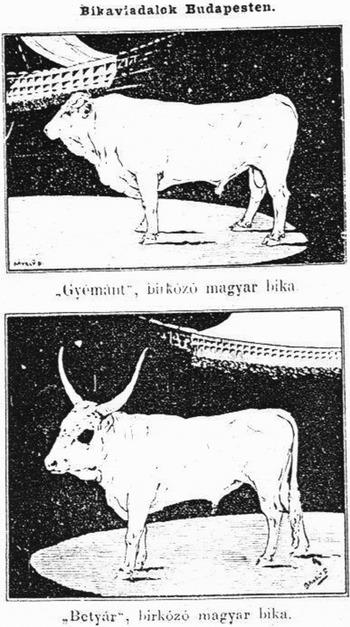
Other attempts were also made to acculturate the Hungarian public to the corrida. What triggered a renewed interest in bullfighting among spectators was the announcement organizers made at the end of a second series of bullfights:Footnote 104 Hungarian bulls would soon be brought to the arena (Figure 2).Footnote 105 The bovines picked for this third series of bullfights were two ferocious bulls that Baron Sennyei, the president of the corrida's jury, owned. After seeing the bulls, nationalist commentators (warmed up as they were now to the event) agreed that, if the quality of the bullfights had been damaged because the Spanish bulls were too small in size, allowing the toreadors only to entertain the lower ranks of the public with such acrobatic movements as their “hilarious” jumps over the bulls' backs, the Hungarian bulls would be able to redeem and ennoble the spectacle. The general expectation was that the Hungarian bulls, with their heavier weight and larger size,Footnote 106 would bring more “decency” [sic] to the bullfights, and would endanger the “Spanish” toreadors.
The Hungarian bulls. Source: Hungarian National Library.

Indeed one of these “giants of the Magyar plains,”Footnote 107 Gyémánt (Diamond), the first Hungarian bull to enter the ring on June 25, had such a huge body mass that compared to him the Spanish bulls were now called “cats” by a mockery-inclined public.Footnote 108 Although size of the bull appeared to matter, the newfangled bullfight aficionados were still uncertain regarding the outcome of the encounter. Several days before Gyémánt's appearance in the arena, the aficionados eagerly evaluated the bull's chances against the Spanish toreadors; the anticipated encounter turned into a matter of general concern. Nationalist commentators emphatically declared that the “Hungarian bull is angrier, stronger and wilder than [the bovine stock] of other nations”Footnote 109 and, therefore, Gyémánt had good chances to win.
On 25 June the long-awaited day came. Several thousand spectators gathered again to watch the bullfights. But their hopes for greater thrills were soon deflated. As a neutral journalist reported:
Finally the public's desire has been fulfilled and a “real” bull was brought in. (…) When the “Hungarian” bull trudged out in the arena he was greeted with a thunderous clapping. It was an enormous beast; big as a hippopotamus. The bull stopped sluggishly near the wooden fence and started to stretch its neck longingly towards the stables. As one of the toreadors started to stab the animal with a red-flagged pique, the huge beast began to run around frightfully, showing no inclination to attack its tormentor. It was to no purpose that the rest of the toreadors tried to get in front of him and stir the animal—the bull was just sluggishly running looking for an exit to escape. It didn't make even a single threatening move. Seeing this, the public became very angry, and many irritated spectators shouted:
“Boo, Hungarian bull! Boo! Don't be a coward!”
The public behaved as if the national honor was at stake. But the bull didn't care. And the toreadors used the most extreme means, hoping to stir the beast's anger. They started to slap and kick him, to pull his tail, turning the bull into a target of their utmost mockery. And this elephant-size animal tolerated all these with the patience of a sheep, so much so, that by the end, the public could not stomach it any longer, and started to boo at him again. So it was that the “Hungarian” bull was hissed off the stage.Footnote 110
Taking the assimilationist and anti-German stance that suffused Budapest urban politics since the 1840sFootnote 111 to a new level, nationalist journalists ascribed the failure of Gyémánt to impersonate the fighting virtues of the Hungarian bulls to the fact that he was an offspring of the Siementhal race and as a bull of German origin was, as an article in the Pesti Hírlap plainly put it, just “a recently settled newcomer,”Footnote 112 unable to perform his assigned task because he had no Hungarian blood. The hopes of nationalist commentators that the corrida would turn into a patriotic spectacle leading to the victory of “Magyar bulls” over “Spanish toreadors” were transferred to the bull scheduled to appear in the arena the next day. Due to its origin in an autochtonous bovine race raised on the Alföld (the Hungarian Plains), Betyár (The Bandit), was seen by nationalist commentators as a more “purely-blooded” Hungarian bull than was Gyémánt.Footnote 113 After the defeat of the Siementhal bull,Footnote 114 Betyár turned into a 1,700-pound embodiment of “national hope” for many nationalists.Footnote 115
The bullfights held on Tuesday, 28 June 1904,Footnote 116 however, caused another major disappointment among supporters of the Hungarian bulls. As one journalist described the disastrous outcome of the fight:
The white-bodied and black-headed animal with huge horns, entered majestically the arena lit by electric lights. He was surrounded immediately by the toreadors with their red capes. For a while the huge animal looked at the exotically dressed and red capes waving chaps in a startled way, and then with a couple of jumps he moved to the middle of the arena. When this happened the circle of toreadors opened up but then they surrounded him again. Betyár charged in the direction of one of them, but instead of running after the red-caped toreador, he sluggisly trudged to the fence of the arena and glanced over it. The toreadors tried in vain to excite him, they tried in vain to anger him with their red capes; and it was to no purpose to stick their piques in the beast's back; although this bull was not as frightened as Gyémánt, its previously running mate of the Siementhal race, he didn't want to please the public by getting angry either. There was a moment though, when everybody started to believe that the attempts to infuriate him would succeed. The bull started to foam and toss sand behind him; the toreadors greeted this ominous sign by shouting bravos, and tried to surround him again, but everything was in vain. They tried to excite him for twenty more minutes; after which the frightful animal was allowed to trample peacefully out of the arena.Footnote 117
What followed after the shameful retreat of Betyár was a course of events, which appeared to confirm nationalist commentators' initial fear that bullfights were a spectacle only to be watched by the lower orders of society. Although on 29 June Betyár was given a second chance (performing even a little better on the occasion),Footnote 118 the next “Hungarian candidate” called into the arena was a bull selected from among those condemned to the Pest slaughterhouse for the numerous lethal wounds they had recently caused. The inclusion of this “killer” bull into the competition also meant that instead of the high patronage of Baron Sennyei, János Bittner, the president of the local Butchers' Association took over supervision of the corrida.Footnote 119 He scheduled the new bull called Rigó (The Thrush) to fight in the arena on 2 July 1904.Footnote 120
According to observers, that day the corrida attracted its highest number of spectators. Over ten thousand people eagerly awaited the appearance of Rigó, who was brought to the arena directly from the Pest slaughterhouse. The public's expectations, however, suffered a new disappointment. As the Pesti Napló reported:
… to be sure, Rigó didn't live up to the task either; trying to get him furious was to no purpose. He got angry only when (the toreadors) stuck their piques into his neck. He jumped then for a minute, but then turned sluggish again, looking continuously for the exit. The Spanish (toreadors) tried everything imaginable to anger him but in vain. Every time, when the huge animal made a more vivid movement, they benevolently tried to further incite him:
“Now, come now, charge!”
But it was in vain. The show started to get boring and the toreadors already wanted to finish it, when suddenly one of the spectators yelled with a shrieking voice:
“Let's play for him the Gotterhalte!”
There was a moment of deep silence, after which someone added:
“Perhaps that will turn him angry!”
At which the public burst out in a homeric laugh. Thousands of people were laughing, and the toreadors started to laugh too at their turn, after they were explained the punch line. The military band, however, refused to play the Gotterhalte in spite of the public's insistent demand. The grey bull was in the meantime taken out, not without having the toreadors kick and mock him several more times beforehand.Footnote 121
The mockery of the imperial anthem triggered an immediate response from the authorities. Endorsing the Budapest Chief of Police's earlier attempt to limit the number of bullfights in Budapest, Prime Minister István Tisza forbade the organization of subsequent corridas in the city. Nationalists were now satisfied. Their initial labeling of the corrida as a barbaric institution and as a mob spectacle, improper and dangerous for Budapest, was finally taken seriously by the government, thanks to an anti-Habsburg incident.
The Reemergence of the Corrida
The ban of bullfights on 2 July 1904, however, was not the last episode in the history of the Budapest corrida. The TTC and Krausz & Bettelheim Co. promptly appealed the official ban.Footnote 122 The leaders of the TTC also tried to convince Prime Minister Tisza to change his mind. In a private meeting, Counts Dessewffy and Eszterházy tried to persuade the prime minister to reinstate his initial permission. Their efforts were not successful; Tisza maintained a stern and firm attitude. What these aristocrats were unable to achieve, however, Pouly fils soon did when he met with the prime minister in private on 6 July. After failing to convince Tisza of the aesthetic and civilizing qualities of the spectacle he had produced, the physically recovered toreador requested a chance to reestablish his “manly honor” in front of an audience and to contradict the public view that had increasingly portrayed him as a swindler.Footnote 123 Indeed, after his wounding, Pouly and his team were described by nationalist journalists as active collaborators in a financial humbug orchestrated by the TTC under the cover of tourism promotion efforts.Footnote 124 The appeal to a chivalric code of manly honor and to Tisza's own strong sense of masculinity was Pouly's winning card. Tisza (a former hussar's captain in the Austro-Hungarian army) agreed immediately to grant Pouly permission to appear three more times in front of the Budapest public.Footnote 125
In spite of the constant failure of the Hungarian bulls and the public mocking of the dynastic anthem on 2 July, the new bullfights scheduled for 9, 12, and 14 July 1904 received feverish attention.Footnote 126 During the first half of July, the bullfights' promotional effects for the tourism industry appeared to have finally been confirmed. On 9 July, thousands of locals and foreigners flocked again to the bullring.Footnote 127 Inspired by the reemerging interest in the Budapest bullfights, the municipalities of Bucharest and Vienna expressed their intent to organize similar events.Footnote 128 Even the city of Bordeaux, in southwest France, was reported to have been influenced by the renewed interest because the city planned to organize a local spectacle modeled after the one taking place in Budapest.Footnote 129
Encouraged by Tisza's decision to honor the 12 July spectacle with his own presence,Footnote 130tout Budapest and many illustrious foreigners showed up again in the tribunes, and the arena reached its full capacity.Footnote 131 Moreover, according to a flurry of new press reports, spectators finally started to show signs of appreciation and to enjoy the “fleeting nuances” of the toreadors' and picadors' fine movements.Footnote 132 After the failure of the Hungarian bulls, the Spanish bulls were finally given their due. At the beginning of each spectacle, the public greeted the toreadors and the bulls with intense clapping,Footnote 133 commenting favorably on their ability with the frequent uttering of a “bravo and vivat.” Footnote 134 Moreover, spectators, “empathizing [now more] fully with the Spanish practice”Footnote 135 than they did before, covered the ground of the arena and the toreadors with a veritable “flower rain”Footnote 136 at the end of each of their charges against the bulls. The general atmosphere of the July corrida and the exuberance of the spectators started to remind one of the bullfights held in Spain.
Indeed, the major reason for the success of the corrida, besides Pouly's reappearance as the main protagonist,Footnote 137 was a renewed interest in its “authentic” form. Pouly was increasingly celebrated for the “elegance” of his passes, the “élan of his daring gestures”, the “steel-like” strength of his muscles and eyesight, and “the playfulness of his smile”Footnote 138 when facing the bull. Eagerness to see him reached even a new peak among spectators when, on the eve of the last bullfight as his farewell to the public, Pouly announced his intention to kill a bull, and offer them the chance to witness a real Spanish corrida in Budapest. As proof of the seriousness of his intent, Pouly had a Toledan spade—advertised as one with which he already killed forty-six bullsFootnote 139—displayed for several days in Calderoni's, a popular local luxury goods storekeeper's, display window on Váci Street.Footnote 140
The last bullfight was hence expected to crown the series of Budapest corridas by turning what was successively depicted by nationalists as a humbug and a barbaric spectacle, and a pale copy of the original, into a real spectacle equivalent with the transplantation of Spain to Budapest. On the evening of 14 July 1904, a journalist reported:
… a huge audience gathered in the arena to see the moment when an agile and innocent bull, overexhausted (by the toreadors) would be killed.
The first four numbers of the program were watched with impatience; everybody was looking for the final number. All the spectators were tormented by the question: would (Pouly) kill the bull or not? Finally, the orchestra started to play the (musical) piece that signaled the start of the awaited moment. Pouly came out, pulled the long and straight spade out of its sheath, sharpened it slowly and with a grand scenic gesture took it in both of his hands. Then he moved to the middle of the arena wherefrom he threw a lace-decorated hat into the jury's box. According to the Spanish custom, this means that the bull is condemned to death. The stable's doors were then opened and through it—a police officer and a couple of sergeants ran into the arena. The police officer asked the matador to surrender his spade to him. The valiant espada raised the spade a couple of more times in front of his chest and then reluctantly, with a gesture worthy of a lion taken to the cage, handed it over to the officer. The audience loudly booed the policemen, while it cheered the toreador who was standing in front of the stable's gate with open arms and with an excellent pantomime was telling to the public that now nothing matters for him anymore; the bull can just come and run over him.Footnote 141
The surrendering of Pouly's spade to the police officer in charge of the arena's security and the exasperated gesture he mimed did not end the bullfights. After the policeman left the arena, Pouly and the rest of the toreadors continued to handle the charges of the bulls. Notwithstanding, the public was extremely angry and discontent. Its fury, however, was not targeted against the toreadors but against the Budapest police. Throughout the rest of the spectacle—as the same journalist reported—the public, “turned bloodthirsty not by the bull but the police,” expressed continuously its fury by “yelling hysterically”:
“Kill (the bull)! Kill (the bull)!”
There was a student among the spectators who knew Spanish, and supported the toreadors in this sonorous language, now that they were more agile and skillful than ever. Delicate ladies, who wouldn't dare behead a chicken, were jumping up from their seats and with their tempers lost, were yelling with a shrieking voice:
“Stab him! Stab him!”
The (women) were throwing their flowers to the toreadors, while the men threw in their hats. We would have never believed that our public can turn so ecstatic about this type of art. But Pouly was not willing to contravene to the police's ban, and gave the bull its grace stab only by miming it. With this the show was over; but (still for long) the public continued to deliriously celebrate the toreador, as a victim of the police's arbitrariness.Footnote 142
The mass hysteria and deceived expectations concluding the last corrida caused at least one bloody event in Budapest. Just a day after the end of the bullfights, a local bull ran amok in the city. As the press reported, in the morning of 15 July, “frightened passersby were running to the closest doorways”Footnote 143 to escape the horns of the raging beast. The bull entered a carpentry shop on one of the city's boulevards, wherefrom apprentices and workers were able to escape only by jumping out the window. An apprentice, however, was unable to jump out, and the bull charged him several times. Frightened as they were by news of this accident and the danger such a raging bull represented for their own safety, passersby were relieved only when a local policeman rushed to the scene, entered the carpentry shop, took out his sword, and killed the bull with a daring gesture worthy of a real toreador.Footnote 144 Passersby then carried the policeman on their shoulders, loudly celebrating him as the first “Hungarian espada”Footnote 145 and turning him, hence, into an unexpected hero of their newfound taste for the bullfights.Footnote 146
Nationalists Celebrate the End of the Bullfights
These last developments were not left without comment. When the Budapest Chief of Police banned the corrida at the beginning of July, nationalists reminded spectators, once again, that the toreadors were not really Spanish but “only from Gascogne [sic].”Footnote 147 Critics of Pouly's team drew a parallel between the proverbial Gascon inclination to exaggerate and show off and the gullibility of the Budapest audience to fall for their tricks. They recommended that the TTC promote urban tourism not by organizing bullfights but, rather, through harvest pageants and horse shows, true “Hungarian specialties” that they claimed would attract as many foreigners to Budapest as the corrida had while promoting the Magyar character of the capital.Footnote 148
But the apex of nationalists' criticism consisted in xenophobicaly pointing to the irreconcilable differences between Hungarian and Spanish people. Nationalist commentators depicted Spain as the most barbarous country on the continent, whereas they presented Spanish people to readers as the most degenerated nation in the world. In reports about the practice of bullfights in Spain, nationalist commentators described the Spaniards as representatives of a “cruel and heartless race.”Footnote 149 Spanish women—who in Spain also flocked in great numbers to the bullfights—were depicted as persons who watched the spectacle with “sweating faces, and messy hair”, turning on that occasion into veritable “furies” devoid of any femininity.Footnote 150 Even the bloodless Portuguese version of the corrida that had been performed in Budapest was described as being too dangerous.Footnote 151 For nationalists, who since 1896 had openly advocated the cultural superiority of the Magyars over that of other ethnic groups living in Hungary, the prospect of having Serbian, Slovak, and Romanian leaders compare their cultural tastes to those of the Spanish, a nation perceived by them as being on the cultural periphery of Europe, was frightening. Thanks to their endorsement of the bullfights, the leaders of the TTC were called traitors to the national cause by the nationalists, and their idea to organize bullfights in Budapest was labeled “insane”.Footnote 152
In spite of their brief interest in acculturating Hungarian society to the corrida by having Hungarian bulls enter the arena, nationalists were only fully satisfied when the bullfights ended. An anonymous article in the Pesti Napló summed up the reasons for the impossibility of transplanting the corrida onto Hungarian soil:
In Spain, amongst a people with a degenerated soul, perhaps the bullfights are justified. There it is horses that whine in deadly torture and bulls with blood flowing out of their bodies that keep the public in continuous ecstasy, a public which is content if it is not awaken from this type of rapture. But here … every idea born of commercial wile that is not rooted in our soil and climate, is condemned to death.
It was only on 14 July 1904 “when a cry coming out of thousands of mouths asked Pouly to kill the bull” that the public seemed to abandon its previous well-pondered stance, threatening hence the reputation of Hungarians as civilized beings. Fortunately, national honor was saved in the eleventh hour, so that—as the author of the article concluded with relief—“at the end of the bullfights everyone [could] leave the arena without having had to watch a [bloody] spectacle that would have hurt the public's dignity.” Footnote 153
Deepening Divisions in Budapest Society
The constant criticism, together with the authorities' fear of urban unrest, which ultimately impeded the bullfights from becoming a long-term attraction represented an important victory of the nationalist camp over more liberal-minded and pragmatic urban tourism promoters. Unlike other tourist associations such as the Magyar Tourist Association (Magyar Turista Egylet) and the Magyar Teachers' Tourist Association (Magyar Tanítók Turista Egyesülete), which by the early 1900 had turned tourism to the mountains and the countryside into an important propaganda vehicle for nation building,Footnote 154 the TTC was perceived by nationalists as too cosmopolitan and hence antinational.
The government's hesitant attitude to the bullfights (and failure to more decidedly support the Budapest tourism-promoting intentions of the state-funded TTC) was related to a great extent to the intensifying domestic conflict between supporters of Austro-Hungarian Dualism and those who opposed it. The discrediting of the bullfights and the rabidly xenophobic articles published in the Budapest press,Footnote 155 foreshadowed important changes to come. The loss of elections in January 1905 by Tisza's National Liberal Party to the nationalist opposition pushing for Hungary's separation from Austria, led to the deepest constitutional crisis that Hungary had experienced during the Dualist period.Footnote 156 It was also around this time that the blossoming conflict between internationalists and nationalists came into the open. The international spirit to which many Budapesters were receptive led to the powerful emergence of Hungarian modernism in the sphere of arts and culture. The proliferation of advertising and urban consumerism, the introduction of the telephone, streetcars, and subway, and the rise of a Pest jargon in everyday communication between urban dwellers pointed to the fact that Budapest was rapidly turning into a world city.Footnote 157 At the same time, however, new nationalist and right-wing organizations in Hungary equated internationalism, consumerism, metropolitan culture, and modernist ideas with a cosmopolitan, Jewish, and Budapest spirit that they increasingly represented as non-Magyar and non-Christian in its character.Footnote 158
The effects of this widening intellectual and ideological rift in Hungarian society were soon felt in the field of city marketing as well. As part of the financing that it received from the new government formed by members of the Hungarian Independence Party, the TTC was charged in October 1906 with the organization of the funeral pageant related to the repatriation of Prince Ferenc Rákóczi's earthly remains (an urban spectacle that this time drew fervent praise from the nationalists).Footnote 159 Although in later years, the TTC organized other transnational events in Budapest such as the XVIth International Congress of Medicine (1909), the flights of Louis Blériot (in the fall of the same year), and the Wagner Festival at the Népopera (People's Opera) during the second half of May 1912, they were hardly as daring as the Spanish bullfights had been.Footnote 160 By 1909, nationalists became stronger as they gained more public support for their plan to make the religious procession held every year on Saint Stephen's Day both into a national holiday and a tourist attraction.Footnote 161
The sense of a relative stalemate reached during these years between supporters of a nationalist takeover of the management of Budapest tourism and those who continued to experiment with foreign imports and cultural hybridization projects was well captured in the words of a city marketing specialist who raised the prospect of overcoming the conflict through the application of common sense. In a 1914 article that analyzed Budapest's prospects of attracting more tourists from the Middle East and Russia, Szemennyei rejected the previous focus on spectacular events, on the one hand, and historical pageants, on the other. Instead, he highlighted the need to switch to a more pragmatic approach that would be based on a presentation of the city's recent achievements under the leadership of its new mayor, István Bárczy.Footnote 162
Although bowing to the nationalists by acknowledging the importance of the Saint Stephen Day's celebrations to strengthen the Magyar character of the capital, Szemennyei also emphasized the importance of selling Budapest abroad “as it was in the present.” He recommended tourist officials to overcome former expectations shaped by the positive or negative response of foreign visitors to what the city had to offer by switching available energies toward the goal of turning Budapest into “a relaxing and enjoyable place for all.”Footnote 163 The common sense of such a strategy was alluring indeed. The feasibility of Szemennyei's proposal, however, was left untested by the outbreak of World War I, an event whose aftereffects would markedly alter the relative stalemate between the two camps.