Increasing survival after the Fontan procedure for a functionally univentricular heart has shifted the focus of care from mortality to morbidity and quality of life.Reference McCrindle 1 After Fontan, children are more sedentary than their peers, independent of their decreased exercise capacity.Reference McCrindle, Williams and Mital 2 Cognitive and motor delays are common in infancy, but the implications for later childhood remain unclear.Reference Snookes, Gunn and Eldridge 3
Children with low motor skill levels are known to be more sedentary.Reference Williams, Pfeiffer and O'Neill 4 Palliative surgeryReference Dittrich, Buhrer, Grimmer, Dittrich, Abdul-khaliq and Lange 5 and multiple hospital admissions,Reference Limperopoulos, Majnemer and Shevell 6 integral to the Fontan pathway, increase the risk of motor skill delay. This study characterised gross motor skill among a large cohort of school-aged children after Fontan. Specifically, locomotor and object control skills were compared with published normative data to determine the type/extent and factors associated with skill deficit after Fontan. We hypothesised that gross motor skills after Fontan would be below age-appropriate norms regardless of age, gender, cardiac lesion, or type of repair.
Methods
Patients
Children known to The Hospital for Sick Children were eligible if it was at least 1 year since their Fontan procedure, if they were 5.9–10.9 years of age and free of physical activity contraindications. Cardiologist permission to approach 87 children, including 33 girls, meeting the study criteria was received. The families of 55 children, including 22 girls, consented, 23 families refused, and nine could not be contacted. Overall participation was 63% of eligible children (n = 55/87). All children, whether or not their physical activity was restricted for medical reasons, completed the same assessment procedures.
Assessments
Children performed the 12 gross motor skills comprising the Test of Gross Motor Development – Version 2,Reference Ulrich 7 and were assessed relative to performance criteria. Locomotor skills assessed were run, gallop, hop on one foot, standing jump, running leap, and sideways slide. Overhand throw, batting, kicking, dribbling, catching, and rolling a ball were the object control skills assessed. Gross motor percentile and age-equivalent scores corrected for age and gender were calculated to indicate skill delay, based on the Test of Gross Motor Development – Version 2 normative sample of 1208 children representative of the school population in the United States.Reference Ulrich 7 Medical chart review provided demographic, medical, and surgical history information. Daily minutes of moderate-to-vigorous physical activity were measured by Actical omnidirectional accelerometer over 7 days.
Assessment of activity preferences
Families completed standardised instruments to assess activity preferences and perceptions. Discretionary time activity preference was assessed by dichotomous pairs of sedentary, moderate, and vigorous activity.Reference Sallis, Prochaska, Taylor, Hill and Geraci 8 Adequacy in, predilection for, and enjoyment of activity were assessed using the Children's Self-perceptions of Adequacy and Predilection for Physical Activity Scale.Reference Hay 9 The children's perceptions of activity expectations were assessed by 5-point Likert scale for family, friends, teacher, and physician.Reference Garcia, Broda, Frenn, Coviak, Pender and Ronis 10 Participation in lessons/teams was assessed by parent questionnaire.
Data analyses
Statistical significance was p = 0.05 for all analyses. Descriptive statistics – median, interquartile range – describe the baseline distribution of percentile scores. Binomial probability analysis compared skill mastery of the patients with published norms. Linear regression evaluated trends in skill mastery by age. Multi-variable linear regression with backward variable selection identified demographic and medical/surgical history variables related to gross motor skill. Regression models via maximum likelihood algorithm determined parameter estimates. All analyses were performed using SAS software, Version 9.2 (SAS Institute, Cary, North Carolina, USA).
Ethics approval
The study protocol was approved by The Hospital for Sick Children Research Ethics Board in accordance with the Tri-Council Policy Statement. 11 Written informed parent consent and verbal child assent was obtained.
Results
Patients
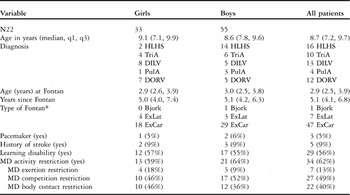
Demographic, medical, and surgical data are summarised in Table 1. All patients were New York Heart Association 12 class I (n = 34) or II (n = 12). There was one child whose echo-reported ventricular function was reasonable, one with mildly decreased ventricular function, and all other patients (n = 44) were reported to have good ventricular function. Echo-reported ventricular function and New York Heart Association class were not available for nine patients followed up outside our institution. There was a higher proportion of boys – that is, 33 of 55 or 60% – in this study than the published normative sample,Reference Ulrich 7 which is typical of the post-Fontan population. Family income, rural versus urban location, and parent education were similar between the patients in this study and the normative sample (p > 0.10). Parents reported that 56% – that is, 29 of 55 – of patients had a learning problem. A majority of the children – that is, 34 of 55 or 62% – had cardiologist-imposed activity restrictions, primarily for body contact – that is, 22 of 55 or 40% – or competitive sports – that is, 27 of 55 or 49%. The gender – 8 girls and 15 boys – and age – 8.2 plus or minus 1.5 years – distributions of children who refused study participation were similar to that of the patients included.
Demographic, medical and surgical data for patients in this study.

DILV = double-inlet left ventricle; DORV = double-outlet right ventricle; HLHS = Hypoplastic left ventricle; PulA = pulmonary atresia; TriA = tricuspid atresia
*Bjork = AV connection or Bjork procedure; ExLat = external lateral tunnel; ExCar = extracardiac conduit.
Gross motor skill
Total motor percentile scores were within the normal range (median: 42, interquartile range: 16–79), with 33 of 55 (60%) scoring below the 50th percentile. Median locomotor and object control percentile sub-scores were 50 for all patients (interquartile ranges: 25–84 and 16–75, respectively). The total (median: 65, interquartile range: 27–84), locomotor (median: 69, interquartile range: 37–84) and object control (median: 75, interquartile range: 25–84) scores of the female patients were within the normal range (p > 0.10). However, the total (median: 27, interquartile range: 12–65) and object control scores (median: 25, interquartile range: 16–63) of the male patients were significantly below (p = 0.04) expected values, with normal range locomotor scores (median: 37, interquartile range: 25–75, p = 0.53).
The four boys and two girls who were classified as very sedentary – that is, less than 30 minutes of moderate-to-vigorous activity per day – had skills significantly below age-expected values (r = −0.37, p = 0.005) and locomotor skills below other patients (r = −0.35, p = 0.01).
Age-equivalent gross motor skill
For girls, locomotor (median: +0.36 years, interquartile range: −1.2 to 1.7 years) and object control (median: +0.21 years, interquartile range: −0.8 to 1.7 years) skills were age-appropriate. Locomotor skills were also age-appropriate for boys (median: −0.58 years, interquartile range: −2.0 to 1.1 years). Object control skills were 1.1 years (interquartile range: −2.1 to −1.1 years) below expected levels (p = 0.05) for boys.
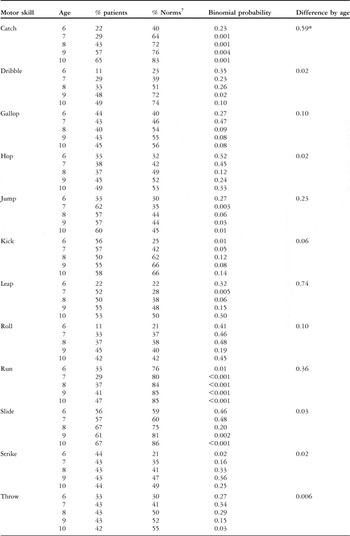
The age of motor skill mastery (perfect score on all criteria) differs by skill complexity and gender. The patients were less likely (p < 0.01) to demonstrate mastery of running and catching at all ages (Table 2). Skill mastery was similar to published data for hopping, leaping, striking, kicking, and rolling. Jumping, sliding, and throwing skills were similar at the youngest age, but skill delays increased with age (p < 0.05), being significant at ages 7, 9, and 10, respectively.
Comparison of the proportion of children demonstrating skill mastery by motor skill.

*Linear regression of age with difference between study patients and normative data
Demographic factors associated with gross motor skill
Boys and children with more complicated medical histories had lower gross motor scores (Table 3). Older children or those with more complicated medical histories had skills equivalent to significantly younger children (p < 0.05). Children categorised as having a more complicated medical history were those who required a pacemaker (n = 4), children whose Fontan completion was delayed until after 6 years of age (n = 5), or those who had another disability in addition to the heart problem (n = 3, arthrogryphosis, autism spectrum disorder, hearing impairment). We also included in this group one child who did not participate in physical education at school and one child whose father had to leave the hospital during the child's physical activity test because of extreme anxiety, as these factors might be expected to impact the child's motor skill development.
Demographic factors associated with gross motor skill.

TGMD-2 = Test of Gross Motor Development – Version 2
*Thirteen children who had a pacemaker (n = 4), repair after 6 years of age (n = 5), another disability (n = 3), no physical education at school (n = 1) or extreme parental anxiety about exercise (n = 1)
**Comparison to six children who were restricted by their cardiologist to physical activity within “comfortable limits”
***Discrepancy between the child's age and the typical age of a child who achieves the same locomotor score
****Discrepancy between the child's age and the typical age of a child who achieves the same object control score
Clinical status indicated by New York Heart Association class or history of ventricular dysfunction was not correlated with locomotor or object manipulation skill or overall gross motor development (p > 0.50). None of the measures of cardiac function contributed significantly to the multi-variable models (p > 0.15).
Activity perceptions and gross motor skill
Children who participated regularly (r = 0.35, p = 0.01) or reported doing well (r = 0.34, p = 0.006) on sports teams had better object control skills than expected for their age. Children involved in lessons/sports had better locomotor (r = 0.42, p = 0.002) and object control (r = 0.32, p = 0.02) skills, and scores that were better than expected for age. Those who prefer active discretionary pursuits (r = 0.39, p = 0.004) and outdoor play on weekends (r = 0.37, p = 0.01) had better locomotor skills and skills above that expected for age (r = 0.38, p = 0.007 and r = 0.36, p = 0.008, respectively). Children who perceived family/peer expectations for activity had better locomotor skills (r = 0.35, p = 0.01).
Multi-variable models of gross motor skill
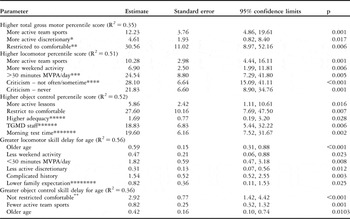
Separate models were developed for total gross motor, locomotor, and object control percentile scores, and locomotor and object control chronological/expected age differences (Table 4). These models account for 35–56% of motor skill score variability.
Multi-variable models for gross motor skill after Fontan.

MVPA = moderate-to-vigorous physical activity; TGMD = Test of Gross Motor Development
*Child reported preference for pursuits during discretionary time
**Children who are/are not restricted by the cardiologist to activity within “comfortable limits”
***Child performed >30 minutes of moderate-to-vigorous physical activity daily, measured over 1 week by omnidirectional accelerometer
****Children's report of how frequently parents criticise their physical activity participation, reference to criticism reported as often or very often
*****Child self-report of activity ability as measured by the Adequacy sub-score of the Children's Self-perceptions of Adequacy and Predilection for Physical Activity scale
******Difference in scores based on staff member administering the Test of Gross Motor Development protocol
*******Time of the day that the Test of Gross Motor Development protocol was completed (children tested in the morning had higher scores)
********Child report of family expectation that child would be active.
More team sports and weekend activity, performing 30 minutes of activity daily, and having parents who seldom/never criticise the activity were associated with higher locomotor skill (p < 0.01). Higher object control skill was associated with involvement in physical activity lessons, higher perceived adequacy for physical activity, and being restricted to “activities within comfortable limits” (p < 0.03).
Older children were more likely to have locomotor and object control skills that were delayed for age (p < 0.01). Less active weekend and discretionary time, less than 30 minutes of activity daily, lower family expectations for activity, and a complicated medical history were associated with greater locomotor skill delay (p < 0.05). Object control skill delay was associated with fewer team sports (p < 0.01). Children who were not restricted to “comfortable limits” had object control skills expected for younger children (p < 0.01).
Discussion
Motor skill relative to peers
After Fontan, the patients had total gross motor skill scores within the normal range. These age-appropriate motor skills are consistent with research, using a test of functional independence,Reference Majnemer, Limperopoulos, Shevell, Rohlicek, Rosenblatt and Tchervenkov 13 that found communication and cognitive but not motor skill delays among preschool children with heart defects. Despite the fact that the total scores were within the normal range, this study identified significant delays for running and catching skills, which are the foundation of early childhood physical activity. In addition, jumping, sliding, and throwing skills were age-appropriate among young patients, but declined with increasing age. Our results suggest that parent reports of mild motor function delays among children after Fontan,Reference Goldberg, Schwartz and Brunberg 14 not identified by a functional independence measure,Reference Majnemer, Limperopoulos, Shevell, Rohlicek, Rosenblatt and Tchervenkov 13 are accurate. Increasing deficits with age are consistent with research demonstrating deficits for complex motor skillsReference Bjarnason-Wehrens, Dordel and Schickendantz 15 and motor performanceReference Holm, Fredriksen, Fosdahl, Olstad and Vollestad 16 among school-aged children with heart defects. Taken together, the results from this investigation and previous research suggest that children with complex heart defects attain basic gross motor skills, such as running and catching, at a later age than their peers, and continue to demonstrate deficits for more complex motor skills, balance, and manual dexterity as age increases. Parent reports of mild motor delays appear accurate.
Physical activity participation and motor skill
Team sports participation and active discretionary pursuits were associated with higher levels of gross motor skill. Better locomotor skills were associated with active weekend pursuits, low or absent activity criticism from parents, and participation in more than 30 minutes of activity daily. Longitudinal research is required to examine the cause of the decreased locomotor skill levels observed in this study. Delayed motor skill development may lead to more activity criticism from parents and more sedentary pursuits. More sedentary lifestyles and child perceptions of criticism may also lead to very low activity levels, which eventually result in decreased locomotor skills through lack of conditioning and practice.
Demographic and treatment history variables
Boys and children who have a complicated treatment history have lower gross motor skill scores resulting from lower than expected object control skills. These deficits could limit participation in peer play, particularly in the team sports associated with higher skill levels. Owing to the fact that boys are more likely to participate in team sports,Reference Eccles and Harold 17 the limited object control skills of the boys in this study would likely impact their involvement in formal and informal, for example recess, sporting activities.
Children with a pacemaker are restricted from body contact activities. Team sports, such as ice hockey or basketball, are discouraged in favour of individual pursuits such as cycling and swimming. The small number of children with pacemakers in this study (n = 3) had a higher rate of object control skill delay than the study group as a whole. Research is needed to confirm this finding in a larger cohort of children with pacemakers. If confirmed, this delay suggests a need to promote non-contact object control activities, such as bowling, golf, or badminton, to assist these children in developing age-appropriate object control skills.
Before Fontan completion, children with single ventricle have a right-to-left intracardiac shunt and increasing hypoxaemia with exercise, which reduces their exercise tolerance.Reference Driscoll and Durongpisitkul 18 Children whose Fontan was completed after 6 years of age would, therefore, have had very limited exercise capacity throughout the most formative years for motor skill development.Reference Klavora 19 Their limited exercise capacity may restrict their ability to practise skills to the same extent as their peers. Once motor skill development lags, motivation to participate typically declines,Reference Klavora 19 leading to a downward spiral of decreased activity and decreased motor skill. The expected outcome from such a sequence of events would be children whose motor skills are increasingly delayed as they get older, a result observed in this study.
Interestingly, six children, including four girls, restricted to activity “within comfortable limits” had significantly better object control skills, a finding that cannot be explained with the data from this research. Theoretically, children told to exercise “within comfortable limits” may choose (or be directed into) activities that rely on skill rather than cardiorespiratory function. Such activity selection, which would lead to preference for activities such as baseball or volleyball, may provide greater opportunities for object control skill development.
Implications for care and future research
Normative data for the Test of Gross Motor Development – Version 2Reference Ulrich 7 indicate that 60% or less of healthy 10-year-old children demonstrate mastery of galloping, hopping, leaping, jumping, striking, overhand throwing, and underhand rolling. These activities require sophisticated motor skills that are acquired and refined at an older age than more basic skills such as running, sliding, dribbling, and catching. Future research should examine motor skill development beyond 10 years of age to determine whether children after Fontan continue to perform acquired motor skills at an age-appropriate rate. These results also emphasize the importance of monitoring motor development among children after Fontan, and timely interventions to address potential delays. For young children, an emphasis on the acquisition of basic motor skills, such as running and catching, should be a priority to enable successful participation in physically active peer play.
Study limitations
In all, 23 families chose not to participate in this research. The motor skills of the patients who did not participate are unknown. It is often assumed that physical activity study patients are more active than non-patients, suggesting that motor skills among all children after Fontan may be lower than observed. In our experience, patients are often families concerned about their child's skill development who volunteer in order to benefit from potential interventions. In this latter situation, children in this study would have lower skill levels than the population of children after Fontan as a whole. This cross-sectional study could not determine the direction or presence of a selection bias among the patients who participated in this study.
The Test of Gross Motor Development – Version 2, a valid and reliable measure of gross motor development for children 3–10 years of age, assesses basic locomotor and object control skills. It does not assess sophisticated motor skills or factors affecting motor performance, for example balance or dexterity. We selected the Test Gross Motor Development – Version 2 because it assesses the motor skills that are essential to childhood physical activity. Previous research had suggested basic skill deficits among preschool children. The purpose of this study was to evaluate the basic motor skills of school-aged children to determine whether the deficits observed among younger children persist. Different measurement instruments would be required to evaluate more sophisticated movement patterns or motor performance.
Conclusion
These results suggest that children after Fontan may experience gross motor skill deficits during elementary school. Deficits in foundational skills, for example running or catching, are associated with more sedentary lifestyles. Boys, children with pacemakers, and those whose Fontan was completed after 6 years of age more commonly experience object control skill delays. Delayed locomotor skills were associated with the very low levels of daily physical activity that increase obesity, atherosclerosis, hypertension, and the risk of diabetes. Future research should investigate whether a rehabilitation intervention could provide these children with the motor skills needed for successful participation in active peer play. The potential for utilising advanced motor skill acquisition to increase physical activity participation via decreased cardiorespiratory demand should also be investigated.
Acknowledgements
This research was made possible through support from the Heart and Stroke Foundation of Ontario, Grant no. NA 5950 and the Canadian Institutes of Health Research (Doctoral Research Award for P. Longmuir).