Active shooter situations in the United States are increasingly frequent.Reference Jacobs and Burns1 There have been a myriad of concepts, opinions, and guidelines directed toward mitigating and responding to such an event. The basic counsel of these multiple iterations is to run from the perpetrator if circumstances permit, hide and barricade if running is considered unsafe, and fight for survival if one comes face-to-face with the perpetrator.2 This advice is usually feasible, as the potential victims strive to first save themselves and, hopefully, others. In the health care arena, however, there is an inherent conflict of duty versus survival for a health care professional (HCP) with regard to their moral obligation to protect the patients entrusted in their care and their own safety during an active shooter situation.Reference Enaba, Eastman and Jacobs3
The accountability of the HCP to both the patient and patient’s family during a life-threatening situation deserves deeper exploration. Accepting responsibility for the lives of one’s patient is a basic principle taught to health care students and accepted by most HCPs. However, to what extent? Should HCPs risk being a victim to protect the safety and well-being of patients?
The literature is sparse regarding the response of health care workers in active shooter situations. Several researchers advise that health care workers should place their own safety at the forefront of survival actions.2, Reference Enaba, Eastman and Jacobs3 Inevitably, patients and their families will look to the health care workers for assistance in these circumstances.
Research involving public and HCPs revealed that most believe doctors and nurses have a “special duty to protect patients, similar to the duties of police officers and firefighters…”Reference Jacobs and Burns1 Recent literature also recognizes there is no simple answer, implying HCPs should first consider themselves, while simultaneously attempting to care for their patients.Reference Enaba, Eastman and Jacobs3, Reference Warren, Bosse and Tornetta4 Yet, exactly how health care workers should accomplish that feat is unclear. This ethical conundrum recently has created an alternative strategy from “Run-Hide-Fight” to “Secure-Preserve-Fight.”Reference Enaba, Eastman and Jacobs3 Health care students, the next generation HCPs, are currently engaged in providing care for their patients as part of their training. With a minimum of experience and a maximum of idealism, how vulnerable are they when faced with an active shooter situation in the health care environment?
This study’s objective was to explore the clinical decisions that health care students would make if faced with an active shooter event while providing patient care.
METHODS
This cross-sectional study involved the distribution of a questionnaire to health care students at The University of Toledo.
Recruitment of Participants
All participating students (n = 245) were enrolled in 1 of the following programs: medicine (n = 87), nursing (n = 79), physician assistant studies (n = 39), respiratory therapy (n = 38), pharmacology (n = 1), or public health (n = 1). There were no exclusion criteria. Participation was voluntary.
Ethics
The study protocol received approval from the Institutional Review Board at The University of Toledo. Students were informed that the questionnaire was anonymous and would not impact their course grade.
Questionnaire
Data collected included age, gender, professional program, years of study, whether they were a victim of gun/knife violence, and whether they had prior active shooter training. The questionnaire contained case scenarios simulating 4 different patient (male and female) care situations. Participants had to decide what action to take when faced with an active shooter event (see Appendix). The scenarios varied by patient acuity level and presence or absence of family members. Within each scenario, the participant is located in the patient’s room when the perpetrator begins shooting. The participant must then choose 1 of the following actions:
a. Escape, and leave your patient to his/her own devices.
b. Escape, but tell your patient what he/she should do to protect herself/himself in the room.
c. Escape with the patient, helping him/her even though it will be slow-going due to his/her ankle injury.
d. Barricade the room with both of you inside, and prepare to use the resources within the room to fight the shooter if he/she attempts to enter.
e. Other:__________________________________________
An open-ended question followed each scenario, asking participants to provide rationale for their selected action.
Statistical Analysis
Data were analyzed using the Statistical Package for the Social Sciences (SPSS), version 24, for Windows (IBM Corp, Armonk, NY). Descriptive statistics for discrete variables were presented as frequencies and proportions. Chi-square tests for univariate analyses were conducted to identify associations between active shooter training and answer patterns.
RESULTS
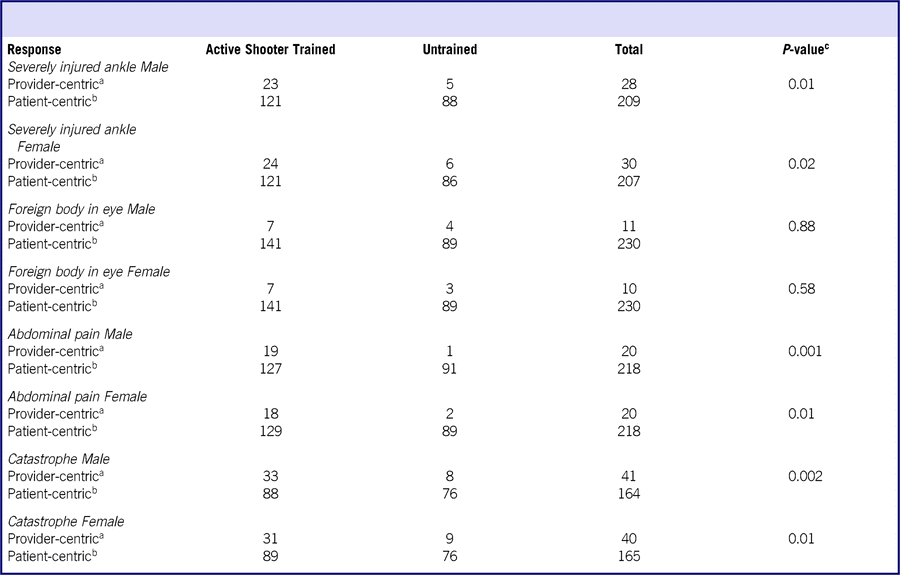
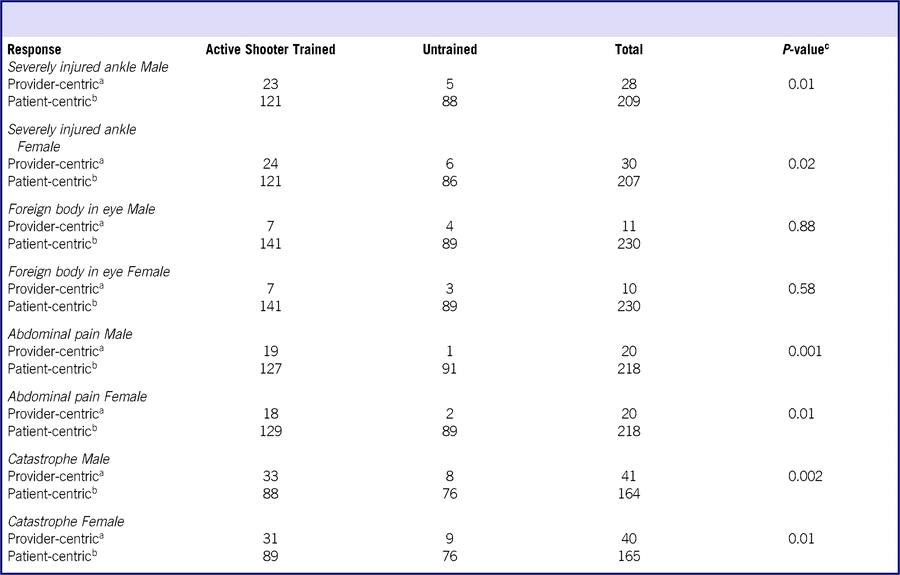
Of the 245 participants (167 females, 78 males), 11 (4.5%) indicated they had been a victim of targeted violence (gun/knife) previously; whereas 150 (61.2%) reported they had received prior active shooter training. In 3 of the 4 scenarios, a higher proportion of students who had received active shooter training chose to escape and leave the patient to his/her own devices (provider-centric) (Table 1). However, the majority of the 245 participants chose to barricade or escape with the patient, regardless of whether or not they had received training.
Health Care Student, Active Shooter Trained, and Untrained Comparison Responsesd
a Participant chooses to escape and leaves patient to his/her own devices or escape, and tells the patient what he/she should do to protect him/herself in the room.
b Participant chooses to escape with the patient or barricade with the patient.
c Chi-square P-value comparing observed and expected frequencies.
d Participants who chose “Other” were excluded.
For the male and female patients with a severely injured ankle sprain (scenarios 1 and 5), most respondents decided to barricade themselves and their patient in the room and be prepared to fight (patient-centric) (66.9% and 66.1%, respectively).
For the male and female patients with a mildly symptomatic ocular foreign body (scenarios 2 and 6), a bare majority of the respondents decided to escape with the patient (patient-centric) (55.5% and 55.9%, respectively). Barricading and preparing to fight (patient-centric), if necessary, was the choice for 38.4% and 38.0%, respectively.
For the male and female pediatric patients with fever and abdominal pain who was accompanied by 1 parent, the majority of the participants chose to hide, barricade, and be prepared to fight in the room with patient and parent (patient-centric) (scenario 3: 58.8% and scenario 7: 59.6%). Escaping with patient and parent (patient-centric) was the second most frequent option accounting for 30.2% and 29.4%, respectively.
For the comatose patient accompanied by a close relative (scenarios 4 and 8), the majority of the participants chose to hide, barricade, and be prepared to fight in the room with both patient and relative (patient-centric) (60.8% and 61.6%, respectively). A small proportion of students decided to escape alone, allowing the patient and relative to fend for themselves (provider-centric) (16.8% and 16.3%, respectively). Escaping with the patient and relative (patient-centric) was an option for 6.1% and 5.7% of the participants, respectively.
Patient gender did not influence decision-making, as 243 of the 245 (99.2%) made the same decision for both their male and female patients. Approximately one-third (82/245 = 33.5%) specifically stated in the rationale section that gender did not play a role.
Those who had received prior active shooter training were more likely to consider their own survival (provider-centric) compared with those who received no such training. Specifically, in scenarios 1 (ankle injury), 3 (pediatric abdominal pain), and 4 (critical, post-resuscitation), those participants who received active shooter training were more likely to “Run” without being encumbered by the patient (provider-centric). Those who did not receive such training were more likely to barricade or to escape with the patient (patient-centric). Only in scenarios 2 and 6 (ocular trauma) was there no statistically significant difference between trained and untrained students.
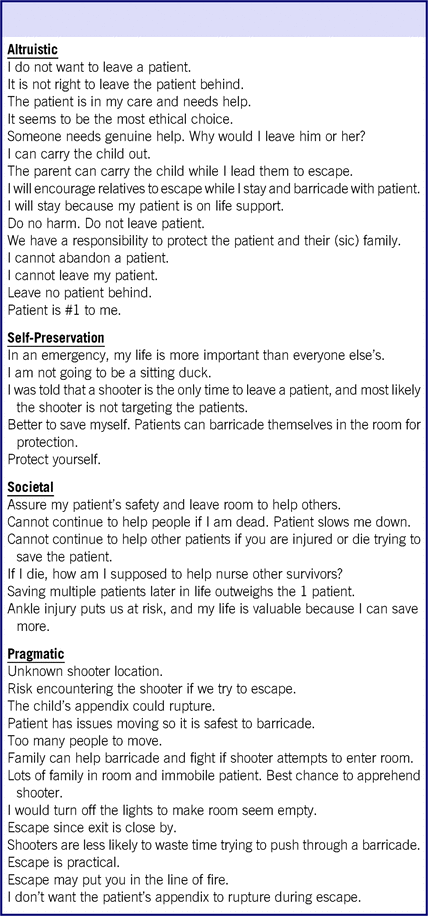
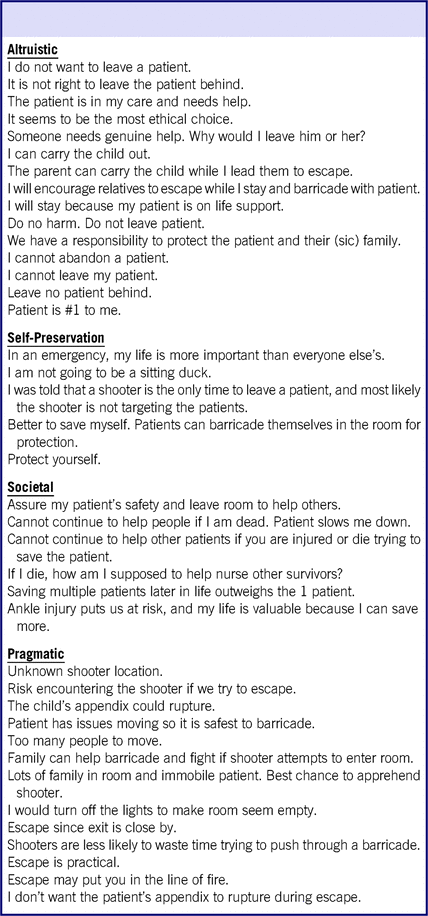
Participants were invited to rationalize their choices for each scenario (Table 2). There were 1582 (80.7%) individual responses out of a possible 1960. Because responses were voluntary and unlimited, there was no attempt to match responses to individuals. However, a thematic analysis of the decipherable comments revealed 4 general themes:
1. Altruistic
2. Self-preservation
3. Societal
4. Pragmatic
Response Themes and Selected Responses
DISCUSSION
To what extent should health care providers risk their own lives while caring for their patients? Patient abandonment by physicians has been documented from the Antonine Plague up to the present.Reference Bell, Dake and Price5 It has taken on new life in the 21st century with past and present challenges: severe acute respiratory syndrome (SARS), H1N1 (swine flu) pandemic, Middle East respiratory syndrome coronavirus (MERS-CoV), Zika virus, and weapons of mass destruction.Reference Bell, Dake and Price5–Reference Silva, Gibson and Robertson8 Professional consensus agrees there is a moral obligation to accept greater personal risk while rendering care. It is not absolute. The risk is dependent upon ill-defined circumstances at the time of the event and one’s value system.Reference Rega, Marco and Shears9
An uncomfortable percentage of HCPs will choose not to render care during an uncommon disaster, thereby fracturing the health care infrastructure.Reference Iserson, Heine and Larkin6, Reference Simonds and Sohol7, Reference Silva, Gibson and Robertson8 In a recent study specifically addressing active shooter situations, 62% of HCPs believed that they have a special duty to protect patients, whereas 27% of the same respondents indicated that doctors and nurses “should accept a high or very high degree of personal risk” to aid the most vulnerable.Reference Jacobs and Burns1 Because these subjects were asked theoretically, it is difficult to extrapolate their responses had they been given the same scenarios we gave our student participants.
We chose to analyze health care students specifically for the following reasons. They are:
1. In direct contact with patients during their clinical rotations
2. Imbued with, arguably, a heightened sense of duty to the patient
3. Relatively unfamiliar with each setting they rotate through
4. Naïve to the strategies and tactics associated with disaster management
Therefore, we consider students to be one of the most vulnerable health care workers during an emergency.
The results from this study indicate that a significant majority of interprofessional health care students are patient-centric in their response efforts to an active shooter situation. This attitude transcends the Run-Hide-Fight axiom and must be addressed by all health care educational institutions.
Considerations
Despite published guidelines that health care workers should consider their own safety first and to assist others as best as possible, a significant percentage of our student participants immediately considered their patients when barricading or escaping, thereby placing themselves at greater risk. However, a second cohort acted contrary to the “altruistic” group and considered their own safety first. The participants’ open-ended responses revealed 2 identifiable motives: (1) self-preservation and (2) survival to serve others in the aftermath.
Results indicate that students who had active shooter training were more likely to consider their own survival first and disregard the well-being of the patient. Consequently, the altruistic concept was more likely to be seen in those who were naïve to any prior active shooter training.
Unless training specifically focuses on health care infrastructural necessities, is consistent, and is mandated for all, there will be an inconsistency in actions of health care workers, which could have mortal consequences. Moreover, there could be a greater chance of guilt, recrimination, and stigmatization creating a division among patient-centric and provider-centric colleagues.Reference Benedek, Fullerton and Ursano10
It is ethically incumbent upon the health care institution’s leadership to develop and implement barricade and fight tactics for their personnel.Reference Rega, Marco and Shears9 It is intuitive to run, but barricading and fighting for survival are 2 unfamiliar actions to most individuals. The institution should be proactive in this endeavor. This is critical because, in the eyes of the lay public and those of health care workers, the provider has a responsibility, above all else (much like policemen and firefighters) to care for the patient.
Regarding mandatory health care active shooter training, experts should provide a comprehensive program that includes threat assessment, active shooter response, tourniquet training, ethical decision-making, and mental health recovery for everyone.Reference Simonds and Sohol7
Health care students are not yet HCPs. Should they be held to the same ethical, moral standards? This question requires further discussion and research.
Limitations
The participants were students, limiting the ability to extrapolate the study’s findings to the HCP. Repeating this study with an interdisciplinary group of HCPs would be beneficial. To minimize any perception of coercion, class attendance was not taken. Therefore, while some students may have elected not to take the questionnaire, it was perceived by the faculty that the number was minuscule. There was no attempt to ascertain which of the certified active shooter programs students may have attended. However, at this particular health care educational institution, only “ALICE Active Shooter Response” is promoted.
CONCLUSIONS
Active shooter events will remain a threat to the health care system. Comprehensive active shooter training should be mandatory for all HCPs. This training should include threat assessment, active shooter precepts, drills, tourniquet training, and mental health recovery. Health care students should also be mandated to receive similar training, and discussions concerning their moral and ethical obligations should be included.
Funding Source
This research received no grant from any funding agency.
Conflict of Interest Statement
The authors have no conflicts of interest to declare.
Author Contributions
All authors gave their final approval of this paper and agreed to be accountable for all aspects of the work. Ms McKenzie, Dr Sexton, Dr Fink, and Dr Rega contributed to the questionnaire design, acquisition of data, interpretation and drafting, and editing. In addition to these contributions, Ms McKenzie was primarily responsible for compilation and submission, Dr Fink was primarily responsible for the data analysis, and Dr Rega was primarily responsible for the conceptual design. Dr Wishner was primarily involved in questionnaire design and data acquisition, and Ms Saevig was primarily involved in data acquisition, interpretation, drafting, and editing.