INTRODUCTION: PUBLIC HEALTH POLICY AND THE FINANCIAL INDUSTRY
The U.S. Public Health Service (PHS) counseled health care regulators reviewing hospital investments in 1985 to prioritize projects forecasting high net revenues.Footnote 1 Such a policy favored building profitable specialty services marketed to affluent people. The PHS’s prioritizing of institutional financial gains over equitable service provision violated public health principles as well as the foundation of not-for-profit institutions. They were meant to offer public-interest alternatives to market-driven business, weren’t they? But proponents of the TINA mantra, “There Is No Alternative,” called the idea that medical care was different from other markets naïve and “pernicious doctrine.”Footnote 2 How did public health policy come to embrace such a perspective?
Health policy guides the allocation of capital to activities that manage and prevent illness. In the twentieth century, the United States experienced recurrent maneuverings among policy leaders seeking a variety of goals. Financial firms and other capital sources sought to increase the value of their invested capital. Medical specialists and hospital administrators sought to build bigger, more highly equipped institutions. Government agencies and political action groups arose to support these objectives or, alternatively, to pursue distributional justice and medical effectiveness. They all maintained that their actions would make a better health care system.
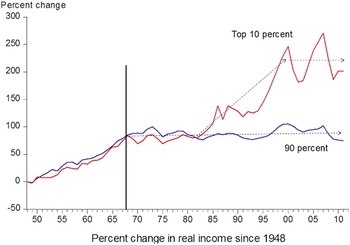
The Great Society of the 1960s signified an important, if politically pragmatic, outburst in government activities designed to improve the health and welfare of the citizenry. Although the postwar years had produced steady growth in real income, as Figure 1 illustrates, civil rights, antipoverty, and feminist movements taught Washington leaders that the nation’s prosperity was not equally shared. Subsequent programs used the rising economic standards of the time to augment their more equitable distribution. Not long afterwards, however, bipartisan market-oriented policies reversed Great Society aspirations (which had political enemies from the beginning).Footnote 3 When growth in production, employment, and income leveled out in the 1970s and the financial services industry gained in political power over manufacturing, it actively aided efforts that reduced social welfare expenses and increased the concentration of wealth, also seen in Figure 1.
Three U.S. Wealth Eras: 1. 1948–1967: Equitable Growth in Real Income; 2. 1968–1982: Income Stagnation for All; 3. 1983–2000: Income Growth for Only the Top 10%
Source: John B. Taylor, “Economic Freedom for All,” Economics One, March 19, 2013. Based on data from Emmanuel Saez.

Scholars and reformers have scrutinized the central role of the finance industry’s insurance sector in formulating the health care reimbursement system and closing off alternatives to it.Footnote 4 Yet the critical influence of the financial system’s investment sector (banking and the stock and bond markets) on policies shaping medical institutional development—the contribution of the present paper—has been far less examined. For example, a leading textbook on economic perspectives of health policy promotes market “solutions” without accounting for the role of organized finance in creating the problems needing to be solved.Footnote 5 The financial industry achieved substantial control over health care delivery and policy by selling debt instruments to medical providers and market ideologies to political leaders.
This article explores how government regulators, hospital administrators, medical specialists, and finance executives collaborated in expanding the capital and clinical intensity of hospital services. Together they crafted policies that favored investments in capital assets (plant and equipment) that generated value solely in terms of future earning power. The financiers advised regulators and administrators to apply management methods that converted hospital specialty services into profit centers treating well-insured people. They appreciated the role of debt in increasing hospital capitalization and in obliging not-for-profit facilities to perform like for-profit businesses.
I join several other scholars in applying the term gentrify to the process—if not necessarily the intent—of building high-cost medical services and pricing underinsured people out of the health care market,Footnote 6 and I further show how the financial industry promoted and public health policy adopted its features. The verb emphasizes that health care inequality is not just a matter of disparate access to services, which is harmful in itself, but that it is a result of preferentially building lucrative services marketing surgical and technological procedures to wealthier people in place of basic medical care for all. My investigation of how policy abetted this process builds on a diversity of scholarly work.
A growing body of historical study has shown how business and its operational models structured twentieth-century medical care.Footnote 7 In many ways, its institutional growth mirrored the transformations that constructed highly capitalized industrial production complexes.Footnote 8 Public policy aided that transformation. Progressive Era business leaders turned to government planning to strengthen what they saw as a natural evolution of capitalist economies from entrepreneurial to corporate organization.Footnote 9 They defined the primary function of government as supporting private property, enforcing contracts, and protecting credit.Footnote 10 For the remainder of the century, business and its think tanks formulated business strategies as conservative philosophy and actively shaped public policy.Footnote 11 Although the 1970s and 1980s would see major financial effects on medical delivery and policy, there were significant antecedents.
CAPITAL ALLOCATION AND MEDICAL CENTER DEVELOPMENT: 1900–1960
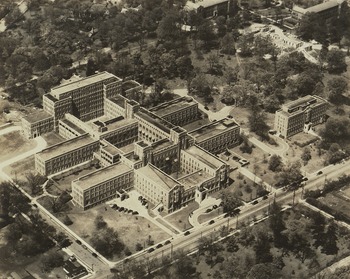
Capital allocation was a critical force forging twentieth-century medical care. Founders integrated large accumulations of nineteenth-century industrial wealth into new academic medical centers. Philanthropists—private donors choosing to construct imposing, often eponymous, edifices with tax-deductible bequests in place of public budgeting of tax payments—joined with administrators at elite universities to create institutions that amalgamated medical treatment and nursing care with teaching and research. Consolidating small hospitals and clinics, they often concentrated capital in specialty departments placed in separate wings or buildings. The 1910 Carnegie Foundation-supported Flexner report planned a national network of such centers modeled after Johns Hopkins’, and Rockefeller money financed many of them.Footnote 12 Shipping magnate and railroad investor Cornelius Vanderbilt, who previously built Grand Central Station, developed the massive Nashville complex seen in Figure 2.
Aerial View of Vanderbilt Medical Center Campus, ca. 1938
Source: Photographic Archive, Series 4, Subseries B, Folder 2, History of Medicine Collections, Eskind Biomedical Library, Vanderbilt University, Nashville, TN.

The financial industry had matured in the nineteenth century in backing capital-intensive industries and innovating accounting methods to manage and conserve their capital.Footnote 13 Men [yes, they were male] who had accumulated wealth as commodities traders set themselves up as financiers on Wall Street. As bankers, they often took leading roles in managing the companies they financed, garnering huge fees and immense power in the process. Their firms shaped the nation’s economic system by financing the mergers and acquisitions that created the modern corporation.Footnote 14
The highly capitalized medical centers with high fixed costs were expensive to operate. Excluded from tax support and proprietary ownership, the voluntary, not-for-profit hospitals had to rely on income from invested endowments, hope for ongoing philanthropy, or build services that generated revenue. Hospital business managers strove to invest their monies in projects that generated more capital.Footnote 15 Many academic centers followed Hopkins [at least partially] in developing “full-time” faculty practice plans. The income-generating plans called for financial accounting methods that could manage their revenues and measure which services were the most efficient—that is, yielded monetary outputs greater than inputs.Footnote 16
The American Hospital Association (AHA) Chart of Accounts entrenched financial rules in hospital management starting in 1922. As chairman of AHA’s Advisory Committee on Accounting, author of the first major financial study of the nation’s hospitals, and leader of the 1927–1932 Committee on the Costs of Medical Care (CCMC), Certified Public Accountant and economist C. Rufus Rorem pioneered finance-based hospital planning.Footnote 17 Although often portrayed as nonnormative, accounting methods built in capital investment strategies and were inherently prescriptive.Footnote 18 They channeled capital into the highest-revenue-producing departments—irrespective of managers’ personal goals or measured patient needs.
The private, blue-ribbon CCMC, more widely known for advocating wider availability of modern medicine to “patients of moderate means,” focused much (if far from all) of its attention on capital allocation. Capital Investment in Hospitals, Crisis in Hospital Finance, and other publications advised hospitals to use business accounting methods to direct their capital expenditures.Footnote 19 Large investments, the reports cautioned, could be justified only if they built services used at maximal capacity.Footnote 20 Presaging voluntary efforts and public health planning, CCMC reports envisioned regional coordinating councils that controlled hospital capital investments. The final report anticipated partnerships between medical professionals and owners of capital, delegating financial responsibilities to the owners.Footnote 21
Applying rules of private finance to publicly supported hospitals after the war, the AHA reinforced the use of accounting methods in hospitals partially funded by the 1946 Hospital Survey and Construction Act (aka Hill-Burton program). Administrators and board members of hospitals receiving Hill-Burton funds held a “sacred duty,” an AHA commission noted, to conserve the value of the capital invested in their institutions. It further advised that large, highly capitalized medical centers best achieved such a conservation.Footnote 22
The private health insurance system of the 1950s fueled competitive growth of community and academic hospitals and their specialty departments by paying itemized charges for their procedures. Many departments would grow into lavish, high-tech specialty centers. By the end of the decade, ironically—but not surprisingly—the Public Health Service identified “duplication of highly specialized and expensive facilities and services” as a major policy problem.Footnote 23
DRIVING AND CONSTRAINING HOSPITAL GROWTH: 1960s
Concerns about excessive costs of specialized services reached a tipping point in the 1960s when hospitals added the latest cobalt “bomb” device to their radiotherapy armamentaria and government insurance joined private insurance in paying for its use.Footnote 24 Existing voluntary hospital councils could not control what many saw as wasteful competitive use of funds that might otherwise have gone to local business, and they sought regulatory mechanisms that could manage medical institutional investments.
Hospital councils and public health professors actively debated [and still do] whether the public utility regulatory model, which had controlled certain private industries as public services for over a century, was applicable to health care.Footnote 25 Applied initially to industries demonstrating scale economies and monopoly efficiencies, such as railroads and electric power, public utility regulation controlled prices, profits, and entry of new firms into the market.Footnote 26 To manage their programs, most states established quasi-independent commissions that did not threaten private ownership. The public utility dispute in health care was a struggle over whether the private sector or the public sector would control hospital capital allocation. When state commissioners had threatened to use their power over health insurance rates to limit hospital charges in the 1950s, Michigan Blue Cross devised a private regulatory approach that would spread into public policy.Footnote 27 It denied reimbursement for capital costs of new construction projects that had not demonstrated sufficient demand for them.
Finding its similar voluntary effort inadequate, Rochester, New York’s, Patient Care Planning Council, a business coalition headed by Eastman Kodak executive Marion Folsom, turned to the state in 1964 for authority to approve hospital construction projects in its region. Folsom, a former secretary of Health, Education, and Welfare in the Eisenhower administration, also chaired Governor Rockefeller’s Committee on Hospital Costs, which recommended that private planning bodies representing community power structures direct capital investments in their local hospitals.Footnote 28 Extending the Rochester process to the entire state, the Metcalf-McCloskey Act inaugurated the first Certificate of Need (CoN) program requiring state approval of hospital capital expenditures exceeding a defined dollar threshold. Although the word “need” may have raised public expectations, New York’s health commissioner announced he would adjudicate CoN applications solely on financial grounds.Footnote 29
The Medicare and Medicaid programs signed into law in 1965 significantly enhanced patient access to medical services by expanding the number of older and lower-income people covered by health insurance—although the programs built in discrimination by establishing Medicare as an entitlement program and Medicaid as a welfare program.Footnote 30 The programs also fueled hospital expansion unrelated to the needs of those populations. Policy leaders hoped that a federally sponsored health planning process might be able to control public expenditures as well as adjust hospital growth to community needs.
The federal Comprehensive Health Planning (CHP) program passed a year later sought to rationalize Great Society expenditures. Citizens’ groups celebrated its democratic principles and its affirmation that equal access to health care was a “basic right rather than an economic privilege.”Footnote 31 Many public health professionals joined up for these reasons—plus the fact that the program challenged organized medicine, provided interesting employment, and offered a potentially viable route to health reform.
But partnerships of businessmen and bureaucrats had historically shaped American social programs,Footnote 32 and CHP was no exception. Despite citizens’ hopes, business and professional organizations maintained substantial control over health care resource allocation. It was not public planning’s job to evaluate hospital capital expenditures, a hospital council leader admonished in a National Academy of Sciences study, but to reinforce private investment decisions.Footnote 33 Another council leader would observe that “major corporate contributors” had controlled health planning from the beginning.Footnote 34 Siding with the community, the Medical Committee for Human Rights published an exposé on corporate control of health planning in Philadelphia.Footnote 35
Comprehensive Health Planning and Certificate of Need collaborated with health care stakeholders and at the same time challenged their power. They shared a public utility view that “scarce, high-interest dollars” should not be used to duplicate high-cost institutions or services in a community.Footnote 36 But providing credit was becoming a powerful means of shaping medical care development.
GROWTH AND SIGNIFICANCE OF HOSPITAL DEBT FINANCE
Hospital borrowing linked medicine to finance and altered administrators’ perspectives. As John Moody, founder of Moody’s Investors Service—which along with other ratings companies played a key role in developing bond markets—had noted early in the century, financial markets made a property’s future earning power the measure of its value.Footnote 37 Financial consultants came to advise that preserving and improving hospital credit positions took precedence over other goals.
Not-for-profit hospitals ineligible to sell ownership shares on the stock markets turned to the credit markets when up-front costs of building new services and buying new technologies outgrew philanthropy and hospital reserves. Although financial institutions had long provided hospitals with mortgage loans, Blue Cross reinforced borrowing in the 1950s by reimbursing hospitals for interest payments and capital depreciation (decline in the appraised value of buildings and other fixed assets). Government followed Blue Cross’s lead in subsidizing hospital debt and added loan guarantees, loan insurance, and tax exemptions.
A joint AHA/U.S. Public Health Service report suggested in 1961 that hospitals borrow money to purchase costly open heart surgery devices and X-ray machines.Footnote 38 Investment banks joined the hospital industry in lobbying state legislatures to authorize bond offerings of nonprofit hospitals and to exempt the bonds from taxes.Footnote 39 The states generally ignored Internal Revenue Service directives to revert property titles to public entities upon debt repayment.Footnote 40
Hospital bonds significantly augmented the role of finance in organizing medical delivery and in choosing which services to build. A “veritable stampede” of banks and financial management firms charged into the hospital debt business, particularly after Medicare reimbursements covering debt service costs reduced the risks of lending to hospitals.Footnote 41 Most of the debt instruments on offer were revenue bonds, which, unlike general obligation bonds, speculate on future income streams from the services they build to pay off the loans. Revenue bonds pressured hospitals into following AHA advice to preferentially build services expected to show high operating margins.Footnote 42
Many Comprehensive Health Planning agencies reinforced AHA’s advice. For example, Southern New Jersey’s CHP advised its staff and committee members to evaluate local hospitals using financial analysis methods that identified hospital assets with the highest profitability ratios.Footnote 43 Agencies following such advice sanctioned selective approval of services expected to generate high net cash flows—excess of revenues over expenses—in place of those serving low-income people.
In contrast, Cleveland’s CHP raised questions about the costs of debt finance to society. The total cost of a $3.0 million project rose to $7.5 million, the agency cautioned, when banking, accounting, and insurance fees were added to interest payments.Footnote 44 This meant that patients and their insurers paid the additional $4.5 million directly to financial firms. Moreover, it was becoming evident that a $3 million project further generated $6 million in annual hospital operating expenses due to new fixed costs.Footnote 45
Hospitals became so burdened with debt service and overhead costs that they had to turn away less remunerative patients and borrow more money to build more revenue-generating services just to tread water. Financiers leapt at the opportunity to profit from nonprofit hospitals by selling their debt to wealthy investors, and armies of consultants sprang up to teach hospital administrators how to borrow more money.
Geoffrey Shields, lawyer and investment bank board member, edited the primer on how to issue tax-free bonds to pay for profitable hospital projects. The medical center’s Chief Financial Officer, Shields advised, first assembled a team of companies experienced in health care finance.Footnote 46 The selected investment bank would “quarterback” the bond issue—calling the plays and coordinating the players. The team also required an accountancy company, a financial feasibility company, and a law firm like his own to prepare bond issue documents and related CoN applications. The process of debt financing clearly raised total health care costs. An executive at Ernst and Whinney, the top financial feasibility assessment firm at the time, stressed the importance of ascertaining whether the proposed service would generate sufficient revenues to cover its principal and interest payments, brokers’ fees, and other debt service costs.Footnote 47
Blyth Eastman Paine Webber Health Care Funding executives enthused that debt financing was actively turning health care into business.Footnote 48 Banks underwriting bonds recruited hospitals seeking to enhance the high end of their service mix as well as those considering corporate restructuring. Blyth Eastman and William Blair and Co. bankers advised nonprofit hospital administrators to spin off their more lucrative services into hospital-owned, for-profit units. Such units, they advised, built equity, developed new sources of revenue, and gained broader shares of specialty and/or geographic markets. As an added benefit, corporate restructuring insulated the reorganized services from hospital rate review (see next section), avoided CoN, and skirted around zoning and land use regulations.Footnote 49
The ratings companies bolstered the hospital bond market and strengthened investor confidence (often undeservedly) by grading hospitals according to projected repayment capacity. Moody’s and Standard & Poor’s gave bonus points to regional referral centers offering “higher,” more technologically intense levels of care and those demonstrating “market dominance or monopoly.”Footnote 50 Actual bond ratings, as Blyth Eastman reported, mirrored rating criteria and reinforced hospital hierarchies. Large, highly equipped medical centers with high cash flows; high proportions of board-certified staff; high specialty service utilization; high bed occupancy; high market shares; and low proportions of Medicare, Medicaid, and uninsured patients received the top ratings (and lowest interest rates).Footnote 51
Borrowing became the fastest growing source of hospital capital. Debt financing of hospital construction escalated from 40% in 1968 to 70% the following decade.Footnote 52 Debt finance taught health care providers to follow financial rules. Many lenders insisted that hospital administrators sign covenants vowing to maintain stipulated financial ratios and to prioritize debt service payments when budgeting revenues. In summary, debt multiplied provider costs, patient inequalities, and a widely perceived oversupply of specialty services. Nonetheless, health policy became even more linked to finance in a rapidly evolving economic environment.
REGULATION VERSUS MARKETS: 1970s
The 1970s were pivotal. The financial system grew to dominate the U.S. economy as the country’s postwar manufacturing boom waned and investment opportunities in it declined.Footnote 53 Business had discouraged public economic planning, and private industry had not built the infrastructure needed to keep up internationally.Footnote 54 On top of that, OPEC turned off the tap of the cheap foreign oil that had subsidized production. In response to the economic downturns combined with rampant inflation, business and government turned to planning.Footnote 55
After the Nixon administration’s wage and price controls ended, individual states during subsequent administrations tried to reduce hospital cost inflation by creating rate review programs—another element of the public utility regulatory model that participants partially accepted. Hospital administrators agreed that price regulation helped protect them from inflation and destabilizing competition. Lenders appreciated that approved prices factored in debt service obligations.Footnote 56 Extending to 35 states at most, state rate review programs ranged widely from setting mandatory rates across all payers to settling for financial disclosures.Footnote 57 Many were short-lived; by 2022, every state save Maryland had abolished hospital rate regulation in the face of vigorous lobbying in favor of markets.
The American Enterprise Institute for Public Policy Research (AEI) pioneered the use of academic studies to endorse free markets and repudiate public policy. The AEI’s 1972 conference on regulating health care construction drew “battle lines,” as one participant put it, between government regulation and private enterprise.Footnote 58 Conference organizer Clark Havighurst, Duke University law professor and AEI scholar, identified the market as the ideal model for health care delivery and the “primary allocator of capital in the health care sector.”Footnote 59 Havighurst advocated eliminating CoN for proprietary hospitals [only], holding that they were already subject to market discipline. However, market ideology had not yet strongly penetrated political strategy, and attempts to abolish CoN were not successful at that time.
Certificate of Need regulation offered health policy leaders a locally malleable way to direct hospital growth, and it offered hospital administrators relief from pressures to add costly services just to keep up with their competitors. These factors may explain how CoN programs survived to 2022 in approximately (the numbers fluctuate) 37 states and jurisdictions. Congress fortified CoN in Section 1122 of the Social Security Amendments of 1972. Using debt-financed hospital growth as its point of entry, Section 1122 enabled states to withhold Medicare payments for interest on loans and depreciation of services not approved by designated state authorities. In assigning financial feasibility assessment of local hospital CoN applications to Comprehensive Health Planning agencies, Section 1122 schooled them in financial perspectives.
Many CHP agencies turned to business consultants to help them judge the potential economic viability of hospital projects applying for CoN approval. The consultants generally reiterated the lessons that investment bankers were teaching hospitals issuing bonds. When Philadelphia’s CHP brought in advisers from Lehman Brothers bank, the resulting study concentrated on debt financing and declared that health planning’s cost containment objectives stood in “direct conflict with the need to provide hospitals with adequate capital.”Footnote 60 This was striking advice to an agency charged with achieving those very objectives. Hospitals’ need for capital continued to weave throughout health planning, hospital rate review, and CoN. Business and academic consultants alike concurred that financial feasibility assessment required CHP agencies to apply accounting methods that evaluated hospital debt capacity (ability to attract and repay loans) and set patient volume goals at or above cost–revenue breakeven points.Footnote 61
Some advisors took the opportunity to champion markets over planning. When the New Orleans CHP turned to health management faculty at Tulane School of Public Health, the academicians told CHP staff and volunteers that planning needed to reinforce an “unhindered functioning of the free-enterprise economic model.”Footnote 62 This model, they advised, required assessing each clinical service solely by its operating margins and patient care activity per hospital asset. Hugh W. Long, first author of the New Orleans report, defined his academic mission as teaching students how to apply corporate finance techniques to nonprofit health care organizations.Footnote 63 “No investment decision should consider social good in the absence of attendant cash flows to the institution,” Long unambiguously advocated.Footnote 64 This advice, plus his calling it “misguided” to allocate capital according to social needs rather than those of capital preservation, reverberated throughout the public health establishment. More universities recruited more PhDs trained in economics, finance, and business administration to staff their public health schools. The new faculty supported a new planning system more attuned to finance.
A NEW PLANNING PROGRAM TAKES ON CAPITAL FORMATION
The National Health Planning and Resources Development Act of 1974 opened with the affirmation that equal access to quality health care at reasonable cost was a major goal and that disease prevention and primary care for medically underserved people were priorities. However, these issues were not among its primary interests. Instead, the new program aligned with finance to ensure the economic security of medical institutions.
A Blue Cross executive had advised in Senate hearings that it was essential to link government power to private finance in order to maintain the vigor of the private health care system. The 1974 law followed Blue Cross’s advice to integrate health planning and CoN in order to provide “teeth” to planning. The Blue Cross Association further attempted (unsuccessfully) to grant planning and CoN the authority to close unprofitable services and expedite hospital mergers.Footnote 65
Many other business organizations at the time favored a strong planning program collaborating with finance. The Washington Business Group on Health (WBGH) aspired to adding a recertification process to CoN, decertification of facilities identified as redundant, and extension of CoN review to all medical providers.Footnote 66 Health care “can’t be left to its own devices,” a Citibank vice president explained, “because it lacks the normal market influences.”Footnote 67 Big business—in contrast to small business—used planning and regulation to apply to health care its own anticompetitive model of restricting the number of producers in an industry and monopolizing its markets. Inadvertently in part, health planning fortified the financial industry’s influence on policy when federal agencies adopted capital formation as a critical issue.
Influential associations like WBGH and Business Roundtable, which employ the star power of celebrity CEOs to promote the interests of large corporations, had responded to the economic stagnation of the 1970s with a political agenda of capital formation.Footnote 68 They strove to increase capital investment in physical assets such as industrial plant and equipment, often with the aid of the financial community. The American Council for Capital Formation, founded in 1973 primarily to reduce corporate capital gains taxes, claimed credit for making capital formation part of the national discourse. Even Congressional Democrats, an AEI spokesman appreciated, could commit to capital formation.Footnote 69
Congress held hearings to garner expertise on why investment spending was not bouncing back as the current recession waned. Speakers testified that industry required more financial capital to achieve full employment [liberals] and to meet business needs [conservatives].Footnote 70 Financiers looked to health care—medical centers and their for-profit spin-offs in particular—to expand investment prospects. Walter Wriston, Chairman of Citicorp bank, reminded WBGH’s 1974 annual meeting of the opportunities that health care facilities offered in capital formation.Footnote 71
The financial and hospital industries were anxious about declining investments in hospital construction in the 1970s in terms of constant dollars.Footnote 72 Engaging with this concern, the new health planning program funded conferences, workshops, and publications featuring hospital capital formation. Conference participants included stakeholders from insurance companies, accounting firms, investment banks, hospital associations, university economics departments, business consulting firms, lobby groups, think tanks, foundations, government agencies, and (sometimes) medical associations.
Do we “want to encourage private capital to enter this field on a large scale?” queried Robert Blendon, vice president of the Robert Wood Johnson Foundation (RWJF), in a discussion at a 1976 federally funded conference on health care capital.Footnote 73 Many participants responded affirmatively, holding that hospitals required continuous investment in profit-making services in order to thrive in a competitive health care market. Goldman Sachs executives specified that commercial banks and insurance companies’ mortgage and investment departments preferred to capitalize high-tech hospital specialty units.Footnote 74 Conferees generally ignored the remarks of physician Kerr White, director of the United Hospital Fund of New York, who suggested that investors might want to be more cautious about putting their money on the many diagnostic, therapeutic, and rehabilitative procedures whose clinical benefits were not demonstrated.Footnote 75
Although many speakers at the 1976 conference did wish to facilitate entry of private capital into health care, they were divided on whether to manage investments collectively or leave them to individual investors in the marketplace. Supporting regulatory control, a vice president of Merrill Lynch, Pierce, Fenner & Smith brokerage firm joined the Goldman Sachs bankers in appreciating that CoN stamp of approval enhanced investor confidence in hospital debt.Footnote 76 Regulation was necessary to assure hospital creditworthiness and ability to repay debts, the Goldman Sachs executives further advised. They even hinted that more secure reimbursement systems—perhaps even national health insurance coverage for certified projects—could reduce interest rates and other financing costs.Footnote 77
At the same time, federal planning directors warned at the conferences and in reports that excessive capital formation could lead to oversupply and overuse of high-cost facilities.Footnote 78 However, other government-issued publications contradicted their warnings. The Public Health Service had already supported a manual instructing the planning program’s local Health Systems Agencies (HSAs) that they had a primary duty to serve as “custodian[s] of capital capability” of their geographic areas. Capital is property, the facilities development company writing the manual advised in its lesson on capitalist health care, and many planning efforts conflicted with hospitals’ need to conserve their capital. Seemingly promulgated by the federal government, such advice undermined regulatory goals to control hospital growth.
Regional technical assistance centers established by the federal planning program to train state and local health planners also boosted financial rules. San Francisco’s Western Center for Health Planning explicitly translated Tulane business economist Hugh Long’s work into instructions on how planners should reinforce hospital asset growth. Western Center authors reiterated Long’s advice that maximizing future net cash flows was hospitals’ only appropriate investment objective.Footnote 79 Such a goal called for maximizing service growth and utilization solely for economic gain. The Western Center also contracted with management consulting firm Booz, Allen and Hamilton to impress upon HSA executive directors the importance of sending their staff to the Center’s training sessions. Capital accumulation and economic growth directly improve health care quality and access, the consultant (erroneously) promised the directors.Footnote 80 Financial training instilled business tactics into health planning and left little room for alternatives. Financial ratio analysis taught planners and CoN staff to evaluate hospital services solely in terms of profitability, productivity, and returns on invested capital.Footnote 81 To the extent that staff applied these lessons to their work—and it varied considerably—they prioritized financial metrics over effectiveness, quality, and equality.
In 1980, the Public Health Service once again brought together representatives of numerous interest groups to weigh in on hospital capital formation. Federal staff introducing the conference again suggested that competition in the capital markets led to wasteful overcapitalization and inappropriate utilization of costly services. Hospital administrators again countered that their institutions needed help accessing more capital to invest in more services that yielded economic returns in order to survive in the marketplace.Footnote 82
The 1980 conference represented another occasion on which government regulators identified overinvestment in specialty services as a major problem and at the same time provided a platform for fostering capital formation—much of which occurred in specialty services. Providers seeking to improve primary care and facilities for underserved populations would have found little support. Although the conferences may be viewed as part of a process of bringing together dominant interests to hash out differences, highlighting capital formation strengthened the investment industry’s hand in allocating resources and amplified the voices of those who benefited from it.
Many health care professionals as well as bankers gained from expanding hospital capital formation. Following a long tradition of deferring to private expertise,Footnote 83 government bureaucrats had turned to hospital administrators and medical specialists for aid in implementing the 1974 law. Leaders from academic medical centers and specialist organizations advocated specialty-specific level-of-care and minimum-volume planning guidelines that privileged high-tech specialty services in large, tertiary-level medical centers.Footnote 84 In addition to welcoming their own personal and institutional economic gains, the leaders labeled such services as epitomizing the highest levels of medical quality.
The regulatory turn to capital formation acceded, if not always consciously, to the growing power of the financial services industry. Its investment sector’s core business was arranging credit for capital formation in productive institutions. The finance industry was not monolithic, however, it divided over capital formation. Each seeking to enhance its own control, its insurance sector sought to manipulate public constraints on hospital capital formation, whereas its investment sector sought to abolish them. The capital formation movement of the 1970s set the stage for the 1980s finance industry triumph, which employed free-market theory to control capital allocation in health care.
FINANCIALIZATION AS MARKET REFORM: 1980s
University of Chicago economist Milton Friedman’s 1962 book, Capitalism and Freedom, portraying competitive capitalism as the basis of economic, social, and political freedom, pervaded American politics only after big business used it to discredit government.Footnote 85 Corporate executives (particularly in the oil, auto, tobacco, and financial industries) together with aligned think tanks like the Cato Institute and the American Enterprise Institute cultivated academic economists legitimizing industrial deregulation.
Market proponents reverted to the basic, if never validated, economic axiom that competition for customers optimized the allocation of social resources. They applied familiar concepts of competition and market to markets for capital in addition to, and often in place of, markets for goods and services—making theories of efficient markets essentially theories of financial markets.Footnote 86 Eugene Fama and Merton Miller’s 1972 Theory of Finance denied any need for regulation when it proclaimed financial markets to be perfect.Footnote 87 The new financial axiom held that allocating capital to the most profitable services optimized its benefits.
A range of political leaders in the 1980s repudiated policy and strengthened financialization as market reform. In adopting market theories of the time, the Reagan administration sought to vanquish Marx, Keynes, and the welfare state (not to mention organized labor).Footnote 88 In so doing, the administration solidified the financial industry coup that appropriated power to allocate social resources.Footnote 89 Citicorp’s Walter Wriston agreed to chair the presidential Economic Policy Advisory Board and joined Treasury secretary Donald Regan, former chairman of Merrill Lynch, in the administration’s pursuits. Tax cuts along with deregulation, they promised, would free up sufficient investment capital to rescue the nation’s faltering economy. Although its policies vastly augmented private wealth, little of it was actually invested in national economic welfare—or in that of its people.Footnote 90 Instead, a rising conservative economic theory blamed government health and welfare programs for a capital formation crisis.Footnote 91
Duke professor Clark Havighurst credited David Stockman, director of Reagan’s Office of Management and Budget, with bringing the market to health policy in Washington.Footnote 92 Stockman had searched for an ideology that would permit “free men in free markets” to achieve “unfettered production of capitalist wealth,” as he later put it.Footnote 93 He became a self-identified disciple of Friedrich Hayek, who had equated economic planning with totalitarianism. Like many other disciples, Stockman ignored Hayek’s support for regulating worker safety, restricting industrial pollution, and ensuring a basic level of food and shelter for all.Footnote 94 Based on his own belief that the “welfare state notion of redistribution” was incompatible with wealth creation, Stockman incited the Reagan revolution because it fed the top income brackets and freed up private investment capital.Footnote 95
As junior congressman, Stockman had helped defeat the Carter administration’s 1977 attempt to cap hospital expenditures and had cosponsored amendments encouraging health planning to foster market mechanisms. Stockman exemplified his view in his “consumer choice” bill that would have offered different health insurance products to different customers based on what they could afford to pay. One of the benefits of such a competitive insurance system, Stockman enthused in the inaugural issue of Health Affairs, was that it minimized the income redistribution inherent in liberal health insurance plans. Planning programs to reorganize health care were unnecessary and even counterproductive, Stockman advised, as the right design would “emerge spontaneously from testing and experimentation in the market-place.”Footnote 96 (However, he did concede a need to ensure catastrophic coverage.) The emergent design, Stockman anticipated, would take the form of for-profit hospital chains.
Banks and other financial organizations were the market “forces” that opened health care to financial penetration. Although many market advocates promoted competition as cost-reducing, a 1982 investment bank report, Health Care Policy: The Crisis in Capital Formation, appreciated that competition would increase medical care capitalization and consequently raise prices. Specifically, Blyth Eastman Paine Webber Health Care Funding noted in its proprietary document, competition would “generate new requirements for capital to renovate outmoded facilities, convert beds and facilities to serve new markets, develop new technologies, and respond to competitive innovations from other providers.”Footnote 97
Despite their market rhetoric, however, neither the financial industry nor the Reagan administration supported actual price competition. The administration retained the Medicare program and proceeded to follow the logic of rate regulation to set its prices. In 1983 it adapted New Jersey’s use of illness categories defined by Diagnosis Related Groups (DRGs)—initially developed as an industrial operations research method—to set Medicare prices.Footnote 98 Designed to shift financial risk from government back to hospitals, the new reimbursement system reinforced Wall Street worries about hospital capital formation. A Health Care Financing Administration study might have exacerbated those concerns when it reported that state-based prospective reimbursement systems applying DRGs may have successfully reduced excessive capital formation in specialty services like heart surgery.Footnote 99
The RWJF commissioned Donald Cohodes, a Blue Cross executive, and Brian Kinkead, a public health professor transitioning to Bank of America, to investigate potential effects of DRG-based reimbursement. Their report, Hospital Capital Formation in the 1980s, expressed concern that hospital dependency on subsidized debt might lead to foreclosures if the DRG system lowered Medicare expenditures and debt service coverage. The RWJF report expressed further concern that financial industry involvement in health care led to medical institutional inequalities. Having accessed an investment banking document demonstrating that the corporate-owned hospital sector had flourished courtesy of greater access to capital, Cohodes and Kinkead cautioned that competition in the capital markets could severely damage hospitals serving low-income people.Footnote 100 Cohodes suggested in a separate paper that markets might not be able to meet all health care needs and that the country should develop national hospital capital formation policy.Footnote 101
However, the question of regulation versus markets became moot, as federal agencies and staff—some of them, at least—increasingly bought into financial strategies. “The new capital environment,” the U.S. Public Health Service’s Division of Planning overtly counseled in 1985, “requires hospitals to approach capital investment decisions with the same analytical discipline and the same underlying principal [sic] of value maximization that governs investment decisions in private industry.”Footnote 102 Financial principles like these rendered public policy superfluous.
State and local health planning agencies also blew with the winds of the capital environment. Many planners, particularly the growing numbers with economic training, leapt onto the market bandwagon. Although they did not necessarily abandon their values of equity and justice, they assimilated economists’ assertions that competition lowered costs and improved outcomes. The tenor of the times portrayed economic metrics as more rigorous, more prestigious, and indeed more manly than “soft” measures like meeting community needs.
However, government planners were not leading players in the drama. Although historian Evan Melhado attributed the “decline of public-interest policy-making” to [unidentified] planners,Footnote 103 actions of multiple agents in a changing economic environment tell a different tale. “Actual planning decisions,” historian Rosemary Stevens observed, “were being made through financial markets.”Footnote 104 Hospital executives and specialty physicians collaborated with bankers, financial consultants, and property developers in making the investment decisions that government agencies approved. Collectively, their actions infused financial values into national policy.
When the Reagan administration officially abolished health planning in 1986, it negated 1960s aspirations of rationally and democratically allocating capital in the health care system according to scientific evidence of effectiveness and population need. But it made little difference in practice. Augmenting the 1970s swerve back to markets, the administration had already instructed the Public Health Service to develop market-oriented policy. To name just one example, the National Center for Health Services Research (NCHSR)—which had previously disseminated studies questioning the efficacy of many medical procedures—announced upcoming studies of demand-side reforms like consumer cost sharing and supply-side reforms like eliminating unprofitable services.Footnote 105 When NCHSR staff rebelled against the new research agenda, the acting deputy director criticized earlier agency studies finding that competition raised total costs. The agency’s technology assessment role would become redundant, the deputy director further held, because under competition, medical organizations “will purchase the appropriate technology for their clientele.”Footnote 106 His advice implied building different services for different clientele on the basis of socioeconomic criteria.
However, NCHSR leaders acknowledged that they were having trouble finding market-leaning academic investigators to perform the kind of studies the administration sought. It seems likely that the government’s requests for proposals on competition accelerated hiring of faculty trained in economics and finance at public health schools to qualify for the grants on offer. Public health professors subsequently produced a profusion of papers promoting markets and trained a generation of professionals who further entrenched market precepts into health policy.
The finance industry gained further power by defining market rules and employing cohorts of lobbyists to propel them into law. Deregulation in favor of capital markets ceded to finance the power to steer health care development. Wall Street investment power, business school professor Patricia Arnold noted, became the new health planning.Footnote 107 Financial interests continued to dominate health policy and remodel American medicine. The capstone of the neoliberal market triumphFootnote 108 would be conversion of all nonprofit health care facilities to, or amalgamation with, corporate for-profit health care systems and elimination of efforts to quantify medical services based on effectiveness and population benefit.
FINANCIAL STRATEGIES, EFFECTIVENESS, AND GENTRIFICATION
Preferred investment in high-revenue specialty services created an unbalanced medical delivery system. For every 10 patients who needed tertiary-level specialty interventions, health services researchers estimated in the 1970s, 100 more needed general acute (secondary) care, and 720 needed primary care.Footnote 109 Many researchers concluded that the system was skewed with excess tertiary-level capacity relative to demonstrated efficacy.
Financial strategies drove the growth of high-tech specialties and use of their interventional procedures significantly beyond scientific evidence of effectiveness. “Unwarranted surgery,” charged Harvard public health school professor Lucian Leape in 1989, “represents a problem of staggering magnitude in terms of needless pain, suffering, and death, as well as a substantial waste of human and financial resources.”Footnote 110 Cardiac surgery, in particular, became a prime target for doctors and regulators seeking to reduce excessive medical intervention and capacity.
But cardiac surgery also served as a magnet for capital investment. Invention of the coronary artery bypass graft (CABG) procedure multiplied the use of open-heart surgery devices, and CABG expanded far beyond its demonstrated effectiveness and limited clinical indications.Footnote 111 Studies found that many patients experienced comparable outcomes—with much less pain and expense—with standard medical treatments. There were also considerable socioeconomic and racial inequities in the use of heart surgery.Footnote 112 The evidence does not indicate which patients not receiving surgery due to discrimination suffered and which benefited from less invasive treatment. The CABG growth abetted medical gentrification and provided an example that other specialties emulated.
Selectively channeling capital into profitable services for wealthier populations and intentionally raising expenditures and therefore costs gentrified medicine. It overfed medical center specialty departments and starved basic health care. It overtreated some patients and undertreated others. The inequities were structural. The medical delivery system constructed different services for different clientele based on class rather than epidemiology. It segregated patients by ability to pay and priced many of them out of the market. Because of the questionable efficacy of many medical procedures and the role of social determinants in creating unequal health status, however, flooding the system with sufficient capital to treat all patients at the widely perceived “highest” levels would, in all likelihood, not improve the health of most of them.
The gentrification business model severely damaged the capacity of American hospitals to treat patients who are acutely ill with infectious disease. The COVID-19 pandemic revealed the flaws of the nation’s investment in highly capitalized, profit-making specialty services at the expense of disease control, primary care, and general acute care. The year before COVID hit, U.S. hospitals depended on elective, often superfluous, specialty procedures for 75% of their revenues.Footnote 113 Tragically but hopefully, the crisis offers an opportunity to build a national health care system based on public interest values of demonstrated clinical effectiveness and population need.
CONCLUSION: IMPLICATIONS FOR FUTURE POLICY
A participant at a conference where I presented an earlier version of this paper complained of “doom and gloom.” Yet the described activities occurred, and they had consequences. Regulatory and market actions alike implanted financial principles into health care. Public health policy supported financial strategies and neglected population needs, capital sources shaped institutional development and formulated market rules, and the hospital industry became more profit oriented and more beholden to capital markets. As a result, health care became more expensive, more inequitable, and less appropriate. Collective head burrowing in the sand is not viable policy.
Historical investigation seeks to uncover the past so we may understand the present and ask better questions for the future. Instead of valuing health care services for their earning power, we should value them for their power to improve people’s health. This requires rethinking critical questions such as How can the nation reallocate capital according to health priorities and treatment effectiveness? How would such a system reapportion primary, secondary, tertiary (and now quaternary) care? Who should allocate the capital, and what is the role of democratic process? What are alternatives to requiring medical center departments to support themselves with service revenues? Should debt be part of their funding package, and, if so, should there be limits on type or quantity? Should government continue to subsidize debt financing? Should it regulate the financial services industry and the health care industry as public utilities? Should we continue paying hundreds of billions of dollars for medical procedures of undemonstrated clinical benefit? If not, (how) should hospitals survive? Should we surrender the concept of not-for-profit health care? How can health care become equitable and fair? Not only can the market not answer these questions; it does not even concede their legitimacy.
Market theories camouflage power. Policy in purely market economies is the sum of private investment decisions. Doctors choose to practice at the highest technological levels of their specialties. Hospital administrators choose to invest in such services to enrich the income and prestige of their institutions. Financial firms provide the capital, impose management rules, and embed those rules into public policy. The financial industry used previously signed loan covenants to demand that hospitals prioritize debt service commitments over services for desperately ill COVID-19 patients.Footnote 114
But past actions do not inexorably doom the future. The extent to which organized finance dominates health care delivery and policy is, and has been, a political choice. The nation can choose alternative ways to allocate resources, alternative forms of service organization, and alternative means of financing. Making such complex, difficult, and politically fraught choices requires organized governance structures and evidence-based decision-making processes. It calls for coherent policy making to replace market ideologies telling us that there are no alternatives to status quo inequities in health and wealth.