Introduction
In 2011, the global adult literacy rate for the population aged 15 years and older was 84% (UNESCO Institute for Statistics, 2013). Literacy rates vary according to region. Adult literacy rates are still very low in South and West Asia (63%) as well as sub-Saharan Africa (59%) where more than one-third of adults cannot read or write (UNESCO Institute for Statistics, 2013).
Many people with reading problems feel significant shame and hide their inability (Baker et al., Reference Baker1996; Parikh et al., Reference Parikh, Parker, Nurss, Baker and Williams1996). Shame and embarrassment often felt by illiterate individuals may lead to social isolation and pose a psychological barrier to overcoming stressful environments (Wolf et al., Reference Wolf, Williams, Parker, Parikh, Nowlan and Baker2007). It has been suggested that the negative feelings accompanying low levels of literacy could contribute to a high risk of developing depression. However, few studies have specifically examined the relationship between illiteracy and depression, and the results were conflicting (Gazmararian et al., Reference Gazmararian, Baker, Parker and Blazer2000; Wolf et al., Reference Wolf, Gazmararian and Baker2005; Weiss et al., Reference Weiss, Sheehan and Gushwa2009). One study reported that illiteracy is not independently related to the occurrence of depressive symptoms (Gazmararian et al., Reference Gazmararian, Baker, Parker and Blazer2000), while other studies showed that the individuals with poor literacy skills had a greater chance of developing depression (Wolf et al., Reference Wolf, Gazmararian and Baker2005; Weiss et al., Reference Weiss, Sheehan and Gushwa2009). Therefore, the putative association between illiteracy and depression has remained unclear and needs further investigation.
Some studies suggested that lower education levels are associated with more symptoms of depression (Beekman et al., Reference Beekman, Deeg, Geerlings, Schoevers, Smit and van Tilburg2001; Azar et al., Reference Azar, Murrell and Mast2005). However, there is a possibility that the amount of education may not be an accurate indicator of literacy. Thus, previous findings about the link between educational level and depression do not represent the true association between illiteracy and depression (Williams et al., Reference Williams1995; Baker et al., Reference Baker2002). In a recent study carried out in China, participants with more years of education were more likely to have major depressive disorders, suggesting that differences in ethnicity may also contribute to the impact of educational level on susceptibility to depression (Gan et al., Reference Gan2012). Therefore, more research is needed to further elucidate the association between illiteracy and depression.
We conducted the present analysis to explore the relationship between illiteracy and depression in community-dwelling elderly individuals. We also assessed the impact of illiteracy on the manifestations of depressive disorder symptoms. We adjusted for potential confounding factors of depression, including the presence of illness. We hypothesized that illiterate participants would experience greater depressive symptoms than literate participants, and the clinical features of depressive symptoms in illiterate individuals may represent their low self-esteem.
Methods
Participants and procedures
South Korea is a rapidly developing country, where, according to a national survey conducted in 2008, illiteracy rate in the population aged over 18 years is very low (1.7%) (The National Institute of the Korean Language, 2008). However, illiteracy rate in the aged population is relatively high. Among these individuals, 4.6% in their sixties and 20.2% in their seventies are illiterate, and represent citizens deprived of the chance for education during the World War II (1941–1945) and the Korean War (1950–1953).
Data for the current study were obtained from the Nationwide Dementia Epidemiology Study of Korea (NDESK), which was conducted from May 1 to December 31, 2008 to evaluate the prevalence and risk factors for dementia in South Korea. The design of NDESK has been previously described in detail (Kim et al., Reference Kim2011). The Institutional Review Board of Seoul National University Hospital (Seoul, South Korea) approved this study, and written informed consent was obtained from all participants.
The target population included eligible residents aged 65 years or older who had been listed in the updated 2005 population census at community registry offices. A multistage, stratified, cluster-sampling design was used for the investigation. The study was performed in two phases. The first phase comprised conducting screening interviews using the Korean version of the Mini-Mental State Examination (MMSE-KC; Lee et al., Reference Lee2002) administered by trained lay interviewers. All screening interviews were conducted face-to-face at the participants’ homes. For the second phase, selected participants from the first phase underwent confirmatory diagnostic interviews conducted by clinicians. Out of the 8,199 eligible respondents aged 65 years or older, a total of 6,141 completed the face-to-face screening interviews with trained interviewers (74.9% response rate).
In order to analyze the association between illiteracy and depression, we used data from five research centers (Yeoncheon-gun, Incheon, Daegu, Kwangju, and Jungnang-gu in Seoul, South Korea) where additional questionnaires, including ones surveying medical conditions, were administered during the screening interviews. The sample size drawn from the five research centers totaled 3,074 participants. Among these selected, 1,972 completed the interview (64.2% response rate). To exclude individuals with cognitive impairments, participants were grouped into high (seven or more years of education) or low (six or less years of education) education groups. Participants who scored below the fifth percentile on the MMSE-KC were also excluded from each group. These exclusionary criteria were based on the NINCDS-ADRDA Work Group's recommendation that a neuropsychological test score falling below the lowest fifth percentile of an individual's normal control group be designated abnormal (McKhann et al., Reference McKhann, Drachman, Folstein, Katzman, Price and Stadlan1984). A total of 1,890 participants were finally included in the analyses after excluding those who scored lower than the fifth percentile on the MMSE-KC within each educational group.
Demographic and clinical variables
For each participant, we gathered information about age, gender, years of education, marital status, cohabitants, economic status, occupation, and basic health-related habits (drinking, smoking, and regular exercise). If the participant drank one or more drinks per day, he or she was regarded as current drinker. If the participant currently smoked one or more cigarettes per day, he or she was regarded as current smoker. To investigate the exercise level, we used the question: “Do you regularly exercise these days?,” and the participants selected an answer among the following four items: “No,” “mild degree exercise (walking slowly),” “moderate degree exercise (walking rapidly, freehand exercise, etc.),” or “hard degree exercise (running, climbing, aerobics, etc.).” Those who selected one among the latter three items were grouped as “persons who exercise regularly.” Participants who were covered by the National Medical Aid program were regarded as the socio-economically disadvantaged group. Information about each of the following medical conditions was acquired using binary questions: hypertension, diabetes, dyslipidemia, cerebrovascular attack, and heart diseases (angina pectoris, myocardial infarction, arrhythmia, and heart failure). Presence of an illness was recorded if the respondent indicated that they were afflicted with any of the above-mentioned five conditions. Data about the participants’ medical conditions were confirmed by family members to minimize recall bias.
Participant literacy
A question about the participants’ reading ability was included in the part of the screening questionnaire designed to acquire demographic data. The participants who could not read at all or could read only several words were regarded as totally illiterate. Participants who could read simple information such as the words written on signs but could not read complex documents such as newspapers or books were considered partially illiterate. When the participants could obtain complex information from newspapers or books without difficulty, he or she was regarded as literate. Therefore, the participants were classified into three groups based on their reported reading ability: totally illiterate, partially illiterate, and literate. Totally illiterate or partially illiterate persons were comprehensively designated as the illiterate group.
Depression
The Korean version of the Geriatric Depression Scale – Short Form (SGDS-K; Bae and Cho, Reference Bae and Cho2004) was used to evaluate depression. The SGDS is a 15-item short version of the 30-item Geriatric Depression Scale (Sheikh and Yesavage, Reference Sheikh, Yesavage and Brink1986). Higher scores correlated with greater depression severity. In the present study, a cut-off score of 8 was used to detect depression.
Cognitive functions
The MMSE was developed to evaluate general cognitive function in a short period of time (Folstein et al., Reference Folstein, Folstein and McHugh1975). It is now widely used to screen for and evaluate dementia severity. The MMSE-KC was used in this study to rule out cognitive impairment of the participants.
Statistical analysis
Analyses were conducted using IBM SPSS Statistics for Windows (Version 21.0, Armonk, NY, USA). The χ 2 test was used to evaluate categorical variables, and an analysis of variance (ANOVA) was used for continuous variables. We conducted logistic regression analyses to determine the relationship between illiteracy and depression. In addition to illiteracy, age and gender (for adjusted model 1) along with other demographic and clinical variables (for adjusted model 2) that were significantly associated with depression in the unadjusted model were considered independent variables. In the adjusted models, we did not enter “years of education” as an independent variable because years of education is causally related to literacy level and adjusting for it may lead to an underestimation of the etiologic relationship between illiteracy and depression. To explore the clinical features of depression in illiterate people, we used logistic regression to calculate the odds ratios of positive responses (or negative responses to reverse-coded items) for each SGDS-K item using the literate group as the reference group. For all tests, p-values of <0.05 were considered statistically significant and adjusted using the Bonferroni correction procedure when necessary.
Results
Demographic and clinical variables
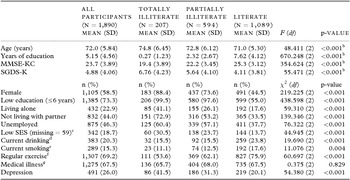
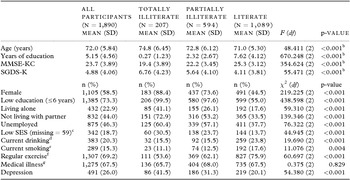
Demographic and clinical characteristics of the study participants are presented in Table 1. Approximately 40% of the respondents were totally (11.0%) or partially (31.4%) illiterate. The mean age of the participants was 72 years; this was slightly higher for the illiterate groups (totally illiterate group: 74.8 ± 6.45 years, partially illiterate group: 72.8 ± 6.12 years) than the literate group (71.0 ± 5.30 years). More than half of the participants were females (58.5%) and had less than six years of education (73.3%). The proportion of females in the literate group was less than half (44.5%), while it was over 70% in the partially illiterate group and nearly 90% in the totally illiterate group.
Demographic and clinical characteristics of all participants and the totally illiterate, partially illiterate, and literate groups (n = 1,890)a
Notes: SD: standard deviation; MMSE-KC: the Korean version of the Mini-Mental State Examination; SGDS-K: the Korean version of the Geriatric Depression Scale – Short Form.
aAnalyses were conducted to compare the characteristics of the totally illiterate, partially illiterate, and literate groups. χ 2 tests were used to compare categorical variables. Analyses of variance were used to compare continuous variables.
bScheffe's post hoc analyses revealed significant differences between the groups.
cParticipants who were covered by the National Medical Aid program.
dOne or more drinks per day.
eOne or more cigarettes per day.
fRegularly performing any exercise.
gThe presence of an illness was recorded if the respondents indicated that they were afflicted with any of the following diseases: hypertension, diabetes, dyslipidemia, cerebrovascular attack, and heart disease (angina pectoris, myocardial infarction, arrhythmia, and heart failure).
Illiterate persons were more likely to be socially isolated. For example, there were more illiterate persons living alone, not living with their partner, unemployed, or with a low socio-economic status than literate participants. Individuals with adequate literacy were more likely to exercise regularly than those with lower literacy. Two-thirds of the respondents had one or more illnesses, and the rates of morbidity were similar between the groups. Illiterate individuals were less likely to smoke or drink compared with individuals with good literacy skills. However, this may represent a lower rate of drinking or smoking among female participants whose literacy rate was much lower than that of male participants. In this sample, the drinking rate was nearly six times higher (39.6% versus 6.5%) and smoking rate was nearly 6.5 times higher (30.2% versus 4.7%) in males than in females. When we performed the same analyses stratified by gender to minimize the confounding effect of gender on the demographic and clinical characteristics of each group based on reading ability, the proportions of current smokers and current drinkers for both genders were the highest for the totally illiterate group followed by the partially illiterate and literate groups. While the rates of employment were significantly different between groups for male participants (totally illiterate group: 62.5%; partially illiterate group: 45.9%; literate group: 24.0%, p < 0.001), the rates of employment were similar between groups among female participants (totally illiterate group: 60.1%; partially illiterate group: 61.1%; literate group: 54.8%, p = 0.134).
Relationship between illiteracy and depression
Overall, about one-fourth (26.0%) of the study participants suffered from depression. The prevalence of depression in the female gender (28.6%) was higher than that in the male gender (22.3%). The prevalence of depression varied according to the level of literacy. Illiteracy was associated with increased severity of depression (mean ± SD: totally illiterate group = 6.76 ± 4.23; partially illiterate group = 5.64 ± 4.10; literate group = 4.11 ± 3.81; p < 0.001) in addition to higher prevalence of depression (totally illiterate group, 41.5%; partially illiterate group, 31.3%; literate group, 20.1%; p < 0.001). When we performed the same analyses according to gender, the results were very similar. In male participants, the mean score of SGDS-K was 6.88 ± 4.08 in totally illiterate group, 5.38 ± 3.84 in partially illiterate group, and 3.95 ± 3.84 in literate group (p < 0.001), showing increased severity of depression in illiterate groups. Prevalence of depression in the male participants was also higher in the illiterate groups than in the literate group (totally illiterate group, 45.8%; partially illiterate group, 29.9%; literate group 19.4%; p < 0.001). In female participants, the mean score of SGDS-K was 6.75 ± 4.26 in the totally illiterate group, 5.73 ± 4.18 in the partially illiterate group, and 4.31 ± 3.76 in the literate group (p < 0.001). The prevalence of depression in female participants was 41.0% in the totally illiterate group, 31.8% in the partially illiterate group, and 21.0% in the literate group (p < 0.001).
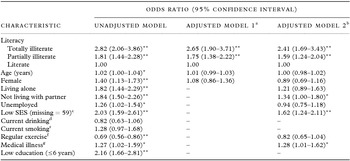
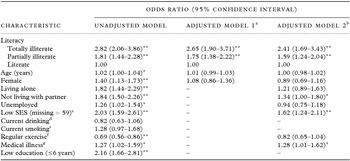
In the unadjusted logistic regression analysis, individuals with total illiteracy had 2.82 times the odds (95% Confidence Interval (CI), 2.06–3.86) of being depressed compared with individuals with adequate literacy skills (Table 2). The partially illiterate persons also had 1.81 times the odds (95% CI, 1.44–2.28) of being depressed than the literate participants. These associations between illiteracy and depression remained significant after controlling for age, gender (adjusted model 1), and other demographic and clinical variables (adjusted model 2). In the unadjusted model, age, being female, living alone, not living with a partner, unemployment, low socio-economic status, regular exercise, presence of an illness, and low education level were also significantly associated with depression. In the full model (adjusted model 2), individuals with total or partial illiteracy, not living with a partner, and having low socio-economic status or an illness had significantly higher odds of developing depression. No colinearity between independent variables was observed (variance inflation factors ≤ 2). When we tried the same analyses using cut-off points other than 8 (i.e. 6, 7, and 9), the results were similar, showing the robustness of the association between illiteracy and depressive mood.
Odds ratios for depression symptomatology (SGDS-K ≥ 8) among study participants (n = 1,890)
Notes: SGDS-K: the Korean version of the Geriatric Depression Scale – Short Form.
*p < 0.05, **p < 0.01.
aControlling for age and gender.
bControlling for age, gender, cohabitants, marital status, employment status, socio-economic status, regular exercise, and the presence of illness. “Low education” was not included as an independent variable because this factor may cause an underestimation of the etiologic relationship between literacy and depression. Two other variables (drinking and smoking) that were not significantly associated with depression in the unadjusted model were omitted from the multivariate analysis.
cParticipants who were covered by the National Medical Aid program.
dOne or more drinks per day.
eOne or more cigarettes per day.
fRegularly performing any exercise.
gThe presence of an illness was recorded if the respondent indicated that they were afflicted with any of the following diseases: hypertension, diabetes, dyslipidemia, cerebrovascular attack, and heart disease (angina pectoris, myocardial infarction, arrhythmia, and heart failure).
Association between education level and depression
In order to investigate in more detail the association between education level and depression we carried out several analyses. We performed logistic regression analysis in the literate individuals to determine the relationship between low education level (≤6 years of education) and depression. In the literate group, individuals with low education had 1.70 times the odds (95% CI, 1.25–2.31) of being depressed compared with individuals with a high education level (p = 0.001). The magnitude of the association between low education and depression in the literate group was smaller than that in all participants, including illiterate individuals (OR = 2.16, 95% CI = 1.66–2.81, p < 0.001). When we adjusted for years of education (as a continuous variable) in the logistic regression analysis of literacy for depression, total illiteracy still showed significant association with depression (adjusted OR = 1.77, 95% CI = 1.21–2.60, p = 0.003) but partial illiteracy showed a trend for depression without significance (adjusted OR = 1.29, 95% CI = 0.98–1.71, p = 0.069). When we adjusted for years of education together with other variables (adjusted model 2), total illiteracy showed significant association with depression (adjusted OR = 1.68, 95% CI = 1.12–2.52, p = 0.012), while partial illiteracy did not show a significant association with depression (adjusted OR = 1.22, 95% CI = 0.91–1.63, p = 0.181).
Clinical presentation of depression in illiterate participants
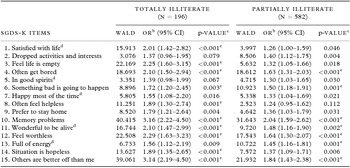
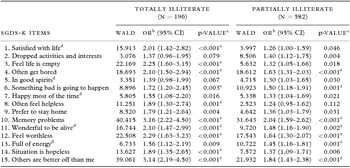
The illiterate elderly individuals were at increased odds of responding negatively to the majority of SGDS-K items (Table 3). Individuals with total illiteracy skills had more than three times the odds of “having memory problems” or stating that “others are better off than me” compared with the literate participants even after controlling for various demographic and clinical factors. Individuals with partial illiteracy skills also showed increased odds of reporting the majority of SGDS-K items, but the magnitude of the odds ratio was smaller than those in the totally illiterate group, thereby decreasing the level of significance.
Relationship between illiteracy and manifestation of depression symptoms (n = 1,831)a
Notes: SGDS-K: the Korean version of the Geriatric Depression Scale – Short Form; OR: odds ratio; CI: confidence interval.
aMultivariate logistic regression analysis. The literacy level was considered an independent variable and each item of SGDS-K was considered a dependent variable. Values represent odds ratios with 95% CI, and p-values were obtained using Wald statistics with df = 1.
bAdjusted for age, gender, cohabitants, marital status, employment status, socio-economic status, doing regular exercise, and presence of medical illness.
cTo maintain an overall significance level of 0.05, the p-value was adjusted using the Bonferroni correction procedure.
dFor the purpose of comparison, response rates and odds ratios for negative answers, which represent a depressive mood, are presented.
eThe level of significance was maintained with a Bonferroni correction.
Discussion
The purpose of this study was to explore the association between illiteracy and depression in community-dwelling elderly adults. The results of the investigation showed that the individuals with poor literacy skills had a greater chance of developing depression. In addition, this finding remained significant even after adjusting for demographic and clinical variables. The magnitude of the odds ratio for depression was greatest for illiteracy, which suggests the importance of illiteracy for the development of depression in elderly adults. Results of the present study closely corresponded with those of earlier studies, which reported that illiteracy is significantly associated with depression in postpartum women (Weiss et al., Reference Weiss, Sheehan and Gushwa2009) and elderly adults (Wolf et al., Reference Wolf, Gazmararian and Baker2005). A report demonstrating that enrolling patients with both depression and limited literacy into adult education classes to enhance literacy improves depressive symptoms also suggests that illiteracy is important for the development and persistence of depression (Weiss et al., Reference Weiss, Francis, Senf, Heist and Hargraves2006). Considering that many previous studies investigated younger population rather than elderly population (Weiss et al., Reference Weiss, Francis, Senf, Heist and Hargraves2006; Reference Weiss, Sheehan and Gushwa2009), that some studies evaluated general mental health instead of depressive symptoms in detail (Wolf et al., Reference Wolf, Gazmararian and Baker2005), and that other studies did not focus on general literacy but health literacy, which is a narrower concept (Gazmararian et al., Reference Gazmararian, Baker, Parker and Blazer2000; Wolf et al., Reference Wolf, Gazmararian and Baker2005), the results of the present study is unique in evaluating the association between general literacy and depressive symptoms in the elderly population.
Contrary to the results of this study, there is a report indicating that inadequate literacy is not related to the occurrence of depressive symptoms after controlling for health status (Gazmararian et al., Reference Gazmararian, Baker, Parker and Blazer2000). There are several likely explanations for this discrepancy. First, we did not included “years of education” as an independent variable in the multivariate logistic regression model to avoid the risk of over-adjustment unlike the previous study. For the participants of the present study, literacy was mainly achieved through formal education because most parents were illiterate at this time in South Korea. In addition, many parents used to stop their children from going to school after acquiring basic literacy skills to help with farm work. For these reasons, we believed that years of education are causally related to literacy. Adjusting for education could therefore change the magnitude of the association and make the results difficult to interpret. Second, a multivariate model used in the previous study included several health-related variables (health conditions, activity of daily living (ADL) limitations, instrumental ADL (IADL) limitations, and self-rated health) for the adjustments (Gazmararian et al., Reference Gazmararian, Baker, Parker and Blazer2000). However, an individual's health can also be in the causal pathway with literacy and depression considering that some studies have found a relationship between low literacy and poor general health. Therefore, more conservative approaches such as adjusting only for the presence of physical illness instead of several health-related variables may offer a better estimate of the magnitude of an etiologic relationship between illiteracy and depression (DeWalt and Pignone, Reference DeWalt and Pignone2005). Third, the mean literacy level of illiterate individuals (e.g., the ratio of totally illiterate individuals to partially illiterate individuals) as well as the health status of participants may vary from study to study. This could have influenced the significance of association between illiteracy and depression.
The level of literacy was inversely related to the severity of depression. In other words, completely illiterate individuals had more severe symptoms of depression than those with partial illiteracy. Similarly, when we adjusted for years of education as a continuous variable in the logistic regression analysis of literacy for depression, partial illiteracy did not show a significant association with depression after adjustment but total illiteracy still showed a significant association with depression. It seems that individuals with total illiteracy experience distress that cannot solely be explained by the lack of education. It is likely that totally illiterate people might experience more social prejudice from others and have experienced more stress in daily life because of poor literacy skills than partially illiterate people. These factors may have increased the risk of developing depression.
When we further investigated the association between education level and depression only in the literate individuals, low education was associated with depression as well. The magnitude of association between low education and depression in the literate group was smaller than that in all participants, including illiterate individuals, which suggests that the magnitude of association between low education and depression in the illiterate group may be larger than that in the literate group. In other words, illiterate individuals are more prone to be depressed due to their low educational attainment than literate individuals. It seems that illiteracy and low education have a synergistic effect rather than an additive effect on depression.
In the current study, 491 (26.0%) out of 1,890 participants were classified as being depressed by the SGDS-K. Although this is a relatively high value compared with the prevalence of depression in other countries (Blazer and Williams, Reference Blazer and Williams1980; Murrell et al., Reference Murrell, Himmelfarb and Wright1983; Berkman et al., Reference Berkman1986; Unutzer et al., Reference Unutzer1997; Beekman et al., Reference Beekman, Copeland and Prince1999; Chi et al., Reference Chi2005), the prevalence of depressive symptoms has been reported to be around 15% and sometimes as high as 33% in community studies conducted in South Korea (Cho et al., Reference Cho, Lee, Kim, Lee and Sohn2011). In fact, the number of suicides in South Korea sharply increased since the late 1990s and the country now has the highest suicide rates among Organization for Economic Cooperation and Development (OECD, 2013) countries.
Similar to other investigations, marital status (Aranda et al., Reference Aranda, Chae, Lincoln, Taylor, Woodward and Chatters2012; Kamiya et al., Reference Kamiya, Doyle, Henretta and Timonen2013), low socio-economic status (Back and Lee, Reference Back and Lee2011; Almeida et al., Reference Almeida2012), and having an illness (Beekman et al., Reference Beekman, Deeg, Smit and van Tilburg1995; Schoevers et al., Reference Schoevers, Beekman, Deeg, Geerlings, Jonker and Van Tilburg2000) were significantly associated with depression even after adjusting for other variables in the present study. However, other demographic and clinical variables were not related to depressive symptoms after controlling for these variables. These results suggest that we should give more attention to the marital status, socio-economic standing, and presence of illness among elderly individuals with depression. Focusing on these issues will help develop programs designed to deliver emotional support and teach relevant social skills that allow the patients overcome their depression.
We explored the impact of illiteracy on the clinical manifestations of depression. To the best of our knowledge, this has never been previously studied. Compared with literate individuals, illiterate people had higher odds of responding positively (or negatively to reverse-coded items) to items related to depression. The item that showed the strongest association with both total and partial illiteracy was “memory problems.” Although there have been reports that low education increases the prevalence and incidence of dementia (De Ronchi et al., Reference De Ronchi, Fratiglioni, Rucci, Paternico, Graziani and Dalmonte1998; Qiu et al., Reference Qiu, Backman, Winblad, Aguero-Torres and Fratiglioni2001; Karp et al., Reference Karp, Kareholt, Qiu, Bellander, Winblad and Fratiglioni2004), it is not likely that illiterate people had more memory problems in our study sample because we excluded those who had cognitive impairment. The result would thus be interpreted as an unduly low estimation of intellectual ability for illiterate people. Depressed individuals often underestimate their actual abilities due to negative views of themselves (Beck, Reference Beck, Leahy and Dowd2002). Illiterate people with depression may also accuse themselves more vigorously of intellectual inadequacy.
Aside from “memory problems,” both totally and partially illiterate people had high odds for responding that “others are better off than me” and/or that they “feel worthless.” These two items represent a feeling of inferiority to others and low self-esteem respectively. It is noteworthy that the three most strongly associated items with illiteracy were based on a negative self-image of the respondents. This negative view may lead to the feelings of shame that are often observed in illiterate persons (Parikh et al., Reference Parikh, Parker, Nurss, Baker and Williams1996). Considering that there have been a number of studies showing an association between shame and the development of depression (Andrews et al., Reference Andrews, Qian and Valentine2002; Stuewig and McCloskey, Reference Stuewig and McCloskey2005; Carvalho et al., Reference Carvalho, Dinis, Pinto-Gouveia and Estanqueiro2013), a negative self-image originating from illiteracy can be an important cause of depression in elderly population.
Both total and partial illiterate groups had high odds for the item “often get bored.” Literacy is important for independent living skills such as using a bank, computer or the internet, and navigating roads or subway systems. Illiteracy can limit an individual's range of activities, consequently making life more boring. In addition, reading newspapers or books is one of the most common hobbies among elderly adults who are not as physically active as younger people. However, illiterate individuals are inevitably deprived of the joy of reading.
Several limitations of this study must be acknowledged. First, information about reading ability and health was based on the participants’ self-report. An absence of a structured evaluation for measuring literacy and health may have produced data with limited validity, although there have been investigations showing that self-reported literacy is highly correlated with objectively evaluated literacy (Bender and McCann, Reference Bender and McCann1993), and self-reported health problems have good agreement with medical records and physician reports (Kehoe et al., Reference Kehoe, Wu, Leske and Chylack1994; Okura et al., Reference Okura, Urban, Mahoney, Jacobsen and Rodeheffer2004). To minimize recall bias, information about literacy and the presence of medical illness was confirmed by family members, especially when the participants were less educated, less intelligent, or seemed to be in poor general condition. Second, there is a possibility that the self-reported literacy level was influenced by the participants’ current mood because depressed persons often underestimate their actual abilities. Considering that increased difficulties with reading causes participants to have more shame at disclosure (Wolf et al., Reference Wolf, Williams, Parker, Parikh, Nowlan and Baker2007), the proportion of totally illiterate individuals might have been underestimated as well as that of the partially illiterate group to a lesser extent. Third, non-response bias could have influenced the study results considering the high exclusion and non-response rates. Finally, we should be cautious in generalizing the results of our study and applying them to other age groups or ethnicities. The rate of illiteracy and speed of change in illiteracy rate vary from country to country, resulting in different associations between illiteracy and depression.
In conclusion, illiteracy in elderly population was associated with higher rates and increased severity of depression. The association between illiteracy and depression remained significant even after adjusting for demographic and clinical variables. When we explored the impact of illiteracy on clinical manifestations of depression, the item that showed the strongest association with illiteracy was “memory problems.” This finding shows how strongly illiterate persons with depression blame themselves for their perceived intellectual inadequacy. The three items most strongly associated with illiteracy were based on the negative self-view of the respondents. A negative self-image originating from illiteracy can be an important cause of depression in elderly individuals. Consequently, clinicians should carefully monitor the presence of depression in illiterate elderly individuals. Providing emotional support for their low self-esteem and enrolling patients with limited literacy in education classes may help these individuals overcome their depression.
Conflict of interest
None.
Description of authors’ roles
Byung-Soo Kim formulated the research question, analyzed the data, and wrote the paper. Dong-Woo Lee, Jae Nam Bae, Sung Man Chang, Shinkyum Kim, Ki Woong Kim, and Maeng Je Cho were involved in the study's design, acquisition of participants, analysis, and interpretation of data. Hyo-Deog Rim and Jee Eun Park helped formulating the research question and interpreting the data. All authors critically reviewed, read, and approved the final paper.
Acknowledgments
This study was supported by a research grant from the Ministry of Health, Welfare, and Family Affairs, South Korea (grant No. 07-2008-0270).