Introduction
Considerable debate exists regarding the relationship between temperament and psychopathology, and given the high degree of overlap in many of the items used to assess these two constructs, it is often very difficult to tease them apart (Foley, McClowry, & Castellanos, Reference Foley, McClowry and Castellanos2008). Some theorists argue that psychiatric disorders are simply an extreme on the temperament continuum (Clark, Watson, & Mineka, Reference Clark, Watson and Mineka1994; Shiner & Caspi, Reference Shiner and Caspi2003); others posit that while temperament may present as a risk factor for the development of psychological disorders, the emergence of psychopathology is influenced by additional factors such as goodness-of-fit within the environment (Rettew, Stanger, McKee, Doyle, & Hudziak, Reference Rettew, Stanger, McKee, Doyle and Hudziak2006) and cognitive and motor deficits (Martel & Nigg, Reference Martel and Nigg2006).
Based on a review of the literature investigating the relationship between temperament and psychopathology, Muris and Ollendick (Reference Muris and Ollendick2005) summarized psychopathology as being linked to temperaments characteristic of high levels of emotionality and low levels of effortful control. They proposed two models depicting possible relationships between the temperamental constructs of emotionality (comprised of fear, sadness, and anger/frustration) and effortful control (comprised of attention control and inhibitory control) and child psychopathology. The first posits that temperamental effortful control acts as a moderator between emotionality and psychopathology such that the negative impact of emotionality is accentuated by low levels of effortful control, or reduced by high levels of effortful control. The second suggests that negative emotionality and effortful control have an additive effect on the development of psychopathology such that high emotionality increases vulnerability and high effortful control exerts a protective influence. Although this was not their aim, Martel and Nigg (Reference Martel and Nigg2006) essentially tested Muris and Ollendick's proposed models as they explored interactions among temperamental dispositions by examining the moderating effect of effortful control on the relationship between negative emotionality and attention deficit/hyperactivity disorder (ADHD) symptom severity. They found a significant interaction such that low negative emotionality, coupled with weak effortful control, resulted in more severe ADHD symptomatology. The significant interaction was supportive of Muris and Ollendick's first model in which it was suggested that effortful control would act as a moderator; however, surprisingly, it was low rather than high negative affect that lead to higher symptom severity when coupled with weak effortful control.
While most researchers have been examining regulatory processes (i.e., effortful control) through temperament measures, these constructs are traditionally examined within the ADHD field through neurocognitive measures. For example, deficits in working memory (Martinussen & Tannock, Reference Martinussen and Tannock2006) and inhibitory control (Nigg, Reference Nigg2001) have consistently been associated with ADHD. Similar cognitive deficits have been associated with temperamental styles as well. For example, Wolfe and Bell (Reference Wolfe and Bell2007) found that high levels of Soothability in infants were associated with higher performance on working memory and inhibitory control tasks, as well as better language development, at age 4.5. These same authors (Wolfe & Bell, Reference Wolfe and Bell2003), found associations between Effortful Control, as measured by the Children's Behavior Questionnaire (CBQ), and working memory abilities. Similarly, Rothbart, Ellis, Rueda, and Posner (Reference Rothbart, Ellis, Rueda and Posner2003) found that interference scores on the Spatial Conflict task (i.e., inhibitory control) correlated negatively with temperamental effortful control, as measured by the CBQ, in a group of typically developing preschoolers.
Thus, it is clear that emotional and cognitive functioning are intertwined and act together to influence functioning. This is further supported by findings suggesting that similar, or perhaps overlapping, neural mechanisms underlie emotional regulation and higher order cognitive processes (Bell & Wolfe, Reference Bell and Wolfe2004). Although neuropsychological functioning and temperament are both clearly linked to ADHD, the interplay between these two constructs and their impact on symptom severity requires further investigation. Healey, Brodzinsky, Bernstein, Rabinovitz, and Halperin (Reference Healey, Brodzinsky, Bernstein, Rabinovitz and Halperin2010) examined the moderating effect of neuropsychological measures of verbal-executive and nonverbal-executive functions on the relation between temperament and global functioning in typically developing preschool children, and found that verbal-executive functions moderated the relation between temperamental traits of both negative emotionality and lack of task persistence (i.e., effortful control), and child global functioning; however, no significant effects for nonverbal-executive functions were found.
To shed further light on these interactions, this study used a similar approach to Healey et al. (Reference Healey, Brodzinsky, Bernstein, Rabinovitz and Halperin2010), but rather than looking at global functioning, this study looked at the relations among negative emotionality, neurocognitive functioning, and ADHD symptom severity in preschool children displaying varying levels of hyperactivity/inattention. While the majority of the neurocognitive work in ADHD has focused on executive functions, deficits in language and sensorimotor skills are also commonly reported within this population (Frazier, Demaree, & Youngstrom, Reference Frazier, Demaree and Youngstrom2004); and have been conceptualized as regulatory processes, and as such these aspects of cognitive functioning were also included, as in Healey et al. (Reference Healey, Brodzinsky, Bernstein, Rabinovitz and Halperin2010). Given their strong association with ADHD, we expected that both verbal- and nonverbal-executive functioning abilities would moderate the relationship between negative emotionality and symptom severity. However, given Martel and Nigg's (Reference Martel and Nigg2006) findings, we predicted that the moderating effect would only be significant when negative emotionality was low, which is the opposite of that found in typically developing children.
Method
Participants
The participants were 216 children aged 3 and 4 years old (M = 51.13 months; SD = 5.69) who were recruited through preschools (n = 144) and clinical referrals from pediatricians, mental health providers and school psychologists/social workers (n = 72) from an urban area. Given that the focus of the larger study is on the developmental trajectory of ADHD, we over-sampled for hyperactive children to target a final sample with an approximate 2:1 ratio of “hyperactive/inattentive” to “typically developing” children, with the groups similar in age and gender.
At screening, all children were rated by their parents on the Attention Deficit/Hyperactivity Disorder Rating Scale-IV (ADHD-RS-IV; DuPaul, Power, Anastopoulos, & Reid, Reference DuPaul, Power, Anastopoulos and Reid1998), and all but two participants were similarly rated by their teacher. The ADHD-RS-IV consists of the 18 ADHD symptoms listed in the DSM-IV, which are rated on a scale from 0 (never or rarely) to 3 (very often). A symptom was deemed to be “endorsed” when a rating of 2 (often) or 3 (very often) was given. Within the sample, 76 children (51 male, 25 female) were classified as typically developing as determined by the endorsement of fewer than 3 symptoms of hyperactivity/impulsivity and inattention, as rated by both parents and teachers on the ADHD-RS-IV. The remaining 140 (106 male, 34 female) children were classified as hyperactive-inattentive as determined by the endorsement of at least six symptoms of hyperactivity/impulsivity and/or inattention across parent and teacher ratings on the ADHD-RS-IV. For example, a parent may have endorsed four symptoms of hyperactivity/impulsivity and the teacher two additional/different symptoms of hyperactivity/impulsivity, resulting in six individual symptoms of hyperactivity/impulsivity being endorsed across settings (i.e., four by parent and an additional two by teacher). By design, this requirement resulted in a sample with a wide range of symptom severity, with 78% of the hyperactive/inattentive group meeting full DSM-IV diagnostic criteria for one of the three subtypes of ADHD diagnosis (i.e., predominantly hyperactive/impulsive, predominantly inattentive, or combined) as determined by the K-SADS-PL semi-structured interview (Kaufman et al., Reference Kaufman, Birmaher, Brent, Rao, Flynn, Moreci and Ryan1997); but all being characterized by varying degrees of symptomatology in at least one setting. Within our group of 140 hyperactive-inattentive children, 36 (25.7%) were rated as meeting ADHD symptom criteria (i.e., six or more symptoms of hyperactivity/impulsivity and/or inattention) by parent only, 54 (38.6%) by teacher only, and 44 (31.4%) by both, and 6 (4.3%) had less than 6 symptoms endorsed by parent and teacher alone, but in combination 6 separate symptoms were endorsed across parent and teacher.
The ethnicity of the sample was diverse; 40.2% of the children were White, Non-Hispanic; 18.2% were White, Hispanic; 10.8% were Black, Non-Hispanic; 1.3% were Black, Hispanic; 10.8% were Asian; and 18.7% reported mixed or “other” ethnicity/race. Socio-economic status (SES) was measured using the Nakao-Treas Socioeconomic Prestige Index (Nakao & Treas, Reference Nakao and Treas1994) where high scores are indicative of higher SES. The SES of this sample was variable (range, 20–89), but most of the children were living in homes with moderate socioeconomic status (M = 55.47; SD = 15.14).
Measures
Attention Deficit Hyperactivity Disorder—Rating Scale, Fourth Edition (ADHD-RS-IV; DuPaul et al., Reference DuPaul, Power, Anastopoulos and Reid1998)
To maintain independence of raters across measures, ADHD symptom severity for all analyses was assessed using only parent ratings on the ADHD-RS-IV, a rating scale based on the 18 DSM-specific ADHD symptoms for which a score on a 4-point scale is assigned by the rater (i.e., “Never or rarely” = 0, “Sometimes” = 1, “Often” = 2, “Very often” = 3) and the maximum possible score is 54. Teacher ratings were only used to screen for study entry. The psychometric properties of this scale, which can be completed by parents and teachers, have been well-established for children above the age of 5 years (DuPaul et al., Reference DuPaul, Power, Anastopoulos and Reid1998). More recent data similarly indicate that the scales are highly reliable and valid when used with preschool children (McGoey, DuPaul, Haley, & Shelton, Reference McGoey, DuPaul, Haley and Shelton2007). Consistent with this, in our sample of 3- and 4-year-old children, reliability, as assessed by coefficient alpha, was found to be quite strong for both parent (α = .92) and teacher (α = .94) ratings.
Temperament Assessment Battery for Children—Revised (TABC-R; Martin & Bridger, Reference Martin and Bridger1998)
Teachers rated each child's temperament on this 29-item questionnaire. Each item was rated on a scale from 1 (hardly ever) to 7 (almost always). This measure generates four subscales: Inhibition (i.e., shyness), Negative Emotionality (i.e., tendency to become emotionally distressed), Activity Level, and Lack of Task Persistence (i.e., effortful control). For this study only the Negative Emotionality domain was of interest in relation to the research question and used in the analyses. Scores on this measure are converted into T-scores. The Mean (SD) of Negative Emotionality scores in this sample were 51.90 (12.03), with a range of 31–78. As reported in the TABC-R manual, the internal consistency (α range from .86 to .95), inter-rater reliability (r range from .34 to .66), and temporal stability (r range from .47 to .71) for this teacher-rated temperament scale have been found to be adequate (Martin & Bridger, Reference Martin and Bridger1998). Within our sample, internal consistency was only slightly lower with α ranging from .81 to .89. Validity data in the manual indicate that Negative Emotionality, as assessed by teacher ratings on the T-ABC, was significantly correlated with the Externalizing Composite (r = .47; p < .001), the Aggressive/Destructive subscale (r = .40; p < .01) and the Management Problems subscale (r = .38; p < .01) of the International Early Childhood Behavior Inventory as rated by parents.
Developmental Neuropsychological Assessment (NEPSY, Korkman, Kirk, & Kemp, Reference Korkman, Kirk and Kemp1998)
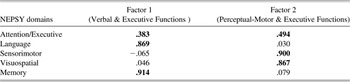
Each child was administered this battery of tests to assess their functioning across five domains of neuropsychological functioning: Attention/Executive, Language, Memory, Sensorimotor (i.e., fine motor coordination), and Visuospatial. The NEPSY has been found to have good stability over time (r = .68–.90). However, given the recent revision of the NEPSY, along with data leading to concerns regarding the construct validity of some of its original domains (Korkman, Kirk, & Kemp, Reference Korkman, Kirk and Kemp2007), we conducted a Principal Components Analysis with Oblimin Rotation to assess the relations among the five NEPSY domains in 3- and 4-year-old children. This yielded a two-factor solution with Language and Memory Domains loading strongly on one factor, Sensorimotor and Visuospatial Domains strongly on the other, and the Attention/Executive Domain splitting evenly across factors (see Table 1). These factor scores were saved as variables and used as the moderators in our analyses. Because all NEPSY memory tests at this age are verbal in nature, we named the first factor (loadings of Language, Memory, and Executive Functions) Verbal & Executive Functions; the second factor (loadings of Sensorimotor, Visuospatial, and Executive Functions) we labeled Perceptual-Motor & Executive Functions.
Principal Components Factor Analysis, with Oblimin Rotation, examining relationships among the five NEPSY domain scores

Procedures
In screening children for suitability to participate in the study, parents and teachers completed the ADHD-RS-IV. These questionnaires were first distributed to parents in local preschools, along with consent forms, and returned in postage-paid addressed envelopes. After receiving the parent rating and consent, the ADHD-RS-IV was sent to the child's teacher. Once being deemed eligible and agreeing to participate, parents were sent-out a package containing additional questionnaires. Consent was also given for teachers to complete the TABC-R and return it in a postage-paid addressed envelope. During the initial laboratory session parents provided additional signed informed consent. Child evaluators administered a comprehensive assessment battery to children consisting of measures of cognitive and neuropsychological functioning. Participants were reimbursed $20/hour for their time spent attending laboratory sessions. This study was approved by the relevant local Institutional Review Board.
Data Analysis
Pearson product moment correlations were initially used to examine the relations among negative emotionality as rated by teachers, neurocognitive functioning (i.e., Verbal & Executive Functions, and Perceptual-Motor & Executive Functions), and ADHD symptom severity as rated by parents. Hierarchical Linear Regression analyses were then conducted to examine whether neuropsychological functioning moderated the relationship between negative emotionality and ADHD symptom severity in preschoolers, by including interaction terms in the hierarchical regression equation. In this case, the predictor variables (i.e., negative emotionality and neuropsychological functioning) were centered by subtracting the sample mean from the individual score before calculating interaction terms between these variables. The plotted moderation model then indicated under which conditions the main effects occur (see Jose & Huntsinger, Reference Jose and Huntsinger2005).
Results
As depicted in Table 2, there were significant correlations among all variables. High levels of negative emotionality were associated with higher ADHD symptom severity and lower Verbal & Executive Functions and Perceptual-Motor & Executive Functions. High ADHD symptom severity was also associated with lower Verbal & Executive Functions and Perceptual-Motor & Executive Functions. Low Verbal & Executive Functions were significantly related to low Perceptual-Motor & Executive Functions.
Correlations among teacher-rated negative emotionality, neurocognitive functioning, and parent-rated ADHD symptom severity

*p < .05; **p < .01; ***p < .001.
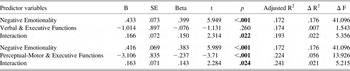
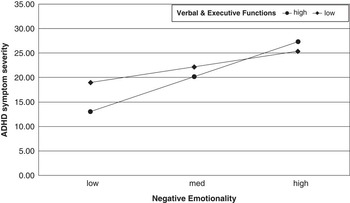
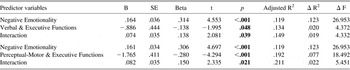
Hierarchical Linear Regression analyses revealed that Negative Emotionality and Perceptual-Motor & Executive Functions accounted for significant unique variance in ADHD symptom severity; while Verbal & Executive Functions did not. Furthermore, significant interaction effects were found for Negative Emotionality and both Verbal & Executive Functions and Perceptual-Motor & Executive Functions (see Table 3). Figure 1 depicts the interaction between Verbal & Executive Functions and Negative Emotionality in predicting ADHD symptom severity. Simple slopes analyses determined that the relation between negative emotionality and ADHD symptom severity was significantly different from zero for both high (t = 5.98; p < .001) and low (t = 2.74; p < .01) Verbal & Executive Functions scores. Further testing of the magnitude of the effect of Verbal & Executive Functions in relation to Negative Emotionality scores revealed that when Negative Emotionality is low, lower Verbal & Executive Functions are associated with higher symptom severity than are higher Verbal & Executive Functions (t = −2.50; p < .05); however, when Negative Emotionality is high the effect of Verbal & Executive Functions on symptoms severity is negligible (t = 0.78, ns). The plotted moderation graph revealed that the association between Negative Emotionality and ADHD symptom severity was stronger among those with higher Verbal & Executive Functions, and weaker (although still significant) among those with lower Verbal & Executive Functions.
Hierarchical Regressions testing whether neuropsychological abilities moderated the relationship between teacher-rated negative emotionality and parent-rated ADHD symptom severity

Moderating effect of Verbal & Executive Functions on the relation between Negative Emotionality and attention deficit/hyperactivity disorder (ADHD) symptom severity.

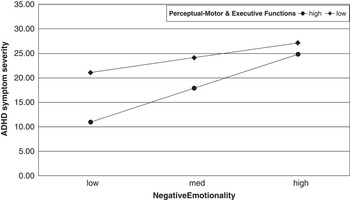
Figure 2 depicts the interaction between Perceptual-Motor & Executive Functions and Negative Emotionality in predicting ADHD symptom severity. Simple slopes analyses indicted that relations between Negative Emotionality and ADHD symptom severity were significantly different from zero for both high (t = 5.63; p < .001) and low (t = 2.61; p < .01) Perceptual-Motor & Executive Functions. Further testing of the magnitude of the effect of Perceptual-Motor & Executive Functions in relation to Negative Emotionality scores revealed that when Negative Emotionality is low, lower Perceptual-Motor & Executive Functions are associated with higher symptom severity than are higher Perceptual-Motor & Executive Functions (t = −4.29; p < .001); however, when Negative Emotionality is high the effect of Perceptual-Motor & Executive Functions skills on symptoms severity is negligible (t = −0.95, ns). The plotted moderation graph indicates that the relationship between Negative Emotionality and ADHD is stronger among those with higher Perceptual-Motor & Executive Functions than in those with lower Perceptual-Motor & Executive Functions. Also indicated is that when Perceptual-Motor & Executive Functions are lower, ADHD symptom severity is greater. In other words, when Perceptual-Motor & Executive Functions skills are higher, children have lower ADHD symptom severity but negative affect has a stronger association with symptom severity.
Moderating effect of Perceptual-Motor & Executive Functions on the relation between Negative Emotionality and attention deficit/hyperactivity disorder (ADHD) symptom severity.

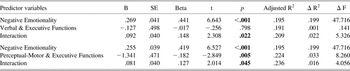
To examine whether these relations differed as a function of inattentive versus hyperactive/impulsive symptoms of ADHD, the regression analyses were rerun using the inattentive and hyperactive/impulsive symptom scores from the parent-rated ADHD-RS. As indicated in Tables 4 and 5, the pattern of results was similar to that found when the total symptom score was used. The only difference was that when predicting inattentive symptoms, the main effect for Verbal & Executive Functions was also significant. The plotted moderation graphs for these analyses resembled the same patterns as those found when the total symptom score was used, indicating that when Negative Emotionality is low, weak neurocognitive/regulatory skills are associated with higher severity in both symptom domains; however, when Negative Emotionality is high, regulatory skills do not appear to significantly influence symptom severity.
Hierarchical Regressions testing whether neuropsychological abilities moderated the relationship between teacher-rated negative emotionality and parent-rated ADHD inattentive symptoms

Hierarchical Regressions testing whether neuropsychological abilities moderated the relationship between teacher-rated negative emotionality and parent-rated ADHD hyperactive/impulsive symptoms

Discussion
The aim of this study was to examine both the unique and combined roles that emotion and cognition play in the severity of ADHD symptomatology in preschool children. First we examined the correlations among these three constructs and, as expected, found that they were all significantly related, although some associations accounted for only a relatively small portion of the variance. These results are in keeping with past research indicating that both negative emotionality and neurocognitive functioning play a key role in ADHD symptom presentation (Martel & Nigg, Reference Martel and Nigg2006; Martel, Reference Martel2009); and also that cognitive and emotional functioning are linked (Blair, Reference Blair2002; Bush, Luu, & Posner, Reference Bush, Luu and Posner2000; Davis, Bruce, & Gunnar, Reference Davis, Bruce and Gunnar2002; Leerkes, Paradise, O'Brien, Calkins, & Lange, Reference Leerkes, Paradise, O'Brien, Calkins and Lange2008; Rothbart et al., Reference Rothbart, Ellis, Rueda and Posner2003; Wolfe & Bell, Reference Wolfe and Bell2007). Furthermore, these findings support the developmental psychopathology literature (Bell & Wolfe, 2004; Muris & Ollendick, Reference Muris and Ollendick2005) in that high negative emotionality and weak higher order cognitive functioning were both associated with higher ADHD symptom severity.
While most of the work in this area to date has focused on the interplay between negative emotionality and executive functions/effortful control, this study included a wider array of neuropsychological abilities by adding language, memory, perceptual, and motor abilities, which we grouped into Verbal & Executive Functions and Perceptual-Motor & Executive Functions. The significant findings for these additional neurocognitive measures are in line with past work by Wolfe and Bell (Reference Wolfe and Bell2007) where they found that low soothability (i.e., high negative emotionality) was associated with both weaker executive functions (i.e., working memory and inhibitory control) and poorer language skills. In relation to the role of visuospatial and sensorimotor skills, Healey et al. (Reference Healey, Brodzinsky, Bernstein, Rabinovitz and Halperin2010) found no significant relations between nonverbal-executive skills (i.e, executive functioning, visuospatial, and sensory motor abilities) and global functioning in typically developing preschoolers; however, our results indicate that perceptual-motor skills (represented by the Perceptual-Motor & Executive Functions factor) appear to be related both to negative emotionality and ADHD symptom severity in a sample with a wider range of severity.
This study is unique in that it extends the current body of work examining relations among negative emotionality, effortful control and ADHD symptom severity by integrating temperament and cognitive measures. The moderation analyses revealed significant interactions between negative emotionality and overall neurocognitive function (i.e., both Verbal & Executive Functions and Perceptual-Motor & Executive Functions) in predicting overall ADHD symptom severity, as well as both inattentive and hyperactive/impulsive symptoms of ADHD. The plotted moderation graphs showed that when low negative emotionality was coupled with weak neurocognitive functioning, ADHD symptoms were higher than when coupled with better neurocognitive skills. However, when negative emotionality was high, symptoms were most severe and neurocognitive functioning did not significantly influence the severity of ADHD symptoms. Thus, in the context of severe temperamental negative emotionality, strong neurocognitive abilities do not seem to serve as a protective factor with regard to ADHD symptoms. On the other hand, with less severe negative emotionality, strong neurocognitive abilities place children at a clear advantage in relation to ADHD severity. Hence, a two-tiered approach to treatment may be called for where negative emotionality is targeted in the first instance and then neurocognitive functioning.
It is notable that these findings differ somewhat from those reported in typically developing preschool children, where neurocognitive abilities were found to moderate the relation between negative emotionality and global functioning (Healey et al., Reference Healey, Brodzinsky, Bernstein, Rabinovitz and Halperin2010). In that sample, which screened-out children with significant ADHD symptoms, strong neurocognitive abilities were protective against the impairing effects of severe negative emotionality. In contrast, when children with high levels of ADHD symptomatology are included in the sample, and the outcome variable is changed from functioning to symptom severity, the nature of the interaction is altered; stronger neurocognitive abilities are most helpful to those with less negative emotionality. These findings are more consistent with those of Martel and Nigg (Reference Martel and Nigg2006) in an older ADHD sample. They found that that both negative emotionality and effortful control play a role in the expression of ADHD symptoms; but that when negative emotionality is high, it has a dominant effect and does not appear to be influenced by higher order cognitive functions. Viewing their data from the perspective of neurocognitive functioning, they found that when neurocognitive functioning is weak, negative emotionality had a limited effect. In contrast, negative emotionality had a potent effect among children with higher neurocognitive functioning. Similarly, Bell & Wolfe (Reference Bell and Wolfe2004) reported that infants with better working memory and cognitive control (i.e., duration of orienting) were rated higher by parents on activity level and distress to limitations (negative emotionality), again indicating that even with strong cognitive control, negative emotionality and hyperactivity can be high. As such, interventions that target neurocognitive growth as an intervention for ADHD (Klingberg et al., Reference Klingberg, Fernell, Olesen, Johnson, Gustafsson, Dahlstrom and Westerberg2005; Shalev, Tsal, & Mevorach, Reference Shalev, Tsal and Mevorach2007) might be most successful in those children who have ADHD without comorbid Oppositional Defiant Disorder, who presumably have less negative emotionality.
The results of this study also have important theoretical implications. Barkley (Reference Barkley2009) has recently stressed the importance of emotional impulsiveness and deficient emotional self-control in the conceptualization ADHD; highlighting its historical association with the disorder, overlapping associated brain regions, as well as the fact that features of emotional impulsivity load on to the same behavioral factor as DSM-IV symptoms of hyperactivity/impulsivity. On this last point, Barkley argues that, if emotional impulsivity was merely a reflection of comorbid ODD, then it should load on a separate factor and not the same one as the hyperactive/impulsive symptoms of ADHD. Also indicating an association between negative emotionality and ADHD, Nigg, Goldsmith, and Sachek (Reference Nigg, Goldsmith and Sachek2004) proposed a multiple pathway model of ADHD, incorporating the role of Oppositional and Conduct disorders, and suggested that there are six possible temperament-related developmental pathways to ADHD-related clinical presentations, with four pathways associated with primary ADHD and two with secondary ADHD associated with a primary Conduct Disorder (CD). However, unlike Barkley, these authors argue that poor affect regulation is associated with primary CD with secondary ADHD, effectively seeing negative emotionality as being more strongly associated with CD than ADHD.
Our data cannot definitively clarify whether negative emotionality is core to ADHD, as posited by Barkley, or part of a separate, yet frequently co-occurring, disruptive behavior disorder. Nevertheless, our findings point to a critical role for negative emotionality in the early expression of ADHD symptoms such that the degree to which neurocognitive functioning influences ADHD severity is highly dependent upon this temperamental factor. Level of neurocognitive functioning and control appears to play a critical (perhaps causal) role in ADHD severity among children with adequate affect regulation. On the other hand, among preschool children characterized by high levels of negative emotional dysregulation, ADHD appears to be less of a cognitive disorder. Further research with patient groups will be necessary to determine whether there are distinct “cognitively driven” and “emotionally driven” subtypes of ADHD and whether or not these should be considered distinct subtypes of ADHD or separate diagnoses.
As with all studies, this one is not without limitations. The generalization of these results may be compromised given that this study was conducted with preschool children evaluated at a single time-point. Ideally the intricate interplay between cognition and emotion across development needs to be examined within a longitudinal study; although our results did mirror those of Martel and Nigg (Reference Martel and Nigg2006) who studied 6- to 9-year-old children. A strength of this study is that all three constructs were independently evaluated; symptom severity was rated by parents, negative emotionality by teachers, and neurocognitive functioning assessed using a standardized assessment battery.
Conclusions
Overall, the results of this study highlight the important interactive effects of emotional dysregulation and level of neurocognitive functioning in the expression of ADHD symptomatology. The findings also have implications for future treatment approaches in ADHD. There has been a recent shift in the literature to a focus on brain plasticity (Halperin & Healey, Reference Halperin and Healey2011) where researchers have begun using working memory and attention training programs as an intervention for ADHD with promising preliminary results (Klingberg et al., Reference Klingberg, Fernell, Olesen, Johnson, Gustafsson, Dahlstrom and Westerberg2005; Shalev et al., Reference Shalev, Tsal and Mevorach2007). However, given the significant role of negative emotionality in ADHD symptom presentation it seems that an additional focus on emotional regulation may be important to add within any treatment regime.
Acknowledgments
The authors acknowledge the invaluable assistance of the staff of the Queens College Preschool Project and the teachers and families who participated in this study. No financial or other relationships exist that could be interpreted as a conflict of interest pertaining to this manuscript. This research was supported by NIH grant R01 MH68286.