


Introduction
Cognitive behavioural therapy for eating disorders (CBT-ED) is an effective intervention for a range of eating disorders. Randomised controlled trials and case series have shown that patients make significant improvements with CBT-ED (Byrne et al., Reference Byrne, Fursland, Allen and Watson2011; Fairburn et al., Reference Fairburn, Cooper, Doll, O’Connor, Bohn, Hawker and Palmer2009; Ghaderi, Reference Ghaderi2006; Knott et al., Reference Knott, Woodward, Hoefkens and Limbert2015; Signorini et al., Reference Signorini, Sheffield, Rhodes, Fleming and Ward2018; Turner et al., Reference Turner, Marshall, Stopa and Waller2015b; Waller et al., Reference Waller, Gray, Hinrichsen, Mountford, Lawson and Patient2014). Consequently, the UK’s National Institute for Health and Clinical Excellence [National Institute for Health and Care Excellence (NICE), 2017] has recommended different forms of CBT-ED for a range of eating disorders. When individual CBT-ED is most appropriate, NICE (2017) recommends 16–20 sessions, which is relatively long and expensive compared with CBT for other disorders (e.g. anxiety and depression). Recent research has demonstrated that a 10-session CBT-ED (CBT-T) is effective for non-underweight transdiagnostic eating disorder groups (Pellizzer et al., Reference Pellizzer, Waller and Wade2019; Waller et al., Reference Waller, Tatham, Turner, Mountford, Bennetts, Bramwell and Ingram2018), making it viable to offer to people with varied symptoms. However, its specific effectiveness for individual diagnostic groups has not yet been assessed, where the presence and function of symptoms differs. In particular, it remains to be determined whether CBT-T is specifically effective among patients with binge-eating disorder, who are not marked by use of compensatory behaviours and whose bingeing is more likely to be driven by emotional factors than by starvation.
In determining the effectiveness of therapy for eating disorders, it is important to consider the definition used, as reductions in core pathology are relatively meaningless if the change is small. For example, it is common to use a reduction in key scores to below a cut-off (Kendall et al., 2009). In eating disorders, this has been operationalised as a reduction in Eating Disorder Examination Questionnaire (EDE-Q; Fairburn, Reference Fairburn2008) scores to below 2.77 (in the UK), where falling to below that level is commonly used as a cut-off for achieving remission. However, such changes might be very small and still meet that criterion, and binge-eating disorder patients often start with lower EDE-Q scores than other eating disorder groups, due to their lack of strong restrictive patterns. Therefore, it is also important to consider more meaningful categorical indices of change. To address this issue, reliable change index (RCI) and clinically significant change (CSC) methods can be used (Jacobson and Truax, Reference Jacobson and Truax1991). These measures of remission have been widely used outside of eating disorder research. The application of more stringent measures of remission ensures that clinicians and researchers can be more certain of the effectiveness of therapies for binge-eating disorder.
Therefore, the aim of this study was to test the effectiveness of brief CBT-ED (CBTT), specifically for binge-eating disorder treated in a routine clinical setting. Outcomes will include eating pathology, as well as comorbid mood and anxiety. Different indices of remission in such a population will be compared, in order to provide realistic estimates of remission rates.
Method
Design
An open label pre–post trial design was used to evaluate the effectiveness of CBT-T for a case series of patients with binge-eating disorder, with no control group. Outcomes were measured at early in treatment (session 4), the end of therapy (session 10), and 3-month follow-up. Intention-to-treat analyses were used, with multiple imputations to correct for missing data.
Participants
Sample size analysis indicated that a total of 15 patients would be sufficient to ensure adequate power to detect small effects on the primary outcome variable (EDE-Q Global score), assuming 95% power at a 5% significance level, given the large effect sizes observed in previous studies (Waller et al., Reference Waller, Tatham, Turner, Mountford, Bennetts, Bramwell and Ingram2018). Fifty-three patients began CBT-T (41 females, 11 males, 1 transgender person), meaning that the study was well-powered. Patients were recruited as a successive case series of individuals referred to the service. They were able to self-refer, or were referred by the relevant General Practitioner or mental health service to this specialist eating disorders service, which accepted all such National Health Service referrals in the area. All patients were assessed prior to entering the case series.
At assessment, all patients met criteria for a DSM-5 diagnosis (American Psychiatric Association, 2013) of binge-eating disorder. All reported at least one objective binge per week. Exclusion criteria for the purpose of this study included episodes of purging or laxative use (during therapy or over the month preceding therapy), low weight [body mass index (BMI)<17.5], active suicidality, or self-harm. No patient manifested any of these exclusion criteria following the start of therapy. The group’s characteristics at the beginning of therapy are provided in Table 1.
Baseline characteristics for the group of patients with binge-eating disorder

n = 53, ITT analysis with multiple imputations. EDE-Q, Eating Disorder Examination Questionnaire.
Measures and procedure
The following measures were used to assess eating pathology and associated mood states. All the measures are well-validated and are widely used to assess progress in eating disorders. Patients completed all measures at sessions 1, 4 and 10 (end of treatment), and at the 3-month follow-up:
-
eating attitudes (EDE-Q, version 6; Fairburn, Reference Fairburn2008)
-
depression [Personal Health Questionnaire-9 (PHQ-9); Kroenke et al., Reference Kroenke, Spitzer and Williams2001]
-
anxiety [Generalized Anxiety Disorder-7 (GAD-7); Spitzer et al., Reference Spitzer, Kroenke, Williams and Löwe2006].
Diary records were used to measure weekly frequency of objective binge eating. BMI was calculated from weight and height measured objectively during therapy sessions.
Intervention
CBT-T is a brief cognitive behavioural therapy designed for non-underweight eating disorder patients (Waller et al., Reference Waller, Turner, Tatham, Mountford and Wade2019). The therapy focuses on restoring nutrition, exposure therapy, behavioural experiments, work on emotional triggers, and body image work. It has shown to be effective in transdiagnostic eating disorder groups (Pellizzer et al., Reference Pellizzer, Waller and Wade2019; Waller et al., Reference Waller, Tatham, Turner, Mountford, Bennetts, Bramwell and Ingram2018). However, the effectiveness of CBT-T in a binge-eating disorder group has not previously been tested. The therapy was delivered individually by the lead author, supervised by the other authors. The therapy consists of phases that aim to: normalise and regularise eating patterns to reduce starvation-based cravings (particularly due to carbohydrate deprivation), using exposure with response prevention; address fears of specific foods, using behavioural experiments; reduce emotionally driven bingeing and other behaviours, using stimulus control, exposure therapy, and challenges to underlying core beliefs; enhance body image, using psychoeducation, perceptual challenges, imagery rescripting for body shame, behavioural experiments, and exposure therapy); and reduce risk of relapse.
A proportion of the data were collected during the COVID-19 pandemic. A total of nine patients (17%) were transferred to video calling platforms during therapy, and a further 11 patients (20.8%) had their follow-ups moved to online meetings during this time. The therapy was adapted to make it effective when delivered remotely (Waller et al., Reference Waller, Pugh, Mulkens, Moore, Mountford, Carter, Wicksteed, Maharaj, Wade, Wisniewski, Farrell, Raykos, Jorgensen, Evans, Thomas, Osenk, Paddock, Bohrer, Anderson, Turner, Hildebrandt, Xanidis and Smit2020). Specific examples of the adaptations made include: self-weighing; use of online diet records or scanned diaries that could be sent to the clinician in advance; using online whiteboards to formulate behaviours and discuss psychoeducation; using either the videocall screen and mirrors for body exposure, rather than a mirror; adapting social behaviours (e.g. eating in front of others) to be done online; and preparation of body image surveys to be delivered online and/or using social media.
Data analysis
Data analysis took place using SPSS (v24). Intention-to-treat analyses were used, with multiple imputations (five iterations) to replace missing data. For dimensional changes, paired t-tests were used to evaluate change over the course of therapy in eating attitudes (EDE-Q), binge frequency, depression (PHQ-9), anxiety (GAD-7) and BMI. Effect sizes (Cohen’s d) were calculated for paired t-tests.
For categorical remission, the percentage of patients achieving meaningful change in EDE-Q Global scores was calculated based on the number of patients who met each of the following indices of meaningful change: ‘cut-off’ on EDE-Q Global score (dropping to below 2.77); RCI (Jacobson and Truax, Reference Jacobson and Truax1991); and CSC (Jacobson and Truax, Reference Jacobson and Truax1991). Achievement of RCI indicates that change is not due to measurement error. Achievement of CSC indicates that change is substantial, relative to the clinical and non-clinical ranges of EDE-Q scores. The criterion for RCI was a reduction in EDE-Q Global score of ≥1.38, while the criterion for CSC was an EDE-Q reduction of ≥1.70 [both calculated using Evans’ (Reference Evans1998) online calculator].
Results
Attrition
A total of 41 patients completed the 10 sessions of CBT-T (or agreed an earlier finish as therapy had met its targets). Thus, the attrition rate was 22.6%, which is at the lower end of the range found in previous CBT-ED effectiveness studies (Byrne et al., Reference Byrne, Fursland, Allen and Watson2011; Dalle Grave et al., Reference Dalle Grave, Calugi, Sartirana and Fairburn2015; Knott et al., Reference Knott, Woodward, Hoefkens and Limbert2015; Raykos et al., Reference Raykos, Watson, Fursland, Byrne and Nathan2013; Rose and Waller, Reference Rose and Waller2017; Signorini et al., Reference Signorini, Sheffield, Rhodes, Fleming and Ward2018; Turner et al., Reference Turner, Bryant-Waugh and Marshall2015a; Turner et al., Reference Turner, Marshall, Stopa and Waller2015b).
Symptom reduction across therapy
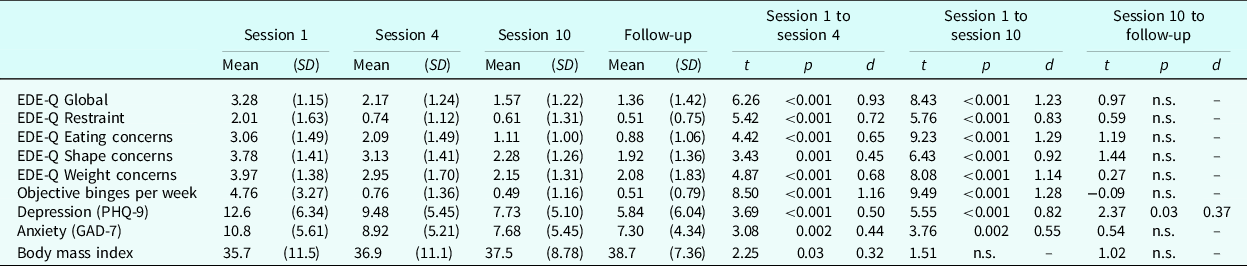
Eating attitudes, binge frequency, depression, anxiety and BMI were assessed at sessions 1, 4 and 10, and at 3-month follow-up. Table 2 shows the means and standard deviations for eating attitudes (EDE-Q), binge frequency per week, depression (PHQ-9), anxiety (GAD-7) and BMI over the course of therapy. Outcomes are tested (intention-to-treat) using paired t-tests (n=53) and effect sizes (Cohen’s d).
Mean eating characteristics over the course of treatment and follow-up, compared using paired t-tests (intention-to-treat analyses; n = 53)

EDE-Q, Eating Disorder Examination Questionnaire; PHQ-9, Patient Health Questionnaire-9; GAD-7, General Anxiety Disorder-7; n.s., not significant.
There were significant reductions in eating attitudes, binge frequency, depression and anxiety from sessions 1 to 10, with significant reductions made in the first 4 weeks. All the effect sizes from by the end of therapy were large, apart from a medium effect for anxiety. Very large effect sizes were observed between sessions 1 and 10, with a substantial amount of that change achieved by session 4. All changes were maintained at follow-up.
Categorical measures of remission
Three categorical measures of remission were used: ‘cut-off’ (an EDE-Q score below 2.77 at session 10); RCI (EDE-Q Global reduction ≥1.38); and CSC (EDE-Q Global reduction ≥1.70). Multiple imputations for missing data and intention-to-treat analyses were used.
Considering the ‘cut-off’ method, 46 patients (87.2%) were below the 2.77 score at the end of therapy, and 50 patients (94.3%) met this criterion at follow-up. However, these findings have to be tempered by the fact that 37.6% started therapy at EDE-Q<2.77 (as binge-eating disorder patients often have very low EDE-Q Restraint scores at the start of therapy). Therefore, those rates reflect a shift to below the cut-off by approximately 50% of patients. The RCI showed that 62.4% (n=33) met the criterion for remission at the end of treatment, and that 66.0% (n=35) met that criterion at follow-up. Taking the more stringent CSC index, 47.6% (n=25) met the criterion for remission by the end of therapy, while 61.5% (n=33) met the criterion for remission at follow-up.
Discussion
This study has assessed the effectiveness of CBT-T for adults with binge-eating disorder in routine settings. Effectiveness was determined by dimensional changes (with large effect sizes on most measures of pathology) and by three categorical measures of remission. Improvements were shown by session 4, developed further by the end of therapy (session 10), and maintained at 3-month follow-up. These outcomes are comparable to those achieved using 20-session versions of CBT-ED for binge-eating disorder (NICE, 2017) and other eating disorders (Byrne et al., Reference Byrne, Fursland, Allen and Watson2011; Fairburn et al., Reference Fairburn, Cooper, Doll, O’Connor, Bohn, Hawker and Palmer2009; Knott et al., Reference Knott, Woodward, Hoefkens and Limbert2015; Raykos et al., Reference Raykos, Watson, Fursland, Byrne and Nathan2013), and are similar to those found in transdiagnostic groups of non-underweight patients when using CBT-T (Pellizzer et al., Reference Pellizzer, Waller and Wade2019; Waller et al., Reference Waller, Tatham, Turner, Mountford, Bennetts, Bramwell and Ingram2018).
The proportion of patients who ended at below the commonly used criterion of EDE-Q mean+1SD (2.77 in the UK) was very high. However, this outcome cannot be treated as indicating remission in a valid way, as many patients began at below that point (due to low EDE-Q Restraint scores). Therefore, such cut-offs should not be treated as meaningful in treatment of binge-eating disorder. Instead, use of the RCI and CSC criteria is critical to understand meaningful change in this patient group.
Overall, CBT-T is a clinically effective and cost-effective therapy for binge-eating disorder (BED), compared with longer forms of CBT-ED. As raised in the Introduction, it was not known whether CBT-T would be effective with BED, given the lack of purging behaviours and the higher likelihood that emotional triggers would be critical. Therefore, it is reassuring that the outcomes for this group of patients with BED were as strong as for other non-underweight eating disorders (Pellizzer et al., Reference Pellizzer, Waller and Wade2019; Waller et al., Reference Waller, Tatham, Turner, Mountford, Bennetts, Bramwell and Ingram2018). It can be hypothesised that this impact on the more emotionally driven element of BED was a result of the phase of CBT-T that addresses emotional factors (as detailed in the Method section).
Furthermore, these results were achieved despite COVID-19 and some therapy moving online (although that group is too small to analyse separately), supporting the case that such online delivery can be effective with appropriate adaptations (e.g. Waller et al., Reference Waller, Pugh, Mulkens, Moore, Mountford, Carter, Wicksteed, Maharaj, Wade, Wisniewski, Farrell, Raykos, Jorgensen, Evans, Thomas, Osenk, Paddock, Bohrer, Anderson, Turner, Hildebrandt, Xanidis and Smit2020). Further research is needed to replicate this finding, and to determine whether greater efficiencies can be achieved through delivering CBT-T in groups, given that NICE (2017) recommended the use of CBT-ED groups for this population. That research should use more meaningful measures of change (RCI and CSC) to ensure that the most effective therapies are recommended to service providers. Clinicians should be encouraged to use the RCI and particularly the CSC criteria in routine practice, to ensure the best remission targets are used.
Acknowledgements
None.
Financial support
This research received no specific grant from any funding agency, commercial or not-for-profit sectors.
Conflicts of interest
Author G.W. receives royalties on the treatment manual used in this research. The other authors have no conflicts of interest.
Ethics statements
Ethical permission was not sought as the study evaluated existing practice (National Health Service Research Authority, 2011). All patients included in the analysis gave written consent for their outcomes to be used anonymously for review of outcomes.
Data availability statement
The anonymised data are available to other researchers on reasonable request.
Key practice points
-
(1) Brief CBT is effective in treating binge-eating disorder.
-
(2) Remission rates are comparable to those achieved with longer therapies.
-
(3) Brief CBT’s benefits are maintained into follow-up.
-
(4) Clinicians should use more stringent definitions of improvement, which are not influenced by low initial scores on key variables.




Comments
No Comments have been published for this article.