Introduction
Parasitoids are known to use host-related volatile signals for foraging and host location (Dicke & Sabelis, Reference Dicke and Sabelis1988; Turlings et al., Reference Turlings, Tumlinson and Lewis1990, Reference Turlings, Tumlinson, Eller and Lewis1991). These volatile signals can be plant-based, originate from the herbivore host or produced from an interaction between herbivores and their plant host. Plant-based host-related volatile signals can be divided into constitutive compounds and inducible compounds. Constitutive compounds are continuously present in the plant and released immediately in response to mechanical plant damage or at the beginning of feeding damage. In many plant species, the compounds include several components of the ubiquitous green leaf volatiles (GLVs) such as cis-3-hexenal, cis-3-hexenol, hexanal, as well as several plant specific compounds (Turlings et al., Reference Turlings, Tumlinson and Lewis1990; Dicke et al., Reference Dicke, Van Baarlen, Wessels and Dijkman1993; Loughrin et al., Reference Loughrin, Manukian, Heath, Turlings and Tumlinson1994; McCall et al., Reference McCall, Turlings, Loughrin, Proveaux and Tumlinson1994; Cortesero et al., Reference Cortesero, De Moraes, Stapel, Tumlinson and Lewis1997; Reddy & Guerrero, Reference Reddy and Guerrero2000; Smid et al., Reference Smid, Van Loon, Posthumus and Vet2002). On the other hand, inducible compounds are emitted as a delayed response to herbivore feeding damage. Herbivore-induced volatile compounds in cotton include cis-3-hexenyl acetate, indole, isomeric hexenyl butyrates and various terpenoids, such as (E,E)-α-farnesene, (E)-β-farnesene, (E)-β-ocimene and linalool (Dicke, Reference Dicke1994; Loughrin et al., Reference Loughrin, Manukian, Heath, Turlings and Tumlinson1994; McCall et al., Reference McCall, Turlings, Loughrin, Proveaux and Tumlinson1994; Röse et al., Reference Röse, Lewis and Tumlinson1998). Although many of the green leaf volatiles and inducible compounds are commonly produced by various plant species in response to damage by different herbivore species (Turlings et al., Reference Turlings, Bernasconi, Bertossa, Bigler, Caloz and Dorn1998), studies have also shown that different plants or varieties may produce distinct volatile blends in response to different herbivore species (Loughrin et al., Reference Loughrin, Manukian, Heath and Tumlinson1995; De Moraes et al., Reference De Moraes, Lewis, Paré, Alborn and Tumlinson1998; Hoballah et al., Reference Hoballah, Tamo and Turlings2002) and that the volatile blend signature may be used by specialist parasitoids for host specificity.
A current paradigm regarding the evolution of parasitoid foraging and host location strategies is that the degree of specificity of the signals needed by a parasitoid species for successful host location correlates with its level of host specialization (Vet & Dicke, Reference Vet and Dicke1992; Cortesero et al., Reference Cortesero, De Moraes, Stapel, Tumlinson and Lewis1997; Röse et al., Reference Röse, Lewis and Tumlinson1998; Smid et al. Reference Smid, Van Loon, Posthumus and Vet2002). Specialist parasitoids utilizing a relatively fewer number of hosts are predicted to have a highly efficient host detection system (high olfactory sensitivity to host-related chemical cues) than generalist parasitoids. Comparative studies of olfactory responses of generalist and specialist parasitoids to host-related volatiles are rare (Elzen et al., Reference Elzen, Williams, Vinson and Powell1987; Vet et al., Reference Vet, Sokolowski, Macdonald and Snellen1993), and the few studies have produced contrasting results. Some studies report relatively greater behavioural responses by specialists compared to generalist parasitoids (Elzen et al., Reference Elzen, Williams, Vinson and Powell1987; Vet et al., Reference Vet, Sokolowski, Macdonald and Snellen1993). In contrast, Geervliet et al. (Reference Geervliet, Vet and Dicke1996) reported no differences in the behavioural responses of the specialist, Cotesia rubecula, and the generalist, C. marginiventris, to host-related volatiles; and both species were unable to distinguish between volatiles induced by their hosts versus volatiles induced by non-host species. Similarly, Smid et al. (Reference Smid, Van Loon, Posthumus and Vet2002) reported no differences between the specialist, C. rubecula, and the generalist, C. glomerata, in their response to a wide range of host-related compounds. The varying results obtained from the above studies suggest that diverse species of generalist and specialist parasitoids may disparately respond to different types of host-related volatile compounds and that specialist parasitoids may not always show a greater response to host-related volatiles than generalists. Even within the broad category of specialist parasitoids, differences may still exist among species based on the degree of specialization. For instance, De Moraes & Lewis (Reference De Moraes and Lewis1999) compared the foraging strategies of the highly specialized, Cardiochiles nigriceps, and the relatively less specialized, Microplitis crociepes, and reported greater long-range sensitivity to host-related semiochemicals for the more specialized species.
The majority of studies on olfactory response of hymenopteran parasitoids to host-related compounds have focused on females (Cortesero et al., Reference Cortesero, De Moraes, Stapel, Tumlinson and Lewis1997; De Moraes et al., Reference De Moraes, Lewis, Paré, Alborn and Tumlinson1998; Röse et al., Reference Röse, Lewis and Tumlinson1998; De Moraes & Lewis, Reference De Moraes and Lewis1999) with relatively little attention paid to male response (although see Whitman & Eller, Reference Whitman and Eller1990; Li et al., Reference Li, Dickens and Steiner1992; Park et al., Reference Park, Zhu, Harris, Ochieng and Baker2001; Jyothi et al., Reference Jyothi, Prasuna, Sighamony, Kumari, Prasad and Yadav2002). The focus on female parasitoids is understandable given that females are involved in host location for oviposition. In the few studies in which olfactory responses of female and male parasitoids were compared, most have recorded no significant sexual difference (Li et al., Reference Li, Dickens and Steiner1992; Park et al., Reference Park, Zhu, Harris, Ochieng and Baker2001). It is commonly argued that female and male parasitoids share some chemical cues and are, therefore, expected to show similar responses to volatile compounds, which both sexes rely on to locate host plants for use as food and mating substrate. However, given that host-related volatiles may play different roles in the ecology of female (host location) and male (mate location) parasitoids, it is possible that sex-related differences occur in the responses of parasitoids to different host-related volatile signals. Indeed, sexual dimorphism in EAG response was reported for Apanteles obliquae (Hymenoptera: Braconidae), with the females being more responsive than males to most of the tested host-related volatiles (Jyothi et al., Reference Jyothi, Prasuna, Sighamony, Kumari, Prasad and Yadav2002). Also, Whitman & Eller (Reference Whitman and Eller1990) reported significantly greater behavioural responses for females of two parasitoid wasps compared to conspecific males to several green leaf volatiles.
Mating can also have an effect on EAG response of insects to host-related volatiles. Studies on the effect of mating on EAG response of female moths to plant volatiles have produced contrasting results. Ding et al. (Reference Ding, Guo and Wu1997) reported that mated female Helicoverpa armigera showed greater EAG response to cotton volatiles compared to virgin females, whereas no significant effect of mating was recorded on EAG response of H. armigera females to volatiles of a non-host plant, Chinese wing-nut tree (Xiao et al., Reference Xiao, Gregg, Hu, Yang and Zhang2002). So far, no data are available on the effect of mating on the behavioural or electrophysiological response of parasitoids to host-related volatiles.
In this paper, we compared the electroantennogram (EAG) responses of both sexes of Microplitis croceipes (Cresson) (Hymenoptera: Braconidae) and Cotesia marginiventris (Cresson) (Hymenoptera: Braconidae) to a range of plant-based host-related volatiles. Microplitis croceipes is a relatively specialist parasitoid specific to the larvae of Helicoverpa spp. and Heliothis spp., while C. marginiventris is a generalist parasitoid of larvae of a wide range of lepidopteran pests, including Helicoverpa spp., Heliothis spp. and Spodoptera spp. (Lewis et al., Reference Lewis, Tumlinson and Krasnoff1991). Few studies have separately examined the EAG responses of M. croceipes to host-related compounds (Li et al., Reference Li, Dickens and Steiner1992; Park et al., Reference Park, Zhu, Harris, Ochieng and Baker2001). Also, a recent study by Gouinguené et al. (Reference Gouinguené, Pickett, Wadhams, Birkett and Turlings2005) reported on the antennal perception by three generalist parasitoids, including C. marginiventris to herbivore-induced plant volatiles. However, no systematic comparative evaluation of EAG responses of both sexes of the two parasitoids to host-related volatiles has been conducted to date.
Here, we utilized the EAG technique to test for any inherent differences in the antennal sensitivity of females and males of both parasitoid species to varying doses of selected compounds representing two categories of host-related volatiles: (i) green leaf volatiles (e.g. cis-3-hexenal, cis-3-hexenol, hexanal), which are the most common volatiles released by plants immediately after the beginning of herbivore feeding damage; and (ii) inducible compounds (e.g. cis-3-hexenyl acetate, (E,E)-α-farnesene, (E)-β-farnesene, (E)-β-ocimene, linalool), which are released in large amounts after several hours of herbivore damage. We also evaluated the potential effect of mating on EAG response.
Materials and methods
Insects
Cocoons of Microplitis croceipes and Cotesia marginiventris were provided by USDA-ARS, BCMRRU, Mississippi State and USDA-ARS, Insect Biology and Population Management Research Laboratory, Tifton, Georgia. Microplitis croceipes was reared on Helicoverpa zea larvae fed on a laboratory-prepared pinto bean diet according to the procedure of Lewis and Burton (Reference Lewis and Burton1970), while C. marginiventris was reared similarly on larvae of Spodoptera frugiperda fed on soybean diet. Upon receipt, cocoons of each species were kept separately in a jar in an incubator at 25±1°C, 75±5% RH and 14:10 h (L:D) photoperiod until adult emergence. For each species, newly emerged adults were collected prior to mating, sexed and placed in groups of two individuals either of the same sex (unmated individuals) or of the opposite sex (mated individuals) in a 6-cm diameter plastic Petri dish supplied with water and sugar sources. Water was provided by filling a 0.5-ml microcentrifuge tube with distilled water and threading a cotton string through a hole in the cap of the tube. About 4–6 drops (2 μl per drop) of sugar solution (1 m sucrose solution) were smeared on the inside of the Petri dish cover with a cotton-tipped applicator. Three-day-old adults of both parasitoid species were used for EAG recordings, although a previous study reported no significant effect of age on EAG response of M. croceipes (Park et al., Reference Park, Zhu, Harris, Ochieng and Baker2001).
Test compounds
Five compounds were tested in this study: cis-3-hexenol; hexanal; cis-3-hexenyl acetate; linalool; and (E,E)-α-farnesene. The aim was not to comprehensively test EAG responses of both parasitoids to a wide array of volatile compounds, but to obtain detailed EAG response profiles to selected compounds representing two categories of plant volatiles: green leaf volatiles and inducible compounds. The first two compounds (cis-3-hexenol and hexanal) are components of green leaf volatiles, while the last three compounds (cis-3-hexenyl acetate, linalool and (E,E)-α-farnesene) are herbivore-inducible compounds in cotton and several other plants (Dicke, Reference Dicke1994; Loughrin et al., Reference Loughrin, Manukian, Heath, Turlings and Tumlinson1994; McCall et al., Reference McCall, Turlings, Loughrin, Proveaux and Tumlinson1994; De Moraes et al., Reference De Moraes, Lewis, Paré, Alborn and Tumlinson1998; Röse et al., Reference Röse, Lewis and Tumlinson1998; Hoballah et al., Reference Hoballah, Tamo and Turlings2002). Although many of the compounds may be produced at different concentrations by some plants in response to damage by different herbivores (De Moraes et al., Reference De Moraes, Lewis, Paré, Alborn and Tumlinson1998), most are produced at significant concentrations by various plants irrespective of the herbivore species eliciting the attack (Loughrin et al., Reference Loughrin, Manukian, Heath, Turlings and Tumlinson1994; McCall et al., Reference McCall, Turlings, Loughrin, Proveaux and Tumlinson1994; Röse et al., Reference Röse, Lewis and Tumlinson1998). Furthermore, these compounds have been tested in previous studies of olfactory responses of parasitoid wasps to host-related volatiles and most have been confirmed as attractants to several parasitoid wasps (Turlings et al., Reference Turlings, Tumlinson and Lewis1990; Dicke et al., Reference Dicke, Van Baarlen, Wessels and Dijkman1993; Loughrin et al., Reference Loughrin, Manukian, Heath, Turlings and Tumlinson1994; McCall et al., Reference McCall, Turlings, Loughrin, Proveaux and Tumlinson1994; Cortesero et al., Reference Cortesero, De Moraes, Stapel, Tumlinson and Lewis1997; Röse et al., Reference Röse, Lewis and Tumlinson1998; Reddy & Guerrero, Reference Reddy and Guerrero2000; Park et al., Reference Park, Zhu, Harris, Ochieng and Baker2001). The compounds were purchased from Sigma® Chemical Co. (St. Louis, Missouri) with purity >97% (as indicated on the labels). Each compound was diluted in hexane to give 100 μg μl−1 solutions. Further dilutions were made to give 0.01, 0.1, 1 and 10 μg μl−1 solutions for dose-response studies. The solutions were kept in a freezer at <−20°C until used.
Antennal preparation, EAG recording and odour presentation
The EAG techniques used in this study were similar to those previously described (e.g. Dickens, Reference Dickens1984; Li et al., Reference Li, Dickens and Steiner1992; Park et al., Reference Park, Zhu, Harris, Ochieng and Baker2001). Briefly, the reference electrode consisting of a glass capillary (1.1 mm ID) filled with 0.1 m KCl solution was connected to the neck of an isolated head of an adult parasitoid. The recording electrode consisted of a similar glass capillary connected to the antennal tip (with the last segment of the antenna cut off). Chlorinated silver-silver chloride junctions were used to maintain electrical contact between the electrodes and input of preamplifier. The analog signal was detected through a probe (INR-II, Syntech®, the Netherlands), captured and processed with a data acquisition controller (IDAC-4, Syntech®, the Netherlands) and later analyzed using EAG 2000 software (Syntech®, the Netherlands) on a PC.
A 10-μl aliquot of each solution was applied to a piece of filter paper (7×40 mm, Whatman® no. 1). After allowing for solvent evaporation, the impregnated filter paper was inserted into a glass Pasteur pipette (~14 cm in length, Fisher Scientific, Pittsburgh, Pennsylvania, USA) constituting an odour cartridge. The control stimulus was a similar pipette containing a filter paper impregnated with a 10-μl aliquot of hexane. The tip of the pipette was placed about 3 mm into a small hole in the wall of a glass tube (13 cm long, 8 mm diameter) orientated towards the antennal preparation (~0.5 cm away from the preparation). In this way, the stimuli were provided as 0.2 s puffs of air (2 ml) into continuous humidified air stream at 1000 ml min−1 generated by an air stimulus controller (CS-55, Syntech®, the Netherlands). At least 2 min was allowed between successive stimulations for antennal recovery. A test series of odourant compounds (volatile stimuli) of the same dose (0.1, 1, 10, 100 or 1000 μg) were applied to ten isolated head preparations (five each for the left and right antennae) of each parasitoid species using the following order: hexane control, standard stimulus, odourant compounds, hexane control and standard stimulus. One hundred micrograms of cis-3-hexenol was used as the standard stimulus (Park et al., Reference Park, Zhu, Harris, Ochieng and Baker2001) and presented to an antenna at the beginning and end of a recording to confirm activity of an antennal preparation. Odourant compounds were presented in a random sequence. For analysis, EAG response to the solvent control (average of two recordings per antennal preparation) was deducted from the EAG amplitudes elicited by the test compounds.
Statistical analyses
For each parasitoid species, data were analyzed by using the standard least squares fit model method (SAS Institute, 1998) to determine the effects of sex, mating, odourant compound and dose on absolute EAGs. This model also allowed testing for effects of two-way, three-way and four-way interactions (a total of 11 possible interactions) among the above four variables. For each species, the effect of sex on absolute EAG response to varying doses of each test compound was compared by using the Student's t-test (P<0.05: SAS Institute, 1998). Data were first checked for normality and transformed when necessary. To compare between the two parasitoid species, data for both species were first analyzed together using the standard least squares fit model method to test for any significant effect of species on absolute EAG response data. Absolute EAG responses to different doses of each odourant compound were then compared between species (by sex) using the Student's t-test (P<0.05: SAS Institute, 1998).
Results
Isolated head preparations, utilized for both species in this study, lasted for up to 0.5 h with no noticeable decreases in EAG responses observed over this time period. Females and males of both parasitoid species showed typical rapid electroantennogram (EAG) responses to the five test compounds. Both species showed EAG amplitudes of about 3 mV to 1000 μg of cis-3-hexenol and up to ~5 mV to 1000 μg of cis-3-hexenyl acetate. All five odourant compounds elicited the greatest EAG responses in both sexes at the 1000 μg dose, although EAG responses at this highest dose were not always significantly greater than at the 100 μg dose.
Microplitis croceipes
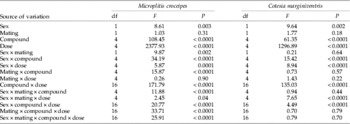
Standard least squares modeling revealed significant effects of sex, odourant compound and dose on EAG responses of M. croceipes, resulting in significant sex×mating, sex×compound, sex×dose, mating×compound, compound×dose, sex×mating×compound, sex×mating×dose, sex×compound×dose, mating×compound×dose and sex×mating×compound×dose interactions (table 1). However, no significant effect of mating was recorded on EAG responses (table 1). Thus, data from unmated and mated wasps were pooled and analyzed by using ANOVA to test for significant effects of sex and odourant compounds.
Standard least squares model testing for effects of sex, mating, test compound, dose and interactions of these variables on absolute EAG responses of two parasitoid species.

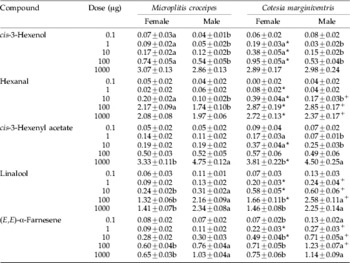
Sex exerted a significant effect on EAG response. The green leaf volatile, cis-3-hexenol, elicited significantly greater EAG in females than in males at all but the 1000 μg dose (table 2). Similar results were obtained for the second green leaf volatile, hexanal, at doses 10 and 100 μg. In no case did males show significantly greater EAG than females to any of the two green leaf volatiles (table 2). In contrast, males showed significantly greater EAG responses than females to linalool (at doses 10, 100 and 1000 μg), (E,E)-α-farnesene (at doses 100 and 1000 μg) and cis-3-hexenyl acetate (at dose 1000 μg) (table 2). However, no significant differences were recorded in the responses of males and females to low doses of the three compounds, suggesting that males are more EAG responsive than females to inducible compounds at high doses.
EAG responses of male and female parasitoids to five test compounds (mean±SE, absolute EAG, n=20 sex−1 dose−1).

Means across the same row for each species followed by different letters are significantly different (P<0.05, t-test).
* significant difference between females of both species (P<0.05, t-test)
+ significant difference between males of both species (P<0.05, t-test).
Cotesia marginiventris
Similar to the results obtained for M. croceipes, significant effects of sex, compound and dose, as well as significant interactions of sex×compound, sex×dose, compound×dose, sex×compound×dose and sex×mating×dose were recorded on the EAG responses of C. marginiventris (table 1). Since mating effect and interactions of mating×compound or mating×dose were not significant (table 1), data for mated and unmated individuals were pooled and analyzed by using ANOVA to test for any significant effects of sex and odourant compounds.
Significantly greater EAG responses were recorded for females compared to males in response to cis-3-hexenol (at doses 1, 10 and 100 μg) and hexanal (at dose 10 μg), whereas males showed significantly greater EAG responses than females to linalool (at doses 100 and 1000 μg) and (E,E)-α-farnesene (at all but the 1 μg dose). EAG response of males was also greater than that of females to the 1000 μg dose of cis-3-hexenyl acetate, but females showed greater response than males to this compound at the lower doses (1 and 10 μg), suggesting that females are more EAG responsive to this compound at lower doses while males show greater response at higher doses (table 2).
In general, three additional trends were recorded for both species. Firstly, male parasitoids appeared to be more EAG sensitive than conspecific females to the inducible compounds (linalool and (E,E)-α-farnesene) at the relatively lower 10 μg dose (table 2). Secondly, the inducible compound, cis-3-hexenyl acetate, evoked a 6–8-fold increase in EAG response at the 1000 μg dose compared to the 100 μg dose, whereas linalool and (E,E)-α-farnesene evoked only a slight (1–2-fold) increase in response at the 1000 μg dose compared to the 100 μg dose. Thirdly, at the lower doses (0.1 and 1 μg), the inducible compounds (linalool and (E,E)-α-farnesene) elicited significantly greater EAG responses than the green leaf volatiles (cis-3-hexenol and hexanal) in both sexes of both parasitoid species.
Comparing EAG response profiles of the two species
When the data for both species were analyzed together using standard least squares modeling, significant effects of species (F=104.8, df=1, P<0.0001) and sex (F=6.6, df=1, P=0.01) were recorded. Since no significant effect of mating (F=0.39, df=1, P=0.53) or significant mating×dose interaction was recorded (F=0.46, df=4, P=0.76), data were pooled for mated and unmated individuals of each sex and analyzed further by using Student's t-test (P<0.05: SAS Institute, 1998) to compare EAG response of the same sex of both parasitoids to varying doses of each test compound. Female C. marginiventris had significantly greater EAG responses than female M. croceipes to cis-3-hexenol (at doses 1, 10 and 100 μg), hexanal (at doses 1, 10, 100 and 1000 μg), cis-3-hexenyl acetate (at doses 10 and 1000 μg), linalool (at doses 1, 10 and 100 μg) and (E,E)-α-farnesene (at doses 1 and 10 μg) (table 2). In no case did female M. croceipes show a significantly greater EAG response than female C. marginiventris to any of the test compounds. Similar results were obtained when males of both species were compared, although the difference in response was not always significant. Male C. marginiventris had significantly greater EAG responses than male M. croceipes to hexanal (at doses 10, 100 and 1000 μg), linalool (at doses 1, 10 and 100 μg) and (E,E)-α-farnesene (at doses 1, 10 and 100 μg), whereas no significant differences were recorded between males of the two species in response to varying doses of cis-3-hexenol and cis-3-hexenyl acetate (table 2). These results suggest that the generalist parasitoid is, in general, more EAG responsive than the specialist parasitoid to the tested compounds.
Discussion
Sexual differences in EAG responses
Our results suggest that female parasitoids of both species show significantly greater EAG response than conspecific males to the two green leaf volatiles (cis-3-hexenol and hexanal), whereas males show greater EAG response than females to the three inducible compounds (linalool, (E,E)-α-farnesene and cis-3-hexenyl acetate), in particular at high doses. The data also suggest a trend indicating dose-dependent partitioning of response of both sexes to some of the compounds, in particular cis-3-hexenyl acetate. Females appear to be more sensitive than males to this compound at lower doses, while males are more sensitive at higher doses. These results are in contrast to some reports showing no significant sexual dimorphism in EAG responses of M. croceipes to host-related compounds (Li et al., Reference Li, Dickens and Steiner1992; Park et al., Reference Park, Zhu, Harris, Ochieng and Baker2001). It should be noted that the focus of the above cited studies was not a detailed evaluation of the possibility of sexual differences in EAG response and that comparisons between the sexes were either made at a single dose (e.g. Park et al., Reference Park, Zhu, Harris, Ochieng and Baker2001) or for a single compound (Li et al., Reference Li, Dickens and Steiner1992). Our results, however, are somewhat in agreement with the findings of Jyothi et al. (Reference Jyothi, Prasuna, Sighamony, Kumari, Prasad and Yadav2002), showing significantly greater EAG amplitudes for female A. obliquae compared to conspecific males, in response to various host-related volatiles.
Effect of mating
The results showed no significant effect of mating on EAG responses of female and male parasitoids of both species to any of the five compounds. We are not aware of any previous studies comparing EAG responses of mated and unmated parasitoids to host-related volatiles; studies have utilized either virgin females only (Li et al., Reference Li, Dickens and Steiner1992; Park et al., Reference Park, Zhu, Harris, Ochieng and Baker2001; Gouinguené et al., Reference Gouinguené, Pickett, Wadhams, Birkett and Turlings2005) or mated females only (Du et al., Reference Du, Poppy, Powell, Pickett, Wadhams and Woodcock1998; Jyothi et al., Reference Jyothi, Prasuna, Sighamony, Kumari, Prasad and Yadav2002). However, mated females have been utilized in most behavioural tests (e.g. Turlings et al., Reference Turlings, Tumlinson and Lewis1990; Whitman & Eller, Reference Whitman and Eller1992; McCall et al., Reference McCall, Turlings, Lewis and Tumlinson1993; Cortesero et al., Reference Cortesero, De Moraes, Stapel, Tumlinson and Lewis1997; De Moraes et al., Reference De Moraes, Lewis, Paré, Alborn and Tumlinson1998; De Moraes & Lewis, Reference De Moraes and Lewis1999; Storeck et al., Reference Storeck, Poppy, van Emden and Powell2000; Mbata et al., Reference Mbata, Shu, Phillips and Ramaswamy2004), presumably because it is commonly assumed that mated females are more likely than their unmated counterparts to search for suitable host plants for oviposition. These results suggest that differences in the behavioural response of mated and virgin female parasitoids to host-related volatiles may arise from possible differences in higher-order processing of olfactory signals in mated and unmated individuals. It would seem adaptive that virgin and mated parasitoids possess similar innate antennal sensitivity to host-related compounds to ensure successful host location, irrespective of their physiological state.
Species differences in EAG responses: generalist vs. specialist
In general, females of the generalist, C. marginiventris, showed greater EAG response than females of the specialist, M. croceipes, to all tested compounds, and this difference was significant at various doses. Similar results were recorded, in most part, for male parasitoids, possibly suggesting that the generalist parasitoid is more EAG responsive than the specialist to the tested host-plant volatiles. Relatively few studies have experimentally compared olfactory responses of specialist and generalist parasitoids to host-plant volatiles (Elzen et al., Reference Elzen, Williams, Vinson and Powell1987; Vet et al., Reference Vet, Sokolowski, Macdonald and Snellen1993; Geervliet et al., Reference Geervliet, Vet and Dicke1996; Smid et al., Reference Smid, Van Loon, Posthumus and Vet2002), and fewer have utilized electrophysiological techniques (Smid et al., Reference Smid, Van Loon, Posthumus and Vet2002). For instance, the specialist parasitoid was reported to show greater behavioural response than the generalist (Elzen et al., Reference Elzen, Williams, Vinson and Powell1987; Vet et al., Reference Vet, Sokolowski, Macdonald and Snellen1993). In contrast, Geervliet et al. (Reference Geervliet, Vet and Dicke1996) reported no difference in the behavioural responses of the specialist, Cotesia rubecula, and the generalist, C. marginiventris, to host-related volatiles. Using the GC-EAG technique, Smid et al. (Reference Smid, Van Loon, Posthumus and Vet2002) detected no differences in the response of the specialist, C. rubecula, and the generalist, C. glomerata, to a wide range of host-plant odour compounds.
The results of the current study showing greater EAG responses for C. marginiventris than M. croceipes may be related to possible differences in the antennal morphology of both parasitoid species. A study of the functional morphology of antennal chemoreceptors of M. croceipes revealed five sensillar types, including sensilla placodea, which was shown to respond to plant volatiles (Ochieng et al., Reference Ochieng, Park, Zhu and Baker2000). Although antennal chemoreceptors of C. marginiventris have not been characterized, a recent study of antennal morphology of two related species (C. rubecula and C. glomerata) reported differences between species in the number and density of olfactory sensilla placodea (Bleeker et al., Reference Bleeker, Smid, Van Aelst and Van Loon2004). It is, therefore, possible that differences may also exist between M. croceipes and C. marginiventris in the number and density of antennal chemoreceptors. Since EAG is a total summation of all receptor responses, the species with the greater number of olfactory receptors is likely to show greater EAG response.
Effect of odourant compounds
All five compounds tested in this study elicited significant EAG responses in females and males of both species (relative to hexane control); and significantly greater EAG responses were evoked by cis-3-hexenyl acetate and cis-3-hexenol at the higher doses than by the other test compounds, although the males appeared to be proportionately more EAG responsive than the females to linalool and (E,E)-α-farnesene. This observed greater EAG response to cis-3-hexenyl acetate and cis-3-hexenol relative to the other compounds may reflect an inherently greater sensitivity of both parasitoids to both compounds, or perhaps be due to relatively higher volatility of both compounds. In the absence of volatile emission rate experiments to quantify the actual amounts of each compound emitted from the filter paper odour cartridge, it is difficult to ascribe the observed greater EAG responses to cis-3-hexenol and cis-3-hexenyl acetate to real differences in parasitoids' sensitivity to these compounds, as cautioned by Park et al. (Reference Park, Zhu, Harris, Ochieng and Baker2001). Even though we did not measure the emission rates of the compounds used in this study, this should not affect our key conclusions regarding differential response of both sexes and species, since the compounds were presented in the same way to both sexes of both species.
Potential ecological significance of results
In this study, we utilized the EAG technique to evaluate potential differential response of parasitoids to different host-related volatiles (e.g. Li et al., Reference Li, Dickens and Steiner1992; Park et al., Reference Park, Zhu, Harris, Ochieng and Baker2001). While EAG response may not always correlate to behaviour or directly relate to the strength of behavioural response, it can provide an indication of response of parasitoids to semiochemicals with known biological functions. Given that the tested host-related volatiles are known behavioural attractants for both parasitoid species (Whitman & Eller, Reference Whitman and Eller1990, Reference Whitman and Eller1992), it is possible that the current EAG results may give an indication of the behavioural responses of both parasitoids to the tested host-related volatiles.
Assuming a correlation between EAG response and behaviour, the results showing differential EAG response of both sexes to the different test compounds are not entirely surprising given our current knowledge of temporal changes in the composition of volatiles emitted by various plants in response to herbivore damage. Green leaf volatiles (constitutive compounds) are the first volatiles released immediately after damage, while induced compounds are released some hours later and continue to be emitted in large amounts long after the initial damage (Dicke, Reference Dicke1994; Loughrin et al., Reference Loughrin, Manukian, Heath, Turlings and Tumlinson1994; McCall et al., Reference McCall, Turlings, Loughrin, Proveaux and Tumlinson1994; Röse et al., Reference Röse, Lewis and Tumlinson1998; Turlings et al., Reference Turlings, Bernasconi, Bertossa, Bigler, Caloz and Dorn1998; Hoballah et al., Reference Hoballah, Tamo and Turlings2002). It, therefore, makes sense that female parasitoids show greater EAG response than males to green leaf volatiles (e.g. cis-3-hexenal and hexanal) even at relatively low doses since these ‘first volatiles’ signal initial attack of plants by herbivores. Due to potential intraspecific and interspecific competitions among female parasitoids for suitable herbivore hosts, evolution would favour females that were able to arrive immediately at the site of attack, as signaled by the release of green leaf volatiles. In contrast, it seems plausible that male parasitoids are possibly exploiting host-plant semiochemical signals for mating and, thus, may have evolved greater sensitivity to the inducible compounds (e.g. cis-3-hexenyl acetate, (E,E)-α-farnesene and linalool), which are released in large amounts several hours or days after damage, rather than to green leaf volatiles, in order to ensure mate location on host plants. Thus, selection pressure would favour males that were best able to locate sites where females are likely to be found, as signaled by the production of inducible plant volatiles.
Alternatively, it is possible that inducible compounds may also play additional roles in the ecology of male parasitoids. Little is known about the identity and origin of female-produced sex pheromones of both parasitoids, or whether there is a connection between inducible compounds and the sex pheromones of both parasitoids.
Our results, showing greater EAG response for the generalist parasitoid compared to the specialist parasitoid, are also not surprising. A relatively greater olfactory response to general plant odour compounds would seem adaptive for generalist parasitoids, whereas specialist parasitoids are likely to have evolved relatively greater olfactory response to host-specific compounds, such as host frass/faeces, larval extracts and host-specific pheromone compounds.
In conclusion, the results of this study represent an initial attempt to elucidate possible differences in the sensitivity of peripheral olfactory receptors on the antennae of both sexes of specialist and generalist parasitoids. Future studies will attempt to further quantify chemoreception to a wider array of odour compounds by using single sensillum recording technique with known emission rates of test compounds. In addition, behavioural studies are needed to test the link between the EAG response and behavioural response and confirm the possible roles of the compounds in the ecology of the parasitoids.
Acknowledgements
The authors would like to thank Drs Eric Riddick (USDA-ARS, BCMRRU, Mississippi State) and Joe Lewis (USDA-ARS, Insect Biology and Population Management Research Laboratory, Tifton, Georgia) for supplying cocoons of both parasitoid species used in this study. We also thank Drs Arthur Appel (Auburn University) and Samuel Ochieng (Tennessee State University) for helping to review an earlier draft of this manuscript. This research was funded in part by grants to HYF from Auburn University New Faculty Mentoring Research Grants Program, Auburn University Title VI Mentoring Grants Program, and Auburn University Competitive Research Grants Program.