Introduction and background
The mechanical behavior of nanoporous materials has been studied extensively over the past two decades; see for example the earliest experiments on nanoporous gold [Reference Biener, Hodge, Hayes, Volkert, Zepeda-Ruiz, Hamza and Abraham1, Reference Volkert and Lilleodden2, Reference Hodge, Biener, Hayes, Bythrow, Volkert and Hamza3]. Typically, the microstructure of nanoporous materials is characterized by two scalar quantities: the ligament size, denoted as λ here, and the relative density of the porous material, denoted as ρ*. The strength of nanoporous materials is highly sensitive to both of these microstructural features. Typically, the Gibson–Ashby relations for foams are invoked to capture the softening of the yield strength σy with decreasing relative density (increasing porosity), i.e., σy ∝ (ρ*)n, with n ∼ 3/2 being a rough fit for most materials [Reference Ashby and Gibson4]. For foams with ligaments tens of microns and larger in diameter, the yield strength is fairly insensitive to ligament size. However, for nanoporous materials, the ligaments are submicrons in diameter and exhibit size-dependent strengthening similar to nanowires and micropillars [Reference Volkert, Lilleodden, Kramer and Weissmüller5, Reference Briot, Kennerknecht, Eberl and Balk6, Reference Dou and Derby7] This size-dependent strengthening of the ligament may be approximated by a power-law relationship, i.e., σy ∝ λ−m, [Reference Dou and Derby8, Reference El-Awady9]. Typical values of the power-law exponent for nanoporous gold are m ∼ 0.3–0.7 [Reference Hodge, Biener, Hayes, Bythrow, Volkert and Hamza3, Reference McCue, Benn, Gaskey and Erlebacher10, Reference Jin, Kurmanaeva, Schmauch, Rösner, Ivanisenko and Weissmüller11, Reference Liu and Antoniou12, Reference Wang, Hartig, Blankenburg, Müller, Günther and Weissmüller13, Reference Jin, Weissmüller and Farkas14]. That said, these power-law relationships and (to some degree) more sophisticated scaling laws, e.g., [Reference Hodge, Biener, Hayes, Bythrow, Volkert and Hamza3, Reference Huber, Viswanath, Mameka, Markmann and Weißmüller15, Reference Briot and Balk16, Reference Mangipudi, Epler and Volkert17, Reference Roschning and Huber18], lack a satisfactory description of the underlying physics. In addition, these traditional relationships are developed for uniaxial stress conditions and fail to predict the behavior of nanoporous materials under general stress states.
More physically based models have been developed to predict the plastic deformation and ductile failure of metals with nanosized voids; e.g., [Reference Reina, Marian and Ortiz19, Reference Wilkerson20]; however, the utility of these models to nanoporous materials seems to have not yet been fully recognized by the broader community. For example, Lubarda et al. [Reference Lubarda, Schneider, Kalantar, Remington and Meyers21] utilized a dislocation analysis to derive a criterion for the hydrostatic pressure that is required to nucleate (emit) a dislocation at the surface of a nanosized pore/ligament. The model agrees well (both qualitatively and quantitatively) with atomistic calculations of size-dependent dislocation emission in nanoporous metals; e.g., [Reference Belak22, Reference Rudd and Belak23, Reference Seppälä, Belak and Rudd24, Reference Traiviratana, Bringa, Benson and Meyers25, Reference Meyers, Traiviratana, Lubarda, Benson and Bringa26, Reference Bringa, Traiviratana and Meyers27, Reference Tang, Bringa, Remington and Meyers28, Reference Ariza, Romero, Ponga and Ortiz29]. Remarkably, Lubarda et al. [Reference Lubarda, Schneider, Kalantar, Remington and Meyers21], model achieves this level of agreement with only one fitting parameter, i.e., the dislocation core size, denoted here as w ⊥. The analysis of [Reference Lubarda, Schneider, Kalantar, Remington and Meyers21] was subsequently extended to be applicable under more general stress states, i.e., biaxial stress states in [Reference Lubarda30] and general three-dimensional stress states in [Reference Wilkerson and Ramesh31]. This class of dislocation emission models are useful for predicting the effective strength of nanoporous materials that lack a sufficient density of dislocations required for conventional plasticity, i.e., dislocation starved. The strength of such dislocation-starved nanoporous materials may be assumed to be governed by the critical stress required to activate dislocation emission.
Another improvement of the Wilkerson and Ramesh [Reference Wilkerson and Ramesh31] model over its earlier predecessors was the introduction of a term to account for the capillary effects on dislocation emission. Such a term is non-negligible for nanoporous materials, as demonstrated by recent in situ electrochemical experiments [Reference Ye and Jin32, Reference Lührs, Zandersons, Huber and Weissmüller33, Reference Mameka, Markmann and Weissmüller34]. The most recent of these experiments demonstrated that a tension–compression asymmetry in the flow strength of nanoporous gold is induced primarily by surface tension with little contribution from surface stress. This tension–compression asymmetry was observed in earlier molecular dynamics calculations of both nanoporous gold [Reference Farkas, Caro, Bringa and Crowson35, Reference Crowson, Farkas and Corcoran36, Reference Ngô, Stukowski, Mameka, Markmann, Albe and Weissmüller37] and nanowires [Reference Weinberger and Cai38, Reference Diao, Gall and Dunn39, Reference Diao, Gall, Dunn and Zimmerman40]. Despite the recent experiments and extensive molecular dynamics calculations, there are few theoretical studies of the implications of surface energy on the mechanical behavior of nanoporous materials, particularly under general stress states.
The present paper is organized as follows. Results demonstrating the implications of high surface energies on the mechanical behavior of dislocation-starved nanoporous are presented in the section “Model predictions and discussion”. A brief summary of the key findings is provided in the section “Summary of key findings”. Lastly, the section “A physics-based model for the strength of dislocation-starved nanoporous materials” provides a review of the Wilkerson and Ramesh [Reference Wilkerson and Ramesh31] criterion for dislocation emission under general stress states and briefly discusses some of the key size effects embedded within the model.
Model predictions and discussion
Tension–compression asymmetry and anomalous size effects
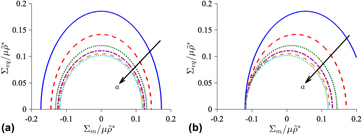
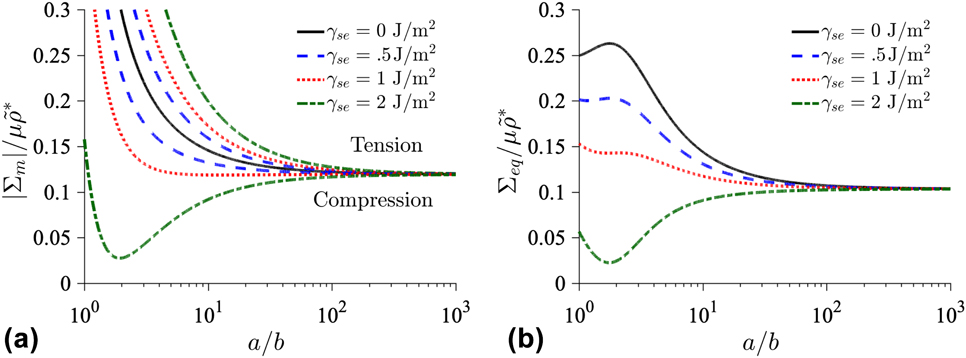
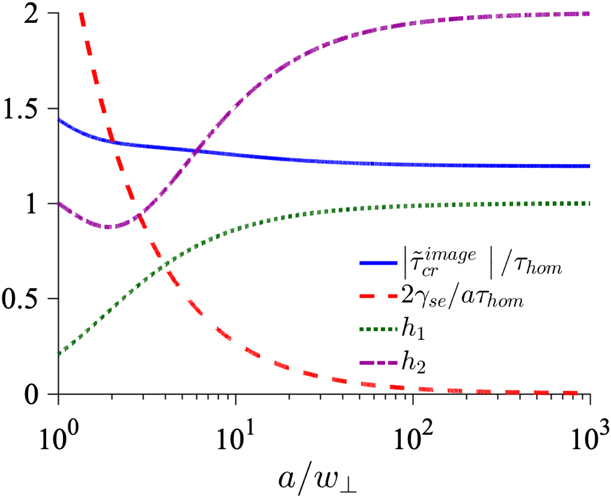
One interesting prediction of our proposed criterion for dislocation emission, i.e., Eq. (6), is a surface-energy-induced tension–compression asymmetry, as reported in some atomistic calculations of nanoporous gold [Reference Farkas, Caro, Bringa and Crowson35, Reference Crowson, Farkas and Corcoran36, Reference Ngô, Stukowski, Mameka, Markmann, Albe and Weissmüller37]. Examining Eq. (6), it is clear that the role of a finite surface energy is simply to shift the center of the emission surface from the origin in the Σm − Σeq stress space by some finite amount in the direction of positive mean stress (with the shift being larger for smaller pore sizes). This is clearly shown in the comparison of the cases of γse = 0, i.e., Fig. 1(a), with γse > 0, i.e., Fig. 1(b). The critical emission surface is symmetric for γse = 0, [Fig. 1(a)], while it is shifted toward positive mean stresses for γse > 0 as in Fig. 1(b). The effect is negligible for larger pore sizes, i.e., a/b ≳ 102, which corresponds to the collapse of the surface tension term γse/a as can be seen in the dashed (red) curve of Fig. 6. Interestingly (for the chosen material parameters utilized here), the surface energy causes the nanoporous material to become nearly size-independent under nearly hydrostatic compression stress states, i.e., Σm < 0 and Σeq ∼ 0. On the other hand, the surface tension causes the nanoporous material to become even more size dependent under nearly hydrostatic tensile stress states, i.e., Σm > 0 and Σeq ∼ 0. In general, a high surface energy results in a strengthening effect under tensile stress states, but a weakening effect under both pure deviatoric and compressive states.
Size dependence of porous critical emission surface, i.e., Eq. (6), with (a) no surface energy, i.e., γse = 0, and (b) finite surface energy of γse = 1 J/m2. The arrows indicate increasing pore size varying as a/b = {3; 5; 10; 25; 100; 1000}.
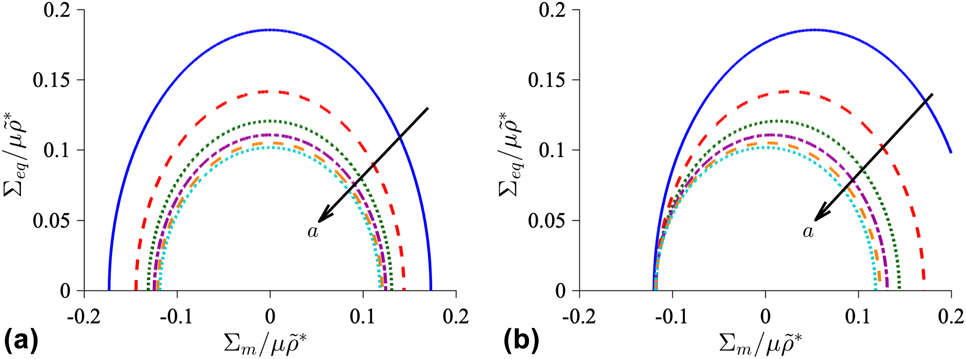
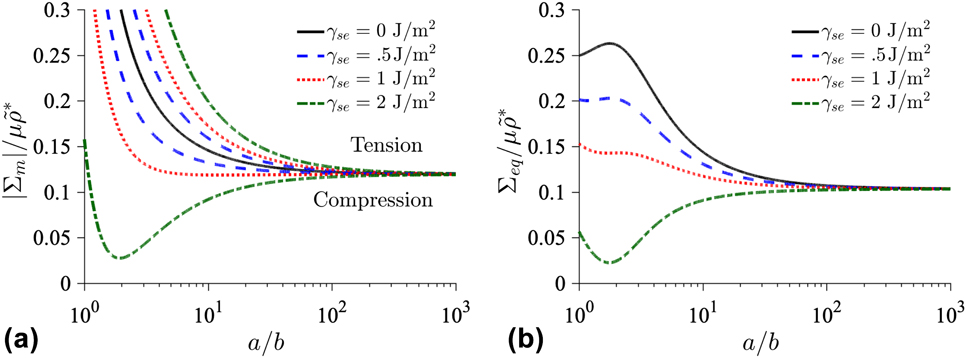
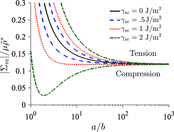
A second interesting prediction of the Wilkerson and Ramesh [Reference Wilkerson and Ramesh31] criterion for dislocation emission is a potential anomalous size effect, with nanoporous materials becoming less resistant to dislocation emission at small pore sizes (under certain conditions). Recall again that the surface energy essentially shifts the center of the emission surface by some finite amount in the positive mean stress direction; see Fig. 1. The higher the surface tension γse/a, the greater this shift. At some point, γse/a may in principle be so large that its size effect dominates the behavior rather than the size effects associated with mean and deviatoric stress modifiers (h 1 and h 2). In this case, it is possible for the material to be less resistant to dislocation emission with decreasing pore size, i.e., smaller is weaker, at low triaxialities, i.e., Σm/Σeq ≲ 0. Such a behavior is demonstrated in Fig. 2 for the highest surface energy considered (γse = 2 J/m2). According to the theory under pure hydrostatic compression, i.e., Σm < 0 and Σeq = 0, a dislocation-starved nanoporous material with a high surface energy (e.g., γse ≳ 1.5 J/m2) is expected to exhibit a nonmonotonic size dependence with the material first weakening with decreasing pore size before strengthening at very small pore sizes (e.g., a/b ≲ 2–3), as shown by the lower dotted-dashed (green) line in Fig. 2(a). This same nonmonotonic size dependence is also observed under pure deviatoric loading, i.e., Σm = 0, as shown in the dotted-dashed (green) line in Fig. 2(b). Note that these are extremely small pore sizes. At high stress triaxialities, this anomalous size effect of smaller is weaker vanishes regardless of the magnitude of the surface energy. That said, the magnitude of the surface energy affects the magnitude of the size dependence at high stress triaxialities, as shown by the upper lines in Fig. 2(a).
Size effect associated with the critical stress required for dislocation emission (a) under pure macroscopic hydrostatic tension and compression, i.e., Σm > 0 and Σm < 0 with Σeq = 0, and (b) under pure macroscopic hydrostatic loading, i.e., Σm = 0.
Effect of nonlinear elasticity on tension–compression asymmetry
The nanoporous materials analyzed in this paper are subject to a fairly large elastic deformation prior to dislocation emission. Under these large stresses, e.g., Σm ∼ 0.1 μ, nonlinear elastic effects may not be negligible, even in nanoporous metals. For simplicity, we limit ourselves here to a pressure-dependent shear modulus and ignore the pressure dependence of the Poisson ratio ν and the surface energy γse (as well as the magnitude of the Burgers vector b), i.e.,
 $$\mu = {\mu _0} + {{\partial \mu } \over {\partial p}}p\quad ,$$
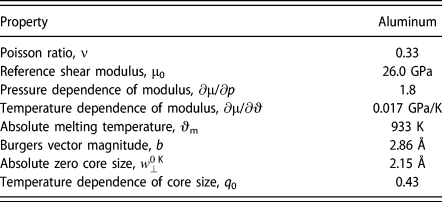
with μ0 being the shear modulus at ambient pressure, i.e., p = 0. Representative values for these parameters are provided in Table I. According to [Reference Wilkerson42], the relationship between the local compressive pressure at the location of dislocation emission and the macroscopic loading may be obtained as
 $$p = - {{{\Sigma _{\rm{m}}}} \over {1 - \tilde{\varphi }}} + {4 \over 3}{{{a^2}} \over {{a^2} + w_ \bot ^2 + \sqrt 2 a{w_ \bot }}}{{{\Sigma _{{\rm{eq}}}}} \over {1 - \tilde{\varphi }}}\quad ,$$
noting that the stress field associated with the surface energy does not contribute to the local hydrostatic pressure.
Thermoelastic properties of aluminum taken from [Reference Peng, Jing, Li and Wang41] with dislocation emission model parameters taken from [Reference Wilkerson and Ramesh31].
The tension–compression asymmetry in size effects presented in Fig. 2 was induced by surface energy. A second source of tension–compression asymmetry results from the pressure dependence of the shear modulus. In our analysis of dislocation emission, the shear modulus scales the magnitude of the image shear stress  $\left| {\tilde{\tau }_{{\rm{cr}}}^{{\rm{image}}}} \right|$ associated with the interaction of the emitting dislocation and the pore surface; see Eq. (7). Since the image force provides the primary resistance to dislocation emission, a higher applied macroscopic load is naturally required to overcome a higher image shear stress. For most materials ∂μ/∂p > 0, and hence a higher shear modulus and thus a higher image shear stress
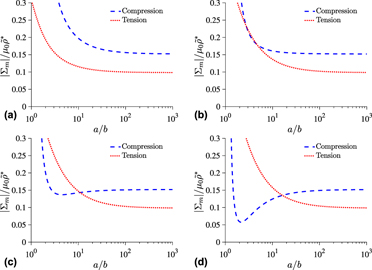
 $\left| {\tilde{\tau }_{{\rm{cr}}}^{{\rm{image}}}} \right|$ will be induced by a local compressive hydrostatic pressure, i.e., p > 0. On the other hand, a lower shear modulus and thus a lower image shear stress is induced by a local tensile pressure, i.e., p < 0. Therefore, ignoring for the moment the effect of surface energy, a lower macroscopic load is required for dislocation emission when the local pressure where dislocation emission occurs is tensile, i.e., p < 0, as compared with compressive, i.e., p > 0. This tension–compression asymmetry induced by the pressure-dependent shear modulus is shown in Fig. 3(a) for the case of nil surface energy, i.e., γse = 0. Unlike the case shown in Fig. 2, the tension–compression asymmetry induced by the pressure-dependent shear modulus is largely size independent and persists even for large pore sizes (provided the nanoporous material remains dislocation starved).
Size effect associated with the critical stress required for dislocation emission considering a pressure-dependent shear modulus, i.e., ∂μ/∂p = 1.8, as a function of surface energy: (a) γse = 0 J/m2; (b) γse = 1 J/m2; (c) γse = 1.5 J/m2; and (d) γse = 2 J/m2.
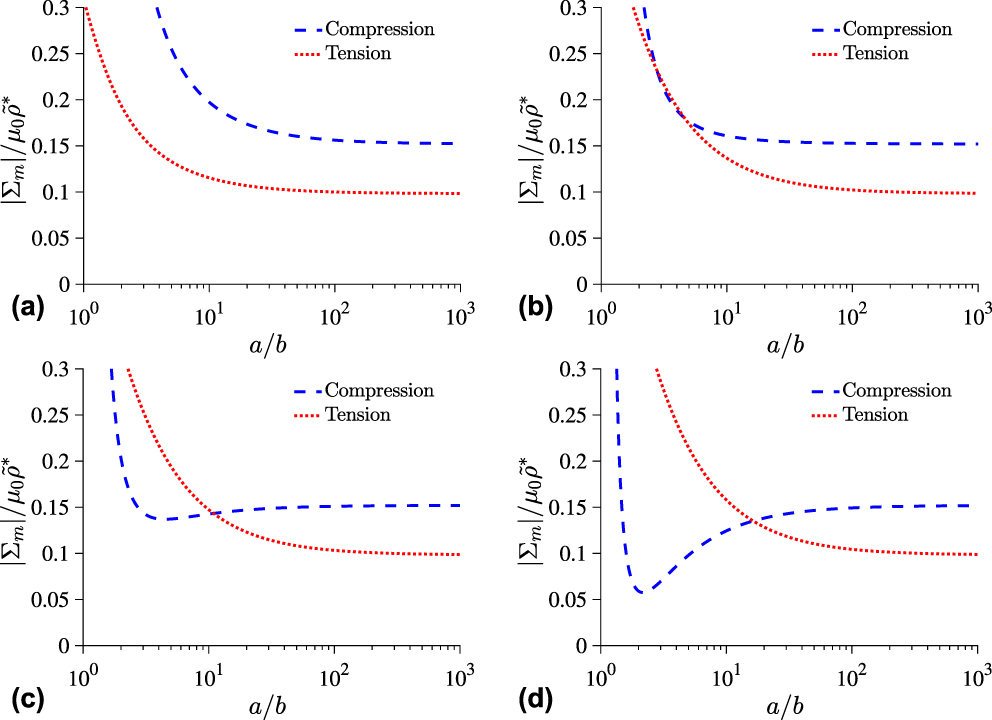
Surface tension and the pressure dependence of the shear modulus affect the tension–compression asymmetry of dislocation emission in different ways. Recall from Fig. 1(b) that surface energy tends to shift the center of the critical emission surface in the positive (tensile) mean stress direction. The result of this is that surface energy causes nanoporous materials to be more resistant to dislocation emission in tension, but less resistant in compression. The tendency is opposite for the effects of the pressure dependence of the shear modulus, with tension being weaker than compression. Considering the effects of both surface tension and a pressure-dependent shear modulus, it is not immediately clear which mechanism will govern the tension–compression asymmetry. Figure 3 demonstrates this competition between the surface energy-induced and pressure-dependent shear modulus-induced tension–compression asymmetry associated with dislocation emission as a function of pore size for four different surface energies. As expected, for high surface energies and very small pore sizes, the material is more resistant to dislocation emission (stronger) in tension than in compression. However, for larger pore sizes (for which the surface energy term γse/a dies out) or for lower surface energies (regardless of the pore size), the material is more resistant to dislocation emission (stronger) in compression as compared with tension. For many realistic values of γse and ∂μ/∂p, the tension–compression asymmetry associated with dislocation emission is dominated by the pressure dependence of the shear modulus, and thus we may expect some nanoporous materials to be stronger in compression than tension. For example, the model predicts that nanoporous copper, for which γse = 1.8 J/m2 [Reference Vitos, Ruban, Skriver and Kollar43] and ∂μ/∂p = 1.25 [Reference Peng, Jing, Li and Wang41], will be stronger in compression than in tension. This claim is also supported by molecular dynamics calculations of [Reference Zhao, Fan and Chen44], which observed that dislocation-starved (open-cell) nanoporous copper is roughly 30% stronger in compression than in tension.
Anomalous temperature dependence of nanoporous materials
Due to their low density, high strength, and multifunctionality, nanoporous materials are likely to be used in applications with a range of temperatures. Here, we consider the temperature dependence of dislocation emission and its implications on size effects in nanoporous materials. Four material properties (μ, ν, γse, and w ⊥) enter into the emission criterion. In general, all of these material parameters are likely sensitive to the local temperature. Here we limit ourselves to a temperature-dependent shear modulus μ and a temperature-dependent dislocation core size w ⊥.
The shear modulus of most materials softens with increasing local absolute temperature ϑ, i.e.,
 $$\mu = {\mu _0} + {{\partial \mu } \over {\partial \vartheta }}\left( {\vartheta - {\vartheta _0}} \right)\quad ,$$
with μ0 being the shear modulus at ambient temperature, i.e., ϑ0 = 300 K. Representative values for this parameter is provided in Table I. Similarly to the pressure dependence of the shear modulus in tension, the temperature dependence of the shear modulus results in a reduction of the magnitude of the image shear stress with increasing temperature (regardless of stress state). Since the image shear stress provides the primary resistance to dislocation emission, the temperature dependence of the shear modulus will naturally cause the nanoporous material to be less resistant to dislocation emission at higher temperatures.
Molecular dynamics calculations have demonstrated that the temperature dependence of dislocation emission is stronger than the temperature dependence of the shear modulus alone. As such, Wilkerson and Ramesh [Reference Wilkerson and Ramesh31] introduced the concept of a temperature-dependent dislocation core size, i.e.,
 $${1 \over {{w_ \bot }}} = {1 \over {w_ \bot ^{0\;{\rm{K}}}}}\left( {1 - {q_0}{\vartheta \over {{\vartheta _{\rm{m}}}}}} \right)\quad ,$$
where  $w_ \bot ^{0\;{\rm{K}}}$ is the value of the dislocation core size at absolute zero, q 0 is a fitting constant, and ϑm is the absolute melting temperature. Accounting for the temperature dependence of both the shear modulus and the core size, Wilkerson and Ramesh [Reference Wilkerson and Ramesh31] reported values of q 0 that bring the theoretical model into good agreement with the molecular dynamics predictions of homogeneous dislocation under simple shear loading [Reference Iskandarov, Dmitriev and Umeno45].
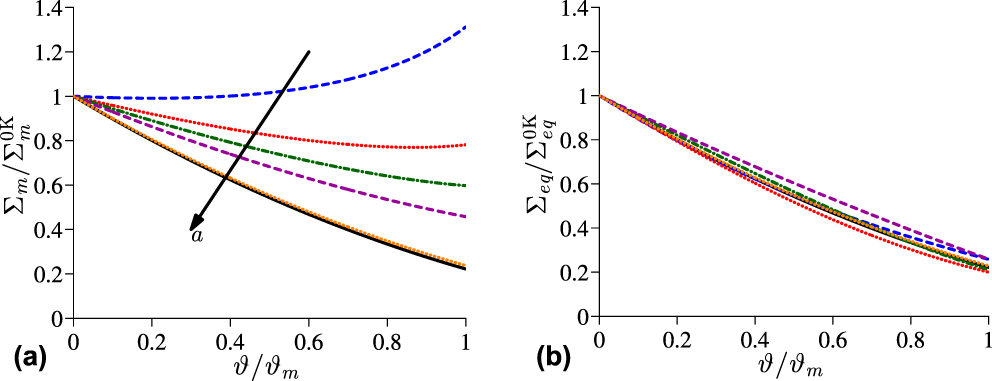
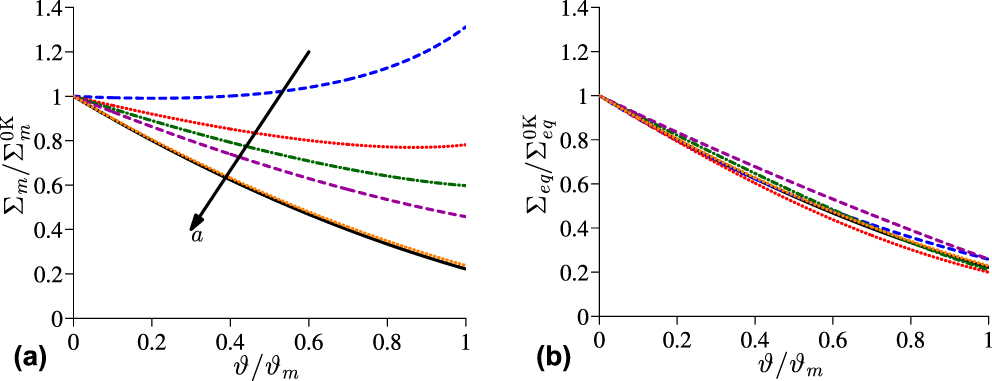
Figure 4 provides predictions of the critical stresses required for dislocation emission as a function of temperature accounting for a temperature-dependent shear modulus, i.e., Eq. (3), and a temperature-dependent dislocation core size, i.e., Eq. (4). For sufficiently large pore sizes, i.e., a/w ⊥ ≳ 102, the critical macroscopic stress required for emission is simply proportional to the ratio of the shear modulus and the dislocation core size, as can be seen by taking the limit of Eq. (7) as a/w ⊥ → ∞. As a consequence, the temperature dependence of the critical macroscopic stress required for dislocation emission from large pores is identical to that of homogeneous nucleation, i.e., ∝(μ0 + ∂μ/∂ϑ(ϑ − ϑ0)) (1 − q 0ϑ/ϑm), as shown by the solid (black) lines in Fig. 4. However, in the case of very small pores, i.e., a/b ≲ 2, a nonintuitive, anomalous temperature dependence of the critical emission stress is predicted as a consequence of the temperature-dependent core size characterized by Eq. (4). This anomalous temperature dependence is shown in Fig. 4(a) for the case of pure macroscopic hydrostatic tension, i.e., Σm > 0 with Σeq = 0. Under conditions in which the magnitude of the triaxiality is high, i.e., |Σm/Σeq| ≳ 10, the anomalous temperature dependence is significant, and dislocation-starved nanoporous materials with extremely small pore sizes, i.e., a/b ≳ 2, actually become more resistant to dislocation emission at higher temperatures, according to the theory. This result is quite unexpected, and it would be interesting to carry out a suite of atomistic calculations to further investigate this unexpected phenomenon. That said, the simple temperature dependencies in Eqs. (3) and (4) are unlikely to hold at high temperatures, and a more sophisticated model is likely needed for temperatures approaching melting. Interestingly, this anomalous temperature dependence completely vanishes (regardless of pore size) for cases in which the magnitude of the triaxiality is low, i.e., |Σm/Σeq| ∼ 0, as shown in Fig. 4(b).
Size effect associated with the temperature dependence of the critical stress required for dislocation emission under (a) pure hydrostatic tension, i.e., Σm > 0 with Σeq = 0, and (b) pure deviatoric stress, i.e., Σm = 0. The arrows indicate increasing pore size varying as a/b = {1; 2; 3; 5; 100; ∞}.
Spontaneous emission of dislocations and unstable collapse of nanopores
It has long been known that wires tend to spontaneously contract unless they are subject to a longitudinal tensile stress of at least γse/r where r is the wire radius [Reference Udin, Shaler and Wulff46, Reference Buttner, Udin and Wulff47]. More recently, atomistic calculations demonstrated a spontaneous phase transformation in nanowires [Reference Diao, Gall and Dunn48, Reference Liang, Zhou and Ke49] and spontaneous plasticity in nanoporous gold [Reference Farkas, Caro, Bringa and Crowson35, Reference Ngô, Stukowski, Mameka, Markmann, Albe and Weissmüller37, Reference Diao, Gall, Dunn and Zimmerman40, Reference Crowson, Farkas and Corcoran50], which can trigger the spontaneous collapse of the nanopores. To some extent, this collapse of nanopores may be inferred from experiments observing spontaneous volume change during processing of nanoporous gold [Reference Parida, Kramer, Volkert, Rösner, Erlebacher and Weissmüller51]. That said, there are few theoretical models capable of predicting this phenomenon.
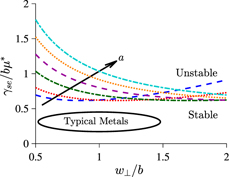
Consider again Fig. 1(b), and the shift in the emission surface caused by the surface tension term γse/a. If this surface tension is large enough, then it is possible for the entire emission surface to shift to the right of the origin (defined by all macroscopic stresses equal to zero). In this case, the point of zero applied macroscopic loading lies outside the critical emission surface and dislocation emission occurs spontaneously. Furthermore, this spontaneous collapse would be unstable if the surface tension 2γse/a driving spontaneous emission increases faster with decreasing pore size a than does the critical resistance, i.e.,  $h_1^{ - 1}\left| {\tilde{\tau }_{{\rm{cr}}}^{{\rm{image}}}} \right|$.
Here, the condition for spontaneous dislocation emission may be obtained by setting all macroscopic stresses equal to zero in the critical emission surface [Eq. (6) with ΦEm = 0], i.e.,
 $$\eqalignb{{{{\gamma _{{\rm{se}}}}} \over {b{\mu ^*}}} = {1 \over 8}{{{{\left( {{a^2} + w_ \bot ^2 + \sqrt 2 a{w_ \bot }} \right)}^2}} \over {{a^2}{w_ \bot }\left( {a + \sqrt 2 {w_ \bot }} \right)}}\cr\left\{ {{{\sqrt 2 a + 2{w_ \bot }} \over {\sqrt 2 a + {w_ \bot }}} - {{{a^2}w_ \bot ^2\left( {\sqrt 2 a + {w_ \bot }} \right)\left( {\sqrt 2 a + 2{w_ \bot }} \right)} \over {{{\left( {{a^2} + w_ \bot ^2 + \sqrt 2 a{w_ \bot }} \right)}^3}}}} \right\}\quad ,$$
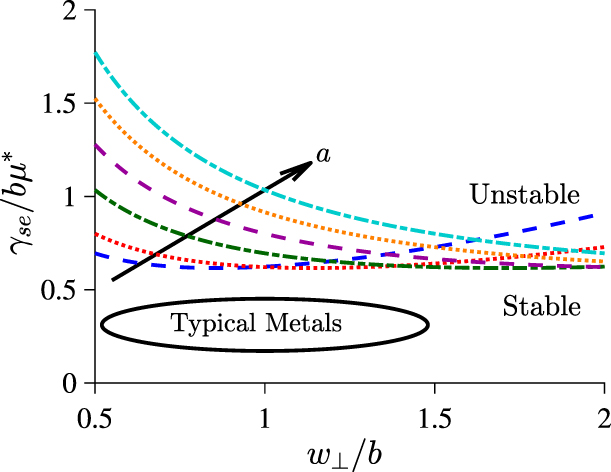
where the right-hand side of this criterion for spontaneous emission is simply a combination of the various physical and nondimensional length scales associated with dislocation emission. Figure 5 provides a stability map for spontaneous dislocation emission computed from Eq. (5). The area above the various curves in Fig. 5 identifies regions where the nondimensional material parameter γse/bμ* is large enough to permit spontaneous dislocation emission. For reference, the typical properties associated with pure face-centered cubic metals fall within the indicated ellipse in Fig. 5; see [Reference Vitos, Ruban, Skriver and Kollar43]. It is relatively easy to create an interatomic potential, e.g., [Reference Crowson, Farkas and Corcoran50], for which the surface energy is sufficiently high such that γse/bμ* ≳ 0.7. Such a material is expected to exhibit this phenomenon of spontaneous dislocation emission and subsequent unstable collapse of any nanopores. Molecular dynamics calculations [Reference Farkas, Caro, Bringa and Crowson35, Reference Ngô, Stukowski, Mameka, Markmann, Albe and Weissmüller37, Reference Crowson, Farkas and Corcoran50] have observed spontaneous plasticity and pore collapse in nanoporous gold with ligament sizes below a few nanometers, which is in reasonably good agreement with the proposed analytic criterion, i.e., Eq. (5).
A stability map identifying the regions in which nanopores and vacancy clusters may spontaneously emit dislocations, thereby collapsing unstably in the absence of applied macroscopic loading. The conditions for spontaneous emission depend strongly on the dislocation core size w ⊥, the surface energy γse, and the effective modulus μ*. For reference, the typical properties associated with typical metals fall within the indicated ellipse; see [Reference Vitos, Ruban, Skriver and Kollar43]. The arrow denotes increasing pore size varying as a/b = {1.5, 2, 3, 4, 5, 6}.
Summary of key findings
Here we have utilized the Wilkerson and Ramesh [Reference Wilkerson and Ramesh31] dislocation emission theory to explore the implications of high surface energies on the mechanical behavior of dislocation-starved nanoporous materials. In particular, we have predicted and partially explained some interesting and perhaps nonintuitive phenomena, i.e.,
(i) Tension–compression asymmetry with dislocation-starved nanoporous materials resisting dislocation emission differently in compression and tension depending on the competition between surface tension and nonlinear stiffness.
(ii) Anomalous size effects in the compressive strength of dislocation-starved nanoporous materials with sufficiently large surface energies (e.g., γse ≳ 1.5 J/m2) is anticipated to decrease with decreasing pore/ligament size, i.e., smaller is weaker.
(iii) An anomalous temperature dependence is predicted for the resistance to dislocation emission in nanoporous materials with extremely small pore sizes, i.e., a/b ≲ 2, subject to near-hydrostatic compression and near-hydrostatic tension stress states.
(iv) Spontaneous dislocation emission in nanoporous materials with relatively high surface energies and relatively low stiffness such that the nondimensional parameter γse/bμ* is approximately greater than 0.7.
A physics-based model for the strength of dislocation-starved nanoporous materials
Similar to many of the scaling laws for nanoporous materials, the Wilkerson and Ramesh [Reference Wilkerson and Ramesh31] model utilizes two geometric factors to describe the microstructure of the nanoporous material, i.e.,
(i) effective pore size, a, and
(ii) porosity (pore volume fraction), φ,
Which can be equivalently represented as the effective ligament size λ and relative density ρ*, e.g., ρ* = 1 − φ. However, the Wilkerson and Ramesh [Reference Wilkerson and Ramesh31] model makes use of a more fundamental set of four (isotropic, linear elastic) material properties of the solid (bulk) phase of the material, i.e.,
(i) surface energy, γse,
(ii) shear modulus, μ,
(iii) Poisson’s ratio, ν, and
(iv) dislocation core size, w ⊥.
It should be noted that the yield strength of the bulk material σy does not enter into the Wilkerson and Ramesh [Reference Wilkerson and Ramesh31] model, since the nanoporous material is assumed to be dislocation starved within the nanosized ligament. According to Wilkerson and Ramesh [Reference Wilkerson and Ramesh31], the radius of a dislocation core (w ⊥) is considered to be (approximately) the maximum distance from the pore surface that a dislocation nucleus can momentarily achieve via a rare thermal excitation. When a dislocation nucleus is spatially perturbed by such a rare thermal excitation, it may find itself in a new location where the local Peach–Koehler forces pushing the dislocation away from the pore surface exceed the image Peach–Koehler forces pulling it back to the pore surface. The Wilkerson and Ramesh [Reference Wilkerson and Ramesh31] model treats this physical situation as the necessary criterion for spontaneous dislocation, which is mathematically consistent with that of [Reference Rice and Thomson52] and [Reference Lubarda, Schneider, Kalantar, Remington and Meyers21].
According to [Reference Wilkerson and Ramesh31], the criterion for dislocation emission may be expressed in a closed manner as
 $${\Phi _{{\rm{Em}}}} = h_1^2{\left| {{{{\Sigma _{\rm{m}}}} \over {{{\tilde{\rho }}^*}}} - 2{{{\gamma _{{\rm{se}}}}} \over a}} \right|^2} + {\left( {{{{h_2}} \over {\sqrt 3 }}{{{\Sigma _{{\rm{eq}}}}} \over {{{\tilde{\rho }}^*}}}} \right)^2} - {\left| {\tilde{\tau }_{{\rm{cr}}}^{{\rm{image}}}} \right|^2}\quad ,$$
where the dislocation emission becomes active for ΦEm ≥ 0. The first term in Eq. (6) is related to the Peach–Koehler forces generated by surface tension, i.e., γse/a and hydrostatic mean stress, i.e.,  ${\Sigma _{\rm{m}}} \equiv {1 \over 3}{\rm{tr}}{\bf{\Sigma }}$ with Σ denoting the applied macroscopic stress tensor. The second term is related to the Peach–Koehler forces generated by the applied macroscopic deviatoric stress, i.e., Σ′≡Σ − ΣmI with
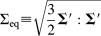 ${\Sigma _{{\rm{eq}}}} \equiv \sqrt {{3 \over 2}{\bf{\boldSigma ′}}:{\bf{\boldSigma ′}}}$. The third term in Eq. (6) is the image shear stress that works to pull a dislocation nucleus back to the pore surface. The relative density dependence is accounted for by
 ${\tilde{\rho }^*}$, i.e.,
 ${\tilde{\varphi }^{ - 1}} \equiv 1 + {2 \over 3}\root 3 \of {{1 / {{\varphi ^2}}}} - {2 \over 3}\root 3 \of \varphi$ with
 ${\tilde{\rho }^*} \equiv 1 - \tilde{\varphi }$.
Following [Reference Dundurs and Mura53] and [Reference Lubarda54], the image shear stress at the location of dislocation emission may be expressed as
 $$\eqalign{\left| {\tilde{\tau }_{{\rm{cr}}}^{{\rm{image}}}} \right| = {{{\mu ^*}} \over 4}{b \over {{w_ \bot }}} \cr\times \left\{ {{{\sqrt 2 a + 2{w_ \bot }} \over {\sqrt 2 a + {w_ \bot }}} - {{{a^2}w_ \bot ^2\left( {\sqrt 2 a + {w_ \bot }} \right)\left( {\sqrt 2 a + 2{w_ \bot }} \right)} \over {{{\left( {{a^2} + w_ \bot ^2 + \sqrt 2 a{w_ \bot }} \right)}^3}}}} \right\}\quad ,$$
where μ* = μ/π(1 − ν) and the Burgers vector magnitude is denoted as b. As the pore size a decreases, the image shear stress increases; however, this size effect is fairly weak in comparison to the size effect associated with surface tension, i.e., γse/a, as shown in Fig. 6. Material properties representative of aluminum are provided in Table I, and are utilized here unless otherwise noted. It should be noted that dislocation nucleation in many face-centered cubic materials may involve partial dislocations and stacking faults. One limitation of the present model is its inability to account for such nucleation processes. That said, aluminum is a high stacking fault energy material for which dissociation into partials is energetically unfavorable.
Various physical and nondimensional length scales that govern the size effects associated with the critical macroscopic stress required for dislocation emission, i.e., Eq. (6). Here τhom = μ/10 is utilized as a normalizing parameter for the surface tension term (with γse = 1 J/m2) and the critical image shear stress  $\left| {\tilde{\tau }_{{\rm{cr}}}^{{\rm{image}}}} \right|$ defined in Eq. (7) (with w ⊥ = b here). The nondimensional stress modifiers h 1 and h 2 govern the magnitude of the local stresses at a distance w ⊥ from the pore surface, and are defined in Eqs. (8) and (9).
In addition to the size effect associated with surface tension, an additional size effect is introduced by nondimensional stress modifiers h 1 and h 2, which convert the macroscopic applied stress into a local resolved shear stress (on the glide plane of interest) at the particular location where dislocation emission occurs. The pore acts as a shear stress concentrator, and the stress concentration is generally larger for larger pore sizes. The stress modifiers may be expressed in the functional form as
 $${h_1} = {{{a^3}\left( {a + \sqrt 2 {w_ \bot }} \right)} \over {{{\left( {{a^2} + w_ \bot ^2 + \sqrt 2 a{w_ \bot }} \right)}^2}}}\quad ,$$
 $$\eqalign{{h_2} = \cr1 + {{{a^2}\left( {{a^2} - 2w_ \bot ^2 - 2\sqrt 2 a{w_ \bot }} \right)\left( {{a^4} - w_ \bot ^4 + 2\sqrt 2 {a^3}{w_ \bot } - 2\sqrt 2 aw_ \bot ^3} \right)} \over {{{\left( {{a^2} + w_ \bot ^2 + \sqrt 2 a{w_ \bot }} \right)}^4}}}\quad .$$
As the pore size a increases, the mean stress modifier h 1 smoothly increases from 0 to 1, and the deviatoric stress modifier increases (nonmonotonically) from 1 to 2, as shown in Fig. 6. It should be noted that the stress modifiers are precisely derived from the analytic solutions of the local stress fields associated with a porous medium subject to an applied (far-field) multiaxial stress state; see [Reference Wilkerson and Ramesh31].
Having provided a brief overview of the key physics governing the Wilkerson and Ramesh [Reference Wilkerson and Ramesh31] model, the reader is referred to section “Model predictions and discussion” which explores some interesting theoretical predictions of the model. For example, anomalous size effects and temperature dependencies are predicted. In addition, a tension–compression asymmetry is predicted to be induced by surface tension. As a final note, it is worth acknowledging some of the key limitations of the Wilkerson and Ramesh [Reference Wilkerson and Ramesh31] model, e.g.,
(i) The current model is unable to predict the full stress–strain response of nanoporous materials, and as such no model comparisons can be made with experimental measurements of the plastic Poisson ratio; e.g., [Reference Lührs, Zandersons, Huber and Weissmüller33].
(ii) The model is limited to dislocation-starved nanoporous materials with little to no preexisting dislocations.
(iii) The details of the crystallographic slip system are neglected.
(iv) The model does not account for grain boundaries, twins, partial dislocations, or stacking faults.
(v) Model predictions are deterministic, despite the fact that nucleation processes tend to be stochastic in nature.
Acknowledgments
The material is based upon work supported by the Army Research Laboratory under the MEDE Collaborative Research Alliance through Cooperative Agreement Number W911NF-12-2-0022. The views and conclusions contained in this document are those of the authors and should not be interpreted as representing the official policies, either expressed or implied, of the Army Research Laboratory or the U.S. Government. The U.S. Government is authorized to reproduce and distribute reprints for government purposes notwithstanding any copyright notation herein.