What measures our distance above the beasts that perish consists in these three things – ethics, intellect, the sense of beauty. . . . On the third [our existing morality] lays no stress at all; and herein the new hedonism has its raison d’être. It is part of its mission to point out to humanity that literature, poetry, painting, sculpture, the beautifying of life by sound, and form, and word, and colour, are among the most important tasks of civilization.
— Grant Allen, “The New Hedonism” (1894), p. 382
Even a colour-sense is more important, in the development of the individual, than a sense of right and wrong. Aesthetics, in fact, are to Ethics in the sphere of conscious civilization, what, in the sphere of the external world, sexual is to natural selection. Ethics, like natural selection, make existence possible. Aesthetics, like sexual selection, make life lovely and wonderful, fill it with new forms, and give it progress, and variety and change.
— Oscar Wilde, “The Critic as Artist” (1890, rev. 1891), p. 204
In his provocative polemic “The New Hedonism,” Grant Allen mounts a passionate defense of fin-de-siècle aestheticism by proposing a modern ethic – the titular “new hedonism,” which he borrows from Oscar Wilde's novel The Picture of Dorian Gray (1890, rev. 1891) – that fully synthesizes aestheticism's insights with up-to-date scientific knowledge.Footnote 1 At first glance, Allen seems an unexpected ally for Wilde, in part because few literary historians have explored the link between the two contemporaries. Many modern-day scholars of Allen's work (including Peter Morton, Bernard Lightman, William Greenslade, and Terence Rodgers) have tended to focus on his popular science writing, his elaborations on Herbert Spencer's evolutionary theories, and his controversial “New Woman” novels The Woman Who Did (1895) and The Type-Writer Girl (1897).Footnote 2 Those who do connect Allen and Wilde, such as Nick Freeman, often draw the relationship into focus through the two writers’ shared interest in libertarian socialism rather than their overlapping philosophical and aesthetic concerns (111–28). Yet, as we can begin to see in the epigraphs, the association that Allen made between evolutionary progress and the “beautifying of life” echoes one of the most significant claims of Wilde's earlier, dialogic essay, “The Critic as Artist.” “Aesthetics,” Wilde's speaker, Gilbert, enthuses, “like sexual selection, make life lovely and wonderful, fill it with new forms, and give it progress, and variety and change” (“The Critic as Artist” 204). Allen's survey of human evolutionary history reminds him, too, that our cultural and artistic achievements are all that lift us “above the beasts that perish” (382). For both writers, then, aestheticism's commitment to beauty, “self-development,” and the emancipated pursuit of pleasure entails potentially sweeping consequences for the future evolution of humankind.Footnote 3 Allen's vocal support for Wilde – which Allen expressed privately in letters as well as publicly in his 1891 article “The Celt in English Art” – was not simply a convenient political alliance, but an integral part of Allen's complete program for sociocultural improvement.
In this essay, I argue that both Allen and Wilde relied on evolutionary discourses to theorize forms of generative “hedonism”: a rational ethics that posited artistic and sexual self-determination as the avenue toward what Wilde called a “saner, healthier, more civilized” species (“The Soul of Man” 267). First, I examine Allen's scientific aesthetics and the incisive social critique that his aesthetics engendered. Though he soon abandoned scientific practice for scientific journalism, Allen had nevertheless initiated certain trends that continued to surface in aesthetics throughout the century, especially in Vernon Lee's work (Morton, “Biographical Essay” 2). As Regenia Gagnier has demonstrated, Allen's “physiological aesthetics” – his term for the study of aesthetic feeling as a corporeal phenomenon – presided over a major late-century shift toward an aesthetics of pleasurable consumption (The Insatiability 11, 139–40). More precisely, Allen's early works formulated and popularized a science of aesthetics that valued beauty and sexual desire for their civilizing, counter-competitive mental and bodily effects.
Thereafter, I consider Wilde's own debts and contributions to this evolutionary aesthetic tradition. By exploring the connection between Allen and Wilde (an approach that their mutual admiration and correspondence justifies), we see that aestheticism in fin-de-siècle Britain acquired a utopian cast within this multidisciplinary debate about the nature of aesthetic experience and its value for cultural progress. Allen and Wilde characterized hedonism as a revolutionary creed that would bring about the systemic reorganization of all aspects of society, from marriage to the economy: to cultivate and express freely one's taste (whether in art, political movements, or sexual partners) was the first step toward the “realization of utopia” that Wilde equated with progress (“The Soul of Man” 247).Footnote 4 In this way, the two writers anticipated radical social changes that depended not on Victorian reform campaigns – freighted with what Lawrence Goldman describes as a toxic “mixture of sympathy and coercion” (146) – but on individual choices compounded by evolutionary processes. I conclude by considering the ways in which Allen's and Wilde's respective hedonisms resonate in our own day, particularly in new ethical approaches to consumerism that Kate Soper has termed “alternative hedonism” (“Alternative Hedonism” 567).
***
Though relatively obscure today, Allen was ubiquitous in the British press in the 1880s and 1890s. Born in 1848 to a prosperous Irish-Canadian family, Allen's early successes at Yale and Oxford evaporated after his disastrous first marriage, which he contracted out of principle rather than affection.Footnote 5 Newly remarried and desperate for work, Allen accepted a professorship at a government college in Spanish Town, Jamaica, in 1873. By all accounts, Allen struggled to adjust to life in Jamaica, but his light teaching responsibilities left him abundant time for his own pursuits: his studies in political economy, biology, and philosophy further cemented his youthful radicalism, while his undergraduate interest in the liberalism of Herbert Spencer grew into an intense admiration for the philosopher's entire evolutionary doctrine (in Morton's words, evolutionism became in this time Allen's “rational religion, and Herbert Spencer was its messiah” [“Biographical Essay” 25]). In 1876, Allen returned to London to make his living through writing. His first publications, which included specialized monographs on botany and physics, proved unprofitable, and he soon entered the more lucrative world of print journalism. Despite his vexed relationship with the industry – perhaps best illustrated in his first novel, Philistia (1884), in which a newspaper editor repeatedly bowdlerizes the work of an idealistic writer in order “to suit the taste of our public” (73; vol. 3, ch. 28) – Allen thrived in this milieu. Before his death in 1899, Allen published over thirty fiction and nonfiction books, dozens of short stories, several volumes of poetry, and hundreds of articles on topics as varied as biology, history, ethics, sociology, anthropology, and art history (Morton, “Biographical Essay” 23–28). Over the course of his astoundingly prolific career, he contributed to almost every major British periodical of the day, at every level of literary respectability and scientific legitimacy – from the Pall Mall Gazette and Cornhill Magazine to Fortnightly Review and Mind.Footnote 6 One of his many protégés, the bohemian writer Richard Le Gallienne, called him “the most variously gifted man of letters of his time” (1025). While he lacked Wilde's literary reputation, Allen was a similarly divisive figure to the Victorian public, especially once he began making the case against marriage in the 1890s. Feminist historian Lucy Bland counts Allen, along with male “New Woman” novelists such as George Gissing and George Moore, among the most prominent proponents of “free unions” (or what Le Gallienne, in his retrospective on Allen, called “free love” [1014]).Footnote 7 Allen's fame and versatility brought him into contact with many of the enduring scientific and literary figures of his day, including Spencer, Darwin, T. H. Huxley, George Meredith, and H. G. Wells (Morton, Busiest 110).
Like Allen, Wilde was a reluctant journalist: the aesthete published in a variety of periodicals and edited the Woman's World from 1887 until 1889 (Ellmann 286).Footnote 8 (Wilde's experiences as both agent and target of journalistic rumor mongering led him to compare the press to the rack in “The Soul of Man under Socialism” [255].) Allen and Wilde crossed paths at least once during their tenure at the Pall Mall Gazette, when both of them participated in an intimate demonstration of “muscle-reading” at the newspaper's offices in May 1884.Footnote 9 We also know that the two writers read and responded to each other's work, at least as early as the late 1880s. In February 1891, Allen's essay “The Celt in English Art” hailed the “great and victorious aesthetic movement” for its much-needed revolt against “Teutonic dominance” in British art and politics; among the numerous Celtic writers who united radicalism with a decorative aesthetic, Allen reserved special praise for “Mr. Oscar Wilde, . . . whom wise men know for a man of rare insight and strong common sense” (272–73). Wilde's “The Soul of Man” – which drew, in turn, on Allen's “Individualism and Socialism” (1889) – appeared in the same issue of the Fortnightly Review, and letters of appreciation soon crossed each other in the mail. Wilde wrote, “I beg you will allow me to express my delight in your article, with its superb assertion of the Celtic spirit in Art”; an equally effusive Allen called Wilde's “Soul of Man” a “beautiful and noble essay,” and added that he “would have written every line [him]self – if only [he] had known how” (Wilde, Letters 469–70). Allen's and Wilde's mutual admiration appears incongruous on its face, but as Gowan Dawson and Bernard Lightman have observed, the Victorian periodical was an interdisciplinary space in which poets, reformers, naturalists, and philosophers spoke to each other as well as to their audiences (Dawson 17; Lightman 13). In this environment, it was not unusual for an aspiring science writer such as Allen to intervene in discussions about beauty and art.
Allen's wide-ranging interests reflect the fact that aesthetics in the late nineteenth century, as Gagnier and others have shown us, was largely considered a science (Insatiability 130). Furthermore, this science of aesthetics occupied an unusual position in Victorian discourse, uniting issues of cultural improvement with rational accounts of the bodily and psychic experience of pleasure. Around the 1840s, early psychologists such as Alexander Bain and Hermann von Helmholtz began tracing the aesthetic emotions to their roots in the physiology of the brain and nerves. Bain's The Senses and the Intellect (1855), in particular, was one of several important texts from the period that explained the abstract concept of mind in terms of bodily organs (10–28). Charles Darwin's 1871 study The Descent of Man, which supplemented and expanded on his monumental Origin of Species (1859), proposed a corresponding evolutionary explanation of the sense of beauty. In short, Darwin argued that the aesthetic sense arose through sexual selection (Descent 241–46). Unlike natural selection, which operated through the violent competition for resources that he memorably termed the “struggle for existence” (Origin 65), the less destructive process of sexual selection depended on the aesthetic preferences of individual animals; by choosing mates for their ornamental qualities alone, females ensured that these qualities, as well as the taste for them, were passed on to future generations. According to Darwin, beautiful traits such as the peacock's plumage had no practical function beyond the gratification of potential mates, and standards of beauty were entirely determined by the “capricious” desires of the beholder (Descent 116). Importantly for Victorian aesthetics, Herbert Spencer – the polymath whose capacious evolutionary philosophy influenced scientific and metaphysical thought all over the globe (Francis 8) – later adapted Friedrich Schiller's eighteenth-century ideas about “play” to fit within an evolutionary framework. Spencer's Principles of Psychology (1873) classified aesthetic feeling as a salutary play activity by which organisms released superfluous nervous energy; since play offered an escape from the “predatory” activities that survival required, Spencer considered play integral to the wellbeing of the individual and, on a larger scale, the upward evolution of the race (648; vol. 2, ch. 9).
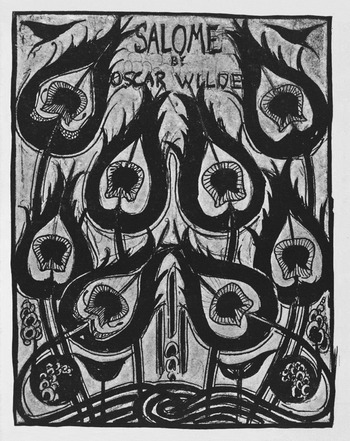
Around the same time that discussions of evolutionism exploded in the public sphere, the cultural critic Walter Pater was composing and publishing the essays that he eventually collected as Studies in the History of the Renaissance (1873) – in many ways the founding document of aestheticism. Several of Pater's essays viewed Renaissance art through the lens of positivist and materialist science, taking into consideration the latest discoveries in psychology and biology. Pater's controversial “Preface” to Studies, for instance, reduced aesthetic feeling to “pleasurable sensations” and denied that beauty had any absolute moral value (xx). On this basis, Pater famously urged his readers to take pleasure in aesthetic “experience itself” rather than its moral or intellectual “fruit[s]”: to “burn always with this hard, gem-like flame,” in Pater's opinion, was the best way to “set the spirit free for a moment” and maximize our transient lives (“Conclusion,” 188–89). Far from a dry academic subject, Victorian aesthetics broached a skein of contentious questions related to sexuality, pleasure, and morality. Not coincidentally, the peacock feather – which to Darwin typified the useless excesses of sexual selection – became a favorite motif of aesthetic and “decadent” artists in the late nineteenth century (Shafe 38, 47–49). Aubrey Beardsley, for instance, incorporated peacock feathers into several of the illustrations he designed for an English translation of Wilde's play Salomé (Figure 6).Footnote 10
Aubrey Beardsley. Illustration for the cover of Salomé by Oscar Wilde. Engraving from Oscar Wilde, Salomé: A Tragedy in One Act (London: John Lane, 1907). Photograph courtesy of the British Library.

Allen made important contributions to these evolutionary accounts of beauty, particularly by aligning the new science of aesthetics with both older hedonic theories of beauty and the embryonic “art for art's sake” movement. His first two books, Physiological Aesthetics (1877) and The Colour-Sense (1879), inquire into the biological origins of art in an attempt to trace the development of aesthetic feelings from “the simple pleasures in bright colour, sweet sound, or rude pictorial imitation, such as delight the child and the savage . . . to the more and more complex gratifications of natural scenery, music, painting, and poetry” (Physiological Aesthetics ix; “Preface”). First and foremost, Allen assumes that the aesthetic sense emerges out of nervous responses to raw impressions: beauty acts upon the body so as to generate the “Maximum of Stimulation with the Minimum of Fatigue or Waste” (39; ch. 3). “Beauty,” from this essentially classical perspective, is a pleasurable physiological response stimulated by objects rather than a quality inherent in objects.Footnote 11 Allen explicitly rests his definition of beauty – which also recalls Immanuel Kant's ideas about the subjectivity of aesthetic taste in The Critique of Judgment (1790) – on the scientific findings of Darwin, Spencer (to whom Allen dedicates Physiological Aesthetics), Bain, and Helmholtz.Footnote 12 More subtly, Allen's interpretation of his philosophical and scientific precedents also reinforces Pater's ongoing critical work. As Gagnier argues, Allen's unique application of Bain's principles furthered an aesthetic paradigm “in which the cultivation of a distinctive ‘taste’ in the consumption of art replaced concern for its producers” (“Production” 136). Allen's emphasis on the subjectivity of aesthetic experience, Gagnier adds, shifted critical focus away from the “productive body” of the artist (the figure of primary interest to earlier nineteenth-century critics such as William Morris and John Ruskin) and toward the “pleasured body” of the spectator (139). Along these lines, Ian Small credits Physiological Aesthetics for clarifying a wide range of psychological research into a single account of aesthetic feeling that “was shared by an entire school of ‘impressionist’ critics,” including Pater, Wilde, and Vernon Lee (75).
Wilde and Lee also adopted strikingly hopeful attitudes toward evolutionary science that they owed, in part, to Allen's investigations into aesthetic pleasure. As we begin to see in Physiological Aesthetics and The Colour-Sense, Allen located utopian potential in aesthetic experience precisely because the perception of beauty offered individuals leverage over sexual selection, for him a more peaceable alternative to the distasteful brutality of natural selection. His tortured subservience to the public taste bred resentment at the constraining influence of market forces on individuals: dependent on the periodical trade for survival, he felt that he had compromised his “original thinking” to appease “two or three bigots among . . . thousands of subscribers” (The British Barbarians 10, 5; “Introduction”). By focusing on an aesthetics of physiological pleasure, however, Allen consciously subverted the cycles of scarcity and competition that drove the Darwinian “struggle for existence” in both nature and the economy. Since we create artworks “expressly for the pleasure which their perception will give us” (37; ch. 3), he writes in Physiological Aesthetics, aesthetic sensation is distinguished by its “disinterestedness and freedom from monopoly” (41; ch. 3). In other words, it is an infinite resource, exempt from the laws of competition that govern natural selection and its counterpart in the laissez-faire marketplace. The Colour-Sense, echoing Spencer as well as Kant, likewise asserts that the human response to pleasing colors has gradually become “more and more divorced from life-serving function with every onward step, until at last the aesthetic sentiment claims to rank with the moral feelings among the most disinterested elements of our nature” (222–23; ch. 12).Footnote 13
As a result, Allen proposes aesthetic education as a means for evolutionary progress that relies neither on unchecked Darwinian struggle nor on utilitarian reform projects (the former mechanism, he believed, subjected personal autonomy to the crushing vicissitudes of life, while the latter sacrificed the wellbeing of the few to the needs of the many). To the contrary, Allen's scientific interpretation of aesthetic taste simultaneously allows for individual whim – the natural consequence of differences in “nervous organization,” environment, and heredity (Physiological Aesthetics 168; ch. 7) – and provides a “relative and temporary standard” for collective improvement in the form of “the judgment of . . . the purest and most cultivated of our contemporaries” (48; ch. 3). He thus attempts to adjudicate a much older debate, one that goes back to the eighteenth-century theories of David Hume and Edmund Burke, concerning the degree to which culture and tradition determine individual taste (Gagnier, Insatiability 136). By reexamining this question in the context of Darwinian sexual selection and Lamarckian models of inheritance – both of which suggest that individual choices can influence future generations – Allen proposes a theory of taste that is both socially generative and individually liberating. While “we cannot transmute our Tastes” in an instant, he reasons in Physiological Aesthetics, we can increase the quality and number of our salutary encounters with the beautiful by deferring to the wisdom of “fine[ly]-nurtured” and exceptionally “discriminative” individuals (48; ch. 3). That is, collective progress occurs through, not in spite of, the diverse and idiosyncratic nature of taste. Gradually, the species inches its way upward in the scale of cultural development through this gentle friction between the “cultivated taste” of the avant-garde and the vulgar “multitude” (Colour-Sense 232; ch. 12).
Given the role that taste plays in human progress, Physiological Aesthetics and The Colour-Sense seek to impress on their readers the ethical ramifications of art, which in its “highest” form is “not merely a means for the gratification of the senses,” but also an appeal to the “nobler sentiments of an all-embracing humanitarianism” (Physiological Aesthetics 216; ch. 9). Allen, we must remember, looks to aesthetic pleasure in order to defend the individual against oppressive external forces: he thus carefully distinguishes the reformist imperative of his aesthetics from a prescriptive moralism, even as he often implies that the experience of aesthetic beauty is an ethical good. In Allen's view, art becomes ethical not by presenting concrete lessons for real life (like Pater, he insists that the “true aesthetic arts” must always present a world “lovelier than reality” [87; ch. 4]) but by “tuning us unconsciously into harmony with whatever is noblest in nature or in man” (216; ch. 9). His musical metaphor remakes the aesthetic consumer's body into an instrument upon which sense impressions play, producing either sweet or discordant results. This description of attunement arguably presents a version of aesthetic experience that is both more spiritualized and more ambitious than Gagnier's paradigm of the “pleasured body”: beautiful objects affect spectators on a physiological level far below conscious thought, and they do not merely please the senses but also condition the whole person for the forms of disinterested sympathy that an “all-embracing humanitarianism” requires. (Interestingly, Allen's humanitarian turn also allies him more closely with Ruskin than either writer might have liked: Allen candidly contradicted Ruskin on many aesthetic and political issues, but here Allen seems to affirm the philanthropic aspect of Ruskin's aesthetic theory.Footnote 14)
With its unique “freedom from monopoly,” Allen concludes, aesthetic pleasure inculcates people into ways of thinking and feeling that strengthen the humane impulse toward harmonious coexistence. The final pages of The Colour-Sense thus culminate in a zealous proclamation on the future evolution of the species:
What a splendid and noble prospect for humanity in its future evolutions may we not find in this thought, that from the coarse animal pleasure of beholding food mankind has already developed, through delicate gradations, our modern disinterested love for the glories of sunset and the melting shades of ocean, for the . . . dying beauty of autumn leaves, for the exquisite harmony which reposes on the canvas of Titian, and the golden haze which glimmers over the dreamy visions of Turner! (282; ch. 14)
Dazzling scientific visions of humankind's transcendence over the state of nature were hardly Allen's invention: even T. H. Huxley, Darwin's infamously unsentimental “bulldog” and a vociferous defender of natural selection, once crowned “Man” the “great Alps and Andes of the living world” (Evidence as to Man's Place in Nature, 132; ch. 2). Here, however, Allen states the connection between evolutionary progress and the cultivation of “disinterested” aesthetic tastes more explicitly than any other critic to date. His series of developmental stages – which proceeds from the single-minded fixation on food to the desire for personal ornamentation and, finally, the taste for art qua art – delineates a trajectory of decreasing functionalism that culminates, at least tacitly, in Pater's anti-utilitarian mantra of “art for art's sake.” Importantly for Wilde, Allen seems to hinge civilization itself on the benevolent and magnanimous feelings that consummate aesthetic experience could best stimulate.
Allen only amplified his utopian projections over the next two decades, when the theory of sexual selection became more instrumental to his social vision. In his article “Falling in Love” (1886), he began to theorize the capacity for sexual selection to translate individual experiences of aesthetic pleasure into wide-scale evolutionary gain. The intrinsic heterodoxy of these ideas raised Allen's public profile and, at the same time, exposed him to conservative censure: his unambiguous acceptance of sexual selection alone (much less his equation of the rarefied concept of spousal love with the procreative instinct) was considered audacious, even within his cohort of rational free thinkers. Gowan Dawson, in his history of the reception of Darwin's theories, argues that many Darwinians hesitated to vocalize their support for sexual selection, in part because its “veritable obsession with sex” reminded critics of “the most lascivious philosophies of the corrupt pagan world” (45). In contrast to Darwin's more hesitant allies, Allen extols sexual love as “nature's guiding voice within us,” which leads individuals to their “moral, mental, and physical complement[s]” and thus “speak[s] for the good of the human race in all future generations” (“Falling in Love” 456–57). Like the “peacock that struts about in imperial pride,” Allen argues, humans also “contribute to the future beauty and strength of [the] race” by making and responding to sexual displays (or “falling in love,” in everyday parlance) (453). Insofar as Allen seeks to increase the rate of genetically “desirable” marriages, he does advocate for a form of eugenics. As Angelique Richardson observes, Allen's rather facile ideas about personal beauty and bodily health (“the beautiful,” he writes elsewhere, generally accords with “the healthy, the normal, the strong, the perfect, and the parentally sound”) appealed to contemporary eugenicists such as Francis Galton and Karl Pearson, who considered racial competition indispensable to evolutionary progress (Allen, “Aesthetic Evolution” 449; Richardson 81).
These eugenic undertones notwithstanding, Allen chafed at all forms of social and political pressure, especially by the state: “Falling in Love,” then, not only stops short of the institutionalized eugenic strategies of Pearson and his ilk, but also categorically rejects any attempt to subject the “inner physiological promptings” of sexual inclination to “abstract biological and ‘eugenic’ principles” (453, 458). Allen's piece in fact castigates Sir George Campbell, the Liberal politician and critic of Darwin who publicly recommended that marriages be arranged according to “physiological knowledge” rather than “foolish ideas about love and the tastes of young people” (Campbell 457). The sexual instinct, Allen retorts, is “so conditioned, so curious, so vague, [and] so unfathomable” that it defies codification altogether (“Falling in Love” 457). Allen thus denies that a bureaucracy, run like “a department of the India Office,” could possibly regulate procreation more effectively than our inborn aesthetic instincts (457). To decide marriages by “committee,” he warns Campbell, is to “crush out all initiative, all spontaneity, all diversity, all originality; you would get an animated moral code instead of living men and women” (457). With a sharp irreverence characteristic of Wilde, Allen consequently demonizes “parents and moralists” and declares “the sentimentalists and the rebels . . . always in the right on this matter”: it is only due to their persistent influence that “we still preserve some vitality and some individual features, in spite of our grinding and crushing civilisation” (459–60). As in Physiological Aesthetics, Allen here asserts that the pursuit of happiness – tempered by a due concern for others – dovetails seamlessly with the long-term wellbeing of the species. As a result, he discerned the key to social progress in the reparation of social and economic structures that prevented individuals from doing whatever made them happy.Footnote 15 (Wilde, years later in “The Soul of Man,” made a similarly sociological argument: the “proper aim” of philanthropy, he reasons, is not to ameliorate any one person's poverty, but “to try and reconstruct society on such a basis that poverty will be impossible” [229]). “Falling in Love,” to a greater extent than his previous works, illustrates the close linkages between Allen's evolutionary theories and the political libertarianism that informed his treatment of courtship and marriage in his novels. The ease with which he passed between novelistic and scientific writing in the last decade of his life speaks to this deeper ideological unity underlying his thought.
Convinced of this connection between politics and evolution, Allen's writing from the 1890s became more self-consciously polemical, extending in scope well beyond the scientific aesthetics with which he launched his career. The most outspoken and confrontational of these pieces was “The New Hedonism,” in which Allen developed many of his longstanding beliefs about evolutionary aesthetics into a philosophy of life. With its deliberately shocking attacks on bourgeois virtues and institutions, “The New Hedonism” set the tone for Allen's most widely discussed work, The Woman Who Did, and gave him a prominent voice in fin-de-siècle debates about the evolution of culture – debates which came to center on theories of “degeneration” that, in stark contrast to Allen, saw in aestheticism evidence of the impending decline of civilization.Footnote 16 To reiterate, Allen lifted his title from Wilde's 1890 novel The Picture of Dorian Gray. Dorian's mentor, the aristocratic libertine Lord Henry, prophesies a “new Hedonism” that will “never accept any theory or system that would involve the sacrifice of any mode of passionate experience,” but would “teach man to concentrate himself upon the moments of a life that is itself but a moment” (278, 187, 26). Lord Henry's carpe diem sentiment, in turn, intensifies Pater's iconic command to expand the “interval” of life by “getting as many pulsations as possible into the given time” (“Conclusion” 190).Footnote 17 Both Allen's and Wilde's usages of “new hedonism” thus tacitly link Pater's economization of aesthetic experience to the concept of “hedonics” – a theory of value, en vogue in later Victorian economics, which calculated utility in terms of pleasure or pain (Gagnier, Insatiability 41).
Like Lord Henry, Allen defines “new hedonism” as a revolutionary ethic of liberated “self-development” that he believes will remedy the conventional Victorian idealization of deprivation and “self-sacrifice” (Dorian Gray 26, ch. 2; “New Hedonism” 377–78). With a daring chiasmus that channels Wilde's aphoristic wit, Allen begins his essay by upending commonsense moralism: “the old asceticism said, ‘Be virtuous and you will be happy.’ The new hedonism says, ‘Be happy, and you will be virtuous’” (“New Hedonism” 377). In a continuation of his early work on aesthetics, he upholds sex as the wellspring of “everything high and ennobling in our nature” (384), from “our love of bright colours [and] graceful form” to our feelings of sympathy and filial affection (387). Ever the iconoclast, Allen points to such risqué figures as the poet Algernon Charles Swinburne and the feminist writers Mary Wollstonecraft and Mary Shelley as evidence of Darwin's scientific ennoblement of sexuality. For Allen, the lives and works of these men and women confirm that the “most imaginative, the most beautiful-minded, [and] the most dainty-souled” individuals always pursue their desires, even (and especially) in the face of social opprobrium (389). Their disregard for sexual propriety, Allen suggests, was part and parcel of a hedonistic individualism that allowed each of these thinkers to break new ground in their respective fields. In the medium term, their sexual choices – Wollstonecraft's decision to live out of wedlock with the philosopher William Godwin, thus leading to the birth of their daughter Mary, and Mary's subsequent determination to run off with Percy Shelley, thus leading to her brilliant literary career – proved to be boons for British culture. In the long term, Allen further argues, the aggregation of such liberated actions could promise what he elsewhere calls a “mighty epoch,” a “great age of humanity” on par with Renaissance Florence and Elizabethan England (“Romance” 78).
Allen therefore couches new hedonism as a serious social “duty”: one that compels every person “to develop himself and herself to the highest possible point, freely, in every direction” (“New Hedonism” 381). He further charges his reader to “get rid of all dogmas, preconceptions, and prejudices . . . to be educated, to be emancipated, to be free, to be beautiful” (381). At the essay's conclusion, Allen finally envisions a future society in which the internalization of hedonistic values has rendered love and sex matters of disinterested aesthetic choice rather than social constraint or financial convenience: in this hypothetical utopia, not only will the “noblest, the purest, the sanest, [and] the healthiest” people be free to fulfill their “moral obligation” to reproduce, but they will also take pleasure in the task (392). Ultimately, Allen's new hedonism does not absolve individuals of social responsibility so much as reevaluate the ways in which the enlightened gratification of one's desires can yield positive social outcomes. At the same time, Allen seeks to rescue his eugenics from its reliance on coercive, even somewhat utilitarian discourses of fitness and obligation that otherwise conflicted with his libertarianism: his initial emphasis on the inherent value of happiness, his appropriation of the neo-classical language of “hedonism,” his condemnation of marriage as an institutionalized form of sexual control, and his self-proclaimed alliance with the Aesthetic Movement were perhaps attempts to downplay his own domineering dogmatism. It was through evolutionary accounts of the aesthetic instinct that Allen was able to strike this delicate balance between radical individualism and pro-socialist ethics.
***
As Linda Dowling observes, Wilde also set out to reconcile the purely self-gratifying nature of aesthetic beauty with what he believed to be “the democratic scope and generous utopian dimension of art” (90). From the very start of his career, Wilde was a voracious and careful reader of science, and many scholars have noted the palpable effects that other evolutionary, psychological, and anthropological thinkers had on Wilde's aesthetic philosophy.Footnote 18 We can see these influences in much of his very early work. Wilde's Oxford and Commonplace notebooks, which he kept from approximately 1874 to 1879, chronicle his formative engagements with many of the same scientific and philosophical thinkers that inspired Allen, from Darwin and Bain to Kant and E. B. Tylor.Footnote 19 Like Allen, Wilde had an omnivorous curiosity, a penchant for synthesizing knowledge across fields, and a facility for finding the greater stakes of technical details: in a typical entry from his Oxford notebook, Wilde fuses Spencerian biology with ethics as he wonders, “What is morality but the perfect adjustment of the human organism to the actual conditions of Life[?]” (156). Wilde was particularly intrigued by Spencer's ideas of evolutionary progress, which Wilde glossed thus: “Progress,” Wilde reflects, “is simply the instinct of self-preservation in humanity, the desire to affirm one's own essence . . . Mankind has been continually . . . turning the key on its own spirit: but after a time there is an enormous desire for higher freedom – for self-preservation” (110). To Wilde, Spencer's conception of progress as a universal process of differentiation (e.g., speciation) and integration suggested that individual acts of deviation from the norm – whether that norm was political, sexual, or artistic – were utterly necessary for the health of the organism and the consequent growth of civilization.
Such “guileless” expressions of “moral optimism” (to quote Dowling) reappear in Wilde's early lecture “The English Renaissance of Art,” which he delivered in various cities in North America in 1882. Following Allen and Darwin, Wilde takes for granted that the real value of art lies in its “sensuous element,” whether in a statue's curves, a painting's color, or a poem's form (260). Yet, it is by “satisfying” the sensual, aesthetic faculty that art, according to Wilde, manages to “touch the soul” (261). So while Wilde denies that art itself can have moral content, he finds a “social aim” in the correct spectatorial response to art – hence the urgency of criticism, which will show the public in what “spirit” they should receive the “joy” and “delight” of sensual, aesthetic experience (261–62). Like Allen, Wilde suggests that art contributes to this progress not by teaching moral lessons, but by “mak[ing] the life of each citizen a sacrament and not a speculation,” and by “creating a common intellectual atmosphere between all countries” (268): in other words, by providing individuals with noncompetitive, nonviolent ways to interface with an often brutal world. Though Wilde discusses art in a more spiritualized register than Allen, they shared at this juncture a basic belief in the capacity for beautiful objects to cultivate (or as Allen put it, “tune”) more humane, cosmopolitan subjects. This notion was closely related to the forms of late-Victorian cosmopolitan liberalism that Spencer and Morris developed in their respective fields: this liberalism, as Gagnier explains, stressed the power of self-culture to rein in anarchic individual impulses, making individualism ultimately compatible with the social good (Individualism 150, 6–7). In this way, Wilde reasoned that the proliferation of art and the education of taste could effect positive political and economic change. “For the good we get from art,” Wilde states toward the end of his lecture, “is not what we learn from it; it is what we become through it” (“The English Renaissance of Art” 273).
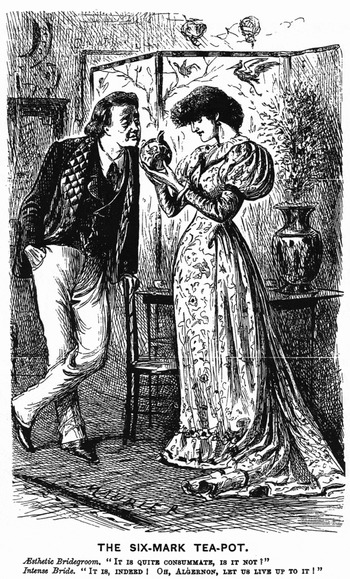
The satirist George Du Maurier, in his famous Punch cartoon “The Six-Mark Tea-Pot” (1880), perhaps unintentionally identified the utopian rationale behind Wilde's early aestheticism (Figure 7). The cartoon presents an “aesthetic bridegroom” – long-haired and wearing a quilted smoking jacket reminiscent of Wilde – and his bride, who both marvel over their blue china teapot. The bridegroom remarks, “It is quite consummate, is it not?” and his beloved replies: “it is, indeed! Oh, Algernon, let us live up to it!” Victorian audiences, as Joseph Bristow observes, would have recognized here the “mythmaking that had gathered around Wilde,” particularly the aesthete's reported quip about how he “found it difficult to live up to the level of his blue china” (14). By recasting Wilde's aphorism within the putatively sacred bond between husband and wife, Du Maurier means to satirize what he sees as aestheticism's perverse devotion to the fetishized decorative object.Footnote 20 But Wilde's interest in the ornamental stemmed not from a desire to jettison ethics or sociability, but from a sincere belief (one endorsed by scientific authorities such as Darwin, Spencer, and Allen) in the ennobling capacity of beauty. To “live up to” a token of aesthetic culture, such as a teapot, was to substitute the animalistic worldview – which assesses objects solely in terms of their survival value – for a more civilized, less functionalist relation to the external world. Wilde's early career thus hints at the ways in which aestheticism, despite its repudiation of practical reform, nonetheless drew on a counter-utilitarian and counter-natural ethics that arose in reaction to modern evolutionary science.
George Du Maurier. “The Six-Mark Tea-Pot.” Engraving from Punch 79 (30 Oct. 1880): 194. Photograph courtesy of the Freer and Sackler Galleries, Smithsonian Institution.

To be sure, much of Wilde's later work evinces a certain sardonic skepticism about “the people” and the cultural value of their tastes. As a queer writer, Wilde also had to reconcile his evolutionism with personal tastes that seemed incompatible with the procreative aspect of sexual selection. Whitney Davis observes that many queer aesthetic writers in the period – including Wilde, John Addington Symonds, Vernon Lee, and Edward Carpenter – “accepted broadly naturalistic and evolutionary premises” even as they recognized that their “aesthetic tastes . . . had an anomalous or paradoxical status in Darwinian terms” (156). These writers, Davis argues, consequently wondered whether a “same-sex taste for beauty, form, or art” might have “the same natural basis as the sense of beauty shaped, according to Darwin, in the cross-sex interactions of sexual selection” (157). In other words, could the principles of sexual selection, which Wilde began to see as the firmest scientific grounds for his individualism, operate through mechanisms beyond that of heterosexual reproduction? Allen's ideas were particularly helpful to Wilde in this regard. As my discussion has demonstrated, Allen scientifically redefined individual desire as a progressive evolutionary instinct that operated most effectively in conditions of perfect freedom (importantly, many readers of “The New Hedonism” construed Allen's argument as an apology for homosexuality).Footnote 21 In this context, Wilde conceived of individualistic, even anarchic forms of social organization that could generate evolutionary and social benefits without the need for forcible reform, unchecked social Darwinism, or heteronormative eugenics. This logic animated Wilde's complex politics and warranted his speculations about what he unapologetically called, in “The Soul of Man,” “Utopia” (247): that future time in which everyone will act “for their own joy” and take sympathetic pleasure “in the contemplation of the joyous lives of others” (263).
In “The Critic as Artist,” Wilde attempts to unify his belief in artistic and political individualism with his equally robust commitment to utopian thinking: sexual selection, with its apparent sanction of personal license, helps him to bridge this gap. The two-part essay takes the form of a Socratic dialogue between Ernest and his mentor Gilbert, who continuously shocks Ernest out of his honest, but unoriginal, opinions about the social and cultural role of the critic. The dialogue begins with Ernest parroting the mainstream view of art criticism as a “shrill clamour” that violates the sanctity of creative work (128); “the Greeks,” Ernest claims, “had no art-critics” (135). Gilbert counters with the example of Aristotle, who “concern[s] himself primarily with the impression that the work of art produces” and, “as a physiologist and psychologist, . . . knows that the health of [the aesthetic] function resides in energy” (140). As Gilbert's gloss of Aristotle suggests, the evolutionary aesthetic theories of Spencer, Darwin, Pater, and Allen are crucial to the cultural principles that Gilbert subsequently demonstrates to Ernest in part one of “The Critic as Artist.”
First and foremost, Gilbert's Spencerian notion of health as a function of energy calls into question Ernest's facile privileging of life over art. Gilbert explains catharsis, for instance, in terms that evoke Spencer's idea of play as the salutary release of superfluous energy: Aristotelian tragedy “cleanses the bosom of much ‘perilous stuff’” by providing the viewer with “high and worthy objects for the exercise of the emotions” (140). Secondly, Spencer's equation of progress with differentiation surfaces in Gilbert's radical upending of Ernest's moralism. After Ernest ingenuously asserts that “it is much more difficult to do a thing than to talk about it,” Gilbert scoffs at the “man of action” who defies the “scientific laws” that show us the ways in which biology and environment dictate even seemingly conscious action (146–47). In the face of this reality, trying to do “good” deeds is pointless, while acting to please oneself – which Gilbert provocatively describes as “sin” – “is an essential element of progress” (148). His scientific reasoning draws on both Darwinian conceptions of species and (given the erotic import of “sin”) the progressive logic of sexual selection. The “machine of life,” Gilbert explains, “may grind our virtues to powder . . . or transform our sins into elements of a new civilization, more marvellous and more splendid than any that has gone before” (147). “Through its curiosity,” he continues, “Sin increases the experience of the race,” and “through its intensified assertion of individualism, it saves us from monotony of type . . . without it the world would stagnate, or grow old, or become colourless” (148).
The second half of “The Critic as Artist” refines the causal relationship between art, individual pleasure, and racial progress by explicating the aesthetic faculty in terms of its sexual selective purpose. As Gilbert predicts at the end of part one, the intervening meal has a “subtle influence” on the tenor of his conversation with Ernest (161): once he has taken care of his basic (or what Spencer and Allen might have deemed “life-serving”) needs, Gilbert becomes increasingly aware of the artistic “failures” of life (167). In a broad sense, “life” and “art” thus come to connote the processes of natural selection – which operates through a confluence of external pressures – and sexual selection – with its intimations of free choice, excess, and pleasure – respectively. “Don't let us go to life for our fulfillment or our experience,” Gilbert urges Ernest, “it is a thing narrowed by circumstances, incoherent in its utterance,” and ultimately dissatisfying to “the artistic and critical temperament” (173). Like Allen, Wilde envisions art as a form of resistance against the biological and physical forces that dictate day-to-day existence (both writers were sufficiently familiar with the journalism trade to count pecuniary need among these constrictions). Art, for Wilde as for Allen, grants its audiences a degree of precious control over their lived experience of the world and, in some measure, compensates for life's demoralizing conditions. By merely picking up a book or attending a play, Gilbert reasons, “we can choose the time of our initiation and the time of our freedom” (172); through art, we can thus “realize our perfection” while “shield[ing] ourselves from the sordid perils of actual existence” (173).
If we bear in mind Allen's prior work, particularly his early monographs on physiological aesthetics and his article “Falling in Love,” we can better contextualize the rhetoric of perfectibility that Wilde applies to aesthetic experience. Gilbert, in the remarkably sanguine passage with which this essay began, broaches the possibility of self-cultivation through the appropriation of progressive sexual selective mechanisms. “In the development of the individual,” Gilbert declares,
even a colour-sense is more important . . . than a sense of right and wrong. Aesthetics, in fact, are to Ethics in the sphere of conscious civilization, what, in the sphere of the external world, sexual is to natural selection. Ethics, like natural selection, make existence possible. Aesthetics, like sexual selection, make life lovely and wonderful, fill it with new forms, and give it progress, and variety and change. And when we reach the true culture that is our aim, we attain to that perfection of which the saints have dreamed, the perfection of those to whom sin is impossible, not because they make the renunciations of the ascetic, but because they can do everything they wish without hurt to the soul, and can wish for nothing that can do the soul harm. (204–05)
Gilbert's analogy subtly, but significantly, revises his comments on sin. While he maintains his previous claims about sin's efficacy, “sin” here has morphed into the more benign locution of “do[ing] everything [one] wish[es]” (148). When Gilbert situates his “antinomian” licentiousness in the paradigm of sexual selection, it sheds its moralistic valence and ceases to be “sin” at all, in part because he considers science, like art, “out of the reach of morals” (204, 190).Footnote 22 In many ways, Gilbert appeals to the amoral “ethic of uselessness” that underwrote, as Christine Ferguson argues, both scientific philosophy and decadent literature in the fin de siècle (470): by invoking sexual selection, which provides an evolutionary standard for the selection of otherwise “useless” ornamental qualities, Gilbert is able to shake off the constraints of utilitarian “Ethics” and simultaneously assume the ethical high ground. Like Allen, then, Wilde suggests that cultured individuals will instinctually gravitate toward the lovely, the beautiful, and the good, and their own diverse inclinations – so long as these inclinations are given free rein – will reap evolutionary profit over the course of generations. His exhortations to individualism in both “The Critic as Artist” and “The Soul of Man” (plus his own iconic performance of the aesthetic lifestyle) were motivated by this deeply held conviction: that the cultivation and expression of one's unique desires could radically transform society for the better.
Though Wilde's detractors often accused him of nihilistic selfishness, his insistence on strenuous self-culture and training prevents his hedonism from slipping into mere sensual abandon. In “The Critic as Artist,” Wilde hopes to realize his utopian vision not through the pursuit of base pleasures (which, after all, might “do the soul harm”), but through the dissemination of a “critical spirit” that will cultivate subjects who never desire these pleasures in the first place (178). The critic and “true man of culture,” Gilbert tells Ernest, makes “instinct self-conscious and intelligent”: that is, he analyzes his latent hereditary impulses, exteriorizes these indwelling instincts, and finally seizes control over an evolutionary process that fulfills all the functions of sexual selection (sexual selection, after all, consists in the same procedures of passive consideration and “fastidious rejection” that Gilbert's critic performs, only on a massive scale) (178). The introspective “perfecting of [one]self” that Gilbert upholds as the critic's only aim paradoxically becomes the very means by which he influences his wider milieu, because the critic, at the same time that he perfects himself, also “creat[es] in [the age] new desires and appetites” by “lending it his larger vision and his nobler moods” (197). Sexual selection, as Wilde acknowledges, invested immense evolutionary power in the accumulated “desires and appetites” of individuals – to such a degree that Gilbert predicts that the critic will spearhead humankind's evolution into a more enlightened species. By the end of Wilde's dialogue, then, criticism has largely subsumed the progressive role of sexual selection and thus obviated the need for procreation. On this view, the critic participates in a kind of queer reproduction by singlehandedly “creating” and proliferating the taste for new and ever more refined pleasures. Wilde's interpretation of sexual selection implicitly decouples sex from the social and biological imperative to reproduce: more radically than Allen, Wilde overturns the potentially coercive heteronormativity of Darwinian evolution and transforms the theory into a defense of non-normative sexual desire, including the homosexual love that Wilde (quoting a poem by his lover, Lord Alfred Douglas) described as the “love that dare not speak its name” (Ellmann 386).
For Allen and Wilde, aesthetics activated alternative evolutionary processes that privileged diversity, spontaneity, choice, and pleasure over the exigencies of survival. On this basis, to follow one's own idiosyncratic passions was to engage in heroic battle with what Wilde called “the modern stress of competition” – and its insidious spiritual analog, “the immoral ideal of uniformity of type and conformity to rule” (“Soul of Man” 250). The decorating of a sitting room, the picking up of a book, the choosing of a sexual partner: these were the day-to-day exertions of taste, apparently insignificant in themselves, that Allen and Wilde believed would decide the evolutionary destiny of humankind.
***
Besides illuminating their respective oeuvres, this more thorough account of Allen's and Wilde's respective hedonisms expands our knowledge of Victorian science and culture in several ways. First, their progressive and even utopian interpretations of evolutionary science remind us of the diversity of Victorian reactions to Darwin's work. Despair over what Alfred Tennyson called “Nature, red in tooth and claw” and moral panic over social degeneration (exemplified in Max Nordau's vituperative anti-aesthetic polemic Degeneration [1892]) are perhaps the best-known cultural responses to evolutionary thought (Tennyson 41; l: 15).Footnote 23 But the Darwinian revolution inspired more varied moods than existential anxiety and alarm. To the contrary, Wilde and Allen excitedly touted sexual selection as the mechanism for sweeping, and yet nonviolent, social change. Evolutionary theory, for them, simultaneously naturalized the aesthetic appeal to hedonic pleasure and elevated the Paterian mission of self-culture to a solemn ethical obligation. Secondly, Allen's association with Wilde points to a deeper synergy between “art for art's sake” and Darwinian science that deserves further scholarly attention, especially because such interdisciplinary concerns also emerge in the work of Pater as well as later aesthetes such as Vernon Lee and John Addington Symonds.Footnote 24 More important, the close alignment of aestheticism and progressive evolutionism (which the pairing of Allen and Wilde so compellingly demonstrates) suggests that British aestheticism was more ethically driven than many theories of the movement currently acknowledge. While Wilde's work is certainly subversive – he often trained his famous aphoristic wit on the hypocrisy of Victorian society – its very dissidence was informed by the idea that deviance had a progressive, and consequently ethical, dimension. On a related note, this study of Allen's and Wilde's optimisms underscores the significant philosophical differences between aestheticism and decadence, which celebrated a more alienated and anti-social version of individualism.Footnote 25
Lastly, both Allen's and Wilde's visions of ethical hedonism offer an intriguing backstory to certain modern trends in consumption, which Kate Soper has grouped under the title “alternative hedonism.” In recent years, Soper has observed a growing “disaffection with consumerism on the part of affluent consumers themselves” (567). These consumers both recoil from the ecological and economic destruction of modern capitalism and look back with yearning to the pleasures that modernity seems to preclude: the sociability and ritual of eating, clean air, leisure liberated from utilitarian calculations of “productivity,” etc. Alternative hedonism, Soper continues, seeks to recapture these lost pleasures by “shift[ing] use/consumption into more sustainable and gratifying directions” (574). Instead of suffering in traffic, for instance, an alternative hedonist might commute by foot or bike, taking pleasure in the use of her body and the conviction that she is reducing her carbon footprint; a similar logic underlies the recent vogue for “farm-to-table” restaurants, tiny houses, and other modes of ostensibly more responsible, but nonetheless prosperous, first-world living.
Though Soper never refers to either Victorian writer, her alternative hedonism bears noticeable similarities to Allen's and Wilde's “new” ones. All of these hedonisms are fundamentally philosophies of privilege, practiced among those with the resources and time to select between innumerable pleasures: Soper presumes that the hedonist has “access to credit and consumer goods” (573), while Allen's and Wilde's aesthete must command enough leisure to cultivate and exercise his taste. While these hedonisms seek to mitigate the forms of ecological devastation and economic exploitation that disproportionately affect the poor, their messages of ethical pleasure exclusively (and, at times, explicitly) target middle- and upper-class audiences. More interestingly, however, both Victorian aesthetic hedonism and alternative hedonism attempt to bring about social improvement through the refinement of aesthetic taste. Soper's hedonism, like Allen's and Wilde's, works not by suppressing our desire for self-gratification, but by changing how we evaluate our desires – in effect, by prioritizing the pleasures of quality and sustainability over the pleasures of accumulation and convenience. In a neo-aesthetic gesture, Soper proposes an “extensive revisioning of the perceived attractions of material culture” and “a gestalt shift of optic and hedonist perception” (579). Soper's hedonism, with its call for a revolutionary consumption, thus emerges as a kind of spiritual successor to the utopian hedonisms of Allen and Wilde. By taking a closer look at this unusual trio of thinkers, we can see the ways in which aestheticism – one that protests against the political as well as aesthetic imperfections of “actual life” – might continue to articulate powerful critiques of the status quo in the modern day.