The difficulty of observing interactions between predators and their prey in natural systems has promoted the use of artificial replicas (Exnerová et al. Reference EXNEROVÁ, SVADOVA, STYS, BARCALOVA, LANDOVA, PROKOPOVA, FUCHS and SOCHA2006, Smith Reference SMITH1977). Plasticine replicas have been successfully used because they retain imprints of predation attempts and enable the identification of the predator (Brodie Reference BRODIE1993).
Despite the wealth of traits and behaviours that may warn predators of dangers from prey, most studies concerning snakes have investigated mimicry of coloured models and the importance of snake coloration in repelling predators (Brodie Reference BRODIE1993, Buasso et al. Reference BUASSO, LEYNAUD and CRUZ2006, Greene & Mcdiarmid Reference GREENE and McDIARMID1981). However, even snakes lacking aposematic colour patterns can generate avoidance, as occurs in many vipers (Greene Reference GREENE1997).
Vipers (Viperidae) are generally cryptic venomous snakes (but see Niskanen & Mappes Reference NISKANEN and MAPPES2005), recognizable by their broad, roughly triangular head (Werner Reference WERNER1985). This morphological trait is related to the enlargement of the head, where the venom glands are laterally positioned, just behind the eyes. This feature is regarded by laymen as a hallmark of danger (Werner & Frankenberg Reference WERNER and FRANKENBERG1982). Snake predators recognize this danger and attack such snakes just on the head (Langkilde et al. Reference LANGKILDE, SHINE and MASON2004) or on the extremities of the body (Smith Reference SMITH1977).
Many non-venomous snakes belong to the widely distributed families Colubridae and Dipsadidae. These snakes display similar traits to those of sympatric vipers including colour, behaviour and morphology, which suggest Batesian mimicry (Greene & Mcdiarmid Reference GREENE and McDIARMID1981, Martins & Oliveira Reference MARTINS and OLIVEIRA1998). Head triangulation is widespread and present in many unrelated taxa throughout the world (Martins & Oliveira Reference MARTINS and OLIVEIRA1998, Sapwell Reference SAPWELL1968, Werner & Frankenberg Reference WERNER and FRANKENBERG1982). Although it has been suggested as a defensive behaviour (Greene Reference GREENE, Gans and Huey1988) it has never been clearly confronted to the mimicry hypothesis by experimental evidence. Therefore, we used plasticine replicas to test the hypothesis that triangular head shape in snakes confers protection against visually oriented predators. We also tested if predators attack snakes more frequently on the head than on other body parts.
We carried out the field work in a 10 000-ha preserved upland rain forest (2°24′S, 59°44′W) in Brazilian Central Amazon. This land is part of the project ‘Biological Dynamics of Forest Fragments’, Amazonas state, northern Brazil.
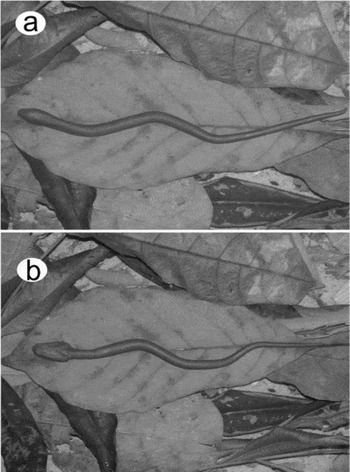
We used non-toxic plasticine to construct snake replicas with oval-shaped head (OSH), as in most colubrids and dipsadids, and triangular-shaped head (TSH) as in vipers (Figure 1). All replicas (210 of each type) were blackish brown, 22 cm in length (3 cm of head, 17 cm of mid-body, and 2 cm of narrower tail) and 1 cm in body diameter. The head shapes were made by impressing in wax heads of freshly killed snakes, Philodryas patagoniensis (Dipsadidae) for OSH and Bothrops jararaca (Viperidae) for TSH.
Plasticine replicas of oval-shaped head (a) and triangular-shaped head (b) on leaves of Theobroma grandiflorum.

The experiment was conducted in six 1-m-wide transects, which were at least 100 m away from one another. Replicas were placed randomly along the transect and systematically 10 m apart from one another. Besides that, to avoid the effect of crypsis replicas were placed on light brown leaves of the tree Theobroma grandiflorum (Figure 1). After 24 h replicas were checked for predatory marks and the attacked part of the body (head, mid-body or tail). Only marks made by mammals (mandible and toothmarks) and birds (a pair of U- or V–shaped marks; Brodie Reference BRODIE1993) were considered.
The number of attacks between OSH and TSH was compared using a Generalized Linear Model with binomial distribution. A likelihood ratio test (LRT) was performed with a null model and another one containing the shape of the head as an explanatory variable. An adherence Chi-square test with Yates correction was used to model the frequency of attack among head, mid-body and tail. The expected values were generated according to the relative projected area of the body segment. In OSH replicas, head was 17.3% of total body area, mid-body 78.4% and tail 4.3%. In TSH replicas head was 25.2% of total body area, mid-body 71% and tail 3.8%. Body areas were obtained using Analysing Digital Images software (Museum of Science, Boston, United States). Statistical analyses were performed using R software (R Core Development Team, Vienna, Austria).
From 420 replicas, seven were lost and 100 were discarded because they showed marks from other animals, such as ants. From the remaining 313, 24 (7.7%) had attack marks made by vertebrates. Four replicas had two different types of attack and were counted twice, totalling 28 attacks. From the 313 replicas, 161 were OSH from which 17 (10.5%) presented attacks. From the remaining 152 TSH replicas, 11 (7.2%) were attacked. No statistical difference was detected between head shapes (χ 2 = 0.399, df = 2, P = 0.30). Head and tail were more attacked than mid-body in OSH (χ 2 = 31.6, df = 2, P ≪ 0.001) and TSH (χ 2 = 30.1, df = 2, P ≪ 0.001) replicas.
Snakes present many anti-predator mechanisms, such as colour or biting (Greene Reference GREENE, Gans and Huey1988). In Central Amazon, defensive tactics of snakes seem to be directed to visually oriented predators, including fleeing, thrashing the body and biting as the most common (Martins & Oliveira Reference MARTINS and OLIVEIRA1998). Aposematic and cryptic patterns have shown variable efficacy against predation (Brodie Reference BRODIE1993, Wüster et al. Reference WÜSTER, ALLUM, BJARGARDÓTTIR, BAILEY, DAWSON, GUENIOUI, LEWIS, MACGURK, MOORE, NISKANEN and POLLARD2004).
Head triangulation occurs in many Amazonian species, including green, variegated and coral snakes, such as Leptophis, Leptodeira and Rhinobothryum, respectively (Martins & Oliveira Reference MARTINS and OLIVEIRA1998). Although body displays are mentioned as useful against predation, in our study head triangulation seemed not to provide protection itself, since the number of attacks on OSH and TSH replicas did not differ. Predators that select specific prey sizes such as the short-toed eagle Circaetus gallicus (Gil & Pleguezuelos Reference GIL and PLEGUEZUELOS2001) could bias the results through arbitrary attack on replicas. However, if head triangulation could be combined with other threat displays, such as body flattening and striking, the signal could be reinforced, contributing to the learning process by the predators.
Intentional attacks on the head are interpreted as an ability to manoeuvre dangerous prey, which suggest that predators perceive replicas as hazardous (Smith Reference SMITH1977). Crows often directed their initial attack to the head of the snake Thamnophis sirtalis parietalis (Langkilde et al. Reference LANGKILDE, SHINE and MASON2004) and the commom opossum, Didelphis marsupialis, also attacks snakes on the head (Almeida-Santos et al. Reference ALMEIDA-SANTOS, ANTONIAZZI, SANT'ANNA and JARED2000). Another sign of the importance of the head is shown by the behaviour of hiding the head under body coils (Greene Reference GREENE1997). Besides hiding the head, some snakes such as corals of the genus Micrurus and their possible mimics elevate the tail to distract the predator (Greene Reference GREENE1997).
Snake predators in Central Amazon seem to perceive the danger of injury, attacking mainly the extremities of the replicas. Attacks diverted to the head could maximize predation success by increasing prey mortality, but indiscriminate attacks to head and tail are common (Brodie Reference BRODIE1993, Buasso et al. Reference BUASSO, LEYNAUD and CRUZ2006). Since predators are expected to attack dangerous snakes in the head (Niskanen & Mappes Reference NISKANEN and MAPPES2005, Wüster et al. Reference WÜSTER, ALLUM, BJARGARDÓTTIR, BAILEY, DAWSON, GUENIOUI, LEWIS, MACGURK, MOORE, NISKANEN and POLLARD2004) this pattern could indicate some difficulty by the predator in identifying the head of a snake, at least in plasticine replicas. On the other hand, many snakes hide their heads when threatened, exposing the tail.
In conclusion, the shape of head seemed not to confer advantage itself. Snakes do not show only one defence behaviour but a set of phased behaviours (Greene Reference GREENE, Gans and Huey1988). A set of traits including colour and behavioural displays may work in synergy to warn and discourage predator attacks. Indeed, predators perceived and tended to attack replicas on the extremities as an attempt to immobilize the prey. Experimentation on mimicry using plasticine replicas has been done exhaustively on bright colours but has never been done before focusing on the body morphology. Additional studies could explore the role of the morphology in the defensive behaviour and the evolution of mimicry in nature.
ACKNOWLEDGEMENTS
We thank Otavio Marques, Valdir Germano and the colleagues of Instituto Butantan for ideas and confection of the replicas, Glauco Machado for helping in the field work and discussion, Ligia Pizzato for critical review, Roberto Munguia-Steyer and Paulo Prado for the analysis, and the PDBFF. An anonymous reviewer made valuable suggestions on the manuscript. This work was developed during the 15th field course ‘Ecologia da Floresta Amazônica’. We thank FAPESP, CNPq and INCTTOX for financial support.