


Introduction
Negative symptoms are a major contributor to poor quality of life in patients with schizophrenia (Galderisi et al., Reference Galderisi, Mucci, Buchanan and Arango2018; Kirkpatrick et al., Reference Kirkpatrick, Fenton, Carpenter and Marder2006). Furthermore, severity of negative symptoms are associated with increased functional deficits in patients with psychosis (Galderisi et al., Reference Galderisi, Mucci, Buchanan and Arango2018; Kirkpatrick et al., Reference Kirkpatrick, Fenton, Carpenter and Marder2006), with both negative symptoms and functional deficits emerging before the onset of psychosis (Galderisi et al., Reference Galderisi, Rossi, Rocca, Bertolino, Mucci and Bucci2014; Harvey and Strassing, Reference Harvey and Strassing2012). One possible mechanism that has been proposed for both negative symptoms and functional deficits in schizophrenia are maladaptive thinking patterns such as defeatist beliefs (Beck and Rector, Reference Beck and Rector2005; Grant and Beck, Reference Grant and Beck2009; Strauss et al., Reference Strauss, Morra, Sullivan and Gold2015; Ventura et al., Reference Ventura, Subotnik, Ered, Gretchen-Doorly, Hellemann, Vaskinn and Nuechterlein2014). Defeatist performance beliefs are defined as negative cognitions about one’s capacity to successfully accomplish goal-directed behaviours (Beck and Rector, Reference Beck and Rector2005; Grant and Beck, Reference Grant and Beck2009). Beck and colleagues (Beck et al., Reference Beck, Rector, Stolar and Grant2009; Grant and Beck, Reference Grant and Beck2009) proposed that both defeatist performance beliefs (e.g. ‘If I fail at my work, then I am a failure as a person’) and asocial beliefs (e.g. ‘Making new friends isn’t worth the energy it takes’) contribute to negative symptoms and poor functioning in schizophrenia. Numerous studies support this model reporting a relationship between negative symptoms and defeatists beliefs (Beck et al., Reference Beck, Grant, Huh, Perivoliotis and Chang2013; Couture et al., Reference Couture, Blanchard and Bennett2011; Grant and Beck, Reference Grant and Beck2009; Strauss et al., Reference Strauss, Morra, Sullivan and Gold2015; Ventura et al., Reference Ventura, Subotnik, Ered, Gretchen-Doorly, Hellemann, Vaskinn and Nuechterlein2014), with change in dysfunctional beliefs partially mediating change in negative symptoms (Staring et al., Reference Staring, Ter Huurne and van der Gaag2013) and the effect of treatment on negative symptoms being mediated by defeatist beliefs and asocial beliefs (Granholm et al., Reference Granholm, Holden and Worley2017). Indeed, one meta-analysis found a significant relationship between defeatist performance beliefs and both negative symptoms and functional outcomes in schizophrenia studies (Campellone et al., Reference Campellone, Sanchez and Kring2016). Similarly, self-efficacy beliefs are central to both motivation and engagement in goal-directed behaviours (Bandura, Reference Bandura1986). Self-efficacy beliefs are defined as a person’s belief in their ability to perform a behaviour or accomplish tasks (e.g. confidence in one’s ability to ask a friend for advice). Self-efficacy beliefs are associated with negative symptoms in patients with schizophrenia (Bentall et al., Reference Bentall, Simpson, Lee, Williams, Elves, Brabbins and Morrison2010; Luther et al., Reference Luther, Coffin, Firmin, Bonfils, Minor and Salyers2018; Pratt et al., Reference Pratt, Mueser, Smith and Lu2005), which in turn have been shown to influence functioning (Ventura et al., Reference Ventura, Subotnik, Ered, Gretchen-Doorly, Hellemann, Vaskinn and Nuechterlein2014).
Schema theory may also contribute to understanding negative symptoms in schizophrenia. According to Young and colleagues (Young et al., Reference Young, Klosko and Weishaar2006), in schema theory the emergence of early maladaptive schemas are generated in childhood based on the amalgamation of memories, emotions, and cognitions concerning oneself and one’s relationship with others (Young et al., Reference Young, Klosko and Weishaar2006). Adding to this, Beck and colleagues proposed that the content of schemas develop through the cognitive triad (e.g. negative beliefs about: (1) one’s self, (2) external situations, and (3) the future) (Beck and Haigh, Reference Beck and Haigh2014; Beck et al., Reference Beck, Himelstein and Grant2019), which in turn may contribute to amotivation, anhedonia and asociality (Beck et al., Reference Beck, Himelstein and Grant2019). Patients with schizophrenia have greater maladaptive schemas compared with healthy controls (Bortolon et al., Reference Bortolon, Capdevielle, Boulenger, Gely-Nargeot and Raffard2013) and early maladaptive schemas relating to social isolation and defectiveness have been significantly associated with negative symptoms in patients with schizophrenia (Khosravani et al., Reference Khosravani, Mohammadzadeh and Sheidaei Oskouyi2019).
Similar to schizophrenia patients, those at clinical high risk (CHR) for psychosis often have significant and severe negative symptoms (Devoe et al., Reference Devoe, Lu, Cannon, Cadenhead, Cornblatt, McGlashan and Addington2020; Piskulic et al., Reference Piskulic, Addington, Cadenhead, Cannon, Cornblatt, Heinssen and McGlashan2012; Yung et al., Reference Yung, Nelson, McGorry, Wood and Lin2018), with one study indicating that over 80% of those at CHR for psychosis present with at least one negative symptom of moderate severity (Piskulic et al., Reference Piskulic, Addington, Cadenhead, Cannon, Cornblatt, Heinssen and McGlashan2012). Several studies have shown that negative symptom severity is associated with increased functional deficits in CHR youth (Corcoran et al., Reference Corcoran, Kimhy, Parrilla-Escobar, Cressman, Stanford, Thompson and Malaspina2011; Kim et al., Reference Kim, Song, Park, Lee, Lee, Lee and Kwon2013; Lee et al., Reference Lee, Kim, Lee and An2017; Meyer et al., Reference Meyer, Carrion, Cornblatt, Addington, Cadenhead, Cannon and Seidman2014; Schlosser et al., Reference Schlosser, Campellone, Biagianti, Delucchi, Gard, Fulford and Vinogradov2015), and both have been reported to be main reasons why CHR youth seek out clinical services (Falkenberg et al., Reference Falkenberg, Valmaggia, Byrnes, Frascarelli, Jones, Rocchetti and Fusar-Poli2015).
To date, two studies have examined defeatist beliefs in CHR youth. The first study demonstrated that CHR youth endorsed defeatist beliefs more than healthy controls, and that defeatist beliefs were associated with severity of negative symptoms (Perivoliotis et al., Reference Perivoliotis, Morrison, Grant, French and Beck2009). The second study found that defeatist performance beliefs did not differ between controls and CHR, and that defeatist performance beliefs were not associated with negative symptoms (Morrison et al., Reference Morrison, French, Lewis, Roberts, Raja, Neil and Bentall2006). In a third study a trend of higher negative-self schemas was found in a CHR sample with persistent negative symptoms versus those without (Devoe et al., Reference Devoe, Lu, Cannon, Cadenhead, Cornblatt, McGlashan and Addington2020). For maladaptive schemas, one longitudinal study found that CHR participants had significantly more maladaptive schemas compared with healthy controls but that these maladaptive schemas had no correlation to negative symptoms (Stowkowy et al., Reference Stowkowy, Liu, Cadenhead, Cannon, Cornblatt, McGlashan and Addington2016).
To our knowledge only two studies have examined self-efficacy in CHR samples (Kang et al., Reference Kang, Bang, Lee, Lee, Yoo and An2018; Schmidt et al., Reference Schmidt, Grunert, Schimmelmann, Schultze-Lutter and Michel2014). The first study demonstrated that CHR youth have both significantly lower general self-efficacy and lower social self-efficacy compared with that of healthy controls (Kang et al., Reference Kang, Bang, Lee, Lee, Yoo and An2018). Moreover, another study reported that CHR participants more frequently reported low self-efficacy compared with first episode psychosis patients (Schmidt et al., Reference Schmidt, Grunert, Schimmelmann, Schultze-Lutter and Michel2014). However, neither study examined the relationship between self-efficacy and negative symptoms in CHR. Lastly, no studies have been conducted examining the relationship between asocial beliefs and negative symptoms in CHR.
Thus, examining negative symptoms in a CHR sample may provide insights into their development, maintenance, and exacerbation. Determining whether negative symptoms in CHR youth are directly related to defeatist performance beliefs, asocial beliefs, maladaptive schemas, and self-efficacy will provide greater insights into the strength and direction of these associations. Most mediational studies in schizophrenia utilize a path with functioning as an outcome, not driving defeatist attitudes to negative symptoms. However, during adolescences, what one achieves in their first roles (i.e. social or first job) may drive their beliefs, attitudes, and self-efficacy which in turn may drive negative symptoms (i.e. functioning → defeatists attitudes/self-efficacy → diminished motivation). This may represent a reciprocal relationship between functioning and negative symptoms in CHR youth, which eventually leads to poor functioning outcomes in those who transition to psychosis, that we often see in patients with schizophrenia.
The present study examined negative symptoms in a large sample of CHR youth. The aim of this current study was to: (1) determine the occurrence of defeatist performance beliefs, asocial beliefs, poor self-efficacy, and maladaptive schemas in a CHR sample, (2) examine the correlations between negative symptoms, defeatist performance beliefs, asocial beliefs, maladaptive schemas, and self-efficacy, and (3) explore potential mediators between the relationship of functioning (i.e. social and role) and negative symptoms and provide an estimation of mediated effects.
Method
Setting and participants
All CHR participants (n = 203; 99 males, 104 females) were recruited as part of a 3-site (University of Calgary, Zucker-Hillside Hospital, and University of California San Diego) randomized control trial: Recovery through Group Study (ReGroup). For further study details, please refer to the ReGroup methods paper (Addington et al., Reference Addington, Liu, Santesteban-Echarri, Brummitt, Braun, Cadenhead and Granholm2021). However, the present study is a cross-sectional study design that analyses the ReGroup data prior to treatment commencement, thus both the control and treatment groups were collapsed into one group for the purpose of this research. CHR participants between the ages of 13 and 30 years were referred by health care providers, social service agencies, educators, or were self-referred in response to community education. Prospective participants underwent a telephone screen to rule out any youth who may already be psychotic, and those for whom it seemed likely that they could meet Criteria of Psychosis-risk Syndromes (COPS) were subsequently invited to an in-person eligibility evaluation and consent. CHR participants were included in the study if they met the following criteria: (1) age between 13 and 30 years; (2) understand and sign an informed consent (or assent for minors) in English; (3) currently meet or have met in the past 4 years diagnostic criteria for a psychosis-risk syndrome as per COPS criteria; (4) had at least one Scale of Psychosis-risk Symptoms (SOPS) attenuated symptom rated 3 and no symptom rated 6; and (5) ratings on the Global Functioning: Social Scale or Role Scale of 7 or less. CHR subjects were excluded based on the following criteria: (1) meeting criteria for current or lifetime Axis 1 psychotic disorder; (2) impaired intellectual functioning (IQ < 70); (3) past or current history of a clinically significant central nervous system disorder that may contribute to prodromal symptoms or confound their assessment; (4) substance dependence in the past 3 months; and (5) the diagnostic psychosis-risk symptoms are or were clearly caused by an Axis 1 disorder, including substance use disorders, in the judgement of the evaluating clinician. All participants provided written informed consent, including parental consent.
Assessments
CHR criteria
Participants were assessed for CHR criteria using the Criteria of Psychosis-risk Syndromes (COPS) based on the Structured Interview for Psychosis-risk Syndromes (SIPS; McGlashan et al., Reference McGlashan, Walsh and Woods2010).
Negative symptoms
Negative symptoms were rated on the SOPS negative symptom subscale based on the SIPS (McGlashan et al., Reference McGlashan, Walsh and Woods2010). According to the NIMH-MATRICS negative symptom consensus the agreed upon domains of negative symptoms include avolition, asociality, anhedonia, blunted affect, and alogia (Kirkpatrick et al., Reference Kirkpatrick, Fenton, Carpenter and Marder2006). Thus, in the current analysis the SOPS negative symptoms were restricted to social anhedonia (N1), avolition (N2), and expression of emotion (N3), whereas experience of emotions and self (N4), ideational richness (N5), and occupational functioning (N6) were excluded. A total negative symptom score was calculated by adding N1, N2 and N3.
Defeatist attitudes
To assess defeatist performance attitudes, the Defeatist Performance Attitude Scale (DPAS) by Beck and colleagues was utilized. The DPAS is a 15-item self-report subscale derived from a factor analysis of the Dysfunctional Attitude Scale (Weissman and Beck, Reference Weissman and Beck1978). The DPAS rates defeatist attitudes on a 1–7 Likert scale with regard to one’s ability to perform tasks. Higher total scores indicate more severe defeatist performance attitudes (range: 15–105).
To further understand aversive social beliefs as opposed to behaviours, Grant and Beck developed the Asocial Beliefs Scale (ABS; Grant and Beck, Reference Grant and Beck2010), which is a 15-item scale (range: 0–15) derived from the Revised Social Anhedonia Scale (RSAS; Eckblad et al., Reference Eckblad, Chapman, Chapman and Mishlove1982). Items are rated either true or false, with higher scores representing more severe asocial beliefs.
Self-efficacy
To assess social self-efficacy, the Social Self-Efficacy subscale from the Revised Self-Efficacy Scale was utilized (McDermott, Reference McDermott1995). This subscale measures how confident individuals are in performing everyday social behaviours (i.e. ‘Go to a party with friends’). The Social Self-Efficacy subscale is a 19-item scale rated from 0 to 100%, with higher scores reflecting greater self-efficacy.
Schemas
The Brief Core Schema Scale (BCSS) is a self-report scale utilized to assess both negative and positive schemas (Addington and Tran, Reference Addington and Tran2009; Fowler et al., Reference Fowler, Freeman, Smith, Kuipers, Bebbington, Bashforth and Garety2006). The BCSS consists of 24 items assessed on a 5-point rating scale regarding beliefs about the self and others. Four total scores are obtained: negative-self, positive-self, negative-others, and positive-others. Higher scores on the negative items indicate more maladaptive schemas.
Functioning
To assess role and social functioning, the Global Functioning: Role (GF:R) and the Global Functioning: Social (GF:S) scales were used (Auther et al., Reference Auther, Smith and Cornblatt2006; Cornblatt et al., Reference Cornblatt, Auther, Niendam, Smith, Zinberg, Bearden and Cannon2007). The GF:R measures the level of role functioning at work or school. The GF:S measures the level of social contact, friendships, age-appropriate intimate relationships, and involvement with family members. The GF:R and GF:S are rated on a 10-point scale, with higher scores indicating higher functioning.
Procedures
All assessments were completed at baseline. This study was approved by institutional review boards at all three sites.
Analyses
Descriptive data for demographics were reported using mean (SD) or n (%) where applicable. Pearson’s r was utilized to examine the correlations between negative symptoms, defeatist performance beliefs, asocial beliefs, maladaptive schemas, social self-efficacy, and functioning.
Mediation analyses were conducted using the PROCESS macro for SPSS developed by Hayes (Reference Hayes2017), a tool for conducting conditional process path analysis using ordinary least squares regression. PROCESS uses bias corrected bootstrap confidence intervals for inference about indirect effects. This allows for computation of the indirect effect (path a × path b) confidence interval of 95%, and 5000 bias corrected bootstrap samples were used for all PROCESS tests (Darlington and Hayes, Reference Darlington and Hayes2016; Hayes, Reference Hayes2017). Therefore, the first mediation model estimated the ‘a path’ [(GF:Role) to [DPAS or Asocial Beliefs or Social Self-efficacy or Negative Schemas], ‘b path’ [DPAS or Asocial Beliefs or Social Self-efficacy or Negative Schemas to negative symptoms] and mediated effects (ab) of functioning on negative symptoms through [DPAS or Asocial Beliefs or Social Self-efficacy or Negative Schemas] with PROCESS model 4. Next, the second mediation models estimated the ‘a path’ [(GF:Social) to [DPAS or Asocial Beliefs or Social Self-efficacy or Negative Schemas], ‘b path’ (DPAS or Asocial Beliefs or Social Self-efficacy or Negative Schemas to negative symptoms) and mediated effects (ab) of functioning on negative symptoms through [DPAS or Asocial Beliefs or Social Self-efficacy or Negative Schemas] with PROCESS model 4.
Results
Sample characteristics
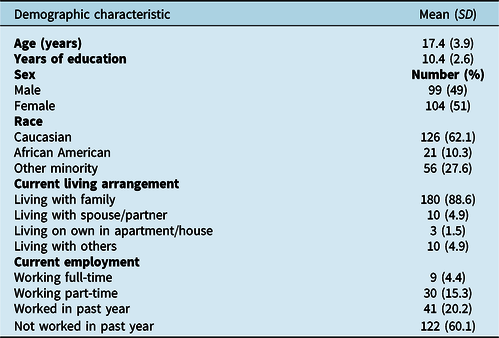
The mean age of CHR participants was 17.4 years (SD = 3.9), with 99 males (49%) and 104 females (51%); see Table 1. CHR participants had an average of 10.4 years of education (SD = 2.6). A total of 126 participants identified themselves as Caucasian (62%), 21 (10%) as African American, and 56 (28%) as other minority. The majority of CHR participants were currently living at home with family members (89%) and 60% had not worked within the past year. See Table 1 for a demographic summary.
Baseline demographics

Negative symptoms
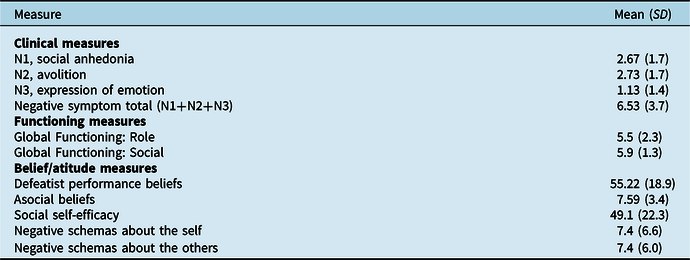
The majority of CHR youth (72.9%) had at least one negative symptom (i.e. SOPS N1 or N2 or N3) of moderate to above moderate severity (i.e. rated ≥3 on the SOPS). Eighty-eight participants (43.4%) rated on one symptom in the moderate to above moderate severity range (i.e. SOPS ratings of 3 and 4), and 60 (29.5%) reported negative symptoms in the severe range (i.e. SOPS ratings of 5–6). In terms of prevalence for specific negative symptoms of ≥3 severity rating at baseline, avolition (N2) was the most reported negative symptom item followed by social anhedonia (N1). Expression of emotion (N3) was the least reported symptom; see Table 2.
Clinical and belief/attitude measures

Beliefs and attitudes
Mean scores and standard deviations for the Defeatist Performance Attitude Scale, Asocial Beliefs Scale, Social Self-Efficacy, and the Brief Core Schema Scale are presented in Table 2.
Correlations between scales
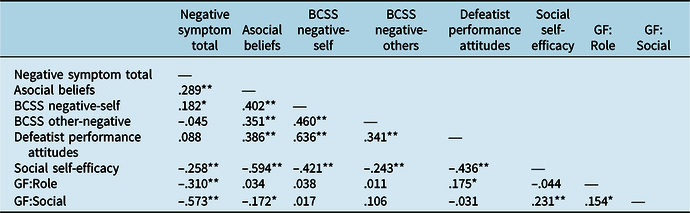
Correlations and p-values are reported in Table 3. These results suggest significant modest to strong associations between defeatist performance attitudes, asocial beliefs, social-self efficacy, negative schemas about the self, and negative schemas about others. Although some correlations were significant, the r was weak (e.g. negative symptoms and BCSS negative-self).
Correlations between scales

**Correlation significant at the 0.01 level; *correlation significant at the 0.05 level. BCSS, Brief Core Schema Scale; GF, Global Functioning.
Mediation analyses
Functioning on mediators
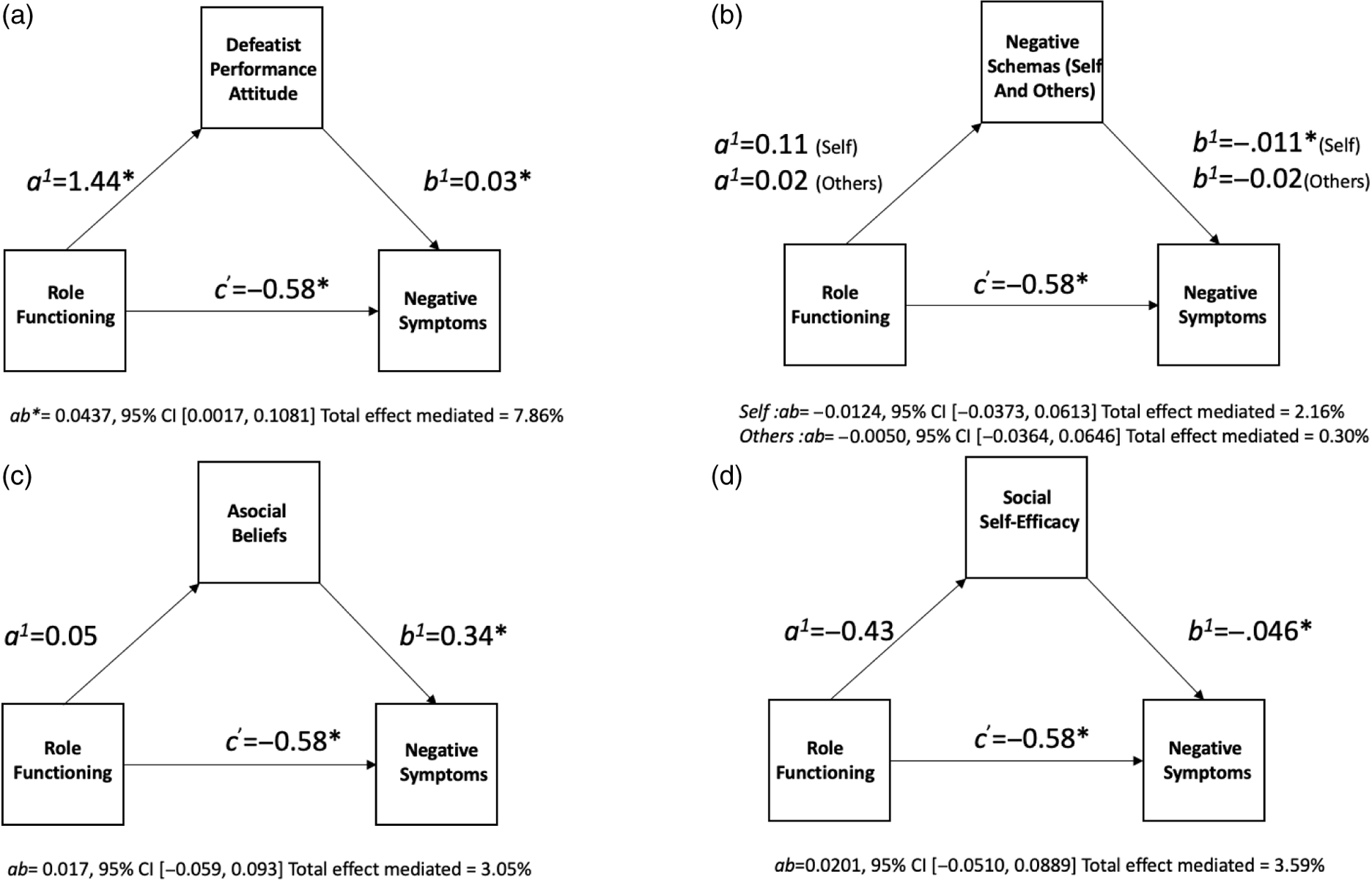
Results of models estimating the ‘a path’ [functioning (social or role) to mediator], ‘b path’ (mediator to outcome) and mediated effects (ab) of functioning on negative symptoms through dysfunctional attitudes (DPAS, ABS) or social self-efficacy or negative schemas are shown in Figs 1 and 2. The ‘a path’ analyses examined the effect of functioning (social or role) on the baseline mediator variable.
Results of models estimating the mediation effects of social functioning on negative symptoms through asocial beliefs or defeatist performance attitudes or social self-efficacy. *P < .05

Results of models estimating the mediation effects of role functioning on negative symptoms through asocial beliefs or defeatist performance attitudes or social self-efficacy. *P < .05

Mediator relation with outcome variables
The ‘b path’ analyses, which examined associations between asocial beliefs, defeatist performance attitudes, negative schemas, or social self-efficacy as mediators on outcomes of negative symptoms, revealed several statistically significant associations. More severe asocial beliefs were associated with greater negative symptoms. More severe defeatist performance attitudes were associated with greater negative symptoms. Finally, social self-efficacy and negative schemas about the self were associated with greater negative symptoms, whereas negative schemas about others were not.
Estimation of mediated effects
Mediation effects (ab) and associated 95% CIs were directly estimated. Specifically, both asocial beliefs and social self-efficacy mediated the effects of social functioning on negative symptoms (ab = −0.098, p < .05 and ab = –0.088, p < .05), whereas defeatist performance attitudes and negative schemas did not significantly mediate this relationship. Finally, defeatist performance attitudes significantly mediated the effects of role functioning on negative symptoms (ab = 0.04, p < .05), whereas asocial beliefs, social self-efficacy, and negative schemas did not significantly mediate this relationship.
Discussion
To our knowledge this is the first study to utilize the DPAS, ABS, and Social Self-Efficacy scale in a CHR sample. Several schizophrenia studies have utilized the DPAS, all of which reported means in the 43–52 range (Grant and Beck, Reference Grant and Beck2009; Green et al., Reference Green, Hellemann, Horan, Lee and Wynn2012; Kiwanuka et al., Reference Kiwanuka, Strauss, McMahon and Gold2014; Ventura et al., Reference Ventura, Subotnik, Ered, Gretchen-Doorly, Hellemann, Vaskinn and Nuechterlein2014). Comparatively, this suggests that defeatist performance attitudes appear to be more severe in CHR youth (mean = 55.2) compared with patients with schizophrenia and healthy controls who typically score in the low 30s (Grant and Beck, Reference Grant and Beck2009; Kiwanuka et al., Reference Kiwanuka, Strauss, McMahon and Gold2014; Ventura et al., Reference Ventura, Subotnik, Ered, Gretchen-Doorly, Hellemann, Vaskinn and Nuechterlein2014). Likewise, schizophrenia studies have also utilized the ABS (Granholm et al., Reference Granholm, Holden and Worley2017; Grant and Beck, Reference Grant and Beck2010), both of which reported means below that of the current CHR youth, which indicates that asocial beliefs also appear to be more severe in CHR youth. In terms of social self-efficacy, CHR youth in this study had poorer social self-efficacy (mean = 49.1) compared with patients with schizophrenia (range 71–74; McDermott, Reference McDermott1995). Finally, for negative schemas about the self and others, CHR youth in this study had comparable scores to previously published scores in CHR individuals and those with psychosis (Stowkowy et al., Reference Stowkowy, Liu, Cadenhead, Cannon, Cornblatt, McGlashan and Addington2016). Thus, a concerning discovery of this study is that defeatist performance attitudes, asocial beliefs, and poor social self-efficacy add to the difficulties that CHR youth already endure and possibly more so than those with schizophrenia. However, the correlations between the beliefs and attitudes scales were all significant, suggesting they may be measuring similar or at least overlapping concepts. One possible explanation for the higher scores in CHR youth compared with schizophrenia for defeatist attitudes is that CHR youth potentially have greater insight, although one study has suggested that those at CHR do not have greater insight than those with schizophrenia (Kimhy et al., Reference Kimhy, Jobson-Ahmed, Ben-David, Ramadhar, Malaspina and Corcoran2014).
Surprisingly, defeatist performance attitudes were not associated with negative symptoms, which although supported by one CHR study (Morrison et al., Reference Morrison, French, Lewis, Roberts, Raja, Neil and Bentall2006) is contradictory to both an earlier CHR study (Perivoliotis et al., Reference Perivoliotis, Morrison, Grant, French and Beck2009), and a meta-analysis in schizophrenia research which reported a small yet significant effect size between negative symptoms and defeatist performance attitudes (Campellone et al., Reference Campellone, Sanchez and Kring2016). One possible explanation is that the relationship may not be linear, as a previous study in schizophrenia demonstrated that only those in the high DPAS tertile had high negative symptoms (Granholm et al., Reference Granholm, Ruiz, Gallegos-Rodriguez, Holden and Link2016). As in previous studies with schizophrenia patients, asocial beliefs and social self-efficacy were significantly associated with negative symptoms (Bentall et al., Reference Bentall, Simpson, Lee, Williams, Elves, Brabbins and Morrison2010; Granholm et al., Reference Granholm, Holden and Worley2017; Grant and Beck, Reference Grant and Beck2010; Luther et al., Reference Luther, Coffin, Firmin, Bonfils, Minor and Salyers2018; Pratt et al., Reference Pratt, Mueser, Smith and Lu2005). Finally, for negative schemas about the self and others, negative symptoms were not significantly related to negative schemas about others and had a very low significant correlation with negative schemas about the self. This is corroborated by a larger CHR study showing that negative schemas appear to have no correlation to negative symptoms (Stowkowy et al., Reference Stowkowy, Liu, Cadenhead, Cannon, Cornblatt, McGlashan and Addington2016). However, negative schemas are more prominent in CHR youth with persistent negative symptoms (Devoe et al., Reference Devoe, Lu, Cannon, Cadenhead, Cornblatt, McGlashan and Addington2020), and perhaps the lack of association in the current results are due to using only the baseline assessment of negative symptoms, which may attenuate or increase in other CHR individuals over time.
For the mediation analyses, the overall goal was to better understand the pathway between both social and role functioning and negative symptoms by exploring how beliefs and attitudes might mediate these relationships. First, defeatist performance attitudes mediated the relationship between role functioning and negative symptoms, meaning that those with reduced functioning also reported greater defeatist performance attitudes and in turn this led to increased negative symptoms. Another interpretation is that lower levels of defeatist performance beliefs contribute to better role functioning, which in turn lead to a reduction in negative symptoms. These results are consistent with studies using structural equation modelling in schizophrenia which have found a direct path from defeatist performance beliefs to negative symptoms and from negative symptoms to functional outcome (Granholm et al., Reference Granholm, Holden, Link, McQuaid and Jeste2013; Green et al., Reference Green, Hellemann, Horan, Lee and Wynn2012; Quinlan et al., Reference Quinlan, Roesch and Granholm2014). Next, both asocial beliefs and social self-efficacy significantly mediated the effects of social functioning on negative symptoms, meaning that those with reduced social functioning also reported greater asocial beliefs or less social self-efficacy and in turn this led to increased negative symptoms. This is supported by a previous model demonstrating that asocial beliefs accounted for 18% of the variability in social functioning in patients with schizophrenia (Grant and Beck, Reference Grant and Beck2010) and predicted asocial behaviour one year later in patients with schizophrenia (Grant and Beck, Reference Grant and Beck2010). These results are also consistent with the model proposed by Beck and colleagues (Beck et al., Reference Beck, Rector, Stolar and Grant2009; Grant and Beck, Reference Grant and Beck2009), that defeatist attitudes contribute to negative symptoms and poor functioning and that self-efficacy beliefs are central to both motivation and engagement in goal-directed behaviours (Bandura, Reference Bandura1986). Perhaps not surprisingly only defeatist performance attitudes (i.e. If I fail at my work, then I am a failure as a person) mediated the relationship with role functioning which contains items directly to role functioning whereas asocial beliefs (i.e. taps beliefs related to social isolation) and social self-efficacy (i.e. measures one’s confidence to perform a social behaviour) only mediated the relationship with social functioning, both of which measure some element closely related to social functioning. Negative schemas did not mediate the relationship in either model which may be due their broad nature (i.e. I am bad), which may not necessarily correspond to specific functional deficits (i.e. social or role functioning). Most schizophrenia studies utilize a path with functioning as an outcome, not driving attitudes to negative symptoms. However, this study represents a novel way of looking at this path in that during adolescence, what one achieves in their roles may drive their attitudes and self-efficacy, which in turn may drive both their negative symptoms and role functioning up or down, in a cyclical fashion. Our results have important implications for the understanding of the relationship between functioning, beliefs and attitudes, and negative in that this relationship appears in much younger individuals than previous studies have reported and prior to the onset of schizophrenia. Adding to this, beliefs and attitudes appear to be much more severe in CHR youth. Thus, in this instance our findings suggest that in those at CHR for psychosis, negative beliefs regarding positive outcomes may contribute to poorer functioning (e.g. school performance; hanging out with friends), which reduces motivation and the ability to feel pleasure in these events. This may represent a window of opportunity for early psychosocial interventions to target negative symptoms before they stabilize by challenging these negative belief patterns earlier in their course. These results also have implications for assessment in that currently beliefs and attitudes are not widely assessed in CHR youth clinical services.
Limitations
This study had the unique opportunity to explore negative symptoms and their relationship with beliefs and attitudes in a large CHR sample. However, some limitations should be considered when interpreting the current study results. First, the inclusion criteria for this study required that ratings on the GF:S or the GF:R were rated 7 or less, meaning that CHR youth with potentially better functioning were eliminated. Thus, restricting the sample to those with poorer functioning could have over-estimated or under-estimated ratings on beliefs, attitudes, and negative symptoms scales in CHR youth in this study. However, the mean ratings of the of the GF:S and GF:R in the current study appear to be similar to previous studies in CHR (Cornblatt et al., Reference Cornblatt, Auther, Niendam, Smith, Zinberg, Bearden and Cannon2007; Lee et al., Reference Lee, Kim, Lee and An2017).
A second limitation was that we utilized the SOPS negative symptom subscale to measure negative symptoms, which does not measure the five recommended NIMH-MATRICS negative symptom domains: asociality, anhedonia, avolition, blunted affect, and alogia (Kirkpatrick et al., Reference Kirkpatrick, Fenton, Carpenter and Marder2006). Thus, only four areas of negative symptoms were measured including social anhedonia (i.e. asociality and anhedonia), avolition, and expression of emotion, with no measure of alogia used. However, we eliminated SOPS negative symptoms of emotions and self (N4), ideational richness (N5), and occupational functioning (N6) in attempt to align the negative symptoms in this study with the recommended NIMH-MATRICS negative symptom domains. In a similar vein, it is possible that by reducing negative symptoms to three items that the negative symptoms were not severe enough and consequently this impacted the association between negative symptoms and defeatist performance beliefs seen in schizophrenia samples. However, the severity of individual negative symptoms in the current study appears to be similar to other studies such as the NAPLS-1 study on negative symptoms (Piskulic, Reference Piskulic, Addington, Cadenhead, Cannon, Cornblatt, Heinssen and McGlashan2012).
A third limitation to this study is that there is no control group and the analysis was conducted using baseline data; this study examined data prior to treatment thus collapsed the two groups into one to look at cross-sectional data. In addition, as there is no other CHR study that has utilized the DPAS, ABS, and the social-self efficacy subscale, the current results are difficult to compare with other CHR studies.
A fourth limitation is that the current study only examined negative symptoms and beliefs at baseline. Thus, it is possible that both negative symptoms and beliefs may attenuate or exacerbate over longer periods of time, making it important to examine this relationship in longitudinal studies and those with persistent negative symptoms.
Finally, although we demonstrated a significant mediation effect for several of the variables, many effect sizes were small. Thus, although the variables considered in this research (i.e. defeatist beliefs, self-efficacy, asocial beliefs) are important, they potentially only explain a portion of the relationship between functioning and negative symptoms. Another important variable to consider may potentially be depression; however, even in schizophrenia research the relationship between depression, defeatist beliefs, and negative symptoms has not received ample attention (Campellone et al., Reference Campellone, Sanchez and Kring2016). In fact, one meta-analysis found that only two studies in schizophrenia research examined the relationship between depression, defeatist beliefs, and negative symptoms, and neither of these studies found a significant relationship between negative symptoms and depression (Campellone et al., Reference Campellone, Sanchez and Kring2016).
Directions for future research
The results of the current study may lead to some possibilities for future research. First, future research studies may wish to employ a measurement of negative symptoms that aligns with the NIMH consensus on negative symptoms to further improve our understanding of the relationship between beliefs, functioning, and negative symptoms in CHR. Second, longitudinal studies are needed to examine the course of attitudes and beliefs in CHR youth and how they relate to functioning and negative symptoms over time. Third, targeting beliefs and attitudes may help improve functioning and negative symptoms in CHR youth, which may help improve their day-to-day lives. Thus, future trials may wish to design interventions that target attitudes and beliefs. Fourth, future studies may also wish to examine other variables that may be of interested in terms of the relationship between functioning and negative symptoms in CHR such as depression.
Conclusion
Negative symptoms are common in individuals at CHR for psychosis, and beliefs and attitudes may play an important role in the relationship between poor functioning and severity of negative symptoms. Thus, psychosocial interventions may wish to target beliefs and attitudes in an effort to reduce negative symptoms in CHR youth.
Acknowledgements
None.
Financial support
This work was supported by NIH grant RO1MH105178 awarded to Dr Jean Addington, and Dan Devoe is funded by the Alberta Innovates Graduate Studentship.
Conflicts of interests
The authors declare none.
Ethics statement
This research study abided by the Ethical Principles of Psychologists and Code of Conduct as set out by the BABCP and BPS. Ethical approval was required and obtained by the University of California San Diego, Zucker Hillside Hospital, and the University of Calgary (REB14-1094).
Data availability
The data that support the findings of this study are available from the corresponding author, upon reasonable request.
Author contributions
Daniel J. Devoe: Methodology (equal); K.S. Cadenhead: Conceptualization (equal), Funding acquisition (equal), Investigation (equal); Barbara Cornblatt: Conceptualization (equal), Funding acquisition (equal), Investigation (equal); Eric Granholm: Conceptualization (equal), Funding acquisition (equal), Investigation (equal); Jean Addington: Conceptualization (equal), Data curation (equal), Funding acquisition (equal), Investigation (equal).




Comments
No Comments have been published for this article.