“Rescuing Boris: The Secret Story of How four US advisors used polls, focus groups, negative ads and all the other techniques of American campaigning to help Boris Yeltsin Win.”
Michael Kramer, Time Magazine, July 1996“Suddenly in Russia, everybody's talking about a revolution.”
Washington Post, April 9, 2005“We assess Russian President Vladimir Putin ordered an influence campaign in 2016 aimed at the US presidential election. Russia's goals were to undermine public faith in the US democratic process, denigrate Secretary Clinton, and harm her electability and potential presidency. We further assess Putin and the Russian Government developed a clear preference for President-elect Trump.”
Office of the Director of National Intelligence report, January 6, 2017.In this paper, I contribute a critical anthropological perspective on the Russian hacking scandal. I am a cultural anthropologist who has undertaken ethnographic research in Russia since the mid-1990s. I have used this invitation to reflect on a very challenging and disorienting time, to trace and track the trajectory of a morphing scandal and its sometimes savagely polarized reception and offer my perspectives on some of the anxieties, phobias, and cultural logics that animate it (both in Russia and the US). I draw conceptual tools from recent anthropological discussions about the US elections and the so-called “crisis of liberalism,” as well as other recent blog posts, public talks, and reflections.Footnote 1 Indeed, I consider these comparative insights crucial: the thing we confront is profoundly global in its nature, complexity, and dimensions. First off, I see the Russian hacking scandal as deeply and inextricably intertwined with the crisis of liberalism. Following these discussions, I understand this “crisis” to refer to the global “surge” of populist politics, which simultaneously challenges the institutions and values of liberal representative democracy and exposes its blind spots. I mean to allude to the crisis’ affective dimensions as well: the shock and dismay it has provoked amongst liberals.Footnote 2 I see the hacking scandal as enabled, and fueled by our collective (liberal) horror at Trumpism, the rise of populism across the globe and its domestic resonance. Second, I argue that to understand it, we need to place it in context. As the above quotes signal, there is not only the history of the Cold War to consider, but a recent history of US interventions in Russian political processes as well. These unique conditions provided fertile ground for the hacking controversy to thrive.
A Moving Target
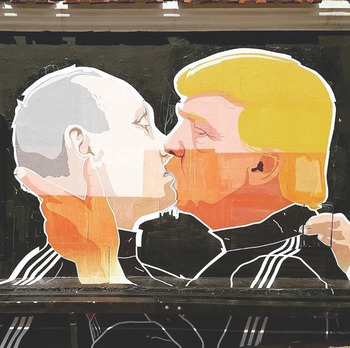
Speculation about the Trump-Putin ties began shortly after Trump announced his presidential campaign, but it gathered speed during the primaries season. The dominant narrative during the spring of 2016 was one of “bromance,” its tone and tenor largely satirical. Already circulating memes and constructions of Putin that had long proliferated on social media and late night comedy shows were now invoked to render Trump the Candidate absurd—one of the most striking was the image of Putin and Trump kissing.Footnote 3
The tenor of discussions shifted markedly during the summer of 2016—convention season—when the Democratic National Committee (DNC) hacking scandal broke just before Trump was appointed Republican nominee. The controversy raged through the fall of 2016, becoming a central theme of the presidential debates. The rage and invective were startling. This scandal involved incendiary claims and inflated language, from Hillary Clinton's charge of “Putin's Puppet” to John McCain's “act of war,” claims that were picked up and amplified by the print and TV media and which spurred lively debates on social media.Footnote 4 As the object shifted from “hacking” to “fake news” after the presidential election, the terrain became ever more murky and slippery: critics offered counter-claims, pointing to the role the mainstream media was playing in circulating unsubstantiated evidence.Footnote 5
Trump-Putin kiss. Photos of this mural by Lithuanian artist Mindaugas Bonanu went viral during late spring 2016. This particular image was one among many that were distributed virally and anonymously by the creator.

Striking as well have been the dizzying flips and inversions: Democrats turned super-hawks, invoking the authority of the FBI and CIA, while for the most part, Republicans displayed a careless disregard of these claims. Dissenters, those who muddied the waters by offering counter-claims to Democrat-led charges, complained of “smear” campaigns and of having been labeled “Breitbart supporters” or “Kremlin operatives.”Footnote 6 One's position on the issue became a litmus test for loyalty; the question became “who do you stand with?”Footnote 7 During the first months of the Trump presidency, these logics have only intensified. “Russiagate”—the media inflamed tumble of revelations and smoking guns that at the time of writing still rages—marks the dysfunctional continuation of these themes.
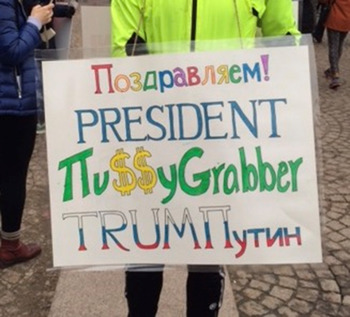
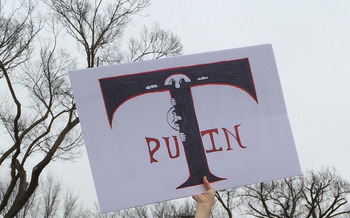
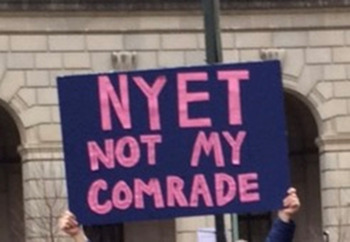
Like many I've been bewildered and troubled by this, equally by this discursive terrain as by the content of the charges themselves. I am aghast at the sharp deterioration of US-Russia relations and the revival of old Cold War tropes. We all lose when skepticism becomes “treason,” and when statements about the desirability of having a good relationship with Russia become marked as beyond the pale.Footnote 8 Indeed, Trump's tweet to this effect may well be “the one thing [he] is right about,” as Paul Robinson put it in a recent post.Footnote 9 I am troubled too by how “Russia” is invoked and what it has come to signal. A recent discussion on the Program on New Approaches to Research and Security in Eurasia (PONARS Eurasia) is devoted to the phenomenon of Russia signs and the role they played at the January 21 Women's Marches; slogans included “Putin's Puppet,” “Trump—Make Russia Great Again,” “Trump is Putin's Pussy.”Footnote 10
Here, as satirical memes made their way onto the streets, “Russia” (once again) comes to mean that which we stand against—with sometimes disquieting effect. In her contribution to the PONARs discussion, Regina Smyth reports that Russian language posters at the Washington, DC Women's March elicited jingoistic “America First” responses.Footnote 11
Red Scares and Orange Mobilizations
The intensity of this reaction, as well as the Russophobia that animates it, recalls prior “Red Scares.” It exhibits characteristics of American exceptionalism also.Footnote 12 So deep is our horror about Trumpism's rise, so convinced are we that populism could never be homegrown, that we are quick to exogenize its origins, that is, to blame external forces. But if we are to understand this scandal, we need to interrogate the cultural logics manifest on the Russian side as well, logics which have enabled this scandal to take form. This means acknowledging the deeper context of US-Russia relations.
Other Russia-themed protest signs in Washington, DC included this: “Congratulations! President Pussy Grabber TRUMPutin” Captured by Nancy Ries and used with permission.

Protest sign, Washington, DC. Captured by Nancy Ries and used with permission.

Protest poster, Washington, DC. Captured by Nancy Ries and used with permission.

In referring to “orange” mobilizations in my title, I obviously mean to refer to Trumpism (as well as the roiling forms of opposition it has engendered), but I mean to invoke something else besides. In Russia, “orange” mobilizations are understood to refer to those instigated and abetted by the US. During the 1990s, the US did exactly what the Director of National Intelligence (DNI) report accuses Russia of now: it deliberately interfered in Russian politics, providing funds, personnel, and technologies in order to guarantee a desired electoral outcome (Boris Yeltsin's 1996 reelection). Indeed, although we are apparently forgetful about it now, during the immediate post-socialist period, mainstream US journals jubilantly trumpeted these interventions. The cover of the July 1996 edition of Time magazine I quoted from in the opening epigraph not only celebrates this “secret” story of US involvement in Russia's election process, but proclaims mission accomplished, via a cartoon image of a grinning Boris Yeltsin waving the stars and stripes flag, under the headline “Yanks to the Rescue.”Footnote 13 Of course, these interventions were made in the name of democracy, not with the intent of undermining it, but from the perspective of many in Russia, this is just a question of semantics. A second round of interventions began in the 2000s via the color revolutions. The so-called “Orange” revolution in Ukraine of late 2004—from which the color gets its significance—was celebrated in the US as a triumph of democracy, yet highly controversial in Russia, where it was taken to signal one more instance of US meddling in postsocialist space. These interventions (which many in Russia perceive to be ongoing, via US involvement in events in Ukraine)—and this triumphalism—are still a source of great resentment in Russia today. Indeed, resentment about these “orange” technologies and interventions has been profoundly productive, harnessed and cultivated by the Putin administration to powerful effect, as I will explain.
Putin's Puppet? Hacking the US election? Toward a Non-Aligned response
I should say that I do NOT think Trump is Putin's puppet. Nor do I think it's useful to follow this logic; like many others, I think that the situation is far more complex and that posing the question in this way is unhelpful. That doesn't mean there's nothing going on, or that Russian actors have not played a role. The hackers of the DNC may well have been affiliated with Russian security services, although it is worth noting that this has still not been definitively proven.Footnote 14 It is a giant leap, however, to assert a causal link between their actions and the outcome of the presidential election. Framing things in this way obscures as much as it reveals and is profoundly dangerous in this volatile moment.
In the rest of my comments, I draw on my research to seek clues about the dynamics of the controversy that has unfolded. In brief, my arguments are: 1) the Russian hacking crisis is enabled by a complex entanglement of factors and dysfunctions on both sides, not merely Russian mischief, including recent US-Russia relations; 2) we need to be reflexive, by considering the implications of our own participation in the Russiagate controversy; 3) we need to be wary of how it distracts; there are important issues the election hacking scandal displaces and other “lessons from the east” we could productively consider.
The DNI Report
The Office of the Director of National Intelligence released its redacted report, “Background to “Assessing Russian Activities and Intentions in Recent US Elections” in early January 2017.Footnote 15 Its claims were twofold: that Russia sought to influence the presidential election 1) first with a goal of undermining faith in democratic institutions and 2) later with the goal of helping elect Trump.
Many mainstream media outlets such as the New York Times and Washington Post reported these charges uncritically. However, others took exception to the report's characterization and logic. Critics pointed to the lack of hard evidence, noting as well that it only enjoyed the “moderate confidence” of the National Security Agency (NSA). Russian-American journalist Masha Gessen—one of Putin's most consistent critics—cited it as an instance of “flawed intelligence.”Footnote 16 Some pointed to the report's focus, which is devoted not to hacking per se but to Russia's “propaganda efforts” more broadly and the tactics it has purportedly adopted.Footnote 17 As the document states, “Moscow's influence campaign followed a Russian messaging strategy that blends covert intelligence operations—such as cyber activity—with overt efforts by Russian Government agencies, state-funded media, third-party intermediaries, and paid social media users or ‘trolls.’”Footnote 18 Strikingly, as this statement suggests, the DNI report conflates the illegal hacking of DNC emails with the productions of diverse media outlets—especially the work of RT, the Russian state backed cable and online news program—and the circulation of memes and other stories. Building on long-established tropes, the report presents this as a uniquely nefarious and weaponized informational strategy, evidence of an ongoing “hybrid war” Russia is waging on the west and liberal democracy itself. My problem with this statement—and the inflammatory reporting that followed—is that it suggests these are uniquely nefarious “dark arts” we do not engage in.Footnote 19 There is a complex and deep history here (of technology transfer and collaboration), as we've seen. Indeed, Russia is not alone in this “new” strategy; the blending of tactics here described, between covert and overt, and state agency resources together with other actors (media, commercial media, including social media) is widespread, and “meme warfare” is undertaken by the US as well.Footnote 20 Viewed from this angle, the vitriol and mutual recriminations of “Russiagate” bears the hallmark of a relationship gone sour, its tactics born of intimacy, not distance.
The DNI report and its eager early reception bore the hallmark of a moral panic—and has been pilloried as such by the Russian media. At the same time, something is going on. There is no question that there's a state-sanctioned antiliberal project afoot in Russia and that it is discursively prolific. Analytically, yes, Russia has been an innovative lab for some of these technologies, including cyber attacks, clever forms of “eviscerating” illiberal narratives, skewering US hypocrisies, and the use/deployment of humor and satire as a “political technology.”Footnote 21 I have traced the early phase of these provocations via my recent research on the controversial pro-Kremlin youth organization Nashi (Ours).Footnote 22 Founded in the immediate aftermath of the “Orange” revolution, a time of high anxiety about the “militarization” of US democracy assistance under the Bush administration's “global war on terror,” Nashi presented itself as a kind of counterinsurgency movement. Between 2005 and 2011, Nashi activists undertook a variety of projects that specifically spoke back to US soft power interventions. It is important to note that while liberal Russian and foreign critics of Nashi (and Putin more broadly) identified their use of “propaganda” and PR as a dirty trick, Nashi actors framed it as an unfortunate necessity for combating nefarious methods of social control that were part and parcel of the foreign-inspired liberal governing project. The “political communication” and strategies Nashi activists learned were pitched as a defensive art, prompted by external meddling and the clever “soft” technologies these foreigners brought to postsocialist Russia (including the “techniques” Kramer's Time magazine article refers to, as well as “technologies of the Orange Revolution”).Footnote 23 These were hybrid technologies that drew on US-emanating resources, deployed here to protect Russia's young people and equip them to withstand the political manipulation they inevitably encountered, both from malign foreigners and from domestic “enemies within” (liberal westernizers). In the aftermath of the 2011–2012 “Bolotnaia” fair election protests, the Kremlin abandoned mass mobilization projects like Nashi to focus on the production of nationalist/patriotic informational campaigns.Footnote 24 Nashi constructions, which most of the Russian people I spoke to in 2005–2011 seemed to regard as exotic and extreme, went mainstream to become the stuff of everyday political commentary (such as labeling liberals “fascists”).Footnote 25 The resurgent nationalist anti-liberal narrative is now an established part of the media landscape. Since 2012, its contours have become clear—it is a lusty, vitriolic thing that takes pleasure out of skewering liberalism (and liberals). It got progressively nastier in the aftermath of the 2013–2014 Maidan movement, escalating still further during the spring of 2014 as Russia's conflict with Ukraine intensified.Footnote 26
This Russian mass-media anti-liberal/anti-US narrative morphed during the last couple of years in ways that appear to give credence to the claims that the Russian government backed a Trump victory. State-sponsored news outlets filled the airwaves with negative reports, demonizing Hillary Clinton. Nancy Ries, who has tracked RT closely, reports that the network spins the news to cast US resistance to Trump as a “Maidan” (here, understood to mean illegitimate coup). There's a satirical, stiob-like dynamic manifest in this reporting that makes it incredibly slippery to handle.Footnote 27 For example, RT’s reports often knowingly blend progressive positions with Russian statist ones, inviting North American and western European leftist commentators to speak to some of these issues. There is a project here—a form of mischief being undertaken, one that is hard to grapple with because it always incorporates partial truths and often follows the lines of progressive critique of US and European hegemony.
Much as I resist the troubling personification of Russian politics, it would be a mistake to overlook Putin's own performative provocations. He's playing a leading role on a global stage at a time when many people, not only in Russia, are sick of US hegemony, liberal pieties, and “public performances of American virtue,” and he's extremely skillful at it.Footnote 28 Obama's decision to expel diplomats and shut down Russian diplomatic compounds in the US in December in response to the DNI report offered a perfect occasion. Putin's surprise response—possibly encouraged by a pledge from then National Security Advisor Michael Flynn, seemed (or is it my fantasy?) to encode a deliberate appropriation of the Obamas’ “When they go low, we go high” strategy. He not only refused to retaliate in kind, but issued an invitation to US diplomats’ children to attend a holiday party at the Kremlin (a follow-up to the publicized complaints of Russian diplomats that their children's festivities were interrupted).”Footnote 29
Did the Kremlin wish to see Trump win? I don't believe this piece is clear either (though it occurs to me that with the Democrats’ defeat, Russian satirists lost a valuable asset). I do want to underscore one thing: this satirical anti-American/illiberal narrative is not merely the top-down production of the Kremlin or Russia's nefarious political technologists; it mobilizes widespread and deeply held frustrations and resentments about the loss of Russia's geopolitical status and the dislocations of the postsocialist period, as well as resentment about perceived US hypocrisies. The prior US-led interventions I've referred to are important to recall, both because they help to explain the current politics of resentment that the Putin administration thrives on, and because they equip this politics conceptually.
Since 2015, Nancy Ries and I have been grappling with a new research agenda that tackles this complex terrain. Our panel at the 2016 American Anthropological Association meetings interrogated what we called the discursive and performative “backlash” or “bite-back” projects that have emerged in postsocialist states in recent years, in the context of the emboldened nationalism, crisis of liberal governance, and exacerbated east-west divisions we now confront. Our point of departure was to point out that—seemingly empowered by international disapprobium—state actors and right-wing campaigners across Russia and Europe have eagerly embraced various elements of their “pariah” identity. Papers explored the boundary-crossing populist projects political leaders and media producers undertake (many of them satirical), mapping their potent critiques of the west, of neo-liberalism, and of western militarism. All take place at the intersections of their overarching “security regimes” (EU, NATO, US, Ukrainian, Russian), and are crucial factors which play into vast and threatening new forms and axes of militarization across Eurasia. One of our central objectives was to flag the troubling mutuality of these processes, as well as the confounding and obfuscating entanglement of actors and participants that takes place within them. While political pundits in Russia and the US loudly denounce each other and cast each other as dangerous and strange, their policies and militarizing practices (both domestic and global) display perverse resemblances. Our panel examined an array of these recent “bite back” projects and considered the complexities they represent for social analysis.
My own paper developed this theme of mutuality and mirroring by examining a prior Russian espionage controversy–the mass-mediated (and eroticized) controversy around Anna Chapman. The twenty-eight year old social media and real estate entrepreneur living in New York City was arrested on June 27, 2010 with nine other young people on suspicion of working for the Illegals Program spy ring. Chapman pleaded guilty and was deported to Russia in July 2010. What followed was a mass-mediated Cold War-era pop culture saturated “bite-back” bonanza that engaged a diverse range of global participants. Dubbed the “red under the bed,” Chapman became a tabloid sensation in the US. Rather than denying the affair or remaining silent, the Kremlin bizarrely picked up the campy “sexy spy” script. In late June, President Putin invited her to the Kremlin for a personal audience where—according to his own media-circulated claim—she sang nostalgic Soviet songs with him including “From Where the Motherland Begins,” a 1970s era song beloved by Soviet intelligence officers.Footnote 30 In dialogue with other anthropologists who are seeking to make sense of late-Putin era cultural logics and Russia's complex relationship with the US and the EU, I have examined the way that satire functions here. In mocking liberal values and principles—lifting up and exposing their hypocrisies and pointing to uncomfortable equivalencies—those who generate these narratives undertake an unsettlingly powerful kind of cultural critique.
Bringing a performance studies lens to this, I'm interested in how this controversy is incited, encouraged, and how we all come to participate in it. Just as the Anna Chapman “sexy spy” affair relied upon the tabloids and titillated media consumers as well as the Kremlin and Russian media outlets, the Russian hacking scandal totally relies upon our participation. It relies upon multiple agents (intelligence agencies, media, social-media users) to work, as well as our (liberals’) enjoyment and outrage, functioning not only by pressing liberal buttons, but also relying upon the outraged liberal response it elicits.Footnote 31 It channels our determination to get to the bottom of things (find facts, seek causal links), the instinct that propels our reactions and responses. The DNI report and the excitement it generated is a classic case in point. Its stern tone and earnest itemizing of Russian infractions, as well as its frantic, heated media reception, prompted mockery amongst Russian commentators, as well as a satirical retort from the Russian Foreign Ministry.Footnote 32
As I've watched the circulating memes and the rather self-congratulatory comic representations of “Putin,” some of which are deployed for the purposes of anti-Trump protest, I've felt uneasy. In our anguish, we perform the same dichotomized and savage caricatures as the Russian state media we are troubled by. It seems to me that we—actors in both Russia and the US—are engaged in a sick and dangerous game. It may have been funny for a while, but the stakes have shifted and I for one am no longer laughing.
In sum, this represents a uniquely powerful and potent means of mischief making, but to gloss it as “hybrid war” is problematic. It is unreflexive and obscures the multiple participants I have drawn attention to. Yes—something is up—(and Russia does appear to be sponsoring, encouraging, even partially bank-rolling the European far-right), but the anti-liberal constructions are not “Made In Russia” exclusives and this is not a one-way relationship. The historical ties I've flagged are important here—so too are the contemporary ties and relationships that enable this. Investigative reports by the day are exploring Steve Bannon's ties to the European far-right, the playbooks he draws on and the new coalitions that are forming. The diverse forms of anti-liberalism that circulate at this febrile moment of American politics may intersect with Russiagate, but they cannot be attributed to Russian “interference.”Footnote 33 The escalation of the affair via the “hybrid war” framing has dangerous implications also. It increases the stakes, empowering military regimes and industries—including new cyber industries—and marginalizing peace activists or those who seek an alternative, non-aligned path.Footnote 34 We should ask ourselves—who stands to benefit from this deterioration of relations and the escalation of the scandal? I turn now to the broader conversations I think we should be having but that this “Russia-US” framing obscures and displaces.
I think we need to view this controversy within the context of other changes and dizzying shifts of the last year, including the US-based Alt-right's move from margins to center and its (re)appropriations of the same “dark arts.” Indeed, as Emily Nussbaum traced in her recent New Yorker piece, satire has been a technology that has proven tremendously effective this past season, harnessed by far-right groups to fundamentally change the terrain of political discourse in the US. We are indeed in “a world of information that is increasingly sequestered or destabilized by malicious disinformation,” as Michael Fischer put it in his recent post.Footnote 35 The unreflexive fixation on Russia, however, does little to elucidate it.Footnote 36
There are other “lessons from the east” we should pay attention to. What we should be watching: future hidden economic transactions. The likely corporate ties between the Trump circle and Russian actors, including Putin, are troubling; I agree with many observers that it is urgent to investigate them. The firing of James Comey as I go to press makes an independent inquiry all the more crucial.
The Russian hacking scandal deflects attention from domestic dysfunctions—including proven forms of election meddling such as voter suppression initiatives. It can also distract us from the possible civil liberty-constraining outcomes of this controversy: the shutting down of free speech and curtailing of the digital sphere. The question of state involvement in the digital sphere is absolutely a topic of concern—but not one limited to Russia. At the same time and on another level, the deterioration of relations between the US and Russia threatens to have serious collateral damage. It threatens to undermine US-Russian institutional and grassroots civic ties and relationships painstakingly built over the past years. In her recent article in The Nation, Russian feminist scholar Nadezda Azhgikhina wrote of the importance of what she called “citizen diplomacy”:
“I think we have to try—before it is too late—to return to the simple idea of dialogue and discussion of problems in our common life, which is short for each of us. Dialogue is based on ordinary meetings of people, professionals, peers, and contemporaries. We do not have to agree on everything, but it is important to hear one another. Our interactions are criminally rare, and we don't know one another at all, despite the apparent abundance of information surrounding us. Let's try to fix this while there is still time. Let's try to hear one another. Find new platforms. Revive old ones. We won't let ourselves be used by politicians and moneybags in the name of their interests instead of our own. Let's try to insist on the need for real citizen diplomacy. And then, for sure, we will have a chance.”Footnote 37
This seemingly simple mission is something that I've tried to enact via my recent Putin-era research projects. It may be the most significant critical anthropological contribution I can make. My research on state-run youth projects (2006–2011) was a collaborative ethnographic project undertaken with my long-term research partner Valentina Uspenskaya, director of the Tver' Center for Women's History and Gender Studies. Our project engaged Russian undergrads (her students) in the process of inquiry. In a modest way, it sought to disrupt these “new Cold War” binaries by enacting an alternative form of international collaboration—feminist-oriented, based on long-term relationships. This past semester, I've continued this via my teaching, placing students of my “Europe After the Wall” class into dialogue with peers at Tver' State University. We last met via a Skype conference in December 2016. Weeks after the US Presidential election, the questions we had prepared to put to each other about politics, youth, populism, and democracy were unexpectedly poignant. The best I can think of doing right now is recommit to this project and propagandize the benefits of earnest—but not humorless—international collaboration on every front.