Myth played an important role in Greek religion: it illustrated and defined the roles of gods and heroes (Chapter II, §1); it also explained aspects of rituals (Chapter IV, §3), showed correct or deviant patterns of behaviour, and reflected on human conduct and the cosmos.Footnote 1 Since, of all aspects of Greek religion, myth has perhaps drawn the greatest attention and the largest number of different approaches,Footnote 2 I start with a short historical survey of these approaches and a brief discussion of recent definitions (§1). I then analyse origins and uses of myth (§2), study the relations between myth and ritual (§3), and conclude by looking at some changes in the popularity of myths, as reflected by the visual arts, and the nature of myth itself (§4).
1. A mini-history and a definition
After the Renaissance, which preferred an allegorical interpretation of Greek myth, as exemplified by the successful handbook of Natale Conti (c. 1520–1600),Footnote 3 and the ahistorical use of Greek mythology as material for literature in the seventeenth century,Footnote 4 modern research started at the beginning of the eighteenth century.Footnote 5 Pioneers were the Frenchmen Bernard de Fontenelle (1657–1757) and Nicolas Fréret (1688–1749). The former postulated a kind of ‘primitive’ mentality, initiated comparative mythology, reflected about the transmission of myths, and, last but not least, recognized the fatal influence of writing on mythology – all this in a small treatise.Footnote 6 The latter saw mythology as the expression of the culture, customs, and social order of a specific community.Footnote 7
Despite this promising start there was insufficient philological expertise in France to develop these ideas. The situation was different in Germany, where the Göttingen professor of Greek, Christian G. Heyne (1729–1812), introduced the term mythus to stress that he was not dealing with a fabula, the invention or fiction of a poet. According to Heyne, myth was the expression of a specific Volksgeist, it explained the admirable or frightening aspects of nature, and (although this is less marked in his work) it was a means to preserve the memories of great exploits.Footnote 8 In the nineteenth century, two Müllers (no relation) further developed Heyne's insights. The first, Karl Otfried Müller (1797–1840), stressed that myth was the reflection of a national (= tribal) identity and various historical periods. The second, Friedrich Max Müller (1823–1900), saw an important clue in the use of etymologies and directed his attention to the connection between myth and nature.Footnote 9 The dominance of these approaches came to an end when the unification of Germany (1870) lessened interest in the political background of Greek myth, and new insights in comparative linguistics destroyed the basis of most etymologies produced by Max Müller and his followers.Footnote 10 Instead of nature, attention was now focused on fertility and agriculture.
The stress on fertility was very successful and became canonized in the writings of James G. Frazer (1854–1941), the famous author of The Golden Bough (1890), and Martin P. Nilsson (1874–1967), who dominated the study of Greek religion in the middle of the twentieth century.Footnote 11 A link of myth with ritual was tentatively explored only late in his life by the learned German Hermann Usener (1834–1905), but especially elaborated in England by the so-called Cambridge ritualists, whose most famous representative, Jane Harrison (1850–1928), eventually discredited this approach by some all-too-fanciful analyses.Footnote 12
After the First World War, the excesses of the ritualists and the rejection of comparative studies by Classicists strongly diminished interest in Greek mythology, but in the middle of the 1960s structuralism promoted new interests, which came to the fore in the works of Walter Burkert (1931–2015), Jean-Pierre Vernant (1914–2007), and Marcel Detienne (1935–2019). Whereas Burkert's main interest has been in links between myth and ritual (see §3), Vernant and Detienne focused on those aspects of myth that elucidate aspects of Greek culture and society, such as the position of women (Chapter VI, §2), values of plants and animals (see §2), or the role and place of sacrifice (Chapter IV, §2).
Although the insights of Burkert and of Vernant and Detienne remain productive, the last two decades have seen two new developments in particular. The first one is an increasing attention to the mythographers: that is, those early Greeks, such as Hekataios and Akousilaos, who around 500 bc started to collect myths and write them down in readable and accessible prose. They emerged at more or less the same time as the tragedians; thus, both provide evidence of the distinctive cultural importance of these stories, and their recognition as a category of tale we call ‘myth’. The books of the mythographers mainly concentrated on what they considered ‘history’ and therefore, somewhat surprisingly to modern students of myth, hardly focused on the gods: a theogony is mostly absent from their writings.Footnote 13 A second striking feature is their often rationalizing approach. It is quite amazing to see how early Greek intellectuals started to systematize and rationalize features of Greek myth before the more radical rationalizers of the fourth century and later, such as Palaephatus.Footnote 14
A second development is the focus on myths as stories, an important mode of transmission and reflection within Greek religion that has not yet received the attention it deserves.Footnote 15 Indeed, the concentration on myth's connection to ritual and its importance for reconstructing ancient Greek culture and society made students neglect the simple fact that for a very long time Greek myths were told to an audience,Footnote 16 whose composition and circumstances were continually changing. In fact, each time a myth was related it had to be adapted to the conventions of the genre, which could be epic, choral lyric, hymns, drama, or just private telling, such as by women at the loom.Footnote 17 From the few surviving fragments of the early mythographers, we can still see that competing versions of Greek myths often circulated without seemingly bothering the Greeks themselves: the Athenians told at least three different myths to explain the origin of the Panathenaea.Footnote 18 Consequently, there was no one authoritative version of a myth. Professional and private storytellers knew standard plots, which they constantly had to adapt. Variation, therefore, is an important characteristic of Greek myth.
From the 1980s onwards, scholars started to call into question the validity of the notion of myth.Footnote 19 And, indeed, Greek mythos does not mean ‘myth’ but ‘is, in Homer, a speech-act indicating authority, performed at length, usually in public, with a focus on full attention to every detail’. However, in the course of the early classical period, we can gradually observe a shift in meaning of mythos from ‘authoritative speech’ to ‘imaginative tale’, as more and more intellectuals contested the authority of fellow historians and poets when speaking about gods and heroes.Footnote 20
All these developments once again force us to ask what we mean by ‘myth’ in early Greece. Burkert once proposed the definition ‘myth is a traditional tale with secondary, partial reference to something of collective importance’, but later suggested ‘traditional tales of special “significance”’, which comes very near to my own ‘traditional tales relevant to society’. In other words, the definition alerts us to those tales which are traditional (even new myths tend to follow patterns of old myths), are of collective importance (they are meant for public performance and not a vehicle for private views), and are transferable from one society to another (Greek mythology is not a closed corpus).Footnote 21
2. Origins and uses
Greek mythology of the archaic and classical periods was a conglomerate of old and new, indigenous and imported.Footnote 22 The myths of Achilles, Arion (the first horse: see Chapter II, §3), Helen (Chapter VI, §1), and the cattle-raiding Heracles (Chapter II, §2) all seem to go back to Indo-European times (and Heracles perhaps even further).Footnote 23 It is their concentration on prime interests of early societies – initiation, horses, marriage, food – which explains their continuity. Unfortunately, other old myths, such as the strange birth of Erichthonius/Erechtheus (Chapter VI, §1) from the seed of Hephaistos, and the mythical complex of Demeter and Persephone (Chapter II, §3), which was closely connected with the Thesmophoria (Chapter VI, §3), remain hard to date.Footnote 24
New imports were Oriental theogonic and cosmogonic myths (Chapter I, §3), but poets also borrowed individual motifs, as in the case of Bellerophontes. Out of spite for rejection by the hero with whom she was in love, King Proitos’ wife had denounced him before her husband. To appease her, the king sent Bellerophontes to his father-in-law, the King of Lycia, with a letter containing ‘many life-destroying things’ (Il. 6.152–210). Homer's version of the myth contains two motifs which are most likely derived from the Near East, since both occur in the Old Testament: the Potiphar episode from the story of Joseph (Genesis 39) and the fateful letter that David sent to his chief-of-staff to get rid of the man whose wife, Bathsheba, he wanted to marry (2 Samuel 11–12). But when, why, how, and where did these Oriental borrowings take place?Footnote 25
Originally, the Greeks were less concerned with the creation of the world than with the origin of their own cities, which presupposed the existence of the gods,Footnote 26 but interest in the creation of gods and the cosmos fitted the new interest in the world which became visible in Ionia in the archaic period. The date fits the fact that borrowings of Oriental myths most likely postdate the Mycenaean period: there is no influence from Canaanite myths, although the powerful city of Ugarit flourished until the invasions of the Sea Peoples, and the version of the Mesopotamian epic Enuma Elish which is quoted by the Iliad (Chapter I, §3) is unlikely to have been composed before 1100 bc. The varying geographical origins of the myths (Anatolia, Mesopotamia, and the Syro-Phoenician coastal area) all point to transmission routes via both Anatolia and the Levant, where Greek traders and mercenaries will have heard Oriental bards or storytellers and, in turn, told their myths to poets at home. The various transmissions must have been an important factor in the origin of the many differences between Greek and Oriental versions, the precise origins of which remain impossible to trace at the moment.Footnote 27
What were the uses of myth? One answer would surely have to be: pure entertainment. Choral lyric with its combination of music, dance, and song provided quite a spectacle, and for thousands of Athenians the dramatic performances must have been welcome breaks in the winter months. However, myths were also a serious matter. As mentioned in the Introduction, in addition to defining the gods (Chapter II, §1) and illuminating rituals (below, §3), they supplied arguments in debates, served as models of ethical and religious behaviour, helped to establish political identities or advance political claims, and contributed towards the Greek mentalité. Let us look at a few examples.
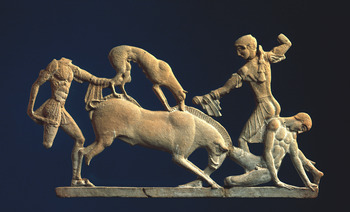
When Achilles had withdrawn into his tent in anger and the Trojans were threatening the Greek camp, an embassy came to Achilles in a last attempt at persuading him to renounce his anger. His old tutor, Phoenix, then told him the myth of Meleager, who had not only killed the Calydonian boar (Figure 10) but also his mother's brother in a battle over the spoils. When his mother cursed him, Meleager became very angry and withdrew from the battle in which the Kouretes threatened to take his town, Calydon in Aetolia. Only at the very last moment did Meleager rejoin the battle, but by his prolonged withdrawal he had forfeited the presents which had been promised to him (Il. 9.529–99).
Terracotta representing the Calydonian Hunt. The so-called Melian relief, c. 460 bc.

The passage is illustrative in more than one aspect. First, it strongly suggests that myths could be told to persuade people to change their actions. Second, the anger of Meleager is hardly mentioned in other versions and is likely, therefore, to be Homer's invention to make the myth more suitable to its context. Third, myths could be continually adapted, since only from about 500 bc do we find versions in which the fate of Meleager was connected with a log of wood which his mother threw into the fire after she had heard about her brother's death.Footnote 28 Apparently, this spectacular motif appealed to the changing tastes of the Greek public, which had become interested in a ‘more emotional, even larmoyant appeal’.Footnote 29
The Calydonian boar had been sent by Artemis, whom the father of Meleager, King Oeneus, had forgotten during a sacrifice. The omission was not unique. Tyndareus once forgot to include Aphrodite, which angered the goddess to such an extent that she made his daughters Helen and Clytaemnestra desert or even deceive their husbands: in other words, Tyndareus’ omission eventually led to the Trojan War; and Hera's anger at Pelias for not having been honoured set off the expedition of the Argonauts. These myths, then, also showed the terrible consequences of not giving the gods their proper due.Footnote 30
Instead of focusing on Panhellenic expeditions, such as the Trojan War or the Seven against Thebes, myths could also advance social and political claims of families and cities, sometimes via genealogies.Footnote 31 Hippocrates’ family was traced back to the healing hero Asclepius, and that of the Athenian priests of Poseidon Erechtheus to Erechtheus, son of Ge (Earth) and Hephaistos. The Athenians promoted Ion's ancestorship of the Ionians to win their support against the Spartans during the Peloponnesian War. In his tragedy Ion, Euripides even went as far as having Creusa conceive Ion by Apollo but his brother Dorus, the ancestor of the Dorian Spartans, by a mortal, whereas traditionally Dorus was the maternal uncle of Ion. One could also adduce foul play in the past. The Spartans underpinned their possession of Messene by claiming that, after the return of the Heraclids, who had divided the Peloponnese among themselves, Kresphontes received Messene via tricks: Sparta's conquest of this area was thus fully justified.Footnote 32
The political side of Greek myth has often been discussed, but until very recently much less attention had been given to ways in which myth was shaped by and articulated the Greek mental landscape.Footnote 33 Its pictures of cities and crossroads,Footnote 34 warriors and women (Chapter VI, §2), meadows and mountains,Footnote 35 plants,Footnote 36 and animalsFootnote 37 can help us to see how the Greeks perceived their world. For instance, when Inachus, the main river of the Argolid, was worshipped as the first king of Argos and ancestor of the Argives, or when Acheloos, the largest river of northern Greece, was closely connected with the education of boys, it is clear that the Greeks perceived their rivers rather differently from, say, those living close to the Thames, Seine, or Mississippi.Footnote 38 More investigations in this direction will eventually enable the reconstruction of a ‘mythical Greece’: that is, the way in which Greece was represented in myth.Footnote 39
Rather optimistically, earlier generations thought that Greek myth could also be used to reconstruct past events, but Greek oral tradition was probably ‘of the most fluid kind, its transmission casual, and its lifespan usually short’, as can indeed be demonstrated for Athens.Footnote 40 On the other hand, myth does reflect customs, relations, institutions, and perceptions of early Greece; in some cases, it even preserved extinct institutions. Myth reveals that heroes such as Hippolytus and Theseus were educated by their maternal kin, and this type of education (fosterage) lasted in western Europe into the Middle Ages, although it did not survive into classical Greece.Footnote 41
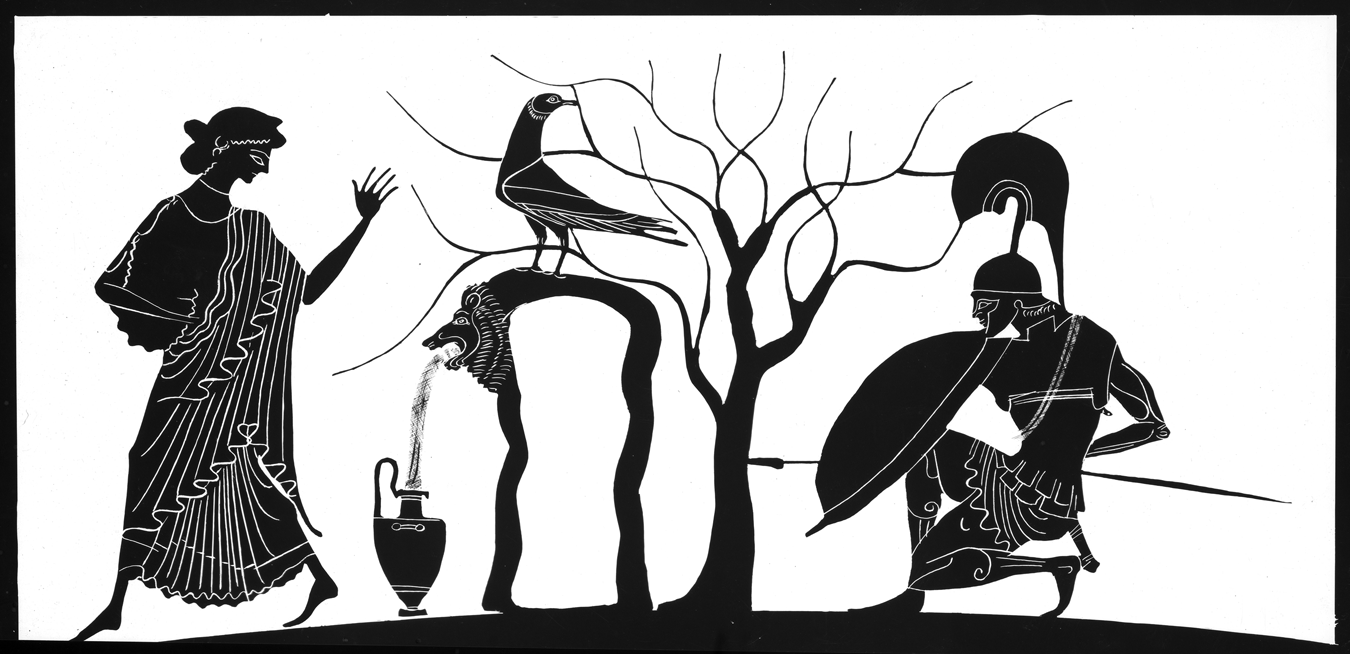
Yet when using myth for the reconstruction of social life in early Greece, we must be very attentive to genre and ideology, as myths about the family may illustrate. The Iliad tended to avoid focusing on family conflict, but Attic tragedy pictured struggles within the family in the most sombre colours. And whereas father–son hostility usually ended badly,Footnote 42 the brother–sister relationship was invariably good. The brother was the protector of his sister's honour: Achilles could ambush Troilus when he accompanied his sister Polyxena to a fountain (Figure 11). Even when, in Euripides’ Helen, the priestess Theonoe opposes her brother, she is reconciled with him at the end of the play. In both cases, myth does not reflect the realities but the imperatives of life in a society with weak legal institutions. In such a society, families need one another in order to survive and prosper, and that is an important message of these myths.Footnote 43
Polyxena and Achilles, who is waiting in ambush for her brother Troilus. Black-figure lekythos, Athena Painter, c. 490 bc.

3. Myth and ritual
In recent decades, scholars have paid much attention to the relation between myth and ritual. Although myths existed without rituals and rituals without myths, the two symbolic systems were often interrelated. This relationship is only gradually becoming clearer and is still the subject of lively debates. In the course of time, three possibilities have been suggested: ritual follows the pattern of myth; ritual generates myth; and ritual and myth arise at the same time, pari passu. We will look at all three possibilities and start with the influence of myth.Footnote 44
Cities not infrequently appropriated figures from Panhellenic mythology for a local cult. So Athens instituted a cult for Theban Oedipus and, in the mid-sixth century bc, Argos founded a heroön for the Seven against Thebes and in this way ‘claimed’ these warriors. In Tarentum we can see a more specific influence of myth, since women were excluded from the cult of Agamemnon – surely in memory of his murder by Clytaemnestra. However, this was the proverbial exception proving the rule: in general, such cults did not display details characteristic of their myth.Footnote 45
More complicated are myths produced by rituals. An interesting example is the myth of Perseus. When this hero of Mykenai beheaded the Gorgon Medusa with a sickle, ‘out jumped big Chrysaor and the horse Pegasus’ (Hesiod, Theog. 281). The winged horse enabled Perseus to rescue the maiden Andromeda from a sea monster in Joppa-Jaffa, where in Roman times the ‘huge bones’ (prehistoric fossils?) of the monster were shown to tourists – an often neglected use of mythology. Burkert rightly noted that ‘the steed and the warrior are indicative of a trial of initiation’, but he overlooked important testimony in support of his interpretation, as in 1892 the following, early fifth-century Mycenaean inscription had been published: ‘If there is no damiorgia [a Doric office], the iaromnamones [recorders of sacred matters] for Perseus are to serve as judges for the parents, according to what has been decided’ (trans. Jameson 2014).Footnote 46 Apparently, Perseus was closely connected with contests of boys, whose role model he will have been.
In the sanctuary of the initiatory Spartan goddess Ortheia masks have been found of old women and of a handsome young man; moreover, Spartan boys engaged in contests and, when victorious, dedicated iron sickles to the goddess. As Michael Jameson perceptively observed, these Spartan initiatory customs must form the ritual counterpart of Perseus’ myth: Mycenaean boys took leave of the world of the females with a sham fight in which masks of terrifying females played an important role. We may even wonder whether this use of masks in ritual is not also the background for Theseus’ victory over the Minotaur with the help of Ariadne: another initiatory fight (Chapter IV, §3). The Minotaur is often pictured as a man with a bull's head and we know that in Cypriot Amathus priests officiated with bull's masks in a sanctuary of Aphrodite Ariadne. But, whereas Perseus’ fight seems to reflect the break with the world of women, Theseus’ victory signifies the entry into the world of adults: some Greek warriors wore bull helmets, and on his return Theseus became king of Athens.Footnote 47
Versnel has strongly argued that in some cases myths and rituals were formed pari passu. His main witness is the myth and ritual complex of Kronos and the Kronia. Versnel approached this complex as follows. First, he gathered all mythical traditions about Kronos, which show that myth depicts this god sometimes negatively (from parricide to general lawlessness) and sometimes positively (king of a golden age). Subsequently, he collected the ritual testimonia, which at Rhodes speak of human sacrifice but in Athens of a very happy atmosphere, since, during the festival, masters and slaves happily dined together. Surveying the myth and the ritual, he concluded that ‘Kronian ritual is just as ambiguous as Kronian myth’.
Regarding the historical development, Versnel suggests that the rite started with an agricultural festival (for obscure reasons devoted to Kronos), which in historical times ‘was firmly anchored in a festive complex which marked the transition from the old to the new year and that, accordingly, it was celebrated with rites of role reversal’. In cult, Kronos developed into the ‘mythical’ god of the precosmic era with its utopian and catastrophic aspects. Consequently, according to Versnel, we find in this complex a correspondence between myth and ritual in structure and atmosphere in such a way that both deal with the same type of experience in the same affective mode and this pari passu.
However, Versnel neglected to study the origin of the Kronia festival and overlooked the fact that we do not have sufficient information to conclude that the myth and the ritual of the Kronia originated alongside each other. Moreover, he did not take into account that, in the cases of human sacrifice, Kronos is usually the interpretatio Graeca of a Carthaginian or Semitic god, whereas, in the case of abundance, Kronos is sometimes the Greek interpretation of the Egyptian god Geb. In fact, the traditions of Kronos seem to have entered Greek mythology from Anatolia, plausibly Lycia, not before the eighth century, with the ritual of the Kronia only being celebrated in a very limited area. Despite his impressive erudition, in the end Versnel's attempt at proving a pari passu origin of Greek myth and ritual fails to convince.Footnote 48
Finally, Claude Calame has suggested replacing the terms ‘myth’ and ‘ritual’ by a single new expression: ‘symbolic process’.Footnote 49 Yet the myth and ritual of Perseus illustrate at least four important differences between these two symbolic systems.Footnote 50 First, whereas the ritual was acted out by boys and men with masks, myth speaks of a real fight between a young man and an old hag, Medusa: what is symbolic and reversible in ritual becomes realistic and irreversible in myth. Second, myth is selective: it mentions only Perseus’ fight, whereas the ritual must have been quite a spectacle, with judges, spectators, and contestants. This selectivity can be quite remarkable. On the island of Lemnos, there was a temporary separation of the sexes during the period leading up to the yearly arrival of new fire. The corresponding myth speaks of a murder of the husbands by their wives but has no mention whatsoever of fire: clearly, a ritual should not be reconstructed on the basis of a myth only. Third, myth bestows significance on ritual. The contest in the ritual for Perseus was not just any game, since the winner became, so to speak, a Perseus-to-be. The significance could also be of an explanatory manner, since many a myth explained striking details of the ritual. Fourth, the name Pegasus and the idea of a winged horse most likely derive from the Near East, as does the location of Andromeda in Joppa/Jaffa. Evidently, myth can incorporate motifs from other myths and be removed from its ritual basis; in fact, whole myths migrated from one cult to another.Footnote 51
4. Visual arts and changes
Our concentration on the performative and literary aspects of myth should not conceal the great importance of the visual arts for the study of myth.Footnote 52 The splendid iconographical encyclopaedia of classical mythology, the Lexicon Iconographicum Mythologiae Classicae (1981–2009), now enables a more intensive ‘cross-fertilization’ between literature and the visual arts, which in antiquity hardly constituted two independent streams of tradition.Footnote 53 In fact, we can sometimes notice a virtually immediate response of artists to poets. After Pindar had described the throttling of serpents by young Heracles in his First Nemean Ode, Attic painters represented the feat within a few years of the poem being premiered in Sikyon shortly after 470 bc.Footnote 54 Painters may even have invented versions of myths which are absent from the literary tradition. On a Douris cup, datable to 480–470 bc, a dragon disgorges Jason in the presence of Athena, and a similar scene already occurs on a late seventh-century Corinthian alabastron, although extant literature never mentions this detail. On the other hand, the early archaic poet Eumelos wrote an epic, Corinthiaca, in which Medea played a considerable role, and vase-painters may have taken the scene from this epic or from similar archaic Argonautic poetry.Footnote 55 However this may be, the interaction between poetry and the figurative arts remains a vexing problem and deserves further attention.
In the course of time some myths declined in popularity, whereas others suddenly caught the Greek imagination. In contrast to the fragmentary state of the literary tradition, the enormous output of vase-painters allows us to trace such changes in Athens, the main producer of vases, in chronological detail. By simply counting surviving vases, even though these are only a fraction of the archaic production, we can see the emergence around 560 bc of a new preference in Athens for myths with specifically Attic associations, such as Theseus and the Minotaur (Chapter IV, §3), or those Panhellenic myths which the Athenians in some sense adopted as their own, such as the ones about Heracles (Chapter II, §1). This popularity can be correlated with the reconstruction of the Panathenaea (Chapter IV, §2) in the 560s and thus testifies to a new spirit in contemporary Athens. Other cases are less easy to explain. Why did maenads suddenly become popular in Athenian imagery towards the end of the sixth century? The question is more easily posed than answered.Footnote 56
Attic vase-painters’ interest in mythological scenes strongly diminished after 480 bc, but myth remained popular in literature, although in changing ways. In the course of the classical period, the position of the poet as the main producer and innovator of religious traditions started to lose importance, and by the Hellenistic age his function had been largely taken over by philosophers and historians. This development also influenced the status of myth, which no longer had the same relevance to society; typically, in the fourth century myths started to be called ‘old wives’ tales’.Footnote 57 It can hardly have been chance that in the same century Asclepiades of Tragilus published Subjects of Tragedy, the first book in which tragedies were retold and compared with earlier versions.Footnote 58 In the Hellenistic and Roman periods, myths were collected as background material for the explanation of great poets or organized around a uniform theme, such as the Library ascribed to Apollodorus which is arranged genealogically by mythical families.Footnote 59 The myths now often served the need to possess cultural capital, as people liked to quiz one another regarding obscure mythological details, but in Roman times painters also decorated the walls of houses with mythological scenes, as the influential wall paintings of Pompeii show, and mosaicists created floors with mythological scenes, examples of which keep turning up in excavations.Footnote 60 The mythographical collections, in which myths have been reduced to fixed, sometimes rather dry texts, are now our main source for the knowledge of Greek mythology.Footnote 61 Yet we should always remember that these texts are only pale reflections of the performances which once brought these myths to life.
This analysis has shown a variety of approaches to myth in the course of time. Gradually, methodological pitfalls and possibilities are becoming clearer, but we are still far from a scholarly consensus regarding the best methods. The plasticity, multifunctionality, and many meanings of myth always make its analysis a hazardous undertaking.