Introduction
The extent to which national versus parochial issues become the basis of representation is one of the central concerns of democratic theory. It has been argued that incentives for parochialism exist primarily in countries that have one or more of the following characteristics: a presidential system, weak parties, an electoral system that allows cultivating personal votes (Lancaster and Patterson, Reference Lancaster and Patterson1990; Ames, Reference Ames1995; Mainwaring and Pérez-Liñán, Reference Mainwaring and Pérez-Liñán1997; Richardson, Reference Richardson1997; Shugart, Reference Shugart1999; Denemark, Reference Denemark2000; Crisp et al., Reference Crisp, Escobar-Lemmon, Jones, Jones and Taylor-Robinson2004; Morgenstern and Swindle, Reference Morgenstern and Swindle2005; Ashworth and Bueno de Mesquita, Reference Ashworth and Bueno de Mesquita2006; see also Hopkin, Reference Hopkin2001). In addition to these institutional features, parochialism is often considered to be a characteristic of developing rather than advanced democracies (see Kitschelt, Reference Kitschelt2000; Kitschelt and Wilkinson, Reference Kitschelt and Wilkinson2007). Evidence of individual and partisan pork-barreling has been documented in the US (Ferejohn, Reference Ferejohn1974; Mayhew, Reference Mayhew1974; Shepsle and Weingast, Reference Shepsle and Weingast1987; Stein and Bickers, Reference Stein and Bickers1994; Levitt and Snyder, Reference Levitt and Snyder1995; Bickers and Stein, Reference Bickers and Stein1996; Lee, Reference Lee2000; Cox and McCubbins, Reference Cox and McCubbins2001; Balla et al., Reference Balla, Lawrence, Maltzman and Sigelman2002) – a country with weak parties and a presidential system. Similar evidence has been provided for Argentina (Calvo and Murillo, Reference Calvo and Murillo2004; Remmer, Reference Remmer2007), Brazil (Ames, Reference Ames1994), Mexico (Costa-i-Font, Rodriguez-Oreggia, and Lunapla, Reference Costa-i-Font, Rodriguez-Oreggia and Lunapla2003), and Peru (Schady, Reference Schady2003) – developing democracies with weak parties and presidential systems. Some, although conflicting, evidence exists about pork-barreling in Australia – a parliamentary but majoritarian democracy with candidate-centered elections (Bowler, Farrell, and McAllister, Reference Bowler, Farrell and McAllister1996; Denemark, Reference Denemark2000).
Parliamentary systems, countries with strong parties and party-centered elections are assumed to be less prone to parochialism, given the incentives of parties to win a nationwide vote (Mainwaring and Pérez-Liñán, Reference Mainwaring and Pérez-Liñán1997; Shugart, Reference Shugart1999; Denemark, Reference Denemark2000; Crisp et al., Reference Crisp, Escobar-Lemmon, Jones, Jones and Taylor-Robinson2004: 827–828; Morgenstern and Swindle, Reference Morgenstern and Swindle2005). Literature on advanced parliamentary democracies largely ignores the study of patronage politics (including parochialism) on the premise that it does not exist in these countries (see Kitschelt, Reference Kitschelt2000: 855–856).
This paper challenges the widespread assumption that parochialism is restricted to certain political systems only. The current study concentrates on one form of clientelism – the tactical use of geographically concentrated spending (or partisan pork-barreling) – in Denmark, Finland, Norway, and Sweden. Specifically, the study considers the extent to which there is a partisan bias in the distribution of municipal grants in these countries. The bias is expected to occur because parties controlling the national government try to use this spending, at least partially, for vote-purchasing purposes. The Nordic countries studied lack the institutional and cultural attributes usually associated with pork-barrel politics. Therefore, such case selection is appropriate for determining the extent to which such vote-purchasing tactics are indeed exceptional.
The results of the study make several novel contributions to the existing literature on clientelism in general and pork-barrel politics more specifically. First, the findings demonstrate that targeted spending is a re-election strategy followed by incumbent government regardless of the system features. Second, the study shows that, in order to secure more votes, parties target their strongholds when distributing municipal grants. Preliminary evidence also indicates that targeting partisan strongholds is a feasible and rational strategy to follow because it pays off in votes.
These findings are in line with the recent theoretical approaches that treat clientelism as a specific form of representational linkage rather than as an aberration from the norm of programmatic representation (Kitschelt, Reference Kitschelt2000; Kitschelt and Wilkinson, Reference Kitschelt and Wilkinson2007; Remmer, Reference Remmer2007). The findings here show evidence of clientelism in systems where we would least expect it, underscoring the argument that providing such a linkage is simply another way politicians can and do construct their support bases. Recognizing this to be the case helps to build a better understanding of the representational process than the existing comparative literature with its primary focus on responsible party government has been able to do.
Targeting municipalities
There is a strong rationale for the assumption that parochialism does not exist in countries with parliamentary systems, strong parties and party-centered elections. Given that parties, not individual legislators, are the primary actors in these systems, parties define both electoral strategies and public policy. Parties have the incentive not to just win in a specific district, but to win as large a proportion of the nationwide vote as possible to maximize their parliamentary representation. Furthermore, in party-centered systems, ‘voters vote on the basis of broad policy options rather than on the basis of promised particularistic benefits’ (Carey and Shugart, Reference Carey and Shugart1995: 433). Thus, parties have an incentive to appeal to a broad nationwide constituency that ‘may displace the district as the primary electoral constituency thereby decreasing the importance of pork-barrel politics’ (Lancaster and Patterson, Reference Lancaster and Patterson1990: 470). Recognizing this, scholars have focused on national level policies rather than on local public goods when studying the electoral strategies of incumbent governments in parliamentary proportional systems (Alesina, Roubini, and Cohen, Reference Alesina, Roubini and Cohen1997), and left the electoral calculus based on distributive policies virtually unexplored.
The emphasis of political parties on national issues does not exclude the possibility of engaging in the tactical use of geographically targeted spending for electoral purposes. Parties in government are motivated by the same desire as individual legislators – to maximize votes in future elections (Balla et al., Reference Balla, Lawrence, Maltzman and Sigelman2002: 545). This vote (and, subsequently, seat) maximization is possible not only by manipulating national issues but also by targeting policies towards specific geographical areas. As long as there is at least some geographically based variation in political support, parties have an incentive to exploit that variation to their advantage. In addition to such an incentive, in the case of the strong party model, government parties also have the opportunity to ‘pork-barrel’ because they can target expenditures to specific localities with relative ease (Budge and Keman, Reference Budge and Keman1990; Levitt and Snyder, Reference Levitt and Snyder1995; see also Castles, Reference Castles1982).
While in majoritarian systems individual legislators provide pork to their electoral districts, partisan pork-barreling in proportional systems cannot be easily targeted to electoral districts because these often do not correspond with administrative units. Rather, municipalities are more appropriate geographically concentrated constituencies for the purposes of tactical spending as these can effectively be targeted via intergovernmental grants. Furthermore, local governments have democratically elected bodies. As I explain below, it is specifically this lower-level democratic governance that greatly enhances the ruling parties’ ability to use targeted policies to influence national electoral results.
Given the incentive and the opportunity, thus, we would expect incumbent governments to engage in vote-purchasing behavior in the manner of pork-barrel politics with an attempt to improve their electoral fortunes. But which grant allocation strategy is a tactical governing party likely to employ and which municipalities to target? The potential strategies available are the following: (1) allocate disproportionately higher share of transfers to municipalities where government party’s support base is strong (Cox and McCubbins, Reference Cox and McCubbins1986), (2) allocate disproportionately higher share of transfers to municipalities where government party’s support base is weak, i.e. that are politically dominated by opposition parties, (3) allocate disproportionately higher share of transfers to municipalities that are ‘marginal’ or contain swing voters (Lindbeck and Weibull, Reference Lindbeck and Weibull1987; Dixit and Londregan, Reference Dixit and Londregan1996).Footnote 1 Not all of these strategies are equally effective or feasible.
In accordance with recent theoretical literature, I argue that the strategy most likely to be followed in proportional systems is the option of targeting spending to those municipalities where the ruling parties are the dominant political force (McGillivray, Reference McGillivray2004; see also Cox and McCubbins, Reference Cox and McCubbins1986; Levitt and Snyder, Reference Levitt and Snyder1995; Balla et al., Reference Balla, Lawrence, Maltzman and Sigelman2002: Calvo and Murillo, Reference Calvo and Murillo2004; Costa-i-Font, Rodriguez-Oreggia, and Lunapla, 2003), i.e., where they enjoy electoral support and their co-partisans dominate local politics. Gaining and maintaining partisan advantage in national elections in a given region is easier when also the local representative body is dominated by co-partisans (see Ames, Reference Ames1994). Furthermore, targeting localities where local council and local executives are dominated by a central government incumbent party allows for a coordinated effort with co-partisan local government leaders to consolidate the partisan advantage in the given locality. It follows that national governments have a strong incentive to win the support of the local party leaders because those leaders are an asset during national election campaigns. Successful and popular local politicians can put a familiar face on an otherwise abstract party label for local voters. Based on their personal appeal, the local politicians can attract voters in their localities to vote for their party on national elections. Shugart, Valdini, and Suominen Reference McGillivray(2005) demonstrate the local political experience and local roots are valuable attributes to attract votes in national elections (see also Tavits, Reference Tavits2009, Reference Tavitsforthcoming). By allocating disproportionally larger amounts of municipal grants to localities controlled by their co-partisans, the incumbent parties in government can boost the image of those local leaders. This boost in reputation, in turn, is likely to enhance the electoral return for the party on national elections (see Ames, Reference Ames1994). In sum, local-level co-partisans are an essential ingredient in incumbent parties’ pork-barreling.
Furthermore, given that incumbent governments try to consolidate the partisan advantage that helped them gain power, they want to maximize the benefits of those groups of voters that are perceived to be more responsive to them. Cox and McCubbins (1986) intuitively argue that opposition supporters are the least responsive to governing parties. Providing targeted benefits is very unlikely to convert them to government supporters. It is quite rational to target benefits towards support groups who are most responsive to the incumbents – voters sympathetic to governing parties. By doing so, parties can create loyal supporters who are unlikely to switch their allegiance to other parties in the next elections. Incumbent parties can thus consolidate their electoral advantage in municipalities where they are likely to maximize their electoral returns (see also Ames, Reference Ames1995; Levitt and Snyder, Reference Levitt and Snyder1995; Costa-i-Font, Rodriguez-Oreggia, and Lunapla, Reference Costa-i-Font, Rodriguez-Oreggia and Lunapla2003; Scheiner, Reference Scheiner2005).
The level of cognitive capacity required from voters for this argument to hold is not excessive. Voters are not required to distinguish between money raised locally and funds transferred from the central government. It is only required that they be able to evaluate the performance of local governments – recognize increases in investments and enhanced local development. Since the ruling party is the same on the local and national level, there is no confusion for the retrospective performance-based voter at the polling booth as to whom to reward. Furthermore, it is in the interests of local leaders to advertise the source of funding for major developmental and investment projects. The cognitive capacity required from voters for either of the remaining explanations to hold is much more stringent: voters need to be able to distinguish between funding originating from different sources and recognize who to reward for which funds. This simplicity makes the current explanation also more realistic.
Parties have additional incentives to target their strongholds. Targeting municipalities controlled by governing parties serves not only the re-election incentive but also partisan policy goals. If one assumes that parties seek office at least partially because they care about policy, it makes sense to target discretionary resources to municipalities where they would lead to the implementation of policies that the governing parties care about. Bias towards municipalities ruled by co-partisans would thus be rational even if it did not buy votes. A separate analysis in the empirical part of the paper tries to sort out to what extent such policy incentive alone accounts for the partisan bias in allocating resources.Footnote 2
Compare the strategy of targeting strongholds to the one of allocating more grants to municipalities dominated by opposition parties. On the one hand, targeting municipalities where government party support is relatively low may have the effect of increasing their popularity compared to the opposition party. This, in turn, might lead to increased support for the governing party at the expense of the opposition, and the strategy would serve its intended purpose. However, in order for pork-barreling to be an effective vote-purchasing strategy, voters need to recognize the source of the targeted benefits. Targeting municipalities controlled by the opposition may create confusion for voters about the source of benefits. Credit for the benefits may mistakenly be attributed to the opposition parties in power in the given locality. On the other hand, withholding benefits from municipalities controlled by the opposition parties may cause people to blame those parties for their inability to address local concerns, as the absence of those grants decreases local investments and other types of local development projects. In line with this argument, previous work has found that if credit for the provision of particularized benefits has to be shared with other claimants (e.g. opposition parties), the extent of pork will decrease (Ames, Reference Ames1995).
Furthermore, as argued above, targeting opposition municipalities is disadvantageous in terms of low voter responsiveness to such attempts of vote purchasing. As stated, providing targeted benefits is unlikely to convert government opponents into their supporters. Given this, the expected electoral benefits to the ruling party do not follow and the strategy does not serve its intended purpose. In sum, targeting municipalities controlled by opposition parties is not likely to be an effective strategy for governing parties seeking to consolidate their support.
Finally, a strategy familiar from the pork-barreling literature in the majortiarian systems focuses on targeting marginal districts (Dixit and Londregan, Reference Dixit and Londregan1996). However, in parliamentary systems with proportional elections such a strategy is much more difficult to justify. In proportional systems, ‘winning’ a marginal district is a nonsensical proposition. McGillivray (Reference McGillivray2004: 39–69) provides and elaborates discussion about how optimal campaign strategies differ significantly between proportional and majoritarian electoral systems. In the former case, parties gain no electoral benefits from simply achieving the plurality or majority in a particular electoral district. Parties want to achieve as many votes as possible, rather than ‘winning’ as many districts as possible. Given that in proportional systems all votes are of equal value to parties, it is cheaper and hence rational to buy the least costly votes – those from individuals who are close to the party. In majoritarian systems all votes are not of equal value to parties: votes in marginal districts are more valuable because winning in marginal districts helps winning the election. In such systems, investing in these more costly votes is, thus, worthwhile.
Targeting marginal municipalities (as opposed to districts) – those where government party (or parties) has marginally lower seat share in the local council than the opposition party (parties) – or municipalities with many swing voters is also not a feasible strategy given the nature of the proportional electoral system. Simply put, ‘it is extremely difficult for a seat-maximizing party to know where the marginal seats are located in a system with proportional representation’ (Sørensen, Reference Sørensen2003: 171). It is equally difficult for parties in a proportional system with more than two parties to identify or even define swing voters. Furthermore, such strategy would pose similar problems to credit claiming as was the case with targeting opposition municipalities.
It follows from the above discussion that the most effective strategy for tactical allocation of municipal grants is to favor municipalities dominated by co-partisans. The fact that parliamentary multi-party systems are often ruled by coalitions rather than single parties does not change the basic rationale described above. That is, benefits are still expected to be targeted to those municipalities that are dominated by the governmental parties. Such geographically targeted spending should be easy to agree upon between coalition partners as it does not create ideological frictions. Rather, such pork-barreling is a win–win situation for all governmental parties, giving each coalition partner an equal opportunity to claim credit for advancing local life.Footnote 3 In sum, the discussion above allows one to hypothesize that local governments whose councils are dominated by national governing parties receive disproportionally larger amounts of national government grants than local governments, where national governing parties are in minority.
Case selection
In order to test the hypothesis about the pork-barrel politics by incumbent governments, I have assembled original data sets on local government grant allocations in Denmark, Finland, Norway, and Sweden. The country selection ensures a conservative test of the proposition for several reasons. First, all of the countries under study are parliamentary democracies with a proportional representation electoral system. The Scandinavian countries have strong and stable parties with a national orientation (Strøm, Reference Strøm1986, Reference Strøm1984) and are among the most advanced democracies in the world. Valen, Narud, and Hardarson (Reference Valen, Narud and Hardarson2000) further suggest that representatives in all four countries advocate the interests of their political party rather than those of their region. Such a national scope is at odds with clientelism in general, including pork-barrel politics. Furthermore, these countries are consensual systems that allow ample opportunities for opposition parties to participate effectively in policy-making (Strøm, Reference Strøm1986, Reference Strøm1984; Lijphart, Reference Lijphart1999). Frequently, they have minority governments (Strøm, Reference Strøm1986) where the incumbents’ hands are very clearly tied, thereby restricting opportunities for the strategic allocation of public goods. Additionally, the four Scandinavian countries subscribe to the notion of egalitarian welfare policy and value equality in the allocation of government resource (Sørensen, Reference Sørensen2003) – a value system that is at odds with the particularized benefits of clientelism. In addition to policies, these countries are also relatively egalitarian in terms of outcomes with little regional inequalities and presumably less demand for geographically separable goods (Ames, Reference Ames1995: 413). Finally, in all four countries, the proportion of discretionary municipal grants is small, contrary to some of the countries studied in the existing literature. For example, Ames (Reference Ames1994) reports that up to 50% of central government grants in Brazil are discretionary. The lower levels of discretion in these countries pose another obstacle for finding support for the hypothesis. Local governments in these countries also lack the kind of ‘machines’ described in the case of Brazil (Ames, Reference Ames1994) or the clientelist system present in Japan (Scheiner, Reference Scheiner2005) that would help to secure votes for the ruling party and facilitate pork-for-votes arrangements between local and central governments. All these conditions pose an uphill battle for detecting significant levels of tactically targeted spending.
The structure of local governments in these four countries differs to a certain extent: Denmark, Norway, and Sweden have a two-tier system of local governments consisting of counties and municipalities while Finland has only the latter. For the sake of comparability and N-size, I concentrated on the lowest level of local government – the municipality – in the case of all countries.
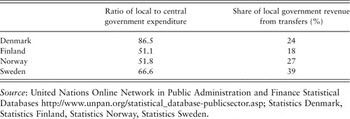
The central focus of this paper is the distribution of national government grants to municipalities. Table 1 provides descriptive information on the ratio of local to central government expenditure and the general share of local government revenue from transfers. As the table entries show, local government represents a sizeable part of the public sector in the countries under study. Local governments in these countries are responsible for half or more of public sector spending. This underlines the potentially high stakes involved in manipulating the funds managed by these governments. Further, a sizeable share (18% to 39%) of these expenditures is under the direct control of the central government in the form of grants. The exact composition of national government grants differs from country to country, but they all share some basic common features. In all countries, national governments transfer money to municipalities via bloc grants, earmarked grants, and special investment grants (Department of the Environment, Transport, and Regions (DETR), 2001). Central government grants can be used for several different purposes: in the case of some funds, local governments can define their own operational priorities, other funds can be used for specific (development) projects only (DETR, 2001).
Level of municipal spending

Source: United Nations Online Network in Public Administration and Finance Statistical Databases http://www.unpan.org/statistical_database-publicsector.asp; Statistics Denmark, Statistics Finland, Statistics Norway, Statistics Sweden.
As in most countries, the distribution of a portion of these grants is based on a formula. However, in all four countries, there is some room for discretion in grant allocation. In the case of Norway, for example, Sørensen (Reference Sørensen2003: 173) argues that ‘about 5 per cent of total grants are allocated according to discretionary criteria’. Discretionary allocation of funds is also present in Denmark and Sweden (DETR, 2001). Additionally, political judgment may also play a role both in determining the overall levels of transfers and in defining and weighting different criteria (DETR, 2001). In sum, there are opportunities in these countries for incumbent governments to strategically manipulate the allocation of grants. Indeed, studies have found significant cross-sectional differences in local revenue per resident in these countries, even after accounting for demographic and geographic variables (Sørensen, Reference Sørensen2003).
Measures and methods of analysis
I use the per-person sum of central government grants to a given municipality in a given year as the dependent variable. The variable is called Amount of grant and measured in local currency units. Furthermore, I have selected data from the year before a national election. This is the time when incumbent governments have the greatest incentive to manipulate grant allocation to their advantage.Footnote 4 Despite the commonalities in grant systems described above, the amounts of grant allocated to municipalities are not directly comparable across countries. There are naturally cross-national differences in these amounts due to differences in the financing systems of local governments and cross-national comparison of the measure of the dependent variable should not be attempted.
The main independent variable is the share of seats held in the municipal council by those parties that form the cabinet at the central level (Incumbent seat share in muni). In the case of a coalition government, I consider the total seat share for all coalition partners.Footnote 5
There are several additional variables that may influence the distribution of central government grants. One of the most important factors concerns the needs and abilities of a municipality, i.e., the demand side (Levitt and Snyder, Reference Levitt and Snyder1995; Martin, Reference Martin2003; Sørensen, Reference Sørensen2003). Poorer communities and those in economic distress are in a greater need of central government grants (Calvo and Murillo, Reference Calvo and Murillo2004; Remmer, Reference Remmer2007). I account for these effects by controlling for per-person Tax income of a municipality measured in local currency and the level of Unemployment rate and Population size (logged). These demographic variables account for at least some factors that make it more likely that a municipality will apply for grants.
In addition to these variables, recent studies have suggested other potential determinants of grant allocation. Martin (Reference Martin2003), for example, argues that voter turnout may determine the distribution of central government grants as the incumbent government is more motivated to target areas that provide the best return in terms of votes. I account for voter Turnout in a given municipality in the latest national election.
District magnitude has also been argued to influence the level of grant allocation (Sørensen, Reference Sørensen2003). Specifically, legislators are expected to be seat maximizers and, thus, have an incentive to give disproportionally higher amounts of grants to districts that have the highest number of seats per voter. Given this, I have added District magnitude per 1000 population as a control variable.Footnote 6
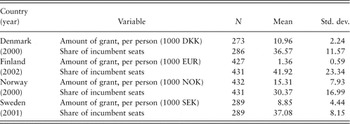
Table 2 provides summary statistics for the dependent and independent variables by country. The table also lists the years for which the measure of the dependent variable was gathered. For every country, I have included the universe of municipalities, subject to data availability.
Summary statistics

I model the effect of political variables on changes in the per-person sum of central government grants to a given municipality in a given year. That is, I will control for the Amount of grant allocated to a given municipality at t−1 or the previous year. Such modeling is appropriate as it accounts for path-dependency in grant allocation and allows observing short-term political manipulation. At the same time, such modeling poses a more conservative test of the hypothesis given that the inclusion of the lagged dependent variable may suppress the explanatory power of other variables (Achen, Reference Achen2000). Note that in all cases central government has the ability to not only increase but also decrease the amount of grant compared to previous years. In no cases have grants been completely withdrawn.
I use three different estimation techniques to confirm the robustness of the results. First, I use the ordinary least-squares regression with Huber–White robust standard errors. Second, I estimate the same model with county fixed effects. This allows one to better account for the fact that the municipal-level observations may not necessarily be independent due to being part of the same region or county.Footnote 7 Third, in order to make sure that the results are not driven by outliers, I also estimate the models with robust regression. The latter is a weighted least-squares estimator that re-weights cases by the inverse of their residuals. This procedure reduces the influence of outliers and results in a more accurate estimation of the underlying relationships. Table 3 presents the results using the first estimation technique. The alternative estimations are presented in Appendix A.Footnote 8
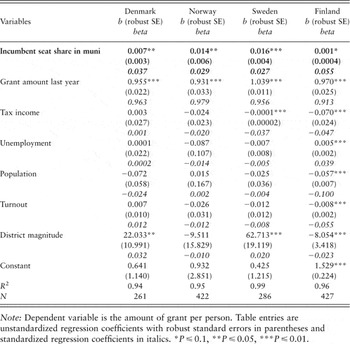
The effect of incumbent seat share on the allocation of central government grants to municipalities

Note: Dependent variable is the amount of grant per person. Table entries are unstandardized regression coefficients with robust standard errors in parentheses and standardized regression coefficients in italics. *P ⩽ 0.1, **P ⩽ 0.05, ***P ⩽ 0.01.
Results and discussion
The most important result of the analysis presented in Table 3 is that the incumbent government seat share in a municipal council is a significant predictor of the change in the amount of central government grant allocated to that municipality: the higher the seat share, the higher the increase in the amount of grants. This result is robust across countries and across different estimation techniques within one country. Of the other variables included in the model, only the lagged value of the dependent variable has an equally robust effect on the amount of grant targeted to a given municipality. Given that this variable is a very strong predictor in all models, it is remarkable that the political variable still appears significant.
The standardized beta coefficients reported in Table 3 allow comparing the extent to which each variable contributes towards explaining the dependent variable. Not surprisingly, the lagged dependent variable contributes the most. However, the incumbent seat share in a given municipality is the second or third most important variable explaining the allocation of grants depending on the country. This underlines the relative significance of the hypothesized partisan pork-barreling effect. Furthermore, as mentioned in footnote 5, the results do not change when alternative measures of the independent variable are used. Given that the countries were selected to maximize conditions against finding support for the hypothesis, this strong and robust result is notable. Robust evidence for partisan pork-barreling in systems where one least expects it suggests that this is a widespread if not universal re-election strategy of incumbent governments.Footnote 9
The results are also substantively significant. For example, in Denmark, municipalities where councils are entirely controlled by the incumbent government parties receive 0.71*1000 = 710 DKK per person more than municipalities where incumbent parties are not represented, other things equal. In the case of a municipality of about 30,000 inhabitants – an average-sized municipality in Denmark – this amounts to 21,300,000 additional DKK. Given that the average size of the budget for such an average municipality in Denmark is about 177,611,456 DKK, there would be about 13% difference in the size of the budget between municipalities controlled by coalition versus the opposition. Similarly, in Norway municipalities controlled by the incumbent government parties receive 1.34*1000 = 1340 NOK per person more than those municipalities where government parties are not represented. For an average municipality of 11,000 inhabitants, this amounts to a difference of about 14,740,000 NOK. The average size of the budget for such an average-sized municipality is about 417,261,000 NOK; here the difference would be about 3%.
Extension: does vote purchasing pay off?
The rationale for targeting geographic constituencies is that it pays off in votes. As briefly discussed in the theory section, if targeting municipalities is not electorally beneficial, one might argue that parties do not necessarily engage in pork-barreling to win votes. Rather, they may target co-partisan municipalities because they share goals with their co-partisans on the local level and communicate with them better than with opposition partisans. Therefore, a test of the vote-purchasing assumption is in order.
Such a test is all the more intriguing because the puzzle has not received much attention outside the US contextFootnote 10 and even these findings have been contradictory. Early studies of this puzzle in the context of the US failed to find any evidence of the electoral benefits of pork-barreling (Feldman and Jondrow, Reference Feldman and Jondrow1984; Stein and Bickers, Reference Stein and Bickers1994). A more recent study, however, has found a robust relationship between pork-barreling and increases in the vote share (Levitt and Snyder, Reference Levitt and Snyder1997).
As an extension of the previous analysis, I will test the following hypothesis: the higher the amount of national government grant received by a given municipality, the higher the vote share in that municipality for the incumbent parties’ in the subsequent national election. I estimate the effect of the Change in the amount of grant to a given municipality 1 year before a national election on the National election vote shares received by national government incumbent parties. As in the case of the previous analyses, I control for the vote shares for the current incumbents in the previous election (Vote share t−1) and, thus, essentially model the effect of change in the amount of grant on the change in the vote share for incumbents. For Finland, I have data for the national elections of 1999 and 2003. The ruling coalition during that time consisted of the following parties: SDP, KOK, SFP, VAS, and VIHR. For Norway, I will consider the elections of 2001 and 2005 and the coalition of the KRF, V, and the Right (H). For Sweden, the consecutive elections to be considered took place in 1998 and 2002 and the incumbent party at that time was the SAP.Footnote 11 Unfortunately, similar data are not available for Denmark.
Additional variables included in the model are the Unemployment rate, and Turnout measured as explained above. These measures are expected to account for some variance in the fluctuation of incumbent support (Powell and Whitten, Reference Powell and Whitten1993). I will also control for Population size of the municipality. In order to estimate these additional models, I use the three different estimation techniques described above. The ordinary least-squares regression results are presented in Table 4, the results of the two alternative estimations are presented in Appendix B.
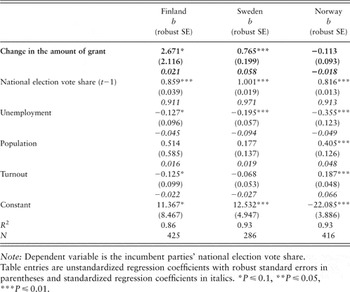
The effect of change in the amount of grant on the change in the vote share for the incumbent parties

Note: Dependent variable is the incumbent parties’ national election vote share. Table entries are unstandardized regression coefficients with robust standard errors in parentheses and standardized regression coefficients in italics. *P ⩽ 0.1, **P ⩽ 0.05, ***P ⩽ 0.01.
It is more difficult to draw as general an inference from the results presented in Table 4 as was the case with the previous analysis. The effect of strategic grant allocation on vote returns differs across countries. To summarize, there is some evidence that pork-barreling is indeed electorally beneficial. Voters in Sweden and Finland seem to be persuaded by partisan pork-barreling and willing to support the incumbents for such particularized benefits; however, the results for the latter are not very robust. The standardized beta coefficients demonstrate that change in the amount of grant is the third or fourth most important explanatory variable for change in vote shares. In the case of Norway, I was not able to confirm that grant allocation serves its desired purpose of winning votes for the incumbent parties.Footnote 12
Substantively, increasing local government grants in Finland by one unit, i.e. by 1000 Euros per person, is associated with 2.7% increase in incumbent parties’ vote share. The maximum increase in grants in the dataset was 1550 Euros per person, which is associated with a 4% increase in vote share. An average change in the amount of grant, however, is more modest: only about 60 Euros per person, which is associated with a modest 0.2% increase in incumbent vote share. In Sweden, increasing grants by one unit, i.e. by 1000 SEK per person, is associated with 0.7% increase in incumbent’s vote share. Compared to this, the Finnish result seems stronger. However, converting the Swedish results into Euros actually reveals a stronger effect for Sweden. One Euro equals about 9.3 SEK; thus, increasing grants by 1000 Euros in Sweden is associated with 7% increase in vote share for the incumbent. The actual increases, however, are again more modest: the maximum increase in grant amount that actually occurred is associated with only 1% increase in the vote share for the incumbent. However, given that party identification in these countries is relatively stable and a myriad of other factors determine parties’ electoral fate, the fact that targeted spending has a measurable effect at all is in itself noteworthy. Given such voter responsiveness to pork-barreling, it is a perfectly rational behavior on the part of the ruling parties to attempt to purchase votes with the help of geographically targeted benefits. Additional research is necessary to determine the robustness of the results in Table 4. However, as long as they hold, the pork-barreling explanation offered here seems more plausible than the argument that biased spending occurs due to shared goals.
The main conclusion of the study stands regardless of the fact that there is only weak evidence for the effectiveness of pork-barreling. Namely, the robust and central findings in this paper strongly suggest that the incumbent governments behave as if their strategizing paid off in votes. As Mayhew (Reference Mayhew1974: 57) reminds, ‘How much particularized benefits count for at the polls is extraordinarily difficult to say, but it will be hard to find a Congressman who thinks he can afford to wait around until precise information is available. The lore is that they count.’
Conclusion
The results of this study provide simple yet strong evidence that incumbent governments in advanced parliamentary and proportional systems engage in geographically targeted spending in the manner of pork-barrel politics. Such vote-purchasing behavior is more ubiquitous than the current studies have led us to believe. The existing research claims that pork-barreling belongs to the realm of personalized politics and is a strategic behavior induced by the presence of presidentialism, majoritarian system, and weak parties, and more likely to be practiced in developing democracies. However, using the ‘crucial case’ strategy, this study has demonstrated that pork-barreling is an attractive electoral calculus even in the most nationally oriented systems.
Additionally, the study provides some evidence that pork-barreling is indeed electorally beneficial and hence a perfectly rational behavior on the part of the incumbent. While prior evidence has focused on political business cycles and demographic constituencies, the results of the current study highlight the need to incorporate the distribution of geographically concentrated benefits into the re-election calculus of incumbent governments.
The study also elaborates a clear rationale for the process of pork-barreling by incumbent governments. Targeting municipalities, rather than electoral districts, makes partisan pork-barreling a meaningful and desirable re-election strategy for incumbents in proportional systems. Pork-barreling by incumbent governments is a partisan phenomenon accruing disproportionally to the governing party strongholds – to municipalities controlled by co-partisans. Indeed, I have argued that the political leaders of municipalities – actors largely ignored by the existing literature – are key participants in the distribution of pork. Such conceptualization of pork-barreling as a partisan rather than individual-level tactic that benefits partisan ties in other levels of government greatly enhances the generalizability of the logic to understand incumbent behavior.
The existing literature has identified three primary forms of representational linkage that parties use to build their electoral support base: programmatic (policy-based), charismatic (leader-centered), and clientelist. The findings here show evidence of clientelism in least likely cases, suggesting that providing such a linkage is not anomalous and can occur in combination with other linkage mechanisms. The importance of each linkage for party performance may vary from party to party and from country to country. Further research is necessary to determine these conditional effects. However, one of the contributions of this study is that it calls into question the primary focus in the existing comparative party literature on responsible party government and suggests a broader approach to understanding how parties garner support.
Acknowledgements
I would like to thank Taavi Annus, A. Cooper Drury, Mark Andreas Kayser, and Patrik Marier for valuable comments on earlier versions of this manuscript.
Appendix A: The effect of incumbent seat share on the allocation of central government grants to municipalities, alternative estimations

Note: Dependent variable is the amount of grant per person. Table entries are unstandardized regression coefficients with robust or regular standard errors in parentheses. *P ⩽ 0.1, **P ⩽ 0.05, ***P ⩽ 0.01.
Appendix B: The effect of change in the amount of grant on the change in the vote share for the incumbent parties, alternative estimations

Note: Dependent variable is the incumbent parties’ national election vote share. Table entries are unstandardized regression coefficients with robust or regular standard errors in parentheses. *P ⩽ 0.1, **P ⩽ 0.05, ***P ⩽ 0.01.