WILTSHIRE
(1) Bourne valley: a hoard of 1,850 radiates and one denarius was discovered within a Roman grey-ware vessel that was removed intact from site, allowing for subsequent micro-excavation in the British Museum conservation laboratories. The denarius is of Gallienus (a.d. 260–68 under sole reign). Date of deposition: c. a.d. 286.Footnote 145
SWINDON
(1) Liddington: a hoard of 14 denarii and one radiate was recovered. The denarii include two of Septimius Severus (a.d. 193–211), one of Caracalla (a.d. 198–217), one of Elagabalus (a.d. 218–22), one of Julia Maesa (a.d. 218–22), one of Julia Soemias (a.d. 218–22), four of Severus Alexander (a.d. 222–35) and three of Julia Mamaea (a.d. 222–35). The radiate is from the reign of Philip I (a.d. 244–49). Date of deposition: c. a.d. 245–47 or later.Footnote 146
HAMPSHIRE
(1) Droxford: five base-metal nummi of Magnentius (a.d. 350‒53), associated with an earlier discovery, were recovered.Footnote 147 Date of deposition: a.d. 367–75 (based on the latest coins of the 2014 discovery).Footnote 148
(2) Kings Worthy, (a) Woodhams Farm, Springvale Road (SU 48585 33171): trial trenches revealed an extensive linear feature, corresponding almost precisely with anomalies identified by geophysical survey which correspond to the projected course and height in the landscape of an aqueduct that served Roman Winchester (previously identified in excavations carried out at Graces Farm, Martyr Worthy in 1991 and more recently at Barton Farm, Winchester).Footnote 149 Although severely eroded by ploughing, the feature appears to have been terraced into the sloped sides of a dry valley and was recorded over a distance of c. 500 m.Footnote 150
(b) 99–103 Springvale Road (SU 48957 33595): a trial trench revealed a large linear feature on the predicted course and height in the landscape of an aqueduct that served Roman Winchester (see above). The feature had a 2 m-deep stepped profile consisting of a wide upper section and narrow basal channel.Footnote 151
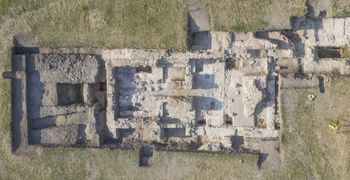
(3) Silchester (Calleva Atrebatum), Insula XXXIII (SU 6430 6240): excavation and re-excavation continued on the site of the town baths.Footnote 152 As well as work continuing on the deposits outside the eastern wall of the baths and the section of the Inner Earthwork ditch, two new areas were examined: the tepidaria on the western side between the frigidarium and the caldarium and the south-eastern corner of the peristyle. The discoveries have led to a major reappraisal of the development of the baths, which may now be seen as a perhaps late Flavian replacement (with later modifications) of a smaller Neronian bath-house (fig. 25). This interpretation supersedes that proposed by the Society of Antiquaries’ excavation of 1903–04 which argued for an essentially single-period, probably Neronian, construction with some later modifications.Footnote 153 Foundations of the Neronian baths were found beneath the south-eastern corner of the peristyle and the floor of the newly exposed tepidarium. The latter was extended to the west, with the new space eventually replacing it functionally in the late third or fourth century, with its furnace fired from the east, within the remains of the abandoned tepidarium. An early, apparently stand-alone structure next to the Inner Earthwork ditch was further explored; the eastern side of the brick-built structure found beneath the robbed out northern wall of the late tepidarium re-excavated in 2018 was revealed, both sides flanked by a wood-lined water channel, the northern side supported by a later buttress. This structure is possibly Claudian in date, but it was apparently retained through the lives of the later bath-houses, and was only demolished and robbed late in the fourth century. A coin from the backfill of the robber trench gives a terminus post quem of a.d. 388+ for the construction of the late hypocaust. The Inner Earthwork ditch was bottomed at a depth of 4.8 m below the present ground surface. Finds from a Claudio-Neronian but basal deposit include a complete human skull lying on a wooden stretcher-like structure. At a slightly lower depth were three dog skulls and the mandible of a fourth.Footnote 154
Silchester: Insula XXXIII town baths. Aerial view with north at top of photo.

(4) Winchester, 63 Tower Street (SU 47894 29825): an evaluation and subsequent watching-brief revealed tipped deposits thought to form part of the Roman rampart sequence.Footnote 155
SUPPLEMENTARY MATERIAL
For supplementary material for this article please visit https://doi.org/10.1017/S0068113X2000046X