Introduction
The popularity of the online social media in China promotes a dynamic digital drive for both global and glocalised communications, facilitating the emergence of more connected intercultural language practices unimaginable in the past. Social media also creates a vast community where pervasive translanguaging practices take place daily. Translanguaging hybrids coined by Chinese university students on WeChat are exactly a case in point. WeChat is a free platform launched in 2011 by Tencent. Well established in China and the world over, Tencent provides multimodal instant messaging services. Open to world cultures, these students show ingenuity in translanguaging linguistic play in their daily text messages; meanwhile, their creative coinage of translanguaging hybrids influences the entire WeChat community. Written language in the WeChat community, often amounting to a new form of speech, deserves serious scholarly inquiry.
This paper examines translanguaging language plays coined by Chinese university students from the perspective of language contact, and it further looks into the functions and semantic effects that Romanised hybrids serve in students’ speech on WeChat. Romanised hybrids refer to pragmatic choices to use an alphabet of 26 romanised characters to blend with Chinese characters on Chinese phonetic principles. A variety of Romanised hybrids are mixed with the Chinese language through students’ interaction. This practice impacts the use of Chinese expressions in cyberspace intralingual communication. The linguistic hybridity involving English and multilingual sources opens a fairly novel perspective. Primarily, it reflects the interrelations between the languages in contact (Rubdy & Alsagoff, Reference Rubdy, Alsagoff, Rubdy and Alsagoff2013), particularly the language play (Rivlina, Reference Rivlina, Nelson, Proshina and Davis2020) in Chinese university WeChatizens’ translanguaging hybrids in the global-local interface on WeChat where sampled Chinese university students articulate their thoughts and employ translanguaging strategies to construct and negotiate their intercultural identities.
Translanguaging, language play, and bilingual creativity
The term ‘translanguaging’ was coined by Williams (Reference Williams1994, Reference Williams, Williams, Lewis and Baker1996) to describe a bilingual phenomenon he observed in Welsh schools where students communicated with one another through the medium of English but occasionally exchanged information through their Welsh language as mixed output. Williams (Reference Williams1994) used translanguaging as an analytical perspective to examine the process of students’ knowledge building and language acquisition. Meanwhile, Williams (Reference Williams, Williams, Lewis and Baker1996) made it clear that translanguaging is a performed translingual practice that involves two languages and language varieties interacting with individual languages.
Li (Reference Li2011a) perceived that translanguaging is a dynamic process whereby bilingual users draw on different linguistic, cognitive, semiotic and modal resources to make meaning and make sense, transcending the boundaries between named languages and between language and other meaning and sense-making resources. Li (Reference Li2011b) further posited that rapid globalisation enlarges the multimodal contacts between people of diverse backgrounds and traditions, and provides new opportunities for innovation, entrepreneurship, and creativity. Individuals are capable of enlarging their bilingual ability in learning and thinking, and critically responding to the historical and present conditions.
As contact linguistists (Myers–Scotton, Reference Myers–Scotton1993) presumed, the forms of language contact are predictable and a clear linguistic membership is rigidly assigned by the structural features involved in these forms. In opposition to structuralist orientation, the authors argue that a postmodernist and poststructuralist view, in the age of information and globalisation, should be adopted to focus on the unpredictable idiolects, sociolinguistic disorders, and fuzzy boundaries between languages when studying language contact from mobile linguistic resources.
As for language play, Crystal (Reference Crystal1996) argued that language learners play with language or respond to the language play. They play with language when manipulating it as a source of enjoyment, either for themselves or for the benefit of others. Learners take any linguistic feature, namely, a word, a phrase, a sentence, a part of a word, a group of sounds, a series of letters, to make it do things it does not normally do. In effect, they bend and break linguistic rules for fun, making the play unregulated at their will. Language play boosts the use of creative strategies. Crystal (Reference Crystal1998) particularly emphasised many ludic linguistic worlds are available and need to be creatively explored, for learners express themselves creatively through languages. Crystal (Reference Crystal1998) held that learners are spontaneous to play with language or respond to language play. As social interactions emerge whenever and wherever possible, the eventual linguistic prowess and pragmatic creativity will be more enhanced and sophisticated.
However, both Crystal (Reference Crystal1998) and Cook (Reference Cook2000) argued a widespread emerging practice in the globalising-localising world that involves the manipulation of two or multiple languages. In the case of bilingual language play, it often involves a creative mixing of more languages and language varieties. Specifically, bilingual language play is part of a complex combination of functions performed simultaneously through translanguaging language mixing, and manifests ‘bilinguals’ creativity’, intercultural interaction, learning to mean, and intellectual enquiry defined as those creative linguistic processes as the achievement of competence in two or more languages (Kachru, Reference Kachru1985).
Context of translanguaging language play in social media
The study of translanguaging hybrids analyses the ways in which English words, phrases, phonemes and Romanised letters are loaned and blended into the matrix of Chinese, and it looks into the cognitive process of translingual hybridisation, where such constructs are adapted and integrated phonologically, alphabetically, semantically, and morpho-lexically in the sampled Chinese matrix, together with blending of various genres (e.g. messages, notices, dialogues, anecdotes and jokes) in the practice of translanguaging play.
This paper examines the language play coined and employed for intra-cultural communication in the online community based on the assumption that communication takes place not only in separate languages, but also in terms of translanguaging practices (Canagarajah, Reference Canagarajah2013; Rubdy & Alsagoff, Reference Rubdy, Alsagoff, Rubdy and Alsagoff2013). Such lines of sociolinguistic study underpin the need to look into the highly fluid, flexible, and dynamic ways that hybrids for intra-cultural communication have evolved in the rapidly glocalising China today, where millions of WeChatizens, in particular university students, are both literate in English and technology savvy (Zhang, Reference Zhang2015).
Research questions
This paper intends to address the following research questions:
1. How are the creative uses of Romanised hybrids incorporated into the translanguaging play in WeChat?
2. What are the roles that translanguaging hybrids perform in the sampled data in WeChat?
Methodology
The current study employs the netnography approach to collecting data. As an emerging interdisciplinary approach, netnography – a type of ethnography – is adapted to the mobile phone-based contexts of today's online social world and has a ‘considerable appeal as a means to study the social life as lived’ (Hine, Reference Hine, Fielding, Lee and Blank2008: 262). It provides researchers with the option of natural methods in observing and reading naturally occurring interactions in online communities through ‘invisible lurking’ (Kozinets, Reference Kozinets2010). Such observations may be considered ‘passive’ in the eyes of traditional ethnographers. In this research, the observation schedule was validated through piloting. Raw data were screen-shot and transcribed for an ensuing offline analysis from the perspective of post-structuralism which does not see languages as discrete entities but allows fuzzy boundaries between languages in contact, and such a perspective further enables the authors to examine other forms of engagement with a central goal of understanding the ‘norms, shared social practices, and commitment’ (Robinson & Schulz, Reference Robinson and Schulz2009: 690) that create a shared sense of identity across the social media community as it exists on WeChat.
To understand the translanguaging practices of Chinese university WeChatizens as a particular group in depth, homogeneous sampling technique was adopted to choose participants who share a similar linguistic environment. Altogether, 20 third-year English major students were selected from the same class in a Chinese university. English majors were chosen both because of their relatively high language proficiency and their sufficient English exposure. They were all proficient Chinese-English bilinguals and frequently switch with their local dialects in the learning context. Aged between 19 and 21, they have received more than 12 years of English as a foreign language (EFL) instruction from the primary school all the way to the university. Their English proficiency is above the upper intermediate level, with estimated IELTS overall scores between 6.5-8.0.
After receiving research participants’ consents, the authors were allowed to access five WeChat groups on different topics (including academic study, future planning, campus events, daily life sharing, and sports). Out of ethical consideration for online research, these WeChat groups contained members only from the participants. All sampled data were screen-collected between March 2020 and August 2021. In order to conduct linguistic data-gathering across WeChat groups, the researchers began with observation. Translanguaging hybrid texts written by relevant participants were read, collected and rated. Altogether, 62 hybrids of different variants were collected through the interrater-selection, whilst nine sampled hybrids with the highest frequency and organic meaning potentials in the contexts were chosen to be analysed to identify intercultural features, linguistic functions, and communicative mechanisms in corresponding WeChat messages.
Every original text was semantically coded based on WeChatizens’ intended meaning in Mandarin Chinese. This process required knowledge of English, Mandarin Chinese, and digital literacy in terms of deciphering the meaning of hybrids in various contexts and scenarios. To gather the functional and semantic values from multiple connotations of data, the authors inter-rated and classified the sampled data into categories of semantic hybrids, phono-semantic hybrids, and lettered and numerical coined hybrids based on their forms, features, and functions in the sampled texts. Evidentially, each sampled data acts as a contact phenomenon in its own right with certain forms, functions, and meanings. The written languages gathered from social media show the pervasiveness and discursiveness of translanguaging hybrids and provide a basis for further inquiry.
A brief description of the social media app WeChat
WeChat is a multifunction messaging and social media application developed by Tencent Holdings Ltd., a Chinese multinational technology company founded in 1998 (NASDAQ: TCEHY). As a popular social networking platform, WeChat had 930 million world-wide subscribers in 2017 (CIW, 2017) and 1.2 billion monthly active users in 2021 (Statista, 2021). The sheer size of its user base makes it a dominant communication tool in higher education as the fastest-growing social media application worldwide (Mao, Reference Mao2014).
With the on-going social interaction, cultural integration, and intra-inter language glocalisation, WeChat has worked as an online community where translanguaging practices take place at every moment and in any forms. On this intra social media platform, WeChatizens encounter and communicate with one another. They adopt, adapt, interface, and exchange diverse languages, cultures, semiotic codes, and emojis for the sake of communication. Aiming at mirroring a glimpse of the age-group's speech scenario, the data from WeChat groups are deemed to be representative and reliable.
Semantic hybrids in Chinese language
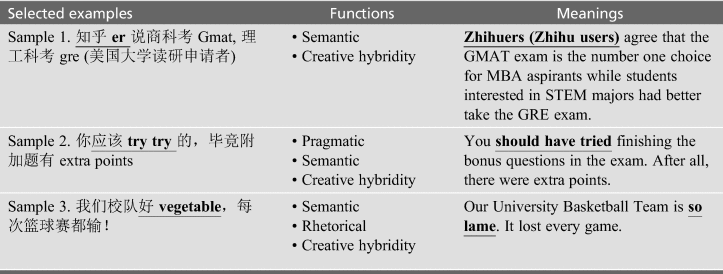
The first type of hybrids used frequently is semantic hybrids in Table 1. The semantic loans represent ‘意译词’ [yìyìcí] (English: meaning-translation-word) in Mandarin. Semantic hybrids are adapted into Mandarin by means of a mechanism of lexical borrowing which is always referred to as loan translation. Through this mechanism, the semantic components of a given source word in English are literally translated into their equivalents in Mandarin. That is, the selection of Mandarin component characters for a semantic hybrid is based upon the Mandarin component characters’ semantic equivalence (near-equivalence) to the corresponding morphemes of the source word in English. A detailed analysis of the semantic features elaborates how English source words are adapted into Mandarin as semantic hybrids.
Semantic hybrids

Forms, features and functions of semantic hybrids in Chinese language
The hybrid ‘知乎 er’ is a derivative, a combination of the Mandarin name of a question-and-answer website ‘知乎’ [zhì hū] (English: Zhihu) and two Roman letters ‘-er’. The two Roman letters ‘-er’ here serve as a quite complex morpheme with English-Mandarin dual linguistic membership. On the one hand, the two Roman letters ‘-er’ are the same as the English derivational morpheme ‘-er’ which means ‘person’. On the other hand, the two Roman letters stand for the Pinyin form of the Mandarin word ‘者’ [zhě] (English: doer, person), a productive Mandarin morpheme which is always being attached to Mandarin nouns or verbs to mean ‘a person belonging to certain groups or taking certain actions’. In this sense, the Mandarin morpheme ‘者’ is quite similar to the English derivational morpheme ‘-er’. Within this hybrid, the Mandarin verb ‘知乎’ serves as a free morpheme while the English expression ‘-er’ serves as a bound morpheme. This innovated hybrid means ‘the user of Zhihu Website’. The two Roman letters ‘-er’ changes a website ‘知乎’ into a person, giving a semantic meaning to the hybrid in this text.
In Sample 2, ‘try try’, a semantic hybrid refers to ‘试试’ [shì shì] in Mandarin Chinese. The Mandarin verb ‘试试’ is a reduplication combining two ‘试’ to express a relaxing and uncertain tone. It only means ‘try’ in English, but the semantic meaning of it is equally expressed by two repetitive English words ‘try try’ in an innovative way. Apparently, ‘try try’ does not go with the grammar rules of English. It was created by the WeChatizens to adopt and adapt to Mandarin reduplicated usage and it reflects the cultures across the speech community. Although Sample 2 expresses disagreement and warning, the coined hybrid ‘try try’ increases the level of uncertainty in this text and may bring the interlocutor a sense of amusement so as to mitigate and soften the gravity of confrontation. This hybrid embodies the Chinese culture of harmony and is seen as a euphemism.
The sample 3 uses the English word ‘vegetable’ creatively. ‘Vegetable’ shares the same semantic meaning with ‘菜’ [cài], a network catchword in Mandarin adopted to describe those who are weak, inexperienced and easily defeated in the games. However, the hybrid's element of speech has been changed, that is, ‘vegetable’ serves as an adjective rather than a noun, whilst the use of ‘vegetable’ of the data is rhetorically playful and ludic with a flavour of casual pun. The University Basketball Team was so lame that it disappointed the students. Therefore, they employed the semantic hybrid to make jokes about the team to fill the text with a sense of sarcasm and a bit of self-mockery to achieve an amusing rhetorical effect of a sharp irony over the speech.
Discussion of the linguistic mechanism
The social media such as WeChat establish a discursive web of discourse for diverse semiotic and linguistic recourses to be transferred and transformed (Gillen & Merchant, Reference Gillen and Merchant2013). For contact linguist (e.g. Canagarajah, Reference Canagarajah2013), a language is an open-ended system dynamically absorbing elements from other languages and hybridising new elements with original elements, which meshes in a transformative way, and generates new meanings and functions. Likewise, Li (Reference Li2016) characterised the re-invented English expressions with new Chinese meanings or new inventions of English expressions with Chinese characters as ‘New Chinglish’.
The samples demonstrate the performance of such features of language as deviation, metaphor, punning, blends, and lexical play, as well as the adaptation of particular colloquial genres, are embedded in broader social and cultural contexts. A language is then regarded as a second-order construct, the product of first-order activity, and languaging (Li, Reference Li2013, Reference Li2016). The semantic hybrids such as ‘好 ([hǎo], so/very) vegetable’ call for knowledge more than simply linguistic codes. The sampled students have a sociocultural repertoire strong enough to support them to play with translanguaging hybrids in such a culturally complex context as they are Chinese-English bilinguals. These translanguaging practices in WeChat are largely catalysed by the Internet, which provides multimodal affordance for them to achieve semantic functions, convey their opinions and articulate a flash of intercultural wit on topics in online interaction.
Phono-semantic mappings in Chinese language
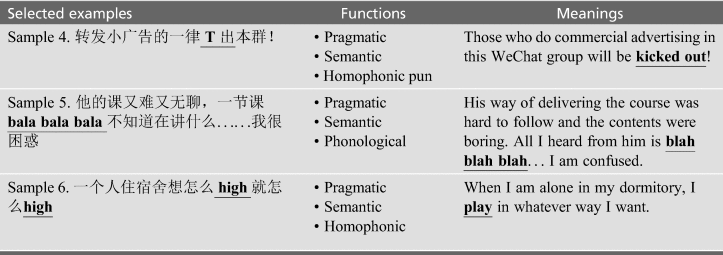
The second type of English loaned hybrids in Mandarin, as presented in Table 2, is called phono-semantic mappings (PSM). Zuckermann (Reference Zuckermann2004) defined phono-semantic mappings as camouflaged lexical borrowing where a word in the source language is matched with a phonetically and semantically similar pre-existent word in the recipient language. Specifically, loaned hybrids of this type are phonemic since their pronunciation derives from those of the source words in English, whilst they carry semantic effects in that they consist of characters that motivate semantic links to the referent.
Phono-semantic hybrids

Forms, features and functions of phono-semantic hybrids in Chinese language
The phono-semantic hybrid ‘T 出’ combines the English letter ‘T’ with the Mandarin character ‘出’ ([chū], out). ‘T’ here is both phonologically and semantically meaningful. On the one hand, the pronunciation of English letter ‘T’ is [tiː], which is homophonic with the Chinese Mandarin character ‘踢’ [tī]. ‘踢’ is a verb referring to ‘kick’. Thus, letter ‘T’ in this example, on the other hand, also represents the semantic meaning of ‘踢’. When English letter ‘T’ and Mandarin character ‘出’ combine to form the compound ‘T出’, it shares exactly the same meaning with Mandarin verb phrase ‘踢出’ [tī chū], which means ‘kick out’ in English. Thus, the text in the fourth example warns those who do commercial advertising in the WeChat group that they will be kicked out. The innovative use of letter ‘T’ here is not only a deterrent for transgressors, but also a more ludic way to communicate, for the fact that it can be written with only two strokes with letter ‘T’ for a pragmatic effect.
In Sample 5, ‘bala bala bala’ is a Romanised version of the Chinese Pinyin [bā lā bā lā bā lā], which refers to the Mandarin characters ‘巴拉巴拉巴拉’ for omitting certain contents in oral speech. In fact, ‘巴拉’ [bā lā] was coined by Chinese WeChatizens according to ‘blah’ [blɑ:], an English word commonly used to describe something boring and meaningless. The coined word ‘bala’ [bā lā] not only serves as a phonological equivalent of English word ‘blah’ [blɑ:], but also expresses the semantic meaning similar to ‘blah’. The repetitive use of ‘bala’ indicates the teacher gabbling on and on, leading the students to grow bored and confused. The pragmatic choice to use ‘bala bala bala’ embodies an emotional state in which the student felt a sense of boredom.
The ‘Sample 6: 想怎么 high 就怎么 high’ (Table 2) uses the English word ‘high’ as a phono-semantic hybrid. ‘High’ [haɪ] here shares the phonological and semantic similarity to Mandarin character ‘嗨’ [hāi]. Actually, ‘嗨’ is a buzzword in Chinese cyberspace expressing the feeling of freedom and excitement. Chinese WeChatizens coined it based on the English word ‘high’. ‘嗨’ can be employed in different contexts among the university students. When serving as a verb, it means ‘play’ in English. In the case of Sample 6, the hybrid ‘high’ acts exactly as a verb and can be explained as ‘play’. The semantic meaning of this data is that when roommates were gone, this student felt free to choose whichever relaxing activity he/she wished to. Pragmatically, the English word ‘high’ was used twice to emphasise a feeling of ‘ease’. It reveals the identities of Chinese university students are influenced by the western concept of individualism and the longing for their private space.
Discussion of the linguistic mechanism
As shown above, the sampled WeChatizens incorporate multiple language features to stylise English and Chinese for communicative, social, or intercultural purposes. These translanguaging practices encourage creativity in language use, especially in WeChat communication where various linguistic and other meaning-making resources can be transmitted, adopted and re-contextualised. In this way, the spread and novel use of translanguaging buzzwords such as ‘T 出’ by the sampled WeChatizens has become a nexus for various creative and playful translanguaging practices.
These bilingual or even multilingual WeChatizens deploy linguistic features (e.g., homophonetic sounds between ‘T’ and ‘踢’), symbolic meaning (e.g., a boring teacher represented by ‘bala bala bala’), re-contextualised meaning (e.g., ‘T 出’ re-adopted in a WeChat group to mean kicking out), and popular-culture influenced meaning (e.g., ‘high’ as an expression of freedom and excitement) to contribute to the multifunctionality of translanguaging hybrids.
Lettered and numerical hybrids in Chinese language
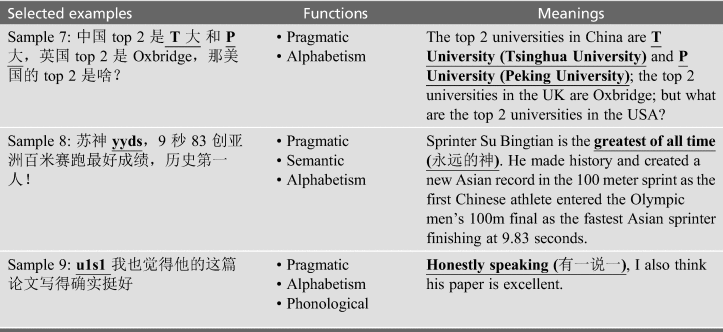
Lettered and numerical words retain their original lettered or numerical form in their usage in Mandarin (Riha, Reference Riha2006), as there are many lettered and numerical words, especially those connected with the latest information technology (e.g. ‘MP3’), which lack Mandarin equivalent forms. Compared with the two types of English hybrids in Mandarin, lettered and numerical words are distinct in that these words are directly imported into Mandarin without being adapted to conform to the phonological and morphological patterns of Mandarin while in the other types of hybrids the English source words are substituted by Mandarin characters. Moreover, it is common for lettered and numerical words to be acronyms formed from the initial components of a longer expression in English or Chinese Pinyin. A typical example would be ‘ASAP’, which is formed from the initial letters of the English phrase ‘as soon as possible’. Three examples are given in Table 3 as follows.
Lettered and numerical coined hybrids

Forms, features and functions of lettered and numerical coined hybrids in Chinese language
As Sample 7 indicates, in the minds of Chinese university students, the top two universities in China are Tsinghua University and Peking University. A high frequency of two universities is concurrently mixed in daily speech as a repertoire. To exchange efficiently, they tend to simplify T University for Tsinghua University and P University for Peking University for the sake of pragmatic and semantic effects. Likewise, they creatively shorten and blend the top 2 universities in the UK – Oxford and Cambridge – in the form of Oxbridge.
Sample 8 ‘苏神 yyds’ (Table 3) employs ‘yyds’ as a typical lettered hybrid. It is formed from the individual initial Pinyin letters of the Mandarin phrase ‘永远的神’ ([yǒng yuǎn de shén], greatest of all time), which was recently coined by Chinese WeChatizens to describe those who have done a marvelous job as the G.O.A.T (greatest of all time). ‘永远的’ [yǒng yuǎn de] literally means ‘of all time’ while ‘神’ [shén] takes on the meaning of ‘greatest’ and ‘legendary’. In Sample 8, the neologism ‘yyds’ is semantically appropriate because it conveys the meaning of a legendary hero. Delivering student-WeChatizens’ admiration and exclamation for Su Bingtian, it achieved pragmatic and semantic effects.
Interestingly, ‘yyds’ and ‘G.O.A.T’ not only share the same meaning of ‘the greatest ever’, but also are both four-letter abbreviations formed from the initial letters of longer expressions. In fact, ‘yyds’ is unprecedentedly popular among young WeChatizens. It is used in different contexts to stand for various Chinese expressions with exactly the same initial letters such as ‘永远单身’ ([yǒng yuǎn dān shēn], being a confirmed bachelor/bachelorette) and ‘抑郁到死’ ([yì yù dào sǐ], being terribly depressed). Chinese university WeChatizens are adopting and re-contextualising ‘yyds’ to express playfulness and creativity in the WeChat community. Other WeChatizens with the similar age, idiolects, and cultural background favour to use this kind of hybrid variant and variations, which makes translanguaging hybrids increasingly pervasive and ludic on social media.
In Sample 9, ‘u1s1’ is an alphabetical-numerical modality. It is classified as a derivative consisting of two English nonce letters ‘u’ and ‘s’ blended with Arabic numeral ‘1’. This hybrid makes use of alphabetism by borrowing the initial Pinyin letter ‘s’ from the third Chinese character of the Mandarin phrase ‘有一说一’ [yǒu yī shuō yī, honestly speaking]. The Arabic numeral ‘1’ has the same meaning as the Mandarin character ‘一’ [yī]. Meanwhile, the phonological similarity is also found in this translanguaging hybrid, for the English letter ‘u’ [juː] here sounds quite similar to ‘有’ [yǒu] in standard Mandarin. Additionally, ‘u1s1’ serves as either an established or a temporary loanword combination for semantic effects. The denotative meaning of the hybrid indicates that in Sample 9 these students complimented the paper they were reading in good faith.
Discussion of the linguistic mechanism
Alongside common bilingual language play techniques such as playful transliteration or script hybridisation, there are also unique patterns of writing system manipulation determined by the unique features of the Chinese language interacting with English. The use of numerical coined hybrids, in particular, embodies an innovative impulse to generate novel pragmatic and semantic effects besides an onomatopoeic and semantic use among WeChatizens and web writers. Zhang (Reference Zhang2017) suggested that two types of numeric homophones are identified: numerical alphabetic homophones of Chinese (e.g., V5 [威武, wēiwŭ] means ‘awesome’) for quasi-homophones, and numerical homophones for onomatopoeia (e.g., the use of numerical 99 [久久, jiŭ jiŭ] means ‘lasting forever’).
These Internet hybrid varieties such as ‘u1s1’ also resonate with Li and Zhu's (Reference Li and Zhu2019: 145) notion of ‘tranβcripting’ defined as ‘writing, designing and digitally generating new scripts with elements from different scriptal and semiotic systems’. The analysis above illustrates some of the dynamics and creative strategies involved in the appropriation of English elements in translanguaging play. These pieces of alphabetical morphemes and numerical hybrids, although seemingly random and nomadic, seem to defy traditional notions of simple language mixing, and have their own values for members of this Internet discourse community (Schneider, Reference Schneider2014). WeChatizens have a natural instinct to draw on as many different sensory, modal, cognitive, and semiotic resources as are available to interpret the intended meanings, whilst assessing relative relevance and significance of multiple cues to produce a message. Creating hybrids as a translanguaging phenomenon demonstrates WeChatizens’ dynamic and intercultural literacy skills, sophisticated communicative abilities, and sensitivity to popular culture.
Controversial issues in translanguaging hybrids and variants in Chinese social media
WeChat serves WeChatizens as a typical ‘translanguaging space’ or a flexible ‘space of multilingualism’ (Blommaert, Collins & Slembrouck, Reference Blommaert, Collins and Slembrouck2005) in which they employ to create a series of morphemic/lettered/lexical/numerical hybrids for communication. Arguably, the government's ideology of linguistic purism and standardisation increasingly seems to be facing opposition whilst newly coined flexible hybrids of English and the variants of other sources in written Mandarin are emerging. China's General Administration of Press and Publication (GAPP, 2010) banned ‘random lexical or morphemic borrowings or acronyms from English or other foreign languages’ in Chinese publications, since the emerging use of language, perceived as abusive, includes random English hybrids and borrowings, and coined expressions mixed with English or other foreign languages in print and digital publications, all of which has ‘seriously eroded the purity of Chinese language and done harm to the harmonious linguistic and cultural environment’ (GAPP, 2010: 8). In this regard, several metaphors describe English as an erosive element that has corrupted the purity of Mandarin. According to one such formulation proposed by a senior editor of the People's Daily, ‘English ants are digging holes in the Chinese levee’ (Yan, Reference Yan2013: 37). Clearly, language purists are fearful that English hybrids or variants mixed with Mandarin erode the purity and downgrade the standards of Mandarin as the national language for the Chinese people.
By and large, the reality of languages resides more with the choice of individual language users - whilst we should not underestimate the power of authoritarian states to implement language policy, which proscribes their unique way of usages of colloquial Chinese language. In fact, as students enlarge their linguistic repertoire during their EFL learning, they will integrate translanguaging hybrids into their choice and use of idiolects. They think, speak, and write in their idiolects, not a named language (Li, Reference Li2011b). As long as EFL learners believe that in using hybrids as they do, their way of speaking and writing constitutes a language in its own right, there is a real sense in which it is a real language. The emerging translanguaging hybrids are derived from individual perceptions and needs rather than the collective sociopolitical and administrative agenda of government officials.
Implications and conclusion
WeChat, as a dynamic ecology, facilitates Chinese university students with a translanguaging mind to navigate through the community to interact with a variety of discursive hybrids. The exemplification of translanguaging practices in the paper suggests that WeChatizens’ use of languages is not restricted to solely shifting or shuttling between languages, but to the interlocutors’ coinage and use of original and complex interrelated discursive practices. The WeChatizens are keen to adopt the discursive practices online with different linguistic codes, symbols, and local culture to make sense of the multilingual and multi-semiotic digital world. Contrarily, from the stand of language purism, they unintentionally erode the uni-scriptal language ideology in China, whilst translanguaging hybrids in the form of phonological, semantic, pragmatic, and rhetorical effects transcend the language ideology of the authoritarian state. Inevitably, language play in translanguaging hybrids wraps and shows its uniqueness, imagination, bilinguality and beyond.
Pedagogically, as EFL learners, Chinese university WeChatizens live in an era of ‘superdiversity’ in the interface between globalisation and glocalisation. Accordingly, EFL teachers are encouraged to embrace students’ language hybridity in virtue and digital context. What seems to go beyond EFL instruction is that sampled students were using English and those non-linguistic constructs as a resource for meaning making and identity construction as China globalises. Their translanguaging practices through social media have aptly displayed their linguistic creativity and the diversity of translanguaging hybrids. As they are wired to think as translanguaging exponents, these Chinese WeChatizens try to negotiate and construct a new identity in the increasingly globalocalised social media, and may even overwhelm the ideology of linguistic purism in China. Multilingual language play in the online educational context is an emerging issue of linguistic inquiry. Though still largely understudied, it has considerable potential to contribute to the theory of contact linguistics and provide educators with insights into students’ language attitudes and their use of Englishes across countries.
 FANG QI is an Associate Professor in the School of Foreign Languages, Shenzhen University, China. He has been teaching Culture and Translation studies and English as a foreign language for over 30 years. He has research articles published extensively in journals such as Asian Englishes, Foreign Language Teaching, China Foreign Languages, Frontiers of Foreign Language Teaching, China Journal of Applied Linguistics, etc. His research interests include L2 writing, contrastive rhetoric, sociolinguistics, and Asian Englishes. Email: georgeiqi@szu.edu.cn
 JUNLONG LI is an MPhil student in Second Language Education at the University of Cambridge. He has obtained a BA (Hons) in English Language Teaching from Shenzhen University, China. He is experienced in teaching English as a foreign language. His research interests include L2 learning motivation, language learning strategies, language learner identity, as well as code-switching. Email: junlongli2266@gmail.com