INTRODUCTION
Opisthobranchs include marine and estuarine and a few limnic gastropod species, characterized by diverse body shapes, life habits and feeding specializations, with the shell reduced or completely lost in the adult stage of life. Traditionally considered a natural group within the Gastropoda, opisthobranchs are now understood to be polyphyletic (see Schrödl et al., Reference Schrödl, Jörger, Klussmann-Kolb and Wilson2011). Most species occur in tropical and subtropical shallow waters worldwide, but some are typical of cold and deep waters (Behrens, Reference Behrens2005). Most opisthobranchs belong to the carnivorous subgroup Nudibranchia (~3000 species), which completely lack a shell as adults (Wagële & Willan, Reference Wagële and Willan2000). Knowledge about Brazilian opisthobranchs is derived mostly from taxonomic studies by Ernst and Eveline Marcus, on material from the intertidal zone of the State of São Paulo and a few samples from other regions of the Brazilian coast (Marcus, Reference Marcus1955, Reference Marcus1957, Reference Marcus1971). The biodiversity of Brazilian opisthobranchs is clearly underestimated (Rios, Reference Rios2009). Recently, sampling in new localities resulted in new country records (García & Troncoso, Reference García and Troncoso2003; Padula & Absalão, Reference Padula and Absalão2005; Padula & Santos, Reference Padula and Santos2006; García García et al., Reference García García, Domínguez and Troncoso2008; Sales et al., Reference Sales, Delgado, Queiroz, Padula, Sampaio and Johnsson2011) and the description of new species (DaCosta et al., Reference DaCosta, Padula and Schrödl2010; Padula & Delgado, Reference Padula and Delgado2010; Alvim et al., Reference Alvim, Padula and Pimenta2011; Cunha, Reference Cunha2011). Currently, around 200 opisthobranch species, excluding the pelagic Thecosomata and Gymnosomata, are listed from Brazil (García García et al., Reference García García, Domínguez and Troncoso2008).
The Brazilian Northeastern coast includes a variety of ecosystems, particularly mangroves, coral and sandstone reefs. The reef ecosystems occur over a large area from the coast of Rio Grande do Norte State to the south coast of Alagoas, near the mouth of the São Francisco River (Castro & Pires, Reference Castro and Pires2001). Although apparently high, the biodiversity of marine invertebrates from Alagoas is still poorly documented. Information is available for a few groups such as Porifera (Sarmento & Correia, Reference Sarmento and Correia2002; Cedro et al., Reference Cedro, Hajdu, Sovierzoski, Correia, Custódio, Lobo-Hajdu, Hajdu and Muricy2007, Reference Cedro, Hajdu and Correia2011); scleractinian corals (Correia, Reference Correia2011), Bryozoa (Vieira et al., Reference Vieira, Gordon and Correia2007, Reference Vieira, Migotto and Winston2008, Reference Vieira, Migotto and Winston2010) and Echinodermata (Lima et al., Reference Lima, Correia, Sovierzoski and Manso2011). Currently, 22 opisthobranch species are known from Alagoas (Rios Reference Rios1994, Reference Rios2009; García García et al., Reference García García, Domínguez and Troncoso2008; pelagic Thecosomata and Gymnosomata excluded). Most records resulted from oceanographic expeditions (MacFarland, Reference MacFarland1909) and others were obtained from isolated samples (Marcus, Reference Marcus1971).
This contribution presents new opisthobranch records from Alagoas, including groups that are traditionally included in ‘Opisthobranchia': such as Sacoglossa and Nudipleura (Pleurobranchomorpha plus Nudibranchia). Material was obtained from a 10-day survey conducted by the authors and also from ecological studies carried out in recent years in the Setor de Comunidades Bentônicas (LABMAR/ICBS), Universidade Federal de Alagoas, Brazil. A list of all opisthobranch species known to date from Alagoas (pelagic Thecosomata and Gymnosomata excluded), and colour photographs of 32 species are provided.
MATERIALS AND METHODS
Study area
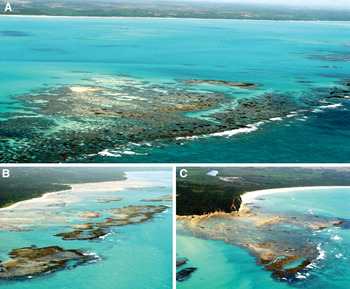
The coast of Alagoas is approximately 230 km long, bordered on the north by the Persinunga River and on the south by the São Francisco River (8o54′S–35o9′W and 10o30′S–36o23′W), and is composed mainly of coral and sandstone reefs, lagoons, rivers and mangrove ecosystems. The reef ecosystems of Alagoas originated from two main geological processes. The coral reefs were formed on calcareous sedimentary rock, composed of an aggregation of dead organisms, including skeletons of corals and hydrocorals combined with crusts of calcareous algae and other invertebrates. Many of these fringing reefs are located near the beach line, where the top of the reef platform is exposed during low tides (Figure 2C). The sandstone reefs were formed by old sandbanks solidified through sedimentation, starting from chemical reactions with calcium carbonate from the Quaternary Period, and are generally arranged in rows parallel to the coastline and near the outlets of rivers and estuaries (Correia & Sovierzoski, Reference Correia and Sovierzoski2009; Correia, Reference Correia2011) (Figures 2–3).
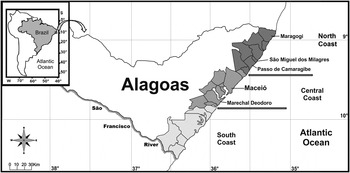
The collection sites were located along the north and central coast of Alagoas, including (from north to south): Maragogi–Gales coral reef (9°01′07″S–35°12′13″W); São Miguel dos Milagres–Porto da Rua coral reef (9°15′11″S–35°20′31″W); Passo de Camaragibe–Morro de Camaragibe coral reef (9°20′40″S–35o26′54″W); Maceió–Ponta do Prego coral reef (9°31′48″S–35°35′30″W), Ponta do Meirim coral reef (9°32′37″S–35°36′52″W), Sereia sandstone reef (9°34′04″S–35°38′46″W), Riacho Doce coral reef (9°34′55″S–35°39′25″W), Jatiúca coral reef (9°39′12″S–35°41′46″W), Ponta Verde coral reef (9°39′57″S–35°41′32″W), Piscina dos Amores coral reef (9°40′39″S–35°42′10″W), Pajuçara coral reef (9°41′06″S–35°43′22″W) and Sobral pier (9°40′45″S–35°45′00″W); and Marechal Deodoro–channel of the Manguaba lagoon (9°43′13″S–35°48′23″W), Saco da Pedra sandstone reef (9°44′26″S–35°48′59″W) and Francês sandstone reef (9°46′03″S–35°50′13″W) (Figures 1–3).
Area of study: north and central coasts of Alagoas, Northeastern Brazil (adapted from Correia & Sovierzoski, Reference Correia and Sovierzoski2009).

Reefs on the north coast of Alagoas, Brazil: (A) Maragogi–Gales coral reef; (B) São Miguel dos Milagres–Porto da Rua coral reef; (C) Passo de Camaragibe–Morro de Camaragibe coral reef.

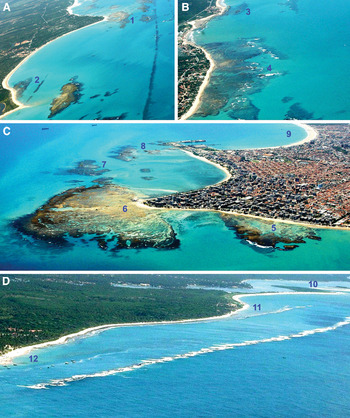
Reefs on the central coast of Alagoas, Brazil: (A) Maceió—1. Ponta do Prego coral reef and 2. Ponta do Meirim coral reef; (B) 3. Sereia sandstone reef and 4. Riacho Doce coral reef; (C) 5. Jatiúca coral reef, 6. Ponta Verde coral reef, 7. Piscina dos Amores coral reef, 8. Pajuçara coral reef and 9. Sobral pier; (D) Marechal Deodoro—10. Channel of the Manguaba lagoon, 11. Saco da Pedra sandstone reef and 12. Francês sandstone reef.

Collection and material processing
Field observations and material collections were made through snorkelling in tide pools and reef edges during low tides. Samples of algae and fouling organisms were also collected to study the associated opisthobranch species. Aerial photographs were taken by M.D. Correia, and specimen photographs were taken by V. Padula. Some specimens were photographed in situ, with a Canon digital camera in an underwater Canon housing. Material was collected manually and stored in small plastic containers with seawater. In the laboratory, the specimens were measured and photographed, frozen in seawater, and then preserved in 70% ethanol. Some of the material obtained from ecological studies by LABMAR/ICBS, found associated with macroalgae and sponges, was fixed in 4% formalin and preserved in 70% ethanol. Species identification was based on body colour and morphology, compared to original descriptions and field guides (Valdés et al., Reference Valdés, Hamann, Behrens and DuPont2006). The material is deposited in the malacological collections of the Setor de Comunidades Bentônicas/Universidade Federal de Alagoas (UFAL/MOL), Museu Nacional/Universidade Federal do Rio de Janeiro (MNRJ) and Museu de Zoologia da Universidade de São Paulo (MZSP).
RESULTS
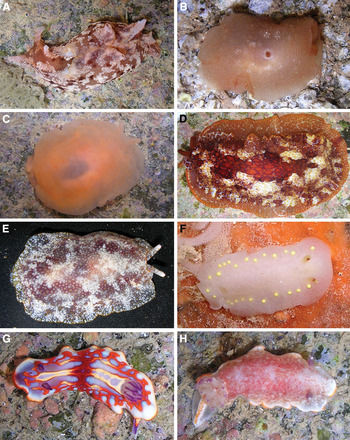
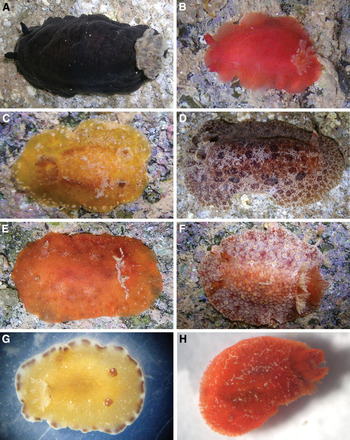
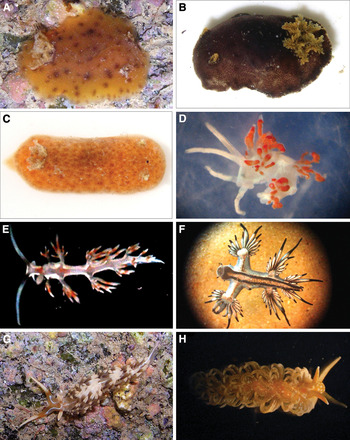
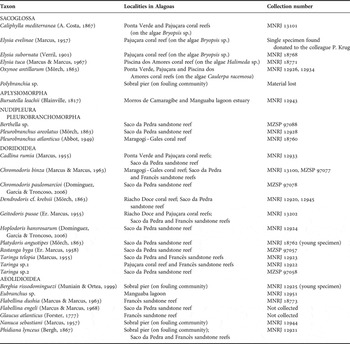
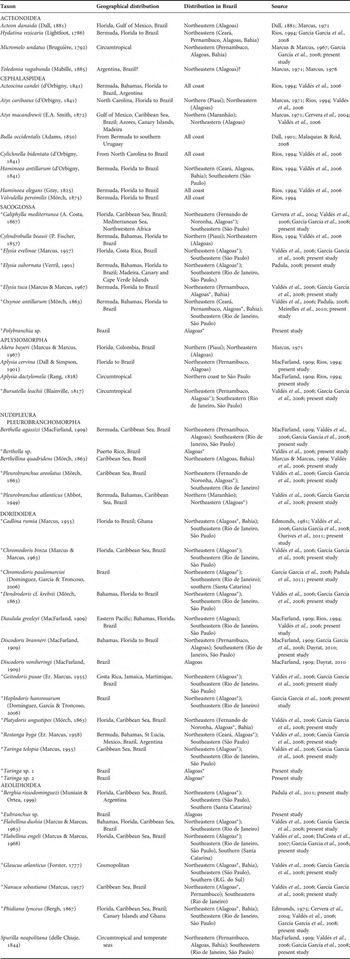
Twenty-eight species representing new records from Alagoas were identified (Table 1; Figures 4–7). Eleven of the species also represent new records from the Brazilian Northeastern coast: Sacoglossa—Elysia evelinae Marcus, Reference Marcus1957 and Elysia subornata Verril, 1901; Doridoidea—Chromodoris binza Marcus & Marcus, 1963, Chromodoris paulomarcioi Domínguez, García & Troncoso Reference Domínguez, García and Troncoso2006, Dendrodoris cf. krebsii (Mörch, 1863), Geitodoris pusae (Er. Marcus, Reference Marcus1955), Hoplodoris hansrosarum Domínguez, García & Troncoso, Reference Domínguez, García and Troncoso2006, and Taringa telopia Marcus, Reference Marcus1955; and Aeolidioidea—Berghia rissodominguezi Muniain & Ortea, 1999, Flabellina dushia (Marcus & Marcus, 1963), and Flabellina engeli Marcus & Marcus, 1968 (see Table 2). This is the first record of Hoplodoris hansrosarum after its original description, which was based on material from Búzios, Rio de Janeiro, Southeastern Brazil (Domínguez et al., Reference Domínguez, García and Troncoso2006). The morphotypes Berthella sp., also known from Puerto Rico (Valdés et al., Reference Valdés, Hamann, Behrens and DuPont2006: 110), Taringa sp. 1 and Taringa sp. 2 probably represent undescribed species.
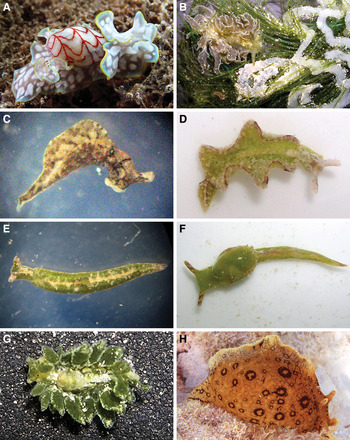
Opisthobranchs from Alagoas: (A) Micromelo undatus (23 mm long); (B) Caliphylla mediterranea (14 mm long); (C) Elysia evelinae (4 mm long); (D) Elysia subornata (13 mm long); (E) Elysia tuca (9 mm long); (F) Oxynoe antillarum (13 mm long); (G) Polybranchia sp. (4 mm long); (H) Aplysia dactylomela (250 mm long).

Opisthobranchs from Alagoas: (A) Aplysia cervina (70 mm long); (B) Berthella sp. (13 mm long); (C) Berthellina quadridens (31 mm long); (D) Pleurobranchus areolatus (80 mm long); (E) Pleurobranchus atlanticus (27 mm long); (F) Cadlina rumia (8 mm long); (G) Chromodoris binza (14 mm long); (H) Chromodoris paulomarcioi (18 mm long).

Opisthobranchs from Alagoas: (A) Dendrodoris cf. krebsii (30 mm long); (B) Dendrodoris cf. krebsii, young specimen (9 mm long); (C) Diaulula greeleyi (14 mm long); (D) Discodoris branneri (46 mm long); (E) Geitodoris pusae (15 mm long); (F) Hoplodoris hansrosarum (28 mm long); (G) Platydoris angustipes (7 mm long); (H) Rostanga byga (5 mm long).

Opisthobranchs from Alagoas: (A) Taringa telopia (11 mm long); (B) Taringa sp.1 (15 mm long); (C) Taringa sp.2 (7 mm long); (D) Flabellina dushia (3 mm long); (E) Flabellina engeli (12 mm long); (F) Glaucus atlanticus (18 mm long); (G) Phidiana lynceus (13 mm long); (H) Spurilla neapolitana (20 mm long).

New records, localities of collection and collection number of voucher specimens.

Opisthobranch species from Alagoas: their general geographical distribution and their distribution in Brazil.

*, new records from Alagoas (present study).
Most specimens were found under rocks and under reef fragments. Francês and, mainly, Saco da Pedra sandstone reefs were the richest collecting sites (Figure 3D). Arranged in rows parallel to the coast, these reefs have inner zones that are protected from waves. In shaded formations such as small caves in these protected zones, communities of sessile invertebrates such as cnidarians, sciaphilous sponges and tunicates develop. These invertebrates constitute the main food of the Nudipleura, the group with the most species collected in the present study (Table 1). The aplysiomorph Bursatella leachii Blainville, 1817 was common during summer months, when it was found in estuaries. Many individuals were observed associated with different macroalga species.
DISCUSSION
The 28 new records reported here (Table 1) comprise more than the total of 22 opisthobranch species that were previously known from Alagoas (Marcus, Reference Marcus1971; Rios, Reference Rios1994, Reference Rios2009; García García et al., Reference García García, Domínguez and Troncoso2008). With the current records the total number of species increases to 50 (Table 2). This hidden biodiversity, now at least in part revealed, reflects the lack of specific research in the region, and illustrates the current state of knowledge for many marine invertebrate groups on the Brazilian coast: sparse information and gaps in the known geographical distributions. The 11 new records from the Northeastern Brazilian coast, for most of the species, fill a gap in their distribution records between Southeastern Brazil and the Caribbean Sea (Valdés et al., Reference Valdés, Hamann, Behrens and DuPont2006). This is the case for Elysia subornata, Chromodoris binza and Flabellina engeli, among others (Table 2).
In addition to their importance as additions to knowledge about Alagoas reef biodiversity, and also because some reefs have been impacted by human activities (Correia & Sovierzoski, Reference Correia and Sovierzoski2009), the new records provide important data for future investigations such as biogeographical studies. The recent biogeographical hypothesis proposed for Brazilian opisthobranchs is not conclusive, because of the sparse data available from most of the Brazilian coast (García García et al., Reference García García, Domínguez and Troncoso2008). For example, the biogeographical region that includes Alagoas plus the coasts of two other Brazilian states (‘EBS') was represented by only 30 species (García García et al., Reference García García, Domínguez and Troncoso2008: 198). The present study nearly doubled the number of species known from this region. This emphasizes that only through further surveys and taxonomic studies, resulting in a comprehensive list of species from most areas of the Brazilian coast, can a comprehensive biogeographical study be conducted and an informative overview be obtained. In addition, new detailed morphological studies and the use of molecular tools are recommended to identify possible cryptic opisthobranch species in the tropical western Atlantic, as recently reported for sponges (Valderrama et al., Reference Valderrama, Rossi, Solé-Cava, Rapp and Klautau2009), polychaetes (Barroso et al., Reference Barroso, Klautau, Solé-Cava and Paiva2010) and reef fishes (Luiz Jr et al., Reference Luiz, Ferreira and Rocha2009; Bernal & Rocha, Reference Bernal and Rocha2011).
ACKNOWLEDGEMENTS
The authors are grateful for the support of LABMAR/ICBS/UFAL students and Leandro M. Vieira (USP) during fieldwork and material processing. We thank Kathe Jensen (Zoological Museum, Copenhagen) for suggestions in the identification of Polybranchia sp. The authors are grateful to three anonymous referees for their comments and suggestions on the manuscript. This work was supported by the National Council for Scientific and Technological Development (CNPq-Brasil) and Deutscher Akademischer Austausch Dienst (DAAD-Germany) with Master's and PhD scholarships to Vinicius Padula; Brazilian Federal Agency for the Support and Evaluation of Graduate Education (CAPES) for the Master's scholarships to Juliana Bahia. The UFAL collection was funded by the National Council for Scientific and Technological Development (CNPq-Brasil–Proc. 505907/2010-0).