




No CrossRef data available.
The mediating role of alienation in the development of maladjustment in youth exposed to community violence
Published online by Cambridge University Press: 10 February 2006
Abstract
A study was conducted to determine predictors of high risk/delinquent behavior and psychoemotional maladjustment in 1,478 sixth and eighth graders who took part in a survey of high-risk and adaptive behaviors. The first goal was to determine the extent to which two distinct dimensions of alienation, normlessness, and isolation/self-estrangement mediated the emergence of maladjustment in youth exposed to community violence. The second goal was to distinguish between violence witnessing and violence victimization, and determine whether these subtypes of violence exposure may differentially affect the proposed mediational factors. The results indicated that normlessness partially mediated the relationship between violence exposure and high-risk/delinquent behavior and between violence exposure and psychoemotional maladjustment. Isolation/self-estrangement partially mediated the relation between violence exposure and psychoemotional maladjustment. Although witnessing of, and victimization by, violence were both significant predictors of normlessness, only violent victimization was significantly linked to isolation/self-estrangement. These results elucidate the mechanisms by which community violence exposure may exert negative influences on youth and suggest that there are distinct patterns of risk associated with different forms of exposure.
This research was facilitated by the support of the William T. Grant Foundation and the Harris Program on Social Policy. The authors gratefully acknowledge the New Haven Public Schools, especially Superintendent Dr. Reginald Mayo and Assistant Superintendent Dr. Verdell Roberts. The authors thank Drs. Alan Kazdin, Joseph Mahoney, and Edward Zigler for their helpful feedback on earlier versions of this manuscript.
Information
- Type
- Research Article
- Information
- Copyright
- © 2006 Cambridge University Press
We have reason to believe that children living under circumstances that expose them to violence may be at risk for developing patterns of high risk behavior and psychoemotional maladjustment (Garbarino, Dubrow, Kostelny, & Pardo, 1992; Martinez & Richters, 1993). Can we discover whether psychological predisposing factors such as attitudes of alienation are important mediators determining which children will be the most likely to experience serious distress under these circumstances? The objective of this study was to examine the extent to which dimensions of alienation, including normlessness, isolation, and self-estrangement, mediate the relation between exposure to violence (both as a witness and victim) and high risk/delinquent behavior and psychoemotional distress among sixth and eighth graders, who are youth at a developmental stage that predisposes them to the emergence of feelings of alienation, in an urban, public school system.
Community Violence and Its Effects on Youth
Community violence, a chronic and pervasive presence in many inner city neighborhoods, impacts children on multiple levels (Lynch, 2003; Martinez & Richters, 1993; Schwab-Stone et al., 1995, 1999). Repeated exposure to violence appears to initiate a cascade of effects prompting negative changes in many youngsters' physiological, emotional, behavioral, and cognitive states (Nelson & Carver, 1998; Perry, 2001; Perry & Pollard, 1998). Such changes, whose core underlying features represent a decreased capacity to regulate brain, mind, and body responses to one's environment, can translate into increased risk for depression, anxiety, posttraumatic stress, somatization, aggressive behavior, academic failure, and interpersonal difficulties (Farrell & Bruce, 1997; Lynch & Cicchetti, 1998; Wilson & Rosenthal, 2003). These maladaptive outcomes have been shown to consist of two broad separate realms, high risk/delinquent behaviors and psychoemotional distress. High risk/delinquent behaviors and psychological distress appear to reflect different maladaptive coping strategies (Doernberger, 1992; Farber & Egeland, 1987; Luthar 1991; Werner & Smith, 1982, 1992), and thus merit separate consideration.
A child's exposure to community violence generally can involve either witnessing violence occurring to others, falling victim to violence oneself, or experiencing some combination of both (Schwab-Stone et al., 1999). Despite moderate to strong associations between youth's self-reports of witnessing and victimization, not all children who witness violence are also victims of such violence (Kliewer, Lepore, Oskin, & Johnson, 1998). Violence victimization, as a more severe affront to a child's schemas regarding safety and well-being (Schwartz & Proctor, 2000), is more strongly associated with multiple domains of internalizing symptomatology, including anxiety, depression, somatization, and posttraumatic stress disorder (PTSD), than is witnessing (Martinez & Richters, 1993).
Developmental psychopathology frameworks have conceived of the effects of community violence exposure on youth as being mediated by environmental, relational, and social–cognitive processes (Garbarino & Kostelny, 1996; Lynch & Cicchetti, 2002; Macksoud, Aber, & Cohen, 1996). Cicchetti and Lynch's (1993) ecological–transactional model conceptualizes violence as influencing all levels of a child's ecology (i.e., individual, family, community, culture) producing maladaptive developmental outcomes in multiple levels. Reciprocal associations among protective and risk factors develop across contexts and domains of adjustment. Such intersystemic transaction may mediate the effects of the relation between violence exposure and children's responses (Cicchetti & Toth, 1997). In Sroufe's (1990) organizational model of the self, self-system functioning, defined as a set of expectations about self, others, and interactions with others may function as a mediator between urban stress and adjustment. These sets of expectations can affect not only thoughts and feelings, but also behavior toward others. Mechanisms of action within both models may be particularly salient during the period of early adolescence, a time when youth develop wider circles of influence and begin to interact with peers and other nonfamily members more than at any other previous point in development (Schaffer, 1996).
These theoretical models discuss social and environmental forces as central components of children's cognitive, emotional, and behavioral interactions with violent and unpredictable urban contexts. Social forces are not under the purview of psychology alone; they also occupy an important place in sociological thinking. Multiple sociological theories of the alienating effects of violence exposure have been put forth and merit consideration as complimentary conceptualizations to psychological theories of intersystemic processes.
Feelings of Alienation as a Mediator of Children's Violence-Related Responses
Although the link between community violence exposure and maladaptive outcomes has been established by multiple researchers, the extent to which other variables may mediate this relationship has not been as systematically investigated. Alienation, defined as a sense of separation or estrangement from society, work (school, in the case of children), one's self, or significant others (Calabrese & Adams, 1990; Schabracq & Cooper, 2003), may occupy this mediational role and serve to unite aspects of ecological and self-system expectancy approaches.
Alienation is a construct with a long history in both sociology and psychology (see Durkheim, 1951; Marx, 1964; Seeman, 1959). Contemporary sociological theorists view alienation as a composite of personal and attitudinal components that act as a foundation for perceptions about the individual relative to his or her social sphere (Gergen, 1992). Others have described alienation as a conduit for establishing empirical connections between undesirable social conditions and maladaptive behavioral and psychological outcomes (Oldenquist & Rosner, 1991). As a bridge between the external social world and a person's thoughts and behaviors, alienation represents a reciprocal association between different levels of a child's ecology. The construct of alienation, then, possesses characteristics of both the intersystemic transaction processes articulated in Cicchetti and Lynch's ecological–transactional model and the expectancies about self, others, and interactions with others put forth in Sroufe's (1990) organizational model of the self.
In the psychological literature, alienation has consistently been found to correlate with anxiety, deviant behavior, substance abuse, and low participation in school activities (Calabrese & Poe, 1990; Wilkerson, Protinsky, Maxwell, & Lentner, 1982), and to exist more frequently among early adolescents (Calabrese, 1988). No research to date has looked at levels of alienation among youth as a function of exposure to community violence. This is surprising, as multiple studies have demonstrated that alienation exists in higher proportions among minorities (Moyer & Motta, 1982) and those of lower socioeconomic status (Calabrese & Poe, 1990; Grabe, 1981), groups that are more likely to be exposed to community violence (Willis & Silovsky, 1998).
Alienation may be exacerbated by youths' sense of inability to control their environment (Calabrese, 1989). Community violence likely heightens this feeling of being acted upon, as such violence is frequently random in nature, comes without warning, and is beyond an individual's immediate control (Willis & Silovsky, 1998). Furthermore, because community violence exposure threatens children's formation of healthy attachments, the capacity to experience trust, and to develop self-confidence and autonomy (Garbarino et al., 1992), such mechanisms may also lead to feelings of estrangement and isolation, the cornerstones of alienation.
Multidimensional Models of Alienation
Alienation research has been most fruitful when examining separate dimensions of alienation as opposed to considering alienation as a single overarching construct (Sankey & Huon, 1999). Seeman (1959, 1983, 1991) has identified five dimensions of alienation: normlessness, isolation, self-estrangement, powerlessness, and meaninglessness. The first three are the focus of the present study. The last two dimensions of alienation were not considered in the present study, as there is substantial overlap between these dimensions and the main constructs of internalizing psychopathology, rendering it difficult to discriminate between the effects of these factors as a part of the alienation construct as separate from one aspect of the outcome variable, the depression construct.
Normlessness denotes a situation in which the social norms regulating conduct are no longer effective as rules for behavior (Seeman, 1991). Witnessing violence may be associated with increased levels of normlessness. Witnessing, unlike victimization, does not always result in unpleasant consequences for the child, and may, in fact, lead to learned positive evaluations of violent behavior (Schwartz & Proctor, 2000). Through witnessing violence, children may develop cognitive schemas that support normlessness and a belief system in which aggression is associated with desired outcomes (Jenkins & Bell, 1997).
Isolation, a real or perceived detachment from others, can be viewed as the expectation that others in one's environment are not interested in or accepting of oneself. Self-estrangement, defined as the inability of the individual to find engaging and self-rewarding activities (Seeman, 1991), can also be recast in terms of expectancies. Self-estrangement is the expectation that one's life or work is not in itself meaningful or worthwhile. It is likely that violence victimization, more so than witnessing, may be associated with both isolation and self-estrangement. Children victimized by community violence often develop PTSD-spectrum symptomatology (e.g., Kliewer et al., 1998), including feelings of detachment or estrangement from others, numbing of general responsiveness, and diminished interest and participation in significant activities (Milgram, 1998). Such features are similar in many ways to those indicative of the isolation and self-estrangement dimensions of alienation.
High-risk/delinquent behaviors are likely predicted most strongly by normlessness. Some researchers assert that, beyond correlating with normlessness, delinquency is a form of normlessness representing a rejection of traditional societal values and social organizations (Kulka, Kahle, & Klingel, 1982). According to problem behavior theory (Costa, Jessor, Donovan, & Fortenberry, 1995; Jessor & Jessor, 1977) many behavior problems in youth arise from psychosocial unconventionality, defined as rejection of societal norms and a propensity to engage in nonconforming behavior. Different from delinquent behavior, normlessness represents a cognitive construct reflecting internalized norms of behavior in society, which may change as a result of traumatic exposure, and may or may not lead to delinquent behavior.
Psychoemotional maladjustment, conversely, is likely affected most by isolation/self-estrangement. The negative expectations about self, others, and the interaction between self and others present in isolation and self-estrangement are thought to be part of the cognitive and attitudinal mechanisms involved in the development of depression, social anxiety, and poor peer relations (Abramson, Metalsky, & Alloy, 1989; Bourne & Russo, 1998; Seligman, 1975).
The present study examines the extent to which normlessness and isolation/self-estrangement mediate the relation between community violence exposure and maladaptive outcomes. Based on the body of theory described above, it is predicted that (a) youth exposed to community violence (either as a witness or victim) will have higher rates of normlessness and isolation/self-estrangement than those experiencing no community violence; (b) normlessness and isolation/self-estrangement will mediate the relation between violence exposure and high-risk/delinquent behavior and psychoemotional maladjustment. Witnessing and victimization serve as independent variables, normlessness and isolation/self-estrangement serve as mediators, and psychoemotional maladjustment and high-risk/delinquent behaviors serve as dependent variables; (c) high-risk/delinquent behaviors will be predicted most strongly by normlessness, which will be predicted most strongly by violence witnessing; and (d) psychoemotional maladjustment will be predicted most strongly by isolation/self-estrangement, which will be predicted most strongly by violence victimization.
Methods
Participants
In 1998, 2,396 youth who were sixth and eighth graders in the New Haven, CT public school system, including students in alternative programs and bilingual classes, completed a survey that is part of an ongoing project aiming to assess risk and protective factors for adolescents' adjustment. The survey was repeated in 2000. A final sample of 1,478 (61.7%) students remained after 918 cases were excluded due to Attrition × Time 2 of data collection. This final sample represents students who had data at both time points (1998 and 2000).
Analyses were conducted to determine whether the subsample of 1,478 students who remained in the study over the 2 years differed from the initial sample of 2,396. The group that remained was compared to the group that dropped out across 1998 study variables. Results indicated that the group who dropped out consisted of more boys than girls (54.6 vs. 49.5%, χ2 = 5.93; p < .015). Youth lost to follow-up also witnessed more violence t (1796.28) = 7.00, p < .001, were victimized more, t (1652.96) = 4.38, p < .001, and had higher levels of depression, t (1727.05) = 3.23, p < .001, alcohol use, t (1404.88) = 8.20, p < .001, and delinquent behavior, t (1239.78) = 8.22, p < .001, than their peers who were not lost to follow-up. Thirty-one percent of youth lost to follow-up were Hispanic, 56.3% were African American, and 11.4% were Caucasian. The sample retained through Wave 2 had a significantly different ethnic breakdown when compared to the group lost to follow-up, with 23.5% Hispanic, 61.4% African American, and 13.8% Caucasian (χ2 = 17.78, p < .001). These findings suggest that attrition was selective across some of the key variables.
The final sample represents children from diverse schools and neighborhoods. New Haven, CT, is a city of approximately 130,500 residents. The children in this study represent students from 13 different public middle and high schools in the New Haven school district. Seven hundred forty-seven of the participants were female and 731 were male. The mean age was 12.47 (SD = 2.56). Nine hundred eight (61.4%) students were African American, 347 (23.5%) were Hispanic, 204 (13.8%) were Caucasian, and 19 (1.3%) were other or mixed race.
Procedures
The survey was administered to a total of 116 classes in 13 middle and high schools in the district as part of a large-scale project on risk and protective factors for problem outcomes. All students were surveyed unless their parents requested that they not be involved, the students said that their parents had objections, or the students said that they themselves wished not to participate (<1.0%). The survey was administered by research project staff and by school system personnel (but not by the classroom teachers) during the regular school day in sessions lasting 45–60 min. All administrators were trained in a standardized procedure for administering the survey. Each student received a survey booklet, which contained all of the questions and response options. Survey administrators read all questions aloud while students followed along, reading questions to themselves and circling responses in the booklet.
The survey was translated into Spanish by the school system's translator. That translation was reviewed by a second translator and some modifications were made to arrive at the Spanish version of the instrument that was used. The survey was administered in Spanish to students who spoke only Spanish or who preferred to take the Spanish version (3.8% of the sample).
Statistical analyses for the present study were longitudinal, with 1998 violence exposure data predicting 2000 alienation data and 2000 high-risk/delinquent behavior and psychoemotional maladjustment outcome data, controlling for baseline 1998 levels of the outcome variables. Alienation data was gathered in 2000 only.
Measures
The present study used data from the 1998 and 2000 administrations of the Social and Health Assessment (SAHA; Weissberg, Voyce, & Kasprow, 1991; modified by Schwab-Stone, 1995), a 182-item instrument designed to assess positive school and community involvements and high-risk behaviors of middle and high school students. The SAHA contains relevant scales used in other studies of adolescents (American School Health Association, 1990; Centers for Disease Control, 1991a, 1991b; Elliott, Huizinga, & Menard, 1989; Hawkins & Catalano, 1990; Jessor, Donovan, & Costa, 1989; Johnston, Bachman, & O'Malley, 1990) and items designed by the investigators. Extensive pilot testing was conducted during the development of the measure (Barone et al., 1995). Answer choices for items are all either true–false or on a Likert scale. All true–false scales are scored 0 = false and 1 = true, and summed to create a total score. Likert-type scale totals were created by averaging the individual item scores. Following is a description of the specific SAHA scales and other additional measures used.
Indices of risk
Each index of violence exposure was preceded by an introductory statement that this set of questions refer to the things that may happen to people in some neighborhoods.
Victimization by violence
Students were asked whether they had, within the past 2 years, been chased by gangs or individuals, threatened with serious physical harm by someone, beaten up or mugged, attacked or stabbed with a knife, seriously wounded in an incident of violence, and shot or shot at with a gun. This six-item true–false scale is a subset of a scale developed by Richters and Martinez (1993), and has a moderate level of internal consistency (Cronbach's α = .63). Possible scores range from 0 (no violence victimization) to 6 (victimization reported on each item).
Witnessing violence
This is a parallel measure to victimization by violence. Students were asked whether they had seen someone being victimized by the same six types of violence during the past 2 years. Cronbach's alpha for this scale was .76. Possible scores range from 0 (no witnessed violence) to 6 (witnessed violence on each item). Richters and Martinez's (1993) study of first and second graders reported a 1-week test–retest reliability of .81 for the witnessing and victimization scales. In an effort to support the validity of adolescent reports of witnessing violence in the SAHA data set, a density map of adolescents' reports of witnessing someone shot or stabbed was plotted and compared to a map with homicide location data from the police department. Results showed a clear match of clusters (Schwab-Stone, Jones, Henrich, Leckman, & Ruchkin, 2003).
Indices of potential mediators
Alienation
Two separate scales, described below, were used to measure the alienation constructs (isolation/self-estrangement and normlessness).
Isolation and self-estrangement: Jessor and Jessor Alienation Scale
This scale, developed by Jessor and Jessor (see Robinson, Shaver, & Wrightsman, 1991), measures alienation in terms of uncertainty about the meaningfulness of daily activities, or self-estrangement, and a belief that one is isolated from others. Sample items include: “Hardly anyone I know is interested in how I really feel inside,” “I sometimes feel uncertain about who I really am,” and “Most of my academic work in school seems worthwhile and meaningful to me” (reverse coded). It is made up of 15 Likert-type items, with possible scores ranging from 15 (low alienation) to 60 (high alienation). Cronbach's alpha for this scale was .76.
Normlessness: Attitudes toward deviance
This measure of normlessness was measured with an 11-item scale derived from Jessor's School Health Study (Jessor et al., 1989). Sample items include: “How wrong is it to shoplift from a store?,” “Damage or mark up public or private property on purpose?,” “Sell drugs if you needed the money?,” and “Skip school without permission?” Cronbach's alpha for this scale was .89. Possible scores range from 11 to 44 (with higher scores reflecting greater levels of normlessness).
Indices of maladjustment
High risk/delinquency
Three separate SAHA scales, described in detail below, were used to measure behavioral maladjustment.
Alcohol use
A nine-item scale derived from the Monitoring the Future Scale (Johnston, Bachman, & O'Malley, 1990) was used to assess students' alcohol use in the past 30 days and their involvement with alcohol during the past year. On three items, subjects report whether they have ever had a drink (not just a sip or taste of someone else's) of beer, wine or wine coolers, or hard liquor. On three separate items, subjects report frequency of alcohol use in the past 30 days for each of the three different types of alcoholic beverages. Three additional items asked about the number of days (during the past 30 days) the respondent had five or more drinks of alcohol in a row (within a couple of hours), and the number of times the respondent had fights or arguments while drinking, and been drunk or very high from drinking, which addressed the issue of problem drinking. Cronbach's alpha for this scale was .88. Possible scores range from 0 (no alcohol use) to 27 (high levels of use).
Marijuana use
This two-item scale was also taken from Jessor's School Health Study (Jessor et al., 1989): “Have you ever used marijuana?” and “In the past 30 days, how many times (if any) have you used marijuana?” Cronbach's alpha for this item set was .83. Possible scores range from 1 (no marijuana use) to 7 (high use).
Delinquent behavior
Delinquent behavior during the past year was assessed via a six-item scale taken from Jessor's School Health Study (Jessor et al., 1989). Sample items include “During the past year, how many times have you started a fist fight or shoving match?,” “Shoplifted from a store?” or “Stayed out all night without permission?” Cronbach's alpha for this scale was .79. Possible scores range from 0 (no delinquent behavior) to 24 (high levels of delinquent behavior).
Psychoemotional maladjustment
Three separate scales, described below, were used to measure psychoemotional maladjustment.
Depression
Depressive symptomatology was assessed by the 13-item, true–false, depression subscale of the Behavioral Assessment System for Children (BASC; Reynolds & Kamphaus, 1992). Sample items include “Nothing about me is right,” and “Life is getting worse and worse.” Cronbach's alpha for this scale was .82. Possible scores range from 0 (no depression) to 13 (high levels of depression). Reliability statistics for this and other scales from the BASC (see below) are consistent with those reported in the BASC Manual (Reynolds & Kamphaus, 1992).
Anxiety
Anxiety was also assessed via the BASC (Reynolds & Kamphaus, 1992). This self-report measure has 14 true–false items such as “I am afraid of a lot of things” and “I worry about what is going to happen.” Cronbach's alpha for the scale was .83. Possible scores range from 0 (no anxiety) to 14 (high anxiety).
Somatization
Somatization was measured via 11 items from the BASC (Reynolds & Kamphaus, 1992). Sample items from this scale include “I have fainting spells,” “I am afraid I have cancer,” “I often have headaches,” and “My stomach gets upset more than in most people.” Cronbach's alpha for this scale was .68. Possible scores range from 0 (no somatization) to 11 (high levels of somatization).
Results
Demographic and adaptive characteristics
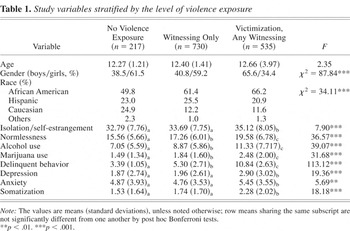
Table 1 presents sociodemographic and adaptive characteristics of the sample stratified by violence exposure. Based on the total sample of 1,478, 217 (14.4%) had neither witnessed nor been victimized by violence within the past 2 years, 730 (49.4%) were witnesses only (without having been victimized by violence), and 535 (36.2%) reported direct victimization (with any level of witnessing). A vast majority of youth who had not experienced any form of violence exposure or who had witnessed only were female, while most of those who had experienced victimization were male (Table 1). There was also a trend for African American youth to be increasingly represented in the groups of witnessing and victimization, with a relative decrease in proportion of Caucasian and Hispanic youth. Although nonsignificant, there was a trend for those who experienced victimization to be older than those who were not exposed to violence, or witnessed only.
Study variables stratified by the level of violence exposure

Univariate analyses of variance were used to compare violence exposure groups on the mediator and outcome variables. To reduce the likelihood of Type I error, Bonferroni corrections were applied. Hypothesis 1 stated that youth exposed to community violence (either as a witness or victim) would have higher rates of normlessness and isolation/self-estrangement than those experiencing no community violence. As shown in Table 1, those who were victimized had significantly higher scores on the isolation/self-estrangement scale than both their witnessing and nonexposed counterparts. Normlessness scores increased in a statistically significant stepwise fashion from no exposure to witnessing to victimization. In terms of outcome variables, depression, anxiety, and somatization scores were significantly higher among youth victimized by violence than among both those not exposed to violence and those who witnessed only. High-risk/delinquency scores significantly increased in a stepwise fashion from no exposure to witnessing to victimization.
Normlessness and isolation/self-estrangement as mediators between community violence exposure and maladaptive outcomes
Hypothesis 2 stated that normlessness and isolation/self-estrangement would mediate the relation between 1998 violence exposure and 2000 high-risk/delinquent behavior and psychoemotional maladjustment, controlling for the prior, baseline 1998 levels of functioning in each outcome domain. Normlessness would have its greatest predictive effect on high-risk/delinquent behavior and would be predicted most strongly by violence witnessing. Isolation/self-estrangement would have its greatest predictive effect on psychoemotional maladjustment, and would be predicted most strongly by violence victimization. This hypothesis was tested through a series of structural equation models (SEMs) first with unmediated, and then mediated models.
Overall model fit and path parameters were estimated using the Analysis of Moment Structures (Arbuckle & Wothke, 1999). Three goodness of fit statistics, in addition to the chi-square statistic, were used: the root mean square error of approximation (RMSEA; Browne & Cudeck, 1993), comparative fit index (CFI; Bentler, 1990) and the normed fit index (NFI). Values less than .08 on the RMSEA and greater than .90 on the CFI and NFI indicate good model fit. All parceling techniques used in this study followed established guidelines set forth by Little and colleagues (Little, Cunningham, Shahar, & Widaman, 2002; Little, Lindenberger, & Nesselroade, 1999). Items were grouped into three balanced parcels based on item-total correlations. Parcels are preferred for the SEM analyses because, compared to individual items, parcels have superior psychometric qualities that reduce both Type I and Type II sources of error, but do not bias or otherwise inflate construct relations (for details, see Little et al., 1999, 2002).
Unmediated model: Violence exposure as a predictor of maladaptive outcomes
The specified measurement model included two latent exogenous variables: (a) violence witnessing and (b) violence victimization. In contrast to the other constructs described below, the measures of witnessing and victimization were considered as indices of exposure, rather than scales, in which items do not necessarily correlate with each other. Thus, the total scores for the witnessing and victimization scales were used for building the models. Conversely, for the mediator variables, items were sorted into three balanced parcels and the outcome variables were each represented by latent constructs, consisting of three scale scores each.
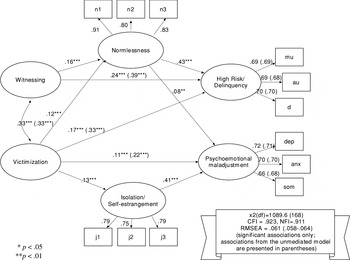
The initial unmediated model (with path coefficients reported in parentheses in Figure 1) included two endogenous outcome variables: (a) high-risk/delinquency and (b) psychoemotional maladjustment. This direct effects model fit the data rather poorly, χ2 (80) = 889.9, CFI = .884, NFI = .875, RMSEA = .083 (.078–.088), with the primary fit indexes not reaching their minimum required values. The parceled indicators that were used for all adjustment constructs loaded on their respective factors very well, ranging from .68 to .71.

The initial unmediated model with path coefficients in parentheses.
For purposes of clarity, only statistically significant standardized path coefficients are presented in the figure. Although significant, covariances in 1998 are also not included in the figures for the same reason. In addition to the relationships presented in the figure, prior (1998) levels of all variables were controlled by covarying them within 1998 and estimating direct paths from their 1998 levels to all 2000 constructs.
Mediated model: The mediating role of isolation/self-estrangement and normlessness
To test the mediational hypotheses, two additional endogenous variables: (a) normlessness and (b) Isolation/self-estrangement, were added to the model as potential mediators between violence exposure and psychoemotional and behavioral outcomes. According to Baron and Kenny (1986), to demonstrate mediation, four conditions need to be established: (a) a significant relation between the independent variables and the mediating variables; (b) a significant relation between the dependent variables and the mediating variables; (c) a significant relation between the dependent variables and the independent variables; and (d) a significant reduction in the strength of the relation between the independent variable and the dependent variable once the mediating variables are entered into the model.
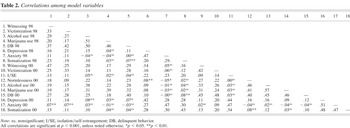
The correlations between the variables included in the model are presented in Table 2 and correspond to the hypothesized associations required for establishing mediation (points a–c above).
Correlations among model variables

The mediated model had a significantly better fit than the unmediated model, χ2 (168) = 1089.6, CFI = .923, NFI = .911, RMSEA = .061 (.058–.064), Δχ2 (88) = 199.8; p < .001, with the primary fit indices reaching minimum required values (Figure 1).
With regard to witnessing, normlessness appeared to partially mediate its association with high risk/delinquency (reducing the significant direct path from .39 to .24, t = 4.2, p < .001), but did not mediate its association with psychoemotional maladjustment. Isolation/self-estrangement did not mediate the associations between witnessing and psychoemotional maladjustment, or between witnessing and high risk/delinquency.
With regard to victimization, normlessness partially mediated the association between victimization and high risk/delinquency (reducing the significant direct path from .33 to .17, t = 4.5, p < .001). The combined indirect effects of normlessness and isolation/self-estrangement partially mediated the association between victimization and psychoemotional maladjustment (reducing the significant direct path from .22 to .11, t = 3.4, p < .001).
As with the unmediated model, covariances in 1998 and direct paths from 1998 to 2000 variables are not included in the figures for purposes of clarity. These associations are briefly summarized below. Witnessing 1998 was significantly related to witnessing 2000 (B = .37, p < .001) and victimization 2000 (B = .11, p < .01). Victimization 1998 was related to victimization 2000 (B = .21, p < .001). Covariances for violence exposure variables remained the same as in the unmediated model (all at p < .001). High risk/delinquency 1998 was related to witnessing 2000 (B = .15, p < .01), to victimization 2000 (B = .12, p < .01), normlessness 2000 (B = .24, p < .001), and high risk/delinquency 2000 (B = .41, p < .001). Psychosocial maladjustment 1998 was related to isolation/self-estrangement 2000 (B = .36, p < .001) and psychosocial maladjustment 2000 (B = .51, p < .001).
In summary, normlessness was found to significantly mediate the relation between violence witnessing and victimization and high-risk/delinquent behavior and the relation between violence victimization and psychoemotional maladjustment. Normlessness predicted high risk/delinquency to a significantly greater degree than it did psychoemotional maladjustment (t = 3.39, p < .001). Violence witnessing was significantly more predictive of normlessness than of isolation/self-estrangement (t = 2.54, p < .001).
Isolation/self-estrangement was found to significantly mediate the relation between violence victimization and psychoemotional maladjustment. Isolation/self-estrangement predicted psychoemotional maladjustment to a significantly greater degree than it did high risk/delinquent behavior (t = 10.64, p < .0001), and was predicted significantly more strongly by victimization than by witnessing (t = 3.64, p < .001).
Discussion
This study examined the relation between community violence exposure and maladaptive outcomes in the domains of high-risk/delinquent behavior and psychoemotional maladjustment. Youth exposed to community violence may develop two different problematic social–cognitive explanatory styles based on type of exposure, reflecting processes from both Cicchetti and Lynch's (1993) ecological–transactional model and Sroufe's (1990) organizational model of the self. Findings suggest that youth exposed to violence as either witnesses or victims may develop normlessness schemas, while those who have been victimized are additionally likely to develop schemas related to themes of isolation and self-estrangement. Each style may give rise to different maladaptive outcomes. Results indicated that normlessness was associated with increased levels of both high risk/delinquent behavior and psychoemotional maladjustment, mediating the relation between violence exposure and these two outcomes. Isolation/self-estrangement was associated with psychoemotional maladjustment.
The finding that violence witnessing and victimization were predictive of normlessness may best be conceptualized in terms of schemas and social–cognitive biases. The schemas of children who are exposed to violence in their communities may come to include cognitions and expectations that aggression is necessary to achieve one's goals and that it is a positive activity in which to engage (Schwartz & Proctor, 2000). Such inflexible and nonelaborated cognitive schemas represent problematic social–cognitive biases and may help explain why the present study found witnessing violence to predict feelings of normlessness most strongly. Normlessness may be more likely to develop among youth who view violence, because they have witnessed it as such, as a positive means of obtaining desired ends.
Violent victimization often involves a more personal affront and severe threat to a child's sense of safety than does violence witnessing (Janoff-Bulman, 1992). In addition to creating an aggressogenic social–cognitive style, children who have been victimized by violence may develop schemas that interpret the world as hostile and unpredictable (Rossman, 1998). With repeated victimization, such schemas may develop into social–cognitive biases that result in misinterpreting ambiguous interpersonal situations as potentially threatening and attributing hostile intent to others. Such attributions often lead to aggressive coping strategies (Crick & Dodge, 1994). However, as a result of the sense of inability to control one's environment that frequently coincides with community violence exposure (Willis & Silovsky, 1998), feelings of hopelessness and helplessness often develop in youth victimized by community violence. Helpless and hopeless attributional styles correlate with depression (Seligman, 1975), expectations of failure in interpersonal interactions (Bourne & Russo, 1998), and low self-esteem and self-efficacy (Rossman, 1998). This triad of psychological correlates, along with the social–cognitive bias of misinterpreting ambiguous situations as threatening, appears to map onto the present findings that violent victimization predicts feelings of isolation, a real or perceived detachment from others, and self-estrangement, the inability to find self-rewarding activities that engage oneself.
Although witnessed violence and violent victimization may be predictive of different mediational processes, youth living in dangerous communities are likely to experience both forms of violence exposure. In the present study, as well as in other similar studies of violence exposure (Schwartz & Proctor, 2000), violence witnessing and victimization have been found to be at least moderately correlated. Thus, many children may develop both sets of social–cognitive biases and forms of alienation.
The second important finding emanating from this study was that feelings of normlessness significantly mediated the relation between violence witnessing and victimization and high-risk/delinquent behavior, and between violence victimization and psychoemotional maladjustment. When individuals, including both children and adults, are unable to attain culturally prescribed goals via socially sanctioned means, they may develop distrust of and decreased willingness to abide by the rules and norms that prevail in society (Geis & Ross, 1998). This diminished respect for the rules and norms of society, rules that in many cases have proven to inadequately serve the needs of inner city residents to begin with, may translate into the development of high-risk/delinquent behavior. When coupled with the added intrapersonal stressors associated with violent victimization, problems with psychoemotional development may also arise.
High-risk and delinquent-type behaviors may develop to the extent that “the technically most effective procedure, whether culturally legitimate or not, becomes typically preferred to institutionally prescribed conduct” (Seeman, 1983, p. 174). In many instances, the perceived “technically most effective procedure,” at least in the short term, involves the use of force or threat of force (Willis & Silovsky, 1998). For children growing up in environments where they frequently witness community violence, violence that in many instances may result from a breakdown in the social norms regulating conduct in a community, this pervasive atmosphere of normlessness may be learned, encoded, and imitated by the child through social learning (Bandura, 1986).
It is important to note that although some researchers may define delinquent behavior as a rejection of society's rules and thus view normlessness as a redundant construct, normlessness represents a psychological state, whereas delinquency refers to a set of behaviors (Roberts, 1987). This is an important distinction, as psychological states need not translate into behavioral or action states (Damon & Hart, 1992). As suggested by the present findings, psychological states may mediate the relation between violence exposure and maladjustment.
In addition to its association with high-risk/delinquent behavior, normlessness was also found to relate to psychoemotional maladjustment in youth victimized by violence, although to a lesser degree than its association with high-risk/delinquent behavior. A state of normlessness, which has been established as potentially developing under conditions of community violence exposure, brings with it feelings of role confusion, lack of boundaries, and attachment difficulties (see Trickett & Schellenbach, 1998). Role confusion may translate into lack of adequate and stable internal representational models of the self. Early experiences of instability, brought about in part by normlessness, may foster the development of negative self-schemata and low self-esteem (Blatt & Homann, 1992). Once these negative self-schemas are formed, a child may pay heightened attention to the negative aspects of any future stressors, resulting in internal, stable, and global attributions that can lead to depression and anxiety. Especially among children who have been victimized by violence or who have witnessed violence performed by individuals known to them, such as family members or neighbors, negative features may be attributed not only to themselves, but also to their parents and significant others (Gara et al., 1993; Lynch & Cicchetti, 2002). In such a manner, individual-level factors like expectations and attributions may interact with family, community, and cultural factors to produce maladaptive developmental outcomes (Cicchetti & Lynch, 1993).
Isolation/self-estrangement was not found to serve a mediating role in the relation between violence exposure and high-risk/delinquent behavior. It did, however, serve as a mediator in the relation between violent victimization and psychoemotional maladjustment, the domain in which it was hypothesized to have its greatest predictive effect. A large body of research shows isolation, a real or perceived detachment from others, to be a key contributing factor to both depression and perceived lack of social skills (Segrin & Abramson, 1994; Stader & Hokanson, 1998).
Self-estrangement, the expectation that one's life or work is not in itself meaningful or worthwhile, has much in common with humanistic and existential formulations of depression and anxiety. Such approaches conceptualize of depression and anxiety as emanating from failed attempts to achieve meaning in life and attain unconditional positive regard (Rogers, 1987). Early adolescence, the age group examined in this study, is often typified by the development of ideals and aspirations, which may make themes of self-estrangement especially salient (Allen, Moore, & Kuperminc, 1997). Self-estrangement may also relate to the development of depression and anxiety from a cognitive–behavioral perspective, when viewed from the standpoint of reinforcement. If a child views his or her life and activities as meaningless, he or she could be said to feel that life is not reinforcing, or that the availability of reinforcements, especially self-reinforcement, is limited (Lewinsohn, 1985). Violent victimization can threaten a child's belief in the meaning or efficacy of his/her activities, and in the availability of reinforcements.
Several shortcomings of the study and the need for further research must be acknowledged. All constructs were based solely on self-report data, and are therefore affected by the inherent limitations of self-report data (e.g., rater bias, deception, distortion due to depression or other forms of psychopathology, etc.). Specifically, relations between variables may be enhanced due to common method variance. Although reliance on a single data source is not ideal, research indicates that youth are reliable informants especially for more personal information such as antisocial behavior (Junger-Tas, 1994; Moffitt, 1996). Parents have been found to underestimate the amount of violence to which their children have been exposed (Richters & Martinez, 1993) and the extent to which their children engage in substance use (O'Donnell et al., 1998). Although research on parent–child agreement on measures of internalizing symptomatology has produced mixed findings (see Klein, 1991, for a review), the fact that our research is concerned with youth's perspectives on their own internal processes may somewhat mitigate the lack of multiple informant data.
The sample retained at follow-up differed significantly from the sample lost to attrition on a number of key variables including gender, levels of violence exposure and maladaptive behaviors, and ethnicity. Although this represents a study limitation and merits attention in future research, those lost to follow-up potentially represent youth more likely to experience feelings of alienation than their retained counterparts. Those lost to follow-up were exposed to more violence and had higher levels of depression, alcohol use, and delinquent behaviors than their peers who were not lost to follow-up. These characteristics are theoretically related to alienation from mainstream values and normative expectations. Thus, although it is unfortunate that these youth are not represented in our follow-up sample, our sample likely represents a weaker test of our theory. One could hypothesize that, if these youth had been retained in follow-up, we may have more strongly supported and specified the relation between violence exposure, alienation, and maladaptive outcomes.
Because the sample comprised youth living in the largely inner city neighborhoods of New Haven, CT, findings should generalize to similar settings, but may not generalize to other community samples. In particular, alienating oneself from a negative social environment may be protective for some youth, and strong bonds to family and society may be counterproductive if the environment is violent. Thus, contrary to the present findings, in some extremely violent communities alienation may actually buffer youth from the negative effects of such violence (see Luthar & Burack, 2000). Furthermore, among minority populations, of which the present sample is representative, it could be argued that racial and/or socioeconomic prejudice may contribute to feelings of alienation and represent a form of alienation “enforced” by the broader society. The dataset used for this study did not have adequate income or parent education data, and the number of Caucasians in the dataset was quite small. As a result, many important questions concerning the relation of socioeconomic and minority status to the variables of interest could not be investigated. Research indicates, though, that perceptions of ethnic discrimination detrimentally affect academic motivation, mental health outcomes, and self-esteem in both African American and Caucasian adolescents, even when socioeconomic status is controlled (Wong, Eccles, & Sameroff, 1998).
Domestic violence, which is a form of “community” violence, and which has been shown to correlate highly with neighborhood violence (Cummings, 1998; Margolin, 1998) was not measured, nor was exposure to television violence. Viewing of action-oriented television is associated with increased aggression in young children (Donnerstein, Slaby, & Eron, 1994; Singer & Singer, 2000). It is open to inquiry whether community violence represents a unique form of exposure or is better conceptualized as co-occurring with other forms of exposure (e.g., domestic violence and media violence) as a synergistic processes. The ecological model put forth in this paper would suggest the latter.
The mediators, normlessness and isolation/self-estrangement, are based on data from the same wave as the dependent variables, high-risk/delinquent behavior and psychoemotional maladjustment. The mediated variable, violence exposure, is from a prior wave. This overlap in waves of data is problematic but unavoidable in a two-wave model. It necessitates making a choice, based on the idea that mediation is consequent to a risk factor, to have mediator and dependent variables measured at the same wave. This approach may lead to potential bias in correlations that might be interpreted as developmental mediation. Although a longitudinal approach helps to better understand the relationships between violence exposure and psychosocial adjustment, all associations described in our models represent changes in violence exposure related to changes in psychopathology, and thus, do not establish causality. In addition, we were not able to control for the 1998 levels of alienation. Thus, although we can theoretically derive a hypothesized directionality of the relationships based on findings described in previous research, we cannot be certain. Future research with multiple waves of data collection will help to better quantify these associations.
Future research would benefit from recruiting samples from suburban and upper-class neighborhoods, using measures of domestic violence and television viewing, and adopting a multimethod approach to data collection that includes analysis of objective neighborhood crime records and objective, independent assessments of mediator and outcome variables. Exploring the interactive effects of community, family, and media violence would be important, and would help to elucidate likely ecological–transactional and self-system processes. Additionally, future research could explore whether different paths to externalizing and internalizing symptomatology are more or less typical of children at different points in development. Different stage-salient issues may act as mediators at different points in development and the timing of when children are exposed to violence might alter the particular effects of violence and the pathways associated with those effects.
References
REFERENCES
Abramson, L. Y.,
Metalsky, G. I., &
Alloy, L. B.
(1989).
Hopeless depression: A theory-based subtype of depression.
Psychological Review,
96,
358–372.Google Scholar
Allen, J. P.,
Moore, C. M., &
Kuperminc, G. P.
(1997).
Developmental approaches to understanding adolescent
deviance. In
S. Luthar,
J. Burack,
D. Cicchetti, &
J. Weisz (Eds.),
Developmental psychopathology: Perspectives on adjustment, risk, and
disorder (pp.
448–567).
New York:
Cambridge University Press.
American School Health Association.
(1990).
The national adolescent student health survey: A report of the
health of America's youth.
Oakland, CA:
Third Party Publishing.
Arbuckle, J. L., &
Wothke, W.
(1999).
Amos 4.0 user's guide.
Chicago:
SmallWaters.
Bandura, A.
(1986).
Social foundations of thought and action: A social cognition
theory.
Englewood Cliffs, NJ:
Prentice Hall.
Baron, R. M., &
Kenny, D. A.
(1986).
The moderator–mediator distinction in social psychological
research: Conceptual, strategic and statistical considerations.
Journal of Personality and Social Psychology,
6,
1173–1182.Google Scholar
Barone, C.,
Weissberg, R. P.,
Kasprow, W. J.,
Voyce, C. K.,
Arthur, M. W., &
Shriver, T. P.
(1995).
Involvement in multiple problem behaviors of young urban
adolescents.
Journal of Primary Prevention,
15,
261–283.Google Scholar
Bentler, P. M.
(1990).
Comparative fit indices in structural models.
Psychological Bulletin,
107,
238–246.Google Scholar
Blatt, S. J., &
Homann, E.
(1992).
Parent–child interaction in the etiology of dependent and
self-critical depression.
Clinical Psychology Review,
12,
47–91.Google Scholar
Bourne, L. E., &
Russo, N. F.
(1998).
Psychology: Behavior in context.
New York:
W.W. Norton.
Browne, M. W., &
Cudeck, R.
(1993).
Alternative ways of assessing model fit. In
K. A. Bollen &
J. S. Long (Eds.),
Testing structural equation models (pp.
136–162).
Newbury Park, CA:
Sage.
Calabrese, R. L.
(1988).
The effects of family factors on levels of adolescent
alienation.
The High School Journal,
24,
187–191.Google Scholar
Calabrese, R. L.
(1989).
The effects of mobility on adolescent alienation.
High School Journal,
73,
41–46.Google Scholar
Calabrese, R. L., &
Adams, J.
(1990).
Alienation: A cause of juvenile delinquency.
Adolescence,
25,
435–440.Google Scholar
Calabrese, R. L., &
Poe, J.
(1990).
Alienation: An explanation of high dropout rates among African
American and Latino students.
Educational Research Quarterly,
14,
22–26.Google Scholar
Centers for Disease Control.
(1991a).
HIV/AIDS Surveillance Report.
Atlanta, GA:
Author.
Centers for Disease Control.
(1991b).
Youth Risk Behavior Survey.
Atlanta, GA:
Author.
Cicchetti, D., &
Lynch, M.
(1993).
Toward an ecological/transactional model of community violence
and child maltreatment: Consequences for children's
development.
Psychiatry,
56,
96–118.Google Scholar
Cicchetti, D., &
Toth, S.
(1997).
Transactional ecological systems in developmental
psychopathology. In
S. Luthar,
J. Burak,
D. Cicchetti, &
J. Weisz (Eds.),
Developmental psychopathology: Perspectives on adjustment, risk, and
disorders (pp.
317–349).
New York:
Cambridge University Press.
Costa, F. M.,
Jessor, R.,
Donovan, J. E., &
Fortenberry, J. D.
(1995).
Early initiation of sexual intercourse: The influence of
psychosocial unconventionality.
Journal of Research on Adolescence,
5,
93–121.Google Scholar
Crick, N. R., &
Dodge, K. A.
(1994).
A review and reformulation of social information-processing
mechanisms in children's social adjustment.
Psychological Bulletin,
115,
74–101.Google Scholar
Cummings, E. M.
(1998).
Children exposed to marital conflict and violence: Conceptual and
theoretical directions. In
G. W. Holden,
R. Geffner, &
E. N. Jouriles (Eds.),
Children exposed to marital violence: Theory, research and applied
issues (pp.
55–94).
Washington, DC:
American Psychological Association.
Damon, W., &
Hart, D.
(1992).
Self-understanding and its role in social and moral
development. In
M. H. Bornstein &
M. E. Lamb (Eds.),
Developmental psychology: An advanced textbook (pp.
421–464).
Hillsdale, NJ:
Erlbaum.
Doernberger, C. H.
(1992).
Aspects of competence: Resilience among inner-city
adolescents.
Unpublished Masters' thesis,
Yale University, New Haven, CT.
Donnerstein, E.,
Slaby, R., &
Eron, L.
(1994).
The mass media and youth aggression. In
L. Eron,
J. Gentry, &
P. Schlegel (Eds.),
Reason to hope: A psychological perspective on violence &
youth (pp.
219–250).
Washington, DC:
American Psychological Association.
Durkheim, E.
(1951).
Suicide: A study in sociology.
Glencoe, IL:
Free Press.
(Original work published 1897)
Elliott, D. S.,
Huizinga, D., &
Menard, S.
(1989).
Multiple problem youth: Delinquency, substance use, and mental
health problems.
New York:
Springer–Verlag.
Farber, E. A., &
Egeland, B.
(1987).
Invulnerability among abused and neglected children. In
E. J. Anthony &
B. J. Cohler (Eds.),
The invulnerable child (pp.
253–288).
New York:
Guilford Press.
Farrell, A. D., &
Bruce, S. E.
(1997).
Impact of exposure to community violence on violent behavior and
emotional distress among urban adolescents.
Journal of Clinical Child Psychology,
26,
2–14.Google Scholar
Gara, M. A.,
Woolfolk, R. L.,
Cohen, B. D.,
Goldston, R. B.,
et al.
(1993).
Perception of self and other in major depression.
Journal of Abnormal Psychology,
102,
93–100.Google Scholar
Garbarino, J.,
Dubrow, N.,
Kostelny, K., &
Pardo, C.
(1992).
Children in danger: Coping with the consequences of community
violence.
San Francisco, CA:
Jossey–Bass.
Garbarino, J., &
Kostelny, K.
(1996).
Child development: What do we need to know to understand children
in war? In
R. Apfel &
B. Simon (Eds.),
Minefields in the heart: The mental health of children in war and
communal violence.
New Haven, CT:
Yale University Press.
Geis, K. J., &
Ross, C. E.
(1998).
A new look at urban alienation: The effects of neighborhood disorder
on perceived powerlessness.
Social Psychology Quarterly,
61,
232–246.Google Scholar
Gergen, K. J.
(1992).
Social construction and moral action. In
D. N. Robinson (Ed.),
Social discourse and moral judgment (pp.
9–27).
San Diego, CA:
Academic Press.
Grabe, M.
(1981).
School size and the importance of school activities.
Adolescence,
16,
21–31.Google Scholar
Hawkins, J. D., &
Catalano, R. F.
(1990).
Seattle social development project.
Seattle, WA:
University of Washington, Social Development Research Group, School
of Social Work.
Janoff-Bulman, R.
(1992).
Shattered assumptions: Towards a new psychology of trauma.
New York:
Free Press.
Jenkins, E. J., &
Bell, C. C.
(1997).
Exposure and response to community violence among children and
adolescents. In
J. D. Osofsky (Ed.),
Children in a violent society (pp.
9–31).
New York:
Guilford Press.
Jessor, R.,
Donovan, J. E., &
Costa, F. M.
(1989).
School health study.
Boulder, CO:
University of Colorado, Institute of Behavioral Science.
Jessor, R., &
Jessor, S.
(1977).
Problem behavior and psychosocial development: A longitudinal study
of youth.
New York:
Academic Press.
Johnston, L. D.,
Bachman, J., &
O'Malley, P. M.
(1990).
Monitoring the future.
Ann Arbor, MI:
University of Michigan, Institute for Social Research.
Junger-Tas, J.
(1994).
Delinquent behavior among young people in the Western world.
Amsterdam:
Kugler Publications.
Klein, R. G.
(1991).
Parent–child agreement in clinical assessment of anxiety and
other psychopathology: A review.
Journal of Anxiety Disorders,
55,
187–198.Google Scholar
Kliewer, W.,
Lepore, S. J.,
Oskin, D., &
Johnson, P. D.
(1998).
The role of social and cognitive processes in children's
adjustment to community violence.
Journal of Consulting and Clinical Psychology,
66,
199–209.Google Scholar
Kulka, R.,
Kahle, L., &
Klingel, D.
(1982).
Aggression, deviance, and personality adaptation as antecedents and
consequences of alienation and involvement in high school.
Journal of Youth and Adolescence,
11,
261–279.Google Scholar
Lewinsohn, P.
(1985).
An integrative theory of depression. In
S. Reiss &
R. R. Bootzin (Eds.),
Theoretical issues in behavioral therapy (pp.
331–359).
Orlando, FL:
Academic Press.
Little, T. D.,
Cunningham, W. A.,
Shahar, G., &
Widaman, K. F.
(2002).
To parcel or not to parcel: Exploring the question, weighing the
merits.
Structural Equation Modeling,
9,
151–173.Google Scholar
Little, T. D.,
Lindenberger, U., &
Nesselroade, J. R.
(1999).
On selecting indicators for multivariate measurement and modeling
with latent variables: When “good” indicators are bad and
“bad” indicators are good.
Psychological Methods,
4,
192–211.Google Scholar
Luthar, S. S.
(1991).
Vulnerability and resilience: A study of high-risk
adolescents.
Child Development,
62,
600–616.Google Scholar
Luthar, S. S., &
Burack, J. A.
(2000).
Adolescent wellness: In the eye of the beholder? In
D. Cicchetti &
J. Rappaport (Eds.),
The promotion of wellness in children and adolescents (pp.
29–57).
Washington, DC:
Child Welfare League of America.
Lynch, M.
(2003).
Consequences of children's exposure to community
violence.
Clinical Child and Family Psychology Review,
6,
265–274.Google Scholar
Lynch, M., &
Cicchetti, D.
(1998).
An ecological–transactional analysis of children and contexts:
The longitudinal interplay among child maltreatment, community violence,
and children's symptomatology.
Development and Psychopathology,
10,
235–257.Google Scholar
Lynch, M., &
Cicchetti, D.
(2002).
Links between community violence and the family system: Evidence
from children's feelings of relatedness and perceptions of parental
behavior.
Family Process,
41,
519–532.Google Scholar
Macksoud, M.,
Aber, J. L., &
Cohen, I.
(1996).
Assessment of the impact of war on children: Theoretical framework
and case example. In
R. Apfel &
B. Simon (Eds.),
Minefields in the heart: The mental health of children in war and
communal violence.
Margolin, G.
(1998).
Effects of domestic violence on children. In
P. K. Trickett &
C. J. Schellenbach (Eds.),
Violence against children in the family and the community
(pp.
57–102).
Washington, DC:
American Psychological Association.
Martinez, P., &
Richters, J. E.
(1993).
The NIMH Community Violence Project: Children's distress
symptoms associated with violence exposure. In
D. Reiss,
J. E. Richters,
M. Radke-Yarrow, &
D. Scharff (Eds.),
Children and violence (pp.
82–95).
New York:
Guilford Press.
Marx, K.
(1964).
The economic and philosophical manuscripts of 1844.
New York:
International Publishers.
(Original work published 1844)
Milgram, N. A.
(1998).
Children under stress. In
T. H. Ollendick &
M. Hersen (Eds.),
Handbook of child psychopathology (pp.
505–536).
New York:
Plenum Press.
Moffitt, T. E.
(1996).
Measuring children's antisocial behavior.
Journal of the American Medical Association,
275,
403–404.Google Scholar
Moyer, T., &
Motta, R.
(1982).
Alienation and school adjustment among African American and white
adolescents.
The Journal of Psychology,
112,
21–28.Google Scholar
Nelson, C. A., &
Carver, L. J.
(1998).
The effects of stress and trauma on brain and memory: A view from
developmental cognitive neuroscience.
Development and Psychopathology,
10,
793–809.Google Scholar
O'Donnell, D.,
Biederman, J.,
Jones, J.,
Wilens, T.,
Milberger, S.,
Mick, E.,
et al.
(1998).
Informativeness of child and parent reports on substance use
disorders in a sample of ADHD probands, control probands, and their
siblings.
Journal of the American Academy of Child and Adolescent
Psychiatry,
37,
752–758.Google Scholar
Oldenquist, A., &
Rosner, M.
(1991).
Alienation, community, and work.
Westport, CT:
Greenwood Press.
Perry, B. D.
(2001).
The neurodevelopmental impact of violence in childhood. In
D. Schetky &
E. Benedek (Eds.),
Textbook of child and adolescent forensic psychiatry (pp.
221–238).
Washington, DC:
American Psychiatric Association.
Perry, B. D., &
Pollard, R. A.
(1998).
Homeostasis, stress, trauma, and adaptation—A
neurodevelopmental view of childhood trauma.
Child and Adolescent Psychiatric Clinics of North America,
7,
33–51.Google Scholar
Reynolds, C. R., &
Kamphaus, R. W.
(1992).
BASC (Behavioral Assessment System for Children) manual.
Circle Pines, MN:
American Guidance Service.
Richters, J. E., &
Martinez, P. E.
(1993).
The NIMH community violence project: I. Children as victims of and
witnesses to violence.
Psychiatry,
56,
7–21.Google Scholar
Roberts, B. R.
(1987).
A confirmatory factor-analytic model of alienation.
Social Psychology Quarterly,
50,
346–351.Google Scholar
Robinson, J. P.,
Shaver, P. R., &
Wrightsman, L. S.
(1991).
Measures of personality and social psychological attitudes.
San Diego, CA:
Academic Press.
Rogers, C. R.
(1987).
The underlying theory: Drawn from experiences with individuals and
groups.
Counseling and Values,
32,
38–45.Google Scholar
Rossman, B.
(1998).
Descartes' error and posttraumatic stress disorder: Cognition
and emotion in children who are exposed to parental violence. In
G. W. Holden,
R. Geffner, &
E. N. Jouriles (Eds.)
Children exposed to marital violence: Theory, research, and applied
issues (pp.
223–256).
Washington, DC:
American Psychological Association.
Sankey, M., &
Huon, G. F.
(1999).
Investigating the role of alienation in a multicomponent model of
juvenile delinquency.
Journal of Adolescence,
22,
95–107.Google Scholar
Schabracq, M., &
Cooper, C.
(2003).
To be me or not to be me: About alienation. Counseling
Psychology Quarterly,
16,
53–79.Google Scholar
Schaffer, H. R.
(1996).
Social development.
Malden, MA:
Blackwell.
Schwab-Stone, M. E.
(1995).
The Social and Health Assessment.
New Haven, CT:
Yale University, Medical School.
Schwab-Stone, M. E.,
Ayers, T. S.,
Kasprow, W.,
Voyce, C.,
Barone, C.,
Shriver, T.,
et al.
(1995).
No safe haven: A study of violence exposure in an urban
community.
Journal of the American Academy of Child and Adolescent
Psychiatry,
34,
1343–1352.Google Scholar
Schwab-Stone, M. E.,
Chen, C.,
Greenberger, E.,
Silver, D.,
Lichtman, J., &
Voyce, C.
(1999).
No safe haven II: The effects of violence exposure in urban
youth.
Journal of the American Academy of Child and Adolescent
Psychiatry,
38,
359–367.Google Scholar
Schwab-Stone, M.,
Jones, S. M.,
Henrich, C.,
Leckman, P., &
Ruchkin, V.
(2003).
No safe haven: III. Disentangling the impact of involvement in
violence from violence exposure.
Unpublished manuscript.
Schwartz, D., &
Proctor, L. J.
(2000).
Community violence exposure and children's social adjustment in
the school peer group: The mediating roles of emotion regulation and
social cognition.
Journal of Consulting and Clinical Psychology,
68,
670–683.Google Scholar
Seeman, M.
(1959).
On the meaning of alienation.
American Sociological Review,
24,
783–791.Google Scholar
Seeman, M.
(1983).
Alienation motifs in contemporary theorizing: The hidden continuity
of classic themes.
Social Psychology Quarterly,
46,
171–184.Google Scholar
Seeman, M.
(1991).
Sentiments and structures: Strategies for research in
alienation. In
A. Oldenquist &
M. Rosner (Eds.),
Alienation, community, and work (pp.
17–34).
Westport, CT:
Greenwood Press.
Segrin, C., &
Abramson, L.
(1994).
Negative reactions to depressive behaviors: A communication theories
analysis.
Journal of Abnormal Psychology,
103,
655–688.Google Scholar
Seligman, M. E. P.
(1975).
Helplessness: On depression, development, and death.
San Francisco, CA:
Freeman.
Singer, D., &
Singer, J.
(2000).
Handbook of children and the media.
Newbury Park, CA:
Sage.
Sroufe, L. A.
(1990).
An organizational perspective on the self. In
D. Cicchetti &
M. Beeghly (Eds.),
The self in transition: Infancy to childhood. The John D. and
Catherine T. MacArthur Foundation series on mental health and
development (pp.
281–307).
Chicago:
University of Chicago Press.
Stader, S., &
Hokanson, J.
(1998).
Psychosocial antecedents of depressive symptoms: An evaluation using
daily experiences methodology.
Journal of Abnormal Psychology,
107,
17–26.Google Scholar
Trickett, P. K., &
Schellenbach, C. J.
(1998).
Violence against children in the family and the community.
Washington, DC:
American Psychological Association.
Weissberg, R. P.,
Voyce, C. K., &
Kasprow, W. J.
(1991).
The Social and Health Assessment.
New Haven, CT:
Yale University, Medical School.
Werner, E. E., &
Smith, R. S.
(1982).
Vulnerable but invincible: A study of resilient children.
New York:
McGraw–Hill.
Werner, E. E., &
Smith, R. S.
(1992).
Overcoming the odds: High risk children from birth to
adulthood.
Ithaca, NY:
Cornell University Press.
Wilkerson, J.,
Protinsky, H.,
Maxwell, J., &
Lentner, M.
(1982).
Alienation and ego identity in adolescents.
Adolescence,
17,
133–139.Google Scholar
Willis, D. J., &
Silovsky, J.
(1998).
Prevention of violence at the societal level. In
P. K. Trickett &
C. J. Schellenbach (Eds.),
Violence against children in the family and community (pp.
401–416).
Washington, DC:
American Psychological Association.
Wilson, W. C., &
Rosenthal, B. S.
(2003).
The relationship between exposure to community violence and
psychological distress among adolescents: A meta-analysis.
Violence and Victims,
18,
335–352.Google Scholar
Wong, C. A.,
Eccles, J. S., &
Sameroff, A. S.
(1998).
What does ethnicity have to do with adolescents' psychosocial
functioning? The influence of perceived discrimination and ethnic
identification on White and African-American early adolescents'
school and socio-emotional adjustment.
Unpublished manuscript,
Ann Arbor, MI.
Study variables stratified by the level of violence exposure
The initial unmediated model with path coefficients in parentheses.
Correlations among model variables
 You have
Access
- 20
- Cited by