Introduction
How often and how much someone drinks alcohol – as well as whether s/he develops alcohol problems – are related to the quality of his or her interpersonal relationships with romantic partners, friends and relatives (Fischer & Wiersma, Reference Fischer and Wiersma2012; Jarnecke & South, Reference Jarnecke and South2014). Important questions remain about the extent to which genetic or environmental influences contribute to the covariance among these variables. Discerning the nature of these associations may have important implications for substance use prevention and intervention efforts.
Alcohol consumption and problems are associated with the quality of interpersonal relationships (Peirce et al. Reference Peirce, Frone, Russell, Cooper and Mudar2000; Levitt & Cooper, Reference Levitt and Cooper2010; Fischer & Wiersma, Reference Fischer and Wiersma2012). As reviewed in Fischer & Wiersma (Reference Fischer and Wiersma2012), several studies find that higher levels of alcohol consumption and alcohol problems are associated with lower romantic quality and satisfaction (Renne, Reference Renne1970; Kearns-Bodkin & Leonard, Reference Kearns-Bodkin and Leonard2005; Whisman et al. Reference Whisman, Uebelacker and Bruce2006; Humbad et al. Reference Humbad, Donnellan, Iacono and Burt2010; Cranford et al. Reference Cranford, Floyd, Schulenberg and Zucker2011; Jarnecke & South, Reference Jarnecke and South2014). Although our focus here is on the within-person associations among these variables, we note that a separate ‘drinking partnerships’ literature shows that couples where both partners consume high levels of alcohol do not differ in terms of marital adjustment or intimacy from light social drinking couples (Roberts & Leonard, Reference Roberts and Leonard1998). The literature on alcohol and social support from friends and relatives is much smaller, but there is some evidence that high levels of alcohol consumption and problems are associated with low levels of social support (Peirce et al. Reference Peirce, Frone, Russell and Cooper1996; Hagihara et al. Reference Hagihara, Miller, Tarumi and Nobutomo2003), particularly during stressful periods (Steptoe et al. Reference Steptoe, Wardle, Pollard, Canaan and Davies1996). Recently, Jarnecke & South (Reference Jarnecke and South2014) reported that higher perceived social support from friends/family members was associated with fewer alcohol problems (r = −0.12 and −0.09).
Twin studies report evidence for genetic influences on alcohol consumption and problems, romantic quality and social support. Additive genetic factors account for 31–51% of the variance in past-year alcohol consumption (Prescott et al. Reference Prescott, Hewitt, Heath, Truett, Neale and Eaves1994; Hansell et al. Reference Hansell, Agrawal, Whitfield, Morley, Zhu, Lind, Pergadia, Madden, Todd, Heath and Martin2008) and 43–53% of the variance in alcohol use disorders (AUDs) (Verhulst et al. Reference Verhulst, Neale and Kendler2014), with the balance primarily accounted for by unique environmental factors (i.e. events or experiences to which only one twin is exposed, such as different friends and spouses). Likewise, genetic factors accounted for 20 and 16% of the variance in self-reported romantic conflict and warmth in male–male twin pairs from the Virginia Adult Twin Study of Psychiatric and Substance Use Disorders (VATSPSUD) (Spotts et al. Reference Spotts, Prescott and Kendler2006), and 13–36% of the variance in the subscales of Spanier's (Reference Spanier1976) Dyadic Adjustment Scale in a sample of female–female twin pairs (Spotts et al. Reference Spotts, Neiderhiser, Towers, Hansson, Lichtenstein, Cederblad, Pedersen and Reiss2004). Perceived social support, indexed with separate measures of problems and support from friends and relatives, is modestly heritable, with additive genetic effects accounting for 19–42% of their variance (Kessler et al. Reference Kessler, Kendler, Heath, Neale and Eaves1992; Bergeman et al. Reference Bergeman, Neiderhiser, Pedersen and Plomin2001; Agrawal et al. Reference Agrawal, Jacobson, Prescott and Kendler2002).
Characterizing the nature of the associations between alcohol use and interpersonal relationships is critical to understanding the shared etiology of these variables. Such knowledge will help us to understand whether the associations arise through correlated genetic or common environmental factors, or whether they are likely to be causally related (Marshal, Reference Marshal2003; Whisman et al. Reference Whisman, Uebelacker and Bruce2006). Understanding this etiology may guide future prevention or intervention methods. To this end, we examined whether overlapping genetic or environmental influences accounted for the covariance among men's alcohol consumption and problems, romantic quality and social support in a sample of adult male–male twin pairs.
Method
Participants
We used data collected from adult male–male twin pairs who participated in wave 2 of the population-based VATSPSUD (Kendler & Prescott, Reference Kendler and Prescott2006). We focused on males because rates of alcohol consumption and problems are typically higher among males than females (Grant et al. Reference Grant, Dawson, Stinson, Chou, Dufour and Pickering2004); accordingly, there is likely to be sufficient variation in alcohol consumption and problems for an examination of their associations with romantic quality and social support. Further, romantic quality was measured somewhat differently in the VATSPSUD female–female twin pair subsample, precluding an explicit test of sex differences. Our sample consisted of 2589 males: 1504 monozygotic (MZ) twins and 1085 dizygotic (DZ) twins from 697 and 487 complete pairs, respectively. Unpaired individuals (110 MZ and 111 DZ) were included and their data contributed to the means and variances of the bivariate genetic models detailed below. Zygosity was previously determined through self-report measures, photographs and genotyping (Kendler & Prescott, Reference Kendler and Prescott2006).
Average age at assessment was 36.28 years (s.d. = 9.13, range = 20–58). Participants had on average 13.56 years (s.d. = 2.67) of education. In terms of relationship status, 62% of the participants were married, 8% were living with a partner in a marriage-like relationship, 10% were separated/divorced/widowed, and 20% were never married and not living with a partner. Average marriage length was 12.07 years (s.d. = 9.11; range 0–39). Participants who were living with a partner in a marriage-like relationship had lived with their partner for 3.20 years (s.d. = 3.66; range 0–25) on average. Only participants who were married or in a marriage-like cohabiting relationship for at least 6 months were asked questions about their romantic quality.
Measures of past-year alcohol consumption and lifetime alcohol problems
A measure of average monthly alcohol consumption in the past year was calculated by multiplying participants’ reports of drinking frequency (number of days out of 30 that they had an alcoholic drink in the typical month in the past year) by drinking quantity (number of drinks they usually had on drinking days in the past year). The alcohol problems measure was assessed during a structured clinical interview using symptom counts based on the Diagnostic and Statistical Manual of Mental Disorders, 4th edition (DSM-IV) (APA, 1994) to index lifetime alcohol dependence (possible range 0–7). Data for time-delimited (i.e. past-year) alcohol dependence symptoms were not available in this sample.
Measures of romantic conflict and warmth
Eligible participants (married or in marriage-like cohabiting relationships for at least 6 months in the year prior to survey) responded to a series of eight items adapted from the National Comorbidity Survey (Zlotnick et al. Reference Zlotnick, Kohn, Keitner and Della Grotta2000) regarding the degree to which their relationship was characterized by conflict (e.g. degree to which the partner makes too many demands, degree to which the partner is critical, degree to which there is relationship tension, and frequency of conflict) and warmth (e.g. feelings of being loved and cared for by the partner, how much the partner is willing to listen, how dependable the partner is, and how much the participant can open up to the partner about important things). Conflict frequency was measured on a six-point Likert scale ranging from 1 (daily) to 6 (never). All other romantic conflict and warmth items used a five-point Likert scale ranging from 1 (a great deal) to 5 (not at all). Previous factor analytic work in this sample confirmed that these items load onto separate conflict and warmth scales (Spotts et al. Reference Spotts, Prescott and Kendler2006). For the present analyses, we extracted scores from principal component analyses of the respective conflict and warmth items, and reverse coded them so that higher values indicated greater conflict and warmth.
Measures of friend and relative problems and support
Five items adapted from the Social Interaction Scale developed by the Institute for Social Research (Schuster et al. Reference Schuster, Kessler and Aseltine1990) were used. This measure included three items about frequency of problems (make too many demands, criticize, and create tensions or arguments) and two about frequency of providing support (make you feel cared for and express interest in how you are doing), using four-point Likert scales anchored 1 (often) to 4 (never). Participants responded to each of these five items for friends and relatives separately. A prior factor analysis of these items identified four separate scales: friend problems, friend support, relative problems, and relative support (Agrawal et al. Reference Agrawal, Jacobson, Prescott and Kendler2002). Four separate sum scores of the respective friend and relative problems and support items were subsequently calculated. These scales were reverse coded so that higher values indicated greater problems and support.
Analytic plan
We examined whether twins from complete pairs differed from incomplete pairs with respect to the focal variables using t tests. We then ran preliminary descriptive analyses, applied transformations for variables with skew greater than |1|, and examined their zero-order correlations. Twin-pair correlations were calculated for the alcohol, romantic quality and social support variables to examine their sources of individual differences.
Bivariate twin modeling
We used bivariate genetic models in OpenMx version 1.31 (Boker et al. Reference Boker, Neale, Maes, Wilde, Spiegel, Brick, Spies, Estabrook, Kenny, Bates, Mehta and Fox2011) to estimate whether alcohol consumption and problems had overlapping genetic, common environmental and unique environmental influences with romantic quality and social support. Bivariate twin models permit the partitioning of the overlapping and unique latent genetic and environmental influences for two variables via comparison of the phenotypic covariation of MZ and DZ twin pairs. Additive genetic (A), common environmental (C) and unique environmental (E) influences can be estimated owing to the fact that both types of twins are exposed to the same rearing environment, but that MZ twins share all of their genetic variation, while DZ twins share half of their genetic variation, on average. When some or all data for the relevant variables in a model were available for both members of the twin pair, these pairs contributed the decomposition of the variance into genetic and environmental factors. Data from single twins contributed to estimates of means, variances and phenotypic covariances between variables. Missingness was handled by analysing all possible data using maximum likelihood estimation.
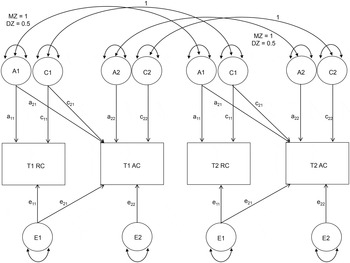
An illustrative bivariate model examining alcohol consumption and romantic conflict is shown in Fig. 1. Two sources of genetic variation contribute to alcohol consumption: that which overlaps with conflict (a21) and that which is specific to alcohol consumption after accounting for conflict (a22). Likewise, there are two sources of common and unique environmental influence (c21 and c22; e21 and e22) that contribute to alcohol consumption. In addition, there are distinct additive genetic, common environmental and unique environmental influences on romantic conflict (a11, c11 and e11). The diagonal elements of either an A, C or E matrix produce the variances due to that specific effect for each of the individual measures, while the off-diagonal elements produce the covariances due to either of the effects. Thus, the Cholesky factorization model allows us to partition A, C and E influences that are specific to alcohol consumption, as well as the A, C and E influences that overlap (i.e. covary) with romantic conflict. For descriptive purposes, we report the overlapping and specific variance components for the ‘full’ bivariate models, which include all possible A, C and E influences prior to fitting the reduced models.
Illustrative full bivariate model for romantic conflict (RC) and alcohol consumption (AC). MZ, Monozygotic; DZ, dizygotic; A, additive genetic factors; C, common environmental factors; E, unique environmental factors; T1, twin 1; T2, twin 2. Genetic, common environmental or unique environmental factors contribute to the covariance between romantic conflict and alcohol consumption if the model fit is worsened when the a21, c21 or e21 parameters (respectively) are removed. Mean values were estimated but are not shown.

We were primarily interested in assessing the overlapping latent genetic and environmental influences for alcohol consumption and problems; romantic quality; and social support. The statistical significance of the genetic and environmental covariances was assessed by comparing twice the log-likelihood of the full Cholesky model with that of submodels in which the genetic or environmental covariation between the alcohol variable and the romantic quality or social support variable was set to zero (degrees of freedom = 1). Under certain regularity conditions, such differences are asymptotically distributed as χ2 with one degree of freedom. Accordingly, submodels where a21, c21 and e21 parameters were removed were compared with the full bivariate model. In addition to testing for the significance of the genetic, common environmental and unique environmental covariance, tests of model parsimony were also assessed using the Akaike information criterion (AIC; Akaike, Reference Akaike1974). Lower AIC values denote more parsimonious models.
Results from the Cholesky model can be used to decompose the covariance between two variables into A, C and E components by dividing the genetic, common environmental and unique environmental covariances (i.e. a21*a11, c21*c11, e21*e11) by the overall covariance. The Cholesky results can also be algebraically transformed into latent genetic and environmental correlations by dividing the genetic/environmental covariance by the square root of the product of the genetic/environmental variances of the two variables. These decomposed sources of covariance and latent genetic and environmental correlations provide an intuitive way to conceptualize the source and magnitude of covariance between two variables, and are also reported.
Ethical statement
All procedures contributing to this work comply with the ethical standards of the relevant national and institutional committees on human experimentation and with the Helsinki Declaration of 1975, as revised in 2008.
Results
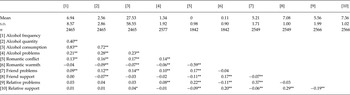
Twins from incomplete and complete pairs did not significantly differ in alcohol consumption, romantic conflict, romantic warmth, friend problems, friend support or relative problems. Twins from complete pairs did, however, have fewer alcohol problems (t 2575 = 2.39, p = 0.02, Cohen's d = 0.16) and lower relative support (t 2564 = 2.10, p = 0.04, Cohen's d = 0.16) compared with twins from incomplete pairs. The effect sizes for these differences were small. All variables were examined and, if needed, corrected for skewness prior to analysis (for complete representativeness results and a description of the transformation procedures, see online Supplementary material). Descriptive statistics and zero-order correlations are shown in Table 1. Higher alcohol consumption was associated with higher alcohol problems, higher romantic conflict, higher friend problems, higher relative support and lower romantic warmth. Higher alcohol problems were related to higher romantic conflict, higher friend problems, higher relative problems and lower romantic warmth. Alcohol consumption and problems were not significantly associated with friend support, and alcohol problems were not significantly associated with relative support.
Descriptive statistics and zero-order correlations a

s.d., Standard deviation; n, sample size.
a Means and standard deviations are reported in their original metrics. Logarithm-transformed versions of the alcohol consumption, alcohol problems, romantic warmth and relative support variables were used for correlations.
* p < 0.05, ** p < 0.01.
Twin pair correlations
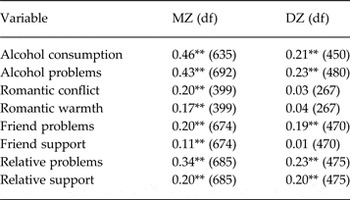
Under additive genetic effects, MZ twins share 100% of their genetic variation and the MZ genetic correlation is expected to be 1.0, while DZ twins on average share 50% of their genetic variation and the DZ genetic correlation is expected to be 0.5. The observed MZ twin phenotypic correlations are generally smaller than 1, reflecting the contribution of unique environmental influences. The pattern of DZ and MZ twin correlations shown in Table 2 suggests that additive genetic and unique environmental influences play a significant role in alcohol consumption, romantic conflict, romantic warmth and friend support. There was evidence for both additive genetic and common environmental influences on alcohol problems and relative problems. There were common environmental influences (and no additive genetic influences) on friend problems and relative support.
Twin correlations for alcohol, romantic quality and social support variables a

MZ, Monozygotic; df, degrees of freedom; DZ, dizygotic.
a Comparison of twin correlations across zygosity groups gives an estimate of the degree to which genetic, common environmental and unique environmental influences account for variance in a variable. When the MZ correlation for a variable is larger than the DZ correlation, this suggests that there are genetic influences. When the DZ correlation for a variable is approximately half of the MZ correlation or lower, this suggests that there are no common environmental influences. Finally, when the DZ correlation for a variable is more than half of the MZ correlation, this suggests the presence of common environmental influences.
** p < 0.01.
Bivariate twin models
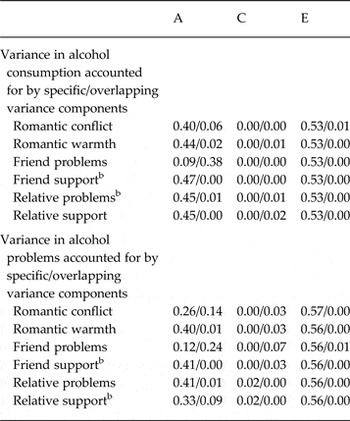
The majority of variance in alcohol consumption was accounted for by additive genetic and unique environmental influences that were specific to alcohol consumption (Table 3, top panel). There was also evidence that alcohol consumption had small overlapping genetic influences with romantic conflict [genetic covariance (covA) = 0.06], romantic warmth (covA = 0.02) and relative problems (covA = 0.01). Alcohol consumption also had overlapping common environmental influences with romantic warmth [common environmental covariance (covC) = 0.01], relative problems (covC = 0.01) and relative support (covC = 0.02); and overlapping unique environmental influences with romantic conflict [unique environmental covariance (covE) = 0.01]. Friend problems were a noticeable exception; overlapping genetic influences for alcohol consumption and friend problems accounted for 38% of the variance in alcohol consumption.
Specific and overlapping variance components for alcohol consumption and problems derived from full bivariate models a

a Specific variance components refer to the proportion of the total variance in alcohol consumption and problems attributable to genetic (A), common environmental (C) or unique environmental (E) influences that are specific to alcohol consumption and problems. Overlapping variance components are the A, C and E components that overlap with the respective romantic quality or social support variable for each model. Standardized variance components are presented; thus, unique and overlapping variance components sum to 1 for each bivariate model.
b No significant zero-order association between the variables (e.g. alcohol consumption and friend support); variance decomposition estimates are provided for completeness.
The majority of variance in alcohol problems was accounted for by genetic and unique environmental influences that were specific to alcohol problems (Table 3, bottom panel). There was also evidence that alcohol problems had overlapping genetic influences with romantic conflict (covA = 0.14), romantic warmth (covA = 0.01), friend problems (covA = 0.24), relative problems (covA = 0.01) and relative support (covA = 0.09). There were common environmental influences that were shared between alcohol problems and romantic conflict (covC = 0.03), romantic warmth (covC = 0.03), friend problems (covC = 0.07) and friend support (covC = 0.03). Alcohol problems and friend problems had overlapping unique environmental influences (covE = 0.01).
Bivariate model fitting
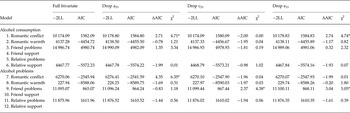
Model-fitting results for the a21, c21 and e21 parameters corresponding to the overlapping genetic, common environmental and unique environmental influences among the alcohol consumption and problems, romantic quality and social support variables are presented in Table 4 and summarized below. The alcohol consumption models are shown in the top panel, and the alcohol problems models are shown in the bottom panel. Formal model fitting proceeded only in instances where there was a significant zero-order association between variables.
Model-fitting results examining bivariate relationships among romantic quality; social support; and alcohol consumption and problems

a21, Genetic covariation; c21, common environmental covariation; e21, unique environmental covariation; −2LL, −2 log likelihood model fit; AIC, Akaike information criterion; ΔAIC, change in AIC (AICreduced model – AICfull bivariate model); χ2, χ2 test statistic (1 degree of freedom) evaluating the loss in −2LL model fit (i.e. −2LLreduced model to −2LLfull bivariate model) as a result of dropping the respective parameter.
a We did not fit bivariate twin models in instances where there was no zero-order association between the variables (e.g. alcohol consumption and friend support).
* p < 0.05.
Alcohol consumption model fitting
There was significant genetic covariance (model 1/drop a21 − χ2 = 4.71, p < 0.05) and unique environmental covariance (model 1/drop e21− χ2 = 4.74, p < 0.05) between alcohol consumption and romantic conflictFootnote 1 Footnote †. In total, genetic influences accounted for the majority (64%) of this covariance, with unique environmental influences accounting for the balance (36%). The latent genetic and environmental correlations for these effects were positive and moderate to modest in size (r A = 0.37, p = 0.03; and r E = 0.09, p = 0.03), indicating that some of the same genetic and unique environmental influences contributed to higher alcohol consumption and higher romantic conflict. Significant covariation that is attributable to unique environmental influences could also be consistent with the causal hypothesis that high levels of alcohol consumption cause romantic conflict (or vice versa) (Prescott & Kendler, Reference Prescott and Kendler1999). The results from supplemental analyses (see online Supplementary material) suggested that there may be a causal pathway from alcohol consumption to romantic conflict.
Tests of genetic covariance (a21), common environmental covariance (c21) and unique environmental covariance (e21) between alcohol consumption and romantic warmth (model 2); alcohol consumption and friend problems (model 3); and alcohol consumption and relative support (model 6) were not statistically significant. This may be attributable to the low phenotypic correlations among these variables (Table 1), and hence limited power to discriminate statistically between genetic or environmental sources of covariance.
Alcohol problems model fitting
There was significant genetic covariance (model 7/drop a21 − χ2 = 6.35, p < 0.05) between alcohol problems and romantic conflict1. There were no significant differences in the fit between submodels in which common environmental covariance (c21) and unique environmental covariance (e21) were set to zero and the full bivariate model, suggesting that overlapping genetic factors accounted for 100% of the covariance between alcohol problems and romantic conflict. The latent genetic correlation for alcohol problems and romantic conflict was large and positive (r A = 0.50, p < 0.001), indicating that some of the same genetic influences contributed to higher levels of alcohol problems and romantic conflict.
There was significant common environmental covariance (model 9/drop c21 − χ2 = 4.38, p < 0.05) and unique environmental covariance (model 9/drop e21 − χ2 = 5.05, p < 0.05) between alcohol problems and friend problems. In total, common environmental influences accounted for the majority (61%) of the covariance, with unique environmental influences accounting for the balance (39%). The common environmental correlation between alcohol problems and friend problems was large (r C = 1.00, p = 0.02). The latent unique environmental correlation was modest (r E = 0.07, p = 0.02). Thus, some of the same common and unique environmental influences contributed to high levels of alcohol problems and friend problems. Overlapping unique environmental influences could also be consistent with a causal association among alcohol problems and friend problems. We conducted supplementary analyses to evaluate this possibility (see online Supplementary material), and our results indicated that a causal explanation was unlikely.
Tests of genetic covariance (a21), common environmental covariance (c21) and unique environmental covariance (e21) between alcohol problems and romantic warmth (model 8), and alcohol problems and relative problems (model 11) were not statistically significant. As noted above, this may be attributable to the low phenotypic correlations (Table 1) and limited power to discriminate sources of covariance.
Discussion
We tested whether the associations between alcohol consumption and problems, romantic quality and social support were attributable to overlapping genetic or environmental factors using a genetically informative population-based male–male twin sample. Consistent with past literature, we found that higher alcohol consumption was associated with higher romantic conflict, lower romantic warmth and more friend problems. Additionally, alcohol problems were also associated with these measures of interpersonal relationships. Unexpectedly, higher alcohol consumption was also associated with higher relative support, although this effect was small. Alcohol consumption and problems were not significantly related to friend support, which is inconsistent with prior studies. This discrepancy may reflect differences in how social support was measured, or the fact that we used an all-male sample.
Bivariate genetic analysis indicated that alcohol consumption and alcohol problems had overlapping genetic influences with romantic conflict. Our findings complement the previous literature examining the associations between alcohol consumption and problems and romantic relationship quality (Renne, Reference Renne1970; Kearns-Bodkin & Leonard, Reference Kearns-Bodkin and Leonard2005; Humbad et al. Reference Humbad, Donnellan, Iacono and Burt2010; Cranford et al. Reference Cranford, Floyd, Schulenberg and Zucker2011) and further suggest that some of the genetic influences that contribute to alcohol consumption and problems also contribute to conflictual romantic relationships. These findings are consistent with the proposal of South et al. (Reference South, Krueger and Iacono2011) that there is a temperamental core (which is likely to be heritable; Loehlin, Reference Loehlin1992) underlying the covariance among externalizing spectrum problems and marital distress, and with previous findings suggesting that some of the same familial influences (which may be in part genetic) contribute to both alcohol consumption and marital instability (Prescott & Kendler, Reference Prescott and Kendler2001). It is notable that genetic influences involved in alcohol consumption and problems were associated with higher levels of conflict. However, these factors did not contribute to warmth in a relationship, highlighting the importance of distinguishing negative and positive relationship quality dimensions (Fincham et al. Reference Fincham, Beach, Kemp-Fincham, Sternberg and Hojjat1997) when examining the associations between alcohol and romantic relationship factors in genetically informative studies.
We also found that alcohol consumption and romantic conflict had overlapping unique environmental influences. It is possible that the alcohol consumption of one's romantic partner may be a unique environmental influence that contributes to participants’ alcohol consumption and perception of romantic conflict. This possibility is interesting to consider in view of previous ‘drinking partnership’ findings, whereby husbands report low levels of marital intimacy when they are heavy drinkers and their wives are not (Roberts & Leonard, Reference Roberts and Leonard1998). Thus, one heavy-drinking twin in a discordant drinking partnership may have a more conflictual relationship with his romantic partner compared with his co-twin who is in a harmonious, concordant moderate-drinking partnership
Our supplementary analyses also indicated that this unique environmental covariance could also reflect a causal pathway from alcohol consumption to romantic conflict. Relatively few studies have attempted to tease apart the causal associations between alcohol use and interpersonal problems; however, our findings map onto laboratory-based experiments that find that alcohol consumption increases negative couple behavior (for a review, see Marshal, Reference Marshal2003). Unlike a previous prospective longitudinal study of marital satisfaction and AUDs (Whisman et al. Reference Whisman, Uebelacker and Bruce2006), we did not find evidence that romantic conflict causes alcohol consumption.
Alcohol problems had overlapping common environmental influences with friend problems. This result dovetails nicely with recent findings that common environmental influences account for a modest but significant proportion of variation (3–16%) in AUDs (Verhulst et al. Reference Verhulst, Neale and Kendler2014), and that common environmental influences that contribute to higher friend support also contribute to lower alcohol problems (Jarnecke & South, Reference Jarnecke and South2014). Early caregiving experiences, which predict both later peer competence (Groh et al. Reference Groh, Fearon, Bakermans-Kranenburg, van Ijzendoorn, Steele and Roisman2014) and externalizing spectrum behavior (Lorber & Egeland, Reference Lorber and Egeland2009) may explain these effects. We also found that alcohol problems had overlapping unique environmental influences with friend problems. Our supplementary analyses indicated that it was unlikely that this unique environmental covariance reflected a causal association between these variables. Therefore, it is likely that a third variable that differs between co-twins (e.g. work stress) also contributes to alcohol problems and friend problems.
There were several instances where there was a significant phenotypic correlation between alcohol consumption and problems and one or more of the interpersonal dimensions (e.g. higher alcohol consumption was associated with lower romantic warmth), but that formal tests of whether this covariance was attributable to genetic or environmental influences were not statistically significant. This may be due to the fact that the correlations between the variables were quite small, and in some cases barely reached statistical significance. As a result, there was little variance to parse in the formal twin model, limiting our ability to discriminate among the sources of covariance at a statistically significant level.
Limitations
Our findings should be interpreted in terms of several limitations. First, we only examined white adult males from Virginia, which may preclude generalizing the findings to females or other races. Second, we relied on self-report measures of romantic quality and social support; replicating and extending these findings with dyadic and observational relationship data is important. Third, there are a number of ways to operationalize romantic quality and social support, and the factors driving their covariance with alcohol consumption and problems may differ. Fourth, because the unique environmental component of the romantic quality and social support environmental variables (which are modeled on the left in Fig. 1) in our bivariate models also contains associated measurement error, it is possible that the effects of the e21 parameters are attenuated. We ran additional analyses where we reparameterized the bivariate model and partitioned the covariance between the variables such that each was allowed to have specific A, C and E components. The pattern of findings (available upon request from the first author, J.E.S.) from these analyses mirrored those from our original bivariate models; thus, it does not appear that measurement error in the interpersonal variables substantially attenuated the e21 parameters in the results presented here.
Implications and future directions
Our findings suggest that behavioral couples therapy interventions for substance use (McCrady, Reference McCrady2012) may be effective because they address problems that, in part, have an overlapping genetic and environmental etiology. Recent evidence from a randomized trial found that alcohol treatment outcomes were more favorable using alcohol behavior couples therapy compared with alcohol behavior individual therapy (McCrady et al. Reference McCrady, Epstein, Cook, Jensen and Hildebrandt2009). Our findings suggest that there is also likely to be value in capitalizing on social support networks to promote alcohol treatment outcomes (Beattie & Longabaugh, Reference Beattie and Longabaugh1999).
Identifying the factors that contribute to these latent genetic and environmental covariances is an important direction for future research in this area. For example, approaches informed by the neurobiology of social bonding and substance use may be a fruitful way to understand overlapping genetic influences. A recent study found that marital satisfaction mediated the association between variation in AVPR1A (arginine vasopressin 1A receptor, a gene implicated in social bonding) and drug use disorder diagnoses (Maher et al. Reference Maher, Vladimirov, Latendresse, Thiselton, McNamee, Kang, Bigdeli, Chen, Riley, Hettema, Chilcoat, Heidbreder, Muglia, Murrelle, Dick, Aliev, Agrawal, Edenberg, Kramer, Nurnberger, Tischfield, Devlin, Ferrell, Kirillova, Tarter, Kendler and Vanyukov2011). It is equally important to identify overlapping common and unique environmental influences among alcohol problems, friend problems and romantic conflict. Childhood adversity (a common environmental factor) or work stress (a unique environmental factor) may increase risk for higher alcohol consumption and problems as well as interpersonal problems in adulthood (Doucet & Aseltine, Reference Doucet and Aseltine2003; Umberson et al. Reference Umberson, Williams, Powers, Liu and Needham2005; Keyes et al. Reference Keyes, Hatzenbuehler and Hasin2011).
Conclusions
In summary, our analyses build and expand on studies documenting the associations among alcohol use and problems and interpersonal relationships. We examined the genetic and environmental sources of these associations. Overlapping genetic and unique environmental influences accounted for the covariance between alcohol consumption and romantic conflict. Further, overlapping genetic influences accounted for the covariance between alcohol problems and romantic conflict. Finally, overlapping common and unique environmental influences account for the covariance between alcohol problems and friend problems. These results suggest opportunities for therapeutic interventions to address both interpersonal and alcohol-related liabilities. Furthermore, we raise new questions regarding specific genes and environments that give rise to this shared etiology.
Supplementary material
For supplementary material accompanying this paper visit http://dx.doi.org/10.1017/S003329171500029X.
Acknowledgements
This work was supported in part by National Institutes of Health (NIH) grants no. R01AA011408, P20AA017828, R01DA025109 and F32AA022269. The Virginia Twin Registry, now part of the Mid-Atlantic Twin Registry (MATR), is supported by NIH grant no. UL1RR031990. The content is solely the responsibility of the authors and does not necessarily represent the official views of the NIH. We would like to thank Alexis C. Edwards for consulting on the twin modeling.
Declaration of Interest
None.