


Statement of Research Significance
Research Question(s) or Topic(s): Traditional risk factors for dementia in non-Latino White adults do not manifest the same level of risk in Latinos. Despite research investigating culturally relevant factors, including acculturation, as it relates to Latino cognition, few studies incorporate individual- or neighborhood-level socioenvironmental contextual factors for a more wholistic approach. Main Findings: Language- and/or social-based levels of acculturation were positively associated with most cognitive outcomes, while older ages at migration were positively associated with nearly all outcomes. Individual-level socioenvironmental measures displayed a more variable profile of cognitive associates depending upon the model employed and the cognitive metric investigated. In contrast, neighborhood-level socioenvironmental measures – especially income inequality and deprivation – were consistently and negatively associated with cognition. Study Contributions: This study extends the importance of considering acculturation to include the context of the lived experience of Hispanics/Latinos and the role of individual and neighborhood health on cognition in this population.
Introduction
The population of US-based Hispanic/Latino adults is aging, as is the number of Hispanic/Latino older adults developing Alzheimer’s disease and related dementias (ADRD) (Matthews et al., Reference Matthews, Xu, Gaglioti, Holt, Croft, Mack and McGuire2019). Investigations applying previously identified risk factors for cognitive impairment and ADRD in studies of non-Latino White adults to Latinos often report these risk factors either do not manifest the same level of risk (O’Bryant et al., Reference O’Bryant, Barber, Philips, Johnson, Hall, Subasinghe, Petersen, Toga, Yaffe and Rissman2022; Stickel et al., Reference Stickel, McKinnon, Matijevic, Grilli, Ruiz and Ryan2021; Xiao et al., Reference Xiao, Pappas, Aksman, O’Bryant and Toga2023) or do not fully account for risk (O’Bryant et al., Reference O’Bryant, Johnson, Reisch, Edwards, Hall, Barber, Devous, Royall and Singh2013). Thus, researchers are increasingly incorporating other, potentially more relevant factors in their investigations of Latino cognitive aging. One factor to consider is acculturation [i.e., the process of adapting to a new environment and potentially adopting its values and practices (Berry, Reference Berry2005)], given it impacts not only Latinos moving to the US, but those attempting to live, work, and play in a society in which they are not the majority (Abraido-Lanza et al., Reference Abraido-Lanza, Echeverria and Florez2016).
An evolving theme of theories of acculturation is that it is a multi-dimensional construct involving a dynamic exchange between new and host members of society. For example, the model of segmented assimilation (Portes & Zhou, Reference Portes and Zhou1992) and the more recent acculturation in context framework (Abraido-Lanza et al., Reference Abraido-Lanza, Echeverria and Florez2016) suggest that acculturation is based on relationships between a “core” culture and ethnoracially diverse individuals that emerge from and are reinforced by broader individual -and neighborhood-level socioenvironmental factors. Thus, acculturation as applied to Latinos in the US should be measured not only by traditional descriptors (e.g., preferences for Spanish versus English language or social interactions, nativity, etc.), but also by the layers of risk and resilience factors embedded in the acculturation process (Abraido-Lanza et al., Reference Abraido-Lanza, Armbrister, Florez and Aguirre2006). Specifically, the acculturation in context framework states that when evaluating acculturation, it is important to do so in the context of individual- (e.g., social support or isolation, family-focused resources) and neighborhood-level (e.g., community’s ethnoracial composition, levels of socioeconomic status) socioenvironmental considerations (Abraido-Lanza et al., Reference Abraido-Lanza, Armbrister, Florez and Aguirre2006; Abraido-Lanza et al., Reference Abraido-Lanza, Echeverria and Florez2016; Lamar et al., Reference Lamar, Barnes, Marquez, Angel, Andrade, Riosemena and Mejia-Arango2024). While specific metrics may vary based on the population and outcome in question (Abraido-Lanza et al., Reference Abraido-Lanza, Armbrister, Florez and Aguirre2006), the conceptualization of acculturation within the context of a more dynamic lived experience may serve as the basis for empirical studies of potentially more relevant risk and resilience factors to broaden our understanding of Hispanic/Latino cognitive and brain aging (Lamar et al., Reference Lamar, Barnes, Marquez, Angel, Andrade, Riosemena and Mejia-Arango2024).
To date, empirical studies of acculturation in context factors focused on individual metrics rather than investigations encompassing the comprehensive framework. For example, higher language- and social-based acculturation as defined by greater English language use and social interactions for US-based Hispanics/Latinos, separately associate with higher levels of global cognition, semantic memory, and processing speed (Alam et al., Reference Alam, Singleton, Aguinaga, Chodzko-Zajko, Jahan, Oke and Schwingel2022; Downer et al., Reference Downer, Milani, Grasso, Lucas and Mehta2024; Martinez-Miller et al., Reference Martinez-Miller, Robinson, Avery, Yang, Haan, Prather and Aiello2020) but lower fluency (Rodriguez et al., Reference Rodriguez, Mendoza, Rodriguez, Rosselli, Loewenstein, Burke, Orozco and Duara2022) and higher ADRD risk (Nianogo et al., Reference Nianogo, Hays, Gong, Yu, Ritz and Duru2024). Similarly, some individual socioenvironmental factors of the framework (e.g., social or family-focused support) appear protective against global and memory-specific cognitive decline in Hispanic/Latino (Estrella et al., Reference Estrella, Tarraf, Kuwayama, Gallo, Wu, Marquine, Perreira, Vasquez, Isasi, Lipton, Mattei, González, Daviglus and Lamar2024) while others like loneliness and social isolation are detrimental to many of these same cognitive domains (Estrella et al., Reference Estrella, Durazo-Arvizu, Gallo, Tarraf, Isasi, Perreira, Zeng and Lamar2021; Estrella et al., Reference Estrella, Tarraf, Kuwayama, Gallo, Wu, Marquine, Perreira, Vasquez, Isasi, Lipton, Mattei, González, Daviglus and Lamar2024; Nkwata et al., Reference Nkwata, Zhang, Song, Giordani and Ezeamama2021) and increase ADRD risk (Tibirica et al., Reference Tibirica, Jester, Kohn, Williams, McEvoy and Palmer2024). Meanwhile, cognitive research considering neighborhood-level factors like ethnoracial composition (Besser et al., Reference Besser, Meyer, Jones, Tran, Booker, Mitsova, Peterson and Hughes2023; Kovalchik et al., Reference Kovalchik, Slaughter, Miles, Friedman and Shih2015; Meyer et al., Reference Meyer, Besser, Mitsova, Booker, Luu, Tobias, Farias and Whitmer2021) and socioeconomic and housing conditions (Cerin et al., Reference Cerin, Barnett, Wu, Martino, Shaw, Knibbs, Poudel and Anstey2023; Lamar et al., Reference Lamar, Kershaw, Leurgans, Mukherjee, Lange-Maia, Marquez and Barnes2023; Meyer et al., Reference Meyer, Besser, Tobias, George, Gavett, Farias, Bhagat and Whitmer2023) has been applied across populations only some of which include Hispanics/Latinos. These studies report separate relationships between neighborhood-level metrics and global cognition (e.g., higher neighborhood-level vulnerability and lower global cognition), and negative relationships with specific cognitive functions that serve as early markers of ADRD including memory, executive functioning, and processing speed (Besser et al., Reference Besser, Meyer, Jones, Tran, Booker, Mitsova, Peterson and Hughes2023; Cerin et al., Reference Cerin, Barnett, Wu, Martino, Shaw, Knibbs, Poudel and Anstey2023; Kovalchik et al., Reference Kovalchik, Slaughter, Miles, Friedman and Shih2015; Lamar et al., Reference Lamar, Kershaw, Leurgans, Mukherjee, Lange-Maia, Marquez and Barnes2023; Meyer et al., Reference Meyer, Besser, Mitsova, Booker, Luu, Tobias, Farias and Whitmer2021; Meyer et al., Reference Meyer, Besser, Tobias, George, Gavett, Farias, Bhagat and Whitmer2023). While these studies point toward acculturation in context variables that are associated with cognitive aging and greater risk of ADRD, more work is needed systematically incorporating a comprehensive set of these variables into a focused study of Latino cognitive aging.
Initial work by our group to incorporate multiple acculturation in context factors into a comprehensive study of cognitive and brain aging leveraged longitudinal data from older Latinos in the Chicagoland area (Fleischman et al., Reference Fleischman, Arfanakis, Zhang, Leurgans, Barnes, Bennett, Marquez and Lamar2023; Lamar et al., Reference Lamar, Barnes, Leurgans, Fleischman, Farfel, Bennett and Marquez2021; Lamar et al., Reference Lamar, Estrella, Capuano, Leurgans, Fleischman, Barnes, Lange-Maia and Marquez2023). We evaluated acculturation-related information (e.g., nativity, language-, and social-based preferences) together with contextually related socioenvironmental information on individual-level risk (e.g., experiences of social isolation) and resilience (e.g., social network size). An unrotated principal component analysis (PCA) (Lamar et al., Reference Lamar, Barnes, Leurgans, Fleischman, Farfel, Bennett and Marquez2021) revealed three separate acculturation in context factors reflecting 1) acculturation-related and individual-level 2) social and 3) familial aspects of the framework. PCA-derived composite scores as applied to our analytic sample differentially related to baseline levels more so than longitudinal changes in cognition (Lamar et al., Reference Lamar, Barnes, Leurgans, Fleischman, Farfel, Bennett and Marquez2021; Lamar et al., Reference Lamar, Estrella, Capuano, Leurgans, Fleischman, Barnes, Lange-Maia and Marquez2023) and altered cerebral white matter integrity (Fleischman et al., Reference Fleischman, Arfanakis, Zhang, Leurgans, Barnes, Bennett, Marquez and Lamar2023). It should be noted that individuals with better cardiovascular health (CVH) but lower acculturation-related composite scores showed slower rates of cognitive decline, and CVH indirectly modified relationships between acculturation in context and levels of, as well as changes in cognition (Lamar et al., Reference Lamar, Estrella, Capuano, Leurgans, Fleischman, Barnes, Lange-Maia and Marquez2023). Despite these initial contributions, our work did not incorporate neighborhood-level factors of the framework, and it lacked wider geographic representation.
The current study employed data from the Hispanic Community Health Study/Study of Latinos (HCHS/SOL) (Lavange et al., Reference Lavange, Kalsbeek, Sorlie, Aviles-Santa, Kaplan, Barnhart, Liu and Elder2010) to conduct the most comprehensive evaluation of the acculturation in context framework to date in a larger, more geographically representative cohort of middle-aged and older Hispanic/Latino adults. First, we investigated the relationship of acculturation in context variables available at HCHS/SOL baseline (including neighborhood-level factors) with each other and then investigated their associations with levels of cognitive performance across domains that may serve as early markers of ADRD (i.e., learning and memory, information processing speed, and executive function). Lastly, we examined if and how CVH, a known contributor to cognitive aging regardless of ethnoracial identity, modified relationships between acculturation in context and cognition.
Methods
Analytic sample
We used baseline (2008–2011) data from HCHS/SOL, a four-center, prospective cohort study of 18–74 year-old community-dwelling Hispanic/Latino adults in the Bronx, Chicago, Miami, and San Diego (Lavange et al., Reference Lavange, Kalsbeek, Sorlie, Aviles-Santa, Kaplan, Barnhart, Liu and Elder2010). At baseline, 16,415 participants self-identifying as Cuban, Central American, Dominican, Mexican, Puerto Rican, South American, or more than one Hispanic/Latino heritage were recruited with oversampling of adults 45–74 years (n = 9,714). A detailed discussion of the study including the sampling design is published elsewhere (Lavange et al., Reference Lavange, Kalsbeek, Sorlie, Aviles-Santa, Kaplan, Barnhart, Liu and Elder2010). Given our study’s scope, we focused on participants ages 45–74 years who underwent baseline cognitive testing (unweighted n = 9,623). After excluding those with missingness on any exposures, covariates, or CVH stratification indicator, our unweighted analytic sample was n = 8,476. Supplemental Tables 1 and 2 show indicators of specific missingness in the sample and differences between those included and excluded.
Acculturation in context
In keeping with the theoretical framework of our work (Abraido-Lanza et al., Reference Abraido-Lanza, Armbrister, Florez and Aguirre2006; Abraido-Lanza et al., Reference Abraido-Lanza, Echeverria and Florez2016), we selected variables that reflected acculturation and the individual- and neighborhood-level socioenvironmental contextual factors embedded in the acculturation process using valid and reliable scales from HCHS/SOL (Estrella et al., Reference Estrella, Durazo-Arvizu, Gallo, Tarraf, Isasi, Perreira, Zeng and Lamar2021; Gallo et al., Reference Gallo, Penedo, Carnethon, Isasi, Sotres-Alvarez, Malcarne, Roesch and Talavera2014).
Acculturation-related variables – language preference for study interview which included cognitive test administration (0 = English, 1 = Spanish); language- and social-based acculturation sub-scores from the Short Acculturation Scale for Hispanics (SASH) (Marín et al., Reference Marín, Sabogal, VanOss Marín, Otero-Sabogal and Pérez-Stable1987) which measure, among other things, a participant’s language used when thinking, speaking, and reading as well as their ethnic preferences for social relations and gatherings; parental nativity (0 = US, 1 = born outside the mainland US). Self-reported nativity (50 United States or the District of Columbia vs elsewhere) and age at immigration to mainland US were combined into a measure reflecting four groups: mainland US-born, age at migration to mainland US ≤ 16, 17 to 34, or 35+ years of age. All acculturation-related variables were used in the first author’s prior acculturation in context research except age at immigration (Fleischman et al., Reference Fleischman, Arfanakis, Zhang, Leurgans, Barnes, Bennett, Marquez and Lamar2023; Lamar et al., Reference Lamar, Barnes, Leurgans, Fleischman, Farfel, Bennett and Marquez2021; Lamar et al., Reference Lamar, Estrella, Capuano, Leurgans, Fleischman, Barnes, Lange-Maia and Marquez2023).
As in prior research (Fleischman et al., Reference Fleischman, Arfanakis, Zhang, Leurgans, Barnes, Bennett, Marquez and Lamar2023; Lamar et al., Reference Lamar, Barnes, Leurgans, Fleischman, Farfel, Bennett and Marquez2021; Lamar et al., Reference Lamar, Estrella, Capuano, Leurgans, Fleischman, Barnes, Lange-Maia and Marquez2023) and in keeping with the acculturation in context framework (Abraido-Lanza et al., Reference Abraido-Lanza, Armbrister, Florez and Aguirre2006; Abraido-Lanza et al., Reference Abraido-Lanza, Echeverria and Florez2016), we considered individual-level cultural attitudes as available at HCHS/SOL baseline. Thus, we incorporated two questions from the Multigroup Ethnic Identity Measure (Roberts et al., Reference Roberts, Phinney, Masse, Chen, Roberts and Romero1999): the degree individuals identify with and have pride in their ethnic group. Other individual-level socioenvironmental variables – self-reported experiences of unfair treatment of self and other Hispanics/Latinos (2-items; higher score = higher unfair treatment); familial structural support (7-items assessing family size and amount of contact; higher score = higher support) (Murillo et al., Reference Murillo, Pirzada, Wu, Gallo, Davis, Ostrovsky, Penedo, Perreira, Reina, Van Horn, Stamler and Daviglus2020).
Neighborhood-level socioenvironmental variables were measured based on geocoded baseline addresses and linked to estimates representative of key considerations outlined in the acculturation in context framework (Abraido-Lanza et al., Reference Abraido-Lanza, Echeverria and Florez2016) – ethnoracial composition (measured by evenness and exposure), gentrification, and socioeconomic status (measured by income inequality and neighborhood deprivation). Detailed elsewhere (Pichardo et al., Reference Pichardo, Pichardo, Talavera, Gallo, Castaneda, Sotres-Alvarez, Molina and Plascak2022), evenness and exposure were derived using 2010 decennial Census tract data. Evenness, or the spatial distribution of a group, was quantified through the Gini coefficient to measure the variability of Hispanic/Latino residents within a given census tract (range: 0 to 1 with higher values = greater ethnoracial uniformity). Exposure was measured by the Isolation Index and reflected the probability that Hispanic/Latino residents encounter other members of their same ethnoracial group (range: 0 to 1 with higher values=greater within member encounters and thus, greater ethnoracial isolation). Gentrification (Huynh & Maroko, Reference Huynh and Maroko2014; Linton et al., Reference Linton, Cooper, Kelley, Karnes, Ross, Wolfe, Friedman, Jarlais, Semaan, Tempalski, Sionean, DiNenno, Wejnert and Paz-Bailey2017; Pichardo et al., Reference Pichardo, Chambers, Sanchez-Johnsen, Pichardo, Gallo, Talavera, Pirzada and Plascak2023; Pichardo et al., Reference Pichardo, Pichardo, Talavera, Gallo, Kuo, Castaneda, Chambers and Plascak2023) used data from the 2000 decennial census and the 2006–10 American Community Survey (ACS). It included a summary z-score of the percent change in (i) college or more educated adults aged 25 or older, (ii) the number of residents living below the federal poverty line, and (iii) median household income; higher values = greater gentrification. To avoid non-convergence in the factor analysis due to scale differences in neighborhood-level variables, we divided the gentrification scores by 100 (original scale range for our analytic sample was −8.59 to 28.31) and excluded participants with values >100.1 on the new scale (i.e., the equivalent of ≥5 standard deviations, SD). Income inequality (Pichardo et al., Reference Pichardo, Chambers, Sanchez-Johnsen, Pichardo, Gallo, Talavera, Pirzada and Plascak2023; Pichardo et al., Reference Pichardo, Pichardo, Talavera, Gallo, Kuo, Castaneda, Chambers and Plascak2023) was based on the Gini coefficient derived from 2005 to 2009 Census tract estimate of the ACS using the IPUMS National Historical Geographic Information System. It calculated the difference between the observed cumulative income distribution and a perfectly equal income distribution during the stated time frame (range: 0 = perfect equality to 1 = perfect inequality). As done previously (Pichardo et al., Reference Pichardo, Chambers, Sanchez-Johnsen, Pichardo, Gallo, Talavera, Pirzada and Plascak2023), we calculated a standardized composite measure (mean = 0, SD = 1) of neighborhood deprivation (Messer et al., Reference Messer, Laraia, Kaufman, Eyster, Holzman, Culhane, Elo, Burke and O’Campo2006) by combining four single-item indicators of the percent of residents with less than high school diploma, with household incomes below 100% of the federal poverty level, the number of residents who are unemployed, and median household income (higher values = higher deprivation). To avoid non-converge due to scale differences, we divided the deprivation scores by 10 and excluded participants with values > 0.1 on the new scale (i.e., the equivalent of ≥5 SD).
Cognitive module
Cognitive tests were administered face-to-face during HCHS/SOL baseline to participants 45 years or older in their preferred language (Spanish or English) (Gonzalez et al., Reference Gonzalez, Tarraf, Gouskova, Gallo, Penedo, Davis, Lipton and Mosley2015). Learning and memory were assessed using an abbreviated version of the Spanish English Verbal Learning Test (B-SEVLT) (Gonzalez et al., Reference Gonzalez, Mungas, Reed, Marshall and Haan2001) and consisted of total recall for Trials 1, 2, and 3 (learning) and post-interference recall (memory). Measures of word fluency (WF; letters F and A) and digit symbol substitution (DSS) comprised two indicators of information processing speed and executive function. These four individual test scores were standardized (Mean = 0, SD = 1) relative to the HCHS/SOL target population of individuals 45-years and older at baseline. In addition to being considered individually, a global cognitive function composite was computed as the z-score average of the four, as available, cognitive indices (B-SEVLT Sum, B-SEVLT Recall, WF, and DSS) with higher scores representing better global cognitive performance (Mean = 0, SD = 0.78) (Gonzalez et al., Reference Gonzalez, Tarraf, Gouskova, Gallo, Penedo, Davis, Lipton and Mosley2015). We subsequently standardized the derived global cognitive function composite, relative to the HCHS/SOL target population of individuals 45-years and older at baseline, to allow for a common metric across tests (Mean = 0, SD = 1).
Cardiovascular health
We examined CVH using the Framingham 10-year cardiovascular risk score (FRS) (D’Agostino et al., Reference D’Agostino, Vasan, Pencina, Wolf, Cobain, Massaro and Kannel2008). Specifically, in addition to accounting for an individual’s age and sex, weighted scores for four vascular risk factors (i.e., high-density lipoprotein-cholesterol, systolic blood pressure, smoking, and total cholesterol) are incorporated into a composite measure of overall 10-year predictive risk for cardiovascular disease (probability range: 0 to 1; categorized as low: <0.1, moderate: 0.1−<0.2, and high: 0.2+).
Statistical analysis
All statistical analyses accounted for the HCHS/SOL complex design (cluster sampling and the use of stratification in sample selection) and sampling weights as described elsewhere (Lavange et al., Reference Lavange, Kalsbeek, Sorlie, Aviles-Santa, Kaplan, Barnhart, Liu and Elder2010) to yield unbiased estimates of the standard errors of the model parameters estimators. Statistical significance of models’ parameters was assessed via p-values < .05. Data analyses were conducted using Stata, for data processing and visualization (Stata Corp. LP, College Station, TX), and MPLUS V8.10, executed within Stata, using the runmplus function for Confirmatory Factor Analysis (CFA). The correlation heatmap was generated using the ggplot2 package, and post hoc processing of the generated latent models was done using the mplusautomation package (Hallquist & Wiley, Reference Hallquist and Wiley2018) both using R V.4.2.3 run through RStudio.
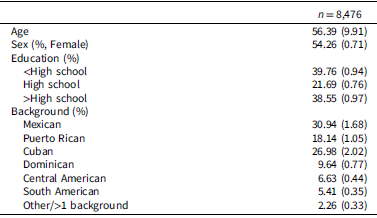
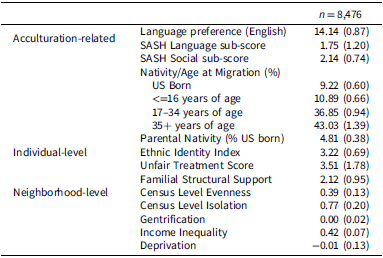
We generated descriptive statistics (including percentages with standard errors, SEs, for categorical variables and means with SDs for continuous variables) characterizing the target population (Table 1). We characterized each variable included in our acculturation in context framework (Table 2) and estimated Pearson correlations for acculturation in context variables (Figure 1) to determine their relationships to each other. CFA determined whether we could validate the previously published structure of each of the proposed acculturation in context constructs (Lamar et al., Reference Lamar, Barnes, Leurgans, Fleischman, Farfel, Bennett and Marquez2021); robust weighted least squares were used when the CFA included categorical measures (e.g., the acculturation factor) and robust maximum likelihood (MLR) when all observed measures were continuous (e.g., the neighborhood factor). Model fit and selection followed established criteria (West et al., Reference West, Taylor, Wu and Hoyle2012).
Heat map of correlations for acculturation-related, individual- and neighborhood-level socioenvironmental measures.
Note: SASH=Short Acculturation Scale for Hispanics, Language Preference (English), US Born, and Parental Nativity are binary indicators

Long description
A heat map of correlations for acculturation-related, individual-, and neighborhood-level socioenvironmental measures. The heat map is structured as a grid with rows and columns labeled with different measures. The x-axis and y-axis both list measures such as SASH Language, SASH Social, Nativity/Age at Migration, Ethnic Identity, Unfair Treatment, Familial Support, Evenness, Isolation, Gentrification, Income Inequality, Deprivation, Preference English, US Born, and Parental Nativity. The color scale ranges from blue to red, indicating the strength and direction of correlations, with blue representing negative correlations and red representing positive correlations. The values range from -1.0 to 1.0. Notable correlations include a strong positive correlation (0.73) between SASH Language and Preference English, and a strong negative correlation (-0.68) between SASH Language and Nativity/Age at Migration. Other significant correlations include a positive correlation (0.62) between SASH Language and US Born, and a negative correlation (-0.55) between Preference English and Nativity/Age at Migration. The heat map reveals various patterns and clusters of correlations, highlighting the complex relationships between these measures.
Descriptive statistics characterizing the target population

Long description
A table with 8476 participants, detailing demographic statistics. The table has 11 rows and 3 columns. Column headers are Age, Sex (%, Female), Education (%), Background (%). Row labels include Age, Sex, Education levels (High school), and Background categories (Mexican, Puerto Rican, Cuban, Dominican, Central American, South American, Other/>1 background). Each row provides specific values and standard errors. For example, Age shows a mean of 56.39 with a standard error of 9.91. Sex indicates 54.26 percent females with a standard error of 0.71. Education levels are broken down into High school (38.55 percent, SE 0.97). Background percentages include Mexican (30.94 percent, SE 1.68), Puerto Rican (18.14 percent, SE 1.05), Cuban (26.98 percent, SE 2.02), Dominican (9.64 percent, SE 0.77), Central American (6.63 percent, SE 0.44), South American (5.41 percent, SE 0.35), and Other/>1 background (2.26 percent, SE 0.33).
Note: %=percentage (standard error) for all.
variables but age which is mean (standard deviation).
Statistics characterizing the acculturation in context framework for the target population

Table 2. Long description
A table with 8476 participants summarizing statistics related to acculturation in context framework. The table has 3 main categories: Acculturation-related, Individual-level, and Neighborhood-level. Each category contains several variables with their respective values. Acculturation-related includes Language preference (English) with a value of 14.14 (0.87), SASH Language sub-score 1.75 (1.20), SASH Social sub-score 2.14 (0.74), Nativity/Age at Migration (%) with US Born at 9.22 (0.60), <=16 years of age at 10.89 (0.66), 17-34 years of age at 36.85 (0.94), and 35+ years of age at 43.03 (1.39). Individual-level includes Parental Nativity (% US born) at 4.81 (0.38), Ethnic Identity Index at 3.22 (0.69), Unfair Treatment Score at 3.51 (1.78), and Familial Structural Support at 2.12 (0.95). Neighborhood-level includes Census Level Evenness at 0.39 (0.13), Census Level Isolation at 0.77 (0.20), Gentrification at 0.00 (0.02), Income Inequality at 0.42 (0.07), and Deprivation at -0.01 (0.13).
Note: %=percentage (standard error) for categorical variables, means (standard deviation) for continuous variables.
SASH = Short Acculturation Scale for Hispanics; US = 50 United States and the District of Columbia.
To investigate acculturation in context variables as related to baseline cognition, we included acculturation in context variables in the same linear regression models as predictors of the separate cognitive outcomes (i.e., global and four test-specific cognitive scores). Regression models controlled for baseline age (in years), sex, and education (three-category indicator: less than high school, high school or equivalent, and more than high school). All acculturation in context measures were min–max rescaled (using the formula: [x – min(x)]/[max(x) – min(x)]) to facilitate interpretation of the regression coefficients on a common scale (change from minimum to maximum value of the exposure in the subpopulation of interest). VIFs were calculated using the predictors from the regression models to investigate multicollinearity (Supplemental Table 3). To assess whether and to what extent accounting for missingness impacted the results of our models, we reran the full regression models using (1) Full Information Maximum Likelihood with Stata’s Structural Equation Modeling with Maximum Likelihood for Missing Values and (2) Chained equations imputation (n = 20 data sets and 10 burn-in iterations), with continuous, binary, and nominal categorical variables imputed using probability-weighted linear, logit, and multinomial logit regression models, respectively (Supplemental Tables 4 and 5).
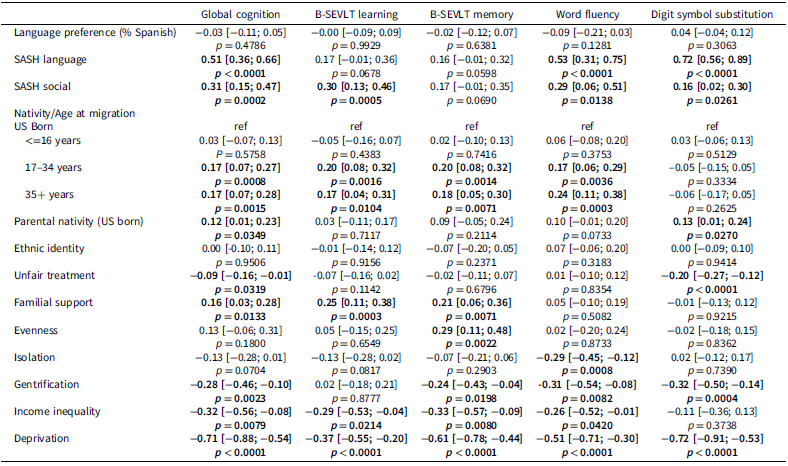
We re-ran primary models, including FRS, to examine the extent to which the association between acculturation in context measures and cognition is modified by a proxy for CVH. Detailed estimates, including regression coefficients and SEs for the initial set of regression models, are presented in Table 3 with forest plots for both sets of regression models presented in Figures 2 and 3, respectively.
Forest plots of regression coefficients including 95% confidence intervals of individual acculturation in context measures as they relate to global cognition and 4 cognitive test measures.
Note: SASH=Short Acculturation Scale for Hispanics. Regression coefficients for the acculturation in context variables represented in the forest plots are based on min-max rescaled variables (represent change in outcomes as a result of change from min to max in the exposure variable) except for categorical measures.

Forest plots of regression coefficients including 95% confidence intervals of individual acculturation in context measures as they relate to global cognition and 4 cognitive test measures when stratified by cardiovascular health as measured by the Framingham 10-year cardiovascular risk score (probability range: 0 to 1; categorized as low: <0.1, moderate: 0.1−<0.2, and high: 0.2+).
Note: SASH=Short Acculturation Scale for Hispanics. Regression coefficients for the acculturation in context variables represented in the forest plots are based on min-max rescaled variables (represent change in outcomes as a result of change from min to max in the exposure variable) except for categorical measures.

Regression coefficients and [95% confidence intervals] derived from the regression model investigating associations between acculturation in context variables and baseline global and test-specific cognition in HCHS/SOL

Long description
The table presents regression coefficients and 95% confidence intervals for associations between various acculturation variables and different cognitive functions. It includes 10 rows and 6 columns. The columns are labeled as Global cognition, B-SEVLT learning, B-SEVLT memory, Word fluency, and Digit symbol substitution. The rows are labeled with different variables such as Language preference, SASH language, SASH social, Nativity/Age at migration, Parental nativity, Ethnic identity, Unfair treatment, Familial support, Evenness, Isolation, Gentrification, Income inequality, and Deprivation. Each row provides regression coefficients and confidence intervals for the respective variables across the different cognitive functions. Notable trends include significant associations for SASH language, SASH social, Nativity/Age at migration, Parental nativity, Familial support, Gentrification, Income inequality, and Deprivation with various cognitive functions.
Note: B-SEVLT = Brief Spanish English Verbal Learning Test. Regression coefficients for the acculturation in context variables are min–max rescaled (represent change in outcomes as a result of change from min to max in the exposure variable) except for categorical outcomes. All models adjusted for age, sex, and education. Bolded values are significant at p < 0.05.
Results
Study characteristics
The weighted average age was ∼56; 2 in 5 individuals reported less than a high school education (Table 1). Additionally, 86% preferred Spanish for their baseline visit, 9% were born in a US state or DC and 5% reported that their parents were also mainland US-born. The estimated averages and SDs for these and other acculturation in context factors are reported in Table 2.
Acculturation in context
Nearly all the acculturation-related variables of interest were at least moderately correlated; however, few to none of the individual- or neighborhood-level variables were correlated with each other (Figure 1).
We next assessed the applicability of previously published acculturation in context constructs to HCHS/SOL data. We found strong support for an acculturation factor (CFA fit statistics: RMSEA = 0.06, CFI = 0.98, TLI = 0.97, SRMR = 0.04; χ 2 = 149.1; df = 5); moderate fit for a neighborhood-level factor was supported by the RMSEA = 0.04 and SRMR = 0.07 but low fit was suggested using the CFI = 0.69, TLI = 0.38, and χ 2 values was 76.56 (df = 5). We did not find evidence to support a cohesive latent factor for the individual-level socioenvironment; in fact, the model did not converge. Given the lack of fit for the hypothesized three-factor model, we decided to rely on the manifest variables to sequentially test associations between acculturation in context measures and cognition beginning with conceptually related models and ending with saturated models including all 13 measures (as noted above, two acculturation in context measures were merged into a single variable).
Acculturation in context and baseline cognition
Global Cognition – When considering acculturation-related indices, higher language- (estimate = 0.54, 95% CI = [0.38; 0.70], p < 0.0001) and social-based SASH sub-scores (estimate = 0.29, 95% CI = [0.13; 0.46], p = 0.0006) – suggestive of greater acculturation to US-based practices – later ages of migration to the US (17 to 34 years of age: estimate = 0.20, 95% CI = [0.10; 0.30], p = 0.0001; 35+ years of age: estimate = 0.19, 95% CI = [0.09; 0.30], p = 0.0004), and parental nativity within the US/DC (estimate = 0.24, 95% CI = [0.13; 0.35], p < 0.0001) were associated with better global cognition. Ethnic identity (estimate = −0.12, 95% CI = [−0.23; −0.00], p = 0.0489) and familial structural support (estimate = 0.18, 95% CI = [0.05; 0.31], p = 0.0085) were negatively and positively, respectively, associated with global cognition in the regression model investigating individual-level socioenvironmental variables. When considering only neighborhood-level socioenvironmental variables, all but eveness associated with global cognition. Specifically, higher isolation (estimate = −0.31, 95% CI = [−0.45; −0.17], p < 0.0001), gentrification (estimate = −0.27, 95% CI = [−0.46; −0.08], p = 0.0048], income inequality (estimate = -0.33, 95% CI = [−0.57; −0.08], p = 0.0097), and deprivation (estimate = −0.71, 95% CI = [−0.89; −0.53], p < 0.0001) were each associated with lower baseline global cognition. In the saturated model including the 13 acculturation in context variables, language- and social-based SASH sub-scores, later ages of migration, US-based parental nativity, familial structural support, and neighborhood-level gentrification, income inequality, and deprivation remained significant (neighborhood-level isolation was no longer significant) and higher individual levels of unfair treatment became significantly associated with lower global cognition (Table 3 and Figure 2 contain details).
Test Specific Cognition – Of the acculturation-related indices, higher language – (estimate = 0.20, 95% CI = [0.01; 0.38], p = 0.0372) and social-based SASH sub-scores (estimate = 0.31, 95% CI = [0.14; 0.48 p = 0.0004) and later ages of migration to the US (17 to 34 years of age: estimate = 0.22, 95% CI = [0.10; 0.34], p = 0.0005; 35+ years of age: estimate: 0.19, 95% CI = [0.05; 0.32], p = 0.0066) were associated with higher B-SEVLT learning scores. Only familial structural support was associated with this same metric (estimate = 0.28, 95% CI = [0.14; 0.41], p = 0.0001) when investigating individual-level socioenvironmental variables. When considering neighborhood-level socioenvironmental variables, higher isolation (estimate = −0.16, 95% CI =[–0.30; –0.03], p = 0.0202), income inequality (estimate = –0.27, 95% CI = [–0.52; –0.01], p = 0.0345), and deprivation (estimate = –0.39, 95% CI = [–0.57; –0.21], p < 0.0001) were each associated with lower baseline verbal learning. In the saturated model, only social-based acculturation, later ages of migration, social support, neighborhood-level income inequality and deprivation remained significant (Table 3 and Figure 2).
Higher language-based SASH sub-scores (estimate = 0.18, 95% CI = [0.01; 0.35], p = 0.0399), older ages of US migration (17 to 34 years of age: estimate = 0.23, 95% CI = [0.11; 0.35], p = 0.0002; 35+ years of age: estimate: 0.20, 95% CI = [0.07; 0.32], p = 0.0002) and parental US/DC nativity (estimate = 0.20, 95% CI = [0.05; 0.34], p = 0.0083) were associated with B-SEVLT post-interference recall when analyses focused on acculturation-related variables. Of the individual-level socioenvironmental variables, only higher levels of familial structural support associated with higher B-SEVLT post-interference recall (estimate = 0.23, 95% CI = [0.08; 0.39], p = 0.0035). Of neighborhood-level variables, higher eveness (estimate = 0.29, 95% CI = [0.10; 0.48], p = 0.0032), gentrification (estimate = −0.24, 95% CI = [−0.44; −0.04], p = 0.0176), income inequality (estimate = −0.33, 95% CI = [−0.58; −0.08], p = 0.0092), and deprivation (estimate = −0.63, 95% CI = [−0.80;−0.46], p < 0.0001) were each associated with lower baseline B-SEVLT recall. In the saturated model including all 13 variables, only later ages of migration, familial structural support, and the four neighborhood-level socioenvironmental variables remained significant (Table 3 and Figure 2 contain details).
When considering acculturation-related variables and WF, higher language (estimate = 0.58, 95% CI = [0.37; 0.79], p < 0.0001) and social (estimate = 0.31, 95% CI = [0.06; 0.55], p = 0.0159) SASH sub-scores, later ages of US migration (17 to 34 years of age: estimate = 0.21, 95% CI = [0.09; 0.33], p = 0.0008; 35+ years of age: estimate = 0.25, 95% CI = [0.12; 0.39], p = 0.0002) and parental US/DC nativity (estimate = 0.20, 95% CI = [0.10; 0.30], p = 0.0001) were associated with higher WF. None of the individual-level socioenvironmental variables were associated with WF. In contrast, 3 of 5 neighborhood-level variables were associated with WF: higher isolation (estimate = −0.41, 95% CI = [−0.58; −0.23], p < 0.0001), gentrification (estimate = −0.30, 95% CI =[−0.54; −0.06], p = 0.0143) and deprivation (estimate = −0.50, 95% CI = [−0.71; –0.30], p < 0.0001) were each associated with lower WF performance. In the saturated model, all but parental nativity remained significantly associated with WF performance and neighborhood-level income inequality was an additional metric that negatively associated with WF (Table 3 and Figure 2).
DSS baseline performance was positively associated with the language-based SASH sub-score (estimate = 0.74, 95% CI = [0.56; 0.91], p < 0.0001) and parental US/DC nativity (estimate = 0.23, 95% CI = [0.11; 0.34], p = 0.0001) when considering acculturation-related metrics. When considering the individual-level socioenvironmental variables, higher ethnic identity (estimate = -0.19, 95% CI = [–0.31; –0.08], p = 0.0006) and more experiences of unfair treatment (estimate = –0.11, 95% CI = [–0.19; –0.02], p = 0.0134) were each significantly associated with lower DSS performance. Higher isolation (estimate = –0.36, 95% CI = [–0.52; –0.21], p < 0.0001), gentrification (estimate = –0.28, 95% CI = [–0.47; –0.09], p = 0.0032) and deprivation (estimate = –0.65, 95% CI = [–0.86; –0.45], p < 0.0001) were each associated with lower DSS performance. Both aforementioned acculturation-related metrics plus social-based SASH sub-scores were significant in the saturated model including all 13 acculturation in context variables (Table 3 and Figure 2 contain details), only individual-level experiences of unfair treatment and neighborhood-level gentrification and deprivation remained significant from the conceptually-based models.
All model predictors had low VIFs except two Nativity/Age at Migration categories with moderately elevated VIFs (6.9 and 8.2). Given elevated VIFs could result from dummy-variable coding of categorical predictors, we conducted a sensitivity analysis replacing the categorical specification with a continuous age-at-migration measure (coded 0 for US-born). All VIFs were below 4 (mean VIF = 1.53), suggesting that the prior elevations reflected dummy-variable coding rather than substantial collinearity. Thus, we did not consider multicollinearity to be a meaningful concern.
Results from our sensitivity analyses (Supplemental Tables 4 and 5) were consistent with the reported primary results.
CVH, acculturation in context and baseline cognition
Given that the CFA did not support composite indices of acculturation in context and out of concerns for creating an over-indexed model, we chose not to include 13 interaction terms to investigate CVH as an effect modifier of the relationships between acculturation in context and cognition. Instead, we stratified and refit our models by FRS levels (low, medium, and high) and graphed the generated regression estimates for comparison purposes only (Figure 3). Briefly, qualitative comparisons indicated that the estimates were consistent across FRS levels with select acculturation in context measures suggesting, descriptively, dose response relationships with cognition. These select measures included age at migration (for all cognitive variables except DSS), experiences of unfair treatment (for all cognitive variables except WF), neighborhood-level isolation (for all cognitive variables except post-interference recall), and gentrification (for all cognitive variables except DSS).
Discussion
In nearly 8,500 middle-aged and older Hispanics/Latinos, we tested latent constructs of the acculturation in context framework and investigated framework associations with baseline global and test-specific cognition. While results did not support the hypothesized three factor model, tests of the associations between acculturation in context measures and cognition demonstrated select measures were associated with cognition in both positive and negative ways. For example, language- and/or social-based levels of acculturation were positively associated with cognitive outcomes as were older ages at migration. In contrast, neighborhood-level socioenvironmental measures were consistently and negatively associated with cognition, with minimal evidence for the protective effects of high ethnoracial neighborhood congruency unless considered with CVH. In sum, strict empirical testing of the hypothesized 3-factor model as applied to the acculturation in context framework was not supported in HCHS/SOL; however, groups of variables were associated with cognition in this same population.
There are several possible reasons why our hypothesized three-factor model was not supported as it pertains to the sample studied. Differences in measurement across studies – especially for individual-level socioenvironmental experiences (Lamar et al., Reference Lamar, Barnes, Leurgans, Fleischman, Farfel, Bennett and Marquez2021) – suggest an alternative set of indicators more in keeping with our prior studies may have yielded potentially more informative results related to the hypothesized three-factor structure. Sample differences, including the broader age range, may have introduced generational variation in reporting (Cano et al., Reference Cano, Perez Portillo, Figuereo, Rahman, Reyes-Martinez, Rosales, Angel Cano and Takeuchi2021; Cheon & Yip, Reference Cheon and Yip2019; Gordon et al., Reference Gordon, Banegas and Tucker-Seeley2020) given some Latino-centric measures change with age (Lamar et al., Reference Lamar, Glover, Capuano, Wilson, Fleischman, Bennett and Marquez2023). Additionally, Latinos represent significant diversity (e.g., cultural, economic, linguistic) that influences a myriad of lived experiences and likely the appropriateness of a 3-factor solution “for all.” Geographic differences (Chicago, Bronx, Miami, San Diego versus Chicago only) may have also contributed to differences in the hypothesized three-factor model including the modest fit for neighborhood-level variables. Rather than being seen as a negative, we contend the lack of support for our hypothesized three-factor model suggests the need for a more flexible population-sensitive application of the framework, as advocated in original acculturation in context literature (Abraido-Lanza et al., Reference Abraido-Lanza, Armbrister, Florez and Aguirre2006; Abraido-Lanza et al., Reference Abraido-Lanza, Echeverria and Florez2016; Hill et al., Reference Hill, Perez-Stable, Anderson and Bernard2015; Lamar et al., Reference Lamar, Barnes, Marquez, Angel, Andrade, Riosemena and Mejia-Arango2024). Accordingly, we investigated acculturation in context variables using sequential then saturated models as predictors of cognition.
Across all models, certain acculturation in context variables consistently associated with global cognition and the four cognitive test scores. Specifically, higher language – and to a lesser extent social-based acculturation to the US as well as later ages of US migration – were associated with higher cognitive performance. While results of language- and social-based acculturation and cognition are in keeping with other studies (Alam et al., Reference Alam, Singleton, Aguinaga, Chodzko-Zajko, Jahan, Oke and Schwingel2022; Liu et al., Reference Liu, Stickel, Tarraf, Li, Perreira, Riosmena, Lamar, Testai, Gallo, Garcia, Llibre-Guerra, Isasi, Lipton, Daviglus, Dow, González and Gaugler2025; Martinez-Miller et al., Reference Martinez-Miller, Robinson, Avery, Yang, Haan, Prather and Aiello2020), including our own (Lamar et al., Reference Lamar, Barnes, Leurgans, Fleischman, Farfel, Bennett and Marquez2021), they may seem at odds with the results for age of migration. Historically, later ages of US migration were associated with lower cognition and risk for cognitive impairment compared to US born Latinos (Downer et al., Reference Downer, Garcia, Saenz, Markides and Wong2018; Garcia et al., Reference Garcia, Saenz, Downer, Chiu, Rote and Wong2018; Hill et al., Reference Hill, Angel, Balistreri and Herrera2012) given older ages of migration (e.g., 50+ years of age) leave less time and opportunity for US-based language, social and/or professional interactions that lead to higher cognition. Our strata for age at migration was ≤16, 17–34, and 35+ years of age. Thus, our “later” ages of US migration encompassed much of adulthood including mid- and late-life, lifespan stages that other studies separate (Downer et al., Reference Downer, Garcia, Saenz, Markides and Wong2018; Garcia et al., Reference Garcia, Saenz, Downer, Chiu, Rote and Wong2018; Hill et al., Reference Hill, Angel, Balistreri and Herrera2012). Studies using similar age categorizations as ours (e.g., 35+) report this group of “later” age migrants had the most cognitively healthy years (Garcia et al., Reference Garcia, Tarraf, Reyes and Chiu2022) and better WF than US born counterparts (Liu et al., Reference Liu, Stickel, Tarraf, Li, Perreira, Riosmena, Lamar, Testai, Gallo, Garcia, Llibre-Guerra, Isasi, Lipton, Daviglus, Dow, González and Gaugler2025). The current categorizations and associates also align with the idea that migration at earlier ages coincides with language-, social- and productivity-based activities that may enhance cognitive health (Downer et al., Reference Downer, Garcia, Saenz, Markides and Wong2018), although the healthy migrant effect cannot be ruled out.
Higher familial social support was the most consistent individual-level socioenvironmental measure associated with higher learning and memory; in contrast, experiences of unfair treatment were negatively associated with information processing. These findings are in keeping with prior studies of the positive impact of social support (Wang et al., Reference Wang, Chen and Hu2023; Yoo et al., Reference Yoo, Tyas, Maxwell and Oremus2023) and the negative impact of unfair treatment (Barnes et al., Reference Barnes, Lewis, Begeny, Yu, Bennett and Wilson2012; Nkwata et al., Reference Nkwata, Zhang, Song, Giordani and Ezeamama2021) on cognition regardless of ethnoracial background. They also suggest that the physiological responses known to be associated with unfair treatment (e.g., higher stress; Jelsma et al., Reference Jelsma, Goosby and Cheadle2021) and social support (e.g., lower stress; Iob et al., Reference Iob, Kirschbaum and Steptoe2018) may differentially impact brain regions and associated cognition. Our negative association between ethnic identity and cognition contrasts with prior HCHS/SOL work reporting a positive association between these same variables (Estrella et al., Reference Estrella, Durazo-Arvizu, Gallo, Tarraf, Isasi, Perreira, Zeng and Lamar2021; Estrella et al., Reference Estrella, Tarraf, Kuwayama, Gallo, Wu, Marquine, Perreira, Vasquez, Isasi, Lipton, Mattei, González, Daviglus and Lamar2024). This may mean that when placed within a comprehensive acculturation in context framework, the relationship between ethnic identity and cognition is altered by other contextual factors. Given the test-specific nature of this supposition, however, future work is needed to support or refute it.
Nearly all neighborhood-level variables were associated with cognition. In fact, the negative associations between neighborhood-level socioenvironmental factors and all cognitive outcomes point toward the pervasiveness of the relationship between one’s environmental milieu and cognitive health (Besser et al., Reference Besser, Meyer, Jones, Tran, Booker, Mitsova, Peterson and Hughes2023; Cerin et al., Reference Cerin, Barnett, Wu, Martino, Shaw, Knibbs, Poudel and Anstey2023; Kovalchik et al., Reference Kovalchik, Slaughter, Miles, Friedman and Shih2015; Lamar et al., Reference Lamar, Kershaw, Leurgans, Mukherjee, Lange-Maia, Marquez and Barnes2023). It also points toward the potential behavioral manifestation of previously reported associations between these neighborhood-level factors and increases in brain atrophy and white matter hyperintensities over time (Hunt et al., Reference Hunt, Buckingham, Kim, Oh, Vogt, Jonaitis, Hunt and Bendlin2020; Hunt et al., Reference Hunt, Vogt, Jonaitis, Buckingham, Koscik, Zuelsdorff, Clark and Kind2021). Given that this is the first study incorporating neighborhood-level socioenvironmental items into an acculturation in context framework and assessing their relationship with cognition in Hispanics/Latinos, more work is needed to empirically confirm and extend these results and the interpretations offered.
While the cross-sectional nature of the current study precludes a discussion of directionality or underlying mechanisms, we did attempt to investigate the role of CVH on associations between acculturation in context variables and baseline cognition. The nature of our analysis did not allow for a formal investigation of effect modification, however, qualitative observations of select does-response trends suggested that participants with higher CVH, particularly those experiencing negative acculturation in context factors like unfair treatment, showed better cognitive performance. In contrast, despite lower CVH, participants experiencing positive factors like living in an ethnic enclave (i.e., neighborhoods with higher ethnoracial isolation) performed better across cognitive tasks. Thus, maintaining higher CVH may buffer against the adverse effects of acculturation- and contextually-related vulnerabilities on cognition for Hispanics/Latinos. They also support the potentially positive role that ethnic enclaves may have when combined with lower CVH profiles.
In addition to the inherent limitations of a cross-sectional study that employed brief or single item measures of some constructs, additional limitations exist. The HCHS/SOL baseline cognitive assessment is limited and data collection occurred over 10 years ago. We are actively investigating acculturation in context as it relates to cognitive change incorporating more recent HCHS/SOL visits that administered the same cognitive tests – chosen for their harmonization to other large-scale studies including the Atherosclerosis Risk in Communities study – and additional measures introduced as part of the SOL-Investigation of Neurocognitive Aging (Gonzalez et al., Reference Gonzalez, Tarraf, Fornage, Gonzalez, Chai, Youngblood, Abreu and Schneiderman2019). Some estimates of the relationship between individual acculturation in context variables and cognition were small and may lack immediate clinical significance. We would argue that baseline levels of cognition dictate where an individual starts their cognitive trajectory, thus, even small differences in baseline cognition lower the threshold for meeting criteria for later-life dementia. Furthermore, some relationships (e.g., SASH language sub-scores and fluency) may reflect construct overlap given that language proficiency and cognitive flexibility/fluency are intertwined. Language of testing was included as an acculturation-related variable in all models, and code switching was allowed for select tests; thus, this may lessen the influence of construct overlap on our results. Lastly, additional variables, for example, individual income, may also be associated with our predictors and outcomes; future work will consider these factors, as relevant, as confounders, mediators, or moderators.
Study strengths included the large analytic sample, the varied geographic and Hispanic/Latino backgrounds represented (although these are not exhaustive and still represent limitations for broader national or overarching heritage inferences), and the wider age range of adults when compared to our previous acculturation in context studies. Our inclusion of neighborhood-level socioenvironmental data answers calls in the literature for a more comprehensive consideration of the acculturation in context framework (Abraido-Lanza et al., Reference Abraido-Lanza, Armbrister, Florez and Aguirre2006; Lamar et al., Reference Lamar, Barnes, Marquez, Angel, Andrade, Riosemena and Mejia-Arango2024). Our choice of employing Census Tract level data is a strength given that more geographical restrictions to our geocoded variables of interest (e.g., block level data) may have introduced more similarities between participants in the same neighborhood.
Taken together, this study in HCHS/SOL extends the importance of considering acculturation within the context of the lived experience of Hispanics/Latinos and the role of individual- as well as neighborhood-level health on cognition in this same population. It suggests a more flexible approach to considering acculturation in context is necessary and that certain framework variables may behave differently in relation to cognition as well as to each other when considered together. Thus, we are actively investigating alternative approaches to empirically test the acculturation in context framework that better reflect these complex relationships and how they relate to cognitive and bran aging for older Hispanic/Latino adults.
Supplementary material
The supplementary material for this article can be found at https://doi.org/10.1017/S1355617726102161.
Data availability statement
To request data used in this study as well as all other data from The Hispanic Community Health Study/Study of Latinos and its ancillary studies, please visit https://www.cscc.unc.edu/hchs/.
Acknowledgments
The authors thank the staff and participants of HCHS/SOL for their important contributions.
Funding statement
This work, part of The Hispanic Community Health Study/Study of Latinos which is a collaborative study, was supported by contracts from the National Heart, Lung, and Blood Institute (NHLBI) to the University of North Carolina (HHSN268201300001I/N01-HC-65233), University of Miami (HHSN268201300004I/N01-HC-65234), Albert Einstein College of Medicine (HHSN268201300002I/N01-HC-65235), University of Illinois at Chicago (HHSN268201300003I/N01- HC-65236 Northwestern Univ), and San Diego State University (HHSN268201300005I/N01-HC-65237). The following Institutes/Centers/Offices have contributed to the HCHS/SOL through a transfer of funds to the NHLBI: National Institute on Minority Health and Health Disparities, National Institute on Deafness and Other Communication Disorders, National Institute of Dental and Craniofacial Research, National Institute of Diabetes and Digestive and Kidney Diseases, National Institute of Neurological Disorders and Stroke, NIH Institution-Office of Dietary Supplements. ML was supported by R01AG062711; ME was supported by K01AG075353.
Competing interests
The authors report no competing interests.





 Open access

