Introduction
The fossil records of paleoscolecidan worms, a group that is characterized by slender, multiannulated bodies covered with distinctive armor of minute phosphatic sclerites and known from Cambrian to Silurian, are better than for any other Cycloneuralia (Maas, Reference Maas2013). Because of their macroscopic, introvert-bearing, and broadly priapulid-like body plan, the extinct paleoscolecids are assumed to have allowed for the expectations of symplesiomorphies of ancestral ecdysozoans (Budd and Jensen, Reference Budd and Jensen2000; Budd, Reference Budd2001, Reference Budd2008; Zrzavý, Reference Zrzavý2003; Webster et al., Reference Webster, Copley, Jenner, Mackenzie-Dodds, Bourlat, Rota-Stabelli, Littlewood and Telford2006), which make these animals a vital component for understanding early evolution of stem group Cycloneuralia within ecdysozoans. Many researchers, however, have suggested that paleoscolecids shared classical morphology and developmental biology with stem priapulids (Conway Morris, Reference Conway Morris1997; Huang, Reference Huang2005; Han et al., Reference Han, Liu, Zhang, Zhang and Shu2007b; Hu et al., Reference Hu, Steiner, Zhu, Luo, Forchielli, Keupp, Zhao and Liu2012; Wills et al., Reference Wills, Gerber, Ruta and Hughes2012), but not with panarthropods (Harvey et al., Reference Harvey, Dong and Donoghue2010), although a more robust analysis of their affinities is required for assessing the significance for ecdysozoan evolution. Furthermore, since incomplete diagnoses and undetected synonymies are common in this group, considerable problems arise in many cases when comparisons are made among morphological characters of fossils preserved in different styles and of variable quality (Conway Morris and Peel, Reference Conway Morris and Peel2010; Harvey et al., Reference Harvey, Dong and Donoghue2010; Topper et al., Reference Topper, Brock, Skovsted and Paterson2010; García-Bellido et al., Reference García-Bellido, Paterson and Edgecombe2013; Yang and Zhang, Reference Yang and Zhang2016).
The fossil records of compressed paleoscolecids preserving an armored terminal introvert from several Cambrian deposits (e.g., Hou and Bergström, Reference Hou and Bergström1994; Chen, Reference Chen2004; Hou et al., Reference Hou, Aldridge, Bergström, Siveter, Siveter and Feng2004; Huang, Reference Huang2005; Han et al., Reference Han, Liu, Zhang, Zhang and Shu2007b; Maas et al., Reference Maas, Huang, Chen, Waloszek and Braun2007; Dornbos and Chen, Reference Dornbos and Chen2008; Conway Morris and Peel, Reference Conway Morris and Peel2010; Hu et al., Reference Hu, Steiner, Zhu, Luo, Forchielli, Keupp, Zhao and Liu2012; García-Bellido et al., Reference García-Bellido, Paterson and Edgecombe2013; Yang and Zhang, Reference Yang and Zhang2016) provide opportunities to constrain their taxonomies and precise affinities. Except for the frontal introvert, however, cuticle ornamentation (e.g., plates, platelets, and microplates) in compression paleoscolecids, which are the key characteristics in taxonomic purposes of the group (Conway Morris, Reference Conway Morris1997; Botting et al., Reference Botting, Van Roy, Bates and Upton2012), are unfortunately poorly preserved. In addition, most of these macrofossil taxa from South China are generally confined to shallow water and epeiric sea platform facies around the center of the Yangtze Platform (Yang, Reference Yang2016).
In this paper, a macroscopic paleoscolecid, Shaanxiscolex xixiangensis new genus new species, is reported from the Cambrian Yanwangbian Formation in the north margin of the Yangtze Platform mainly on the basis of its well-preserved scleritome pattern. In addition, a set of S. xixiangensis buried in life position along with some other Cambrian paleoscolecids from South China, provide valuable information in analyzing the ecology of this extinct class. Accordingly, the occurrence of the studied material as seemingly persistent elements of phosphatized forms suggests that Cambrian paleoscolecids achieved a widespread geographic distribution in South China and exploited a sophisticated life habit in the early Cambrian seafloor.
Geologic setting and age constraints
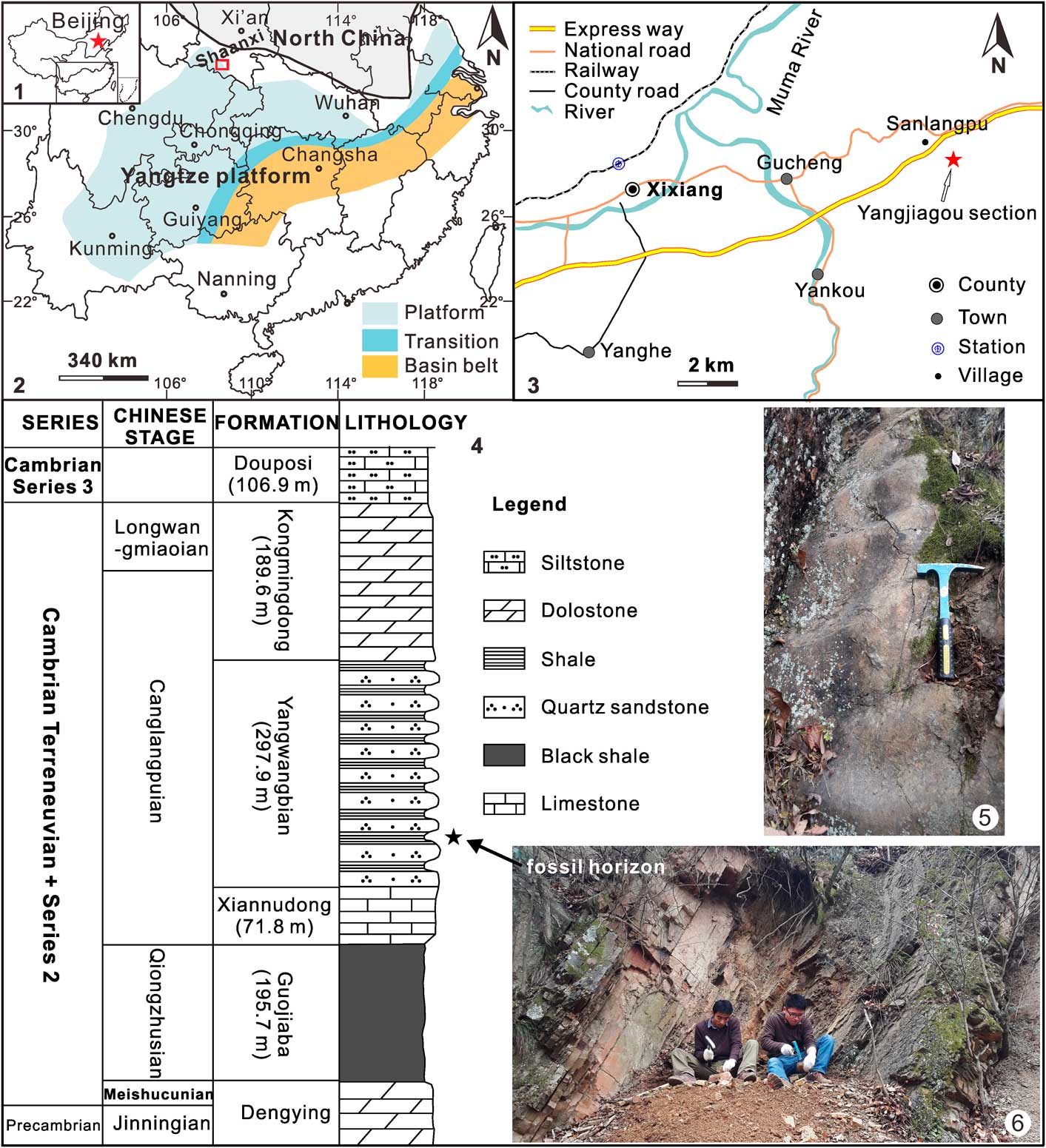
The described fossil material was collected from yellowish-green silty mudstone of the lower Yanwangbian Formation at the Yangjiagou section near Xixiang County, southern Shaanxi Province of China, bordering the north margin of the Yangtze Block (Fig. 1.1–1.3). In the study area, the Yanwangbian Formation is overlain by dolostones of the Kongmingdong Formation, in which fossils are rare (Chen and Zhang, Reference Chen and Zhang1987), and it conformably overlies the Xiannudong Formation, a succession of limestone of archaeocyathan reef facies (Hicks and Rowland, Reference Hicks and Rowland2009; Yang et al., Reference Yang, Mao, Pan and Li2016). Lithologically, the Yanwangbian Formation at the Yangjiagou section is about 298 m thick and consists mainly of thick-bedded sandstones interbedded with yellowish-green shales or mudstones (Fig. 1.4), with common ripple marks (Fig. 1.5) and bioturbations (Chen and Zhang, Reference Chen and Zhang1987; Zhang et al., Reference Zhang, Liu and Zhao2008; Zhu, Reference Zhu2010). It therefore represents sediments deposited in a littoral facies environment (Zhu, Reference Zhu2010). Surprisingly, the interbedded shales from the lower part of the formation (Fig. 1.6) yield a relatively productive fossil assemblage. This Lagerstätte is dominated by abundant shelly fossils such as trilobites, hyolithids, bradoriids, and brachiopods (e.g., Chen and Zhang, Reference Chen and Zhang1987; Chen, Reference Chen1999; Liu et al., Reference Liu, Zhang, Liu and Zhang2008); soft-bodied paleoscolecids have also been collected (Zhang et al., Reference Zhang, Liu and Zhao2008, fig. 4B).
Locality and horizon of the studied material from the Yanwangbian assemblage in South China. (1) Regional outline of South China indicated by a boxed area; (2) map showing the paleogeographic location of the study area (red box) in the north margin of the Yangtze Platform, South China; (3) location map of the Yangjiagou section, indicated by a red star; (4) chronostratigraphic and lithostratigraphic sequences of the Cambrian at the Yangjiagou section, indicating the horizon of paleoscolecids; (5) ripple marks of sandstones from the lower part of the Yanwangbian Formation at the Yangjiagou section; (6) outcrop photograph of the fossil horizon.

In terms of trilobite biostratigraphy, Chen and Zhang (Reference Chen and Zhang1987) proposed that the upper and lower parts of the Yanwangbian Formation at the Yangjiagou section were comparable with the Wulongqing and Hongjingshao members of the Canglangpu Formation in eastern Yunnan, respectively. Whereas the occurrence of the trilobite Palaeolenus in the lower Yanwangbian Formation (e.g., Cheng et al., Reference Cheng, Gao, Wang, Zhang, Yuan and Ding1980; Chen and Zhang, Reference Chen and Zhang1987) indicates that the fossil horizons are generally correlated with the Canglangpuan regional stage for South China (Zhang et al., Reference Zhang, Liu and Zhao2008) and Series 2, Stage 4 of the provisional stratigraphic scheme for the Cambrian (Peng et al., Reference Peng, Babcock and Cooper2012). It is therefore coeval with the Shipai fauna (Zhang and Hua, Reference Zhang and Hua2005; Yang and Zhang, Reference Yang and Zhang2016) and the Guanshan biota (Luo et al., Reference Luo, Fu, Hu, Li, Chen, You and Liu2006; Hu et al., Reference Hu, Li, Luo, Fu, You, Pang, Liu and Steiner2008), also from South China, as well as the Emu Bay Shale from South Australia (Paterson et al., Reference Paterson, Jago, Gehling, García-Bellido, Edgecombe and Lee2008). Clearly then, the Yanwangbian assemblage is a new Burgess Shale–type biota, implying a unique faunal realm from the north margin of the Yangtze Platform during the early Cambrian.
Materials, preservation, and methods
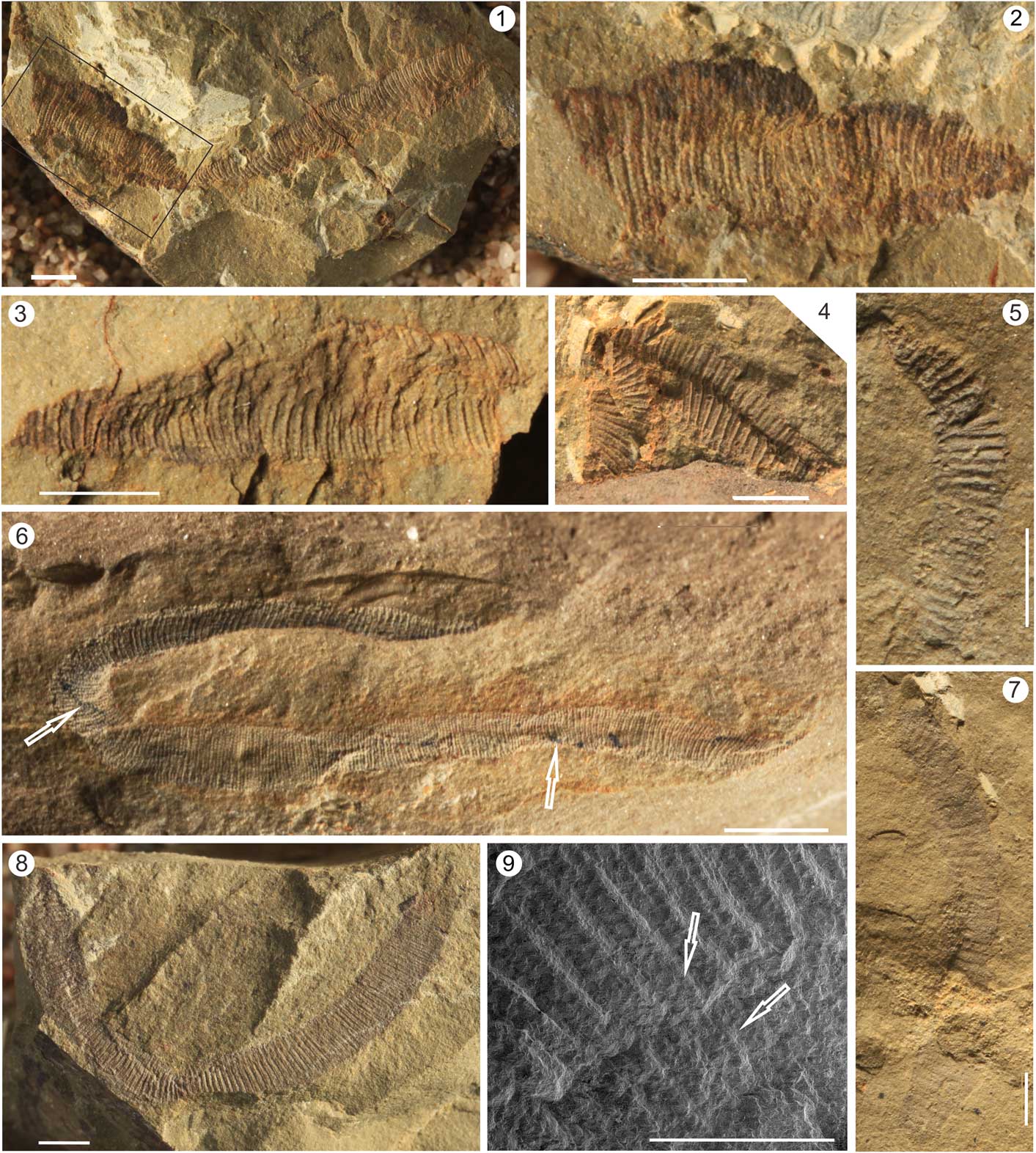
The new taxon is represented by twelve specimens, all of which are long annulated trunks (Fig. 2) from the trilobite Palaeolenus Zone of the Yanwangbian Formation near Xixiang County, Shaanxi Province, China. All specimens investigated in this study are obtained by splitting mudstone slabs, meaning that fossils are generally flatted and compressed on bedding surfaces. However, several specimens are preserved in slight relief (Fig. 2.1–2.6), possibly due to postmortem contraction. Intriguingly, individuals either were obtained by splitting the longitudinal section of the rock slab (Fig. 2.6) or display a penetrative attitude into the substrate (Fig. 2.1), revealing dramatic information regarding life habit (see the following). These fossils can also be treated as evidences of in situ preservation of the material. Studied material is generally preserved in a curved attitude (Fig. 2.1, 2.5–2.8); thus, the concave side is considered ventral because paleoscolecids are always coiled with the ventral side inward (Huang, Reference Huang2005). Extremities at both ends are unfortunately not preserved, so it is difficult to determine an anterior-posterior direction for these fossils. Although none of the fossils are preserved together with a lined burrow, the presence of black gut trace (Fig. 2.6) shows that the fossils are decayed remains and not molts.
Shaaxiscolex xixiangensis n. gen. n. sp. from the Cambrian Yanwangbian Formation at the Yangjiagou section near Xixiang County, Shaanxi, China. (1, 3) SXYY-008a/b, part and counterpart of the holotype, an incomplete trunk with strong annulations covered with plates; (2) enlarged view of the boxed area in (1) showing that each annulus consists of two plate rows positioned close to the borders; (4) SXYY-009a, a recurved individual with strong annuli and a midfolding along the trunk; (5, 7) SXYY-014, 011, incomplete specimens showing prominent annulations; (6) SXYY-001a, an elongated specimen with prominent annuli and a black gut trace (white arrows) running along the entire body; (8) SXYY-002, an incomplete individual occurs in a C-shaped position; (9) SEM image showing two cuticle layers (white arrows). (1–8) Scale bars=2 mm; (9) scale bar =1 mm.

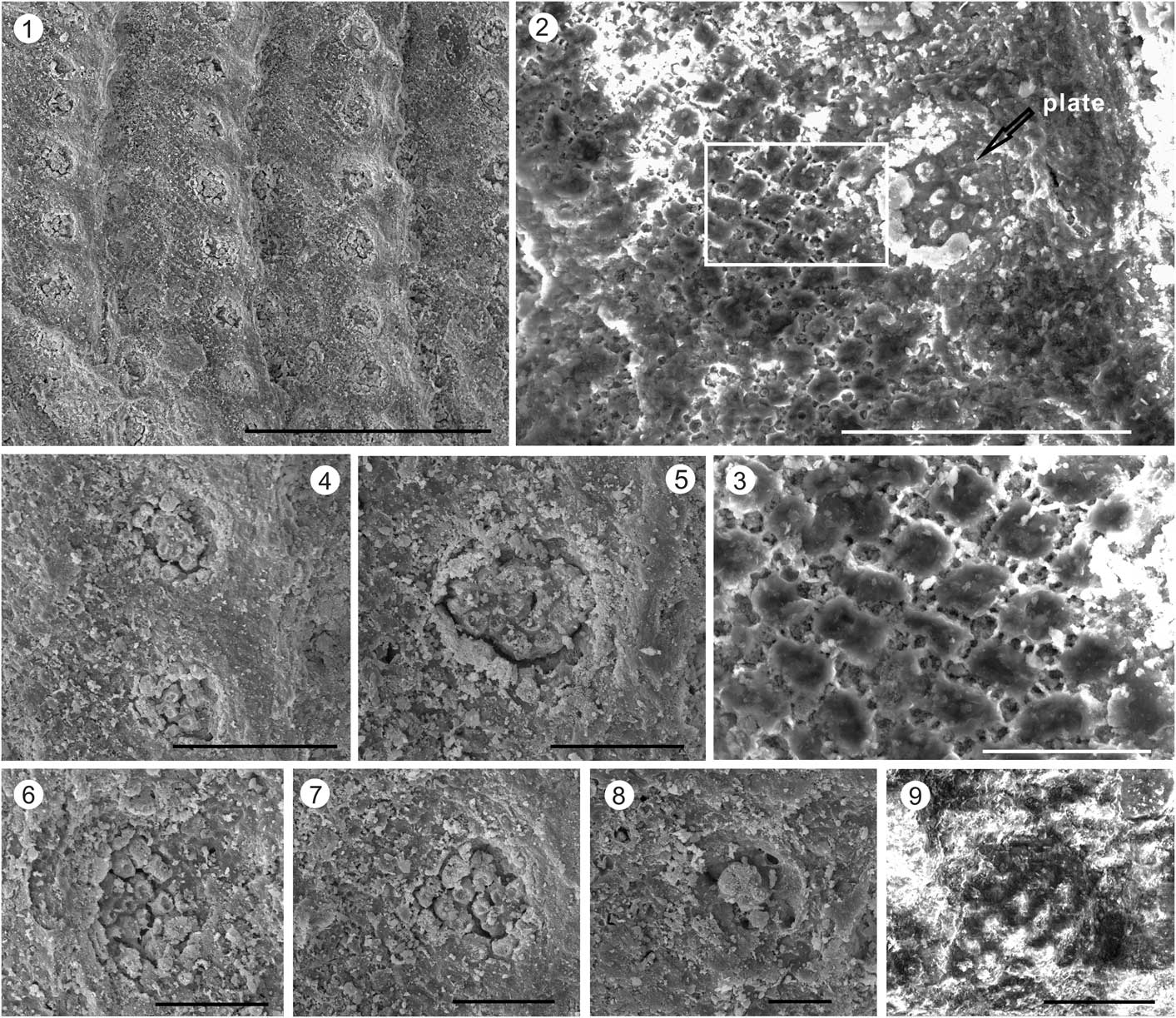
Fine cuticular structures (plates and associated microstructures) are well preserved in most specimens (Figs. 2, 3). EDX elemental mapping concurs with a common view that the plates of paleoscolecids are usually composed of calcium phosphate.
SEM images of S. xixiangensis from the Yanwangbian Formation. (1) Each annulus consists of two rows of separated Hadimopanella-type plates positioned to the borders and with the intervening spaces and intersegmental furrows filled with a mosaic pattern of microplates; (2) cuticle detail showing that the plates were separated by microplates; (3) enlarged view of the boxed area in (2) showing that the microplates are variable in size and shape, approximately rhombic pattern to completely irregular; (4) two plates separated by intervening microplates; (5–7, 9) plates with two circles of nodes and an occasional central node on the surface; (8) a negative relief plate with a circle of approximately five nodes on the surface. (1) Scale bar=400 μm; (2, 4) scale bars=100 μm; (3) sale bar=30 μm; (5–7, 9) scale bars=50 μm; (8) scale bar=20 μm.

The specimens were photographed using a Canon 5D Mark II camera with auxiliary light to increase the color contrast of the morphological structures. A FEI Quanta 500 scanning electron microscope (SEM) equipped with an energy dispersive X-ray analyzer (EDX) was used at the State Key Laboratory of Continental Dynamics of Northwest University, China. Line drawing and diagrammatic figures were made using Coreldraw X6 and Photoshop CS4 software.
Repository
Fossils investigated in this study were housed in the collection of the Early Life Institute, Northwest University, China.
Systematic paleontology
Terminology
The definitions of morphological terms are a combination of Conway Morris and Robison (Reference Conway Morris and Robison1986), Müller and Hinz-Schallreuter (Reference Müller and Hinz-Schallreuter1993), Conway Morris (Reference Conway Morris1997), and Topper et al. (Reference Topper, Brock, Skovsted and Paterson2010).
Class Palaeoscolecida Conway Morris and Robison, Reference Conway Morris and Robison1986
Family Palaeoscolecida Whittard, Reference Whittard1953
Genus Shaanxiscolex new genus
urn:lsid:zoobank.org:act:37B6571C-E363-4869-B50B-B597C88F88AD
Type species
Shaanxiscolex xixiangensis new genus new species, from the Palaeolenus Biozone of the Cambrian Yanwangbian Formation at the Yangjiagou section near Xixiang County, Shaanxi Province, China.
Diagnosis
Macroscopic worm, with slender, cylindrical body consisting of uniform, serial annuli repeated along entire trunk, each annulation with two rows of alternating Hadimopanella-type plates positioned close to borders and with a mosaic pattern of intervening microplates separating the plates and filling intersegmental furrows. Plates round or slightly ovate discs, 40 to 95 μm in diameter and generally isolated from one another; each plate covered with one or two circles of five to 18 nodes and an occasional central node on surface.
Etymology
Shaanxi represents the Shaanxi Province, China, where the studied material was collected; scolex is Greek for worm.
Occurrence
The trilobite Palaeolenus Zone of the Cambrian Yanwangbian Formation (Series 2, Stage 4) at the Yangjiagou section near Xixiang County, Shaanxi Province, China.
Remarks
The new genus currently includes the type species only. Despite its overall dimensions and gross morphological similarity to some reported paleoscolecid fossils, Shaanxiscolex differs notably from other genera by the exclusive cuticular ornamentation that includes Hadimopanella-type plates bearing one or two circles of nodes on the surface and with a mosaic pattern of microplates occurring between the plates and within the intersegmental furrows. The differentiation of cuticular sclerites (e.g., plates, platelets, and microplates) has been suggested as being useful for taxonomic purposes of paleoscolecids (Botting et al., Reference Botting, Van Roy, Bates and Upton2012), and Paleozoic paleoscolecids from different localities and/or horizons often exhibit different scleritomes (Yang, Reference Yang2016). Accordingly, the taxonomic resolution attainable for the Yanwangbian material, in our opinion, recognizes a genus-level variation and thereby is described as a new genus, Shaanxiscolex.
Shaanxiscolex xixiangensis new genus new species
urn:lsid:zoobank.org:act:172F65C8-C047-44A4-869D-347677703EB0
Holotype
SXYY-P 008a/b (part and counterpart; Fig. 2.1–2.3), an incomplete specimen with tessellating phosphatic plate array; trilobite Palaeolenus Zone of the Cambrian Yanwangbian Formation at the Yangjiagou section near Xixiang County, Shaanxi Province, China.
Paratypes
A total of 12 compression fossils (SXYY-P 001a/b, 002, 004, 005, 009a/b, 010, 011, 012, 013, 014, 016, 017a/b) from the same level and locality as the holotype.
Diagnosis
As for the genus.
Occurrence
As for the type species.
Description
Specimens are preserved as flattened trunk compressions lacking both oral and aboral terminations, and most show a curved attitude (Fig. 2). A midfold along the trunk present in an individual (Fig. 2.4) is probably taphonomical. The trunk is slender and cylindrical, with preserved length ranging from 8.9 to 30.7 mm; its width is 1.3 to 3.0 mm. The fossils are often preserved in slight relief, which may be attributed to postmortem contraction; two cuticle layers are observed in some instances (Fig. 2.9).
The entire trunk is traversed by a series of raised annuli, with about 4–7 annulations per millimeter. Each annulus is typically covered with two rows of Hadimopanella-type plates that lie parallel to the annulations. The plates are generally positioned close to the borders of the annulations and are isolated from one another; they tend to be separated by a mosaic pattern of intervening microplates (Figs. 2, 3). The plates are round or slightly ovate discs in outline, mostly showing severe abrasion, with the upper series of node crowns invariably scattered (Fig. 3) due to taphonomic processes. The majority of plates are 65 to 95 μm in diameter with two circles of 12–18 nodes and an occasional central node on the convex surfaces (Fig. 3.4–3.7). A few smaller plates (40 to 50 μm in diameter) adorned the surfaces with a single circle of approximately five nodes and an occasional central node (Fig. 3.8). Microplates are irregular in shape and size (approximately rhombic pattern to completely irregular), forming a mosaic and intervening pattern, separating the plates and filling the intersegmental furrows (Fig. 3.1–3.4). The platelet is invisible. A black, narrow, and straight gut trace is occasionally present and runs the length of the body (Fig. 2.6).
Etymology
After Xixiang County of Shaanxi Province, where the Yanwangbian assemblage to which the new material belongs is located.
Remarks
Since macroscopic and compressed paleoscolecids collected from shales often superficially resemble one another in gross morphology (Conway Morris, Reference Conway Morris1997; Harvey et al., Reference Harvey, Dong and Donoghue2010; Yang and Zhang, Reference Yang and Zhang2016), the rare preservation of their cuticular ornamentations prevents straightforward comparisons with Shaanxiscolex xixiangensis n. gen. n. sp. However, the arrangement of scleritomes of S. xixiangensis is reminiscent of some previously reported paleoscolecid taxa (Fig. 4). For example, Wudingscolex sapushanensis Hu et al., Reference Hu, Steiner, Zhu, Luo, Forchielli, Keupp, Zhao and Liu2012 from the Guanshan Biota in Yunnan has two rows of plates and numerous platelets in each annulus, and each plate is covered by three circles of nodes outside and one or two central nodes (Hu et al., Reference Hu, Steiner, Zhu, Luo, Forchielli, Keupp, Zhao and Liu2012, fig. 3A–G). Wudingscolex lacks comparable microplates of Shaanxiscolex and bears many more nodes (36 to 42) on the surface of the plates (Hu et al., Reference Hu, Steiner, Zhu, Luo, Forchielli, Keupp, Zhao and Liu2012). Guanduscolex minor Hu et al., Reference Hu, Li, Luo, Fu, You, Pang, Liu and Steiner2008 is another species known from the Guanshan Biota characterized by each annulus having three rows of smaller plates (about 30 μm in diameter), each plate with a circle of nine to 10 nodes and about five central nodes (Hu et al., Reference Hu, Li, Luo, Fu, You, Pang, Liu and Steiner2008, pl. 1–10; Fig. 4.3). By comparison, each annulus of S. xixiangensis typically has two plate rows with a mosaic pattern of microplates between the plates (Fig. 4.1, 4.3).
Idealized cuticle reconstructions of Shaaxiscolex xixiangensis n. gen. n. sp. and other related taxa. (1) Shaaxiscolex xixiangensis; (2) Wronascolex yichangensis Yang and Zhang, Reference Yang and Zhang2016 from the Shipai Biota (Cambrian, Stage 4), South China (after Yang and Zhang, Reference Yang and Zhang2016); (3) Guanduscolex minor Hu et al., Reference Hu, Li, Luo, Fu, You, Pang, Liu and Steiner2008 from the Guanshan Biota (Cambrian, Stage 4), South China (after Hu et al., Reference Hu, Li, Luo, Fu, You, Pang, Liu and Steiner2008); (4) Paleoscolecid (SAMP 43301) under open nomenclature from the lower Cambrian Mernmerna Formation of South Australia (after Topper et al., Reference Topper, Brock, Skovsted and Paterson2010).

Wronascolex Ivantsov and Zhuravlev, Reference Ivantsov and Zhuravlev2005 is a fairly species-rich and cosmopolitan genus extending from Cambrian, Stage 4 to Drumian (Yang and Zhang, Reference Yang and Zhang2016), characterized by two Hadimopanella-type plate rows in each annulus and adorning plates with 4 to10 nodes arranged in a single circle and occasionally with a central node on the upper surfaces (García-Bellido et al., Reference García-Bellido, Paterson and Edgecombe2013; Yang and Zhang, Reference Yang and Zhang2016; Fig. 4.2). A significant difference between Wronascolex and Shaanxiscolex, however, is that the latter has intervening microplates on the surfaces of annuli and its plates are always adorned with one or two circles of nodes (Fig. 4.1–4.2).
The scleritome pattern of Shaanxiscolex is also similar to the patterns of some phosphatized microscopic taxa. For example, a phosphatized trunk fragment (SAMP 43301) under open nomenclature was recently reported from the lower Cambrian Mernmerna Formation of South Australia (Topper et al., Reference Topper, Brock, Skovsted and Paterson2010). Each annulus of SAMP 43301 consists of two rows (occasionally with a developed third row) of irregularly alternating plates (with one to three conical median nodes) positioned close to the borders, and with the interannular furrows occupied by irregular microplates and occasional smaller platelets (Topper et al., Reference Topper, Brock, Skovsted and Paterson2010, fig. 4; Fig. 4.4). However, S. xixiangensis lacks platelets and its plates generally bear many more nodes (12 to18). These differences argue against a close relationship between the two taxa. Another comparable phosphatized taxon is the Murrayscolex serratus Müller and Hinz-Schallreuter, Reference Müller and Hinz-Schallreuter1993 from the middle Cambrian in Queensland of Australia. Each annulus of Murrayscolex has two rows of irregularly alternating plates positioned close to the borders with sporadic platelets in central zone; its plates have jagged margins and the surfaces are covered with a circle of irregularly spaced nodes and about four larger central nodes; microplates occur between the plates and along borders of annuli (Müller and Hinz-Schallreuter, Reference Müller and Hinz-Schallreuter1993, text-fig. 8A–C, G–K). However, Shaanxiscolex has Hadimopanella-type plates with 12 to18 nodes on the surface and completely lacks platelets, markedly different from the scleritome of Murrayscolex.
Paleoecologic implication of new Cambrian paleoscolecids from South China
Living habits
Paleoscolecids are numerically more prominent than other worm-like animals in the early Cambrian (Huang, Reference Huang2005; Han et al., Reference Han, Liu, Zhang, Zhang and Shu2007b; Maas, Reference Maas2013; Zhao et al., Reference Zhao, Caron, Bottjer, Hu, Yin and Zhu2014); some taxa generally exhibit body plans compatible with an essentially endobenthic community (Han et al., Reference Han, Yao, Zhang, Liu and Shu2007a, Reference Han, Liu, Zhang, Zhang and Shub; Conway Morris and Peel, Reference Conway Morris and Peel2010; Hu et al., Reference Hu, Steiner, Zhu, Luo, Forchielli, Keupp, Zhao and Liu2012; Huang et al., Reference Huang, Chen, Zhu and Zhao2014; Martin et al., Reference Martin, Lerosey-Aubril and Vannier2016). Accordingly, this group is central to our understanding of the components of infaunal communities, the nature of the substrate, and the ecological change of the marine ecospace during the early Cambrian (Dornbos and Chen, Reference Dornbos and Chen2008; Huang et al., Reference Huang, Chen, Zhu and Zhao2014; Zhao et al., Reference Zhao, Caron, Bottjer, Hu, Yin and Zhu2014). Priapulid worms have been suggested as the makers of the cosmopolitan Treptichnus trace fossils, whose first appearance was effectively used to define the base of the Cambrian (Dzik, Reference Dzik2005; Huang, Reference Huang2005; Vannier et al., Reference Vannier, Calandra, Gaillard and Zylinska2010). It is interesting to note that preserved bodies of paleoscolecid worms (e.g., Cricocosmia jinningensis Hou and Sun, Reference Hou and Sun1988 and Mafangscolex sinensis Hu, Reference Hu2005) together with lined burrows have been collected from the Chengjiang fauna, South China (Zhang et al., Reference Zhang, Hou and Bergström2006; Huang et al., Reference Huang, Chen, Zhu and Zhao2014), indicating that they acted as the producers of subhorizontal burrow systems in shallow marine substrates of the Cambrian sea. On the other hand, the hints of dorsoventral differentiation of cuticular ornamentation (different morphology and/or uneven distribution of the cuticular sclerites), the presence of aboral hooks, and lateral papillae and/or projection of the trunk are inferred to indicate engagement in epifaunal excursion (e.g., Müller and Hinz-Schallreuter, Reference Müller and Hinz-Schallreuter1993; Zhang and Pratt, Reference Zhang and Pratt1996; Ivantsov and Wrona, Reference Ivantsov and Wrona2004; Han et al., Reference Han, Liu, Zhang, Zhang and Shu2007b; Maas et al., Reference Maas, Huang, Chen, Waloszek and Braun2007; Harvey et al., Reference Harvey, Dong and Donoghue2010).
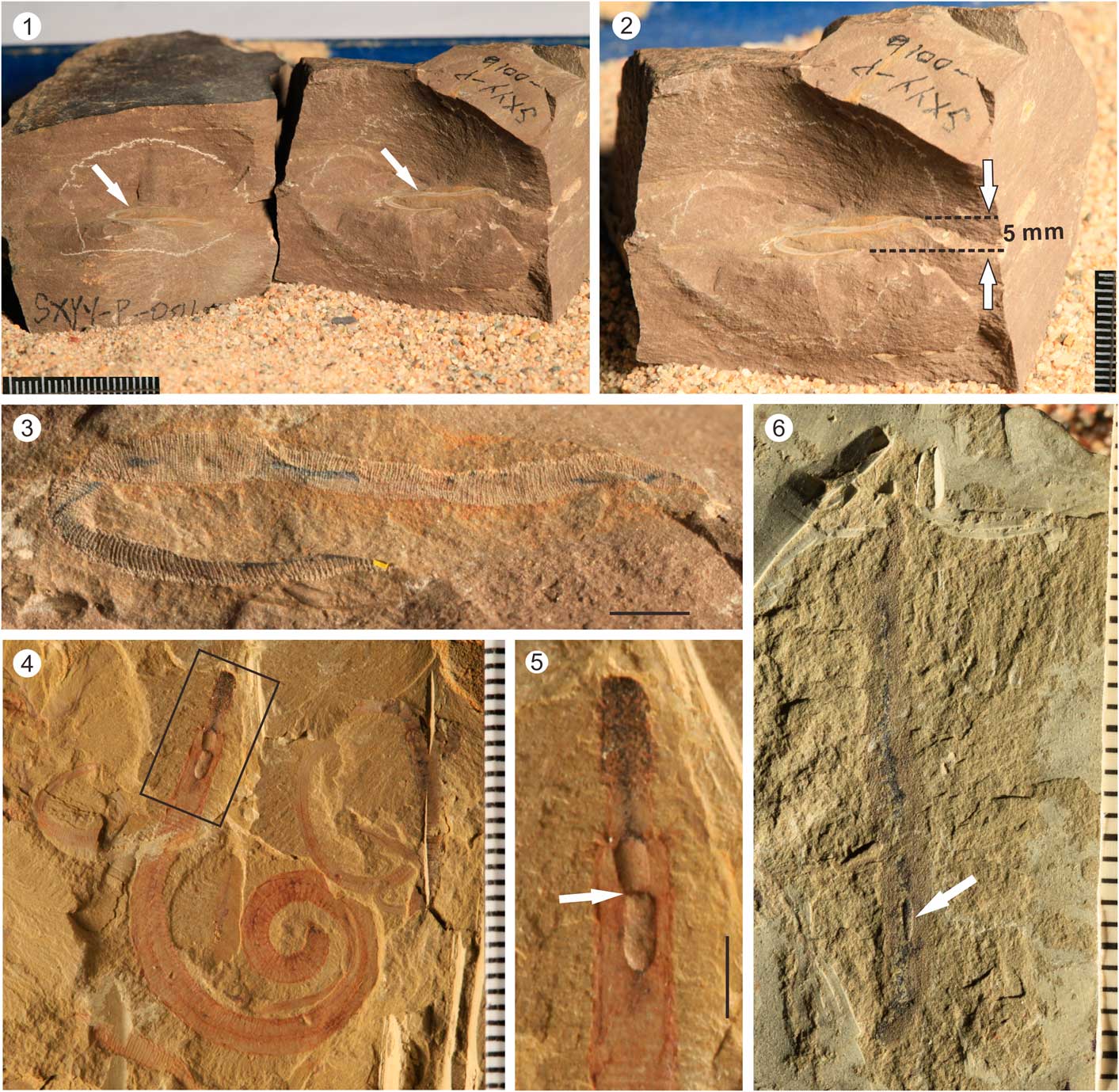
As do most macroscopic compressions, paleoscolecids and their line burrows occur invariably parallel to bedding surfaces, providing limited clue as to the original modes of life. Integral to the lifestyle, a unique individual of Shaanxiscolex xixiangensis n. gen. n. sp. obtained by splitting the longitudinal section of the rock slab, in our opinion, provides vital clues to reconstruct its living habit, combining both vertical and horizontal spacing: the body extends obliquely to the layers of substrate at a depth of approximate 5 mm, with its posterior strongly recurved (Fig. 5.1–5.3). Considering bioturbations are very common at the horizons yielding the worms (Chen and Zhang, Reference Chen and Zhang1987; Zhu, Reference Zhu2010), this fossil probably records the animal either in the process of escaping or during normal burrowing activity, captured by a depositional event. Such a burial attitude, together with the evidence that widespread, large sized, and ecologically dominanct endobenthic paleoscolecids were found living with elongate burrows (e.g., Zhang et al., Reference Zhang, Hou and Bergström2006; Huang et al., Reference Huang, Chen, Zhu and Zhao2014), would strongly suggest that paleoscolecids were infaunal colonizers that contributed to subvertical and oblique exploration of the early Cambrian substrate.
Some paleoscolecid worms from the Cambrian of South China. (1–3) SXYY001, Shaaxiscolex xixiangensis n. gen. n. sp. from the Yanwangbian assemblage near Xixiang County, Shaaxi; (1) specimen obtained by splitting the longitudinal section of a rock slab, showing that the fossil was buried in life position (white arrows); (2) the fossil penetrating obliquely into the layers of substrate at a depth of approximately 5 mm and with its posterior part strongly recurved; (3) enlarged image of the fossil in (2). (4–5) SJZ 14-4619, Cricocosmia jinningensis Hou and Sun, Reference Hou and Sun1988 from the Chengjiang fauna in Sanjiezi, Jinning, Yunnan; (4) several individuals found on a single slab; (5) enlarged view of the boxed area in (4), one of individuals has 3D-preserved sediment-like material (white arrow) close to the oral spiny pharynx. (6) GM 17-642, an indeterminate paleoscolecid from the Kaili Biota (Stage 5) in Jianhe County, Guizhou, with sediment-like pellet in the hindgut (white arrow). (1, 2, 4, 6) Scale bar is linear scale graduated in 1 mm increments; (3, 5) scale bars=2 mm.

Trophic relationships
A slender, straight digestive tract running the length of the body is essentially a conservative organization of the paleoscolecids (Conway Morris, Reference Conway Morris1997; Harvey et al., Reference Harvey, Dong and Donoghue2010), which, along with the spiny introvert, largely reflects the feeding types and strategies of the animals (e.g., Hou et al., Reference Hou, Aldridge, Bergström, Siveter, Siveter and Feng2004; Huang, Reference Huang2005; Maas et al., Reference Maas, Huang, Chen, Waloszek and Braun2007; Conway Morris and Peel, Reference Conway Morris and Peel2010; García-Bellido et al., Reference García-Bellido, Paterson and Edgecombe2013; Martin et al., Reference Martin, Lerosey-Aubril and Vannier2016).
Although guts preserved as black carbon films are very common in compressed paleoscolecids, digestive remains are only documented in very rare specimens of several taxa and are supposed to reflect a deposit-feeding habit (García-Bellido et al., Reference García-Bellido, Paterson and Edgecombe2013, fig. 4I–K; Martin et al., Reference Martin, Lerosey-Aubril and Vannier2016, fig. 6A, B) and/or an omnivorous strategy (Conway Morris and Peel, Reference Conway Morris and Peel2010, fig. 4C). New paleoscolecids with gut contents preserved from Cambrian deposits of South China are illustrated herein (Fig. 5.4–5.6): Cricocosmia from the Chengjiang fauna, Yunnan, and an indeterminate taxon from the Kaili Biota in eastern Guizhou.
The Cricocosmia is strongly recurved, with 3D preservation of sediment-like pellets restricted to the anteriormost part of the trunk and delimited by the lateral constriction, while other parts of the intestine are completely flat and preserved in a dark color (Fig. 5.4, 5.5). It leaves little doubt that the sediment was ingested in vivo during normal feeding. Sediment-like pellets in the Kaili material, by contrast, are confined to the black hindgut and retain a slight relief (Fig. 5.6). These gut contents, in our opinion, are not phosphatized alterations of intestine remains as exemplified by García-Bellido et al. (Reference García-Bellido, Paterson and Edgecombe2013), but sediments that support the interpretation of paleoscolecids as deposit-feeders.
Conclusion
The paleoscolecid Shaanxiscolex xixiangensis n. gen. n. sp. is described from the Cambrian Yanwangbian Biota bordering the north margin of the Yangtze Platform near Xixiang County, Shaanxi Province, China, on the basis of fine-scale cuticle organization. S. xixiangensis exhibits a scleritome pattern that is unique among previously reported taxa and reveals a widespread geographic distribution of paleoscolecid worms in South China during the early Cambrian period.
The paleoecological analysis of paleoscolecids exemplified by S. xixaingensis and other Cambrian taxa also from South China provides direct evidence for the mode of life and the feeding strategies of this extinct group. It reveals that some paleoscolecids were both deposit feeders and carnivores and may be interpreted as a major subhorizontal and subvertical bioturbators in the substrates of the Cambrian sea, which highlights the role that paleoscolecid worms may have played in the ‘Cambrian Substrate Revolution.’
Acknowledgments
This work was supported by the Major Basic Research Project of the Ministry of Science and Technology of China under Grant 2013CB835002, the National Natural Science Foundation of China under Grant 41272036, the Scientific Research Foundation for Talent Introduced in Guizhou University (Grant No. 2016–83), State Key Laboratory of Palaeobiology and Stratigraphy (Nanjing Institute of Geology and Palaeontology, CAS) (No.173130), and the Research Centre of Palaeontology of Guizhou (Gui, Sci. Z. 2014–4003). We are grateful to W. Liu, Y. Zhang, L. Li, and H. Yun from Northwest University, China, for their kind assistance in fieldwork. The scientific comments of two anonymous reviewers and the linguistic assistance of the journal editor (J. Jin) were greatly beneficial to this paper.