

Descartes: principles of light and ideal motion
Thomas Harriot, whose work was discussed in the first part of this paper, generalized the kinematics and dynamics of optical reflection to form the foundations of an atomistic theory of impact.Footnote 1 What of Descartes and his abhorrence of the vacuum? What insights, if any, does he obtain from his early studies in optics? There are two striking differences between Harriot's conception of principles of motion, through the grounding of theories of impact on generalized optical principles, and that of Descartes.Footnote 2 Firstly, Descartes presents his principles as universal laws of motion, applicable not only to how all things actually move but also to how all things would move though their paths are impeded – that is, to their tendency to move. Secondly, his conception of these laws of motion does not arise from his (much later) formulation of a theory of impact.Footnote 3 It rather stems from cosmological considerations that involved a mechanical explanation for the propagation of sunlight and analyses of light–matter interactions.Footnote 4
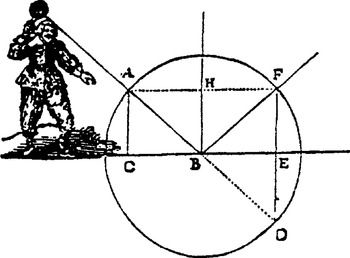
Descartes is the first explicitly to apply the geometry of the parallelogram rule found in the Aristotelian Mechanica to the reflection of light. Its provenance is established by Descartes's identical kinematical explication of this geometry.Footnote 5 He gives a new physical interpretation of the dynamics of reflection in line with the tradition of light mechanics. However, this interpretation follows his novel conception of the nature of light as a tendency to move, not motion itself. Hence the mechanical explanation of the equality of light's angles of incidence and reflection in terms of an unaffected parallel component motion and a resisted perpendicular component must apply to a tendency to motion. He then resolves the ball's motion (AB, Figure 1) into a determination (a directed tendency to move) and its force of motion, which are physically independent. One can be changed without affecting the other.Footnote 6 Using this distinction, Descartes deviates from the light-mechanical explanation of reflection by ignoring the perpendicular component's reversal upon impact.Footnote 7 He favours, instead, an analysis in terms of the conservation of motion.Footnote 8
Dioptrics: Descartes on reflection.

Descartes's explanation for the path of rebound/reflection incorporates the geometry of image location, the parallelogram rule of the Mechanica and a framing circle taken from long-established diagrammatic representations of refraction. The incident line forms the circle's radius. It represents both the direction of the ‘movable’ (such as a ray or tennis ball), the measure of its force and the distance travelled, in a unit of time. In the same time as it takes to travel from A to B, if unhindered at B it would travel to D (Figure 1). Yet since it is prevented from doing so by the surface, and with its quantity of motion AB conserved, its rebound path must also be of radius length. After combining this conserved quantity of motion with the conserved parallel component determination (HF), the only physically possible path possessing both these determinations is that which results in rebound at equal angles, BF.Footnote 9 In this way, Descartes sidesteps the key dynamical element of mechanical impact – the resistance/repulsion acting along the line perpendicular to the tangent plane at the point of impact – focusing instead on the conservation of determinations and their quantities of motion.
Descartes's selection from the kinematical and dynamical principles of light mechanics creates a bridge between optics and mechanics different to that of Harriot and Marci. Though Harriot's resultant ‘doctrine of reflexions’ is superior to Marci's theory of impact, they are built upon the same light-mechanical foundations. In disregarding the dynamical reversal of the perpendicular component of oblique motion, Descartes's bridge between optics and mechanics could not therefore lead to a theory of impact grounded in the law of reflection. Rather, this Cartesian bridge allows the formulation of dynamical principles not limited to impact phenomena. From the kinematics and dynamics of reflection he draws the following general principles: (i) the conservation of both quantity of motion and component determinations, and (ii) the tendency to uniform rectilinear motion in the absence of obstacles, or interfering forces (in his appeal to the mechanical interpretation of the geometry of image location and in the light-mechanical analysis of rebound, respectively).
Of course, Descartes's natural philosophy necessitates a law of motion specifically governing mechanical collisions.Footnote 10 Yet it, and the later rules of impact derived from it, concern direct collisions. The law is largely premised upon the physics of reflection.Footnote 11 However, the subsequent rules also appeal to statical concepts and to the scholastic doctrine that motion results from an excess of force over resistance. This approach is very similar to that of Marci.Footnote 12 It is possible that Descartes knew of Marci's work before publishing his Principia.Footnote 13 Indeed, Marci's failure to consider oblique collisions between unequal balls is reflected in Descartes's solitary and flawed analysis of just such a case, in which he failed to incorporate the light-mechanical principle of action and reaction. Descartes therefore failed to apply the kinematics and dynamics of oblique reflection to collision between unequal bodies (unlike Harriot), let alone equal bodies (unlike Marci). However, the generalization of the dynamics of reflection to mechanical collisions facilitated the generalizability of the parallelogram rule in mechanics. This was something that Descartes therefore signally failed to achieve, unlike Harriot and, especially, Newton.Footnote 14
In conclusion, Descartes's introduction of a hydrostatically derived model of light's propagation and interaction with matter entailed the generalization of physical principles employed in interpreting the geometry of reflection from a particle's local motion to its tendency to motion.Footnote 15 This extension of the dynamical principles employed in the mechanical analogy of optical reflection to light propagation allowed Descartes to construct a single theory of dynamics for both motion (through light metaphysics' focus on light propagation) and resistance to motion (through light mechanics' focus on light–matter interaction). Light's actual propagation as a tendency to motion constitutes a physical demonstration of a material body's tendency to motion, which does not determine its actual motion in a plenum. The mechanical analysis of a tendency's interaction with matter (such as incidence and reflection) demonstrates that the dynamical principles employed apply equally to a body's local motion (such as incidence and rebound) and its component tendencies. However, this dynamical synthesis of the twin optical traditions of light mechanics and light metaphysics was weighted toward the latter. His hydrostatic mechanization of the multiplication of species equally asserted the infinite velocity of light, contrary to the kinematical requirements of light mechanics. This process of pressure-pulse transmission was also entirely dissimilar to that of mechanical rebound. His treatment of optical reflection as mechanical rebound thus remained purely analogical.Footnote 16 Yet his dynamical analysis of mechanical rebound via this analogy, when combined with the atomistic mechanization of light propagation, was what allowed the formulation of a unified dynamics of mechanical motion.
Axiomatization
The paper has thus far charted the historical continuity and conceptual concretization of the mechanical analogy of reflection. It has shown how the widespread yet implicit belief in the generalizability of the geometrical law of reflection to material collision led key kinematical and dynamical features of the physical interpretation of that law to be applied to oblique mechanical collisions in the early to mid-seventeenth century. There is of course more to mechanics than can be generalized from optics, since there are variables such as differing weights and speeds involved in analysing collisions between physical bodies. These are not applicable to light motion/reflection. There exists, therefore, a traditional ‘non-optical’ strand of mechanical thought originating in ancient Greek mechanics and statics that developed further via the medieval science of weights through to Galileo's more immediate predecessors in the sixteenth-century Italian school of Tartaglia, Cardano, Benedetti, Guido Ubaldo and Baldi.Footnote 17 Yet as the seventeenth-century search for laws of motion gathered pace after Descartes, atomism's particulate theory of light offered a conceptualization of light motion as ideal physical motion, a species of material motion completely unaffected by gravity or air friction. In this way, the kinematics and dynamics of light motion become the kinematics and dynamics of mechanical motion, when idealized to the degree necessary for the construction of laws of motion at a higher level of abstraction than those achieved by Galileo for motion affected by gravity (such as projectile and free fall).
Newton: reflection and material collisions
In Newton's early dynamical writings he applies optical principles both to the propagation of forces such as gravity and magnetismFootnote 18 and to material impact/rebound in light mechanics.Footnote 19 These two traditions allow the conceptualization of phenomena ordinarily treated in distinct disciplines (such as astronomy and mechanics) via a single theoretical framework, physical optics. Descartes had previously similarly conjoined the two through his mechanization of the multiplication of (light) species in the celestial medium and the compound analysis of light reflection/mechanical rebound. However, he offered a confused account of circular motion by applying to the tangential component of circular motion the above compound analysis of light as a rectilinear tendency to motion, which failed to grasp the dynamics involved.Footnote 20 With Newton's atomistic conception of light as local (projectile) motion,Footnote 21 his application of the compound analysis of reflection/rebound to circular motion entailed the direct generalization of the dynamics of reflection from rectilinear (optical and mechanical) motion to circular (geometrical and mechanical) motion. Newton was able to identify the dynamical principles requiring axiomatization in the construction of a general theory of mechanics.
Newton's early application of optical principles to rectilinear mechanical motion begins with mechanical definitions of reflection and refraction.Footnote 22 We shall focus on the former: ‘A quantity [body] is reflected when meeting another quantity it looseth the determination of its motion by rebounding from it’, where their parting is due as if to ‘some springing motion in themselves or in the matter crouded betwixt them’.Footnote 23 Newton then clarifies the Cartesian distinction between determination and motion employed in this definition of reflection in a marginal note on circular motion: ‘noe motion is lost in reflection. For then circular motion being made by continuall reflection would decay’.Footnote 24 A body loses its determination to travel in a certain direction, but its quantity of motion is simply redirected. He reiterates this element of conservation in the definition a little later by proposing that motion before reflection is the same as motion after reflection.Footnote 25 This matches the mechanical generalization of optical principles as conducted by, for example, Ibn al-Haytham and Harriot.
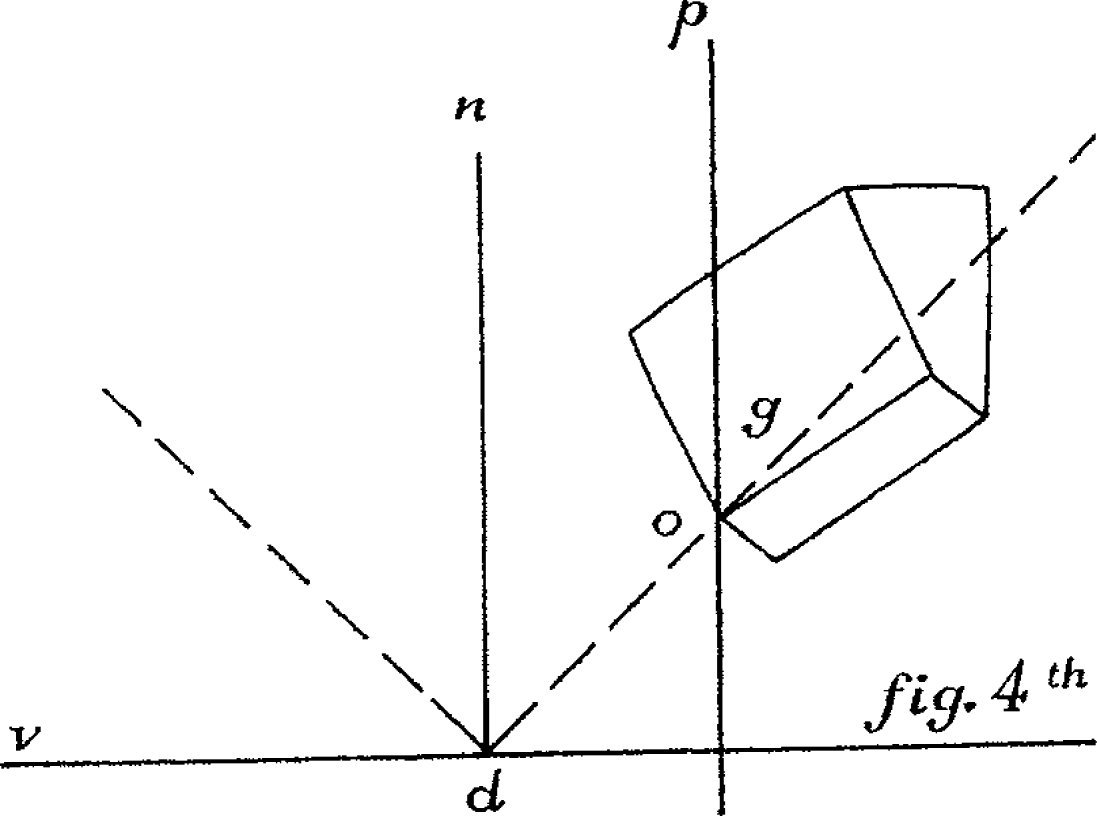
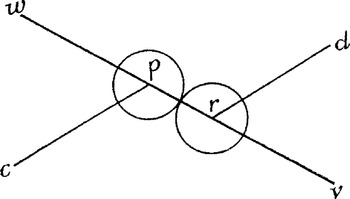
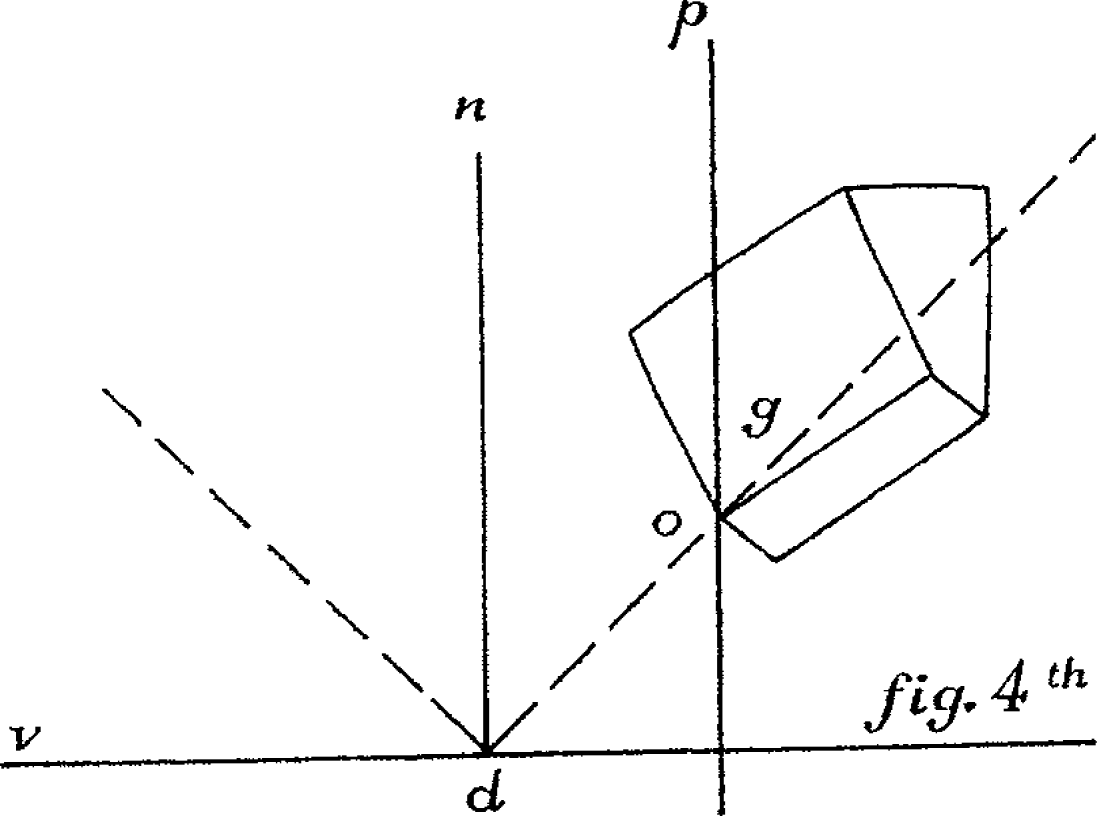
Newton continues to apply the dynamical principles developed within light mechanics to the analysis of material collisions of a body both against a surface and against another body. Regarding the former type of collision (Figure 2), he emphasizes the preserved parallel component of a body's obliquely incident motion and suggests that it is entirely independent of the perpendicular component. It is preserved even when the latter is lost, implicitly raising Harriot's first motive action (see Figure 2 in Part 1 of this paper).Footnote 26 In examining two-body collisions, Newton later explicitly applies to each body this compound analysis of a body's reflection from a surface, where the ‘surface’ is reconstructed as the plane of contact tangent to the point of collision.Footnote 27 Regarding the latter type of collision (Figure 3Footnote 28), under the marginal heading ‘Of the mutuall force in reflected bodys’, he sets out several axioms which duplicate the generalization of the dynamics of reflection found in the light mechanics of writers such as al-Haytham and Harriot. These include the identification of the line of action in impact with that joining the two bodies' centres, the perpendicular component of oblique motion, Kepler's equality of action and effect in opposite directions and the change of motion in rebound via alteration of this perpendicular component.Footnote 29 The concluding axiom (122) states: ‘Therefore if the body p come from c and the body r from d soe much as p's motion is changed towards w, so much the motion of r will be changed towards v’.Footnote 30 Hence here, in Newton's early axioms governing the ‘reflection’ of bodies in rectilinear motion employing generalized optical principles, is the first conceptualization of what later became his third law of motion: ‘To every action there is an equal and opposite reaction: or the mutual action of two bodies upon each other are always equal, and directed to contrary parts.’ This idea of action (impact) and reaction (rebound) being equal and opposite has long been evident in the ideal case of optical reflection and its mechanical analogy and was expressed in Kepler's Optics.Footnote 31 Newton's analysis of two bodies' mutual ‘reflections’ generalized the simple case of equal and opposite reflection/rebound from a surface to the reflections between two incident movables.Footnote 32
Early Newton: reflection from a surface.
Early Newton: two-body collision.

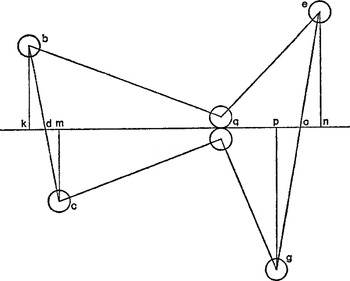
The equality of action and reaction in opposite directions is evident when the incident and rebound angles are equal, in cases such as equal bodies colliding with equal motion, whether oblique or direct. However, where a body's angle of incidence differs from its rebound angle on colliding with another incident body (see Figure 7 in Part 1 of this paper), the equality of action and reaction is difficult to determine. Newton overcomes this problem by applying this principle to the motion of both bodies relative to their common point of motion, from which their rebound motions are equal and opposite (Figure 4).Footnote 33
Newton: rebound – equal and opposite.

Newton's creative introduction of statical concepts into the dynamical analysis of rectilinear collisions enabled the application of the dynamics of reflection to be extended beyond the simple cases of mechanical reflection mirroring the analogies of light mechanics to those cases in which the geometry of reflection does not hold.Footnote 34 This in turn allowed Newton to appreciate their utility with respect to the formulation of general laws of motion, such as the equality of action and reaction evident in the pure case of rebound: optical reflection.
Newton's mechanical laws of reflection
Around 1666 Newton wrote a paper on the motion of bodies through space and their reflections from other bodies, entitled ‘The Lawes of Motion’, most probably drafted as his virtually identical paper entitled ‘On the Laws of Reflection’.Footnote 35 Newton's notion that his own Harriot-like ‘doctrine of reflexions’ constituted general laws of motion is doubtless linked to his statement elsewhere that the ability to reflect light or other bodies, or to be reflected, in collisions, is the defining property of a corporeal, impenetrable, body, where such (reflective/rebound) motion occurs ‘in accord with certain laws’.Footnote 36 This linking of optical and material incidence upon corporeal surfaces allows Newton to refine the geometrical content of principles of motion, as is evident in the conceptual shift occurring between the geometrical treatment of compound rectilinear motion in his ‘To resolve problems by Motion’ and ‘The Lawes of Motion’.
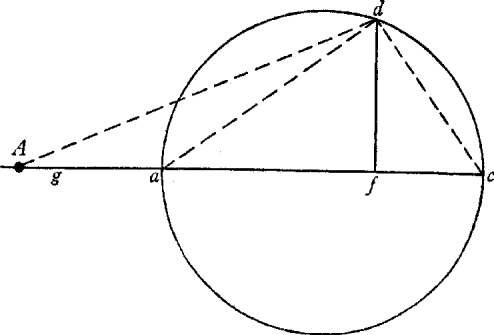
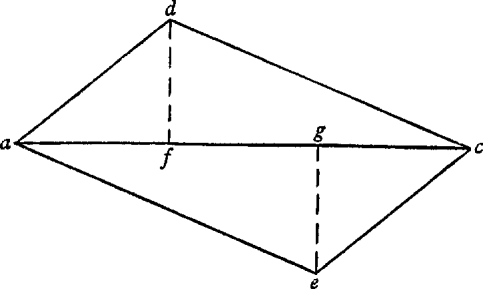
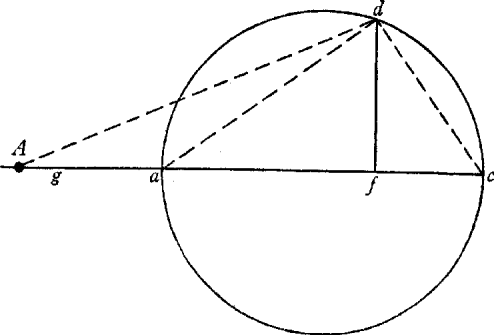
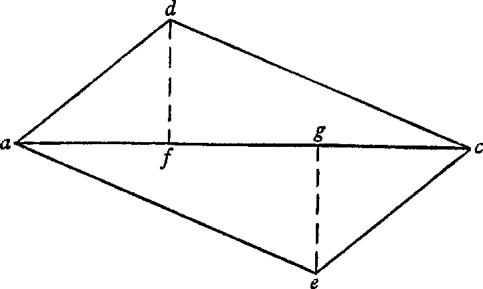
In the former paper, he applies a ‘mechanical’ method to the resolution of mathematical problems via the introduction of motion into geometrical constructions. His statement and demonstration of the basic kinematical principles of component and compound motion are themselves geometrical. Hence Newton (Figure 5a) represents the velocity of a body moving along diameter ac relative to any point (d) on the circumference as a chord (ad),Footnote 37 and his subsequent geometrical demonstration of this proposition on the relative velocities of a moving body rests on Pythagoras' theorem.Footnote 38 Having introduced the notion of direct motion possessing various component velocities, Newton moves on to show that such direct motion can result from a compounding of these motions (Figure 5b), by identifying two components of body a's motion arranged in a parallelogram with the direct motion of two other bodies.Footnote 39 His demonstration appeals to the geometrical argument of the previous proposition (compare adf in Figure 5a and 5b),Footnote 40 in determining the component motions of the first and second bodies towards c.
Newton: component chords.
Newton: summed motion.
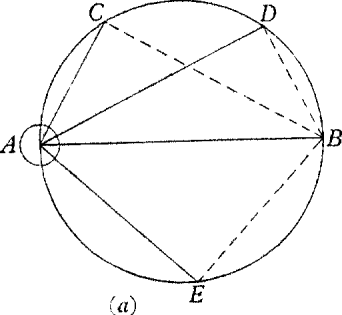
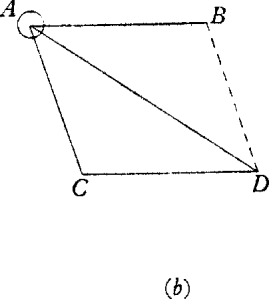
On the other hand, in ‘The Lawes of Motion’, Newton is examining bodies reflecting from others, so their motion towards impact can be conceived in terms of optical incidence and its mechanical generalization, through the compound analysis of obliquely incident motion. The paper has three chapters: ‘How solitary bodyes are moved’, ‘How bodys are Reflected’ and ‘Some Observations about Motion’. At the beginning of the first chapter Newton restates the two principles above, but in a way which now requires no separate geometrical demonstration. This is because he employs the well-established compound analysis of optical incidence/reflection to state general principles of motion, making them seem virtually self-evident. Regarding the first principle, the motion of a body A along the diameter AB (Figure 6a) is no longer considered relative to a point on the circumference (C), but as being oblique to a line (BC). What was once a chord (AC) is thus transformed into the perpendicular component of A's oblique motion AB towards ‘surface’ CB. Moreover, Newton introduces here a body's several tendencies to motion, as presented in Descartes's dynamical analysis of optical reflection and its mechanical analogy. In this way the component velocities of A's velocity towards B, relative to other lines/surfaces, are, as its component of impact motion upon each of these lines/surfaces, perpendicular to these incident ‘surfaces’.Footnote 41 Newton's law of a solitary body's various tendencies to motion and their relative measures follows uncontroversially once Figure 6a is viewed as representing a light ray or tennis ball moving from A to B, obliquely incident upon various surfaces (BC, BD, BE); for the component of their motion directed towards these surfaces will be the perpendicular component of such oblique incidence.
Newton: oblique components.
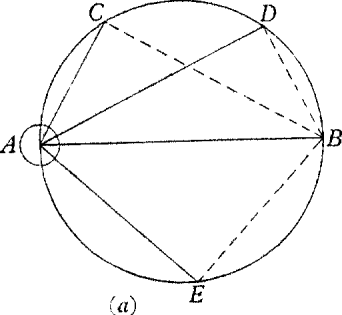
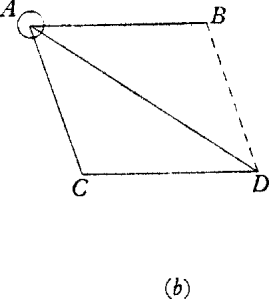
With respect to the second proposition (Figure 6b), Newton demonstrates that these components of direct motion introduced in the first proposition can produce the direct motion, by representing the direct motion possessing component tendencies to motion (AB – Figure 6a), as motion resulting from the composition of two such tendencies (AD – Figure 6b).Footnote 42 The continued appeal to the compound analysis of reflection is evident in Newton's identical representation of a line/surface (BD), upon which the actual motion of the body is obliquely incident (AD), as found in the first proposition (DB and AB respectively – Figure 6a). This implies that the component of velocity AB (Figure 6b) corresponds to the component of velocity AD as the perpendicular component of oblique motion AB (Figure 6a). Newton's appeal to bodies in collision as a means of compounding motions constitutes a mechanical generalization of the dynamics of impact derived from optical reflection: A's physical tendency towards B and the impressed force of impact towards C, composing its (oblique) motion AD. He thus provides a mechanical substitution for the perpendicularly related components of oblique optical incidence constructed within the tradition of light mechanics, as is evident in his subsequent clarification of the above parallelogram principle.
Newton: compound motion.
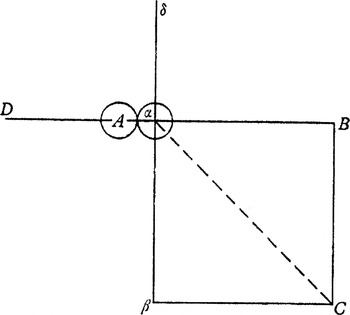
In the paper's last section, ‘Some Observations about Motion’, Newton demonstrates (through Figure 7) both that the actual motions of two bodies are convertible into two component tendencies to motion of one body moving obliquely to a plane of incidence (diagonally),Footnote 43 and that the two component tendencies to motion of one body moving obliquely to a plane of incidence (diagonally) are convertible into the actual motions of two bodies via mechanical collision.Footnote 44 The latter case matches Harriot's first motive act (see Figures 2 and 3 in Part 1 of this paper), and shows that his second principle's composition of tendencies to motion via the parallelogram rule constitutes a mechanical generalization of the dynamical analysis of reflection. Taking Cα as the oblique line of impact of particle α (of light or matter) upon ‘immovable surface’ δβ, its parallel component CB would be preserved unchanged while its perpendicular component Cβ would be reversed, resulting in the usual reflection at an angle equal to BαC. However, taken as a body hitting instead an equal but stationary movable body, its parallel component (CB) is still preserved unchanged, but its perpendicular component Cβ is entirely transferred to this other body, resulting in the incident body's rebound entirely in the direction αδ of its sole remaining (parallel) component motion, and the struck body's motion in the direction AD of its sole, newly acquired and perpendicular, component motion. Running the collision forwards, as two moving bodies meeting at right angles, it becomes clear that α's motion along δβ is perpendicular to the line of body A's impact (DB). This is dynamically identical to motion parallel to a surface of impact vis-à-vis oblique reflection, and so it will be preserved unchanged upon its impact with body A. But since the components of reflection are independent of each other, body α's initial motion is preserved and combined with the motion obtained from the perpendicular impact of body A. We thus arrive at body α possessing perpendicularly related components of motion, just like a light ray αC obliquely incident upon surface βC (or, running the collision backwards, Cα upon βα).
Newton: compounded collisions.

It should now be clear why Newton conceives of his ‘Lawes of Motion’ as ‘Laws of Reflection’. The kinematical and dynamical principles of reflection developed within the optical tradition of light mechanics become directly applicable to colliding bodies upon the atomistic conception of light. Shifting from the simple case of a body rebounding at equal angles from an immovable surface, to that of the mutual collision of two moving or movable bodies disobeying the geometrical law of reflection, rests on the recognition that it is these principles of reflection which require mechanical generalization, not the geometrical law, as previously assumed in the long-espoused mechanical analogy of reflection. Harriot's ‘doctrine of reflexions’ achieved this, but he was unable to generalize Kepler's dynamical analysis of impact/rebound from a surface, equal in power and opposite in direction, to mechanical collisions where the geometrical law of reflection does not hold. Newton, on the other hand, did so by analysing the mutual rebound of bodies from each other, irrespective of a body's incident and rebound angles relative to the mutual ‘plane of contact’. However, the crucial advance made by Newton was his use of the kinematics and dynamics of reflection to analyse the dynamics of circular motion, through their reasonable extension to impulse as well as to impact forces.
Newton: reflection and circular motion
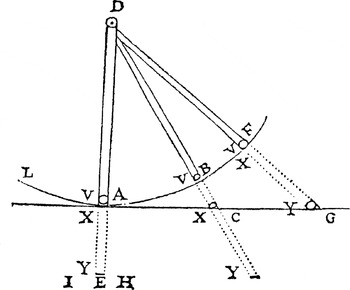
Newton's extension of his analysis of impact to circular motion in his early writings is well known.Footnote 45 But no one has taken his constant appeals to ‘reflection’ seriously enough, so no one has identified or examined the conceptual consequences of Newton's mechanical generalization of the dynamics of optical reflection for the construction of a general theory of mechanics. This is best introduced through Descartes's confused analysis of circular motion, in which he analyses the tangential, rectilinear tendency to motion of a stone whirled around in a sling into two component determinations to establish the body's centrifugal determination (Figure 8):Footnote 46
imagine this inclination that the stone has to move from A to C as if it were composed of two others, that is, one to turn around the circle AB, and the other to go straight along the line VXY, in such proportion that, finding itself at the point of the sling marked V when the sling is at the point of the circle marked A, it ought to find itself later at the point marked X when the sling would be at B, and at the point marked Y when it would be at F, and thus it ought always to remain on the straight line ACG. Then, since we know that one of the parts of its inclination, namely that which carries it along the circle AB, is in no way impeded by this sling, it is easily seen that the stone meets resistance only in its other part, namely that which would cause it to move along the line DVXY …Footnote 47
This confusion arises because Descartes applies the compound analysis of an oblique light ray as a rectilinear tendency to motion to the whirled stone's (tangential) rectilinear tendency to motion. The propagation of light manifests a God-given rectilinear tendency to motion of all bodies and is, when obliquely incident, resolvable into perpendicularly related determinations. Thus this tendency, made manifest upon a body's release from circular motion, must also be so resolvable. Such a compound analysis of the tangential component of circular motion and the conceptualization of a simple circular tendency to motion both rest upon Descartes's metaphysical rejection of the possible existence of centripetal attraction. He can therefore only consider the erroneous centrifugal component motion AE of a falsely compounded tangential motion ACG, rather than the correct centripetal component motion DA of genuinely compounded circular motion AB.
Descartes: circular motion, 1644.

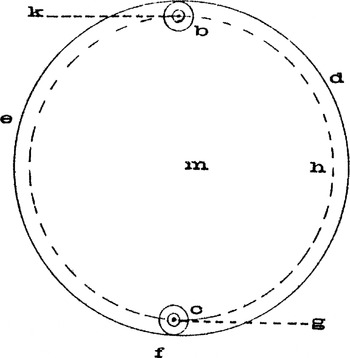
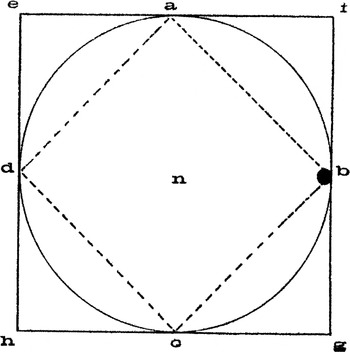
Newton begins to break away from this analysis of circular motion by attempting to analyse the centrifugal force involved in circular motion via his optically derived analysis of impact. He conceives of such motion as resulting from the continual resistance of an external concave surface to the body's tangential tendency to motion, which is continually reflected by the resisting surface (Figure 9). This inwardly directed force/pressure upon the ball from the surface must be equal and opposite to the ball's centrifugal force.Footnote 48 The consequence of such ‘continued reflection’ upon the ball's tangential tendency cg in half a revolution is the equal and opposite tangential tendency bk.Footnote 49 This is in direct agreement with the dynamics of optical reflection and its mechanical generalization to rebound from a surface. Around this time, Newton knew of Descartes's and Hooke's geometrical representations of a raindrop's internal reflections of light.Footnote 50 He was also aware of Hobbes's representation of chords of a circle as obliquely incident lines subject to reflection and his use of the law of reflection as a principle of geometrical construction.Footnote 51 He may also have known of Marci's work on the squaring of the circle via motion.Footnote 52 Whether Newton was influenced by one or all of these geometrical arguments, the result is the same: the analysis of circular motion via reflection from four tangent planes (Figure 10). Newton immediately applied to this problem Archimedes' geometrical solution to the squaring of the circle by increasing the number of sides (reflections) to infinity until it approximates the circle itself.Footnote 53
Newton: circular motion, 1664.

Newton: circular motion by reflection.

Newton here gives physical meaning to a purely geometrical problem and its Archimedean solution by introducing the kinematics and dynamics used in the physical interpretation of geometrical optics.Footnote 54 In this way, the incident path of motion ab (of light or matter) upon surface fbg evidently has perpendicular component af and parallel component fb, while the reflected path bc has perpendicular component gc and parallel component bg. This provides Newton with an insight into the dynamics of circular motion by enabling him to relate the force of the body moving away from the centre n via path ab to the force of one entire revolution (abcd).Footnote 55
As with optical reflection, the impact force of the ball's motion ab upon fg is its perpendicular component fa, reversed by the equal and opposite force of resistance directed towards the centre n of the circular orbit. Hence this centripetal impulse force at b is twice the body's perpendicular component of motion ab, i.e. 2fa. This is shown most clearly in Erlichson's illustration (Figure 11), in which he unknowingly yet appropriately replicates the geometry of image location, providing a dynamical demonstration of the law of reflection. Had the ball encountered no resistance at b it would have continued with uniform motion to x, in the same time that it had moved from a to b. So the impulse force at b produces the displacement xc=2fa.Footnote 56 Therefore the relation between b's motion (ab) and its force (fa) is proportional to the relation between b's ‘force or pression upon fg at its reflecting’ and its force of motion (fa), and the perpendicular component (fa) of obliquely incident motion ab determines the force at fg, due to the reversal of this perpendicular force fa according to the dynamics of reflection. Newton could then apply this analysis to all four reflections (ab, bc, cd, da), making a complete circuit (4ab), and see that the force of reflection in a circuit is proportional to the force of b's motion (fa), where the latter constitutes the required circle's radius.
Erlichson: modern illustration.

Newton immediately goes on to apply the purely geometrical method of exhaustion employed in the classical problem of ‘squaring the circle’ to this square circuit (4ab) crudely approximating circular motion. He conceives of the polygon's many sides as a body's ever-decreasing paths of reflected motion occurring in ever-shorter periods of time. This is entirely kinematical. Yet the number of sides equals the number of the body's multiple reflections, hence the forces involved in its complete circuit. Consequently, Newton reasons that the relation between the total force of all these reflections and the force of the body's motion (perpendicular to the reflecting surface) is proportional to the relation between the sum of all the polygon's sides and the radius of the circle to which the polygon approximates. He then considers a polygon of infinite sides.Footnote 57 He draws the conclusion that the relation between the total force involved in a body's motion around centre n and the force of its motion from centre n (that is, fa) is proportional to the relation between the circle and its radius, i.e, 2πr:r (or 2πr/r).Footnote 58 He obtains this insight by providing a novel dynamical interpretation of the geometrical method of exhaustion, applied not to the area of a circle but to its circumference via infinitesimal line segments representing the continually reflected motions of a body under centripetal impulses.
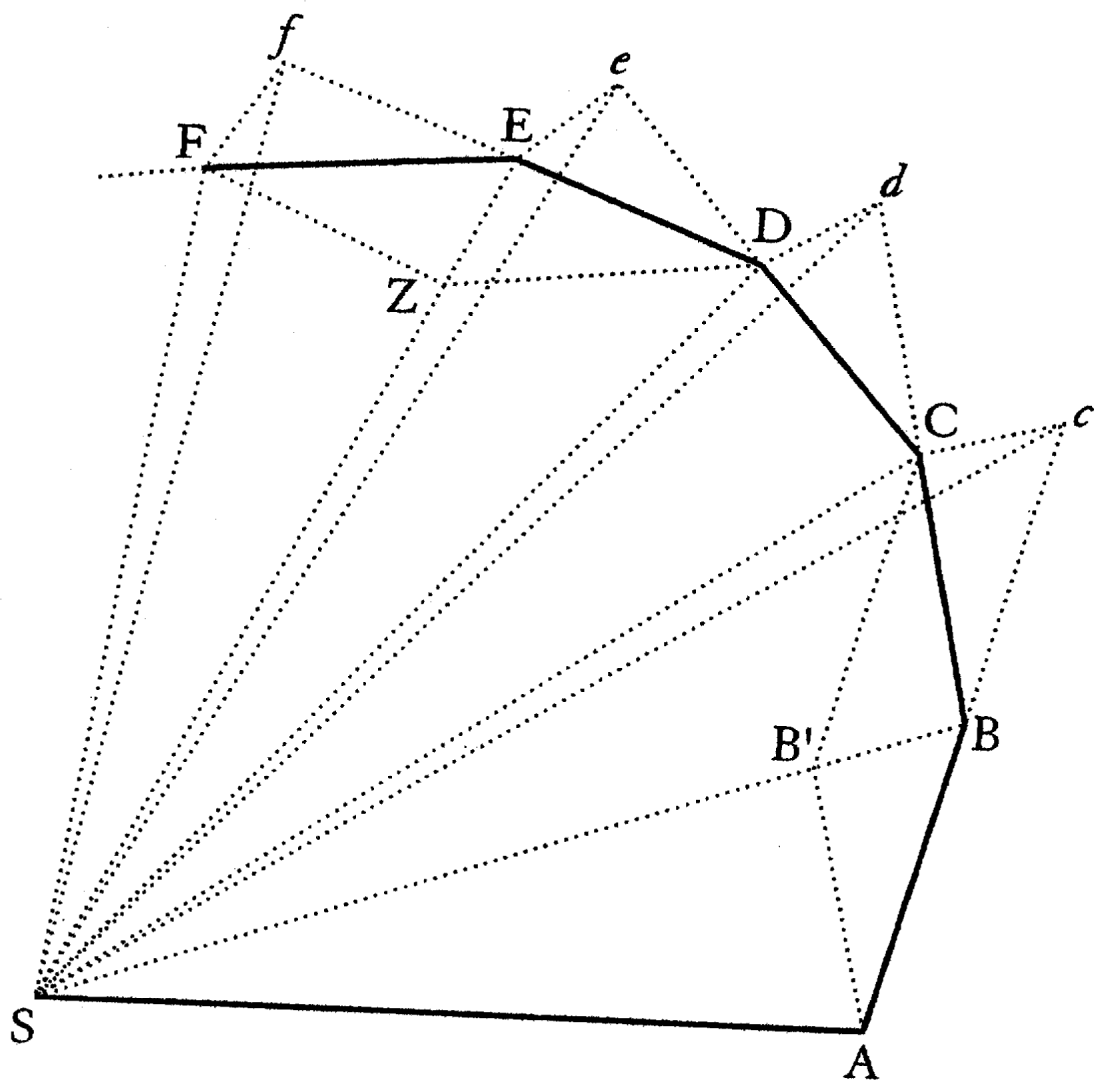
Newton's synthesis of the physico-mathematics of reflection and the geometrical method of exhaustion extends the dynamics of reflection from rectilinear to circular motion through its employment of the parallelogram rule for rectilinear motion. Such a physical interpretation of the geometry of exhaustion in terms of material motion and impulse forces, grounded in a creative appeal to geometrical optics, was a breakthrough in the conceptualization of compound circular motion.Footnote 59 Its enduring conceptual utility is most evident in the Principia's further development (Figure 12) of the original polygonal approach to circular motion (Figure 10). Its first two propositions employ this optically derived approach to show that a body in uniform (inertial) motion subject to a centripetal force will move according to Kepler's law of areas.Footnote 60 The geometrical application of the parallelogram rule via a reflecting ‘surface’ to the classical ‘squaring of the circle’ (as in Figure 10) is here abandoned by Newton in favour of the rule's direct application to the inertial rectilinear motion of a particle and its ‘collision’ with a deviating force (as in Figure 7). Since the ‘collision’ is no longer referred to a reflecting ‘surface’, the resulting component motions of ‘rebound’ at B are no longer conceived as being perpendicular and parallel to a plane. Instead, the body's rectilinear inertial tendency forms one component (Bc) while the centripetal impulse directed in a straight line forms the other (BB′), producing the rhomboid parallelogram BcCB′ and the body's compound motion (diagonal BC) (Figure 12). In this way Newton is able to resolve circular motion into two independent and rectilinear component motions: one towards the centre of motion, the other ‘obliquely’ away from it, becoming tangent to the curve as these inertial line segments (chords of the orbit's arcs) become infinitely small. He reconstructs the ancient Greek parallelogram rule for circular motion, similarly employing a tangential inertial motion but substituting centripetally directed impulse forces for a centrally attractive force.Footnote 61
Newton: polygonal method.

Between 1664 and 1666 Newton developed his own ‘doctrine of reflexions’ for the mutual collisions of bodies, grounded in the physico-mathematical principles of optical reflection. This was more advanced than Harriot's, because it incorporated the mechanical generalization of the law of reflection's equality of action and reaction in opposite directions (as stated by Kepler) to the mutual collisions of bodies having unequal angles of incidence and reflection. Newton also applied these physico-mathematical principles to circular motion through their employment in the physical interpretation of the purely geometrical method of squaring the circle. By 1666 these generalized principles of reflection became for Newton principles of rectilinear and circular motion. He could subsequently construe them as general laws of motion.
We can now identify these generalized principles of reflection and their Newtonian axiomatization. Firstly, all applications of the dynamics of reflection to moving bodies under impact (and, later, impulse) forces assume the mechanical generalization of the principle of the rectilinearity of light propagation: (Descartes's) principle of rectilinear inertia.Footnote 62 Hence everything, whether light corpuscles, material particles or planets, uniformly moves in straight lines before encountering obstacles or deviating forces. This constitutes the kinematic element of Newton's first law of motion. Secondly, all applications of the dynamics of reflection to moving bodies under impact and impulse forces employ the parallelogram rule in the construction and combination of component motions and forces, incorporating their dynamical independence, the conservation of the body's initial inertial motion and the perpendicular action of any deviating force. These constitute key dynamical elements of Newton's second law of motion. Thirdly, having successfully generalized the equality of action and ‘effect’ in opposite directions evident in optical reflection (as stated by Kepler), Newton was the first to incorporate this in the application of the dynamics of reflection to moving bodies under impact and impulse forces. This constitutes his third law of motion.
Conclusion
The specifically seventeenth-century emergence of a general mechanics based upon universal laws of motion cannot be understood without reference to the history of optics. The universality of such laws lies in their equal applicability to light motion and material motion. In principle, the most practical ways of obtaining these laws would be either the generalization of the laws of light to cover material motion or the generalization of the laws of material motion to cover light motion. Historically, the geometrical law of light reflection and its physical interpretation were developed first. From the ancient Greeks, this process involved the (initially) analogical application of the geometrically and experientially demonstrated law of reflection to material motion, in the direct and oblique rebound of bodies from hard surfaces. For centuries the dominance of Aristotelian natural philosophy and the Aristotelian view of light propagation ensured its analogical status. Within optics the physico-mathematical development of this analogical interpretation of reflection constitutes the tradition of light mechanics. At the beginning of the seventeenth century the conceptual hold of Aristotelianism was weakened by competing anti-Aristotelian natural philosophers. In the hands of some of these competitors to Scholastic Aristotelianism, the process of light propagation became mechanized and the physico-mathematical principles of reflection were extended beyond optics into natural philosophy.
The renaissance of atomism prompted a preference for generalizing the physico-mathematics of reflection (light mechanics) across the entire geometrical content of optics as developed within the medieval tradition of light metaphysics. Natural philosophers with mechanist leanings, articulating their view of nature as simply matter in motion, were able to transform the light-metaphysical notion of emanationist force into one of particles in collision. The light-mechanical analysis of reflection/rebound could thus be generalized to form the foundations of a new physics. Yet before this could be achieved there were several conceptual hurdles to be overcome: first, the realization that what requires generalization is the physico-mathematical principles of reflection, not the geometrical law of reflection, for these principles apply even when the geometrical law of reflection does not; second, the realization that one of these generalized principles is the equality of action and reaction in opposite directions; and third, the realization that these principles can be extended to circular motion via their application to impulse, as well as impact, forces.
The tradition of light mechanics provided a dynamical interpretation of the kinematical description of the parallelogram rule for rectilinear geometrical point motion, stated in the ancient Greek Mechanica, through the compound analysis of oblique incidence and reflection. Newton extended the application of this rule to (traditionally simple) circular motion through the creative employment of the emergent conception of the law of reflection as a principle of geometrical demonstration to interpret the purely geometrical resolution of the problem of squaring the circle. He successfully completed the partial transference of the physico-mathematical character of the ‘middle science’ of optics (specifically on light motion) to a science of general motion. This was achieved by the early seventeenth-century construction of theories of impact through the further generalization of its domain of application from impact to impulse forces. Newton's systematic and novel use of the physico-mathematics of reflection provided the key dynamical and mathematical principles upon which his Principia was built, thus founding the new ‘middle science’ of motion – Newtonian mechanics.