Earth and environmental science (EES) education is becoming increasingly important in school science education. With global issues of sustainability, climate change, threats to biodiversity, and dwindling energy and mineral resources, it is important that young people are scientifically literate with respect to the complex multidisciplinary science underpinning these issues. EES courses are being introduced internationally at all levels of schooling as countries attempt to produce environmentally literate citizens, capable of understanding both the daily discourse on such topics, as well as the consequences of actions they undertake in their everyday lives (e.g., Chang, Chang, & Yang, Reference Chang, Chang and Yang2009; Chapman, Reference Chapman2011; Jenkins, Reference Jenkins2000; Metz, McMillan, Maxwell, & Tetrault, Reference Metz, McMillan, Maxwell and Tetrault2010). An understanding of environmental science content by young people can improve their attitudes and subsequent behaviour regarding the environment (Ballentyne, Fien, & Packer, Reference Ballantyne, Fien and Packer1996; Bradley, Waliczek, & Zajicek, Reference Bradley, Waliczek and Zajicek1999).
Traditionally, Earth science has not had the same prestige as physics, chemistry and biology and indeed, a survey by Jenkins (Reference Jenkins2000) in the United Kingdom showed some teachers felt resentment at having to teach the subject. This lack of prestige was exacerbated by university courses not including Earth science subjects as prerequisites for their courses (Burg, Reference Burg2003). A review of the introduction of EES as a new senior school subject in New South Wales by Burg (Reference Burg2003) showed students also viewed this subject as ‘easy science’ and it often attracted weaker students. Mayer and Armstrong (Reference Mayer and Armstrong1990) stated that ‘the science curriculum is trapped in the century old curricular strait-jacket of biology, chemistry and physics. This seems to have ensured the neglect of the planet earth systems that are our home and govern our well-being’ (p. 155). Such traditional and conservative views on science demonstrate that the introduction of EES as a new upper secondary science subject may be challenging.
In 1989, a new national curriculum for science was introduced in England and Wales for 11- to 16-year-olds, which included new aspects of Earth science. Ten years later, King (Reference King2001) surveyed teachers about their views and knowledge on teaching Earth science and found that although teachers reported their own Earth science knowledge and that of their students as moderate, in both cases it was actually poor. King believes this was partly due to a lack of professional development and ongoing support for teachers. When surveyed, most teachers reported obtaining their Earth science knowledge from student science textbooks (which contained little Earth science content) and from other teachers (whose Earth science knowledge may also be poor).
In 2004, in Taiwan the Earth Science curriculum was restructured to address students’ increasing need of awareness of environmental issues (Chang, Chang, & Yang, Reference Chang, Chang and Yang2009). The name was changed from ‘Earth Science’ to ‘Earth and Environmental Science’. Over 1,000 Taiwanese secondary school teachers were surveyed on their views of teaching EES. Teachers were asked to rank certain statements according to their perceived importance. The results demonstrate that a high priority for teachers was to support students’ scientific literacy so they could become interested in and understand the world around them.
The introduction of EES as a senior school subject in New South Wales in 2000 brought challenges for teachers. While most teachers felt the combination of Earth science and environmental science was appropriate, teachers also felt the course contained too much information to teach effectively (Burg, Reference Burg2003). Students also faced challenges with the new subject. After the first year, 32% of students dropped the subject (the highest of any science subject). Nevertheless, the combination of Earth science and environmental science provided a subject with many attributes that potentially linked positively to student learning. Students are exposed to environmental issues and terminology frequently in the media. The relevance of this subject to students was immense, given its media exposure and applications to daily life. Students are interested in learning about and understanding the world around them. Fieldwork and practical work comprise a large part of EES courses, and it has been shown that students show a greater content knowledge when given fieldwork-based instruction as opposed to classroom-based instruction (Elkins & Elkins, Reference Elkins and Elkins2007). Chang and Weng (Reference Chang and Weng2002) also found that students gained a better understanding of content when taught using inquiry-based teaching versus didactic teaching in Earth science, and concluded that ‘process skills, especially those of observation and hypothesis formulation skills, be infused throughout all Earth science curricula’ (p. 449).
The development and implementation of EES curriculum needs to be informed by findings from environmental education research (Ballantyne & Parker, Reference Ballantyne and Packer1996; Jenson, Reference Jenson2002; Stevenson, Reference Stevenson2007). Ballantyne and Parker (Reference Ballantyne and Packer1996) developed a theoretical model for the effective teaching of environmental education that focuses on the three key components of knowledge, attitudes and behaviour. Jenson (Reference Jenson2002) also highlights the importance of knowledge, attitudes and behaviour in his ‘action competence model’. These models promote a student-centred, collaborative model that is constructivist rather than didactic.
At present in Australia, each state and territory is responsible for the selection of science subjects and prescribed curriculum. In the senior secondary years (Years 11 and 12), South Australia, Queensland and the Northern Territory schools offer Geology. The Australian Capital Territory teaches Earth Science. Tasmanian and Victorian schools offer Environmental Science and Tasmanian schools teach Environmental Science and Society. New South Wales is the only other state besides Western Australia to offer EES.
However, an Australia-wide national curriculum for Kindergarten to Year 12 is currently being developed and implemented. In Kindergarten to Year 10 there is an Earth and space sciences strand. In the senior secondary years there are four courses — Biology, Chemistry, Physics and EES — that are currently being developed for full implementation from 2015 (Australian Curriculum Assessment and Reporting Authority, 2013). This will standardise the teaching of science occurring in senior secondary schools Australia-wide and ensure students are entering tertiary institutions with similar background knowledge and skills. The inclusion of EES as one of the four senior secondary science subjects highlights the recognised importance of the need for both understanding and human resources in this field in Australia.
An understanding of EES is particularly important in Western Australia. Western Australia is the largest state in Australia, covering almost one third of the country. The climate of Western Australia is unique, with conditions that vary from Mediterranean in the South West, to arid in the centre and monsoonal in the North. In addition, Western Australia is well known for its resources industry. Yet, Western Australia is also well known for its pristine natural environment and, in particular, its biodiversity. Australia is recognised as one of 17 countries that holds more than two thirds of the world's known living life forms (Mittermeier, Gil, & Mittermeier, Reference Mittermeier, Robles-Gil and Mittermeier1997). Of particular interest is Western Australia's South West region, which is internationally recognised as one of 34 ‘biodiversity hotspots’ in the world, defined by Conservation International as ‘the richest and most threatened reservoirs of plant and animal life on Earth’ (Conservation International, 2007). This is the only ‘biodiversity hotspot’ in Australia. Because of the wealth of both resources and biodiversity, it is essential for future generations of Western Australians to be equipped with the knowledge and understanding to benefit from, as well as protect, the state's natural heritage.
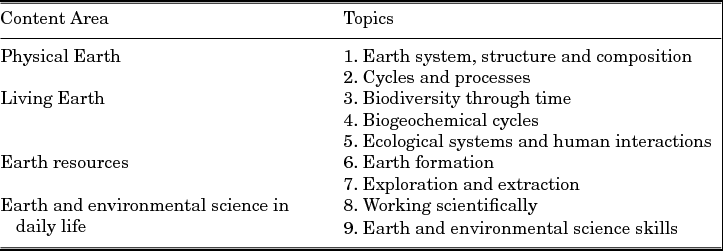
In 2006, Earth Science Western Australia (ESWA) was formed to promote and support the teaching of Earth science in secondary schools across Western Australia (WA). ESWA is a consortium representing Curtin University, the University of Western Australia, Australia's Commonwealth Scientific and Industrial Research Organisation (CSIRO), and the Geological Survey of Western Australia and the Western Australian Museum. ESWA worked closely with the education sector to support the development of the new Year 11 and 12 course, EES. Since the introduction of EES as a Western Australian Curriculum Council approved course in 2007, the number of students studying EES has steadily increased from 416 in 2008, 591 in 2009, 667 in 2010 to 660 in 2011 and 817 in 2012. In contrast, there has been a slight decrease in the number of students studying Biology, Chemistry and Physics. The EES course comprises six semester length units called 1A, 1B, 2A, 2B, 3A and 3C. The 3A and 3B units are normally offered in year 12, while 2A and 2B are offered in Years 11 or 12. 1A and 1B are offered in Year 11. Within the syllabus there are four content areas with topics that are taught in each pair of units (e.g., 2A/2B). Table 1 summarises the content areas and topics in the EES course.
EES Content Areas and Topics

The purpose of the research study reported here was to determine teachers’ and students’ perceptions of the EES course. Part of the research (not reported here) examined factors that influenced the uptake of EES in Western Australian secondary schools (Dawson & Moore, Reference Dawson and Moore2011). It was found that EES was introduced at schools where the teacher had an educational qualification, employment history or personal interest in geology or environmental science. Teachers perceived that studying EES would increase students’ career and university choices and help them understand the importance of environmental issues in society. This research study addressed the following research questions:
1. Why do students choose to study EES in Years 11 and 12?
2. What EES topics do students find difficult, relevant/useful and interesting/?
3. What effect does studying EES have on students’ views about Earth and environmental science topics?
Method
The research design and methods were developed within a qualitative research paradigm. An instrumental case study approach (Merriam, Reference Merriam2009; Stake, Reference Stake, Denzin and Lincoln2000) was the primary research method used in this study. A case study is a suitable research design for understanding and interpreting a phenomenon. A case study is bounded in terms of time, sample, location and phenomenon. In this case study, the impact of a new upper secondary EES course in Western Australia was examined. Multiple data sources, including teacher interviews, student interviews and questionnaires, and syllabus documents were examined. The data were triangulated to contribute to the reliability of the findings. An instrumental case study is distinguished from other case study types in that it aims to provide insight into an issue (in this situation, the introduction of a new EES course). It is acknowledged that a limitation of case study research designs is that the findings cannot readily be generalised to other contexts. However, the transferability of the findings is enhanced through triangulation, and readers may decide on the extent to which the findings are applicable to their context.
Data sources included semi-structured interviews with EES teachers, focus group interviews with Year 12 EES students and written questionnaires from Years 11 and 12 students studying EES. The use of these multiple sources of data allowed triangulation and cross-checking of emergent hypotheses (Creswell, Reference Creswell2008). Each of these data sources are described below. Before commencing the research study, ethics approval was obtained from the authors’ University and the WA Department of Education.
Teacher Interviews
EES teachers from all 34 schools that offered EES in 2008 and/or 2009 were invited to participate. A total of 27 teachers from 24 schools agreed to be interviewed. In 10 schools, either no teacher was available or no teacher agreed to be interviewed. The educational background of the 27 teachers tended to be in either Earth science or environmental science. Only two teachers had formal qualifications in both Earth and environmental science. Almost two thirds (15/24) of the schools taught EES in the science department, while one third (9/24) of schools taught EES in the social studies department (Dawson & Moore, Reference Dawson and Moore2011). The semi-structured teacher interviews (which ranged in length from 4 to 26 minutes) were audio-recorded and conducted either face to face or by telephone at a time convenient to the teacher. The purpose of the interview was to determine:
• what factors influenced the school to offer EES;
• EES teacher background/expertise;
• EES resources used;
• professional development undertaken and needed;
• what parts of the course students find easy, relevant or interesting;
• any perceived changes in students’ attitudes; and
• suggested improvements.
All recorded interviews were fully transcribed and the transcripts were analysed question by question. At the first level of analysis, each of the interviewee's responses to each of the questions were cut and pasted into separate files. Using a grounded theory approach, the text for each question was analysed for distinct categories or themes (Corbin & Strauss, Reference Corbin and Strauss2008). At the second level of analysis, the themes were coded and the entire text related to each question was coded. The themes and related quotes were ranked by listing them in order of frequency cited from most frequent to least frequent.
Student Interviews
Student interviews were conducted with 20 Year 12 students from each of four schools (one independent, one Catholic and two government schools). The schools were selected because they represent the three school types in Western Australia. The proportion matched the types of schools that offered EES in that EES was offered in twice as many government schools as Catholic and independent schools. The four schools had offered EES since it commenced in 2007, and relatively large numbers of students were enrolled in EES. Year 12 students were selected because they had studied EES over 2 years. The EES teachers were asked to select five students with EES grades ranging from A to D. The students and the schools are not intended to be representative of all schools offering EES. The purpose of the interviews was to determine students’ perceptions of aspects of the course. Specifically, students were asked questions about:
• why they chose to study EES;
• future career and study choices;
• whether and how the EES course influenced their attitudes;
• what parts of the course they found easy, relevant or interesting; and
• suggested improvements.
The focus group interviews ranged in length from 30 to 45 minutes. The interviews were recorded and fully transcribed. The transcripts were analysed question by question as described for the teacher interviews.
Student Questionnaire
A questionnaire was developed and administered to Years 11 and 12 students to determine what parts of the EES course they found easy/difficult, relevant/irrelevant or interesting/uninteresting. The students were also asked which EES units they had previously completed, which Year 11 and Year 12 courses they were studying, why they chose to study EES, and their future study or career plans for 2010.
Face validity (Creswell, Reference Creswell2008) was ensured through consultation with a tertiary science educator, a geologist and an EES teacher, who independently examined the wording of the questionnaire. Students were asked to rank nine topics (see Appendix) on a scale of 1 to 9 using the criteria of difficulty, relevance or interest. If a topic had not been studied or students were unfamiliar with the topic they were asked to record a U for ‘unsure’.
The questionnaire was trialled for construct validity (Creswell, Reference Creswell2008) with a group of five Year 12 EES students from one independent school. As a result of their feedback, examples were provided for each of the nine topics and extra options were added for reasons for studying EES and post-school destinations. A geologist and an EES teacher assisted with the wording of the topic examples. In addition, the term ‘relevance’ was replaced by ‘usefulness’. The questionnaire is included in the Appendix.
The 34 schools that offered EES in 2008 and/or 2009 were approached and their Year 11 and 12 EES students were invited to complete the student questionnaire. Students from 13 schools were unable to participate. The reasons for schools not participating were that EES was no longer offered (five schools) or that teachers could not be contacted after numerous attempts (eight schools). Questionnaires were sent to 436 students in 21 schools. A total of 243 questionnaires from 14 schools were returned. Questionnaires were returned from 155 (64%) Year 11 students and 88 (36%) of Year 12 students. More Year 11 students responded because enrolments in Year 11 were higher than Year 12, and in some schools Year 12 students were unable to participate because of final year examination pressures. The student responses to each question were categorised, coded and entered into SPSS (Allen & Bennet, Reference Allen and Bennett2008). Each question was analysed separately. Where appropriate, frequency counts, means and standard deviations were calculated.
Results
Reasons for Studying EES
The 20 Year 12 students who were interviewed were asked why they had chosen to study EES and whether they would still choose EES if they were able to choose again. Most students (12/20) chose the course because they were interested in Earth science or environmental science topics as the following quote illustrates: ‘I kind of liked the natural disaster aspect of it, like volcanoes and explosions. I think that's pretty cool.’
Five of the students studied EES because there were no other choices on their timetable. Several students studied EES in Year 12 because they had found a different Year 11 course to be too difficult: ‘I chose it because I did biology in Year 11 and they didn't run it, they stopped running it and it fitted my timetable and it was like the closest thing.’
Only three students chose EES because it fitted with their possible career choices: ‘I wanted to be a geologist, so the course fitted.’
Three quarters of the students said they would select the course if they were able to go back and select their courses again.
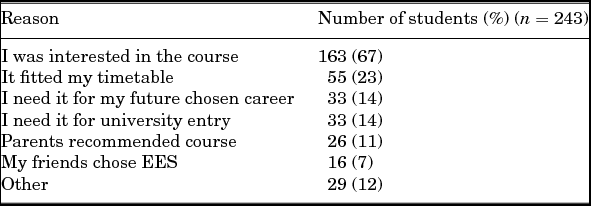
In the questionnaire, students were asked why they had chosen to study EES and given a range of reasons to select from. Table 2 shows the frequency of responses. Students were able to select more than one answer. More than two thirds of students chose EES because they were interested in the course and almost a quarter for timetable reasons.
Reasons Students Chose to Study EES
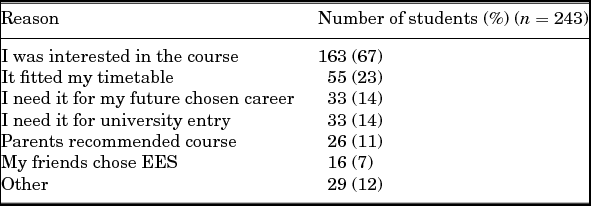
The students were asked if they selected their courses again, would they still choose to study EES and why. A total of 152 (63%) students would select the course again, while 50 (20%) would not. The remaining 41 (17%) students were unsure. Students were asked to provide a reason for their answer. The most frequently cited reasons for choosing to study EES again were: ‘interest in the course’ (77, 51%); ‘enjoyment of the course’ (38, 25%); ‘improved understanding of the world’ (33, 22%); ‘needed for chosen career’ (25, 16%); and ‘easy’ (24, 16%). The main reasons why students would not choose to study EES again were that EES is: ‘too difficult’ (18, 36%); ‘boring’ (14, 28%); ‘not needed for future study/career’ (9, 18%); and ‘not enjoyable’ (7, 14%). As one student explained: ‘It is a very heavy course requiring much reading/researching, very large workloads when coupled with other heavy courses.’
Difficulty of EES Topics
Teachers’ perceptions of difficulty
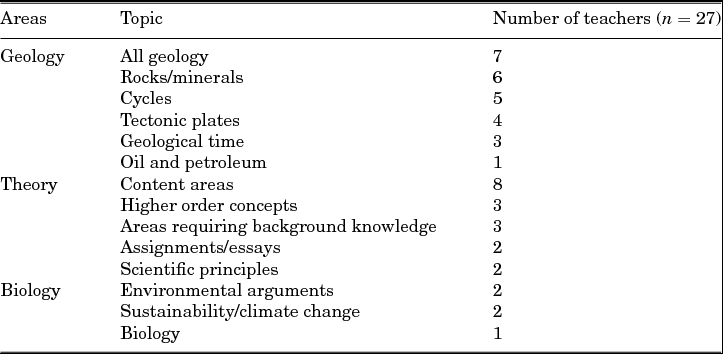
The EES teachers stated that students experienced difficulty with several areas and topics within the course. The areas and topics are summarised in Table 3.
Teachers’ Perceptions of Difficult Topics Within EES Course
The most frequently cited area was geology. As one teacher explained: ‘It's the Earth bit that the kids struggle with. The geology, the rock section, the organic geology, the formation of oil and petroleum products, that kind of stuff.’
The theory or content areas of the course were considered to be difficult because students did not have sufficient background knowledge from lower secondary school:
Understanding anything new that wasn't taught to them in lower school. Earth science is a bit of a challenging one for lower school. So they come up with not much prior knowledge. They do the basics — layers of the earth, atmosphere. We’ve just started to touch on climate change in Year 10, but previously I hadn't taught that.
The teachers were also asked which topics or aspects of the course students found easiest to understand. Environmental science topics, practical work and field trips were considered to be the easiest topics:
Stuff that's related to what they can see, so the weather stuff they can pick up, forestry, stuff that's pretty common in the news that's to do with global warming, rainforests and things like that, that are quite general knowledge type issues that are taught through the course.
They love the practical stuff. They love fieldwork because I do incorporate a lot of fieldwork and things that relate to local areas. So, we’ve got lots of field trips that relate to here, where the school is actually located. So it's relevant to them, where they are living and what's happening around them in their suburbs, in their area.
A small proportion of teachers considered that students found geology topics easiest. These teachers had qualifications in geology:
Like I said, processes. They understand how tectonic plates move, they understand how faulting works, they can understand how unconformities occur. They understand things that are quite visual to them and processes. They get those straight away.
Students’ perceptions of difficulty
A quarter of the students who were interviewed considered biodiversity and environmental issues to be difficult because they were complex: ‘Maybe stuff related to human impact on the environment. It just tends to be complex because there are all these different arguments for “for” and “against”.’
Also, some students were not interested in the environment: ‘Probably the environment and the chemistry stuff. It's my only science course and I’m not interested in it [environmental side].’
Other students (3/20) argued that environmental topics, including biodiversity, were the easiest: ‘I find the environmental stuff the easiest. Global warming and the stuff we are doing now, and also the working scientifically.’
Several students (3/20) found the science content (e.g., chemical formulas) difficult, especially if they were not studying any other science courses. It was noted during the interviews that while some students studied chemistry, physics and EES, some students studied only EES: ‘This is my only science course, so the scientific side of it is hard to get. As in the chemical formulas and things like that. I don't have as deep an understanding as some people do.’
Six students stated that rocks and cross-sections were the most difficult topics to understand: ‘It's always rocks. Figuring out which rock it is by looking at a picture or description and trying to remember what they are made of and what is the parent rock and all this stuff.’
In contrast, the easiest topics identified by almost half the students (8/20) were rocks, rock cycles and processes: ‘The rocks, and because in chemistry we do the same stuff that we do here, it's just more applied to situations. It's like real-life examples of what we do in chemistry.’
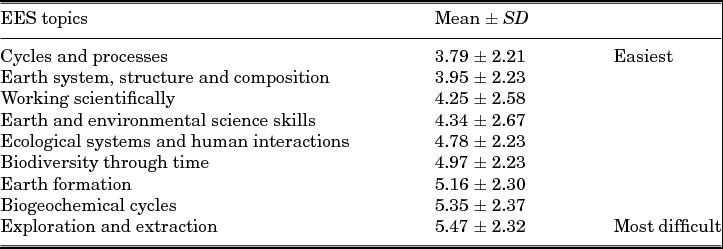
In the questionnaire, students were asked to rank EES topics from 1 to 9 according to how difficult they were to understand. A mean and standard deviation was calculated for each topic. Table 4 summarises the students’ perceptions of difficulty. The higher the mean the more difficult the topic.
Students’ Perceptions of Difficulty of EES topics (n = 243)
‘Exploration and extraction’ and ‘Biogeochemical cycles’ were perceived to be the most difficult topics. The topics ‘Cycles and processes’ and ‘Earth system, structure and composition’ were perceived by students as the easiest topics. ‘Working scientifically’ and ‘Earth and environmental science skills’ were also considered to be relatively easy.
Relevant EES Topics
Teachers’ perceptions of relevance
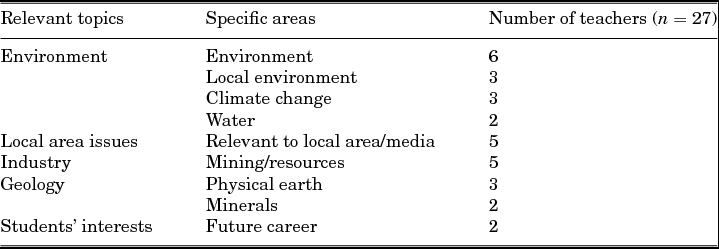
The teachers were asked which topics of the course students found the most relevant or useful. The topics or areas are summarised in Table 5.
Teachers’ Perceptions of Relevance of EES Topics
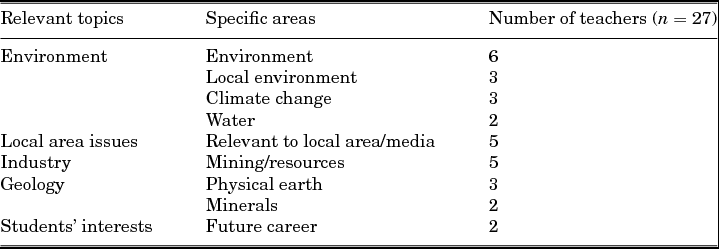
Overall, teachers considered that students found environmental topics to be the most relevant. This included issues relating to both the global ecosystem and the local environment:
To the students, I think the most relevant elements of the course are seeing how the Earth naturally cycles to contribute to things like climate change, the historical significance of global warming and global cooling periods through geological history.
Topical issues relating to the local environment, as well as issues raised in the media were also considered to be relevant:
Topics that come up that are relevant for them today or maybe in the news, things that they are hearing at the time I think. And their prior knowledge. They know about plate tectonics, so they know mountains and volcanoes and things like that, but looking at the mechanisms and the evidence that's when they get a bit lost.
Five teachers stated that their students found the Earth science/geology topics most relevant. As one teacher stated:
The physical earth. We moved into earthquakes and of course volcanoes and so on and we moved onto natural disasters etc, so we added that layering. Not just making it physical earth and the structure and composition, but we tried to bring in what was the environmental change or the impact of that change on society and people.
Of the five teachers who included mining and resources in their answer, three were located in mining towns:
Maybe it's very easy for them to grasp the ideas of resources and knowing what is petroleum, what is coal, how is it extracted, how is it formed. They found that quite useful and a lot of them have parents who work in the industry. It was like, ‘I find this great, I need to know this so I can talk to Dad about it.’ So I guess when we were looking at the resources and the economic geology, they find that relevant.
Students’ perceptions of relevance
Almost half of the interviewed students (8/20) stated that topics related to their future career and life choices were most relevant. Students who planned to continue with geology perceived geology topics to be relevant. Some students stated that EES was relevant to their life and helped them when faced with issues about EES topics:
There's all this stuff . . . like whenever you go travelling now or when you’re watching TV. I was watching TV the other day and I could see a rock in the background and I was questioning it. It's not really applicable to my occupation but everyday life. That's why I love doing it.
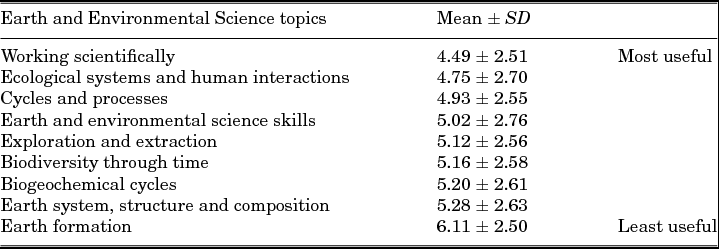
Students ranked the nine EES topics based on how relevant they thought they would be in their future career or university study. Table 6 shows the mean and standard deviation of the usefulness the EES topics for the future career or university study of the students. ‘Working scientifically’ and ‘Ecological systems and human interactions’ are perceived to be the most useful topics. ‘Earth formation’ is perceived as the least useful topic by students.
Students’ Perceptions of Relevance of EES Topics
Interesting EES Topics
Teachers’ perceptions of student interest
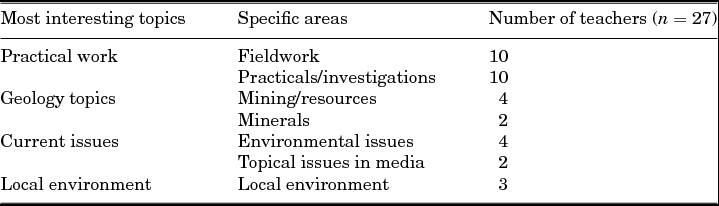
The teachers were asked which parts of the course students found the most interesting. The areas are summarised in Table 7.
Teachers’ Perceptions of Interesting EES Topics
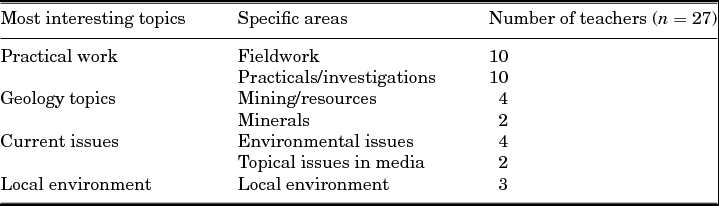
Many teachers responded that students were most interested in the practical side of the course, including fieldwork, practical work and investigations. Several teachers mentioned relating fieldwork to the students’ local environment and thus increasing both the relevance and the interest to students:
As I said, they like doing the prac work and finding out about their areas because they’ve had to get soil samples and analyse them and look at the biotic factors in that area. So, they’ve enjoyed going out and looking at their physical environment and collecting samples and testing samples. It's the practical side of it rather than the theory side of it.
Six teachers had students who were interested in geological aspects of the course. These aspects included rocks and minerals, fossils, soil and plate tectonics: ‘They find the traditional, hard rock geological aspects the most interesting, the rock types, rock cycle, minerals and the relationship between the rock types and the minerals.’
Six teachers also mentioned their students were particularly interested in current and topical issues that they found relevant to their own lives. These issues included climate change and appropriate use of resources: ‘Climate change again, and they do like the sustainable use of Earth's resources. We talked a bit about the precautionary principle and we talked about things that were relevant to them up here.’
A small proportion of teachers (3) noted that students were particularly interested in their local environment. Two of these teachers teach in mining towns: ‘I think that they found the iron ore most interesting because that's what we do here. It's part of their daily lives.’
Students’ perceptions of interest
For the students who were interviewed, 7/20 students stated that field trips were the most interesting aspect of the course: ‘Field trips! Hands down. Yeah, really seeing it rather than looking at pictures on the Internet and stuff. It just really consolidates it.’
Three students thought the environmental aspect, including biodiversity, was the most interesting element: ‘The stuff we are doing now — the environmental. I don't go out and look at rocks and go, oh that's magic kind of thing! It's not useful and it doesn't interest me.’
Another three students stated that rocks, minerals and processes were the most interesting aspect.
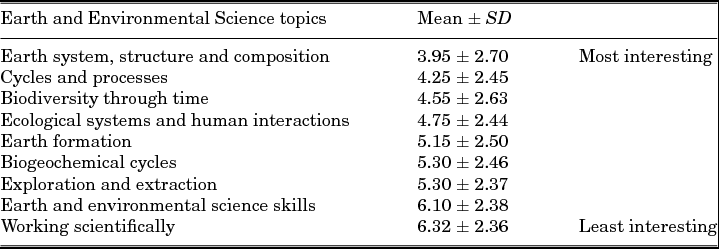
Students were asked to rank the EES topics from 1 to 9 based on how interesting they were to study. Table 8 shows the mean and standard deviation of the level of interest in each EES topic from lowest to highest. The topics are thus ranked from the most interesting to the least interesting.
Students’ Perceptions of Interesting EES Topics
‘Earth system, structure and composition’ and ‘Cycles and processes’ are perceived by students as the most interesting topics while ‘Working scientifically’ and ‘Earth and environmental science skills’ were considered the least interesting topics.
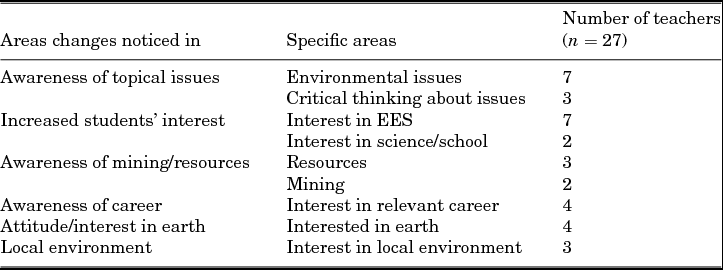
Effect of EES Course on Students’ Views of EES
Teachers were asked if they had noticed any changes among their EES students as a result of studying the course. Almost all teachers (24/27, 89%) noticed positive changes in their students’ views towards EES topics. The areas in which these changes occurred are summarised in Table 9.
Changes in Students’ Views of Earth and Environmental Science
Most of these positive changes occurred in the area of students’ awareness of environmental issues:
Definitely. Definitely, yes. In regards to use of pesticides — what's gone in, what's gone into our drinking water, the state of the rivers, the quality of water because we test water from various parts of the Swan River because we’re actually part of the catchment. And so we collected our water and the water quality deteriorated quite badly all the way down. So there was a lot of interest in that. Their ideas for saving the water were fantastic.
In seven classes, students showed great enthusiasm and interest in the course. Some teachers noted an increase in interest from their students as the course progressed:
I was unlucky because my school ran the course at the same time as biology, so there were about six or seven kids in the biology course who were very keen on EES as well. So at first, I didn't have a very enthusiastic class. To start with they were kind of just the ones who didn't want to do biology. But over time, they have really developed an enthusiasm and are really quite excited about the course. They came in with, ‘Oh well this is just a class that I’ve got to do’ and now they actually quite enjoy it. They voluntarily all came on the tour and enjoyed themselves.
Mining/resources were another important area where teachers had noticed a positive change in their students. This included students gaining a better understanding of the importance of renewable and non-renewable resources: ‘Their knowledge of the minerals and where they come from in the Earth and they actually understand now that they run out. And that we have to look for new renewable resources.’
Several teachers (4) mentioned that students in their EES classes had gone on to investigate careers in Earth science and/or environmental science fields, with some students entering university in a relevant course:
Well, I’ve definitely had a number of students who have taken career directions like that. We’ve had a few that have gone onto UWA, one to Curtin, so they have actually continued in geoscience. And next year, I’m going to have a whole pile of students who are actually really interested in the environmental side of it. And I guess just piquing their interest and their understanding in topical issues that are in the media has been quite good.
As well as improved student interest in general environmental issues, a small proportion of teachers noted their students’ became interested in their local environment:
Some of the kids are asking a lot more questions about the Earth and during the lessons they are asking relevant questions about our local area. ‘So what age are the rocks up on the hills that we looked at on our last excursion?’ They are actually quite interested in their local area.
Two teachers referred to one particular student who stood out as an example of a student who had dramatically improved their attitude to their work:
One of the students was reluctant to do any work, wouldn't sit any tasks. He now submits every task and gets 100% for them. And he's just been accepted to attend the National Youth Science Forum in Canberra in January and he works three days a week full-time in a mining company in the town that he lives in. Because it's in his interest, he's actually motivated to do it. Before that, it was really difficult to get him motivated into school. His whole attitude has changed and he likes doing this course. That's one of the positives.
Nearly half of the students who were interviewed (9/20) stated that the EES course had had a positive effect on their attitudes to the environment, global warming and resource use: ‘More the resources. If I [see] someone wasting water, it makes me think about what I’ve learnt in EES because there's not enough water here. And all the global warming and stuff.’
Discussion
The purpose of this research study was to determine: why students choose to study EES in Years 11 and 12; which EES topics students find difficult, relevant/useful and interesting; and if the study of EES has any effect on students’ views about EES and their future study and career choices. It is intended that the findings of this case study will inform the curriculum design and implementation processes of EES courses nationally and internationally. Most students who were interviewed chose to study EES because they thought it sounded interesting. Only a small number chose EES because of future career choices. This was supported by the questionnaire data, with 67% of students studying EES because of interest. Other reasons were that it fitted their timetable, was needed for their future career or university entry, or had been recommended by their parents. It is positive that the majority of students (63%) would choose to study EES again because of interest and enjoyment in the course. However, a proportion of students (21%) would not choose EES because they thought it was boring and difficult.
In examining teachers’ and students’ perceptions of the course, we were surprised at the diversity of views of both teachers and students. From many of the teachers’ perspectives, the most difficult topics for students were Earth science content areas. Some teachers stated that all areas of geology were difficult while others mentioned specific areas, including rocks/minerals, cycles, tectonic plates and geological time. However, some teachers (all of whom had a geology background — and their students) perceived geology topics to be the easiest. Difficulties associated with content were thought to be due to lack of student background knowledge from lower secondary school and academic weakness. The environmental science part of the course was considered to be the easiest, as well as practical work and field trips. The teachers’ views are supported by the students with the most difficult topics, ‘Exploration and extraction’, followed by ‘Biogeochemical cycles’. The two topics of ‘Environment and biodiversity’ and ‘Rocks, rock cycles and processes’ were deemed by some students in the interviews to be the easiest and by others to be the most difficult. The easiest topics according to the student questionnaire data were ‘Cycles and processes’ and ‘Earth system, structure and composition’.
In terms of relevance, interviewed students found topics related to their everyday lives and future career plans to be most relevant. This was confirmed by the teachers. However, there was a dichotomy of views about what those topics were. For example, students who were interested in geology-related careers found topics involving rocks to be relevant. ‘Working scientifically’ was considered the most useful topic followed by ‘Ecological systems and human interactions’. The topic considered the least useful was ‘Earth formation’ followed by ‘Earth system, structure and composition’.
The least interesting topics were ‘Working scientifically’ and ‘Earth and environmental science skills’. Both teachers and interviewed students stated that field trips, rocks and the environment were the most interesting parts of the course. This finding is supported by Boyle et al. (Reference Boyle, Maguire, Martin, Milsom, Nash, Rawlinson, Turner, Wurthman and Conchie2007), who found that fieldwork in tertiary environmental science and earth science courses resulted in increased student interest and engagement. In addition to improving student interest, extended fieldwork has been shown to improve academic achievement. Elkins and Elkins (Reference Elkins and Elkins2007) found that university students enrolled in an entirely field-based geology course achieved a greater understanding of geology concepts than students studying traditional courses.
In the student interviews, there was a consistent pattern between difficulty, relevance and interest in a topic. Those students who considered rocks or the environment to be relevant were more likely to find these topics easy and interesting. Students considered ‘Working scientifically’ to be the most relevant topic for their future university study or career, albeit the least interesting. The topic of ‘Earth system, structure and composition’ was the most interesting topic as well as the second easiest; however, it was also perceived to be the second least useful topic.
Despite variability about exactly which topics were difficult, relevant or interesting, the EES course seems to have had a positive influence on many students. The majority of teachers noticed a positive change in their students in a variety of areas, including awareness of topical issues, increased interest in EES, awareness of mining and resources, and awareness of EES as a career choice. Students seemed to realise that EES was relevant to their other subjects and to life. Students also noticed a positive change in their attitudes towards the environment, global warming and resource use.
The findings of this study have several limitations. First, as explained in the method, with a case study research design it is not possible to generalise the findings to all EES courses. Nevertheless, the findings may be transferable to similar EES courses. Second, the data was collected at a single point in time (2009), 18 months after the introduction of the course. It is likely that if the study was repeated now that the findings may be different. Some of the teachers who had been teaching EES for only 18 months will now have over 5 years’ experience. However, as explained earlier, the findings of this study are intended to assist in the initial implementation of new EES courses so that they are sustained with increased enrolments.
Conclusion
The research presented here focused on why students chose to study Earth and Environmental Science in Years 11 and 12, what topics they found difficult, relevant and interesting, and what effect studying the subject had on their attitudes towards EES topics. The findings have implications for the introduction of new EES courses, particularly in upper secondary school. The successful introduction of a new EES course seems to depend on several factors. Teacher background is important, given that those with a familiarity with the topics will be more comfortable teaching them. Certainly, students of teachers with Earth science backgrounds perceived geology topics to be more interesting than those students with teachers who had no geology background. The location of the school in terms of its local environment was also important. Students who studied EES in a mining town in Western Australia seemed to have a more personal interest in Earth science than those studying in metropolitan areas.
An unexpected finding was the diversity of students studying EES. Some students studied EES simply because it fitted into the timetable so may have had little interest in the subject. There were students who took this subject as their only science subject, or who viewed the subject as an easy science, and they seemed to struggle with the more complex scientific concepts. Other students were studying chemistry and physics in addition to EES and had clear career goals in mining. Some students were interested in environmental science but not Earth science.
The lack of EES content knowledge by students was perceived to be an issue by some teachers and may have contributed to students’ perceptions of difficulty. The inclusion of Earth science in the lower secondary school science curriculum is essential to overcome this issue. We did not examine the lower secondary science curriculum of the participating schools. At the time of this evaluation, the Western Australian Curriculum Framework (Curriculum Council of Western Australia, 1998) includes ‘Earth and Beyond’ as one of four content areas in Kindergarten to Year 10. EES teachers need to recognise which topics students are likely to find difficult, especially if they are only studying one science subject, and allow extra time to teach these topics.
Professional development is a cornerstone of the introduction of any course, and especially EES with its combination of Earth science (considered a physical science) and environmental science (considered a biological science). Teachers may have expertise in one of these areas but not both (Dawson & Moore, Reference Dawson and Moore2011). As EES is a new course offered within science or social studies departments, university teacher educators and preservice science and social studies teachers also need appropriate professional development. As recommended by Ballantyne and Parker (Reference Ballantyne and Packer1996) and supported by the findings here, teacher professional development should focus on EES knowledge and the development of constructivist strategies such as inquiry based approaches. The teaching strategies need to provide opportunities for students to use their knowledge to think critically, question, suspend judgement and make evidence based decisions (Littledyke, Taylor, & Eames, Reference Littledyke, Taylor and Eames2009; Stevenson, Reference Stevenson2007; Wilson, Reference Wilson2012)
In conclusion, EES is a course being recognised internationally as pertinent and imperative for formal school study. As the world faces an uncertain future, it will surely be the next generation of scientists, perhaps those who studied EES at school, who will determine the outcome of our fate.
Acknowledgments
The authors acknowledge the support of Earth Science Western Australia for funding the evaluation of the WA EES course, and Associate Professor Leah Moore (University of Canberra) who was Executive Director when the study was conducted.
Appendix Earth and Environmental Science Student Survey
School Year level EES units completed
1. What were the main reasons you chose to study EES? (please tick one or more boxes)
□ It fitted my timetable
□ My friends chose EES
□ I was interested in the subject
□ My parents thought it would be a good idea
□ I need it for my future chosen career
□ I need it for university entry
□ Other
2. What other courses are you studying at the moment?
3. Rank the following based on how easy they were for you to understand. Use a scale of 1 to 9 where 1 is the easiest and 9 is the most difficult. If you are unfamiliar with the term, please put a U to show you are unsure.
Other comments:
4. Rank the following based on how useful you think they will be for you in your future career or university study. Use a scale of 1 to 9 where 1 is the most useful and 9 is the least useful. If you are unfamiliar with the term, please put a U to show you are unsure.
Table as for Question 3
5. Rank the following based on how interesting they have been to study. Use a scale of 1 to 9 where 1 is the most interesting and 9 is the least interesting. If you are unfamiliar with the term, please put a U to show you are unsure.
Table as for Question 3
6. If you were to go back and select your courses of study again would you still choose EES? (please tick box)
□ Yes □ No □ Undecided
Why?
Author Biographies
Vaille Dawson is Professor of Science Education and Dean of Teaching and Learning in the Faculty of Science and Engineering, Curtin University, Western Australia. She holds an ARC Discovery grant (2013–2015) on scientific literacy and is on the editorial board of four high impact factor science education journals. Her research interests include socioscientific issues. She has co-edited three widely used preservice teacher education textbooks for primary and secondary science teachers and co-authored 14 book chapters, 40 peer-reviewed journal papers and presented more than 80 conference papers at local, national and international science education conferences.
Katherine Carson is a Research Associate in the Science and Mathematics Education Centre, Curtin University. Previously a veterinarian, she completed a graduate diploma in education at Edith Cowan University in 2007. Since then she has worked at Edith Cowan University (School of Education) and Curtin University researching Australian secondary school students’ understandings and attitudes about socioscientific issues such as genetically modified foods, genetic testing and climate change. She is currently developing curriculum resources on climate change science for secondary school students.