Surgical site infections (SSIs) account for a significant portion of healthcare-associated infections and costs.Reference Zimlichman, Henderson and Tamir 1 In 2006, the Surgical Care Improvement Project (SCIP) introduced measures to reduce the incidence of SSI and included recommendations on timely and appropriate administration of antimicrobial prophylaxis prior to incision.Reference Berenguer, Ochsner, Lord and Senkowski 2 Despite widespread adoption of these measures, there continues to be relatively high rates of SSI,Reference Hawn, Vick and Richman 3 especially in hepatobiliary procedures.Reference Saeed, Dubberke, Fraser and Olsen 4 National guidelines endorsed by the American Society of Health-System Pharmacists and the Infectious Diseases Society of America recommend the use of cefazolin (a first-generation cephalosporin), a second-generation cephamycin-type cephalosporin (cefoxitin or cefotetan), ceftriaxone (a third-generation cephalosporin), or ampicillin-sulbactam for biliary tract procedures.Reference Bratzler, Dellinger and Olsen 5 Some investigators have suggested that these regimens are inadequate for hepatobiliary procedures, particularly pancreaticoduodenectomy, and have advocated for the use of broader-spectrum agents, such as piperacillin-tazobactam, instead.Reference Donald, Sunjaya and Lu 6
We sought to characterize the microbiology of hepatobiliary SSI at our institution and to explore associations between patient, procedure, and prophylaxis factors and the development of SSI. We specifically sought to determine whether receipt of a regimen with expanded gram-negative (anti-pseudomonal) or anti-enterococcal coverage is protective against SSI.
Methods
This study was conducted at Beth Israel Deaconess Medical Center, a tertiary-care academic medical center in Boston, Massachusetts, that performs ~300 nontransplant hepatobiliary procedures per year. The study was approved by the institutional review board at the study institution. The study population was derived from all patients who underwent a hepatobiliary procedure between January 1, 2013, and June 30, 2016, excluding procedures among patients who had a hepatobiliary procedure in the year preceding the index procedure. We captured hepatobiliary procedures using the National Healthcare Safety Network (NHSN)–defined ‘BILI’ (bile duct, liver, or pancreas surgery) category, which includes pancreaticoduodenectomy, hepatic resection, and pancreatectomy. Patients undergoing liver transplantation were excluded. SSIs were determined through routine infection control surveillance and defined using NHSN definitions. 7
All patients with an NHSN-defined SSI complicating a study procedure were defined as cases for this analysis. Controls were randomly selected from patients who underwent one of the study procedures uncomplicated by the development of an SSI; they were matched 2:1 with cases based on the fiscal quarter of the procedure date. Patient factors, including demographic characteristics and baseline comorbidities, were collected through retrospective chart review. Procedure factors, including type of surgery, duration, and antimicrobial prophylaxis administered were collected through review of operative and anesthesia reports and electronic medical administration record data. Antimicrobial prophylaxis was defined as all antimicrobials received within 1 hour prior to incision (2 hours for vancomycin administration). Study institution practice guidelines during the entire study period recommended cefazolin plus metronidazole for pancreaticoduodenectomy and cefazolin alone for other pancreatico-biliary procedures (including low-risk laparoscopic procedures), with no postoperative doses recommended unless infection is noted during the procedure; clindamycin plus gentamicin were recommended in the case of severe β-lactam allergy. Providers were able to deviate from these guidelines at their discretion. Organism identification and susceptibility were determined through review of microbiology reports and interpreted according to Clinical and Laboratory Standards Institute (CLSI) definitions. 8
Descriptive data are presented as means with standard deviation or percentages where appropriate. To identify patient, procedure, and prophylaxis variables associated with SSI, we first performed univariate logistic regression including variables thought a priori to be associated with SSI. We then constructed a multivariate logistic regression model to examine whether coverage for Enterococcus spp or expanded gram-negative coverage (defined as the inclusion of activity against Pseudomonas aeruginosa) was associated with the development of SSI, after adjusting for other predictors of SSI. Antimicrobial spectrum-of-activity variables and variables with a P value of≤0.15 on univariate analysis were included in the multivariate model. We performed a sensitivity analysis using the same cohort but excluding superficial SSI; the multivariate model included variables used in the primary multivariate regression model. All analyses were conducted using STATA version 14 software (StataCorp, College Station, TX).
Results
Study population, procedures, and SSI outcomes
The study period included 975 hepatobiliary procedures, 80 (8.2%) of which were complicated by a SSI. Between 1 and 9 SSIs were detected per fiscal quarter, corresponding to an SSI rate ranging from 1.6% to 13.6% (median, 8.2%; interquartile range, 6.4%–10.6%). Of the 80 SSIs, 15 (18.8%) were superficial and 65 (81.3%) were deep or organ/space. Table 1 demonstrates the characteristics of the study population and procedures.
Characteristics of Study Population

Note. ASA, American Society of Anesthesiologists; ERCP, endoscopic retrograde cholangiopancreatography; MDRO, multidrug-resistant organism (defined as methicillin-resistant Staphylococcus aureus, vancomycin-resistant enterococci, or multidrug-resistant Gram negative organism resistant to an agent in at least three antimicrobial classes: third- or fourth-generation cephalosporins, β-lactam-β-lactamase inhibitors, carbapenems, quinolones, and aminoglycosides, identified on culture from any site); SD, standard deviation. Totals may not equal 100% due to rounding.
a Unless otherwise specified.
b Tobacco use was characterized as any lifetime use.
c Malignancy was characterized as any nondermatologic solid organ malignancy, or leukemia or lymphoma.
d Other procedure types included liver biopsy, hepaticojejunostomy, cholodochojejunostomy, cholecystectomy with biliary manipulation, duodenal resection, pancreatic gastrostomy. Each of these procedure types comprised<10% of all procedures.
Antimicrobial prophylaxis administered
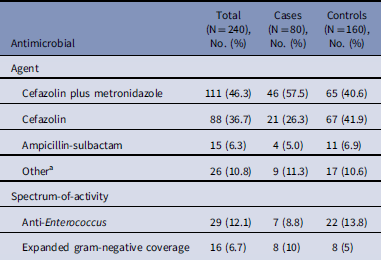
Among the 240 procedures in the analysis, the most common regimen administered was cefazolin plus metronidazole (111 procedures, 46.3%), followed by cefazolin (88 procedures, 36.7%) and ampicillin-sulbactam (15 procedures, 6.3%). Additional regimens each constituted fewer than 2% of procedures (Table 2). Cases and controls received a first-line perioperative prophylaxis regimen at similar frequencies (83.3% vs 83.1%, respectively). Among procedures lasting >4 hours, 88% of patients in case procedures and 87% of patients in control procedures received≥1 additional intraoperative dose of antimicrobial prophylaxis. Patients with a documented β-lactam allergy at the time of the procedure received a first-line regimen less frequently than patients without a documented β-lactam allergy (Supplemental Table S1).
Perioperative Antimicrobial Prophylaxis Administered

Note. Totals may not equal 100% due to rounding.
a Other regimens, each comprising<2% of all regimens, included vancomycin plus piperacillin-tazobactam, vancomycin plus cefepime, vancomycin plus ciprofloxacin, vancomycin plus levofloxacin, vancomycin plus ceftriaxone, clindamycin plus gentamicin, ceftriaxone, piperacillin-tazobactam, meropenem, and linezolid plus meropenem.
Microbiology of SSIs
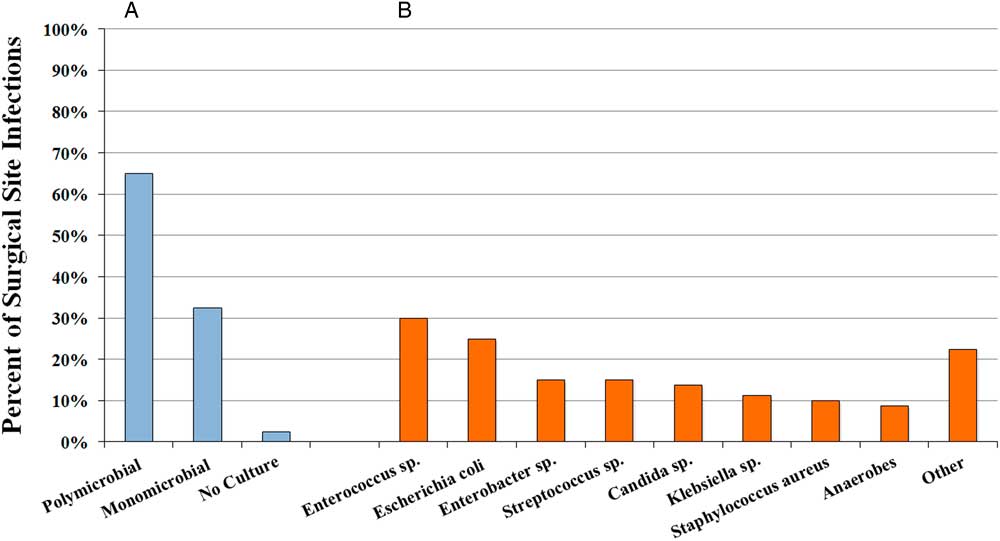
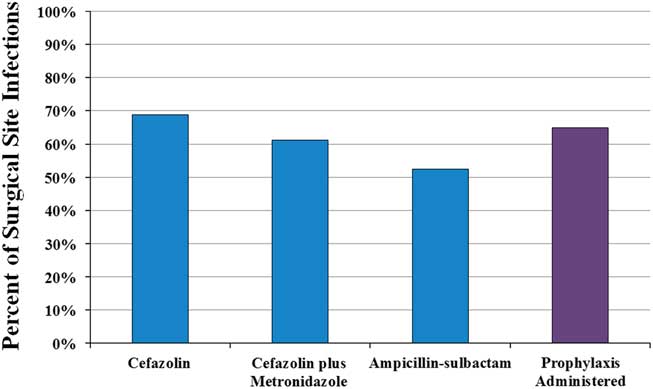
Figures 1A and 1B demonstrate the microbiology of SSIs. Most SSIs (52, 65%) were polymicrobial in nature, 26 (32.5%) were monomicrobial, and 2 (2.5%) had no culture data. The most commonly implicated organism was Enterococcus spp (24 SSI, 30%), followed by Escherichia coli (20 SSI, 25%) and Enterobacter spp (12 SSI, 15%). Most cases demonstrated an organism nonsusceptible to standard prophylaxis regimens (Fig. 2). The prophylaxis administered lacked activity against at least 1 isolate in 65% of cases.
Microbiology of surgical site infections among patients undergoing hepatobiliary procedures. (A) Polymicrobial is defined as≥1 organism isolated in the culture defining surgical site infection, and monomicrobial is defined as only 1 organism isolated on culture. (B) Percent of all surgical site infections (N=80) with organism implicated (isolated in culture). ‘Other’ includes Serratia marcescens, Pseudomonas aeruginosa, Coagulase-negative Staphylococcus, Achromobacter spp, Citrobacter freundii, Morganella morganii, and Haemophilus spp, all at<7%. Note. N=80 surgical site infections.

The frequency of 1 or more organisms nonsusceptible to the prophylaxis administered and guideline prophylaxis regimens. Note. N=80 surgical site infections. Yeast as a cause of surgical site infection has been excluded from this analysis.

Of the 80 SSIs, 19 (23.8%) were attributable to a multidrug-resistant organism (as a monomicrobial infection or part of a polymicrobial infection), including 2 (2.5% of SSIs) due to methicillin-resistant Staphylococcus aureus, 5 (6.3% of SSIs) due to vancomycin-resistant enterococci, and 15 (18.8% of SSIs) due to multidrug-resistant gram-negative bacilli. Among these, patients with 0 of 2 (0%) methicillin-resistant Staphylococcus aureus infections, 0 of 5 vancomycin-resistant enterococcal infections (0%), and 3 of 15 infections (20%) due to multidrug-resistant gram-negative bacilli were given an antimicrobial prophylaxis agent active against the multidrug-resistant pathogen that was associated with the SSI.
Risk factors for SSI
Table 3 demonstrates the univariate and multivariate analyses of patient, procedure, and prophylaxis-related variables among cases and controls. In univariate analysis, male gender, prior ERCP with stent, tobacco use, presence of a β-lactam allergy, and undergoing a pancreaticoduodenectomy, open procedure, or procedure >4 hours were significantly associated with development of an SSI (P<.05). Antimicrobial prophylaxis-related variables, including receipt of antimicrobials for >24 hours postprocedure, receipt of a regimen with Enterococcus coverage, or receipt of a regimen with expanded gram-negative coverage were not significantly associated with development of an SSI. In the multivariate model, neither the receipt of a regimen with Enterococcus coverage nor receipt of expanded gram-negative coverage was significantly protective against SSI (for Enterococcus coverage, adjusted odds ratio [aOR], 0.58; 95% confidence interval [CI], 0.17–2.04; and for Pseudomonas coverage, aOR 2.4; 95% CI, 0.56–10.29). Male gender (aOR, 2.75; 95% CI, 1.41–5.37), documented β-lactam allergy (aOR, 3.54; 95% CI, 1.36–9.19), open procedure (compared with laparoscopic: aOR, 3.55; 95% CI, 1.39–9.05), and procedure duration>4 hours (aOR, 3.84; 95% CI, 1.82–8.12) were significantly associated with SSI in multivariate analysis. In our sensitivity analysis, the results of the primary analysis were unchanged when considering only deep or organ-space SSIs (data not shown).
Univariate and Multivariate Analysis of Factors Associated with Surgical Site Infection

Note. 95% CI, 95% confidence interval; ASA, American Society of Anesthesiologists; ERCP, endoscopic retrograde cholangiopancreatography; MDRO, multidrug-resistant organism (defined as methicillin-resistant Staphylococcus aureus, vancomycin-resistant enterococci, and multidrug-resistant Gram-negative organism resistant to an agent in at least three antimicrobial classes, identified on culture from any site). A “...“ symbol indicates that the variable was not included in the model.
a Tobacco use was characterized as any lifetime use.
b Malignancy was characterized as any nondermatologic solid organ malignancy, or leukemia or lymphoma.
c Other procedure types included: hepatic resection, pancreatectomy, liver biopsy, hepaticojejunostomy, cholodochojejunostomy, cholecystectomy with biliary manipulation, duodenal resection, pancreatic gastrostomy. Each of these procedure types comprised<10% of all procedures.
Discussion
In this study, we found that most of the 80 studied hepatobiliary SSIs demonstrated organisms nonsusceptible to standard prophylaxis regimens but that receipt of prophylaxis with either enterococcal or pseudomonal spectrum-of-activity was not associated with reduced risk of SSI. These findings regarding the microbiology of hepatobiliary SSI agree with studies that have demonstrated resistance rates of >50% in culture isolates implicated in infections after hepatobiliary procedures.Reference Fong, McMillan and Marchegiani 9 , Reference Gavazzi, Ridolfi and Capretti 10
While most SSI cases demonstrated an organism nonsusceptible to the prophylaxis received, we found only patient and procedure-specific factors to be predictive of SSI, rather than antimicrobial spectrum of activity. Patient-specific predictors of SSI included male gender, which has been identified as a risk factor for SSI after hepatobiliary procedures previously.Reference Morikane 11 Having a listed β-lactam allergy was also predictive of SSI. Documentation of a β-lactam allergy has been associated with worse outcomes in hospitalized patients,Reference Charneski, Deshpande and Smith 12 , Reference Macy and Contreras 13 but conclusions regarding its association with the development of SSI are mixed.Reference Trinh, Chen, Sexton and Anderson 14 , Reference Tan, Springer, Ruder, Ruffolo and Chen 15 A recent large retrospective cohort investigation found that having a listed penicillin allergy resulted in a 50% increased odds of SSI, which was largely attributable to the receipt of second-line perioperative regimens.Reference Blumenthal, Ryan, Li, Lee, Kuhlen and Shenoy 16 Indeed, the increased risk of SSI in our population may also be attributable to the receipt of nonstandard prophylaxis regimens, as 32% of patients with a β-lactam allergy received a nonstandard regimen, as opposed to 11% without a listed allergy. This finding emphasizes the importance of obtaining an accurate allergy history and considering the use of alternate agents only when patients report a history of an IgE-mediated or severe reaction such as Stevens-Johnson syndrome/toxic epidermal necrolysis to β-lactams.
Procedure-specific predictors of SSI included undergoing an open procedure and procedure duration >4 hours. These findings correlate with other studies that have demonstrated an association between open procedure and increased procedure duration and the development of an SSI in hepatobiliary procedures.Reference Morikane 11 , Reference Mu, Edwards, Horan, Berrios-Torres and Fridkin 17 These findings may suggest the importance of intraoperative re-dosing of antimicrobial agents with relatively short half-lives in procedures of prolonged duration.
Providers may consider the administration of broad-spectrum or extended-duration prophylaxis to be potentially advantageous in reducing SSI.Reference Donald, Sunjaya and Lu 6 , Reference Bull, Worth, Spelman and Richards 18 We did not find this to be the case, however, as receipt of antimicrobials for >24 hours and receipt of a regimen with expanded gram-negative or anti-enterococcal coverage was not associated with reduced risk of SSI. These results suggest that, in hepatobiliary procedures, patient and procedure specific factors are more associated with the outcome of SSI rather than the spectrum or duration of prophylaxis received.
The strengths of our study include the use of a nationally recognized NHSN definition to select cases and controls. Given the robustness of our electronic medical record, missing data was minimal. Indeed, 98% of cases had accompanying culture results. In addition, risk factors traditionally associated with SSI in prior studies were found to be predictive of SSI in our cohort suggesting external validity of our findings.
The limitations of this study include the retrospective design, which prohibits randomization and, therefore, introduces the possibility of unmeasured confounding. The ascertainment process of cases and controls created a significant difference between the groups in baseline comorbidities and procedure characteristics. We attempted to correct both limitations by performing a regression analysis to control for factors believed to be most associated with SSI. We did not directly assess the timing of intraoperative re-dosing of prophylaxis. However, additional doses were received at similar frequencies in both case and control patient procedures, making differences in re-dosing an unlikely confounder in the relationship between antimicrobial and SSI. While we did not find receipt of a regimen with expanded gram-negative or enterococcal activity to be protective of SSI, we cannot exclude the possibility that this is a false-negative finding due to a lack of power, as the retrospective nature of our design inherently limited our sample size. It is a reasonable hypothesis that specific patient groups, such as those with a history of MDRO, or certain high-risk procedures may benefit from broad-spectrum antimicrobial prophylaxis, but this could not be assessed due to limited sample size. This should be the focus of future investigation.
In conclusion, most hepatobiliary SSI cases at our institution demonstrated pathogens nonsusceptible to standard prophylaxis regimens. Our analysis suggests that patient-specific and procedure-specific risk factors may be more predictive of SSI than the spectrum or duration of prophylaxis administered. Practitioners should strive to obtain an accurate allergy history, as the documentation of a β-lactam allergy was predictive of SSI in this cohort and was potentially mediated by receipt of a non-β-lactam prophylaxis regimen.
Supplementary materials
To view supplementary material for this article, please visit https://doi.org/10.1017/ice.2018.164
Acknowledgments
We thank Monica V. Mahoney, PharmD, and Christopher McCoy, PharmD, for providing feedback regarding study design.
Financial support
No financial support was provided relevant to this article.
Conflicts of interest
All authors report no conflicts of interest relevant to this article.