Implications
This paper considers the basis of genetic variation in the components that contribute towards dietary nutrient efficiency among pig and poultry, and whether there would be any benefit in including these components in breeding programmes that aim to improve nutrient utilisation efficiency. I conclude that genetic variation in certain such components exists, and in particular digestive efficiency, maintenance requirements and perhaps nutrient partitioning between certain functions, such as productive v. fitness functions, among pig and poultry populations. This variation can be exploited to improve efficiency of nutrient use in pig and poultry systems and thus improve their economic and environmental performance.
Introduction
Efficiency of food use and of nutrient (including energy) use in particular are considered the key factors in the economic and environmental performance of livestock systems. The latter is of particular relevance now that there are increased concerns about the environmental impacts of livestock systems and their contribution to climate change (Steinfeld et al., Reference Steinfeld, Gerber, Wassenaar, Castel, Rosales and de Haan2006). Pig and poultry systems are considered relatively ‘environmentally efficient’ but, due to the large annual production of pig meat and poultry meat and eggs worldwide (115, 87 and 68 million tonnes produced annually, respectively (FAO, 2009)), they have the potential to be significant contributors to both global resource use and environmental burdens. It has been estimated, for example, that production of 1 tonne poultry meat and 1 tonne of eggs (20 000) in UK still use 12 and 14 GJ of primary energy respectively, and emit greenhouse gases with total aggregated global warming potentials of 4.6 and 5.5 tonne CO2 equivalent (CO2e over a 100 year horizon) per tonne (Williams et al., Reference Williams, Audsley and Sandars2006). As such, any improvements in the nutrient utilisation efficiency of pigs and poultry will be accompanied by environmental benefits.
Gross efficiency for a nutrient or energy, the dimension most frequently considered, is the ratio of output to intake. This measurement may contain components of inefficiency in the production system (for e.g. the amount of nutrients that is fed in excess of animal requirements) or may be affected by imbalances in the offered food (Carré et al., Reference Carré, Mignon-Grasteau and Juin2008). As such, gross efficiency may be in part independent of animal genotype. In addition, it is well established that such gross efficiency or efficiencies may also depend on animal genotype, with selection against fatness being the most obvious way of improving energy efficiency, although the basis of these relationships is not always clearly understood (Pym, Reference Pym1985; Emmans and Kyriazakis, Reference Emmans and Kyriazakis2000). Genetic selection for output characteristics, such as increased live weight gain or physical form (conformation), and in most cases for a combination of various performance and fitness traits in poultry and pigs, may have both direct and indirect effects on gross nutrient and energy utilisation efficiency that are not always straightforward to appreciate or predict (Emmans and Kyriazakis, Reference Emmans and Kyriazakis2000). This may be particularly the case when genotypes selected for different traits and intensities are given access to the same food or kept in the same environment, which, althoughit may be appropriate for one, could be inappropriate for another. For this reason it has been suggested that it would be more appropriate to consider the relationship between the components that constitute gross nutrient utilisation efficiency and animal genotype (Sandberg et al., Reference Sandberg, Emmans and Kyriazakis2005a and Reference Sandberg, Emmans and Kyriazakis2005b). This paper aims to address precisely this question, and to consider whether there would be benefit, in any relevant terms, in including these components in breeding programmes that aim to improve nutrient utilisation efficiency within pig and poultry systems of production. This should also assist in interpreting the consequences of genetic variation for these traits.
Rules of method
For the purposes of this paper, food energy is considered as a ‘nutrient’. As gross nutrient efficiency contains components both associated and not associated with animal genotype, as indicated above, Sandberg et al. (Reference Sandberg, Emmans and Kyriazakis2005a and Reference Sandberg, Emmans and Kyriazakis2005b) suggested that it would be more useful, and this is relevant to the paper's objective, if this measure is broken down into its components. These components can be seen as including:
1. The ‘external’, pre-ingestion losses that may arise from, for example, food spillage.
2. The digestibility coefficient of the nutrient at a given level of feeding and its variation with level of feeding.
3. The quantity of a nutrient needed for maintenance when this is properly scaled.
4. The net efficiency of using an absorbed nutrient for a given productive function such as protein retention, egg production or milk lactose production.
5. The rules used to partition a scarce nutrient within productive functions including maintenance, growth, body lipid, and milk and egg production, and between productive and fitness functions, such as the immune response to pathogens. These rules a priori could vary with stage of life cycle.
It is possible that genetic variation exists in any of these components and could, in principle, provide the basis of genetic selection. Below I will review information for each of the above components, where available, and consider whether there are differences within and between breeds or lines within species for both poultry and pigs. My reasonable starting point is that existing farm animal genotypes are the outcomes of past selection for commercial fitness superimposed on natural selection over long periods of genetic time. Although natural selection may have resulted in these components operating towards their optimum, with continual changes in environmental conditions and input of new genetic variation (e.g. through mutations), it is likely that genetic variation in each component is prevalent. In addition, it may be possible that these components can be made worse by genetic selection, possibly as the outcome of correlated responses (see, for e.g. under section ‘Digestive efficiency’). This will be considered in the review. Component 5 is the most likely to have been affected by genetic selection (Rauw et al., Reference Rauw, Kanis, Noordhuizen-Stassen and Grommers1998) and for this reason the expectation is that this is where most genetic variation exists between breeds.
External, pre-ingestion losses
Under this category, I consider genetic variation that might exist in the feeding behaviour of poultry and pigs, which in turn may contribute to losses due to spillage or other system inefficiencies. This issue has been taken care of, in part, by the design of appropriate equipment that minimises spillage in both poultry and pig systems; however, it has been estimated that under current commercial conditions spillage may still account for 2% to 5% loss of the total food consumed (Svihus et al., Reference Svihus, Juvik, Hetland and Krogdahl2004; Kyriazakis and Whittemore, Reference Kyriazakis and Whittemore2006). As there are substantial differences in the feeding behaviour traits of lines selected for either different productive traits or between different breeds of both poultry and pigs (Labroue et al., Reference Labroue, Gueblez and Sellier1997 and Reference Labroue, Gueblez, Meuneir-Salaun and Sellier1999; Howie et al., Reference Howie, Tolkamp, Avandano and Kyriazakis2009), such differences could contribute, in principle at least, to variation in food spillage.
Behavioural traits that intuitively have the potential to affect these may include feeding rate and total time spent feeding. For example, animals that consume food at a faster rate may spill more food and vice versa; animals that displace others from the feeders because they differ in the degree of aggression they exhibit, may contribute more to spillage. Although not directly investigated in pigs and poultry, it has been shown that feedlot cattle from an ‘inefficient’ line have more variable temporal patterns of feed intake and spent more time eating than animals that have been selected for ‘efficiency’ (Richardson, Reference Richardson2003); there are several reasons that could link this ‘inefficiency’ to feeding behaviour, one of which could have been increased food spillage. However, recent studies that utilise the technology of recording the individual feeding behaviour of poultry and pigs housed in groups, and apply an appropriate analysis on these traits, suggest that there are very low genetic and phenotypic correlations between feeding behaviour and performance traits between lines of broiler breeders selected for different growth and food conversion efficiency intensities (Howie, Reference Howie2010) and between different pig genotypes (e.g. Large White v. French Landrace; Labroue et al., Reference Labroue, Gueblez and Sellier1997). This is despite the fact that the feeding behaviour traits considered are moderately heritable (Labroue et al., Reference Labroue, Gueblez and Sellier1997; Howie, Reference Howie2010). The absence of such correlations indirectly suggests that differences in feeding behaviour between different genotypes are unlikely to contribute significantly to the nutrient efficiency of poultry and pigs systems, at least through food spillage.
Digestive efficiency
Under usual husbandry conditions, losses due to digestion represent approximately 17% and 25% of the total gross energy intake in pigs (Noblet et al., Reference Noblet, Fortune, Dubois and Henry1989) and poultry (Carré et al., Reference Carré, Mignon-Grasteau and Juin2008), respectively. These differences are a reflection of the differences in the digestive capacities of the two species, respectively. Poultry rely mainly on enzymatic digestion of their diet; their colon is very short and lacks bacterial digestion, whereas their caeca are very small and only liquids and small particles can enter them (Mitchell and Smith, Reference Mitchell and Smith1991). On the other hand, the pig colon and caecum are relatively large and up to 20% of (bacterial) digestion may take place in these sections (Noblet et al., Reference Noblet, Fortune, Dubois and Henry1989); this percentage may increase, if pigs are given access to fibrous foods. For this reason, it is to be expected that any improvements in the digestive efficiency through genetic improvement are more likely to apply in pigs rather than poultry through changes in the efficiency of bacterial digestion. Conceivable differences in the length and/or structure of other components of the digestive tract, such as small intestine, and their potential contribution to efficiency of enzymatic digestion are also considered below.
Poultry
There are numerous papers that report differences in the digestive efficiency between broiler and layer genotypes of chickens (e.g. Spratt and Leeson, Reference Spratt and Leeson1987; Pishnamazi et al., Reference Pishnamazi, Pourezza, Edriss and Samie2005). Most of these studies report a higher digestibility of organic matter in layers as opposed to broiler strains. Pishnamazi et al. (Reference Pishnamazi, Pourezza, Edriss and Samie2005), for example, have reported that layers may derive up to 3% more metabolisable energy (ME) from their food than broilers. As these differences are likely to reflect differences in the food intake between the two types of birds – higher in the faster growing broilers as opposed to the slower growing layers – they will not be considered any further here; the focus below is on the digestibility coefficient of the nutrient at a given level of feeding. In addition, I have been unable to find any reported differences in digestive efficiency between layer genotypes that have been selected for different ‘efficiencies’, such as the genotypes of Luiting et al. (Reference Luiting, Schrama, van der Hel and Urff1991) – see under ‘Maintenance requirements’.
There are no reported differences in digestive efficiency, measured by ME, in broilers that have been selected for different degrees of fatness (Leclercq and Saadoun, Reference Leclercq and Saadoun1982; Laurin et al., Reference Laurin, Touchburn, Chavez and Chan1985; Geraert et al., Reference Geraert, MacCleod and Leclercq1988). In contrast, there are documented differences in, for example, metabolisability of dietary energy or enzymatic activity in the small intestine between broiler genotypes that have been selected for different traits, such as growth, food intake or food conversion ratio (FCR; Pym, Reference Pym1985; Leenstra and Pit, Reference Leenstra and Pit1987; Jorgensen et al., Reference Jorgensen, Sorensen and Eggum1990; ten Doeschate et al., Reference ten Doeschate, Scheele, Schreurs and van der Klis1993; Dunnington and Siegel, Reference Dunnington and Siegel1995). Some of these differences could be accounted for by the difference in the degree of maturity at a given weight between birds of different growth rates (Emmans and Kyriazakis, Reference Emmans and Kyriazakis2000). However, birds selected for reduced (i.e. improved) FCR also showed a higher digestive efficiency than randomly bred controls; this was consistent for most nutrients considered and energy, although the improvement was relatively small (∼3% above that of randomly bred controls and was not consistent across ages; ten Doeschate et al., Reference ten Doeschate, Scheele, Schreurs and van der Klis1993). Pym (Reference Pym1985) suggested that this improvement in digestive efficiency was associated with an increase in food retention time, thus opening up the possibility that selection for improved FCR may be accompanied by correlated responses in digestive efficiency.
As far as I am aware there have been only two attempts to select directly for different digestive efficiencies in broiler chickens. Zhang et al. (Reference Zhang, Aggrey, Pesti, Bakalli and Edwards2005) attempted to select for phytate phosphorous (P) bioavailability in a randomly bred chicken population. Selection for this trait for three generations improved P bioavailability; although the heritability of the trait was very low (0.05), it was significantly different from zero. Correlations between this and other performance traits, such as body weight (BW) gain and FCR were either low or negligible; suggesting that selection for P bioavailability will not affect adversely the performance (Zhang et al., Reference Zhang, Aggrey, Pesti, Edwards and Bakalli2003). The attempts of Carré et al. (Reference Carré, Mignon-Grasteau and Juin2008; Mignon-Grasteau et al., Reference Mignon-Grasteau, Muley, Bastianelli, Gomez, Peron, Sellier, Millet, Besnard, Hallouis and Carre2004; Péron et al., Reference Péron, Gomez, Mignon-Grasteau, Sellier, Besnard, Derouet, Juin and Carre2006) to select for overall digestive efficiency in broiler chickens have been more promising, as they reported relatively high heritabilities (0.33 to 0.47) for energy, lipid, starch and protein digestion efficiencies for 3-week-old broilers fed on a wheat-based diet in birds selected for digestive efficiency (Mignon-Grasteau et al., Reference Mignon-Grasteau, Muley, Bastianelli, Gomez, Peron, Sellier, Millet, Besnard, Hallouis and Carre2004). Interestingly, these differences had disappeared by 8 weeks of age and were affected greatly by diet type (Péron et al., Reference Péron, Gomez, Mignon-Grasteau, Sellier, Besnard, Derouet, Juin and Carre2006; Carré et al., Reference Carré, Mignon-Grasteau and Juin2008). These experiments were conducted over one generation and do not report the values of the same traits for a contemporary randomly bred population; the comparisons are made with birds that have been selected for decreased digestive efficiency. Carré et al. (Reference Carré, Mignon-Grasteau and Juin2008) concluded that the energy digestibility of the birds selected for digestive efficiency were stable, close to the values predicted from diet composition tables. By contrast, the values for the birds selected against digestive efficiency were ‘volatile’ and were affected by many unexpected factors, including bird age and diet composition. A tentative interpretation of these results is that it is probably easier to select to reduce digestive efficiency than to increase it.
The conclusion drawn from the studies on poultry is that there are only limited possibilities to improve the digestive efficiency in most breeds or lines of chickens. It may be possible, however, to reduce the digestive efficiency of broilers as a correlated response to selection (Mitchell and Smith, Reference Mitchell and Smith1991). The observation that broilers selected for reduced FCR may have an improved digestive efficiency is something that merits further investigation in order to confirm and elucidate the basis of the phenomenon.
Pigs
There are no similar experiments that have attempted to select for improved digestive efficiency in a randomly bred population of pigs, in the manner conducted in poultry. On the other hand, there have been several comparisons for this trait between current crossbred pig genotypes and local or unimproved breeds (Kemp et al., Reference Kemp, Den Hartog, Klok and Zandstra1991; Fevrier et al., Reference Fevrier, Bourdon and Aumaitre1992; Kyriazakis and Emmans, Reference Kyriazakis and Emmans1995; Morales et al., Reference Morales, Perez, Baucells, Mourot and Gasa2002; Ly et al., Reference Ly, Ty and Samkol2003; Savon, Reference Savon2005; Morel et al., Reference Morel, Lee and Moughan2006). The conclusion drawn from these experiments is that local or ‘unimproved’ breeds were able to digest foods more efficiently, especially foods high in fibre. The exception was the comparison between Large White crossbreeds and Iberian pigs made by Morales et al. (Reference Morales, Perez, Baucells, Mourot and Gasa2002). In this instance, however, Iberian pigs also consumed higher amounts of food and had lower food retention times. There is one report (Windisch et al., Reference Windisch, Gotterbarm, Roth, Schams and Kirchgessner2000) that suggests that Landrace pigs have a higher apparent digestibility of crude protein (CP) than Pietrain pigs; the difference between the two breeds being 2.2%.
There has been some considerable debate on whether the higher digestive efficiency of the unimproved breeds is observed on both high- and low-quality foods. For example, Kemp et al. (Reference Kemp, Den Hartog, Klok and Zandstra1991) have found that the digestive efficiency of Meishan pigs was higher than European pigs on standard diets, whereas Fevrier et al. (Reference Fevrier, Bourdon and Aumaitre1992) found the opposite. There are several reasons why such contradictions may arise, including the level of feeding, the age and size of the pigs when the comparisons were made, the prior experience of the pigs on low-quality foods, etc. One expectation is that when animals are selected for the yield of specific components of the carcass (such as meat yielding traits) at a weight, this is done against the yield of others, such as the digestive tract (Mitchell and Smith, Reference Mitchell and Smith1991; Emmans and Kyriazakis, Reference Emmans and Kyriazakis2000); this is probably the unintentional consequences of selection in European pig breeds selected for such traits. A consequence of this is that it may affect the digestive efficiency of such pigs on low-quality foods. As Meishan pigs have more developed lower digestive tracts at a weight (Fevrier et al., Reference Fevrier, Bourdon and Aumaitre1992), it would be sensible to expect that they would also be able to digest more efficiently lower quality fibrous foods through fermentation (Savon, Reference Savon2005). In addition to the above, however, Kyriazakis and Emmans (Reference Kyriazakis and Emmans1995) have reported that Meishan pigs were able to extract more energy from the same amount of a very high-quality food than commercial hybrids of the same size. It was suggested that this was associated with higher retention times in the Meishan digestive tract.
The possibility that there are genetic differences in the digestive efficiency between breeds of pigs opens up the opportunity that these can be exploited in future. Even if this superiority in digestive efficiency is manifested only on low-quality fibrous foods, this would be of relevance to systems that currently utilise or may need to utilise low-quality ingredients, including some co-products.
Maintenance requirements
Traditionally, maintenance requirements for a food resource have been expressed per unit of (metabolic) BW. Comparisons made on this basis have led to inconsistent conclusions, as they have not accounted for differences in the composition of live weight and the effects this might have on maintenance requirements (Emmans, Reference Emmans1997). Below, I address how this issue might affect the conclusions drawn about genetic variation in maintenance requirements, especially in pigs.
Thiessen and Taylor (Reference Thiessen and Taylor St1986) proposed that selection for higher rates of output, particularly for milk production, would lead, as a direct genetic consequence, to an increase in maintenance. This conclusion was based on a literature review using material that was far from perfectly suitable, across different breeds of cattle. The principle behind this suggestion is that if an animal has been selected for a high rate of a specific output, such as reproductive capacity, then the organs associated with this output (e.g. the reproductive tract in pigs selected for high litter size) would contribute to increased maintenance requirements. This hypothesis has yet to be addressed in non-ruminant animals. Selection for egg laying or litter size could, in principle, have associated effects on maintenance and this is an issue that needs to be investigated (see ‘Poultry’ section).
Poultry
Differences in (energy) maintenance requirements have been reported both between breeds of broilers and between breeds of laying hens. Whereas Geraert et al. (Reference Geraert, MacLeod, Larbier and Leclercq1990) and Buyse et al. (Reference Buyse, Michels, Vloeberghs, Saevels, Aerts, Ducro, Berckmans and Decuypere1998) have reported few differences in maintenance between broiler strains that have been selected against fatness, Pym et al. (Reference Pym, Nicholls, Thomson, Choice and Farrell1984) have reported large differences between broilers that have been selected for traits such as growth, food intake or FCR. However, these differences were mainly due to the increased energy maintenance requirements of birds selected for food intake. As these birds also had poor feathering and needed to consume more feed to maintain their body temperature, this opens up the possibility that selection for feathering in suboptimal environments can affect the maintenance requirements of chickens.
Emmans and Kyriazakis (Reference Emmans and Kyriazakis2000) elaborated on the idea of Taylor (Reference Taylor St1965) on why the maintenance requirements at a weight would decrease as the mature size of an animal would increase through selection. The increase in mature size is the consequence of selection for weight at an age, which is the case for broilers (McKay et al., Reference McKay, Barton, Kolhuis and McAdam2000). However, Emmans and Kyriazakis (Reference Emmans and Kyriazakis2000) emphasised that part of this decrease in maintenance is offset by the fact that a smaller genotype will contain more protein at a given weight, that is, it will be more mature; this in turn will increase the maintenance requirements of the smaller genotype, as maintenance is proportional to body protein weight (see below). Given also the fact that as broiler chickens are slaughtered at low degrees of maturity and the proportion of the total food nutrients consumed that is consumed as maintenance is relatively small, Emmans and Kyriazakis (Reference Emmans and Kyriazakis2000) suggested that variation in maintenance requirements between broiler genotypes would be difficult to measure. This is consistent with the findings of Geraert et al. (Reference Geraert, MacLeod, Larbier and Leclercq1990), Buyse et al. (Reference Buyse, Michels, Vloeberghs, Saevels, Aerts, Ducro, Berckmans and Decuypere1998) and Skinner-Noble et al. (Reference Skinner-Noble, Jones and Teeter2003) who compared different broiler genotypes and found little variation in their maintenance requirements.
On the other hand, it might be possible to select for maintenance efficiency in animals in which the maintenance requirements constitute a large proportion of total nutrient intake, such as the laying hens. This has led to the idea that hens can be selected for low residual food intake (RFI; e.g. Luiting and Urff, Reference Luiting and Urff1991), in order to improve the (energetic) efficiency of poultry systems. RFI is the amount of food that remains unaccounted for when the expected requirements for maintenance and a measurement of productive output are taken into account. It has been suggested that the main reasons for differences in RFI are due to differences in physical activity, feather cover and hence cold thermogenesis or the immune response to pathogens, and as a consequence this opens up the possibility that animals may differ genetically in these dimensions. This has indeed been the case in the comparisons between ‘efficient’ and ‘inefficient’ laying hens, that is, selected for low and high RFI respectively, with more efficient birds having lower activity levels and improved feather cover (Luiting, Reference Luiting1990; Katle, Reference Katle1991; Luiting et al., Reference Luiting, Schrama, van der Hel and Urff1991). The study of Campo et al. (Reference Campo, Gil, Torres and Davila2001) has further suggested that stress responses and plumage condition in hens may be related, opening up the possibility that selection for docility may lead to correlated responses in feather cover.
The possibility that birds that differ in RFI may do so because of differences in their immune response to pathogens has been explored to a lesser extent. Van Eerden et al. (Reference Van Eerden, Van Den Brand, Parmentier, de Jong and Kemp2004a and Reference Van Eerden, Van Den Brand, Reilingh, Parmentier, de Jong and Kemp2004b) have reported that birds with a high RFI were ‘able to keep to keep their metabolism at a higher level, as indicated by higher heart and liver weights’ in the presence of challenge with Salmonella. However, as these experiments did not have formal, non-infected controls for comparison, we cannot assess whether these differences were maintained even in the absence of an infectious challenge. It is possible that an animal that copes better with infection, maintains the apparatus that enables it to do so even in the absence of infection (Wilkie and Mallard, Reference Wilkie and Mallard1998; Sandberg et al., Reference Sandberg, Emmans and Kyriazakis2007); this may contribute towards higher maintenance requirements. However, maintenance of the genetic ability to cope with pathogens should be a priority, especially as disease contributes greatly to livestock system efficiency (see section ‘Partitioning of scarce energy and nutrients between the various body functions’). The issue of genetic variation in maintenance requirements while animals are exposed to the same health challenge will be explored further below, as it is inextricably linked with the issue of resilience and nutrient partitioning.
Pigs
There are numerous experiments that have compared the (energy) maintenance requirements between pigs of different genotypes and sexes and have reached variable conclusions. For example, van Milgen et al. (Reference van Milgen, Bernier, Lecozler, Dubois and Noblet1998) reported large differences between European pig breeds (Pietrain and Large White synthetic lines) and Chinese Meishan pigs in energy maintenance requirements, expressed as resting fasting heat production (FHP) per unit of metabolic live weight. However, differences between pigs of the different breeds, including Meishan and its crosses disappeared when differences in body composition were taken into account to express maintenance requirements. van Milgen et al. (Reference van Milgen, Bernier, Lecozler, Dubois and Noblet1998) reported very similar FHP between the different genotypes considered, when their calculations took into account differences in muscle, viscera and fat. These authors considered surprising the need to include fat mass in their calculations, which was mainly due to the presence of Meishan pigs in the comparisons. They speculated that the inclusion of fat can be the result of a low FHP, rather than the cause of it. This is consistent with the view that Meishan pigs show considerably less activity than European breeds of pigs (see below).
van Milgen et al. (Reference van Milgen, Bernier, Lecozler, Dubois and Noblet1998) and Noblet et al. (Reference Noblet, Karege, Dubois and van Milgen1999) have criticised the suggestions of Whittemore (Reference Whittemore1983) and Emmans (Reference Emmans1994 and Reference Emmans1997) that total protein mass can be used as a scalar for the estimate of maintenance requirements, on the basis of the above results. The fact that both muscle and viscera mass need to be taken into account in the estimation of FHP, implies that animals that have different proportions of muscle and viscera at the same protein mass will have different maintenance requirements for energy and maybe protein. This suggestion will have implications whether the animals are selected for different digestive efficiencies proposed above, especially on low-quality foods.
In addition, differences have been reported between pig genotypes in their RFI. Such differences are more pronounced between European crossbred and Meishan breeds (Lepron et al., Reference Lepron, Bergeron, Robert, Faucitano, Bernier and Pomar2007), although some smaller differences appear to exist between European crossbreeds (Henken et al., Reference Henken, Vanderhel, Brandsma and Verstegen1991). These differences can be accounted for by differences in activity, as Meishan pigs are more docile and tend to spend more time lying and have less involvement in aggressive behaviours (Lepron et al., Reference Lepron, Bergeron, Robert, Faucitano, Bernier and Pomar2007). All these behavioural modifications may contribute to lower energy expenditure by these animals.
One issue that has not been considered in detail is the relationship between pig activity and the feeding level or diet composition in different pig genotypes (van Milgen and Noblet, Reference van Milgen and Noblet2003). It has been reported that different genotypes may react differently to qualitative or quantitative feed restriction in terms of physical activity and hence energy expenditure (Knap, Reference Knap2009). Commercial pig crossbreeds increase their exploratory behaviour activities and time spent standing, when they are unable to meet their requirements for nutrients (Jensen et al., Reference Jensen, Kyriazakis and Lawrence1993). In addition, it has been observed that Meishan pigs spend less time standing than Large White pigs when they are given access to the same restricted amount of food (Kyriazakis and Emmans, Reference Kyriazakis and Emmans1995). Furthermore, there are differences between pig genotypes in their propensity to develop stereotypical behaviour when their food intake is restricted during pregnancy, and this increases their maintenance requirements for energy (Barnett et al., Reference Barnett, Hemsworth, Cronin, Winfield, McCallum and Newman1988). All the above mentioned observations, open up the possibility that selection for behavioural traits may lead to improvements in energy efficiency in pig systems. Given, however, that in growing pigs, as in growing broilers, maintenance is as small proportion of total energy intake, the genetic variation in the components that contribute to RFI will need to be large in order to be exploited.
In conclusion, differences in the (energy) maintenance requirements of different genotypes of pigs and poultry, especially hens do exist. These differences are mainly due to variation in animal activity for both species and feather cover for poultry, and have already been exploited in the selection of hens for low RFI. There may also be genetic variation in maintenance that arises from animals (pigs) that could potentially be selected for digestive efficiency, especially when they are offered access to poor-quality foods. This will arise from more developed lower digestive tracts and would need to be taken into account in breeding programmes.
Efficiency of net energy and nutrient (protein) utilisation
As there are a large number of substrates at the post-absorptive level and the various pathways of their metabolism that generate ATP, the question of variation in the net efficiency of energy utilisation for a specific function has been difficult to answer. Thus, measurements of the energetic efficiencies for the different functions have usually been combined and this makes difficult comparisons between studies. On the other hand, the question of whether there is genetic variation in the net efficiency of utilisation has been addressed with a degree of success for other nutrients, such as protein or individual amino acids and maybe minerals, such as phosphorus. Here, caution is needed when one talks about the net efficiency of utilisation of an amino acid or a mineral. This is when the nutrient in question is first limiting in the feed and its efficiency of utilisation is considered above maintenance. This consideration has not been always taken into account and as a consequence erroneous conclusions have been drawn.
Poultry
Emmans (Reference Emmans1994) considered the evidence from 1900 to 1975 in cattle and broiler chickens and concluded that the values of the important energy constants had not changed over time, despite the operating intensive selection. It would be interesting to know whether the values of these constants have changed over the last 30 years in the face of further genetic progress, especially in broilers. Some experiments considered below suggest that this has not been the case (also reviewed recently by Lopez and Leeson, Reference Lopez and Leeson2008). Swennen et al. (Reference Swennen, Janssens, Collin, Le Bihan-Duval, Verbeke, Decuypere and Buyse2006) measured the diet induced thermogenesis (DIT) per metabolic BW in lines of broilers that differed in degree of fatness, as a proxy for energetic efficiency. There was no evidence that DIT differed between the two lines. The same conclusions were reached when the DIT of broiler lines selected for different RFI were compared by the same authors (Swennen et al., Reference Swennen, Verhulst, Collin, Bordas, Verbeke, Vansant, Decuypere and Buyse2007); in this case DIT had to be adjusted for the amount of feed consumed by the line selected for high RFI, as animals that consume more food would have a higher DIT.
Similar conclusions on the absence of measurable genetic differences between selected lines can be reached about the net efficiency of protein utilisation in broilers. Pym et al. (Reference Pym, Nicholls, Thomson, Choice and Farrell1984) found no differences in net N retention efficiency between broilers that had been selected for traits such as growth, food intake or FCR. Fractional rates of protein turnover did not differ between a line selected for high breast yield and a random bred control line (Pym et al., Reference Pym, Leclercq, Tomas and Tesseraud2004). However, there were marked differential responses in the two lines in the fractional rates of protein deposition, breakdown and synthesis, to increases in protein intake. This is to be expected as the different genotypes received diets with the same protein concentration. The same applied to comparisons made by the same authors between lines selected for high or low abdominal fatness (Pym et al., Reference Pym, Leclercq, Tomas and Tesseraud2004).
I have been unable to find any studies that compared the net efficiency of nutrient utilisation in laying hens. The usual assumption made in nutrient requirement tables (National Research Council, 1994) is that such differences do not exist between hen genotypes. On the basis of the current evidence reviewed above, it would be safe to conclude that genetic selection for a number of traits seems to have had little measurable effects on net efficiency use of energy and protein in (broiler) chickens, that is, such differences that may exist are too small to be revealed by the measurement techniques we currently have. Currently there is an increased interest in studies that address the effects of genetic variation on nutrient utilisation at cellular or molecular level, as reviewed by Bottje and Carstens (Reference Bottje and Carstens2009). These are expected to shed more light on the issue, although the conclusion from the whole animal studies is that such differences are likely to be very small.
Pigs
The question on whether different pig genotypes are able to utilise nutrients with similar or different net efficiencies has been the subject of numerous papers; the focus has been on the net efficiency of protein or amino acid utilisation (de Greef et al., Reference de Greef, Kemp and Verstegen1992; de Greef and Verstegen, Reference de Greef and Verstegen1993; Kyriazakis et al., Reference Kyriazakis, Dotas and Emmans1994; Fuller et al., Reference Fuller, Franklin, McWilliam and Pennie1995; Kyriazakis and Emmans, Reference Kyriazakis and Emmans1995; Quiniou et al., Reference Quiniou, Dourmad and Nobelt1996; Susenbeth et al., Reference Susenbeth, Dickel, Diekenhorst and Hohler1999; Windisch et al., Reference Windisch, Gotterbarm, Roth, Schams and Kirchgessner2000; Cameron et al., Reference Cameron, Garth, Penman and Fiskin2003). Models of pig growth that consider the relationship between protein intake and protein retention have modelled the net efficiency of protein utilisation as being both a function of genotype (Black et al., Reference Black, Davis, Bray, Giles and Chapple1986) and as being independent of genotype (Wellock et al., Reference Wellock, Emmans and Kyriazakis2003).
The issue has been relatively recently reviewed extensively by Sandberg et al. (Reference Sandberg, Emmans and Kyriazakis2005a and Reference Sandberg, Emmans and Kyriazakis2005b) and I will refer to the conclusions drawn from it here, rather than reviewing the literature in full. Sandberg et al. (Reference Sandberg, Emmans and Kyriazakis2005b) considered the net efficiency of protein utilisation on foods that were either protein- or energy-limiting. The definition of such foods depended on their ratio of ME content to digestible CP content, with protein-limiting foods having being above and energy-limiting foods being below a critical value of this ratio respectively. As far as the marginal response in protein retention to protein supply in protein-limiting foods is concerned, the conclusion was unequivocal, in that this appeared to be unaffected by pig genotype. Thus, the efficiency of net protein or individual amino acid utilisation on such foods was proposed to have a constant value of 0.75 to 0.80 across pig genotypes; the suggestion was that a similar value could apply across broiler chicken genotypes (Gous, Reference Gous2007). The conclusions were less definitive when the same trait was considered for energy-limiting foods. For example, the experiment of Kyriazakis et al. (Reference Kyriazakis, Dotas and Emmans1994) suggested that there were no differences in the efficiency of net protein utilisation on energy-limiting foods between Meishan and Large White × Landrace genotypes. On the other hand, Quiniou et al. (Reference Quiniou, Dourmad and Nobelt1996) concluded the opposite in the comparisons of Large White × Pietrain and Large White pigs. A re-analysis of these data by Sandberg et al. (Reference Sandberg, Emmans and Kyriazakis2005b) suggested that the conclusion drawn on Quiniou's experiment was affected by the statistical model used to analyse the data and that the opposite conclusion could be reached by applying a different statistical model. The goodness of fit of the two models to the data could not be distinguished statistically.
In addition to the above Sandberg et al. (Reference Sandberg, Emmans and Kyriazakis2005b) concluded that there was no effect of life cycle stage, such as live weight, on the net efficiencies of energy and protein utilisation, neither were there any interactions between pig genotype and life cycle stage. On the basis of the above I am tempted to draw similar conclusions to those drawn for poultry: that pig genotype appears to have little measurable effect on the net efficiency of protein utilisation.
Partitioning of scarce energy and nutrients between the various body functions
Partitioning between productive functions
The implication of the suggestion that scarce energy and nutrients are utilised with the same net efficiency between poultry and pig genotypes that have been selected for very different performance traits, is that when food resources are limited, different genotypes will partition these resources in a similar manner. The challenge then is to identify the partitioning rule or rules that animals use to allocate these scarce resources.
Kyriazakis and Emmans (Reference Kyriazakis and Emmans1992a and Reference Kyriazakis and Emmans1992b) and subsequently Sandberg et al. (Reference Sandberg, Emmans and Kyriazakis2005b) suggested that for energy-limiting foods the partitioning of protein (and presumably amino acids) is a direct function of the ratio of the ME content to the digestible CP content of the food offered to pigs. The same assumption has been made for broiler chickens by Gous (Reference Gous2007). This simply implies that when there is insufficient energy in the diet, some protein intake would be utilised as an energy source to support protein growth. When the diet consumed is very imbalanced some protein retention is still possible at the expense of body lipid (Campbell and Dunkin, Reference Campbell and Dunkin1983). A consequence of these is that the net efficiency with which protein is utilised in energy-limiting foods would be lower than its maximum value.
When nutrient resources are not limiting, additional nutrients consumed will be either deposited in the body as lipid or excreted in the environment. This will clearly affect the gross efficiency of utilisation of food resources. Sometimes confusion about partitioning arises when divergent genotypes of pigs or poultry are compared in similar environments. This is because selection for weight at an age, which is usually the trait selected for in poultry, or selection for reduced fatness at a weight as applied in pigs (Emmans and Kyriazakis, Reference Emmans and Kyriazakis2000) may change dramatically the requirements of a genotype both in terms of food composition and the environment in which it is kept. For example, selection for reduced fatness at a weight is expected to lead to a reduced daily need for energy; however, the daily requirement for material nutrients, such as protein will not be affected. A consequence of this is that such genotypes will need to be given access to foods of much higher protein-to-energy ratio at a given weight. Comparisons between ‘improved’ and unimproved genotypes will then need to be carried out at a nutritional environment that is limiting for both, in order to reach appropriate conclusions about nutrient partitioning of a limiting resource. This condition is not always attained when comparing genotypes that have undergone different selection intensities.
Partitioning between productive and fitness functions
There is significantly less clear understanding of how genetic selection affects the partitioning of nutrient and energy between performance and fitness functions, such as the immune response towards pathogens. This is of particular relevance when animals are bred for resistance to pathogens. The traditional view is that costs associated with pathogen challenges, including the immune response and repair of damage caused by the pathogens, should be considered as part of maintenance (Klasing et al., Reference Klasing, Laurin, Peng and Fry1987; Schrama et al., Reference Schrama, Schouten, Swinkels, Gentry, Reiligh and Parmentier1997; Colditz, Reference Colditz2002). This implies that: (i) maintenance requirements are met first (including costs associated with pathogen challenges), after which resources are partitioned towards performance functions, such as growth; and (ii) the observed performance will be the outcome of the balance of the costs of investing in the functions associated with pathogens against the beneficial consequences that arise from it (Bishop and Kyriazakis, Reference Bishop and Kyriazakis2008). An implicit assumption is that efficiencies of nutrient use above maintenance are not affected by breeding for resistance. The above suggestions would account for the conflicting observation that selection for resistance to pathogens is sometimes associated with negative correlations with performance traits (greater costs than benefits from being resistant), whereas in others it is associated with positive such correlations (greater benefits than costs from being resistant).
The consequences of the above view are that for intake above maintenance no further improvements in immune responses would be expected to be observed. This, however, is contradicted by several experiments both in pigs and poultry (e.g. Bhargava et al., Reference Bhargava, Hanson and Sunde1970a and Reference Bhargava, Hanson and Sunde1970b; Lee et al., Reference Lee, Austic, Naqi, Golemboski and Dietert2002) and other species (e.g. Datta et al., Reference Datta, Nolan, Rowe and Gray1998), in which additional intake of nutrients above maintenance lead to both increased immune and performance responses. In addition, the experiments of Williams et al. (Reference Williams, Stahly and Zimmerman1997a, Reference Williams, Stahly and Zimmerman1997b and Reference Williams, Stahly and Zimmerman1997c) on pigs and Webel et al. (Reference Webel, Johnson and Baker1998a and Reference Webel, Johnson and Baker1998b) on chickens found no effect on the marginal responses in protein retention to protein amino acid supplies between pathogen challenged and control animals. A possible interpretation of this is that the marginal response (net efficiency of utilisation) in protein–protein (amino acid) supply was not different. The above suggest that there is the need to reconsider how food resources are partitioned between performance and fitness functions, especially for genotypes that are selected for either of these traits, and what the consequences of this partitioning are on animal performance.
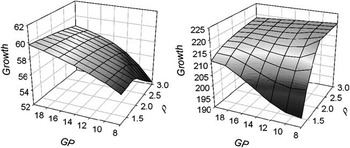
In order to account for the above observations, Sandberg et al. (Reference Sandberg, Emmans and Kyriazakis2007) suggested that there is a partial prioritisation of additional nutrient supply between growth and immune response. No suggestion was made on how this prioritisation may be affected by breeding for resistance. Recently Doeschl-Wilson et al. (Reference Doeschl-Wilson, Brindle, Emmans and Kyriazakis2009a) considered, in a modelling study, the consequences of a similar partitioning rule on the performance of animals selected for growth and resistance traits. The rule was that nutrient resources are partitioned proportionally to the maximum, intrinsic resource demands for these processes. This implies that animals selected for fast growth will be allocating proportionally more nutrients to growth and vice versa if they are selected for resistance. The simulations, reproduced on Figure 1, suggest that under nutritionally limiting environments the conclusions drawn about the consequences of these selection strategies will depend on the point of infection considered. During the early stages of infection, when requirements for resistance functions are low, animals selected for fast growth may show the best performance, whereas over the long term the combination of intrinsic slow growth and high resistance appears more advantageous. These predictions would be expected to have very different effects on nutrient efficiency utilisation, although Doeschl-Wilson et al. (Reference Doeschl-Wilson, Brindle, Emmans and Kyriazakis2009a) did not make predictions on this basis.
The simulated effect of the intrinsic capacity for growth (GP) and resistance (ρ) of an animal on BW growth at two points during infection from a microparasite (early (left) and late (right) stages of infection). Hosts differ in the combinations of the GP and ρ values, both set at arbitrary units, and are given access to a scarce resource. During the early stages of infection growth is mostly affected by GP, whereas when infection advances growth is affected mostly by ρ (for further details see text and Doeschl-Wilson et al., Reference Doeschl-Wilson, Brindle, Emmans and Kyriazakis2009a).

The above partitioning rule was able to account for the observations seen on the performance of different genotypes of pigs that have been selected for different growth intensities and then subjected to infection with pathogens such as the Porcine Reproductive and Respiratory Syndrome virus (Petry et al., Reference Petry, Holl, Weber, Doster, Osorio and Johnson2005; Doeschl-Wilson et al., Reference Doeschl-Wilson, Kyriazakis, Vincent, Rothchild, Thacker and Galina-Pantoja2009b); the same applies to the prediction of the performance of different poultry genotypes exposed to other pathogens (Yunis et al., Reference Yunis, Ben-David, Heller and Cahaner2000; Huff et al., Reference Huff, Huff, Balog, Rath, Anthony and Nestor2005). This also agreed with the suggestion made by Rauw et al. (Reference Rauw, Kanis, Noordhuizen-Stassen and Grommers1998) that animals selected for faster growth will be affected more by pathogens when kept in (nutrient) limiting environments. The simulations also provided insights into how the performance of animals challenged by pathogens may be affected differently at different infection time points. However, the rule did not link partitioning to either the level of the challenge or the composition of the food. It is likely that genetic selection for resistance may affect the relationship of either of these two quantities with partitioning. Appropriately designed experiments will shed light on these relationships, especially now that lines of poultry and pigs that have been selected for different performance characteristics and different degrees of resistance to pathogens exist (Magnusson et al., Reference Magnusson, Bosse, Mallard, Rosendal and Wilkie1997; Yunis et al., Reference Yunis, Ben-David, Heller and Cahaner2000). This view is reflected in the recent statement made by Knap and Rauw (Reference Knap and Rauw2009) that ‘at present, the serious literature provides very little quantitative information on the above issue of the way an animal's immunocompetence is influenced by its production potential, in combination with the environmental resources that are available to it at a given time’.
The majority of the experiments that have addressed the issue of partitioning of scarce resources during a health challenge have been carried out on growing animals, for obvious reasons. Growing pigs and poultry may have a less developed immune system or may be naïve to certain pathogens; both these will affect the severity of infection and by extension their performance (Kyriazakis and Houdijk, Reference Kyriazakis and Houdijk2007). The question is what happens when reproducing sows and hens are challenged by a pathogen while being offered a scarce resource(s). Evidence from other species (Houdijk et al., Reference Houdijk, Jackson and Kyriazakis2009) suggests that reproducing animals will tend to prioritise functions associated with reproductive fitness over immune responses when nutrients are scarce. This is consistent with the phenomenon of peri-parturient relaxation of immunity seen in most mammals (Coop and Kyriazakis, Reference Coop and Kyriazakis1999). Nevertheless, the expectation is that some genetic variation would exist in the degree of prioritisation of nutrient allocation towards the reproductive and away from immune functions. This would account for the variation seen among lactating mammals in immune response related traits (Kidane et al., Reference Kidane, Houdijk, Athanasiadou, Tolkamp and Kyriazakis2010).
It is concluded that there is some considerable lack in our understanding of the partitioning of scarce resources in both poultry and pigs genotypes that have been selected for different performance and resistance traits when they are exposed to pathogens. It is expected that genetic variation in such partitioning may affect the efficiency of nutrient utilisation in pig and poultry systems, but our current knowledge does not allow us to make predictions on either the direction or the magnitude of these effects. Recent advances in the characterisation of pig and poultry genotypes in relation to disease resistance traits should enable advance in this issue. However, because of the complexity of the above relationships, some of these issues may be addressed more effectively through modelling.
Conclusions
The summary of the conclusions on which components of the gross efficiency of nutrient and energy utilisation may be subject to genetic variation is given in Table 1. It is concluded that some opportunities exist for improving the components of the gross efficiency of nutrient and energy utilisation through breeding in poultry and pigs. These opportunities mainly are in the potential to (i) improve the digestive efficiency of pigs and (ii) reduce the maintenance requirements for resources mainly in laying hens, but also potentially in pigs. Current evidence suggests that although there may be substantial genetic variation in the feeding behaviour of pigs and poultry, this contributes little to the potential for food spillage and other system inefficiencies pre-ingestion. In addition, extensive review of the literature suggests that little measurable variation exists in the net efficiency in nutrient utilisation between poultry and pig genotypes. This probably implies that as far as the latter trait is concerned the system may already operate towards its optimum capacity.
Summary of the evidence for genetic variation in the components that constitute gross nutrient (and energy) utilisation efficiency in poultry and pigs

The partitioning considered is for scarce energy and nutrient resources between the various body functions.
There is no evidence of measurable genetic variation in the partitioning of scarce nutrient resources between the various productive functions, including between lean and fat growth, among pig and poultry genotypes. Currently we do not know how genetic variation in pigs and poultry affects the partitioning of scarce nutrients when animals are exposed to pathogens, and how this in turn will affect the efficiency of nutrient utilisation. It is suggested that some effort should be directed towards this issue.
Acknowledgements
I am grateful to Steve Bishop, Ilias Giannenas, Andrea Doeschl-Wilson and Sandra Edwards for commenting on earlier versions of the manuscript.