Introduction
During the transition to agriculture, mortuary rituals and feasting were widespread in south-west Asia, and highlight cultural connections across a broad interaction sphere (Bar-Yosef & Belfer-Cohen Reference Bar-Yosef and Belfer-Cohen1989). The growing body of archaeological evidence of these practices allows us to distinguish specific pathways of social and ideological change that were regionally diverse (e.g. Belfer-Cohen & Goring-Morris Reference Belfer-Cohen, Goring-Morris, Finlayson and Makarewicz2014). The integration of wild cattle (or aurochs; Bos primigenius) into ritual practice was pervasive across south-west Asia (Twiss & Russell Reference Twiss and Russell2009), but varies tremendously in its context, in the associated ritual evidence and in its probable function and meaning.
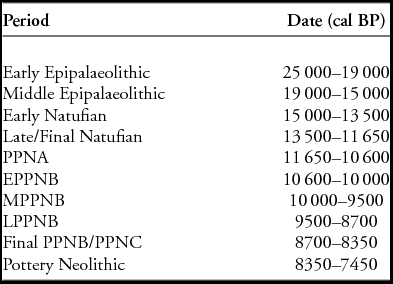
New evidence for patterns of ancient cattle use comes from the Pre-Pottery Neolithic B (PPNB; 10600–8700 cal BP) site of Kfar HaHoresh in the Lower Galilee region of Israel. In particular, a new concentration of cattle remains dating to the Early Pre-Pottery Neolithic B period (EPPNB; 10600–10000) has been discovered, adding to the large EPPNB feasting deposit that was previously documented (Horwitz & Goring-Morris Reference Horwitz and Goring-Morris2004) and other evidence of Middle Pre-Pottery Neolithic B (MPPNB; 10000–9500 cal BP) and Late Pre-Pottery Neolithic B (LPPNB; 9500–8700 cal BP) deposits with aurochs remains at the site. This evidence allows us to investigate anew the nature of cattle use in the southern Levant and to enquire whether local traditions were maintained as the economic and symbolic roles of animals shifted from hunted prey to domesticated property. The role of cattle is of special interest in the southern Levantine Neolithic Transition, as it represents the last livestock taxon in the region to be managed by humans, beginning in the Pre-Pottery Neolithic C (PPNC; 8700–8350 cal BP) or Pottery Neolithic (8350–7450 cal BP) period (Marom & Bar-Oz Reference Marom and Bar-Oz2013). How the use of aurochs may have been affected by shifting human-animal relationships once local MPPNB-period goat management began, however, remains unclear (Sapir-Hen et al. Reference Sapir-Hen, Dayan, Khalaily and Munro2016). Our study focuses on spatially segregated concentrations of aurochs remains and deposits associated with graves, structures or pits in order to examine how non-mundane behaviours changed during this critical transition.
Cattle in south-west Asian ritual contexts (25000–8350 cal BP)
Animals were integral symbolic and subsistence components of ritual during the transition to agriculture in south-west Asia. Given that ritual and economic change are highly integrated, changing human-animal interactions at the beginning of livestock management probably affected the roles of cattle in ritual, even though cattle were not the first domestic progenitor taxa to be managed in most regions. The earliest evidence of cattle management is found in Early to Middle PPNB contexts from the Euphrates region (Helmer & Gourichon Reference Helmer and Gourichon2008). In the southern Levant, however, demographic, body-size and morphological data indicate that cattle management began later during the PPNC to Pottery Neolithic periods, or in subsequent periods (Marom & Bar-Oz Reference Marom and Bar-Oz2013). A previous study on Kfar HaHoresh confirms that the cattle remains derive from wild aurochs throughout the PPNB; Bos body size and mortality profiles reveal large animals within the aurochs body-size range and prime-dominated age profiles (Meier et al. Reference Meier, Munro and Goring-Morris2016).
Wild cattle played important roles in ritual practice, both as symbols and suppliers of considerable calories (Twiss & Russell Reference Twiss and Russell2009). The variety of archaeological features that include aurochs skeletal remains or depictions highlight their symbolic importance at this time across south-west Asia. Exceptional well-preserved aurochs finds from unusual contexts in the northern Levant inspired Cauvin's (Reference Cauvin2000) classic hypothesis that a bull cult was central to the ideology of early farmers. Other studies focus on the socially integrative function of rituals featuring aurochs, generated by cooperative hunting and abundant meat that arguably encouraged sharing and minimised social differentiation (e.g. Goring-Morris & Horwitz Reference Goring-Morris and Horwitz2007). Social uses beyond food have also been studied, including how aurochs remains served as reminders of past events and reinforced shared symbols (Hodder & Cessford Reference Hodder and Cessford2004).
Neolithic rituals featuring aurochs are best known from Anatolia and the Euphrates Valley. Earlier Epipalaeolithic evidence for rituals involving aurochs is rare in this region, but includes a possible depiction in wall art from Öküzini Cave (Otte et al. Reference Otte, Yalcinkaya, Leotard, Kartal, Bar-Yosef, Kozłowski, Bayón and Marshack1995). Neolithic evidence for ritual aurochs use features aurochs bucrania recovered from many Pre-Pottery Neolithic sites in the northern Levant (for a review, see Twiss & Russell Reference Twiss and Russell2009), including a large Pre-Pottery Neolithic A (PPNA) building termed house A at Hallan Çemi (Zeder & Spitzer Reference Zeder and Spitzer2016), and a pit at PPNA/EPPNB Tell Qaramel (Kanjou et al. Reference Kanjou, Kuijt, Erdal and Kondo2013). Other exceptional evidence includes numerous aurochs bucrania embedded in architectural features and an iconic painted aurochs hunting scene at Pottery Neolithic Çatalhöyük (Hodder & Cessford Reference Hodder and Cessford2004).
Recent evidence suggests that aurochs also figured prominently in southern Levantine ritual before and during the agricultural transition at sites ranging from the Epipalaeolithic through to the PPNB (Table 1). Concentrated deposits of aurochs remains from the south have received attention (Goring-Morris & Horwitz Reference Goring-Morris and Horwitz2007; Munro & Grosman Reference Munro and Grosman2010), but further such studies are required to understand inter-regional variation. New finds from Kfar HaHoresh offer the opportunity to define the character of Bos use in the south.
Dates for southern Levantine sites with aurochs deposits surveyed herein.

Kfar HaHoresh
As the only primarily ritual PPNB site in the southern Levant (Goring-Morris Reference Goring-Morris and Kuijt2000), Kfar HaHoresh provides a natural setting for our investigation. The site spans the Early, Middle and Late PPNB periods (10600–8700 cal BP). Evidence for ritual practices involving animals abounds at Kfar HaHoresh, including a plastered human skull found with a headless gazelle carcass, associations between fox and immature human remains, a possible animal depiction made from arranged human bones (locus 1155), and concentrations of aurochs remains produced by funerary feasts (Goring-Morris Reference Goring-Morris and Kuijt2000; Horwitz & Goring-Morris Reference Horwitz and Goring-Morris2004).
Aurochs remains from previous excavations at Kfar HaHoresh
Aurochs remains were recovered from several previously described contexts at Kfar HaHoresh. Human bones were arranged with aurochs, boar and gazelle bones around the edge of a kidney-shaped ash deposit (locus 1003) (Goring-Morris et al. Reference Goring-Morris, Burns, Eshed and Goren1998). Numerous aurochs specimens were also recovered from a pit described below (locus 1005). Aurochs remains were, however, largely absent from grave contexts in the current and previous analyses (Horwitz & Goring-Morris Reference Horwitz and Goring-Morris2004). Artistic representations of aurochs include a single complete figurine and a few broken figurine horns (Biton Reference Biton2010).
Bos pit locus 1005
The contents of an EPPNB pit (locus 1005; ‘Bos pit’, measuring 1.5m maximum diameter, 0.6m in depth) associated with a contemporaneous monumental platform/podium (locus 1604) in the north-western area of the site, have been previously described (Horwitz & Goring-Morris Reference Horwitz and Goring-Morris2004; Goring-Morris & Horwitz Reference Goring-Morris and Horwitz2007). The pit was dug into sterile sediment beneath three plastered surfaces of the podium. It contained 356 aurochs bones, fox and goat bones, and a groundstone fragment (Goring-Morris & Horwitz Reference Goring-Morris and Horwitz2007). The aurochs assemblage derives from at least eight individuals—six adult females, one adult male and at least one juvenile of unknown sex. These comprised mostly complete meaty elements with articulated long-bone joints, carpals/tarsals and vertebrae (Horwitz & Goring-Morris Reference Horwitz and Goring-Morris2004). Most lacked signs of butchery. A limestone slab covered the pit, above which was interred a flexed, partially articulated, headless young adult male, whose grave was capped with plaster. Horwitz and Goring-Morris (Reference Horwitz and Goring-Morris2004) interpret the contents of the pit as the remnants of a funerary feast that served to alleviate scalar stresses at Kfar HaHoresh. Another pit (locus 1006) containing Bos remains was noted approximately 2m north of locus 1005. This also underlies the locus 1604 platform but remains to be excavated (Goring-Morris et al. Reference Goring-Morris, Goren, Horwitz, Bar-Yosef and Hershkovitz1995: plan 1).
A new Bos concentration
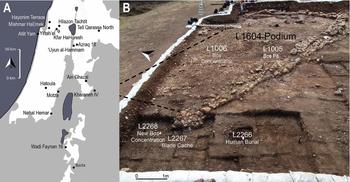
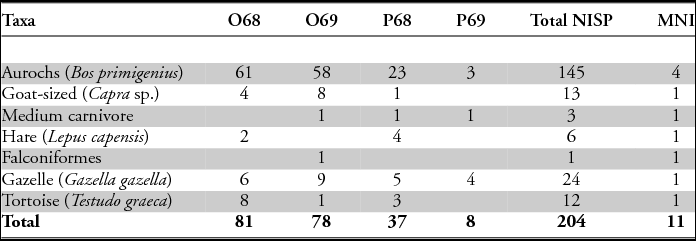
A new pit discovered in 2011 revealed a second concentrated EPPNB (10600–10000 cal BP) aurochs deposit (locus 2268) in the north-west sector of the site (Figure 1B). Composed mainly of aurochs (71 per cent; n = 204; Table 2), the bone concentration was found in a large sub-elliptical pit dug into sterile sediments and abutting the monumental platform. Locus 2268 was partially covered by later MPPNB midden deposits, a probable plaster kiln and a flat dolomitic stone with incised edges. A cache (locus 2267) of 13 flint blades deposited at the same level in the sterile sediment may be associated with locus 2268. Less clearly associated is a headless, flexed, primary human burial with a stone marker (locus 2266) situated approximately one metre from the pit.
A) Locations of southern Levantine sites mentioned in the text including Kfar HaHoresh (open circle); B) photograph of locus 2268 and nearby features facing east in 2011. Photograph by N. Goring-Morris.

Number of identifiable specimens (NISP) in locus 2268 by excavation square. Medium carnivore category includes wildcat, fox and similarly sized carnivore specimens.

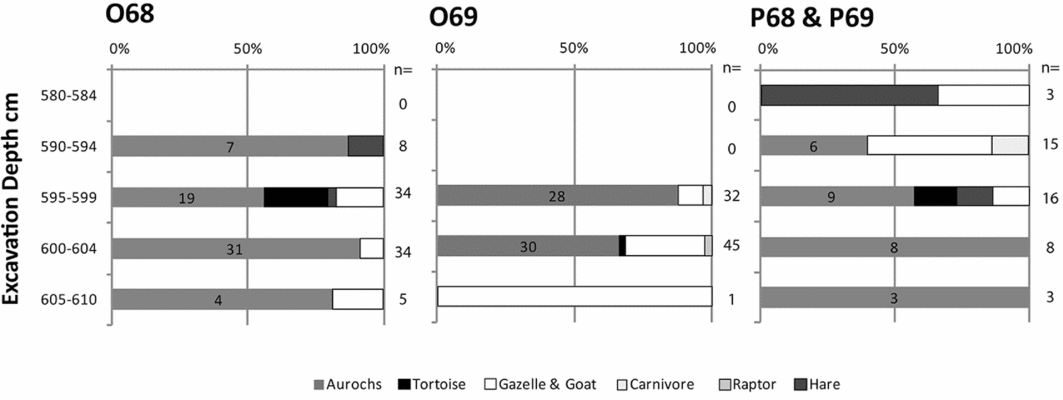
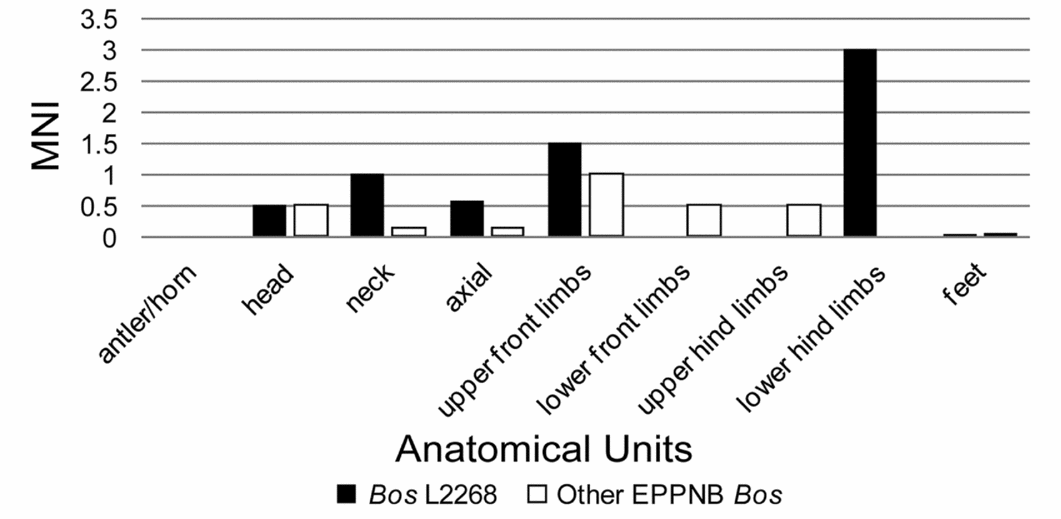
The aurochs remains were mostly packed amongst dense quantities of fire-cracked angular stone into the base of the pit (Figure 2). The remaining 59 specimens represent other taxa, including gazelle, goat-sized ungulates, hare, raptor, tortoise and wildcat. The aurochs fragments derive from 34 elements (Table S1 in online supplementary material) from at least four animals. The body parts are dominated by lower hindlimbs (Figure 3), and all anatomical regions (as defined by Stiner Reference Stiner1994) are represented, except for horns. Ages at death based on epiphyseal fusion reveal that one aurochs was at least three and a half years of age, while the other three were younger. Light weathering (stages 1–3; Behrensmeyer Reference Behrensmeyer1978) was common on the aurochs remains (45 per cent) (Table S2A). Cutmarks were absent. Many aurochs bones were broken during excavation (a common occurrence). Of the non-excavation-related fractures (n = 37), the majority are spiral breaks (67.6 per cent) (Table S2B), made when the bones were fresh; the remainder were post-depositional transverse (16.2 per cent) or dry breaks (16.2 per cent). Locus 2268 aurochs element completeness is low due to fragmentation (Table S2C). The average maximum fragment length is longer in locus 2268 (47mm) than in other EPPNB deposits excavated during the 2010–2012 seasons (38mm). Burning is rare (2 per cent) (Table S2D). The tip of a flint point was lodged in one aurochs humerus fragment.
Relative taxonomic representation (percentage of number of identified specimens = %NISP) in locus 2268 by excavation square. Bos NISP labelled by the depth of the 2010–2012 excavation spits, with total NISP of spits at the right of each bar chart (n = 204). Aurochs remains are more concentrated in squares O68–O69 from depths of 5.95–6.04m.

Minimum number of aurochs individuals (MNI) by anatomical units (Stiner Reference Stiner1994) in locus 2268 and other EPPNB Kfar HaHoresh contexts from the 2010–2012 excavations.

The distribution of taxa within locus 2268 suggests a degree of admixture of the upper deposit layers with the later midden deposits and kiln. Aurochs bones at the base of the locus were undisturbed (Figure 2). Weathering was most prevalent in square P68 (69 per cent lightly weathered), where the deposit may have been more disturbed. Some closely associated adjoining elements were noted during analysis. This suggests minimal bone movement or primary deposition (e.g. Yeshurun et al. Reference Yeshurun, Bar-Oz, Kaufman and Weinstein-Evron2014).
Of the EPPNB faunal loci excavated from 2010–2012, aurochs remains are most abundant in locus 2268 (62 per cent of identifiable specimens of aurochs). This contributed to the high relative abundance of aurochs among the ungulates in the overall EPPNB assemblage from Kfar HaHoresh and lower aurochs abundances in the MPPNB and LPPNB assemblages (Meier et al. Reference Meier, Munro and Goring-Morris2016). Although locus 2268 is dominated by hindlimbs, other EPPNB cattle deposits in this sample comprised mainly forelimbs (Figure 3). Aurochs remains from locus 2268 were clearly processed for marrow (based on breakage and fragmentation), but the larger size of aurochs fragments in this context suggests that they were processed less intensively than those from EPPNB midden contexts (Table S2).
Feasting at Kfar HaHoresh
Feasting events increased in frequency in the Pre-Pottery Neolithic period (Twiss Reference Twiss2008). Aurochs figured prominently in feasts, both because they provide large quantities of meat and because of their symbolic roles, which may be associated, for example, with the danger involved in their capture (Twiss & Russell Reference Twiss and Russell2009). Locus 1005 is a feasting deposit associated with funerary activities. Aurochs remains in locus 2268 are more abundant, more heavily processed and located in a less structured deposit than locus 1005. Nevertheless, the remains of four aurochs in locus 2268 indicate the consumption of a substantial quantity of meat in a single episode and minimal evidence of bone processing and depositional movement, thereby suggesting a feasting deposit. Several close associations among anatomically associated elements imply rapid burial. That these remains were deposited in a pit dug into sterile soil, in close proximity to a public-use monumental structure, suggests that this feast was associated with a communal ritual event. Ritual feasting deposits such as the two found at Kfar HaHoresh are notable due to their rarity at Natufian and Pre-Pottery Neolithic sites. Feasting can be difficult to detect in aggregations of food rubbish formed over long periods of time.
Aurochs deposits in the southern Levant
To situate the Bos concentrations at Kfar HaHoresh within a regional context, a survey of aurochs deposits from Epipalaeolithic and PPNB southern Levantine sites was undertaken.
Bos concentrations
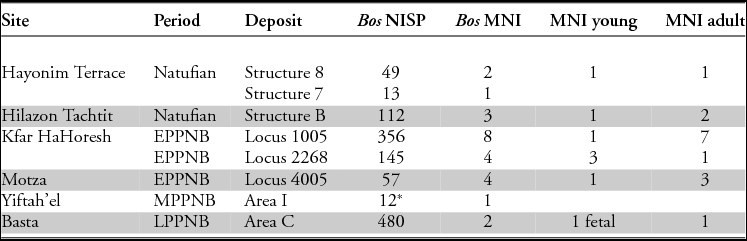
Here, a Bos concentration is defined as an aggregation of faunal remains dominated by cattle (>70 per cent), in a structured/constructed deposit. Most southern Levantine Bos concentrations date to the Late Natufian to EPPNB, with few later examples (Table 3). The largest Late Natufian Bos concentration (n = 112, minimum number of individuals (MNI) = 3) was deposited in a structured pit capped by a human burial at the mortuary site of Hilazon Tachtit (Munro & Grosman Reference Munro and Grosman2010). Most of the bones were opened for marrow, and three articulations were present. Smaller aurochs concentrations were found in structures 7 (n = 13, MNI = 1) and 8 (n = 49, MNI = 2) at Hayonim Terrace. Both concentrations included articulated foot bones (Munro Reference Munro and Valla2012). EPPNB evidence includes the two examples from Kfar HaHoresh and a concentration of mostly postcranial aurochs remains with articulated and cut-marked bones from Motza (n = 57, MNI = 4) (Sapir-Hen in press). This deposit was found near a human burial in the northern sector—an area with a prominent red-plastered structure (Sapir-Hen et al. Reference Sapir-Hen, Bar-Oz, Khalaily and Dayan2009). MPPNB concentrations include articulated aurochs pelvis, sacrum, vertebrae and two limb elements (estimated minimum number of elements from photograph = 12) from a pit in Area I at Yiftah'el (Khalaily et al. Reference Khalaily, Milevski, Getzov, Hershkovitz, Barzilai, Yarosevich, Shlomi, Najjar, Zidan and Smithline2008). An adjacent pit contained a single aurochs horncore. Area I also included a midden containing elements of gazelle, goat and aurochs in anatomical association (Horwitz Reference Horwitz2003; Alhaique & Horwitz Reference Alhaique, Horwitz and Garfinkel2012) and 72 per cent of the MPPNB to LPPNB primary and secondary human burials (Milevski et al. Reference Milevski, Khalaily, Getzov and Hershkovitz2008). Finally, a LPPNB Bos concentration at Basta included cut-marked adult and unmodified neonate aurochs bones (n = 480, MNI = 2) interred in “a, more or less, anatomically correct arrangement” (Becker Reference Becker2002: 124), in a pit less than 1m from a red-ochre-covered human burial and near a midden of articulated, smaller ungulate limbs.
Aurochs NISP and MNI in Natufian to LPPNB Bos concentrations from the southern LevantFootnote † .

† References in Table S3. * Values in MNE.
Documented Bos concentrations range widely in size from small deposits at Yiftah'el and Hayonim Terrace to the large locus 1005 assemblage at Kfar HaHoresh. All represent multiple individuals of different ages, except Yiftah'el. All nine anatomical body regions are represented by elements in concentrations at Hilazon Tachtit, Basta and Kfar HaHoresh locus 1005, and only horns are absent at Hayonim Terrace, Kfar HaHoresh locus 2268 and Motza. At Yiftah'el, only a limb and axial section are represented (Table S3).
Although human remains were located near all concentrations (most within 1m), any meaningful association is not always clear. This is particularly the case when cattle concentrations do not directly intersect human interments in sites with abundant evidence for mortuary practices (Hilazon Tachtit, Hayonim Terrace, Yiftah'el), or are located in pits close to human burials (Motza, Kfar HaHoresh locus 2268, Basta). The locus 1005 and Hilazon Tachtit concentrations were capped with stone slabs and burials, with locus 1005 clearly linked to a mortuary event.
Although anatomical connections were present in all Bos concentrations, indicating limited bone processing, cut-mark and breakage data suggest that bones from most deposits were butchered for meat and sometimes marrow (especially concentrations of earlier date). The concentrations also commonly show structured deposition, including anatomically positioned elements and placement in purposefully dug pits, suggesting single-deposit events. The Bos concentration at Basta differs most in its placement and treatment, as the aurochs remains were largely in anatomical association and the foetal aurochs was not butchered. In summary, at southern Levantine sites from the Natufian to LPPNB periods, carcass-processing evidence suggests that most aurochs remains found in concentrations were butchered for food and deposited in pits that are often separated from associated/nearby features (e.g. by slabs/plaster layers), suggesting primary aurochs refuse disposal related to ritual activity.
Mortuary contexts
Aurochs remains are frequently found in human mortuary contexts (n = 10; Table S4). Two deposits near human remains were excavated from Early Epipalaeolithic Kharaneh IV—one contained burnt aurochs and gazelle horncores, while the other comprised five articulated aurochs vertebra situated close to three concentrations of pierced shells (n > 1000) (Maher et al. Reference Maher, Richter, MacDonald, Jones, Martin and Stock2012). Also, an aurochs patella and carved aurochs radius were found in grave I at Middle Epipalaeolithic ‘Uyun al-Hammam (Maher et al. Reference Maher, Stock, Finney, Heywood, Miracle and Banning2011). An aurochs tail in partial articulation was found in the shaman burial at Natufian Hilazon Tachtit (Grosman et al. Reference Grosman, Munro and Belfer-Cohen2008) and one aurochs horncore with three perforations and several fragmented aurochs horncores were recovered above at least eight interred human individuals at Natufian Azraq 18 (Bocquentin & Garrard Reference Bocquentin and Garrard2016). Aurochs elements interred with human burials also include a bucranium at PPNA Hatoula and an articulated aurochs foot at E/MPPNB Mishmar Ha'Emek (Le Mort Reference Le Mort and Hershkovitz1989; Barzilai & Getzov Reference Barzilai and Getzov2008). Additional examples include the LPPNB bone arrangement at Kfar HaHoresh (see above) and cattle horncores from graves at Final PPNB/PPNC Atlit Yam (Galili et al. Reference Galili, Gopher, Eshed and Hershkovitz2005).
Other aurochs deposits
Many isolated aurochs remains were also found in structural features, or within bone arrangements and concentrations of diverse taxa that are distinct from typical scattered refuse (n = 8; Table S5). Abundant aurochs remains were reported from a large communal space associated with decorated benches at Wadi Faynan (Finlayson et al. Reference Finlayson, Mithen, Najjar, Smith, Maričević, Pankhurst and Yeomans2011). Deposits of carved aurochs elements include three incised aurochs metapodials and associated aurochs figurines at MPPNB ‘Ain Ghazal, four figurines carved from aurochs bones from PPNB Nahal Hemar, and a rib shaped into a wand carved with two human faces from E/MPPNB Tell Qarassa North (Rollefson Reference Rollefson1986; Bar-Yosef & Alon Reference Bar-Yosef and Alon1988; Ibáñez et al. Reference Ibáñez, González-Urquijo and Braemer2014). At MPPNB Ghwair I, one cattle bucranium and four goat bucrania were deposited on a plaster floor above an infant burial, a blade cache and polished stones (Simmons & Najjar Reference Simmons and Najjar2006). A pit at Yiftah'el contained articulated aurochs, gazelle, goat and fox elements (Alhaique & Horwitz Reference Alhaique, Horwitz and Garfinkel2012; Gubenko & Ronen Reference Gubenko and Ronen2014). Dense aurochs remains from installation 9/2 at Final PPNB/PPNC Atlit Yam may also represent a Bos concentration; but most of the faunal remains were recovered from this part of the site (n = 78; 54 per cent) (Horwitz & Tchernov Reference Horwitz and Tchernov1987).
Summary of aurochs deposits
Although cattle remains are found in diverse contexts, some patterning is apparent. Aurochs horncore fragments are common in mortuary contexts. In all context types, cattle remains are usually articulated or in close anatomical association. Articulated elements from other taxa are also often associated, such as gazelle, goat and fox. In contrast, there is no pattern in the types of artefacts associated with cattle bones or the burning data. Importantly, aurochs deposits are most commonly found near human remains (n = 21), particularly in Epipalaeolithic contexts (n = 8 of 8 contexts). From the MPPNB, mortuary contexts (n = 8 of 12 contexts) are more diverse, associations with structures are more common (n = 3) and concentrated bone deposits were not dominated by aurochs remains, but included remains of diverse species and cattle.
Discussion
Epipalaeolithic to EPPNB (25000–10000 cal BP)
In the southern Levantine Epipalaeolithic to EPPNB record, aurochs remains that do not constitute typical food refuse are most often found as concentrated remnants of large communal meals. Smaller distinct secondary deposits are primarily found in graves, and occasionally in caches near human bones. At Wadi Faynan 16, aurochs comprise the majority of bones in the fill of a communal structure.
Feasts
The presence of multiple aurochs in single concentrations implies the rapid consumption of large quantities of meat, suggesting that funerals were social events centred on public food-sharing (Twiss Reference Twiss2008). Their association with mortuary practices implies that these communal events represent funerary feasts (Hayden Reference Hayden, Dietler and Hayden2001). Many skeletal elements are missing from these concentrations, suggesting that some meat was consumed elsewhere (Horwitz & Goring-Morris Reference Horwitz and Goring-Morris2004). The purposeful burial of many cattle parts at one time, probably publicly, conveyed and commemorated the socially integrative aspect of feasting (Munro & Grosman Reference Munro and Grosman2010). Large funerary feasts may also lead to social exchanges, thereby facilitating community integration or social competition (Hayden Reference Hayden, Dietler and Hayden2001; Kuijt Reference Kuijt2008). Moreover, the continuity of feasting practices from the Natufian to the EPPNB in the southern Levant indicates that this tradition was upheld as plant cultivation was adopted and humans first began to control animals. Thus, ritualised aurochs feasting was most common at the beginning of agricultural life-ways, possibly serving to reinforce and negotiate local social identities during this dynamic social transition.
The Bos concentrations also highlight the atypical treatment of feast refuse from the Natufian to the EPPNB (Munro & Grosman Reference Munro and Grosman2010). Evidence of anatomical associations and placement of aurochs parts in purposefully dug pits differentiates these concentrations from the scattered, gazelle-dominated food waste typical of these periods (Yeshurun et al. Reference Yeshurun, Bar-Oz, Kaufman and Weinstein-Evron2014). This indicates purposeful burial more akin to human burial practices (Goring-Morris Reference Goring-Morris and Kuijt2000). This may relate to shared rules about disposal practices for ritual objects that held symbolic importance, or ‘ceremonial trash’ (Walker Reference Walker, Skibo, Walker and Nielsen1995), and is similar to the regulated deposition of ritual objects in designated repositories, such as favissae, which are structures used to contain ceremonial items (Goring-Morris Reference Goring-Morris and Kuijt2000). Regardless of the exact rules surrounding the disposal of feasting refuse, the atypical deposition of these remains clearly reflects perceptions of ceremonial food that included disposal rules.
The disposal of ceremonial refuse may also reflect planning for the long-term use of public mortuary spaces. Discrete refuse deposits in mortuary areas display purposeful burial in concentrated locales. More formalised removal of bulky aurochs remains was probably necessary to preserve space in public areas for recurring activities, such as skull-removal practices and associated rituals (Belfer-Cohen & Goring-Morris Reference Belfer-Cohen, Goring-Morris, Finlayson and Makarewicz2014). Even though more typical scattered refuse is also present, hints of refuse maintenance may reflect planning for longer-term site use (Kent Reference Kent1992). Additionally, repeated use of areas for burial (e.g. at Raqefet) also suggests that memory of the funerary function of these areas persisted over time (Yeshurun et al. Reference Yeshurun, Bar-Oz and Nadel2013).
MPPNB to PPNC (10000–8350 cal BP)
Depositional practices from the MPPNB onward mark a pivotal shift in the regional signature of aurochs use in the southern Levant. Bos concentrations are fewer, with only one small example from MPPNB Yiftah'el and the anatomically positioned remains from LPPNB Basta. Both provide less-clear examples of communal feasts. Instead, between the MPPNB to PPNC, cattle deposits are more commonly associated with architectural features or concentrations of diverse faunal remains, and continued to be associated with human burials. Overall, fewer public feasting events involving aurochs are represented by the MPPNB, although public practices continued in mortuary contexts. This decline in aurochs feasting across the PPNB is also reflected in the decreasing relative abundance of aurochs at Kfar HaHoresh, following peak levels detected in the EPPNB (Meier et al. Reference Meier, Munro and Goring-Morris2016). Notably, other distinct types of aurochs deposits begin to appear by the MPPNB.
Small-scale practices
Most southern Levant MPPNB (and later) aurochs deposits are smaller and more idiosyncratic than in earlier periods. High levels of bone completeness and anatomical associations in the southern Levantine cases distinguish these deposits from routine refuse disposal. They are, however, more taxonomically diverse, contain fewer body parts, derive from more variable contexts and are less often associated with mortuary contexts than earlier Natufian to EPPNB Bos concentrations interpreted as remains of in situ feasts (Horwitz & Goring-Morris Reference Horwitz and Goring-Morris2004; Grosman & Munro Reference Grosman and Munro2016). This suggests that southern Levantine cattle use shifted away from communal to more small-scale practices in the MPPNB.
With the exception of the cattle bucranium from MPPNB Ghwair I, southern Levantine aurochs deposits differ from more visible cattle horns or skulls displayed in structures in the north (Twiss & Russell Reference Twiss and Russell2009). In the southern Levant, aurochs deposits were more purposefully deposited out of sight, and thus were less likely to have promoted costly competitive social actions, such as dangerous aurochs hunts or rites of passage, or to have served as regularly viewed reminders of past events, promoting community integration (Kuijt Reference Kuijt2008). Instead, these deposits may have served to mark events at the time of deposition, link current and past participants in ritual events and commemorate shared symbolic depositional actions, thus promoting social memory construction (cf. Kuijt Reference Kuijt2008).
Additionally, from the MPPNB onward, concentrations of fauna that included aurochs elements may reflect the continuation of earlier practices of ceremonial refuse disposal and long-term use of mortuary areas. Articulations present in these contexts indicate little post-depositional disturbance (Yeshurun et al. Reference Yeshurun, Bar-Oz, Kaufman and Weinstein-Evron2014) and more deliberate deposition of refuse in mortuary areas. This atypical treatment suggests that other food remains found in these areas may also have been considered to be ceremonial refuse. Alternatively, these remains may represent mundane waste produced by visitors to mortuary areas that was intentionally deposited to make room for anticipated practices at a later date, or to maintain the sanctity, or unchanging quality (Rappaport Reference Rappaport1999), of the mortuary space. Ultimately, purposeful deposition of aurochs remains alongside other taxa suggests the continuation and expansion of the differential treatment of consumption refuse in mortuary spaces from the MPPNB onward.
Cattle deposits and the Neolithic transition
Cattle played important roles beyond food provisioning across Neolithic south-west Asia; this use has its own regional character from the Natufian to EPPNB in the southern Levant, after which point cattle-depositional practice began to change. Although the shift suggests a move away from the earlier pattern of more public deposition, refuse disposal practices continued to treat ceremonial trash distinctly and to encourage the long-term use of mortuary areas. This suggests a shared practice of symbolic cattle-use spanning many generations in the southern Levant and shifting in form by the MPPNB, but maintaining some depositional rules that probably contributed to the long-term construction and expression of social memory through ritual practice (Kuijt Reference Kuijt2008).
The shift in the local southern Levantine signature of cattle deposition in feasting and mortuary contexts by the MPPNB suggests increasingly small-scale practices and changing social interactions that reflect the greater processes of the Neolithic transition across south-west Asia. Similar social changes are reflected in PPNB architecture, such as the development of spatially segregated buildings with independent domestic and non-domestic areas (Byrd Reference Byrd1994). Additionally, reduced evidence for feasting hints at a shift towards other mechanisms of community integration by the MPPNB.
The shift in the ritual use of aurochs by the MPPNB may also be associated with new economic roles for herd animals in the southern Levant—the first clear evidence for goat management also emerges in the MPPNB (Horwitz Reference Horwitz2003; Sapir-Hen et al. Reference Sapir-Hen, Dayan, Khalaily and Munro2016). The close timing of these shifts accentuates the similar pace of local-scale ritual and economic change, highlighting their close integration during the Neolithic transition in the southern Levant. Further comparative spatial studies of faunal disposal patterns across different regions, site functions and time periods are merited to better detect the trajectory of social change at the local level.
Acknowledgements
The authors would like to thank Melinda Zeder and an anonymous reviewer for their insightful comments on a previous draft. Research was supported by NSF Dissertation Improvement Grant Award 1355608 (principal investigator: N.M., co-principal investigator: J.M.), the Irene Levi Sala CARE Foundation (N.M.), a University of Connecticut Department of Anthropology Dissertation Writing Fellowship and Summer Research Fellowships. Kfar HaHoresh investigations were supported by the Israel Science Foundation (grants to A.N.G.-M. 840/01, 558/04, 755/07, 1161/10), The National Geographic Society (grant 8625/09) and the Irene Levi Sala CARE Foundation. This article benefited from comments from Gideon Hartman, Alexia Smith and Leore Grosman. We thank Rivka Rabinovich for providing workspace and access to the National Natural History Collections at the Hebrew University, Jerusalem. Thanks to Lidar Sapir-Hen for sharing early manuscripts, Hadas Goldgeier for bone-washing assistance, to Richard Sosis for thoughtful discussion and to the Kfar HaHoresh research and excavation team.
Supplementary material
To view supplementary material for this article, please visit https://doi.org/10.15184/aqy.2017.179