INTRODUCTION
The language development of internationally adopted (IA) children is of theoretical interest because they usually experience an early and abrupt disruption in acquisition of their birth language, normally resulting in its complete loss within the first year post-adoption (e.g. Kaufman & Aronoff, Reference Kaufman, Aronoff, Seliger and Vago1991; Nicoladis & Grabois, Reference Nicoladis and Grabois2002). Following adoption, like monolingual first language (L1) learners, they are immersed in a wholly monolingual environment. However, and in contrast to typical L1 learners, they experience a delay after birth, often of twelve to twenty-four months, in exposure to their new language. Several studies have documented differences between typical L1 learners and both L1 and L2 learners who experience similar short delays in acquisition onset (e.g. Abrahamsson & Hyltenstam, Reference Abrahamsson and Hyltenstam2009; Mayberry, Reference Mayberry1993; Paradis, Reference Paradis2005; Paradis, Rice, Crago & Marquis, Reference Paradis, Rice, Crago and Marquis2008). IA children may similarly differ from typical L1 learners because of their delayed exposure to the adoption language. Indeed, there is an association between age at adoption and vocabulary development, with children adopted relatively early acquiring vocabulary faster than both L1 learners and children adopted relatively later, even if acquisition occurs at a later age (e.g. Krakow, Tao & Roberts, Reference Krakow, Tao and Roberts2005; Pollock, Reference Pollock2005). While most IA children ‘catch up’ and perform within native-speaker norms on standardized language measures (e.g. Geren, Snedeker & Ax, Reference Geren, Snedeker and Ax2005; Glennen, Reference Glennen2005; Reference Glennen2009; Tan & Yang, Reference Tan and Yang2005), there is evidence of lags between IA and non-adopted children during the preschool and early school years (e.g. Cohen, Lojkasek, Zadeh, Pugliese & Kiefer, Reference Cohen, Lojkasek, Zadeh, Pugliese and Kiefer2008; Delcenserie, Genesee & Gauthier, Reference Delcenserie, Genesee and Gauthier2012; Gauthier & Genesee, Reference Gauthier and Genesee2011), suggesting that delayed exposure to the adoption language affects IA children's development in the short and long term. In addition to delayed acquisition onset, it is possible that IA children's L1, despite being discontinued, influences their acquisition of the adoption language. There is neurocognitive evidence that infants fine-tune their language abilities to specific properties of the ambient language during the first months of life (e.g. Werker & Tees, Reference Werker and Tees1984) causing lasting changes in the brain (Kuhl, Williams, Lacerda, Stevens & Linblom, Reference Kuhl, Williams, Lacerda, Stevens and Linblom1992). Conversely, attrition of the L1 during this critical developmental period may have effects on subsequent language learning.
The question arises whether the language development of IA children resembles that of L1 or child L2 learners. To address this question, we examined their acquisition of linguistic elements that differ across these learner groups. While both L1 and child L2 learners have some difficulty acquiring tense-marking (i.e. past tense -ed, third person singular -s) compared to non-tense-marking morphemes (i.e. progressive -ing, plural -s) (e.g. Ionin & Wexler, Reference Ionin and Wexler2002; Paradis, Reference Paradis2005; Reference Paradis, Gavruseva and Haznedar2008), there are at least two ways in which L1 and child L2 learners differ. First, child L2 learners master the tense-marking morpheme BE (copula: I am happy; and auxiliary: he is running) early, such that its developmental trajectory is similar to that of non-tense-marking, rather than tense-marking, morphemes (Haznedar, Reference Haznedar2001; Ionin & Wexler, Reference Ionin and Wexler2002; Paradis, Reference Paradis2005; Reference Paradis, Gavruseva and Haznedar2008; Reference Paradis2011; Paradis et al., Reference Paradis, Rice, Crago and Marquis2008; for explanations for this phenomenon see Paradis et al., Reference Paradis, Rice, Crago and Marquis2008). Second, overall, although both L1 and child L2 learners produce more omission (e.g. she Ø eating) than commission errors (e.g. she are eating) (Jia, Reference Jia2003; Paradis, Reference Paradis2005; Paradis et al., Reference Paradis, Rice, Crago and Marquis2008), child L2 learners produce relatively more of the latter (e.g. Paradis, Reference Paradis2005). For example, Paradis (Reference Paradis, Gavruseva and Haznedar2008) found child L2 learners made 35–47% commission errors producing BE (i.e. substitution of the wrong form, double-marking, or replacing BE with DO), whereas L1 learners with similar exposure made only 10% commission errors. Child L2 learners, in comparison to L1 learners, also tend to make errors involving BE overgeneration (e.g. he is go) in which they erroneously use BE as a type of all-purpose marker of tense or agreement, constituting roughly 25% of their utterances involving BE (Ionin & Wexler, Reference Ionin and Wexler2002).
Few studies have examined the acquisition of grammatical morphology in IA children, and extant studies have compared their development to L1 learners or monolingual age-norms only. In these studies, some IA children show small or no delays in acquisition of certain morphemes (i.e. regular past tense -ed, present progressive -ing, plural, possessive, and third person singular -s) (Glennen & Masters, Reference Glennen and Masters2002; Pollock, Price & Fulmer, Reference Pollock, Price and Fulmer2003), while others show deficits even after several years of exposure to English (Glennen & Masters, Reference Glennen and Masters2002; Glennen, Rosinsky-Grunhut & Tracy, Reference Glennen, Rosinsky-Grunhut and Tracy2005; Pollock et al., Reference Pollock, Price and Fulmer2003). The reported delays may be affected by age of acquisition onset insofar as IA children adopted at younger ages (i.e. less than 1;0–1;1) acquire English grammatical morphemes more quickly (Glennen & Masters, Reference Glennen and Masters2002) and more accurately (Pollock et al., Reference Pollock, Price and Fulmer2003) than children adopted at later ages (i.e. 1;8–2;6). Glennen (Reference Glennen2005) found that, despite overall delays in acquisition, IA children acquired grammatical morphemes in the same sequence as monolingual English-learning children, albeit at a later age. However, a limited number of morphemes were examined in this study – progressive-ing, articles a/the, contracted and uncontracted copulas, and uncontracted auxiliary BE – and comparisons were not made with L2 patterns.
These studies suggest that delays in acquisition onset, or L1 attrition, may affect IA children's acquisition of grammatical morphology. For example, it is theoretically possible that the substrate for language learning that is linked to L1 acquisition is weakened or even lost through this early language change, thus influencing the acquisition of subsequent languages. However, none of these studies specifically consider the possibility that their acquisition resembles that of child L2 learners. The present study was designed to address this issue. We focused specifically on the morphology, discussed earlier, that research shows differs between L1 and child L2 learners. As well, and unlike previous studies, both spontaneous and elicited language samples were used to ensure generalizability of our results.
METHOD
Participants
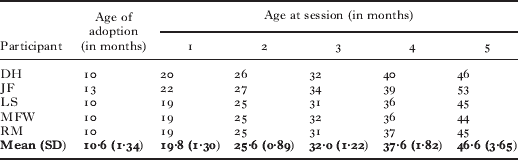
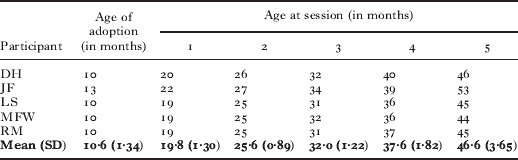
Participants were five IA children from China (all girls) adopted into English-speaking families in different regions of Canada. They ranged in age from 0;10 to 1;1 at the time of adoption and were tested five times, at nine, fifteen, twenty-one, twenty-seven, and thirty-four months post-adoption (Table 1). The IA children's exposure to English at testing was generally comparable to that of the child L2 learners of English studied by Paradis (Reference Paradis, Gavruseva and Haznedar2008) who, on average, had eleven, twenty-four, and thirty-six months' exposure to English at the time of testing. This was done to facilitate comparison of the present results with those of Paradis' child L2 learners. Slight differences in times of testing are due to availability of IA parents. Participants were recruited through ads in a national newsletter for adoptive parents. All parents gave informed consent at the first session.
Age of IA children at adoption and at each session
Procedure
Spontaneous language samples of approximately one hour were collected and video-recorded at each session by trained native English-speaking research assistants during free-play sessions with each child and a parent. In four instances with one child (JF), free-play sessions were predominantly with a research assistant. However, the mother was also present.
The Test of Early Grammatical Impairment (TEGI: Rice & Wexler, Reference Rice and Wexler2001) was administered during the final session to elicit children's production of third person singular -s, regular past tense -ed, irregular past tense, BE copula and auxiliary, and DO auxiliary. The TEGI was not administered earlier because the children were below test age norms. The TEGI elicits production of each morpheme type using visual and verbal probes; for example, to elicit third person singular, the child is shown a picture (e.g. a teacher), given a prompt by the examiner (“Here is a teacher. Tell me what a teacher does.”), and asked to respond (“She teaches.”). Percentage correct scores for each child were obtained by dividing number of correct uses of each morpheme by total number of attempts. An elicited grammar composite (EGC) score was calculated as the average of the individual probe scores. Scores on the TEGI were compared to the children's spontaneous language productions in order to cross-validate the latter results. We also compared the IA children's scores to the test's norms for L1 learners.
Data transcription and analysis
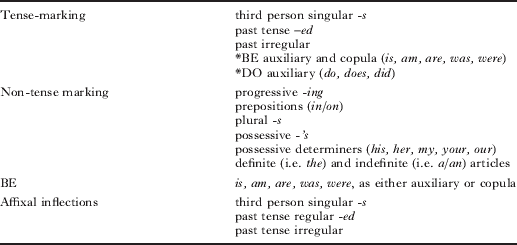
Transcription and analysis of the spontaneous language samples were carried out as by Paradis (Reference Paradis, Gavruseva and Haznedar2008) to facilitate comparison with her results. The spontaneous language samples were transcribed by the first author or a trained research assistant using CHAT conventions (MacWhinney, Reference MacWhinney2000), and a second time by a different assistant using the same procedures. Discrepancies were resolved by discussion. Each child's transcripts were then coded and analyzed using CLAN software (MacWhinney, Reference MacWhinney2000) to examine the children's use of tense-marking and non-tense-marking morphemes in obligatory contexts (Table 2). Obligatory context was determined based on either the context of discourse (e.g. the context called for use of a past tense verb) or the structure of the utterance (e.g. “I running now” requires the missing BE auxiliary am). Failure to provide a structure in obligatory context was coded as an omission error if an alternate structure was not provided and as a commission error if an alternative but incorrect structure was used (e.g. BE: “I is walking” instead of “I am walking”; past irregular: “I goed to the kitchen” instead of “I went …”; third person singular: “he is want to go” instead of “he wants to go”). It should be noted that some commission errors involved choosing a wrong morpheme of the right type (e.g. “I is walking” is an incorrect form of the correct morpheme BE), while others involved choosing an entirely incorrect morpheme (e.g. “he is want to go” replaces third person singular with BE). This last type, while included in the analysis of commission errors, was also examined separately in a discussion of BE overgeneration. Direct repetitions were excluded from the analysis. A research assistant re-coded a random 10% of each child's utterances in each transcript. Inter-rater agreement was 96%, on average. Discrepancies were discussed and changes made based on discussion.
Individual morphemes comprising each composite
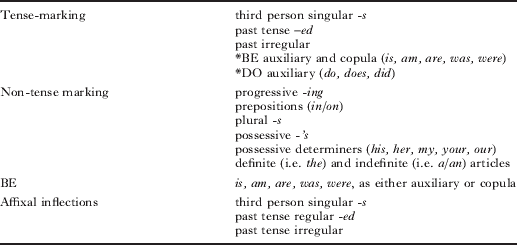
notes:* Although BE and DO can also appear in past irregular forms (i.e. was, did) or third person singular forms (i.e. does), all of these were classified only in the BE and DO categories, respectively. Main verb DO, however, was coded along with either third person singular does and past irregular did, and negative DO forms (e.g. didn't) were omitted to conform to Paradis' analyses and to match the TEGI probes.
Once morpheme use had been coded, a list of each instance of each morpheme used was generated and the number of correct usages, omissions, and commission errors was calculated manually. Percent correct usage in obligatory context and total percentage omission and commission errors were calculated for each morpheme for each session, and for composite BE and DO morphemes, composite tense-marking morphemes, composite non-tense-marking morphemes, and composite affixal inflectional morphemes (Table 2). The affixal inflectional morpheme composite was created so that acquisition of the free-standing morpheme BE could be compared to that of other tense-marking morphology. The number of children at mastery (90% correct use in obligatory context: Brown, Reference Brown1973) for each morpheme at each session was also examined. Responses to the TEGI probes were analyzed compared to performance during spontaneous production.
RESULTS
Due to the small sample size, which caused a normality violation, non-parametric Wilcoxon signed rank tests were used for all statistical comparisons and are reported with effect sizes (r). Session 1 was excluded from the analyses because not all children contributed scores during this session. Due to the small sample size, individual results are also discussed.
Spontaneous language samples
Correct use in obligatory context
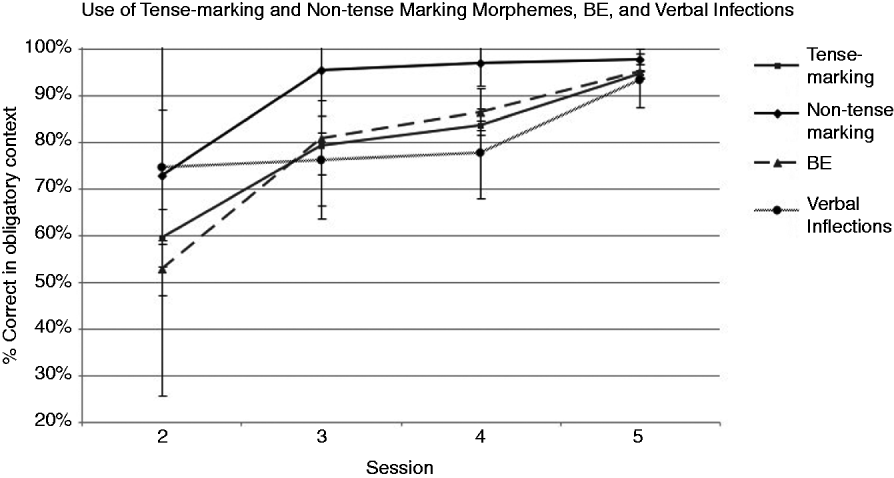
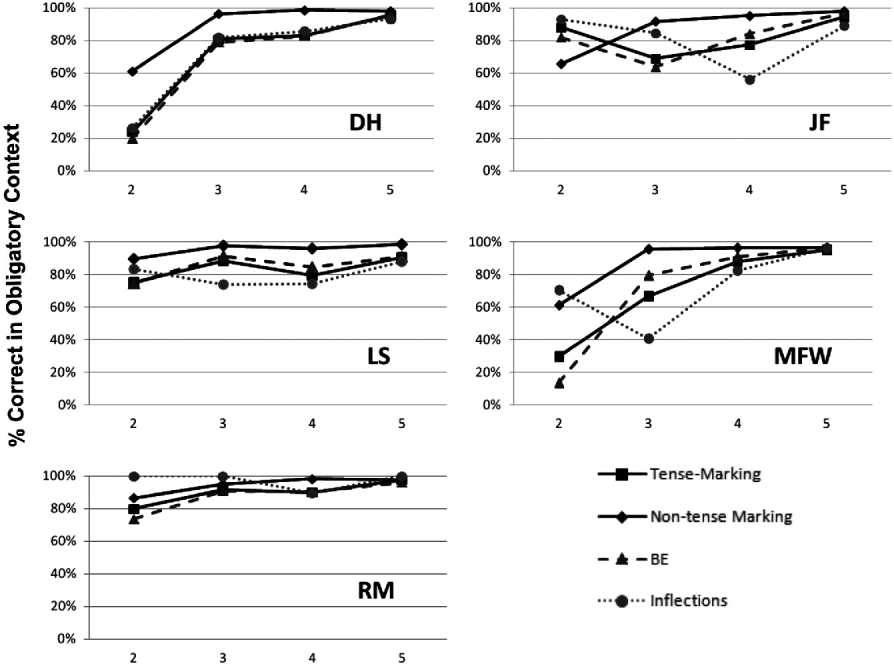
To compare the use of tense-marking and non-tense-marking morphemes during spontaneous language production, total percent correct in obligatory contexts of tense- and non-tense composites were compared (Figure 1). Accuracy was equivalent in Session 2 (Z=−1·21, p=0·23, r=0·38), but was greater for non-tense-marking morphemes in Sessions 3 (Z=−2·02, p=0·04, r=0·64), 4 (Z=−2·02, p=0·04, r=0·64), and 5 (Z=−2·02, p=0·04, r=0·64). Although accuracy for tense- and non-tense-marking morphemes is very close in Session 5, all children displayed the same pattern, making the difference significant. In fact, all children were more accurate using non-tense- than tense-marking morphemes in all sessions, except for Session 2 when one child (JF) showed greater accuracy for tense-marking morphemes (Figure 2).
Percentage correct in obligatory context for tense-marking and non-tense marking morphemes, BE, and affixal inflections for all children combined at each session.

Percentage correct use of morphemes in obligatory context for individual participants at each session.
In order to examine whether BE was used more accurately than other tense-marking morphemes (i.e. affixal inflections) and as accurately as non-tense-marking morphemes, percent correct use of BE in obligatory contexts was compared to use of both non-tense-marking morphemes and affixal inflections. Children produced BE significantly less accurately than affixal inflections in Session 2 (Z=−2·02, p=0·04, r=0·64), and there were no significant differences in Sessions 3 (Z=−0·14, p=0·89, r=0·04), 4 (Z=−1·48, p=0·14, r=0·47), and 5 (Z=−0·94, p=0·35, r=0·30). In contrast, there was no significant difference in accuracy for BE and non-tense-marking morphemes in Session 2 (Z=−1·21, p=0·23, r=0·38), but use of BE was significantly less accurate in Sessions 3 (Z=−2·02, p=0·04, r=0·64), 4 (Z=−2·02, p=0·04, r=0·64), and 5 (Z=−2·02, p=0·04, r=0·64) (Figure 1). Reinforcing this pattern, BE was not produced more accurately than affixal inflections by any child in Session 2, and by only two children in Session 3 (JF, RM) (Figure 2). In Sessions 4 and 5, use of BE and affixal inflections was remarkably similar, except for JF in Session 4. BE was never produced as accurately as non-tense-marking morphemes except in one case (JF Session 1). Thus, like L1 learners and unlike child L2 learners, the IA children's use of BE was generally more similar to other tense-marking morphology than to non-tense-marking morphology.
Mastery of morphemes
Individual child data were used to determine the point at which each child mastered each morpheme type (Figure 2). No child had mastered either tense- or non-tense-marking morphemes in Session 2. However, all children had mastered non-tense-marking morphemes by Session 3. In contrast, only one child (RM) had mastered tense-marking morphemes by Session 3; all other children achieved mastery at Session 5. Similar to the pattern for tense-marking morphemes, only two children demonstrated mastery of BE in Session 3 (LS and RM), and another in Session 4 (MFW). By Session 5, all children displayed mastery of BE. With respect to affixal inflections, two children (JF and RM) displayed mastery as early as Session 2, but only one of these children (RM) continued to display mastery by Session 3. No child displayed mastery of affixal inflections at Session 4, and only three displayed mastery at Session 5 (DH, MFW, RM), although the others were close. Tense-marking morphemes, BE, and affixal inflections were never mastered by more children than non-tense-marking morphemes, again providing evidence that acquisition of BE followed a trajectory more similar to other tense-marking morphemes (i.e. affixal inflections) than to non-tense-marking morphemes.
To investigate the extent to which the children used tense- and non-tense-marking morphemes flexibly, not simply as memorized chunks, a productivity analysis of each morpheme was conducted by counting the number of contexts in which a given morpheme occurred (e.g. Miyata, Hirakawa, Ito, MacWhinney, Oshima-Takane et al., Reference Miyata, Hirakawa, Ito, MacWhinney, Oshima-Takane, Otomo, Shirai, Sirai, Sugiura and Miyata2009). If a morpheme occurred in one context (e.g. swim-ing), it was assigned a score of 1; if it occurred in two contexts (e.g. swim-ing, eat-ing), it was assigned a score of 2; and so on. A different linguistic context was defined as a different verb or noun stem (for affixal inflections) and different adjacent words in the context of isolated words (e.g. free-standing morphemes like BE and DO). A morpheme was productive if used in at least four different contexts.
All children used tense- and non-tense-marking morphemes flexibly by Session 2. BE was used productively by four children (JF, LS, MFW, RM) by Session 2 and all children by Session 3. Affixal inflections were used productively by four children (DH, LS, MFW, RM) in Sessions 2 and 3, and all children by Session 4. Thus, mastery scores used in the preceding analyses can be considered reliable estimates of the children's productive mastery of these morphemes in a variety of contexts. Rare instances of mastery loss across sessions can generally be attributed to an increased number of contexts attempted.
Error types
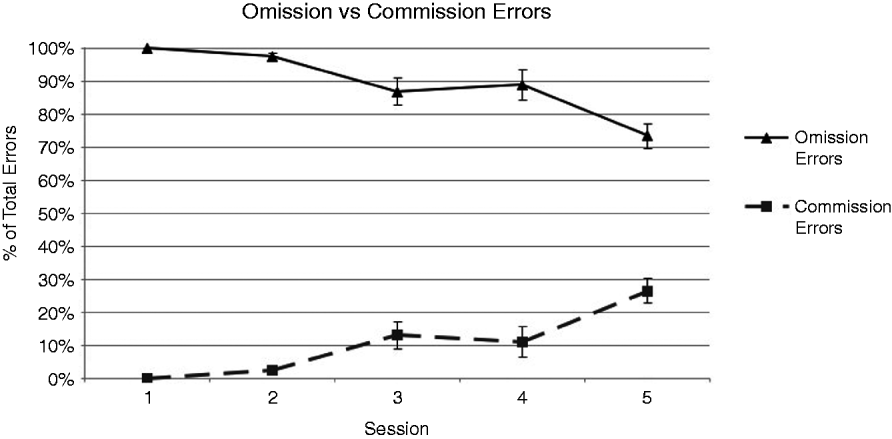
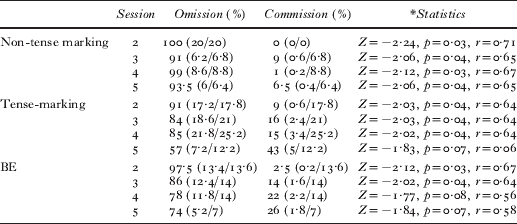
Errors were examined to determine if there were more omission than commission errors and if this differed for non-tense-marking, tense-marking (including BE), and BE morphemes separately (Table 3). The affixal inflection composite could not be examined separately because the only session in which all children contributed to these scores was Session 4. Overall, there was a greater percentage of omission than commission errors in each session (Figure 3) (Session 2: Z=−2·03, p=0·04, r=0·64; Session 3: Z=−2·02, p=0·04, r=0·64; Session 4: Z=−2·02, p=0·04, r=0·64; Session 5: Z=−2·06, p=0·04, r=0·65). This was also true when non-tense-marking morphemes were analyzed separately (Table 3). For tense-marking morphemes, there were more omission than commission errors in Sessions 2, 3, and 4. Although there was a greater percentage of omission errors in Session 5, this was only marginally significant (p=0·06). For BE, there were significantly more omission errors in Sessions 2 and 3, but there was no difference in error types in Sessions 4 and 5, although differences were marginally significant. Accuracy was above 85% for tense-marking morphemes in Session 5 and for BE in Sessions 4 and 5; thus the actual frequency of errors in these sessions was low, making a comparison of error types problematic. This may account for the lack of significant differences between error types in these sessions. Overall, commission error rates were below 10% in fifteen of the twenty-five transcripts. In all cases where commission errors were produced at higher rates, actual error rates were low (below 10%), reinforcing the preceding findings that omission errors tended to predominate.
Percentage of omission and commission errors combined across morphemes and children for each session.
Percentage and frequency of omission and commission errors for non-tense marking morphemes, tense-marking morphemes, and BE in sessions 2–5 (N=5)
note:* Significant at p<0·05. r=effect size.
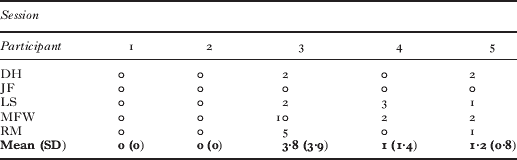
We also examined the extent to which IA children overgenerated BE, like child L2 learners do (Table 4). During Sessions 1 and 2, no child overgenerated BE; average instances during Session 3 were 3·8; during Session 4, only 1; and during Session 5, only 1·2. The high rate of BE overgeneration in Session 3 is due largely to one child (MFW) who produced ten overgenerations. All, except one of these, were repetitions of the type “it's go here”, “it's go there”. Thus, the Session 3 results do not appear to be indicative of a general trend.
Frequency of BE overgeneration for each participant at each session
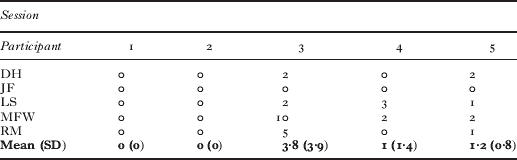
The IA children's use of BE also differed from that typically seen in child L2 learners who generally show relatively low (e.g. less than 10%) omission rates for this morpheme (Ionin & Wexler, Reference Ionin and Wexler2002). In contrast, the IA children displayed high rates of BE omission in all sessions prior to mastery. Specifically, 11–45% of BE obligatory contexts, on average, involved omissions. Furthermore, during Session 3, when child MFW produced the highest rates of BE overgenerations, she also omitted BE 21% of the time in obligatory contexts. Thus, while L2 learners appear to overgenerate BE as a type of all-purpose tense and aspect marker en route to mastering BE, the IA children appeared unsure of the correct contexts in which to use BE and erroneously included or omitted it until they had achieved mastery.
Elicited language
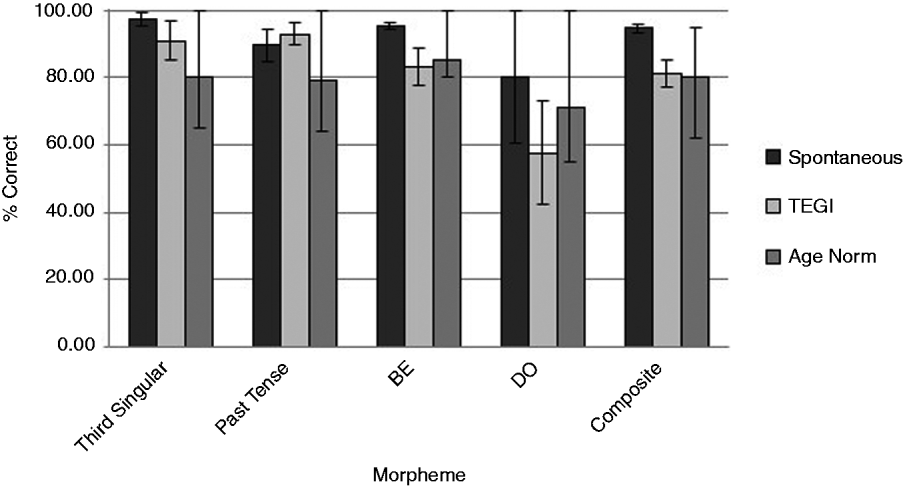
Responses to the TEGI probes were used to calculate accuracy scores for the following tense-marking morphemes: third person singular -s, regular past tense -ed, irregular past tense, BE copula and auxiliary, and DO auxiliary. The average of all accuracy scores comprised the elicited grammar composite (EGC) score. Each IA child's percentage accuracy score for each morpheme, except irregular past tense, was compared to TEGI age-matched norms for children learning English as an L1. The irregular past tense and regular past tense are combined in the TEGI norms, and thus there was no appropriate norm for irregular past tense only (Rice & Wexler, Reference Rice and Wexler2001). Four of the IA children (DH, JF, LS, MFW) were at or above the age-norms for third person singular; all were at or above age-norms for past tense; three (DH, MFW, RM) were at or above the age-norm for BE; three were at or above age-norms for DO (DH, JF, LS); and three (DH, JF, LS) were at or above the age-norm for the EGC. Average percentage correct for each morpheme was also calculated (Figure 4). In general, most of the children were at or above norms for each morpheme.
Percentage correct at Session 5 for tense morphemes and composite in spontaneous speech and on the TEGI. TEGI norms are presented with error bars representing the 25th and 75th percentiles.
The children's EGC composite scores were compared to percent correct tense-marking composite scores based on spontaneous productions. Scores for individual TEGI probes were also compared to percent correct scores for each morpheme from the spontaneous language samples (Figure 4). EGC scores were significantly lower than spontaneous tense-marking composite scores (Z=−2·02, p=0·04, r=0·64), (ECG mean=81·15%, tense-marking mean=94·57%). However, there were no significant differences between elicitation and spontaneous language production scores when each type of morpheme was considered separately (third person singular: Z=−0·73, p=0·47, r=0·23; past tense regular: Z=−1·07, p=0·29, r=0·34; past tense irregular: Z=−1·21, p=0·23, r=0·38; BE: Z=−1·75, p=0·08, r=0·55; DO: Z=−0·94, p=0·35, r=0·30).
DISCUSSION
The IA children's acquisition of both tense- and non-tense-marking morphology exhibited the same characteristics displayed by L1 learners and was unlike that of child L2 learners of English. Like both L1 and child L2 learners (e.g. Ionin & Wexler; Paradis, Reference Paradis2005; Reference Paradis, Gavruseva and Haznedar2008; Paradis et al., Reference Paradis, Rice, Crago and Marquis2008), the IA children mastered non-tense-marking morphemes earlier and produced them more accurately than tense-marking morphemes. Although the TEGI results suggest that the spontaneous language samples might overestimate the IA children's competence, they nevertheless corroborate that the IA children show greater difficulty with tense- than non-tense-marking morphology.
More specifically, like typical L1 learners but unlike child L2 learners, the IA children showed no advantage acquiring BE over other tense-marking morphemes. They were less accurate in their spontaneous use of BE compared to non-tense-marking morphemes in all sessions prior to mastery (Session 5), and accuracy for BE never differed from accuracy for tense-marking morphemes. Corroborating this result, use of BE in response to TEGI probes was essentially identical to mean EGC scores and was lower than their scores for other tense-marking morphemes. Thus, there is no evidence for precocious BE mastery.
IA children also produced few commission errors, and these resembled the errors of L1 learners both quantitatively and qualitatively. Their rate of commission errors for non-tense-marking morphemes was always below 10%. For BE and other tense-marking morphemes, commission errors were initially below 10% (Session 2). Although this increased in Sessions 3 and 4 (14–22%), rates were still considerably lower than those observed in Paradis' (Reference Paradis, Rice, Crago and Marquis2008) child L2 learners who had had similar amounts of exposure to English; they produced commission errors at rates as high as 47%. What appear to be large percentage differences in error rates in our results could be due to small differences in actual frequencies. By Session 5, the actual numbers of errors is so low that it is difficult to interpret these results unequivocally. Importantly, a qualitative examination of error types reveals typical L1 patterns. Specifically, BE overgeneration, commonly observed in child L2 learners (e.g. Ionin & Wexler, Reference Ionin and Wexler2002), was observed at very low rates in these children, who also showed high rates of BE omissions; an atypical pattern for child L2 learners. Thus, the types of errors made by these IA children do not resemble those of typical child L2 learners.
That the IA children displayed mastery on par with, or even ahead of, typical L1 learners, along with typical L1 acquisition patterns, could be explained in a number of ways. One possibility may be related to the fact that all of the IA children examined here had initial exposure to the adoption language within the classic critical period for language development (generally thought to end between twelve and fifteen years of age, although it has been argued that ‘critical periods’ for subsystems of language (such as phonology) may occur much earlier; e.g. Birdsong, Reference Birdsong2006), and likely within the period of primary language acquisition as well. Second, these children were immersed in only one language, and thus experienced monolingual exposure, not divided language input as is the case for typical L2 learners. Third, while it is unclear whether IA children lose their birth language entirely (e.g. Pallier et al., Reference Pallier, Dehaene, Poline, LeBihan, Argenti, Dupoux and Mehler2003) or whether some neurocognitive traces remain (e.g. Abrahamsson & Hyltenstam, Reference Abrahamsson and Hyltenstam2009), it appears that any interference (or benefits) that typical L2 learners might experience as a result of L1 transfer were inconsequential or diminished in the case of these IA children (Pallier et al., Reference Pallier, Dehaene, Poline, LeBihan, Argenti, Dupoux and Mehler2003). Finally, the IA children's grammatical development may have been facilitated by the enrichment that comes with being raised in high SES families (e.g. Hoff, Reference Hoff2006), and this may have counteracted any deleterious effects due to delayed exposure to English, loss of the birth language, and/or any adverse pre-adoptive conditions.
There are, of course, limitations to this study, including a small and homogenous sample size. Testing larger samples of children from different countries learning different languages would serve to establish the reliability of these findings. It would also be useful to compare these IA children directly to matched L1 and child L2 learners. Notwithstanding these limitations, these results suggest that despite delay in acquisition onset, IA children's English acquisition displays a developmental trajectory similar to that of L1 learners and different from child L2 learners.