Catheter ablation procedures are performed to treat various types of arrhythmias. Three-dimensional electroanatomic mapping systems are increasingly being used during ablation procedures to reduce/eliminate the need for fluoroscopy and therefore exposure to ionising radiation. Reference Clark, Bockoven, Lane, Patel and Smith1–Reference Papagiannis, Tsoutsinos and Kirvassilis4 Although these systems have greatly reduced radiation exposure, they have not completely eliminated the use of fluoroscopy in all cases. Transseptal puncture, a technique of creating a small hole in the atrial septum in order to gain access to the left atrium from the right side of the heart, is a commonly employed procedure in the electrophysiology lab. In paediatrics, it is most commonly done for left-sided accessory pathways and less commonly for ectopic foci. In the adult population, it is most commonly used for atrial fibrillation ablation. The need for transseptal puncture is a common reason for fluoroscopy use during an ablation procedure. Reference Rolf, Schoene and Kircher5–Reference Koca, Paç, Eriş, Zabun, Özeke and Özcan7
Transseptal puncture is traditionally performed under fluoroscopic guidance. Reference Sharma, Nalamasu, Gopinathannair, Vasamreddy and Lakkireddy8 Fluoroscopy exposes patients and staff to ionising radiation which can have long-term adverse health effects. In recent years, efforts to reduce fluoroscopy use during ablation procedures have included the use of non-fluoroscopic imaging during transseptal puncture. Current technologies include transesophageal echocardiography, intracardiac echocardiography, transthoracic echocardiography, and three-dimensional electroanatomic mapping systems.
Previous studies have demonstrated reduced radiation exposure when transseptal puncture is performed using electroanatomic mapping systems compared to conventional fluoroscopic guidance. Reference Troisi, Quadrini and Di Monaco9,Reference Sawhney, Breitenstein and Watts10 In this study, we describe the radiation exposure associated with transseptal puncture from procedures recorded in a multi-institutional database. We compare this to the radiation exposure associated with catheter ablation procedures of left-sided accessory pathways that do not require transseptal puncture.
Materials and methods
The study was approved by the institutional review board.
Data were obtained retrospectively from the Catheter Ablation with Reduction or Elimination of Fluoroscopy registry, which is a multi-institutional research database tracking outcome of ablations in which three-dimensional mapping has been utilised in both children and adults. Patients undergoing catheter ablation for a left-sided accessory pathway (concealed or manifest)-mediated tachycardia, with a structurally normal heart, who had a transseptal puncture, and were under 22 years of age were selected for inclusion in the study group. Patients with a patent foramen ovale, meeting the same criteria, but who did not have a transseptal puncture, were selected for the control group. Patients who had previous ablations or concurrent diagnostic or interventional catheter procedures and those with missing data for either fluoroscopy use or acute procedural success were excluded.
All catheter ablation procedures were performed utilising one of two three-dimensional electroanatomic systems (EnSite, St. Jude Medical/Abbott or CARTO, Biosense Webster).
The following data were evaluated and compared between the two groups: patient characteristics, total procedure time, rate of fluoroscopy use, total fluoroscopy time, acute procedural success, and minor and major complications. Procedure time is defined as sheath in to sheath out time. Acute procedural success is categorised as complete success, partial success, or failure. Complete success is defined as elimination of tachycardia and all evidence of accessory pathway conduction. Partial success is defined as modification of the tachycardia or incomplete elimination of the pathway. Failure is defined as no change in the arrhythmia or substrate. Since the majority of patients had fluoroscopy time reported but not radiation dose, radiation dose is not evaluated in this study.
Reviewing the data, it was seen that most of the completely fluoroless procedures were performed at a single institution. We, therefore, compared the procedural outcomes of the patent foramen ovale and transseptal puncture groups after excluding that institution.
Statistical analysis
Data were imported into SPSSv250.0 software (IBM Corp., Armonk, NY). Numeric characteristics were summarised using means, standard deviations, and minimum and maximum values and compared for mean equality between strata via independent samples Student’s t-tests. Categorical characteristics were summarised using frequencies and percentages, and the strata were compared for distributional equality using Pearson’s chi-square or Fisher’s exact tests depending on cell sample size distribution. The data were evaluated at the type I error rate of α = 0.05 level of statistical significance.
Results
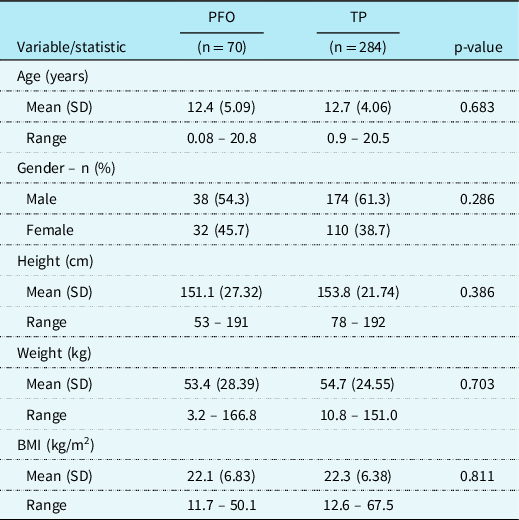
The transseptal puncture group consisted of 284 patients, and the patent foramen ovale group consisted of 70 patients who underwent a catheter ablation procedure using three-dimensional mapping from January 2006 to September 2020. There were no significant differences in demographic data between the two groups (Table 1).
Transseptal puncture/PFO baseline comparison

PFO = patent foramen ovale; TP = transseptal puncture.
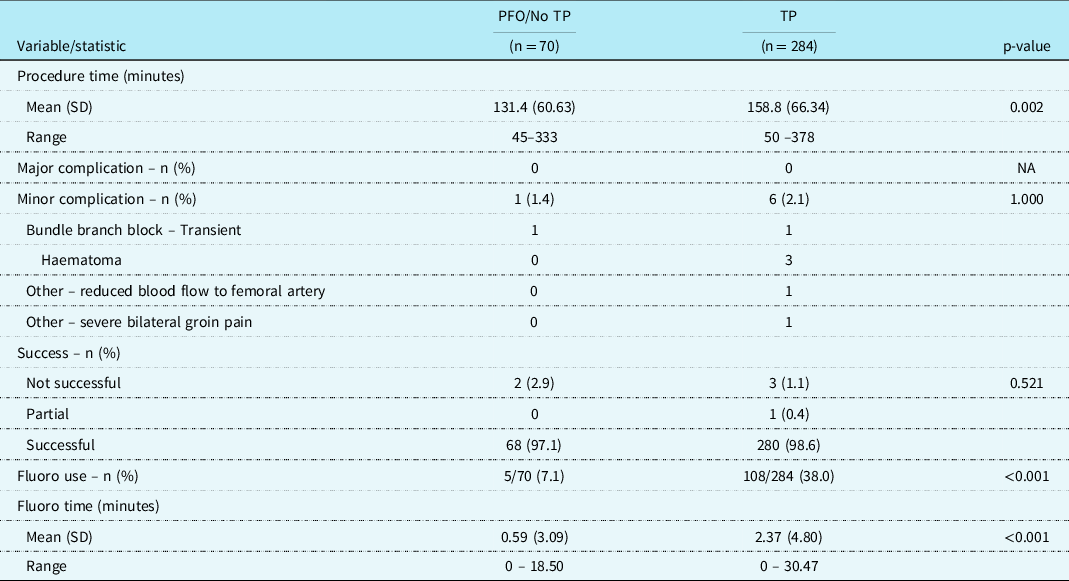
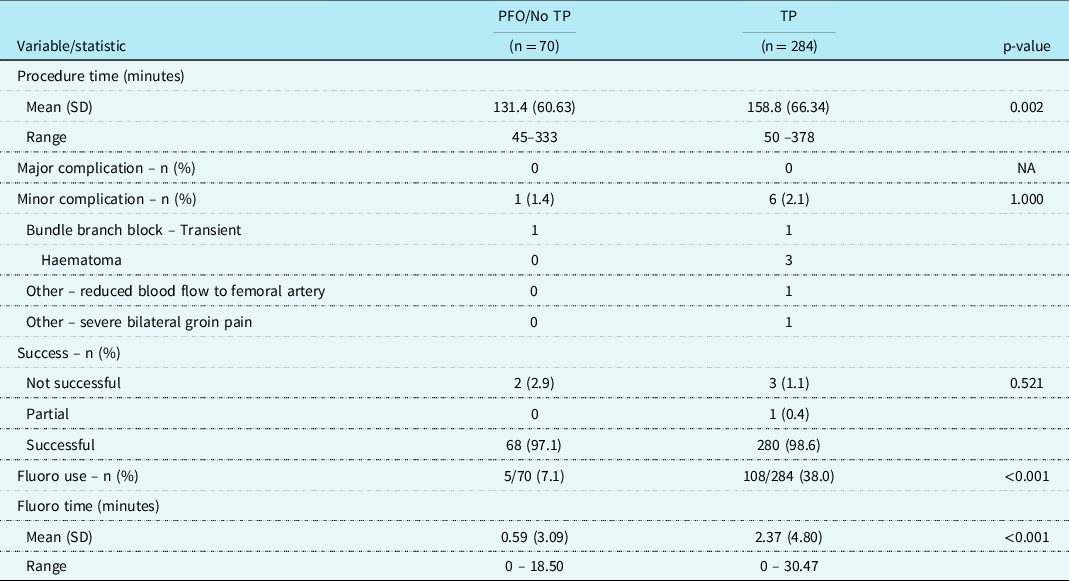
Procedural outcomes are listed in Table 2. In the transseptal puncture group, the mean procedure time was 158.8 ± 66.3 minutes (range 50–378 minutes). Fluoroscopy was used in 108/284 (38%) ablation procedures. The mean fluoroscopy time for the group was 2.4 ± 4.8 minutes (range 0–30.5 minutes). Acute procedural success was achieved in 281/284 (99%) patients; 280 patients had complete success, and 1 had partial success. There were no major complications reported. Minor complications occurred in 6/284 (2%) patients. The minor complications included haematoma (3/284, 1.1%), transient bundle branch block (1/284, 0.4%), reduced blood flow to femoral artery (1/284, 0.4%), and severe bilateral groin pain (1/284, 0.4%).
Transseptal puncture/PFO outcome comparison
Note: Percentages are expressed per the number of non-missing values.
PFO = patent foramen ovale; TP = transseptal puncture.
In the patent foramen ovale group, the mean procedure time was 131.4 ± 60.6 minutes (range 45–333 minutes). Fluoroscopy was used in 5/70 (7%) ablation procedures. The mean fluoroscopy time for the group was 0.6 ± 3.1 minutes (range 0–18.5 minutes). Acute procedural success was achieved in 68/70 (97%) patients, all of whom had complete success. There were no major complications reported. Minor complications occurred in 1/70 (1.4%) patients. The minor complication was transient bundle branch block (1/70, 1.4%).
Patients who underwent a transseptal puncture procedure had a significantly higher mean procedure time compared to the control group (158.8 versus 131.4 minutes, p = 0.002). The transseptal puncture group had a significantly higher rate of fluoroscopy use (38% versus 7%, p < 0.001). They, overall, also had a significantly higher mean fluoroscopy time (2.4 versus 0.6 minutes, p < 0.001). There was no statistically significant difference in the rate of acute success (p = 0.521), minor complications (p = 1.000), or major complications between the two groups.
Since the majority of the fluoroless procedures were performed at a single institution, we performed a secondary evaluation of the data on a subset of patients after removing that institution from the review. Table 3 shows the procedural outcomes on that subset of patients. The transseptal puncture group consisted of 90 patients, and the patent foramen ovale group consisted of 17 patients. In the transseptal puncture group, the median procedure time was 200 minutes (interquartile range 157–241 minutes). Fluoroscopy was used in 88/90 (98%) ablation procedures. The median fluoroscopy time for the group was 3.7 minutes (interquartile range 2.1–8.9 minutes). In the patent foramen ovale group, the median procedure time was 170 minutes (interquartile range 154–214 minutes). Fluoroscopy was used in 4/17 (24%) ablation procedures. The median fluoroscopy time for the group was 0 minutes (interquartile range 0–0.42 minutes). There was no statistical difference (p = 0.167) in the procedure times between the two groups. The rate of fluoroscopy use (p < 0.001) and fluoroscopy time (p < 0.001) was significantly higher in the transseptal puncture group compared to the patent foramen ovale group.
Outcome comparison after excluding one fluoroless centre

PFO = patent foramen ovale; TP = transseptal puncture; IQR = interquartile range.
Echocardiography was a common adjunct to electroanatomic mapping for transseptal puncture, with transesophageal echocardiography being most often used (54% of procedures). However, in the patent foramen ovale group, it was rarely used. Transthoracic echocardiography was used in 2 procedures; transesophageal and intracardiac echocardiography were not utilised.
Discussion
Transseptal puncture has been performed since the 1950s. The procedure requires positioning, repositioning, and visualisation of the sheath, dilator, needle and guidewire. Traditionally, visualisation has been done by fluoroscopy. Reference Ross11 With the advent of three-dimensional mapping systems and their ability to minimise the radiation exposure, there has been an interest in non-fluoroscopic methods for crossing the interatrial septum. Since the sheath, dilator, guidewire, and needle cannot be readily viewed on three-dimensional mapping systems, an alternative means of guiding the procedure is required. Ultrasound is the standard tool to guide transseptal puncture without fluoroscopy. This may be intracardiac, transesophageal, or transthoracic echocardiography. Since there is not yet a perfect alternative to fluoroscopy for transseptal puncture, many physicians still choose to utilise fluoroscopy for the procedure.
In this study, we evaluated the radiation exposure associated with transseptal puncture. This is the first study to directly compare the procedural outcomes in patients requiring transseptal puncture with those not requiring transseptal puncture, during ablation procedures utilising three-dimensional electroanatomic mapping. Our findings demonstrate that patients undergoing transseptal puncture have longer procedure durations and are exposed to more fluoroscopy, compared to patients who do not require transseptal puncture.
In order to ensure a direct comparison of procedures in which transseptal puncture was performed to those without transseptal puncture, we limited our patient population to those with a left-sided accessory pathway and selected patients with a structurally normal heart undergoing transseptal puncture as the study group and patients with a patent foramen ovale not requiring transseptal puncture as the control group. There may be occasions when a transseptal puncture is still performed, even in the presence of a patent foramen ovale, as in atrial fibrillation ablation. However, the patients in the current study who had a patent foramen ovale did not undergo transseptal puncture. By evaluating left-sided pathways only, we eliminated confounding variables such as different types of arrhythmias. Specifically, we wanted to avoid comparing ablations of right-sided accessory pathways and atrioventricular nodal reentrant tachycardia to those of left-sided pathways, as these may require different amounts of fluoroscopy to ablate successfully and thus affect the total fluoroscopy time. Kean et al. retrospectively evaluated ablation procedures in which non-fluoroscopic navigation was employed and compared those requiring high fluoroscopy time (≥10 minutes of fluoroscopy) to those requiring low fluoroscopy time (<10 minutes). High fluoroscopy time was associated with transseptal puncture but when atrioventricular nodal reentrant tachycardia was excluded, this was no longer true. The authors hypothesised that there was no association between high fluoroscopy and transseptal puncture because less fluoroscopy is required to ablate left-sided substrates. Reference Kean, LaPage, Yu, Dick and Bradley12 By using only left-sided accessory pathways in the current study, we aimed to evaluate the outcomes associated specifically with the performance of transseptal puncture.
Transseptal puncture is an extra procedure performed during catheter ablation; therefore, it was expected that ablations requiring transseptal puncture would take longer, as was found in our study. There are multiple steps involved in performing a transseptal puncture, and it is important to be in the correct spot at the fossa ovalis in order to increase success and avoid complications. The correct location represents only about 20% of the atrial septum and failure to localise/puncture it is the most common cause of uncompleted transseptal puncture procedures. Reference Sharma, Nalamasu, Gopinathannair, Vasamreddy and Lakkireddy8 Traditionally, fluoroscopy has been used to confirm the location of the needle at the fossa ovalis and in the left atrium once the puncture is made. In recent years, three-dimensional electroanatomic mapping systems have been used to reduce and even eliminate the need for fluoroscopy. However, even with the use of electroanatomic mapping, some cases still require the use of fluoroscopy. This includes patients with complex anatomy, prior septal repair, implantable cardiac devices, and any challenging transseptal puncture cases. Reference Sawhney, Breitenstein and Watts10,Reference Baykaner, Quadros and Thosani13,Reference Clark, Sumihara, McCarter, Berul and Moak14 Therefore, it was expected that transseptal puncture would be associated with a higher rate of fluoroscopy use and overall longer fluoroscopy times, as was found in our study. Given the possibility of other indications for fluoroscopy use, it is also not surprising that some patients in the patent foramen ovale group required the use of fluoroscopy.
Despite the higher fluoroscopy times and thus ionising radiation exposure associated with transseptal puncture, utilisation of electroanatomic mapping during the procedure has been shown to reduce fluoroscopy use. Troisi et al. retrospectively evaluated 145 patients who underwent atrial fibrillation ablation using electroanatomic mapping guidance between June 2018 and April 2019 and 145 patients who underwent atrial fibrillation ablation using standard fluoroscopic guidance before June 2018. The group using electroanatomic mapping guidance had significantly shorter fluoroscopy times (3.6 ± 2.5 versus 13.5 ± 10.5 minutes, p < 0.001) and a lower dose area product (13 ± 11 Gy*cm Reference Smith and Clark2 versus 28 ± 27 Gy*cm Reference Smith and Clark2 , p < 0.001). Reference Troisi, Quadrini and Di Monaco9 Another study by Sawhney et al. retrospectively evaluated 20 patients (32 transseptal punctures) who had a transseptal puncture using three-dimensional mapping systems alone and 14 patients (25 transseptal punctures) who had a transseptal puncture using fluoroscopic guidance. The authors reported a significantly lower mean fluoroscopy time and dose in the group using three-dimensional mapping (0.75 ± 0.50 versus 5.32 ± 3.23 minutes, p < 0.001; 92.5 ± 60.7 versus 394.3 ± 182.7 cGy/cm Reference Smith and Clark2 , p < 0.001). Reference Sawhney, Breitenstein and Watts10 In our study, transseptal puncture was performed on 62% of the patients without the use of fluoroscopy. These findings highlight the benefit of reduced fluoroscopy use associated with electroanatomic mapping.
Use of electroanatomic mapping has emerged as a tool to reduce radiation exposure. This is an important topic in electrophysiology for both patients and staff, as both can be exposed to high cumulative levels of ionising radiation which may be associated with adverse health effects, including an increased risk of cancer. Reference Journy, Dreuil and Rage15–Reference Macle, Weerasooriya and Jais23 This is especially important in CHD patients as they may need to undergo multiple diagnostic and interventional procedures throughout their lifetime which can expose them to high levels of cumulative radiation which can exceed the recommended limit. Reference Glatz, Purrington and Klinger24 Therefore, the goal should be to eliminate any radiation whenever possible, as it is difficult to predict what procedures patients will need in the future and when they will reach their limit.
Efforts should be undertaken to further reduce radiation exposure during catheter ablation procedures. In the current study, excluding one institution that is entirely fluoroless, transseptal puncture resulted in radiation exposure in 98% of procedures, compared to 24% when transseptal puncture was not performed. These data are from institutions with a very aggressive use of three-dimensional mapping. The data suggest that transseptal puncture is likely the number one reason that fluoroscopy is still used in the paediatric electrophysiology lab. While the radiation times are low, there is no lower limit of dose that is known to be safe. Visualising most sheaths, dilators, and guidewires is not possible with current three-dimensional mapping systems. Therefore, the easiest way to perform transseptal puncture is with fluoroscopy. However, providing data to demonstrate this fact can be the impetus for industry to provide better tools for fluoroscopy reduction.
Ultrasound is typically used as an adjunctive tool to try to reduce fluoroscopy use. All procedures in the current study in which non-fluoroscopic transseptal puncture was performed utilised some form of ultrasound, either transesophageal or intracardiac echocardiography. However, both of these modalities have potential drawbacks. The use of transesophageal echocardiography is limited by the need for an additional provider to perform the test as well as requiring the patient to go under general anaesthesia instead of deep sedation. The use of intracardiac echocardiography is limited by its expense as well as difficulty with vascular access, especially in small children and patients who have had multiple previous vascular accesses. Therefore, this is less commonly used in the paediatric population. Both transesophageal and intracardiac echocardiography also increase the procedure duration. In order to use electroanatomic mapping alone to reduce or eliminate fluoroscopy use, there is a need for guidewires, sheaths, and dilators that are visible on electroanatomic mapping systems. These advancements would reduce the total procedure time, making the use of adjunctive transesophageal or intracardiac echocardiography more acceptable. These tools might also make it more feasible to use transthoracic echocardiography instead of transesophageal or intracardiac echocardiography. With improved tools, fluoroscopy-free electroanatomic mapping-guided transseptal punctures may be promising.
Compared to a traditional fluoroscopic approach, three-dimensional electroanatomic mapping has greatly reduced fluoroscopy use during ablations, even in those requiring transseptal puncture. However, transseptal punctures are still associated with longer procedure durations and higher radiation exposure compared to procedures not requiring transseptal puncture. Although 2.4 minutes of fluoroscopy time in the whole group, or 3.7 minutes in the subset, may seem like a reasonable amount of radiation exposure, the goal should be to eliminate any radiation whenever possible, as it can contribute to a patient’s lifetime cumulative radiation exposure. There remains much room for improvement, and radiation times can be further decreased or eliminated. This can be accomplished with the help of industry, by providing the electrophysiology community with improved tools.
Limitations
This is a retrospective study employing a multi-institutional database with some missing data noted. Long-term success was not evaluated, as long-term outcomes were not reported in the database. The majority of fluoroless procedures were performed at a single institution. Therefore, the data were evaluated both for the entire group and as a subset of patients excluding the fluoroless centre.
Conclusions
In conclusion, our study demonstrates that ablation of left-sided accessory pathways is accomplished with a high rate of acute procedural success and low complication rate in a large multi-institutional database of centres employing three-dimensional electroanatomic mapping systems with the goal of reducing or eliminating fluoroscopy exposure. After eliminating patients from one institution with significant fluoroless ablation experience, transseptal puncture was the number one indication for fluoroscopy use, with the majority of the transseptal puncture procedures (98%) requiring fluoroscopy. These findings are of clinical importance as they demonstrate a need from industry for the development of improved tools for performing transseptal puncture, with the goal of making fluoroless transseptal puncture more easily performed and more widely accepted.
Acknowledgements
We would like to thank the Rebecca D. Considine Research Institute for their administrative support.
Financial support
This research received no specific grant from any funding agency, commercial, or not-for-profit sectors.
Conflicts of interest
Dr. Razminia is a consultant for Abbott. The other authors have no conflicts of interest to declare.