INTRODUCTION
The experience that time passes at different speeds is part of our daily life. An hour may pass extremely quickly or, in contrast, just seem to drag. Our subjective well-being is linked to the experience of time: distraction by entertaining activities seems to speed up time. During pleasant activities, attention is directed to an event—a conversation or a thrilling movie—and time seems to pass quickly (Baum et al., 1984; Zakay & Block, 1997; Wittmann & Lehnhoff, 2005). In contrast, the boredom that may arise in uneventful situations is associated with the apparent slowing down of time. Bored persons more often perceive time as passing slowly, even when they are busy performing a task (Watt, 1991). Institutionalized clients who live, for example, in residential homes for the elderly and whose days are highly regulated and monotonous experience time as passing slowly (Locsin, 1993). There is evidence that patients with depression perceive a slowing of the pace of time (Blewett, 1992) and tend to overestimate durations in time-judgment tasks (when subjective ratings of durations are compared with objective clock time; Kuhs et al., 1989; Münzel et al., 1998; Bschor et al., 2004). In more general terms, studies suggest that the overestimation of time intervals is a sign of emotional distress that draws attention away from meaningful thoughts and actions and directs it to the passage of time (Twenge et al., 2003). Focusing one's attention to time, then, slows down the subjective passage of time.
Cognitive models on prospective time estimation—when a person estimates the duration of a time interval that he or she is presently experiencing—propose that an individual's perception of time depends on an internal clock with a pacemaker producing subjective time units (Zakay & Block, 1996; Wearden, 2004). In these cognitive models, subjective time units are only registered at moments when attention is drawn to time. An attentional gate then opens, and time units are fed into a counter. At moments of distraction from time, the attentional gate is closed, and time units are not recorded (Zakay & Block, 1997; Wittmann, 1999). The number of units that are collected during a given time span corresponds to the subjective impression of duration. If more attention is directed to time, duration is experienced as being longer, as more time units have been collected. This cognitive model of prospective time perception suggests that stress-related emotional states, which cause a person to draw attention away from meaningful thoughts and to direct it to the passage of time, leads to the subjective impression of a slower pace of time and an overestimation of time intervals.
Due to the life-threatening illness and severe side effects of treatment, cancer patients show a high level of distress that can lead to symptoms of depression and anxiety (Holland, 1989; Massie, 1989; Massie & Holland, 1990; Sellick & Crooks, 1999; Montgomery et al. 2003; Midtgaard et al., 2005). This is not a problem of transient distressed mood, but a serious disturbance affecting patients' quality of life (Hyodo et al., 1999; Skarstein et al., 2000), which often creates the need for psychotherapeutic treatment (Fritzsche et al., 2004). Moreover, institutionalized patients are not able to engage in their usual role function and have to spend much of their time in situations where they are not emotionally or cognitively engaged, that is, in a series of waiting periods during their stay in hospital. In these situations, not only do diagnosis-related anxieties play a fundamental role for the quality of life, but also the experience of boredom. Both the feeling of meaninglessness and the absence of a stimulating environment can manifest themselves in a state of boredom, an existential vacuum (Passik et al., 2003). The focus of attention during these waiting periods, that is, the ability to form meaningful thoughts and to distract oneself, affects the experience of time. Several studies suggest that meaning-centered psychotherapy positively influences spiritual well-being and hope (Greenstein & Breitbart, 2000; Breitbart et al., 2004; Cole, 2005). Empirical evidence shows the relationship between meaning and purpose in life and the possibility of psychosocial adjustment to cancer. Although cancer can vehemently disturb a person's sense of meaning, the ability to reconstruct meaning following the diagnosis is associated with a lowering of psychological distress (Lee et al., 2004).
Our study focused on the relationship between psychological well-being and the perception of time. Anecdotal reports, but no systematically collected information, exist on the relationship between the experience of time and psychological, as well as spiritual, distress in cancer patients. We refer to the aforementioned body of evidence on the association between mood states and time perception mediated through the direction of attention to time. We hypothesized that patients with hematological malignancies (our selected patient group) who experience more anxiety and/or depression and have a lower quality of life focus their attention more on the passage of time compared to patients who report less distress and higher quality of life. Patients with higher mental distress and a lower quality of life were expected to report a subjective slowing down of time and to overestimate time durations they were experiencing.
METHOD
Participants in this study were inpatients with hematological malignancies recruited in the Department of Internal Medicine III at the University Hospital Großhadern in Munich. They represented the whole spectrum of hematological malignancies and received treatment during a period of approximately 6 to 8 weeks. The study was approved by the Institutional Review Board of the University Hospital Großhadern and the Ethics Committee of the Medical Faculty of the University of Munich.
All subjects who agreed to participate after an informative talk with a psycho-oncologist signed an informed consent for the study. The specified age range was between 18 and 75 years. Patients with a severe illness of the central nervous system or a cognitive deficit assessed with the Cognitive Minimal Screening (Kessler et al., 1991) were excluded from the study.
Questionnaires for Psychological Distress and Quality of Life
The Hospital Anxiety and Depression Scale (HADS) contains 14 items measuring anxiety and depression in patients with a physical illness (Zigmond & Snaith, 1983). The HADS has often been used in studies on cancer patients (Hyodo et al., 1999), especially in patients with leukemia and lymphoma (Skarstein et al., 2000; Montgomery et al., 2003). Scores of 11 and above on the subscales are considered to be a sign of depression and anxiety; scores of 8 to 10 are treated as possible depression and anxiety (Zigmond & Snaith, 1983). The Functional Assessment of Chronic Illness Therapy—General (FACT-G; Cella et al., 1993) with 28 items was developed to measure the quality of life of cancer patients in subscale scores for physical, functional, social, and emotional well-being, as well as a total score. We were specifically interested in one item of the physical subscale, “I have pain.” Due to its strong and disturbing emotional component for patients with cancer (Massie & Holland, 1987), pain might influence the perception of time. The Functional Assessment of Chronic Illness Therapy—Spiritual Well-Being (FACIT-SP) assesses the spiritual dimension of mental health with 12 items that are summed up to a total score. Questions concern spiritual beliefs, purpose of life, and the feeling of peacefulness. Examples of items include “I feel a sense of harmony within myself” and “My life has meaning and purpose.” The FACIT-SP is a reliable and valid measure of spiritual well-being for people with cancer (Peterman et al., 2002).
Measures of Time Perception
Subjects first had to indicate how fast they experienced time passing in their present situation at the hospital on a visual rating scale ranging from 0 (very slow) to 10 (very fast). In a prospective time-estimation task, subjects were instructed to estimate a temporal interval from an indicated moment to the end of the interval signaled by the bell of an alarm clock. The interval to be estimated lasted 13 min. During this time interval patients filled out study questionnaires. We used the following instructions for the prospective timing tasks: “In a moment I'm going to say ‘start’ and then later the bell of the alarm clock will indicate the end of the time period. You are requested to indicate how much time you feel has gone by during that interval.” At the end of the time interval, subjects marked the estimated duration on a visual scale representing a time arrow covering a duration from 0 to 60 min with bars indicating 1-min steps. With this procedure we hoped to reduce the effects of whole number bias that can appear in verbal accounts of time intervals. This is a classic prospective time-estimation method that has shown to be sensitive to between-group differences in time perception (Stine et al., 2002; Bschor et al., 2004).
Partial correlations were employed for the assessment of associations between the measurements of subjective well-being and time estimation. Controlled covariates were age, gender, and first diagnose versus relapse. An independent samples t test was employed for detected group differences. Significance levels were set to values of p < .05 (one-tailed for the directional hypotheses concerning the correlations and the t test, i.e., patients with more psychological distress experience a slower passage of time and an overestimation of time intervals).
RESULTS
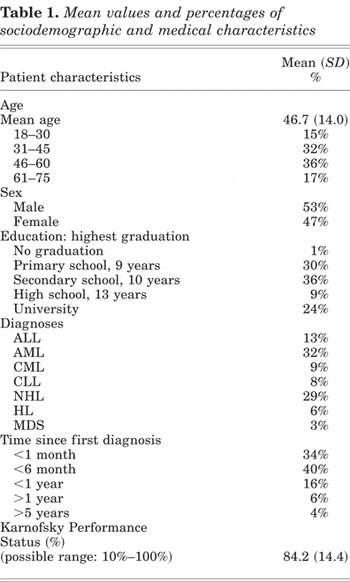
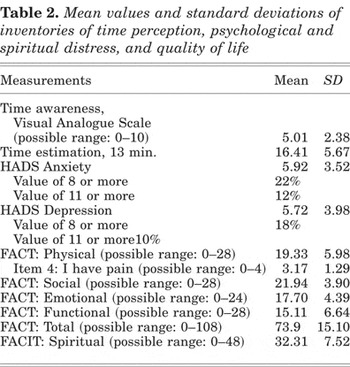
A total of 88 hospitalized patients with hematological malignancies (47 men and 41 women with a mean age of 46.7 years; range = 18–73) completed the questionnaires and time-estimation tasks. Patients had acute lymphocytic leukemia (ALL) (13%), acute myeloid leukemia (AML) (32%), chronic myeloid leukemia (CML) (9%), chronic lymphocytic leukemia (CLL) (8%), non-Hodgkin's lymphoma (NHL)—plasmocytoma (9%), non-Hodgkin's lymphoma (NHL)—other (20%), Hodgkin's Lymphoma (HL) (6%), and myelodysplastic syndrome (MDS) (3%). Fifty-seven patients were newly diagnosed, and 31 were in relapse. The Karnofsky performance status showed a mean value of 84.2% for the patient group. A detailed description of the patients' characteristics can be found in Table 1. According to the HADS, 22% of the patients were possible or clear cases with anxiety, 18% of the patients were possible or clear cases with depression. Table 2 summarizes the mean values of the patient group in the employed inventories.
Mean values and percentages of sociodemographic and medical characteristics

Mean values and standard deviations of inventories of time perception, psychological and spiritual distress, and quality of life

Correlations between Time Estimation, Psychological Distress and Quality of Life
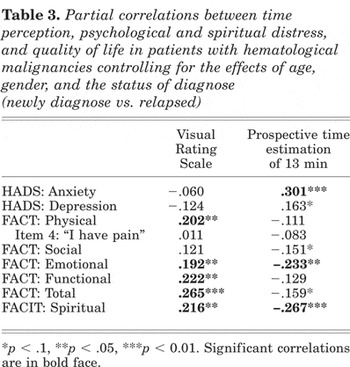
Several significant correlations between time estimation, psychological distress, and quality of life scores can be found. The correlation coefficients between the variables that are significant on the 1% and 5% levels all lie roughly between .2 and .3 (see Table 3).
Partial correlations between time perception, psychological and spiritual distress, and quality of life in patients with hematological malignancies controlling for the effects of age, gender, and the status of diagnose (newly diagnose vs. relapsed)

The visual rating scale for the perception of the passage of time is associated with the FACT-G subscale of physical (r = .202, p = .032), emotional (r = .192, p = .039), and functional well-being (r = .222, p = .021), as well as the total score of the FACT-G (r = .265, p = .007). When patients indicated that their subjective overall quality of life was higher, time also seemed to pass subjectively faster. The same association existed with the FACIT-Sp, the spiritual dimension of well-being (r = .216, p = .027). The higher the subjective spiritual well-being, the faster the experienced passage of time. For the 13-min, prospective time-estimation task, significant correlations were found with the HADS subscale for anxiety (r = .301, p = .003), the FACT subscale of emotional aspects of quality of life (r = −.233, p = .019), and the FACIT-SP (r = −.267, p = .010). These associations can be expressed as follows: Patients who prospectively estimated the time span as being longer showed a higher anxiety level, lower quality of life, and less spiritual well-being. No association between the subjective pain score and any measure of time perception could be detected.
As there was a correlation between HADS–Anxiety and the longer prospective time-estimation task, we wanted to know whether the subgroup of patients classified with a high anxiety level would differ from the subgroup of patients without anxiety. We therefore compared cancer patients with HADS values below 8 (n = 54; no anxiety) with patients with values above 8 (n = 29; possible and clear cases of anxiety; Zigmond & Snaith, 1983). A t test for independent samples revealed a significant difference between the two groups (t = 2.1, p = 0.02). The subgroup of patients with anxiety performed on average (18.1 min) with longer estimates in prospective time judgment of a 13-min interval than patients without anxiety (15.5 min).
DISCUSSION
In this study we investigated the association among time perception, psychological and spiritual well-being, and quality of life in patients with hematological malignancies. The subjective passage of time was slower when patients reported a lower quality of life and less spiritual well-being. In prospective time estimation of the 13-min interval, longer subjective ratings were found in more anxious patients and in patients who reported lower quality of life and spiritual well-being.
These findings can be explained by the models of psychological time estimation (Zakay & Block, 1997; Wittmann, 1999) introduced at the beginning of this report and by comparing them with other empirical studies with subjects in special emotional states, such as depression, boredom, or even social rejection (Watt, 1991; Twenge et al., 2003; Bschor et al., 2004). In our sample of patients, anxiety and an overall quality of life, as well as lower spiritual well-being, but not depression, were associated with the time domain. The correlations between time and mood in the range between .2 and .3 (explaining variance below 10%) were rather low. Although the strengths of association in the group of patients with hematological malignancies are not that strong, a significant categorization can be undertaken, as demonstrated with the HADS subscale “anxiety,” where patients with no anxiety had significantly shorter prospective time judgments than patients with anxiety.
According to the cognitive model of time perception, the results could indicate that cancer patients who show more anxiety and less overall quality of life focus their attention more on time. Theoretically, this focus on time can be explained by a loss of meaning or a fear of the future, that is, impending death (Vollmer et al., 2000). With less meaningful thoughts in mind, a person's capacity to distract himself from attending to time deteriorates (Twenge et al., 2003; Wittmann & Lehnhoff, 2005). According to models of prospective time estimation, attention to time leads to the accumulation of more subjective time units (Zakay & Block, 1997). Patients in distress pay more attention to time, resulting in longer duration estimates in the prospective time-estimation task and an overall feeling that time passes more slowly.
The results of our study indicate that the experience of the passage of time should be investigated and taken seriously in psycho-oncological interventions. The feeling that time passes slowly could indicate psychological distress resulting from an inability to focus on meaningful thoughts and to engage in purposeful actions. Patients who are able to distract themselves during stressful periods of time experience less distress. The correlations of the experience of time with spiritual well-being also indicate that meaning and purposefulness in life have an impact on subjective time awareness. Patients who are able to find meaning during their stay in hospital—a period of time that is characterized as being emotionally painful—experience time as passing more quickly. Our results, therefore, encourage the employment of meaning-centered psychotherapy in patients with a malignant illness as a means to positively influence psychological well-being and related subjective experiences (Breitbart et al., 2000, 2004). Our findings also emphasize the importance of addressing the search for meaning as a coping factor in dealing with life-threatening illnesses—not only in terminally ill patients.
The prevalence of anxiety and depression in cancer patients varies considerably depending on the assessment tools, but can roughly be estimated as lying between 20% and 50% (Sellick & Crooks, 1999; Skarstein et al., 2000). Patients with leukemia and lymphoma also develop high levels of anxiety and depression (Montgomery et al., 2003), but their scores are lower in contrast to cancer patients with other diagnoses (Skarstein et al., 2000). The prevalence of depression and anxiety measured with the HADS in our sample of cancer inpatients with hematological malignancies (10% had clear cases of depression and an additional 8% had possible depression; 12% showed clear signs of anxiety and additional 9% possible signs) also seems to be comparably low. Only a structured psychiatric interview could have accurately revealed mental disorders in our group of patients. The HADS, however, has been shown to be a reliable and valid screening instrument in large samples of patients with physical illnesses, especially cancer patients (Montgomery et al., 2003). Therefore, we used this instrument as a screening device for the likelihood of affective disorders. Only the association between time estimation and anxiety was significant, but not the association between time estimation and depression (although there was a positive tendency). Further research involving different time spans and other cancer-patient groups should show whether anxiety in patients with hematological malignancies is, indeed, the predominant mood state that is related to alterations in the experience of time passage.
Although there were only mild overall associations between time perception and psychological well-being, this study revealed for the first time that an association actually exists within a group of patients with hematological malignancies. Further studies with patients with solid tumors, who suffer more strongly from depression and anxiety (Holland et al., 1986; 1988; Green & Austin, 1994), should be conducted to find out whether even stronger associations can be revealed and whether depressive mood states can be associated with time perception. Confirmation of our initial findings could lead to interesting diagnostic possibilities in psycho-oncological interventions.
Patients' personal reports on their experience of time seem to be a valid, yet only mildly associated, indicator of a person's momentary mood state. Psycho-oncological caregivers usually do not take patients' reports on the perception of time into account (Gruber et al., 2000). Related issues of subjective experience, such as finding meaning and coping with boredom, both of which are psychosocial aspects of adjustment to cancer, are emerging in clinical research (Passik et al., 2003; Lee et al., 2004). The concept of time awareness in this context could also become increasingly important as an indicator of success in coping with mental distress caused by a life-threatening disease. Forms of distraction to avoid boredom and ways of regaining meaning and purposefulness in life could become more explicit topics in psycho-oncological interventions, subjective time being one essential component. Studies with patients suffering from terminal illnesses who experience the value of time and its speed of passage even more strongly could lead to the systematic use of the concept of time awareness.
ACKNOWLEDGMENTS
We thank the medical and psychology students Stefan Bauer, Nicole Stark, Susanne Neumann, and Monika Buchmann for their assistance in data collection and data management and all the staff of the Department of Internal Medicine III at the University Hospital Großhadern for their cooperation. This research was supported by a grant from the Else Kröner-Fresenius foundation on “Time perception in subjective confrontation with death” (VW 00-1).