I start with a character assessment of Giacomo Meyerbeer printed at the close of a memoir from 1848:
Although Meyerbeer is richly endowed with the good things of this world, his life is devoted to his art … He is to be admired as an artist, [but] he is, however, more to be prized as a man. The natural benevolence and mildness of his character; his agreeable and amiable behaviour to everybody; his modest and reasonable estimation of his own powers … his disinterestedness of mind; his scrupulous honesty, have long procured for him the esteem and affection of all who know him. And the personal virtues of this artist – as amiable as he is distinguished – must charm even those who envy him his fortune and fame. In short, he is fully deserving of the estimation in which he is held as a distinguished composer, and of the esteem which, as a man, is so universally felt for him.Footnote 1
The memoir was a primer about the composer rushed into publication to reach readers before Les Huguenots – a work that had premiered in Paris twelve years earlier – was mounted in England for the first time. That an introduction to the man was written at all does not mean audiences would have been unfamiliar with his work. Across its short narrative arc, the memoir even returns to instances when Londoners had encountered his music. But, in the moment the memoir was written, there was nonetheless a notable lack of connection between the composer’s status on the continent and in London. That marked contrast can be traced back to 1832. This was the last time his work had been mounted in the English metropolis, when the opera performed had been Robert le diable, a composition whose success in Paris months earlier could not have been more pronounced.Footnote 2 Flush with enthusiasm, Meyerbeer crossed the channel to oversee the London production, only to realise his status there was not so secure. We find crammed into one rushed memo to himself, written in a London hotel room, the wearied admissions: ‘No one has taken any trouble on my behalf’, ‘no one [has] lifted a finger’ and ‘the newspapers have ignored my arrival’.Footnote 3 These were, to be sure, the intimate notes of someone accustomed to fame; but to turn to a moment when there was comparable interest in the composer on the continent and in London, we need instead to consider the 1840s. At home in Paris, Meyerbeer would receive a stream of house calls from theatre directors who had themselves crossed the channel to secure authorisation to mount his works in London. The reasons for these house calls were intricate, as we shall see, but the result can be summarised in neat form: Robert, Les Huguenots and the brand new Le Prophète were all mounted in London theatres within months of one another in the late 1840s. And this cluster of performances created a Meyerbeer mania that would last for decades. In the words of one commentator, whether one wandered ‘east or west, north or south’, was ‘a speculator at [the] races or a spectator at [the] cricket ground’, London was ‘in a ferment’.Footnote 4 The composer became the talk of all; a discussion the memoir’s author was keen to manage.
To understand this turn of events, we need to examine the connection between this critical moment in the late 1840s and the institutional status of London’s main theatres at the time. The dramatic domain of individual theatres had been protected since 1737, such that three alone were licensed to mount opera – Drury Lane, Covent Garden and the Haymarket. The last of these was the only one licensed to mount it in a foreign language (rather than English) and in continuously sung form (rather than with spoken recitative). Monies had been invested in these theatres on condition that their exclusive dramatic domains should be maintained and when, in 1843, a new act enabled all theatres to be issued with a licence of their choice, Covent Garden closed its doors.Footnote 5 Meanwhile, the theatre at the Haymarket – then known as Her Majesty’s – was in the midst of its own institutional crisis. The theatre director there had to contend with routine insubordination as tension mounted between musicians and administrators and, in 1846, the theatre’s conductor Michael Costa abandoned the opera house with a host of fellow artists.Footnote 6 Costa went on to establish a new opera house at the site of the former Covent Garden theatre: the Royal Italian Opera, which opened in 1847. For the first time since the 1700s, London had two theatres devoted to opera, and their niche was more or less the same: both performed works in Italian and banished the spoken voice.
It was at this precise moment that the house calls to Meyerbeer commenced. In 1847, the directors of both theatres – Benjamin Lumley at the Haymarket, Edward Delafield, Arthur Webster and Frederick Gye at the Royal Italian Opera – travelled to Paris in an attempt to secure permission to reproduce Robert, Les Huguenots and soon-to-be premiered Le Prophète.Footnote 7 While these operas had been written for Paris, and in the case of Robert and Les Huguenots more than a decade earlier, it would have been prohibitively expensive for London theatres to commission new operas. Their directors instead reasoned that, since the English were more used to works from the continent than commissions for their own theatres, it made sense to court the most influential opera composer of the day. As they vied for status and audiences at their respective theatres then, these men also vied over their respective claims to the music of Meyerbeer. Her Majesty’s announced in its season prospectus for 1847 that the celebrated soprano Jenny Lind would appear as Alice in Robert, while the Royal Italian Opera promised in 1848 that Les Huguenots and Le Prophète would be the attractions of their forthcoming seasons, with mezzo-soprano Pauline Viardot featured in both. The memoir with which we started was penned within this institutional nexus, as a missive meant to lure readers towards the new institution: its author was Charles Gruneisen, a music critic for the Morning Chronicle, and a founder of the Royal Italian Opera.Footnote 8
The promotional document remains one of the most internally consistent accounts of the composer produced in England in 1848; one free from the complex moves that characterise most others. Commentators needed to create discursive space for Meyerbeer in late 1840s London, but had to do so in a critical landscape marked with distinct tensions. As Jennifer Hall-Witt has shown, in the decades that followed the 1832 Reform Act the opera in London remained to a considerable extent the haunt of the landed elite, much as parliament remained, above all, a seat of this same social and political class. If the Reform was meant to stamp out Old Corruption, numerous critics insisted that Her Majesty’s and the Royal Italian Opera were nonetheless home to Old Leisure – elites who were content to understand little about the world around them; and for whom music was to be contemplated in the manner of a fine wine.Footnote 9 Their motivations for doing so were above all musical in nature. What made London criticism so distinctive at the time was the mission numerous professional music critics set themselves: not to account for the reactions of audience members to new works, less still to endorse these theatres’ initiatives. Their ultimate aim was rather to promote a serious-minded approach to music and influence repertorial choices, and to do so with maximal rhetorical force these critics dovetailed criticism of music with anti-elite discourse: they harnessed widespread anti-elite sentiment to lend credence to their musical pronouncements. This took the form of criticism directed at the music these critics disliked, but that the fashionables most readily consumed – by Rossini, Donizetti, Bellini and Verdi – which could be likened to the elite itself in its artifice, ornament and show.
In this context it was almost inevitable that the Robert–Huguenots–Prophète London performances – which unfolded in theatres crowded to suffocation with fashionables – would also be vulnerable to similar attack, not least since Queen Victoria had a fondness for their composer.Footnote 10 Commentators in London inclined to fault these works and their audiences had numerous models on which to base their criticism. For while on the continent most musicians and critics had understood that in Robert and Les Huguenots Meyerbeer had ventured into uncharted – and important – new territory, from the outset discourse about the composer foreshadowed darker criticism to come. Felix Mendelssohn, Heinrich Heine, Robert Schumann and others voiced concern in the 1830s that the composer was false; that behind all the visual and sonic materialism of his work – the lavish sets and the unusual instrumental combinations – was the mere shadow of a man, someone with no real vision to share with the world.Footnote 11 When Richard Wagner later launched his anti-Semitic diatribes about the man and his music, and ridiculed him for unmotivated and cheap scenarios (what he termed ‘effects without causes’), he was building on an established discourse.Footnote 12
What is more, it was a discourse that reached across the channel, likely circulating across social networks as idle chatter. Consider for instance the similarities between one famous anti-Meyerbeer diatribe from the 1830s, an article Schumann published in the Neue Zeitschrift für Musik (but which was not printed in England for decades), and an 1847 article in London’s The Musical World. In reaction to the premiere of Les Huguenots, Schumann would claim:
An entire book would be insufficient for the discussion of the music. Every measure is planned; something could be said about each. ‘To strike dumb or to titillate’ is Meyerbeer’s principal motto … Meyerbeer’s extreme externalism, his lack of originality and his eclecticism, are as well known as is his talent for dramatic treatment, polish, brilliancy, instrumental cleverness, also his considerable variety in forms … It is easy to trace in Meyerbeer Rossini, Mozart, Hérold, Weber, Bellini, even Spohr; in short, all there is of music … I do not blame the use of any means in the right place; but we must not exclaim ‘Glorious!’ when a dozen trombones, trumpets, and … a hundred voices singing in unison can be heard in the distance.
And he would conclude:
Only hatred could deny that [Les Huguenots] contains some better elements … But what does this amount to compared with the vulgarity, distortion, unnaturalness, indecency, unmusicality of the whole?Footnote 13
Over a decade later, when the Robert–Huguenots–Prophète cluster was about to begin in London, The Musical World would describe the composer in remarkably similar terms:
As impressionable as water, and as unstable, the talent of Meyerbeer will ever reflect the form and colour of whatever outward influence may predominate for the time. The originality which he seems to possess is not the offspring of spontaneous feeling but the result of a certain obstinacy of volition, which by long exercise has enabled him to make old forms wear the aspect of novelty, by exaggerating their characteristics, or by omitting some points essential to their symmetry. Thus, in his hands, a melody that would at first sight appear but a vulgar tune, affects a kind of exclusiveness on the strength of a quaint turn of cadence, an unusual distribution of a chord or two in the harmony, or absolute oddity in the orchestral arrangement. Innumerable examples of this kind of treatment, scattered over the surface of a large work, such as a grand opera, endow the whole with a distorted something which is not originality but its shadow.
It would conclude:
Meyerbeer is for ever straining for effect. His melodies are rarely fresh and genuine; they do not, like Mozart’s, flow from the soul, as water from the hidden springs. His effects are seldom vigorous and natural illustrations of sentiment or incident, but, like the images which delirium paints upon darkness, vague, incoherent, and without manifest purpose.Footnote 14
This London review was not alone in its assessment of Meyerbeer. Numerous feature articles about the composer were issued at the time of the Robert–Huguenots–Prophète cluster, and such criticism littered their prose.Footnote 15 As London critics pressed hard on such ideas, the composer assumed an all-too-familiar form. This was after all a moment in which ‘sincerity’ had become the watchword of the times; when, in the words of Lionel Trilling, ‘certain classes of men conceived that sincerity was of supreme importance in moral life’, and the state of being sincere ‘stood high in the cultural firmament and had dominion over men’s imagination of how they ought to be’.Footnote 16 As a peculiarly Victorian obsession, the imperative to be sincere meant that one either had to have real conviction in intellectual and ethical matters or be disturbed that one did not; and it was to set aside a causal, superficial attitude in order to embrace a seriousness that befitted life. On this view, the essential problem with a composer who was false to the core was that he was insincere; that he did not write in earnest.
Thus at the same time as London’s main opera houses used Robert, Les Huguenots and Le Prophète to vie for survival, a narrative circulated that undermined the composer in a manner few other discourses could have done.Footnote 17 To intimate that someone was not sincere in Victorian England was to do none other than assassinate their character; no wonder then that Gruneisen finished his memoir as he did, with a character assessment that pushed back at those narratives with full force. His memoir reads as a sketch of the Victorian who has none of the vices of Old Leisure: ‘endowed with the good things of the world’, the composer still does not covet his coins; showered with all the honours possible, he is nonetheless never conceited.
For the remainder of this article, I will turn from the tales that swirled around the composer alone to consider how critics were alert to nuances in his works and influenced their success. Yet this wider frame is nonetheless important. In the earliest years of the Royal Italian Opera – precisely those in which the English premieres of Les Huguenots and Le Prophète took place – broadsheets such as The Spectator tried to distance the new theatre from its rival, and drew on a set of binaries that had hardened in the decades before to do so.Footnote 18 Influenced by German-language critics who had started to insist on the importance of work- rather than performance-centred reviews, these news outlets presented the two theatres as inversions of one another. On the one hand there were the old aristocratic habitués who went to the opera to socialise and chatter, were content to be amused by Italian opera and cared more for the thrill of the performance than the notes the composer had written; on the other hand there was a more ideal audience of musical purists sat in silent reverence, score in hand; and who went to listen to Mozart. It was at the Royal Italian Opera that critics most often envisioned this other, ideal audience, and to cultivate such an audience, their criticism tended to underscore the more sober dimensions of theatrical experience there. The Meyerbeer premieres, in particular that of Le Prophète, were drawn into this dance: they were cast, in the same vein as Mozart, as an earnest alternative to Italian opera.Footnote 19
True to Victorian stereotypes, these London critics discerned in Meyerbeer the most conservative elements possible. On the continent, meanwhile, another strain of discourse developed: French critics famously read the composer’s grands opéras for their political content, and while dramatic situations were a crucial element in their readings, so too was the sonic and visual abundance of these works. Their astounding instrumental combinations and intricate mise-en-scène threatened to overwhelm viewers so completely that for some these operas captured the essence of the sublime terror so characteristic of the revolutionary age.Footnote 20 Others still debated the motivations for the composer’s material abundance, which was at once admired and understood to enchant audiences, much as a new commercialism invested items on sale with a similar, baseless allure.Footnote 21 All these reactions to the composer’s works were dependent on meticulous attention to material dimensions in the Opéra’s productions, of course, but the material was also nurtured with considerable care at the Royal Italian Opera, within a newly reconstructed theatre with impressive acoustics and sight lines.Footnote 22 The director of the theatre, Frederick Gye, even went on to patent new devices to create some of the most famous scenic moments in Meyerbeer, such as the electrical sunrise in Le Prophète.Footnote 23 But most London critics made no more than passing mention of these characteristics. Theirs is not the Meyerbeer who was a master of mechanically produced illusion that aimed to invest the theatre with a necromantic aura, nor someone who rendered vivid the terror of the revolutions on the continent. In the relatively stable English political context – and perhaps in compensation for these works’ lack of obvious political relevance there – critics instead tended to direct their readers’ attention to those moments that were bare and understated, and above all to instances when visual and sonic climaxes did not combine.Footnote 24
To follow these historical traces could lead us into clichéd territory: with their fixation on the most parsimonious elements in these works, we seem to have once more caught Victorians in denial of pleasure; locked into a process of sublimation. But the encounter need not lead us to such predictable ends. As critics strove to invest these works with moral and intellectual relevance for English audiences, they also found ways to approach them with which we can productively engage, and which might even offer an alternative to a recent focus on material excess in Meyerbeer. To examine the cultural work that operas so overwhelmingly associated with the Paris Opéra did for other institutions, and other audiences, is after all to discover new ways in which these could be seen and heard.Footnote 25 That cultural work is nowhere more apparent than in the critical reactions to the 1849 English performance of Le Prophète.
On stillness
Composed in collaboration with librettist Eugène Scribe, Le Prophète premiered at the Paris Opéra in April 1849 with Pauline Viardot, Gustave-Hippolyte Roger and Jeanne Castellan in the main roles.Footnote 26 It was mounted a mere three months later at the Royal Italian Opera, and while the composer declined to attend – he did not set foot in London between 1832 and 1855 – he nonetheless collaborated with the theatre director Gye and the artistic director Augustus Harris.Footnote 27 What is more, he sent Viardot to star in the London performance, alongside the tenor Giovanni Matteo Mario and the soprano Charlotte Hayes. Billed as an event that the composer had overseen and authorised, the London Prophète met with phenomenal success, and soon became a favourite in the Robert–Huguenots–Prophète cluster.Footnote 28
But some critics had reservations. The most troublesome issue for numerous commentators on both sides of the Channel was that Scribe seemed to have crafted a world of impostors in Le Prophète – fanatical characters with no real conviction. The libretto concerns the rise of an Evangelical confederation in sixteenth-century Münster. The men behind the movement are three Anabaptists who chance upon the innkeeper Jean of Leyden and become convinced he should lead them in revolt and be their Prophet, but who later abandon him in order to save themselves. Their fanaticism, however intended, came across as mere charlatanism to most commentators, so soon do the Anabaptists cast their Prophet aside.Footnote 29 Jean, meanwhile, has no pretensions at first to be more than a son and husband; it is not until the feudal overlord Oberthal forces him to choose between Berthe, his lover, and Fidès, his mother, that he assumes the role the Anabaptists envision for him in order to enact revenge. But once he does so (a dream which foreshadows his rule is critical in this choice), has led a successful attack on Münster and has been crowned Prophet-King, he becomes enchanted with his own status and turns his back on the one woman he had resolved to save: his mother. In the end he is overcome with shame, abandons the revolution, and sets the palace (filled with the opera’s entire cast) aflame. Scribe and Meyerbeer were themselves concerned that Jean would seem flimsy and insincere; their partial solution was to make him a dreamer, someone who could vacillate between commitment to one ideal and another with all the ease of an eccentric.Footnote 30
The clear counterpart to these characters, however, was the mezzo-soprano Fidès. The Athenaeum was fascinated with this unusual character and forewent the usual formula for reviews when it summarised the libretto first in terms of a series of events that revolve around the humble older woman, and later in more conventional detail.Footnote 31 For The Musical World, Meyerbeer had
developed the character of his heroine, slowly, and step by step, as it were, feeling his way for her with the audience, and gaining their sympathy so gradually, that the interest increases with each scene, until at last it rises to a climax of the most overwhelming and irresistible nature.
That exquisite moment comes in the coronation scene. Fidès, who believes Jean to be dead, is astonished to recognise the Prophet-King as her son; the crowd – who are invested in the idea he was born to God alone – are thrown into confusion. Unsure how to resolve this, Jean decides to declare his mother mad and then simulate an exorcism: according to the stage directions he ‘places his hands on her head and fixes on her a look so fascinating that she falls involuntarily to her knees’; humiliated, she concedes to the onlookers that she never in fact had a son. The Musical World revelled in the raw power of the exchange:
In the scene of the coronation of the Prophet as Emperor of Germany, the character of Fidès is illustrated with a power that we have hitherto denied to Meyerbeer. Nothing can be more impressive than the one figure of truth amidst all this gallery of impostures – one pure heart scorning the empty pomp and glitter that surround it – a mother, who, to save the life of her unhappy son, is compelled to own herself childless, and thus to utter the only lie that has stained a life of sincerity and truth.Footnote 32
Fidès, for these critics, was the moral compass of the opera.Footnote 33
It was the performance of Viardot, moreover, that invested the character with such a remarkable aura of truth. For various critics at Prophète’s London premiere, hers was a performance that rendered character and actress inseparable.Footnote 34 Thus, on her contribution to the coronation scene, The Musical World – which had no discernible interest in the promotion of either opera house – would add:
The sudden recognition by the afflicted mother of her son in his imperial robes – the scream of rapture, succeeded by the mingled look of astonishment and doubt – the arms thrown forward yearning for the maternal embrace – the shuddering and effort to subdue her emotion when Jean demands ‘who that woman is’ – the anguish, despair and hopeless dread of the scene were so earnestly and intensely wrought, as to present a picture too painful to contemplate even in dramatic fiction; while the whole was illustrated by the grandest, purest, and most striking display of vocalisation.Footnote 35
Close attention to Viardot’s dramatic eloquence had a long history. Ever since her operatic debut she had earned a reputation as a sublime actress, comparable only to her contemporary Giuditta Pasta.Footnote 36 The tone of the London reviews of Le Prophète had been set in Paris three months earlier, when she created the role at the Opéra. There, critics pronounced her none other than the one, true Fidès: the sole woman who could enter into the mind-set of the humble mother and recreate her trials with singular dignity.Footnote 37 When the London critics devoted more column inches to Viardot as actress than vocalist – and these column inches were substantial – their fascination with Viardot in motion was also continuous with the approach of the Parisian critics.
Similar though these discourses were, however, when the London critics described Viardot the meaning that clung to their words was quite different from that in Paris. Journalists in England commonly traced how vocalists moved their bodies at this time, and while the direct stimulus was the attention that dramatic critics devoted to such matters, the broader impetus was a contemporary preoccupation with how subjectivity could be embodied on the stage. As Lynn Voskuil has demonstrated, if the nineteenth-century theatre as a site for interiority strikes us as an almost paradoxical idea, so attuned have scholars been to the private dimensions of inward experience, the theatre was no less a site for self-understanding than a room that housed a lone author and a writing desk.Footnote 38 As Voskuil shows, for the nineteenth-century drama critics William Hazlitt (1778–1830) and George Henry Lewes (1817–78), the stage was somewhere the actor could see and know ‘even the deepest, innermost reaches of the self’.Footnote 39 In order to achieve this, he had to learn to ‘act naturally’, and if in the hands of these theorists that was an intricate and even indeterminate proposition at times, it nonetheless demanded that the actor examine his own consciousness; that to create a character the audience could believe in, one first had to be a spectator of oneself. In the context of such intense discussion, which informed the prolific broadsheet criticism of Hazlitt in particular, and influenced journalism for decades to come, to insist on the believability of Viardot was also to attest to her essential naturalness. It was, in other words, to link her to an entire discourse in which identification with the character was predicated on knowledge of the self. A review that described Viardot as acting convincingly was a review that already established her credentials as self-aware and sincere.Footnote 40 That she was also associated with a robust intellectualism doubtless reinforced this impression: the singer sustained friendships with a series of thinkers across her life, including her husband, Louis Viardot, former director of the Paris Théâtre-Italien and an author and translator; her companion/lover, Ivan Turgenev, the Russian author now most famous for his novel Fathers and Sons (1859), and later in life, Charles Dickens.Footnote 41 Her social milieu and inclinations were well known to reviewers, who across the 1840s noted her considered investment in her characters.Footnote 42 In the climate of the times, this mattered: if novelist George Eliot (1819–80) could caricature Old Leisure as ‘undiseased by hypothesis’ and ‘happy in [its] inability to know the causes of things’, it was Viardot’s examination of the world around her that linked her to a more sincere class of individuals.Footnote 43
Perhaps fittingly for someone associated in the opera with a steadfast belief in truth, what marked Viardot as a natural actress was control and restraint; her actions were fluid but she never moved more than was called for. It was this reserve that critics thought Lind lacked in her 1847 London season. In one serially released account of operatic stars, Desmond Ryan bemoaned Lind’s continual need to move, her insistence that ‘to produce any great effect, a point should be made at every phrase, at every bar’, and her propensity to ‘illustrate … almost every word by some corresponding gesture or look’.Footnote 44 Like Mademoiselle Mars, whom Hazlitt had compared to Giuditta Pasta in an 1826 essay on how not to act, Lind never seemed sufficiently absorbed in the action. Viardot, in contrast, had understood that stillness and even silence could bind the character into their fictional world.Footnote 45
On silence
If reticence characterised Viardot’s acting, critics were conscious that this was a quality also scripted into the music of Fidès. The Musical World, for instance, remarked on her initial entrance in Act I:
It was not, as we have hinted, the aim of the composer to introduce his heroine by an extraordinary display, vocal or instrumental. Accordingly there is no grand aria d’intrata [sic] given to Fidès, nor is she brought upon the stage ushered in between two lines of obsequious choristers, who render due homage to the prima donna, after the manner of Italian writers. Fidès enters with Berthe, and, in placid recitative, they converse on the marriage of Jean with the latter. Nor did Pauline Garcia attempt aught beyond what the composer intended. Calm and collected she stood, full only of the realities of the scene.Footnote 46
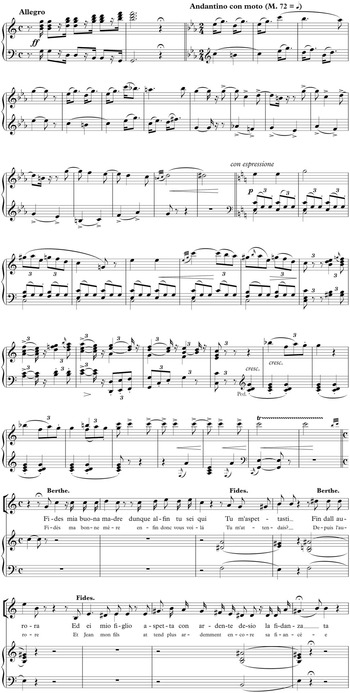
The silent entrance of Fidès is notable for its ‘economical’ musical means: introduced to a bare and jagged theme in the woodwinds that alternates between semiquavers and dotted quavers, the old woman is accompanied by music that underlines her uncertain footsteps. The moment is all the more stark because this is also the first entrance of her interlocutor, Berthe. In Paris, the opera had opened with a pastoral choral number that ceded to an ornamented aria for Berthe, ‘Mon coeur s’élance et palpite’ (‘My heart is leaping and throbbing’), followed by the laboured entrance of Fidès. In most London productions, however, this aria, which had been inserted into the Parisian premiere at the insistence of Jeanne Castellan, the first Berthe, was not performed.Footnote 47 Thus, in the revised version, neither enters with an aria. Berthe makes her first entrance in the opera moments after Fidès, and also does so in pantomime, but this time to a musical accompaniment whose instrumentation and triplet figures hint at her character’s more youthful profile. Once their protracted entrance is complete, the women do indeed converse in placid recitative, with the low strains of Viardot’s voice emerging out from the string texture beneath it (Ex. 1).
Meyerbeer, Le Prophète (Il profeta), Act I, first entrance of Berthe and Fidès in the London version.

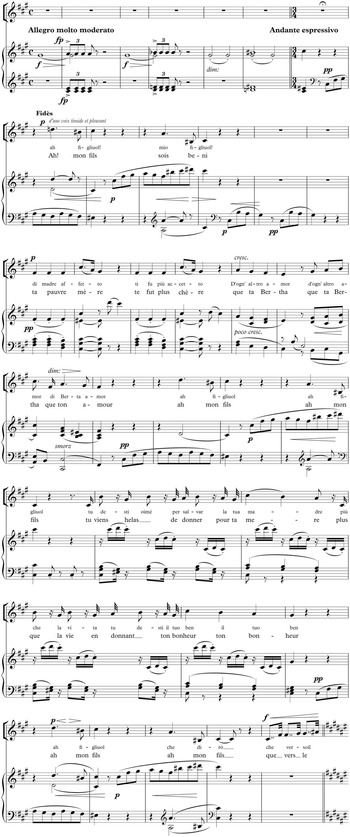
Such understated utterances characterise the music for Fidès across the work. Consider, for instance, Fidès’s first aria. In the London version, which was translated into Italian and fashioned into a four-act work in line with adaptation practice at the time, this comes at the close of Act I.Footnote 48 Moments before, Jean has hidden Berthe so that Oberthal will be unable to harm her. Fidès makes a mute entrance, forcibly restrained by Oberthal’s forces, who threaten to take her life unless Jean relinquishes Berthe. Unable to sacrifice his mother, Jean tears his lover from where she has sheltered and thrusts her into Oberthal’s hands. Fidès is released, from both Oberthal and the silence that Meyerbeer has imposed on her, drops to her knees and intones her first aria in the opera, ‘Oh, Figlio mio’ (‘Oh, beloved son’) (Ex. 2). Despite Meyerbeer’s usual attentiveness to the nuances of Scribe’s libretti, the orchestral music here does not seem to comment on or otherwise nuance her words. The two three-note phrases with which Fides starts the aria, for instance, slump downwards in clear evocation of her folded body, yet the cello and flute lines that decorate her phrases wend around it and conceal its contours. In what follows, the orchestra contains Viardot’s declamatory utterances and reinforces stasis, with its insistence on moving in lockstep with her voice. Combined with the built-in vocal and orchestral silences, the start of the aria has all the restraint of a prayer.
Meyerbeer, Le Prophète (Il profeta), Act I, Fidès, ‘O, Figlio mio!’.

Fidès’s reluctance to vocalise too much was rooted in what Peter Brooks has termed the ‘aesthetic of muteness’ so prominent in the Parisian culture in which she was conceived.Footnote 49 Her models included the subdued heroines of the Walter Scott novels and the dumb characters of French mélodrame.Footnote 50 But her most immediate model was of course Fenella, the silent heroine of Daniel Auber’s 1828 opera La Muette de Portici, who interacts with the world around her in mute pantomime alone and in whose role a ballerina, not a vocalist, was cast at the premiere.Footnote 51 If Fenella and her dances enthralled Parisian audiences almost too much – to usher another mute into the operatic domain would be an all-too obvious bid to replicate her success – she could nonetheless claim a line of reticent descendants at the Paris Opéra. While Fenella became a silent partner for Elvira in La Muette – most famously in Act I, in which Elvira narrates aloud the tale that Fenella mimes – her descendants were characters whose limited (and highly declamatory) use of their voices was marked, and all the more so because these characters had aristocratic female counterparts with much more florid idioms.Footnote 52 London audiences would have been familiar with this convention in at least two works: the maiden Alice in Robert le diable (performed by Jenny Lind) has measured vocal lines that contrast with the ornamented utterances of Princess Isabelle, while the modest Valentine in Les Huguenots (a role Viardot herself created in London, but not Paris) has none of the flourishes that characterise the music of Queen Marguerite.Footnote 53
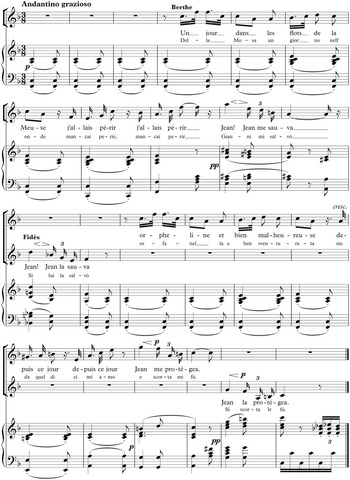
Reticence assumes new associations in Le Prophète however, not least because this characteristic division of roles breaks down. The first marker of something new in Le Prophète comes with the introduction of both women at the same time in the London version. Whereas in both Robert and Les Huguenots the reticent heroines had been afforded at least one act in which to demonstrate their commitment to vocal restraint before the entrance of their vocally ebullient female counterparts (Valentine in fact is seen almost two acts before she is heard), in the London Prophète both women share musical space from the outset. The duet for the two women that follows later in the act, ‘Della Mosa un dì nell’onde’ (‘One day, in the waters of the Meuse’), further locks them into the same musical domain. Duets for the female leads had no precedent in either Robert or Les Huguenots, where their voices never even sound simultaneously unless lost amid the tumult of a choral number. In ‘Della Mosa un dì nell’onde’ Berthe at first leads the duet while Fidès echoes the ends of her phrases; in the remainder of the duet, the women share the same musical material, sometimes in an echo effect, more often in unison (Ex. 3). Their voices, in other words, are entwined, such that the sound of Fidès remains far from defined. These choices make sense when one considers the unusual connection between the two women: Fidès and Berthe share musical space because, as mother and daughter (in-law), they belong to the same social rank. But this musical presentation of characters denies Fidès a claim to her own distinct idiom, and in a genre built around contrast between heroines no less. Combined with the understated nature of her utterances, Fidès is at first both central to the drama and sonically under available.
Meyerbeer, Le Prophète (Il profeta), Act I, Berthe and Fidès, ‘Della Mosa un dì nell’onde’.

Her voice is not suppressed forever, however. As Mary Ann Smart has proposed, Viardot could be ‘all things to call composers’ not least because she had a vocal compass that extended over a two-and-a-half octave range, and, since her debut, had been associated with a voice that was at once severe and brilliant. This ‘doubleness’ to her voice was a trait that her late sister Maria Malibran had famously boasted and a characteristic that their father, the acclaimed baritone and vocal instructor Manuel García, had fostered in them as adolescents.Footnote 54 Viardot’s brilliance does indeed emerge at moments across the opera – in the second section of her first aria, for instance, which corresponds with a move into chest voice, and in the Cathedral scene, which The Musical World singled out as the ‘grandest, purest, most striking display of vocalisation’.Footnote 55 And yet, the dominant impression remains one of restraint. An ecstatic reviewer for The Spectator even confessed that the part of Fidès elicited a sort of sublime sonic amnesia, such that on his return from the opera house, he had ‘almost forgot[ten]’ Viardot’s singing.Footnote 56
Reticence, like stillness, had clear moral import. On the continent it had long been understood that Alice and Valentine were unassailable characters who never allowed themselves to be compromised by words, and whose reticence vouched for their moral worth. This association was not lost on London audiences. What made Le Prophète such a phenomenal success at London’s Royal Italian Opera, however, was that for these audiences Viardot-as-Fidès tied reticence, stillness and shades of earnestness into one unbreakable compact. Thus, when that reviewer for The Spectator was ultimately able to summon to mind some music once he had returned home, it was not Viardot’s ‘airs or duets’ that infiltrated his consciousness, but the ‘passionate earnestness of her dialogue’, fastened to visual memories of her character in (carefully controlled) motion.Footnote 57
A musical Meyerbeer
For those critics who wanted to underscore the sober dimensions of theatrical experience at the Royal Italian Opera, and to promote a serious-minded approach to music, Le Prophète therefore ticked all the boxes. Even numerous commentators with no obvious interest in one theatre over another understood Le Prophète to fit with their vision of music as deep and ennobling: here was a work with an unusual plot about an unassuming mother who refuses to abandon her son, with a musical score that never undermines the dramatic truth of Viardot.
But there is more to be learned from this musical encounter in London. Critics’ accounts tended to devote far more space to ‘musical prose’ than is at first evident: even when their words did not describe the progress of an aria or a thematic recurrence, these commentators were nonetheless describing the sonic environment in which characters moved. It was not merely the case that music and dramatic motion worked in combination to create a sense that Fidès was the moral centre of an earnest work, after all: if reviewers in London were sometimes inclined to address these as individual domains, not least because there was such a developed discourse about acting on the theatrical stage in England, their remarks about gesture can nonetheless be read backwards as a comment on the music that paced and framed these actions. The music created the boundaries within which Viardot was able to act: her restrained motions took their cue from the musical world her character inhabits.Footnote 58 Crucially, since Fidès is never overwhelmed with music, her motions are also contained. It was this control that the reviewer for The Musical World so admired when he drew attention to Viardot’s entrance in Act I to minimal musical announcement and her conversation with Berthe, ‘full only of the realities of the scene’. In this sense, these critical reactions hint at what historical listeners made of the score, and indeed what drew them back into the auditorium to hear this same work for decades to come, even once Viardot retired from the London scene.Footnote 59 This was music which – in the hands of critics motivated to do so – could be cast as understated and tender.
This music did not of course occasion uniform praise from these critics; writing for The Examiner at the time of the Paris premiere, for instance, Leigh Hunt told his readers that one French critic had to pace the corridors to relieve his ennui, so devoid of melodies was the opera.Footnote 61 A critic for The Athenaeum meanwhile found that the bare moments in the score made him uncomfortable, the ‘overuse’ of rests amounting to ‘a mannerism’ that made the score sound ‘incomplete’.Footnote 62 Yet in the Victorian economy of earnestness this work, in all its starkness, was cast as haunting. And this is a process that might give us pause for thought. For all the criticisms levelled against him in his lifetime, Meyerbeer was an almost unrivalled success on the European operatic scene for much of the nineteenth century. Despite our full knowledge of this fact, however, such intense enthusiasm can now appear mysterious. Or put another way, somehow we have lost touch with our historical counterparts. To close the divide, we could listen to these works with the sublime sensitivities of a Parisian in the revolutionary age; or else embrace the composer’s visual and sonic materialism, and all it meant in the nineteenth century. We could also, however, hear these works anew, in search of moments of earnest restraint.