Introduction
First Nations people (FN) in Canada are experiencing an epidemic of type 2 diabetes (T2DM)Reference Dyck, Osgood, Lin, Gao and Stang1 and its complications.Reference Young, Reading, Elias and O'Neil2 We recently reported that the incidence of end-stage renal disease (ESRD) among FN with diabetes is still 2–3 times higher than that observed in their non-FN counterparts, although the difference has decreased somewhat since the early 1990s.Reference Dyck, Osgood, Lin, Gao and Stang3 Although sub-optimal glycemic control and age-related differential mortality appear to contribute to these ethnic-based disparities in ESRD,Reference Dyck, Sidhu, Klomp, Cascagnette and Teare4 other environmental and genetic factors have also been implicated.Reference Imperatore, Knowler, Nelson and Hanson5 Because maternal diabetes [pre-existing T2DM and gestational diabetes (GDM)] increases the risk for T2DM in the next generation,Reference Dabelea and Pettitt6, Reference Osgood, Dyck and Grassmann7 does exposure to a diabetic intrauterine environment also affect the development of fetal kidneys and increase the risk for future kidney disease in the offspring? In support of this hypothesis is the finding among adult Pima Indians that the diabetic offspring of diabetic mothers had higher rates of microalbuminuria than the diabetic offspring of non-diabetic mothers.Reference Nelson, Morgenstern and Bennett8 In a case–control study, we also found that female FN with diabetic ESRD had higher birth weights than controls,Reference Dyck, Klomp, Tan and Stang9 an observation consistent with exposure to diabetic pregnancies.Reference Dyck, Klomp, Tan, Turnell and Boctor10
Because there are few previous studies of urine albumin levels in neonatesReference Yap, Yap and Chio11–Reference Fell, Thakkar, Newman and Price13 and only one small pilot study that we carried out in infants of diabetic mothers (InfDM+),Reference Dyck, Bingham and Bedard14 the purposes of this study were to establish the levels and distribution of urine albumin:creatinine ratios (ACRs) in InfDM+ and infants of non-diabetic mothers (InfDM−) to determine whether or not ACRs differed between the two groups, and finally to evaluate the possible predictors of abnormal ACRs including ethnicity. Because microalbuminuria is a sensitive indicator of diabetic kidney disease,Reference Viberti, Hill and Jarrett15 we reasoned that altered ACRs among InfDM+ might reflect abnormal renal development that could increase the risk for future renal disease but might also create opportunities for screening and prevention initiatives.
Methods
This was a University of Saskatchewan Ethics Review Board-approved prospective study comparing ACRs in InfDM+ and InfDM− at the Royal University Hospital in Saskatoon. Mothers and their infants were identified by obstetrical nurses using opportunistic sampling to obtain similar numbers of InfDM+ and InfDM− from July 2006 to January 2008.
Informed consent was obtained from mothers to participate in the study, to obtain a urine sample from their infants (non-invasive unless a bladder catheter was in place for medical reasons) and to complete a brief questionnaire. The latter included a diabetes history (family history; pre-existing type 1 (T1DM) or T2DM; previous GDM, stillborn infant and/or macrosomic infant; testing, diagnosis and treatment of GDM in current pregnancy), demographic and lifestyle information (age, age at menarche, height, pre-pregnancy weight and weight gain during pregnancy, physical activity during pregnancy); and ethnic background (self-identified). Nursing staff obtained a full obstetrical history (gravidity, term births, preterm births, abortions, live births, still births) and recorded maternal pregnancy and delivery complications, neonatal complications, neonatal characteristics (gender, birth weight, gestational age from ultrasound estimates or date of last normal menstrual period, singleton pregnancy or other and vaginal v. cesarian delivery) and apgars at 1 and 5 min.
A woman without pre-existing T1DM or T2DM was considered to have GDM in this pregnancy if she had been treated with insulin (n = 35), met the criteria for GDM with a 50 g oral glucose screening test (n = 7) and/or a 75 g oral glucose tolerance test (n = 15) or it was diagnosed by a physician after having GDM in a previous pregnancy (n = 1).
Neonatal urine samples were obtained during micturition, using non-invasive urine collection bags, and from bladder catheters when present for other reasons. Although we initially intended to collect urine samples by placing cotton balls in diapers, we found that such samples had substantially lower urine albumin concentrations than the same urine samples collected directly from a bladder catheter (data not shown). Urine samples were refrigerated until tested for urine albumin (mg/l) and creatinine (mmol/l) using a Beckman DX 20 autoanalyzer. Urine albumin, creatinine and ACRs (in mg/mmol), and the timing of urine sample collections after birth were then provided for biostatistical analyses.
After the initial results revealed that many apparently normal infants had ACRs much higher than normal adult reference levels (<2.0 mg/mmol for men and <2.8 mg/mmol for women),16 we sent letters and laboratory requisitions to family physicians of study subjects requesting that a second urine sample be collected for ACRs at 6–12 months of age. If a second ACR was either still or newly elevated, we provided recommendations for further follow-up.
We initially evaluated selected features of mothers and their infants stratified by maternal diabetes status using t-tests to compare continuous data and Fisher's exact tests to compare categorical data (both two tailed). We then performed basic statistical measures of ACRs and its components for all infants and compared those values by maternal diabetes status and infant gender. For those children who had a follow-up urine sample, we also compared ACRs at the two times. Because ACR values did not follow a normal distribution, all ACR comparisons were conducted using both t-tests and Wilcoxan two-sample tests. Finally, we performed univariate analyses to compare the relationship of each of the independent variables above with neonatal ACR as a categorical outcome. Because normal ACR values for neonates have not been established, ACRs were divided into those <13 and ⩾13mg/mmol based on the median value for InfDM− with normal birth weights (2500–4000 g), normal gestational age (38–42 weeks) and with mothers who had not experienced any significant pregnancy complications. Starting with all variables with a P-value ⩽ 0.10 (see Table 3), we then developed a multivariate logistic regression model in which maternal diabetes, delivery complications and delivery type remained after backwards elimination. All univariate and multivariate results were expressed as odds ratios with 95% confidence intervals to show the unadjusted and adjusted relationship with higher or lower ACR values. In all analyses, a P-value of ⩽0.05 was considered significant. Data abstraction and analyses were carried out using SAS software version 9.1.3.
Results
From July 2006 to January 2008, 166 women provided consent to participate in the study. Of those women experiencing a diabetic pregnancy (58 GDM, 15 T2DM, 4 T1DM), 65 of their 77 infants were able to provide an adequate urine specimen (48 GDM, 13 T2DM, 4 T1DM). Of the 89 infants whose mothers were not diabetic, 59 provided a urine specimen. Apart from a slightly higher proportion of male infants and of neonates requiring intensive care, the overall maternal and infant characteristics of those providing a urine sample were very similar to the total participants (data not shown).
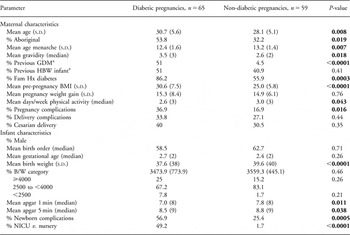
Table 1 shows the characteristics of maternal/infant pairs with a neonatal urine sample. Mothers with diabetes were significantly older, more likely aboriginal and had higher gravidity and younger age of menarche than non-diabetic mothers. They were also more likely to have had GDM in a previous pregnancy and to have a family history of diabetes. Related to the current pregnancy, mothers with diabetes had significantly higher pre-pregnancy body mass index, engaged in less physical activity and were more likely to experience pregnancy complications than mothers without diabetes.
Maternal and infant characteristics by the presence of diabetes during pregnancy

GDM, gestational diabetes; HBW, high birth weight; Fam Hx, family history; BMI, body mass index; B/W, birth weight; NICU, neonatal intensive care unit.
Bold values indicate P≤0.05.
aOf those with previous pregnancies.
Both InfDM+ and InfDM− were more likely to be male. InfDM+ had a higher mean birth order than InfDM− but the difference was not significant. InfDM+ experienced a significantly younger gestational age than InfDM− but, despite this, the mean birth weight was similar. Although a higher proportion of InfDM+ had either high birth weight or low birth weight, these differences were not significant. Finally, InfDM+ were more likely to experience newborn complications and this was associated with significantly lower apgars at 1 and 5 min.
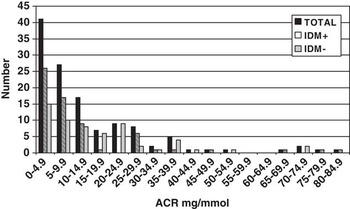
Figure 1 shows the overall distribution of ACRs and stratification by maternal diabetes status. ACRs displayed a marked left skew in the distribution pattern, with the greatest frequency <5 mg/mmol, followed by a long tapering tail ending at 82.7 mg/mmol. InfDM− had ACRs that displayed a slight shift to the right compared with InfDM+. Overall, there were no significant differences in ACRs between males (mean = 13.3; median = 8.1) and females (mean = 16.8; median = 9.4). Furthermore, the mean urine creatinine concentrations were almost identical between sexes (6.29 mmol/l for females and 6.27 mmol/l for males).
Distribution of neonatal albumin:creatinine ratio values.

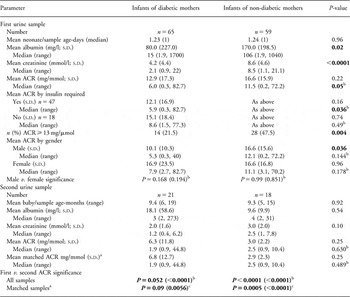
Table 2 shows urine albumin, creatinine and ACRs stratified by maternal diabetes status. InfDM+ and InfDM− were of similar age at both the first and the second urine sampling. Among neonates, InfDM− had significantly higher mean urine albumin and urine creatinine concentrations than InfDM+. Although the resulting mean ACRs were lower in InfDM+ compared with InfDM−, the difference was not significant using t-test. However, the median ACR value was almost 50% lower in InfDM+ than InfDM− (6.0 v. 11.5 mg/mmol, respectively) and the difference was significant using Wilcoxan two-sample testing (P = 0.05). Furthermore, the significance of this difference was enhanced when InfDM+ were further subdivided by a maternal requirement for insulin (yes/no); the median ACR in those whose mothers had taken insulin was 5.9 mg/mmol (P = 0.036). Finally, based on the median ACR of 13 mg/mmol for normal infants (see the section ‘Methods’), only 14/65 (21.5%) InfDM+ had an ACR ⩾13 mg/mmol compared with 28/59 (47.5%) InfDM− (P = 0.004).
ACR parameters by maternal diabetes status

ACR, albumin:creatinine ratio.
Bold values indicate P≤0.05.
aThose with samples at both times (18 InfDM+ and 15 InfDM−).
bWilcoxan two-sample test.
cWilcoxan matched pairs signed-ranks test.
There were no gender differences in ACRs within the InfDM+ and InfDM− groups but InfDM+ males had a significantly lower mean ACR than InfDM− males.
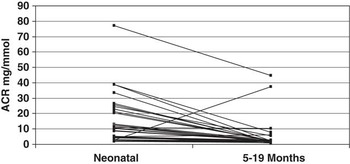
The second urine sample was collected at an average of 9 months of age for both InfDM+ and InfDM−. Within-group mean and median ACR values were substantially lower in the second compared with the first urine samples and this was associated with a relatively greater decrease in urine albumin compared with creatinine concentrations. The second urine ACRs were not significantly different between InfDM+ and InfDM− although the mean ACR was over twice as high for InfDM+ compared with InfDM− (6.3 v. 3.0 mg/mmol). Figure 2 shows that only one child experienced a substantial increase in ACRs between the first and the second sample collection, and only one other child continued to have an ACR above 13 mg/mmol. Both children were InfDM+.
Change in albumin:creatinine values by 5–19 months.

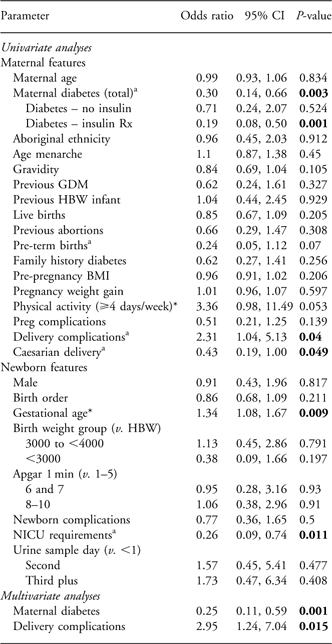
Table 3 shows the results of logistic regression analysis using ACR outcomes of ⩾13 v. <13. Initial univariate analysis showed that increased gestational age and delivery complications were significant predictors for higher ACRs (P-values = 0.009 and 0.04, respectively), whereas increased days of maternal physical activity per week almost achieved significance as well (P = 0.053). In contrast, requirement for Cesarian section and neonatal intensive care were statistically significant predictors for lower ACRs (P-values = 0.049 and 0.011, respectively), as was the use of insulin among mothers with diabetic pregnancies (P = 0.001). In the final multivariate model, only maternal diabetes remained significant as a predictor for lower ACRs whereas delivery complications were the only independent predictor of higher ACRs (P-values = 0.001 and 0.015, respectively).
Predictors of neonatal ACR ⩾ 13 v. ACR < 13
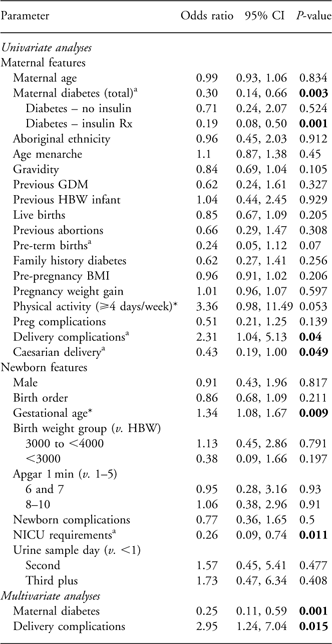
ACR, albumin:creatinine ratio; GDM, gestational diabetes; HBW, high birth weight; BMI, body mass index; NICU, neonatal intensive care unit.
Bold values indicate P≤0.05.
aParameters included in multivariate analyses were maternal diabetes (total), pre-term births, maternal physical activity >4 days/week, delivery complications, cesarian delivery and NICU requirements.
Discussion
Offspring of diabetic mothers experience an increased risk for T2DMReference Dabelea and Pettitt6, Reference Osgood, Dyck and Grassmann7 but it is not known whether diabetic pregnancies also confer a higher inter-generational risk for diabetic complications. Because microalbuminuria is a sensitive indicator of diabetic nephropathy,Reference Viberti, Hill and Jarrett15 we conducted the largest study of microalbuminuria yet reported in newborns and compared ACRs between InfDM+ and non-diabetic mothers (InfDM−) in the first study to do so. ACRs were substantially higher among neonates compared with normal reference values for adults (<2.0 for men and <2.8 for women16), but declined to adult levels in most children by 5–19 months of age. We did not observe significant gender differences in ACRs (or urine creatinine) overall or among either InfDM+ or InfDM− neonates. Our most unique finding was that InfDM+ had significantly lower ACRs than InfDM− even after adjusting for other variables. This appeared to be at least partly related to maternal treatment with insulin. The only independent predictor of higher ACRs was the presence of maternal complications during delivery. An important negative finding was that neither high nor low birth weight was a risk factor for elevated ACRs among neonates in univariate analysis and did not achieve a level of significance to be included in the multivariate analysis. Although aboriginal ethnicity was significantly associated with GDM, it was not an independent predictor of lower ACRs.
In a recent review of childhood albuminuria that summarized nine studies, none of the subjects were under the age of 2 years.Reference Rademacher and Sinaiko17 An additional large study of 550 children reported that three had ‘positive microalbuminuria’ but did not provide test results or age breakdown.Reference Grisler, Botta and Forestieri18 We are aware of only three pediatric studies that included neonates. The first reported on 28 infants with a mean ACR of 5.24 mg/mmol and two older groups aged 4–6 months and 7–23 months having mean ACRs of 4.06 and 1.76, respectively.Reference Yap, Yap and Chio11 The second study reported on 12 children aged from birth to 1 year whose mean ACR was 4.07 mg/mmol; a larger group of 84 children aged 1–7 years had a mean ACR of 1.16.Reference Del Campo Balsa, Tato Rocha, Tenias Burillo and Ramos Hernandez12 Finally, the largest and most comprehensive study reported on 64 newborns of varying gestational age.Reference Fell, Thakkar, Newman and Price13 The mean ACRs were 96.9 mg/mmol at 24–28 weeks, 31.7 at 29–36 weeks and 19.3 (median = 16.3) at term. The latter is very similar to the mean ACR of 16.6 (median = 15.9) that we found in term InfDM− births. Thus, it appears from these reports and our study that there is a progressive decrease in ACR from very high values in early preterm infants to values similar to adults by about 1 year of age. However, there is a large variation in ACRs even among apparently normal subjects until children approach the end of their first year. Thus, the diagnostic value of ACR measurement for identifying underlying renal disease or other problems (see below) in children under 6 months may be limited.
We had speculated that if abnormal urine albumin excretion occurred among InfDM+, it might reflect renal injury or altered renal development due to exposure to a diabetic intrauterine environment. We had further speculated that this might predispose these infants to later renal disease including diabetic glomerulosclerosis because InfDM+ have a higher risk for T2DM.Reference Dabelea and Pettitt6, Reference Osgood, Dyck and Grassmann7 Anticipating the possibility of elevated ACRs among InfDM+, we instead found significantly lower ACRs in this group and particularly in those whose mothers required insulin. This was due to a lower concentration of urine albumin relative to urine creatinine. Because a reduction in urine albumin excretion is a function of its decreased glomerular filtration and/or increased tubular reabsorption, could fetal exposure to a diabetic intrauterine environment somehow affect these mechanisms? Exogenous insulin does not normally cross the placentaReference Garcia-Bournissen, Feig and Koren19 but its use likely reflects a higher degree of maternal dysglycemia that is associated with increased glucose transport to the fetus and fetal hyperinsulinemia.Reference Pederson20 This promotes fetal growth most commonly observed as macrosomiaReference Freinkel21 and that is associated with elevated levels of insulin-like growth factor I (IGF-I) in cord blood of InfDM+.Reference Lindsay, Westgate and Beattie22 However, specific organs may also be affected because the infusion of IGF-I stimulates kidney growth in fetal sheepReference Marsh, Gibson and Wu23, Reference Marsh, Gibson and Wu24 and monkeys,Reference Tarantal, Hunter and Gargosky25 and may also enhance the growth and maturation of renal tubules.Reference Lindsay, Westgate and Beattie22, Reference Marsh, Gibson and Wu23 It is therefore possible that our findings of lower ACRs in InfDM+ may be due to increased tubular reabsorption (or decreased glomerular filtration) of albumin related to earlier maturation of renal tubules induced by a diabetic intrauterine environment. This is supported by the findings from Fell's study above; urinary excretion of low-molecular-weight proteins (and albumin) decreased significantly with increasing gestational age (i.e. increasing maturity), an observation consistent with increased tubular uptake of proteins small enough to be filtered at the glomerular level.Reference Fell, Thakkar, Newman and Price13
Whatever the underlying mechanism, the finding of significantly lower ACRs in InfDM+ is an important observation because it demonstrates that exposure to a diabetic intrauterine environment may affect renal growth and development in fetal humans. It is conceivable that in some way, this might influence the risk for later renal disease in the offspring of diabetic mothers, most importantly in those who later develop T2DM. This provides an opportunity for more sophisticated studies that can examine the underlying pathophysiology and the possible role of genetic and epigeneticReference Bell, Teschendorff and Rakyan26 mechanisms.
What we did not find in InfDM+ was evidence for direct glomerular damage as would have been implied by significantly increased ACRs. However, the mean ACR at 5–19 months was slightly higher for InfDM+ than for InfDM− and the decrease in both the mean and the median ACRs between the first and the second samples was less for InfDM+ than for InfDM−. In the context of our original hypothesis, this is an intriguing observation that also warrants further evaluation. We would suggest that a future study designed to examine this question should compare somewhat older offspring of diabetic and non-diabetic mothers. Children 1–2 years of age would likely be old enough to have stable urine albumin excretion and young enough for very few to have developed de novo renal problems leading to microalbuminuria.
Our study found that higher infant ACRs were independently associated with maternal delivery complications but not with other adverse perinatal outcomes. This somewhat confusing finding is likely explained by increased requirements for Cesarian deliveries and neonatal intensive care and higher rates of pregnancy and newborn complications among InfDM+ who overall had significantly lower ACRs. On examining this further, we also found that maternal delivery complications were frequently associated with a wide variety of newborn complications in both InfDM+ and InfDM−. Thus, it is likely that elevated ACRs associated with delivery complications reflected neonatal rather than maternal problems. However, this finding requires further evaluation.
The main strengths of this study were the number of subjects recruited, the detailed maternal/infant data collected and our ability to compare InfDM+ with InfDM−. The main limitation was the use of opportunistic sampling of subjects, which was more likely to include maternal/infant pairs with problems requiring longer hospital stays. This likely accounted for the larger proportion of InfDM+ requiring neonatal intensive care and the slight preponderance of males from whom urine samples were easier to collect. Although we excluded infants with known renal disease and renal anomalies, the study was also limited by our inability to systematically correlate ACRs with renal function and renal morphology. A final important limitation was the relatively small number of subjects from whom we were able to collect a second urine sample. Although we were still able to show significant longitudinal changes in ACR over time, we did not have sufficient numbers to adequately compare InfDM+ and InfDM− at 5–19 months.
ACRs are elevated in both InfDM+ and InfDM− but decrease to adult reference levels in most children by about 1 year of age. Maternal/infant problems independent of maternal diabetes may account for higher ACRs in some infants but the wide range of underlying causes limits its diagnostic usefulness at this age. The most novel and important finding from this study is that InfDM+ have significantly lower ACRs than InfDM−. We have presented indirect evidence that this might be a consequence of earlier nephron maturation induced by fetal hyperinsulinemia and question whether this may have long-term consequences for future renal disease risk in the offspring of diabetic mothers. If the marginally higher ACRs found in a small number of InfDM+ by 5–19 months is confirmed in larger studies, that finding would support our hypothesis. The potential for identifying children at risk for developing kidney disease in later years provides an opportunity for the prevention of chronic kidney disease through monitoring and early initiation of appropriate therapy. Furthermore, preventing GDM and optimally managing women with diabetic pregnancies might reduce damage to fetal kidneys and serve as a primary prevention strategy for both T2DM and diabetic nephropathy.
Acknowledgements
This study was supported by a grant from the Royal University Hospital Foundation in Saskatoon. The authors thank Pat Paulo for data management, and Brenda Andreychuk, Marie Penner and Janet DeGirolamo for applying questionnaires and organizing urine sample collections.