Introduction
The 2010 Deepwater Horizon oil spill (DHOS) caused the largest amount of coastline oiling of any industrial disaster on record. More than 200 million gallons of oil spilled and 2 million gallons of dispersants were released into the Gulf of Mexico. As a complex technological disaster, the social and economic effects of the spill are myriad, and impacts on human health from both physical oil spill contact and economic disruption remain an important concern. Reference Laffon, Pásaro and Valdiglesias1,Reference Gill, Ritchie and Picou2
Most population-based research has used cross-sectional data to study health in the context of the DHOS, an important shortcoming because technological disasters can have health impacts spanning years. Reference Gill, Ritchie and Picou2–Reference Slack, Kroeger and Stroope5 Few panel studies exist and even fewer cover more than 1 or 2 years, thus, much remains unknown about the long-term DHOS effects on health. Reference Hansel, Osofsky, Osofsky and Speier6–Reference Stroope, Kroeger and Slack9 Exceptions include a panel study of women following the DHOS which found ongoing elevated symptoms of depression and mental distress up to 6 years following the spill. Reference Rung, Oral and Fontham10 Panel studies with probability samples including both women and men are especially lacking in extant research. Reference Beedasy, Petkova, Lackner and Sury11 Moreover, the health and well-being of parents is critical because of their resource provision and promotion of the well-being of children in their household, especially in contexts of disasters. Reference Abramson, Park, Stehling-Ariza and Redlener12
The current study extends prior research by examining DHOS exposures and their independent associations with community-dwelling parents’ (women and men) levels of overall self-rated health over time in a panel study spanning 3 time points up to 8 years after the DHOS (2014, 2016, and 2018). In part, due to their vital role as caregivers, the study focuses on the health of parents in a household with a child. DHOS exposures are assessed in 2 ways: (1) physical contact with the oil spill, and (2) economic impacts from the oil spill. Data from areas highly affected by the DHOS in coastal Louisiana were analyzed.
In addition to examining the direct effects of DHOS exposures on parent health, we also assessed contingencies based on social position. Social science research and policy initiatives have identified social statuses (e.g., race, gender, and social class) as being associated with disparities in health problems generally, and vulnerability in the aftermath of disasters specifically. 13,Reference Tierney14 These statuses can operate as health contingencies because ‘various structural arrangements in which individuals are embedded determine the stressors they encounter, the stress mediators they are able to mobilize, and their inner experiences of stress.’ Reference Aneshensel, Rutter and Lachenbruch15(p167),Reference Pearlin16,Reference Williams and Sternthal17 Due to the added obligations of parenting, these contingencies can be especially pronounced among parents. Reference Nomaguchi and Milkie18 As such, we examine whether race, gender, and social class influence the relationships between BP-DHOS exposure and health among parents.
Data and methods
The analysis used a panel study comprised of data from the 2014 Gulf Coast Population Impact (GCPI) study and the 2016 and 2018 waves of the Resilient Children, Youth, and Communities (RCYC) study. This combined data file was made up of 3 waves of surveys which interviewed the same cohort of parents.Footnote a In 2014, the GCPI interviewed respondents in households from a 2012 study of communities in 4 states in the Gulf Coast affected by the Deepwater Horizon oil spill (DHOS). The communities were selected based on high levels of oiling according to an oil impact index, and individual and business claims data. Reference Beedasy, Petkova, Lackner and Sury11,Reference Slack, Kroeger and Stroope19 Two-stage sampling was used where census blocks and then households were randomly sampled. Households with a child aged 4 - 18 were included in the sample (N = 720). Of these households surveyed during the GCPI 2014 survey, 655 agreed to be followed up for participation in subsequent studies. The RCYC followed up with 484 GCPI respondents in 2016 and 485 in 2018, a re-contact rate of approximately 74% for both waves. The data are well-suited for the current study because (1) they are a probability sample of parents from Louisiana communities in DHOS high impact areas, and (2) they follow the same individuals over 3 survey waves spanning a space of 4 years. More information about methodology is detailed in prior work using the GCPI and RCYC. Reference Beedasy, Petkova, Lackner and Sury11,Reference Abramson, Peek and Redlener20 Institutional Review Board approval was granted for the data collection and study procedures by Louisiana State University and Columbia University.
Measures
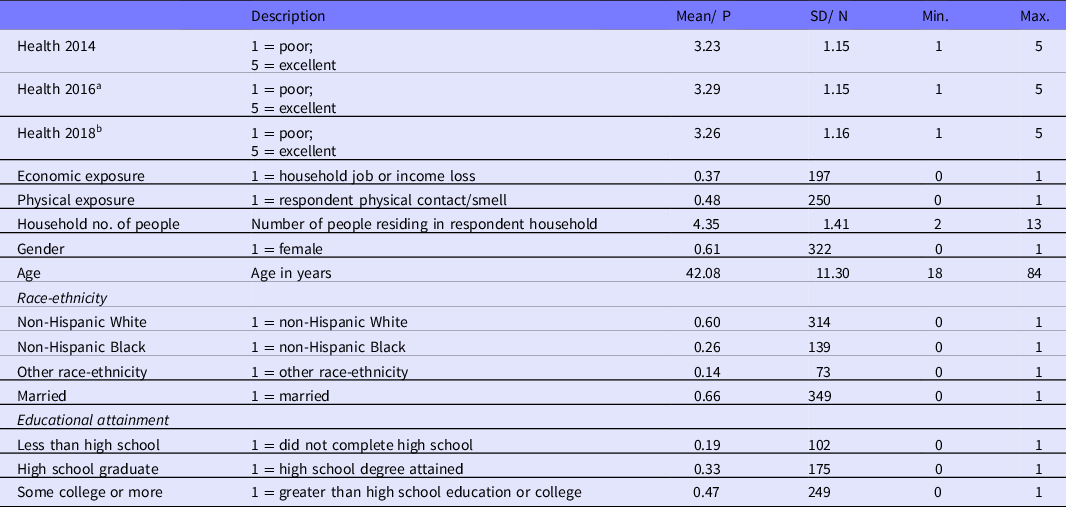
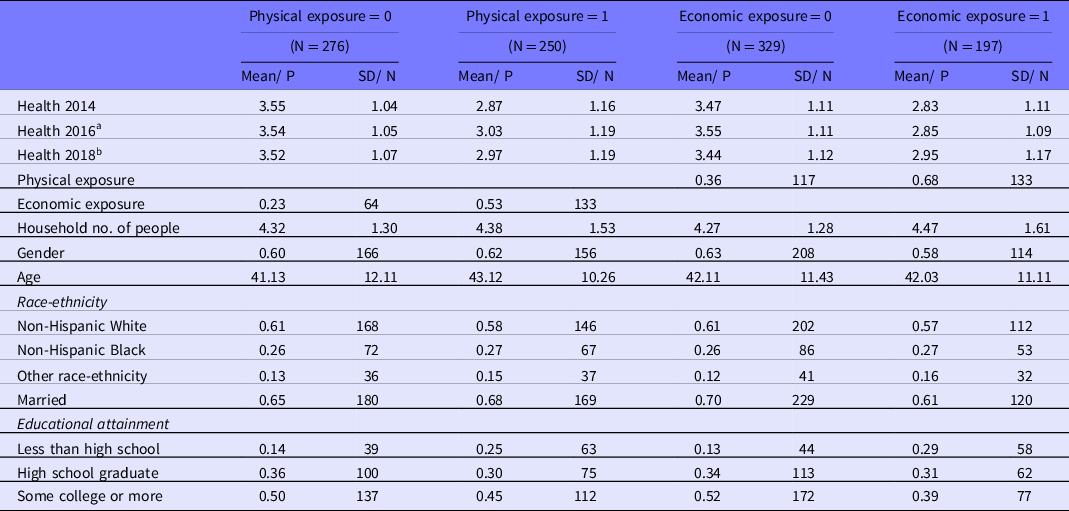
Adult self-rated health is measured at 3 waves with a question that asked, ‘In general, how would you rate your health right now?’ Response options are coded as (1) poor, (2) fair, (3) good, (4) very good, and (5) excellent. Physical DHOS exposure is an indicator measuring whether the respondent came into direct physical contact with or smelled the oil any time from the oil spill event to 6 months after the spill. Economic DHOS exposure is an indicator of whether the respondent or anyone in the respondent’s household lost their job or income due to the oil spill. Similar to prior DHOS research, covariates include the number of people in the household, gender, age, race-ethnicity, marital status, educational attainment, and survey wave. Reference Slack, Kroeger and Stroope19 Tables 1 and 2 show descriptive statistics and descriptions for study variables overall, and by physical and economic DHOS exposure.
Descriptive statistics and study variable descriptions

Source: GCPI/RCYC Study (N = 526).
Note: P = proportion; SD = standard deviation; aN = 471; bN= 465.
Descriptive statistics by DHOS physical and economic exposure

Source: GCPI/RCYC Study (N = 526).
Note: P = proportion; SD = standard deviation.
Analysis
We used econometric random effects regression for panel data to assess the relationships between DHOS exposures and levels of health over time. Independent variables were measured in 2014 and self-rated health was measured in 2014, 2016, and 2018. The analysis used random effects regression over competing models for panel data for 2 main reasons. First, because physical DHOS exposure was measured only in 2014 and economic DHOS exposure did not change across waves for most respondents, a fixed-effects or ‘between-within’ modeling approach was not appropriate. Reference Allison21 Second, because about 22% of respondents in the sample had 2 waves of dataFootnote b — with at least 3 waves required for estimation of growth curves — a linear growth curve model was not appropriate. Conversely, random effects regression models accommodate time-invariant predictors and require only 2 waves of data for estimation.
Our starting analytic sample included 543 parents with non-missing values on self-rated health for at least 2 waves. An additional 10 cases were dropped due to the original respondent being deceased, incarcerated, or no longer a caregiver. Following this data filter, 7 more cases were dropped due to missing values on education, marital status, or age; resulting in a final analytic sample of 526 parents. Among parents in the final analytic sample, about 70% reported a change in self-rated health over the study period.
We assessed time-varying self-rated health as a function of the focal predictors (i.e., physical exposure and economic exposure), control variables (i.e., number of people in household, age, race-ethnicity, marital status, and educational attainment), survey wave, and occasion-specific as well as person-specific error. Control variables in the current study were selected for consistency with prior research. Models were estimated in Stata 16.1. (Stata Corp. LLC, College Station, Texas, USA). 22
The econometric linear random effects models are based on the following equation:
 $$y_{it} = \beta_{0} + \beta_{t}T_{it} + \beta_{x}X_{i1} + \alpha_{i} + \epsilon_{it},$$
where y it is self-rated health for person i at time t, β 0 is the intercept, β t indicates the effect of survey wave on self-rated health and T it is a continuous indicator for wave of interview (equal to 0 at time 1 (in 2014), equal to 1 at time 2 (in 2016), and equal to 2 at time 3 (in 2018), β x is the vector of effects of the predictors for person i reported at time 1, α i is the person-specific error assumed to be uncorrelated with the predictors, and ϵ it is the occasion-specific error for person i at time t. For the calculation of standardized coefficients, we used partially standardized coefficients.23
Results
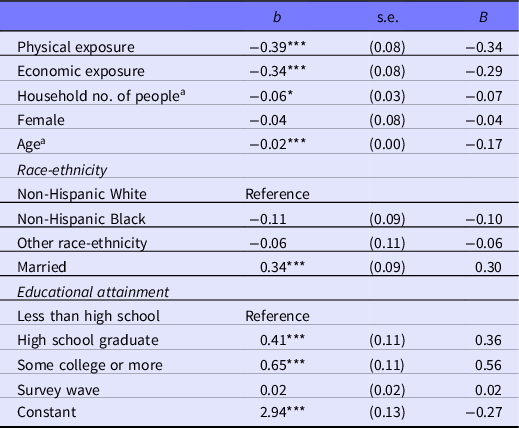
Descriptive statistics for study variables are shown in Table 1. Table 2 presents descriptive statistics by DHOS physical and economic exposure. Table 3 shows results from the random effects model predicting self-rated health, independent of survey wave and control variables. In specifying our chosen model, we evaluated goodness of fit for nested, stepwise models. Likelihood ratio tests indicated that a model including the focal predictors but no covariates provided a significantly better fit to the data relative to the baseline model (P < 0.001), and that a model including both the focal predictors and all covariates provided a significantly better fit to the data than the model including only the focal predictors (P < 0.001).The model in Table 3 shows that being physically exposed to the oil spill is associated with a 0.39 decrease in self-rated health, and experiencing economic exposure to the oil spill is associated with a 0.34 decrease in self-rated health. Both are highly statistically significant (P < 0.001). In a comparison of partially standardized coefficients, the effect size of physical exposure (B = −0.34) is larger than that of economic exposure (B = −0.29).Footnote c
Random effects regression of self-rated health

Source: GCPI/ RCYC (N = 526)
b = unstandardized coefficient; s.e. = standard error; B = standardized coefficients for continuous variables and partially standardized coefficients for categorical variables; ***P < 0.001, *P < 0.05. acentered in model for unstandardized coefficients; Model fit, estimated with maximum likelihood: chi-squared = 180.66 (P < 0.001)
To assess expectations regarding social position contingencies, we incorporated interaction effects of physical DHOS exposure by social statuses defined by gender, race-ethnicity, and educational attainment. Reference Aneshensel, Rutter and Lachenbruch15–Reference Nomaguchi and Milkie18 We also tested interactions of economic DHOS exposure by the same social statuses. Interactions were assessed in models with and without control variables. Results showed that physical exposure carried no significant interactions with any of the social statuses. Similarly, economic exposure had no significant interactions with gender or race-ethnicity. Interactions between economic exposure and educational attainment were inconsistent across models with and without controls.Footnote d
Discussion
This study documented relationships between physical and economic exposures to the 2010 Deepwater Horizon oil spill (DHOS) and self-rated health in probabilistic panel data on parents in coastal Louisiana that extended up to 8 years after the DHOS. We found that physical exposure to the DHOS was negatively associated with parents’ health over the study period. We also found that economic exposure to the DHOS was negatively associated with parents’ health. Of the two, physical exposure had the greater magnitude of association. These associations were robust to sociodemographic controls and survey wave, a notable finding given the established literature on social disparities in health problems generally and vulnerability in the aftermath of disasters specifically. These findings extend prior research highlighting the long-term health sequelae of economic and physical oil spill exposures. Reference Laffon, Pásaro and Valdiglesias1,Reference Gill, Ritchie and Picou2
We note several study limitations. First, given the baseline survey occurred in 2014, no data were collected on the health status of parents prior to the 2010 DHOS. This is a serious limitation to the current study, though one that is common to disaster research utilizing individual-level survey data. Disasters, by definition, are largely unanticipated events, thus pre-disaster data only exists if researchers are already on the ground (often working on unrelated issues) when catastrophic events happen to unfold. A potentially fruitful way forward for future research is the maintenance of a regional health monitoring system of individuals living in areas with frequent disaster events, so that pre-disaster baseline data will exist for future disasters in the region. Reference Parker, Edelman, Carman and Finucane24 Second, notwithstanding consistent correlations with mortality, biomarkers, reported physical health, and healthcare utilization, self-rated health has limitations as a subjective measure. Reference Goldman, Glei and Chang25 Subsequent research can build on this study by measuring a wider array of health outcomes and using objective measures of health. Third, the study’s DHOS exposure measures were based upon self-reports several years after the onset of the disaster. Thus, errors of attribution, problems with recall of experiences, and subjective differences in the definition of the situation may apply. Also, in a region characterized by a large petrochemical industrial complex, some level of chronic risk to toxic exposure can become normalized. Reference Thomas, Elliott and Chavez26,Reference Slack, Parks, Ayer, Parker, Finucane and Ramchand27 A fourth limitation pertains to sample size. Differences between subgroups in the coastal Louisiana population could be examined with a larger study sample size. Though our results did not support the theory Reference Aneshensel, Rutter and Lachenbruch15–Reference Nomaguchi and Milkie18 suggesting social status contingencies in DHOS exposure effects, the current study’s limited sample size may help explain the lack of statistically significant interactions of DHOS exposures with race, gender, and educational attainment. Greater sample size and oversampling of population subgroups are important considerations for future research. For example, some populations have experienced disparate impacts from technological and natural disasters. Reference Elliott and Race28,Reference VanLandingham29 Groups, such as Vietnamese Americans with employment concentration in the Louisiana fishing industry, Reference Cowley, Schafer and Blanchard30 were likely disproportionately affected by the DHOS and should be oversampled in future studies.Footnote e
Conclusions
Compromised adult health can have an array of important consequences for individuals and communities including lost days of work, medical costs, and downstream effects on health and well-being. Poor parental health can have the added consequence of negatively impacting children’s health. Reference Abramson, Park, Stehling-Ariza and Redlener12 In addition to showing the connection between physical exposure to the DHOS and long-term poor health, this study suggested the long-term negative health effects associated with parents’ employment and income disruptions that followed the DHOS. These results highlight the need to evaluate multi-year policy and programmatic initiatives to support the health and well-being of parents related to both economic impacts and physical exposures stemming from complex technological disasters. Doing so has the potential to promote both the wellbeing of parents and their children.
Acknowledgements
We thank all those who participated in the Resilient Children, Youth, and Communities (RCYC) study. This research was made possible by grants from the Baton Rouge Area Foundation and the Gulf of Mexico Research Initiative (GoMRI). Data funded by GoMRI are publicly available through the Gulf of Mexico Research Initiative Information & Data Cooperative (GRIIDC) at https://data.gulfresearchinitiative.org (doi: 10.7266/n7-hjz4-w930. doi: 10.7266/n7-9ftv-yd07).
Conflict of interest
The authors declare they have no actual or potential competing financial interests.
Disclaimer
The scientific results and conclusions, as well as any views or opinions expressed herein, do not necessarily reflect the views of the author’s respective institutions.