Implications
Di-d-fructose dianhydride (DFA)-enriched caramels that were added to a commercial broilers’ diet resisted to some extent small intestinal digestion, gave place to lower counts of potentially pathogenic bacteria in the intestine in vivo, and increased BW, faecal energy, fat, fibre and non-starch polysaccharide faecal apparent digestibilities as compared with controls. DFA-enriched caramels may therefore represent a type of new additives useful to improve health, productivity and well-being for poultry production.
Introduction
Worldwide concern about the development of antimicrobial resistance and about transference of antibiotic resistance genes from animal to human microbiota led to banning the use of antibiotics as growth promoters in the European Union since January 2006 (EC Regulation, 1831/2003). One of the main consequences of this ban has been a substantial increase in the use of therapeutic antibiotics (Gaggìa et al., Reference Gaggìa, Mattarelli and Biavati2010). As a consequence, there is a need to look for viable alternatives that could enhance the natural defence mechanisms of animals and reduce the massive use of antibiotics. One way is to use specific feed additives and/or dietary raw materials to favourably affect animal performance and welfare, particularly through the modulation of the gut microbiota, which plays a critical role in maintaining host health. In this context, probiotics, prebiotics and synbiotics, that is, combinations of prebiotics and probiotics, have been proposed as possible solutions (Huyghebaert et al., Reference Huyghebaert, Ducatelle and Van Immerseel2011). The main putative effects of these feed additives are the improved resistance to pathogenic bacteria colonization and enhanced host mucosa immunity, thus resulting in a reduced pathogen load, an improved health status of the animals and a reduced risk of food-borne pathogens in foods (Williams et al., Reference Williams, Verstegen and Tamminga2001). However, although prebiotics seem to selectively enhance lactobacilli and bifidobacteria populations and reduce colonization by pathogenic bacteria, results on performance are often contradictory and mostly affected by the microorganisms or compound chosen, the dietary supplementation level and duration of use. In many cases, the environmental and the stress status of the animals are not reported or considered, as the experimental settings are often too far from farm conditions (Gaggìa et al., Reference Gaggìa, Mattarelli and Biavati2010).
The concept of prebiotics has been recently formalized by the establishment of three scientific criteria that a food ingredient must satisfy to be considered as such: (i) resistance to gastric acidity, to hydrolysis by mammalian enzymes and to gastrointestinal absorption; (ii) be a fermentable substrate by intestinal microorganisms belonging to the human (mammalian) microbiota; and (iii) selective stimulation of the growth and/or activity of intestinal bacteria associated with health and well-being (Roberfroid, Reference Roberfroid2007). Several complex oligosaccharides, such as inulin, galactooligosaccharides and lactulose, fulfil the three criteria and can be effectively considered as prebiotics (Candela et al., Reference Candela, Maccaferri, Turoni, Carnevali and Brigidi2010). Di-d-fructose dianhydrides (DFAs) and their glycosylated derivatives (glycosyl-DFAs) represent recent candidates to this list (Arribas et al., Reference Arribas, Suárez-Pereira, Ortiz Mellet, García Fernández, Buttersack, Rodríguez-Cabezas, Garrido-Mesa, Bailon, Guerra-Hernández, Zarzuelo and Gálvez2010; Ortiz Mellet and García Fernández, Reference Ortiz Mellet and García Fernández2010). However, the number of studies on the effects of DFAs on bacterial growth is quite limited so far, and very little effort has been made specifically in poultry nutrition.
DFAs were found to be present in the non-volatile fraction of industrial soft caramel, although in a relatively modest (15–18%) proportion. Recently, caramelization technologies, based on the use of heterogeneous acid catalysts, have been developed that allow producing DFA-enriched products (up to 70–80% DFAs and glycosyl-DFAs) from fructose or fructose-containing mixtures of food-grade carbohydrates (Suárez-Pereira et al., Reference Suárez-Pereira, Rubio, Pilard, Ortiz Mellet and García-Fernández2010). Initial results in rats fed with a fructose-derived DFA-enriched caramel were consistent with a prebiotic behaviour associated with the preservation of a healthy microbiota equilibrium (Arribas et al. Reference Arribas, Suárez-Pereira, Ortiz Mellet, García Fernández, Buttersack, Rodríguez-Cabezas, Garrido-Mesa, Bailon, Guerra-Hernández, Zarzuelo and Gálvez2010). Investigating the nutritional effects of these new caramels with high DFA content in farm animals was then very appealing. Accordingly, the work here described was designed to evaluate in vitro and in vivo the effects of the use of DFA-enriched caramels, in comparison with an industrial sucrose caramel or inulin, on microbial biochemical parameters, and the eventual changes in the intestinal microbiota composition of broilers fed on diets supplemented with these products.
Material and methods
Additives
Three different DFA-enriched caramels obtained from d-fructose (FC) or 1 : 1 mixtures (w/w) of d-fructose and sucrose (FSC), and d-fructose and β-cyclodextrin (FCDC), and a commercial sucrose caramel (CSC) were tested in the in vitro trial. FC was also tested in vivo. These products were obtained by using a newly developed technology to produce caramels with high DFA and glycosyl-DFA content (>60%) on the basis of the activation of d-fructose or mixtures of different carbohydrates containing d-fructose by strongly acidic ion-exchange resins (Suárez-Pereira et al., Reference Suárez-Pereira, Rubio, Pilard, Ortiz Mellet and García-Fernández2010). The sucrose caramel was a commercial aromatic caramel produced by Nigay (Feurs, France, ref. Nigay 1395 SMA6) conforming to the AFNOR NF V 00-100 norm (Association Française de Normalisation, Paris, 1988) and having the following technical characteristics: dry matter 792 g/kg; pH (50% in demineralized water) 2.80; colour (absorbance at 520 nm) 6.04. Powdered raftilose® P95 (Orafti, Tienen, Belgium) used for the in vitro trial was a powder produced through enzymatic hydrolysis of chicory inulin and contains oligofructose (>932 g/kg) with degree of polymerization between 2 and 8, with an average of four residues. Inulin (92.8%) was obtained from Farmusal (Granada, Spain).
In vitro fermentation procedure
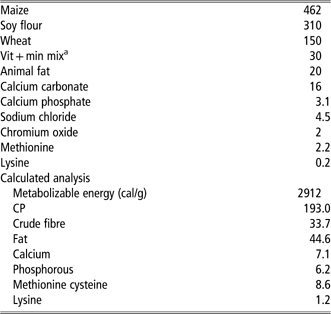
Fermentations were conducted in triplicate in 50 ml sterile polypropylene tubes. The composition of the semi-defined medium used for fermentations were as in Ruiz et al. (Reference Ruiz, García, Lara and Rubio2010). Caecal contents from 10 chickens receiving a cereal-based diet (Table 1) free of any antimicrobial agent were collected in aseptic tubes, sealed, immediately frozen in liquid N2 and kept at −80°C until the inoculum was prepared. Rose et al. (Reference Rose, Venema, Keshavarzian and Hamaker2010) showed that freezing at −80°C had minimal influence on the intestinal microbiota composition or metabolism. To prepare the inoculum, caecal contents were thawed at room temperature, immediately diluted 1 : 10 in 150 mM NaHCO3 buffer adjusted to pH 7.4 (1 g of caecal content in 9 ml of buffer), and mixed in a stomacher for 2 min. Bags were previously treated with a N2 stream. Blended, diluted caecal contents were filtered through miracloth (Calbiochem, Merck Millipore, Barcelona, Spain) and sealed in serum bottles under an N2 stream. Raftilose or caramels were added to the semi-defined medium to reach a final concentration of 10 mg/ml and autoclaved. No additive (negative control), raftilose (positive control) and sample tubes (n=3) were then aseptically inoculated with 4 ml of inoculum that were added to 26 ml of medium (see above) in each tube under N2 stream. Therefore, seven treatments (no additive, raftilose, FSC, FCDC, FC-1%, FC-2% and CSC) with three replicates per treatment were used. Sealed tubes were incubated at 37°C with continuous mixing for 24 h. After this time, tubes were placed into a −80°C freezer and freeze-dried.
Ingredient and nutrient analysis (g/kg) of the experimental diet

a The mineral–vitamin mix contained (per 30 kg): vitamin A, 7 500 000 IU; vitamin D3, 1 500 000 IU; vitamin E, 25 g; vitamin B2, 2 g; thiamin B12, 10 mg; vitamin B6, 67 mg; calcium pantothenate, 7.5 g; nicotinic acid, 10 g; folic acid, 25 mg; vitamin K3, 1 g; coline chloride, 250 g; Fe, 4 g; Cu, 750 mg; Co, 50 ng; Zn, 38 g; Mn, 42 g; I, 680 mg; Se, 45 mg; coccidiostate (Nistatin+Nicarbacin), 0.50 kg; BHT, 250 mg.
Birds, diets and housing
A total of 144 male 1-day-old broiler chickens of the Cobb strain were randomly assigned to one of the three dietary treatments. Birds were weighed on arrival and raised in wire-floored batteries. Each treatment had eight replicates (cages) of six birds. Cages were provided with the convenient heating and the birds received a lighting regimen of 23 h light : 1 h darkness. Balanced commercial diets (Table 1) free of any feed antibiotics and formulated to match the requirements for growing birds of this age and genotype were used. Diets were fed ad libitum for 21 days. Dietary treatments were control (commercial diet with no additive), inulin (commercial diet supplemented with 20 g inulin/kg diet) and FC (commercial diet supplemented with 20 g FC/kg diet). FC was chosen for the in vivo trial because it was at the moment better characterized chemically than the others. The experimental protocol was reviewed and approved by the Institutional Animal Care and Use Committee of the Spanish Council for Scientific Research (CSIC, Spain), and the animals were cared for in accordance with the Spanish Ministry of Agriculture guidelines (RD 1201/2005).
Sacrifice and sample collection
Data on live BW and feed consumption were recorded at the beginning and at the end of the experiment and used to calculate feed intake (FI) and feed: gain ratio (F/G). At 21 days of age, birds (three per replicate, i.e. 18 per treatment) were randomly selected and killed by intra-thoracic injection of the euthanasic T61 (0.2 ml/bird) (Laboratorios Intervet SA, Salamanca, Spain). The pH was immediately measured in the crop content of each bird by using a Crison pH meter (Crison Instruments SA, Alella, Spain). Immediately after killing, contents from the crop, ileum (considered as the section between the Meckel’s diverticulum and the ileo-cecal junction) and caeca of each bird were collected into plastic tubes, stored at −20°C and freeze-dried (Ruiz and Rubio, Reference Ruiz and Rubio2009). Samples of about 1 cm taken at the mid-point of the ileum of three randomly selected birds from each treatment were removed for histological analysis. The samples were flushed twice with PBS to remove luminal digesta and immersed in formalin (10% neutral buffered formaldehyde) for fixation. After 24 h in 10% neutral buffered formaldehyde, the tissue samples were carefully cleaned of any remaining digesta with deionized water, and then transferred to a fresh solution of 10% neutral buffered formaldehyde (Sigma, Alcobendas, Spain).
q-PCR analysis for the in vivo and in vitro trials
Total DNA was isolated from freeze-dried intestinal or fermentation samples (40 mg) using the QIAamp DNA stool kit (Qiagen, West Sussex, UK) by following the manufacturer’s instructions. To increase its effectiveness, the lysis temperature was increased to 95°C and an additional step with lysozyme (10 mg/ml, 37°C, 30 min) incubation was added. Eluted DNA was treated with RNase and the DNA concentration assessed spectrophotometrically by using a NanoDrop ND-100 Spectrophotometer (NanoDrop Technologies, Wilmington, DE, USA). Purified DNA samples were stored at −20°C until use (Ruiz and Rubio, Reference Ruiz and Rubio2009). Bacterial log10 number of copies was determined in faecal samples by using q-PCR. The 16S rRNA gene-targeted primers and PCR conditions used in this study are given as Supplementary Material S1.
Chemical and biochemical analysis and calculations
Amounts of DFAs in caramel samples were determined by GC analysis as in Suárez-Pereira et al. (Reference Suárez-Pereira, Rubio, Pilard, Ortiz Mellet and García-Fernández2010). Their total content in monosaccharides, DFAs and higher oligosaccharides (including glycosyl DFAs) were: FC, 185 g/kg d-fructose, 316 g/kg DFAs, 480 g/kg glycosyl-DFAs; FSC, 211 g/kg d-fructose, 77 g/kg d-glucose, 272 g/kg DFAs, 410 g/kg glycosyl-DFAs and glucooligosaccharides; FCDC, 100 g/kg d-fructose, 8 g/kg d-glucose, 217 g/kg DFAs, 640 g/kg glycosyl-DFAs and glucooligosaccharides; CSC, 167 g/kg d-fructose; 348 g/kg d-glucose; 136 g/kg DAFs; 311 g/kg glycosyl-DFAs and glucooligosaccharides. For determination of DFAs in samples from the in vitro trial and from faecal samples, aliquots (25–40 mg) were diluted in distilled water (60 ml) and dialysed using a Jumbosep™ Centrifugal Devices system equipped with 3 kDa membranes. The system was centrifuged at 960 g for 25 min using a Hettich Rotina 35 centrifuge (Andreas Hettich GmbH, Tuttlingen, Germany). The filtrate containing the DAFs was collected and re-dialysed five times, freeze-dried and analysed as in Suárez-Pereira et al. (Reference Suárez-Pereira, Rubio, Pilard, Ortiz Mellet and García-Fernández2010).
The pH of the in vitro fermentation solutions was measured immediately after the 24 h fermentation period. l-lactate and raftilose concentrations were determined by using Megazyme kits (K-LATE 10/04 and K-FRUC 12/04, respectively) (Megazyme International, Wicklow, Ireland).
Short-chain fatty acids (SCFA) (acetate, propionate, butyrate, isobutyrate, valerate and isovalerate) concentrations were determined by GLC (Playne, Reference Playne1985). Briefly, 2.0 ml of the fermentation product was centrifuged (4°C, 15 000×g, 15 min) and the supernatant (0.5 ml) mixed with 0.5 ml of a mix of crotonic acid (4 g/l)+metaphosphoric acid (20 g/l)+HCl (0.5 N), and left overnight at −20°C. After centrifugation, 1 μl of the supernatant was injected in a Perkin Elmer model AutoSystem (PerkinElmer, Madrid, Spain) gas chromatograph fitted with a Supelco SP 2380 (Sigma-Aldrich Química SL, Madrid, Spain) capillary column (30 m×0.25 mm×0.2 μm). Samples were analysed in triplicate. Appropriate SCFA standards were produced with crotonic acid (2 g/l) as internal standard.
The N contents in feed, ileal contents and faeces were determined according to the Dumas procedure using a LECO Truspec CN analyser (LECO Corporation, St. Joseph, MI, USA). NDF and ADF were carried out according to van Soest et al. (Reference Van Soest, Robertson and Lewis1991) by using an Ankom220 fiber analyzer unit (Ankom Technology Corp., Macedon, NY, USA). NSP in diets and faecal samples was determined as in Englyst et al. (Reference Englyst, Quigley, Hudson and Cummings1982). Chromium oxide in diets and faecal samples was determined following a colorimetric micromethod (Fenton and Fenton, Reference Fenton and Fenton1979). AMEn was calculated as in Hill and Anderson (Reference Hill and Anderson1958), and gross energy in feed and faeces was determined in a bomb calorimeter (Parr 1356 bomb calorimeter; Parr Instruments Co., IL, USA).
Apparent ileal or faecal digestibility (AFD) for each substance (S) (N, ADF, NDF, NSP, fat, FC) was obtained from the expression AFD=100×[1−(S f/Cr2O3f)/(Sd/Cr2O3d)], where d and f indicate concentrations in diet and faeces, respectively.
Histological analysis
Fixed samples were dehydrated and embedded in paraffin wax. Three slides were prepared from each sample, and each slide contained a minimum of two sections cut at 4 μm, at least 50 μm apart. The slides were stained with haematoxylin and eosin. All measurements were made with a light microscope with the help of an image analysis system (CellA Imagen Software, Olympus, Hamburg, Germany) equipped with a monitor. Five well-oriented villi and crypts were selected on each slide to determine villus height, width and crypt depth. The villus height was determined as the distance from the tip to the bottom of the villi, and crypt depth was determined as the distance between its mouth and its base. Villus surface area was calculated as (3.1416×villus width)×villus height. Mucosal thickness was determined as the distance between the mucosal epithelium and the muscular layer, and the muscularis as the inner circular and outer longitudinal layers of smooth-muscle cells (Peinado et al., Reference Peinado, Ruiz, Echávarri and Rubio2012).
Statistical analysis
Data were analysed as a one-way ANOVA using the GLM procedure of SAS (SAS Institute, 2003, Cary, NC, USA), with the pen serving as the experimental unit for performance parameters, and the individual chicken or the fermentation tube as the experimental unit for biochemical or microbiological parameters. All microbiological counts were subject to base-10 logarithm transformation before analysis. Treatment means were separated using Bonferroni’s multiple comparison tests. Statistical significance was declared at a probability of P<0.05.
Results
Effects of caramels on biochemical parameters and microbial populations in vitro
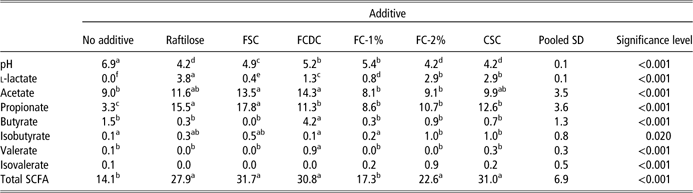
The pH of the solutions (Table 2) decreased (P<0.05) after in vitro fermentation with all additives compared with the non-additive control, the lowest values being reached with raftilose, FC (2%) and CSC. l-lactate concentration in vitro (Table 2) was higher (P<0.05) for raftilose than for the other additives, of which the highest values were found for FC (2%) and CSC. Regarding SCFA concentrations (Table 2), acetate concentration was highest (P<0.05) for FSC and FCDC followed by raftilose. Propionate values were increased (P<0.05) compared with controls for all additives tested, with the highest values for FSC and raftilose. FCDC was the only additive that increased (P<0.05) butyrate and valerate concentrations. No effect was detected with respect to control values on isobutyrate or isovalerate production. The total SCFA concentration (P<0.05) was higher than the concentration of control in tubes containing raftilose, FSC, FCDC and CSC, with FC (1%) showing a tendency for increased values as compared with control diets.
Effect of the type of additive (10 mg/ml) on pH and concentrations of l-lactate (g/l), acetate, propionate, butyrate, isobutyrate, valerate and isovalerate (μmol/ml) in vitro after 24 h fermentation
FSC=d-fructose/sucrose caramel; FCDC=d-fructose/β-cyclodextrin caramel; FC=d-fructose caramel; CSC=commercial sucrose caramel.
Means (each sample was analysed in triplicate) in the same row with different superscript letters differ (P<0.05).
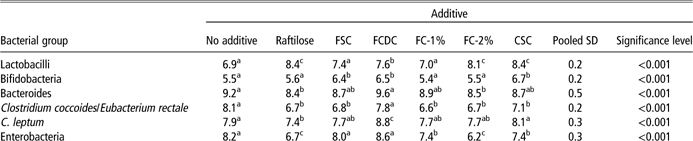
Incubation for 24 h within the defined media, regardless of the additive, resulted in significant (P<0.01) differences in all groups of bacteria examined in this study (Table 3). Raftilose and all caramels tested, except FSC and FC (1%), increased (P<0.01) lactobacilli log10 number of copies compared with the non-additive control. No differences in lactobacilli number of copies were found between raftilose, FC (2%) and CSC. FSC, FCDC and CSC induced increased (P<0.01) bifidobacteria log10 number of copies as compared with control tubes. Only FCDC induced an increase (P<0.01) in the bacteroides log10 number of copies repect to raftilose. All additives, except FCDC, decreased (P<0.01) Clostridium coccoides/Eubacterium rectale number of copies. Raftilose decreased (P<0.01) and FCDC increased (P<0.01) C. leptum log number of copies. Compared with controls, raftilose, FC and CSC gave place to lower (P<0.01) Escherichia–Shigella and enterobacteria log number of copies.
Effect of the type of additive (10 mg/ml, except for FC-2%, which contained 20 mg/ml) on the bacterial log10 number of copies/mg of freeze-dried material after the in vitro fermentation for 24 h within a defined medium
FSC=d-fructose/sucrose caramel; FCDC=d-fructose/β-cyclodextrin caramel; FC=d-fructose caramel; CSC=commercial sucrose caramel.
Means (each sample was analysed in triplicate) in the same row with different superscript letters differ (P<0.01).
Effects of inulin and caramels on performance and crop pH
Final BW of birds fed the FC diet was higher (P<0.01) than controls or inulin-fed birds (Figure 1), although feed: gain values were not different. Feed intake of chickens fed the FC diet was higher (P<0.01) than inulin but not different from controls. Crop pH values were lower (P<0.01) than controls in birds fed the FC diet, with inulin-fed chickens showing values not different from controls or FC-fed birds.
Effects of dietary inclusion of inulin or caramel FC on final BW (a), feed intake (b), feed gain ratio (c) and crop pH (d) of chickens from 1 to 21 days of age. a,bBars with different superscripts were significantly different (P<0.01). Values are means (eight replicates of six birds each) with their SD in bars, except for crop pH values, where individual values (n=18 per treatment) were used.
Effects of inulin and caramels on intestinal microbiota composition in vivo
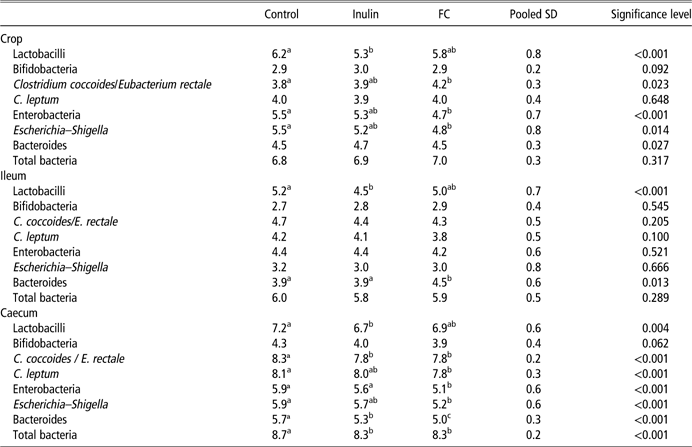
Decreased (P<0.05) lactobacilli log10 number of copies was determined in crop, ileum and caecal contents of birds fed the inulin diet (Table 4). Inulin supplementation also resulted in lower (P<0.05) C. coccoides/E. rectale, bacteroides and total bacteria in caecal contents. Addition of d-fructose caramel (FC, 2%) to broilers’ diets resulted in higher (P<0.05) C. coccoides/E. rectale number of copies in the crop, and in lower (P<0.05) enterobacteria and Escherichia–Shigella log10 number of copies in crop and caecal contents compared with controls. Compared with controls, bacteroides number of copies increased (P<0.05) in the ileum, but decreased (P<0.05) in the caeca, of chickens fed the FC diet.
Bacterial log10 number of copies/mg of freeze-dried contents in the crop, ileum and caeca of broiler chickens fed on control, inulin or DFA-enriched caramel supplemented diets from 1 to 21 days
DFA=d-fructose dianhydride; FC=d-fructose caramel.
Means in the same row with different superscript letters differ (P<0.05).
In vivo intestinal digestibility of substances
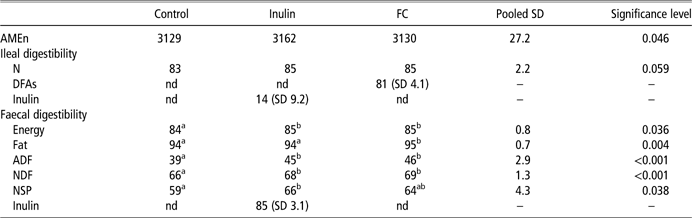
In vivo ileal apparent digestibility of DAFs in birds fed FC diet was 0.81 (Table 5). No DAFs were detected in the control diet or in the ileal contents of birds fed the control diet. Inulin digestibility was 14% and 85% at the ileal and fecal levels, respectively. Ileal N digestibility was not affected (P<0.05) by the supplementation with either inulin or FC. On the contrary, faecal energy, ADF and NDF apparent digestibilities were greater (P<0.05) than controls in chickens fed diets containing either inulin or FC. Fat faecal apparent digestibility was higher (P<0.05) in FC-fed birds compared with controls or inulin-fed chickens. NSP digestibility was higher (P<0.05) than controls in inulin-fed birds, but not in those fed the FC diet.
AMEn (cal/g) and ileal and faceal apparent digestibility (%) in growing broiler chickens fed control, inulin or DFA-enriched caramel supplemented diets from 1 to 21 days of age
DFAs=di-d-fructose-dianhydrides; nd=not detected.
Means in each row with different superscript letters differ (P<0.05).
Morphology of the ileal mucosa
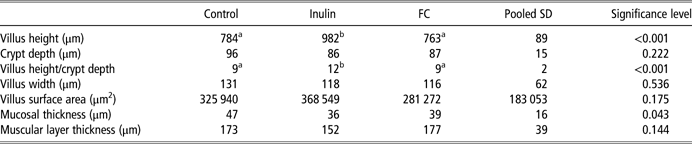
Inclusion of 20 g of FC/kg in diets for broiler chickens between 1 and 21 days had no significant effect on the histological parameters measured (Table 6). Nevertheless, inulin supplementation with 20 g/kg diet increased (P<0.01) villus height and the ratio of villus height/crypt depth as compared with both control- and FC-fed birds.
Morphology of the ileal sections of broiler chickens fed control, inulin or FC diets from 1 to 21 days of age
Means (n=3, with five measurements per sample) with different superscripts in each row were significantly different (P<0.01).
Discussion
The nutritional effects of sucrose-derived DFA-enriched products and biotechnologically produced individual DFAs have been previously investigated to some extent in laboratory animals (rat), but studies on production animals (pig, broiler chicken) are very scarce. Arribas et al. (Reference Arribas, Suárez-Pereira, Ortiz Mellet, García Fernández, Buttersack, Rodríguez-Cabezas, Garrido-Mesa, Bailon, Guerra-Hernández, Zarzuelo and Gálvez2010) recently showed that the administration of a DFA-enriched caramel obtained from fructose (containing 70% of an isomeric mixture of 13 DFAs and glycosyl-DFAs, identical to FC in this work) to colitic rats promoted a more favourable intestinal microbiota, increasing lactobacilli and bifidobacteria log10 number of copies, as well as inducing increased concentrations of SCFA in the luminal colonic contents. Previous results on the prebiotic potential of a caramel obtained by pyrolysis of sucrose in the presence of citric acid (Manley-Harris and Richards, Reference Manley-Harris and Richards1997) containing ~34% of DFAs and 43% of monosaccharides indicated that DFAs and their glycosylated derivatives might represent promising candidates as prebiotic agents (Orban et al., Reference Orban, Patterson, Sutton and Richards1997). It is important to mention here that in the present study fructose-derived caramels were used. These were obtained through a different procedure that involves thermal activation at a much lower temperature (90°C) in the presence of an acid resin approved for its use in the food industry that is then removed from the final product by filtration. The content of DFAs and glycosyl-DFAs, assumed to be the active prebiotic components, in the caramels assayed in vitro amounts to 60–80%, being of ~80% in the fructose caramel used for the in vivo evaluation.
The DFA-enriched caramels and the commercial sucrose caramel used here increased the numbers of potentially beneficial bacteria in vitro. Although numerous studies indicate that inulin and oligofructose selectively stimulate the health-promoting groups of the human intestinal microbiota (Candela et al., Reference Candela, Maccaferri, Turoni, Carnevali and Brigidi2010), in vitro studies on oligosaccharides involving animal microbiota are scarce, and as far as we know there are no references using chicken microbiota. Caramels used here mostly resembled the effects obtained with raftilose. Thus, raftilose and most caramels tested increased lactobacilli, bifidobacteria, bacteroide and clostridia log number of copies as compared with the non-additive control diet, whereas coliforms and enterobacteria number of colonies were decreased by two of the caramels tested (i.e. FC and FSC) but not by raftilose. This effect is similar to those found with a number of substances with potential (isomalto-oligosaccharides, lactosucrose, xylo-oligosaccharides) or confirmed (inulin, transgalacto-oligosaccharides, lactulose) prebiotic effects in humans (Candela et al., Reference Candela, Maccaferri, Turoni, Carnevali and Brigidi2010). Regarding the products of microbial metabolism, it is well established that the principal end products of bacterial fermentation processes are SCFA, with inulin and fructooligosaccharides (FOS) giving rise mainly to acetate (Candela et al., Reference Candela, Maccaferri, Turoni, Carnevali and Brigidi2010). The results found with raftilose and caramels in our in vitro trial (lower pH values, and higher lactate and SCFA, mainly acetate, production) are similar to those reported by Tzortzis et al. (Reference Tzortzis, Goulas, Gee and Gibson2005) using galacto-oligosaccharides and inulin.
Although in vitro results provide a preliminary indication, the final demonstration of a prebiotic effect of any food ingredient must be carried out in vivo (Roberfroid, Reference Roberfroid2007). In the current work, the addition to the diet of d-fructose-derived caramel (FC, 2%) did not significantly affect lactobacilli or bifidobaceria number of copies, but led to lower enterobacteria and Escherichia–Shigella numbers in crop and caecal contents compared with controls. Compared with controls bacteroides number of copies increased controls in ileal contents but decreased in the caeca of chickens fed the FC diet. As for the inulin-fed birds, lower lactobacilli log10 number of copies was determined in the crop, ileum and caeca compared with controls. Inulin supplementation also resulted in lower bacteroides and total bacteria in caecal contents. These differences in the effects found with inulin and DAFs are likely to be linked to their different intestinal digestibility. Surprisingly, although most of the research interest on prebiotics has focused on their role as modulators of the intestinal microbiota, little effort has been made on their intestinal digestibility, a major criterion to determine their prebiotic potential and mechanism of action (Roberfroid, Reference Roberfroid2007). However, given that DFAs are highly stable in acidic media and that they are inert to the action of mammalian intestinal glycosidases, it is likely that substantial amounts reach the final sections of the intestinal tract essentially inaltered (Manley-Harris and Richards, Reference Manley-Harris and Richards1997). In the current work, ileal apparent digestibility of DAFs in birds fed FC diet was 81%, which means that about 19% of the amounts present in the diet would reach the caeca. The ileal digestibility of inulin was 14% at the ileal level and 85% at the faecal level, which indicates that higher amounts (about 86% of the inulin in the diet) reach the chickens’ caeca. These data suggest that the effectiveness of inulin and caramels is mainly at the caecal and ileal levels, respectively. In fact, this higher digestibility of DFAs in the upper parts of the intestinal tract is likely to explain the lower pH in the crop of birds fed diets containing caramel with respect to control or inulin-fed chickens. In addition, lactobacilli number of copies was not different from controls in the upper gut of caramel-fed birds, but was affected in inulin-fed chickens.
The effectiveness of a given additive in broiler feeding depends on a variety of factors. Variables such as concentration, diet type, animal characteristics, hygiene and husbandry conditions, and environmental stress can influence the response to inulin or FOS in broiler feeding (Patterson and Burkholder, Reference Patterson and Burkholder2003). Dietary supplementation with chito-oligosaccharide (COS) improved the growth rate of broilers, which was likely mediated through the effects of COS on FI and nutrient digestibility. COS may also serve as a growth promoter in broiler production by modulating the concentrations of intestinal microbial flora, as this additive increased the concentrations of cecal lactobacilli and reduced the caecal concentrations of Eubacterium coli (Li et al., Reference Li, Piao, Kim, Liu, Wang, Shen, Jung and Lee2007). In the current work, BW was greater than controls in animals fed the FC diet, and faecal energy, ADF, NDF and NSP apparent digestibilities were greater than controls in chickens fed diets containing inulin or FC. Fat faecal apparent digestibility was higher in FC-fed birds compared with controls or inulin-fed chickens. The mechanism by which NSP exert their anti-nutritive effects in poultry is usually linked to the increased bulk and viscosity of the intestinal contents, which decrease the rate of diffusion of substrates and digestive enzymes, thus hindering their effective interaction at the mucosal surface (Choct et al., Reference Choct, Hughes, Wang, Bedford, Morgan and Annison1996). The concentrations of soluble NSP in wheat were inversely correlated with their metabolizable energy (MEn)-values in broiler chickens (Annison, Reference Annison1991). The viscous conditions in the small intestine may interfere with crude fat digestibility owing to draining of bile acids from enterohepatic circulation (Malayoğlu et al., Reference Malayoğlu, Baysal, Misirlioğlu, Polat, Yilmaz and Turan2010). It has been suggested that an increased digesta viscosity may reduce the amounts of conjugated bile acids, affect fat emulsification negatively and thus decrease fat digestibility (Langhout et al., Reference Langhout, Schutte, Geerse, Kies, De Jong and Verstegen1997). Therefore, a higher NSP digestibility as reported here would decrease NSP amounts within the intestine and consequently increase nutrients digestibility.
Although it has been reported that a high level of bird performance may be supported by a range of microbial compositions (Geier et al., Reference Geier, Torok, Allison, Ophel-Keller and Hughes2009), and despite its scientific and practical relevance, the study on the relationship between variations of the microbiota composition and productive/physiological parameters is still at the beginning in poultry production. In a pioneering work, by using T-RFLP analysis together with multivariate statistical methods, Torok et al. (Reference Torok, Allison, Percy, Ophel-Keller and Hughes2011a) identified and characterized changes in gut microbiota development in chickens in response to enzyme or antimicrobial agents in feed that had performance implications. More specifically, an overgrowth of some microorganisms including enterobacteria in the intestine has been reported (Bourlinoux et al., Reference Bourlinoux, Koletzko and Guarner2003; Pelicano et al., Reference Pelicano, Souza, Souza, Figueiredo, Boiago, Carvalho and Bordon2005) to result in mucosal impairment, villus erosion and damage to the intestinal cells, thus reducing its nutrients’ absorptive potential. Fonseca et al. (Reference Fonseca, Beletti, da Silva, da Silva, Duarte and Rossi2010) linked a decrease in the quantity of caecal enterobacteria to improved performance in broilers, and Kim et al. (Reference Kim, Seo, Kim and Paik2011) proved that lower numbers of certain gut pathogens such as E. coli may improve broiler performance. Peinado et al. (Reference Peinado, Ruiz, Echávarri and Rubio2012) recently showed that a garlic derivative lowered the intestinal numbers of enteropathogens and improved the ileal histological structure and productive parameters of broilers. On the other hand, in the current work, lactobacilli numbers were lower in the crop, ileum and caeca of chickens fed on the inulin diet and tended to be lower in the FC-fed chickens, which was accompanied by an increase in the bacetroides number of copies in the ileum. Although generally regarded as a beneficial group, higher numbers of lactobacilli have been implicated in broiler growth depression owing to competition for nutrient uptake or impaired fat absorption linked to deconjugation of bile acids (Torok et al., Reference Torok, Hughes, Mikkelsen, Pérez-Maldonado, Balding, MacAlpine, Percy and Ophel-Keller2011b). Meanwhile, species from the Bacteroidetes family are involved in many important metabolic activities including fermentation of carbohydrates, induction of critical glycolytic enzymes in the enterocytes, utilization of nitrogenous substances, biotransformation of bile acids and prevention of pathogen colonization (Bry et al., Reference Bry, Falk, Midtvedt and Gordon1996; Phillips, Reference Phillips2009). In summary, according to the literature and the current results, it could be concluded that a decrease in the numbers of some bacterial groups such as enterobacteria, and probably lactobacilli, accompanied by an increase in others such as bacteroides in the intestine might be related to improved performance in poultry. However, with the information at present available, it is not possible to rule out other mechanisms such as modifications in the microbiota metabolism, effects on bacterial groups other than those studied here, effects on the immune system, absorption of substances and so on.
Inulin-type fructans are regarded as prebiotics in various intestinal environments of diverse animal genera (mammal, fish, bird, etc.). The specific intestinal fermentation results in a bacterial ecosystem that is less prone to pathogen invasion and in an increased production of SCFA characterized by a higher proportion of butyrate. As a result, the increased absorptive capacity, reflected in a longer intestinal length and increased villus height or crypt depth of the intestine, results in improved feed conversion and better growth in the young animal. The only effect observed in the present work on the histological structure of the chickens’ mucosa was that inulin supplementation increased villus height and the ratio between villus height and crypt depth as compared with both control- and FC-fed birds, which is in keeping with previous reports (Rebolé et al., Reference Rebolé, Ortiz, Rodríguez, Alzueta, Treviño and Velasco2010).
In summary, the results presented in this study show that DFAs in DFA-enriched caramels resisted to some extent chickens’ small intestinal digestion in vivo, were fermented in vitro by birds’ caecal microbiota and selectively stimulated the growth of bacteria associated with health and well-being in vitro. FC supplementation also gave place to lower counts of potentially pathogenic bacteria in the broiler’s intestine in vivo. Faecal energy, fat, ADF, NDF and NSP apparent digestibilities were greater than controls in chickens fed diets containing DFA-enriched caramels.
Acknowledgements
Authors are indebted to Drs L. Lara and A. Nieto and to Mrs M. A. Guzmán for excellent technical assistance, and to the Spanish MICIIN (SAF2008-02616, SAF 2010-15670 and AGL 2009-11925) and the Junta de Andalucía (project AGR395) for financial support. This research has been also partially supported by the FEDER and FSE funds from the European Union. ES-P is a ‘Project of Excellence’ Fellow (Junta de Andalucía, contract no. P06-AGR-02150) and M. J. P. is a recipient of a JAEpredoc (CSIC) grant.