Introduction
The development of state finance is a crucial aspect of processes of state formation, such finance having long been viewed as the ‘nerve’ of the state. Little wonder, therefore, that historians of state finance have always been eager to attempt comparisons of fiscal systems in different states. Comparative history is, on the one hand, an important challenge for ‘global historians’;Footnote 1 on the other hand, it is a difficult and perilous field, because most historians have detailed knowledge of aspects of one country and a much more superficial knowledge of those of other countries. Nevertheless, comparative history may contribute to a better understanding of similarities and differences viewed from a global perspective, especially if it stimulates debates with historians more familiar with the other country.
During the last quarter of the twentieth century, comparisons in state finance were still mainly limited to European states for the period before 1800.Footnote 2 Since then, new initiatives have been started, attempting comparisons on a more global scale.Footnote 3 Against this background, this article aims to contribute to the field by comparing aspects of state finance of a west European state, the Dutch Republic, with that of a state from another part of the world, the Ottoman Empire. The comparison is interesting because there is, on the one hand, an old historiographical tradition in which the Ottoman Empire is seen as the antithesis of European states,Footnote 4 while, on the other hand, there is a more recent tendency to emphasize increasing similarities between developments in the Ottoman Empire and western Europe, especially during the eighteenth century.Footnote 5
Moreover, in the field of state finance a remarkable difference between most states in ‘the West’ and those in ‘the rest’ of the world before about 1800 turned out to be the development of long-term domestic public debts at relatively low rates of interest. The Dutch Republic is particularly striking in this regard, because its remarkable position as one of the great European powers before the start of the nineteenth century – despite a population of only about two million, much smaller than that of the other great powers – had been dependent not only on the wealth of its taxpayers but also, for a large part, on its ability to augment its state revenue with domestic loans at low rates of interest.
The first two parts of this article provide the results of a long-term quantitative comparison of some aspects of state finance in these two states over two centuries. Apart from total revenue and the proportion of indirect taxation, special attention will be given to the advance payments made to the Ottoman government by means of the so-called malikane and esham systems of tax-raising, introduced in 1695 and 1776 respectively, which, according to some historians of the Ottoman Empire, can be considered as equivalent alternatives to western European systems of state debt. The third and fourth parts of the article will offer a tentative sketch of the possible consequences of the respective trajectories of urbanization for characteristic aspects of state finance for the two states. The conclusion will connect the results to the possible role of ‘citizenship’ in the level of state revenue in both states and to the debate on ‘the Islamic city’, by highlighting the possible importance of the absence of urban public finance in this part of the world for understanding differences in state formation between the Ottoman Empire and western Europe.
State finance in the Ottoman Empire and the Dutch Republic: total revenue
At the end of the eighteenth century, western European observers were already convinced that total state revenue in the increasingly powerless Ottoman Empire was extremely low as compared to that in western European states with a much smaller population. Modern Turkish historians suggest, however, that their estimates of Ottoman tax revenue were much too low.Footnote 6 How did the amounts of revenue received by the Ottoman state truly compare to those of a western European state such as the Dutch Republic?
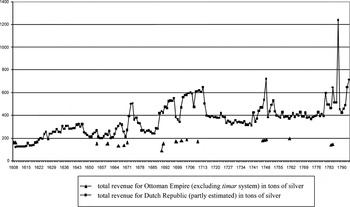
To answer this question we must first identify the kind of figures to be compared. In the Dutch Republic of the Seven United Provinces, budgets for war expenditure and some other central expenses were made at the central level but almost all state expenditure and revenue-raising was decentralized: about 60% of the amounts that had been agreed to on the central level had to be realized by Holland, the most important of the seven provinces; much smaller percentages by each of the others, according to a fixed distributive key. There were only a few central sources of revenue in the Dutch Republic, of which customs revenue – earmarked for the navy and to be received and spent by five admiralties in different places – was the most important. The provinces were fiscally autonomous, collected their own taxes, and had their own provincial debts.Footnote 7 This means that information on the amounts received in taxes and loans, and on what was actually spent – not only on the army and navy but also on increasing amounts for debt service and relatively very low amounts for administrative and other expenditure – is mainly available in the separate provincial administrations. The available data on public finance are now electronically accessible for most of the provinces.Footnote 8 The results, complemented with estimates for missing data are plotted in Figure 1, converted to tons of silver.
Total revenue for the Ottoman Empire and the Dutch Republic in tons of silver, 1608–1794.

For the Ottoman Empire, figures on state finance (designated as ‘budgets’ although they were produced after the factFootnote 9) are only available for a restricted number of years in English publications.Footnote 10 A more recent publication in Turkish gives much more detailed information for some of these years and a number of other years.Footnote 11 Sahillioğlu has provided information on the character of the very rich archival material on state finance, which is not easily accessible even for Turkish researchers because it has been preserved in the form of series of daily accounts of state revenue and expenditure, and of registers of daily totals. The amounts resulting from these registers have, moreover, yet to be complemented by registers of sums that never actually entered or left the Imperial Treasury but were nevertheless accounted for because they were considered to be part of imperial state finance.Footnote 12
As in the Dutch Republic, an important part of what was received in the provinces of the Ottoman Empire was spent in the provinces themselves. From the tax revenue in the rich province of Egypt at the end of the eighteenth century, for instance, 75% had to be retained for Egyptian expenditure, with only 25% at the disposal of the central treasury; and even this amount had become subject to an increasing burden of deductions to meet obligations imposed on the Porte in Egypt, so that in the end very little was sent to the Porte itself.Footnote 13 Sahillioğlu shows that totals of the ‘budget’ figures, at least for the years after 1698/9, are comparable to the sum of the figures in the ruznamce (the daily accounts) and the mahsub, which specified revenue and expenditure in the provinces, including the amounts that never reached the treasury but were received and spent in the provinces themselves.Footnote 14 This seems to imply that a low level of public revenue in the Ottoman budget figures in the eighteenth century cannot simply be explained by the disintegration of Ottoman central power in the course of the eighteenth century, as might have been thought.
Faroqhi notes that we do not possess any studies to estimate the value of services to the army as required from peasants and nomads, especially for transport,Footnote 15 but this would not have been a major component of the costs of warfare. Moreover, this phenomenon may have become relatively less important as the money economy spread. Another point to be mentioned is that, when the provinces sent extra auxiliary troops in case of war, these had to meet their own expenses, which will not have been taken into account in the central administration;Footnote 16 and in the course of time the treasury tried to reduce expenditure on armed forces stationed in the provinces, increasingly expecting governors to pay for their own military retinues.Footnote 17 It can be argued, however, that this development is rather a reflection of the decrease in state revenue, and of the emergence of new states, than a reason to attempt to correct the budget figures for this fact.
A much more important point to consider is that Sahillioğlu showed that, except for the year 1527/8, the budget figures do not include state expenditure and state revenue from the timar system, whereby sources of tax revenue were handed over to individuals, mainly cavalrymen, in order to enable them to finance their military tasks. Only for the year 1527/8 is it known that, of a total revenue of 537.9 million akçe, 200.17 million was the revenue of timar holders. Moreover, of this 537.9 million akçe, about 11% (59.2 million akçe) came (mainly) from religious endowments (awqaf or evkaf; singular, waqf and vakif ), by means of which social and economic forms of expenditure – such as poor relief, schools, hospitals, and other (also economic, and mostly urban) facilities – were financed. In the Dutch Republic, however, these kinds of expenditures were mostly financed from urban revenue sources not included in the data for provincial finance. If waqf revenue is left out of the total, Ottoman imperial revenue exclusive of timar revenues in that year was only about 58% of imperial revenue including timar revenues. This implies that, during the sixteenth century, the available imperial budget figures may have to be increased by at least 72% to get an idea of total state revenue including that provided by the timar system.
It is impossible to estimate with any accuracy what this information about 1527/8 may have implied for total revenue (including that of the timar system) in the seventeenth and eighteenth centuries. The number of religious endowments would certainly have increased considerably, as they were a means for the rich to bestow their property to the benefit of their offspring, by making sons directors of these institutions and thus circumventing Islamic inheritance laws; but, as argued above, this aspect of ‘public’ finance can be left out of this comparison. There is no doubt at all, however, that the significance of the originally very important timar system declined after the increase in tax-farming from the end of the sixteenth century. Farming of taxes had become necessary to obtain cash for restructuring and modernizing the army: cavalrymen were increasingly replaced by large numbers of centrally paid infantrymen, and the number of timar continuously decreased during the seventeenth century. In Anatolia in 1760, all remaining timar land had been usurped by fiscal entrepreneurs.Footnote 18 According to Barkan, the number of timar cavalry fell from 87,000 in the 1560s to 8,000 in 1630, while janissaries and palace sipahis increased from 12,900 to 67,500.Footnote 19 In view of these figures it is highly improbable that the available Ottoman ‘budget’ amounts will have to be more than doubled for the seventeenth and eighteenth centuries to get an estimate for total revenue including timar revenues.
Despite all the reservations made above and the resulting crudeness of the comparison, there is therefore little doubt as to the main conclusion that can be drawn from Figure 1, which shows the available ‘budget’ figures for total imperial tax revenue (excluding timar revenue), converted to tons of silver, in comparison with (partly estimated) total revenue figures for the Dutch Republic. Even if these figures for the Ottoman Empire were doubled, total revenue in the small Dutch Republic is still likely to have been not much lower, and probably higher, than that in the huge Ottoman Empire in the eighteenth century, despite the fact that the population in the Dutch Republic was no more than about 2.1 million in 1800, while that of the Ottoman Empire has been estimated at somewhere between 25 and 34 million for that date.Footnote 20 In 1789, a foreign observer thought that total tax revenue in the Ottoman Empire was about £2.25 million. Genç mentions that tax revenues worth some £3.4 million at that time might be more probable. This would confirm the result that total revenue was less than that of the powerless Dutch Republic at the end of the eighteenth century, as this then worth about £3.5 million.Footnote 21
It may be objected that soldiers would have been much less expensive in the Ottoman Empire than in the Dutch Republic because of much lower price and wage levels. To get an impression of the order of magnitude of this difference one can compare wage data for unskilled labourers in both states. Wage data collected by PamukFootnote 22 and by de Vries and van der WoudeFootnote 23 converted to grams of silver show that the amount of silver needed per soldier may have been on average about 2.3 times higher in the Dutch Republic than in the Ottoman Empire during the seventeenth century and on average about 2.6 times higher during the eighteenth century. To this can be added that in western European countries an increasing part of state expenditure had to be used for debt service, which did not occur in the Ottoman Empire.
Nevertheless it can be concluded that, even if the amounts in state revenue per head in both states are corrected for differences in wage and price levels, the amount realized in revenue per head turns out to have been at least five times lower in the Ottoman Empire than in the Dutch Republic. This result is in line with Pamuk's estimate that not only the amount in tax revenue per head in the Ottoman Empire but also the amount as a percentage of national income was, at the end of the eighteenth century, much lower in the Ottoman Empire than in western European states: about 2–3%, compared to about 10% in states such as Britain and the Dutch Republic.Footnote 24
Why was this the case? Prak and van Zanden have recently suggested that ‘citizenship arrangements’ were crucially important in successfully meeting the challenge of mobilizing as many resources as possible to survive the early modern arms race, without at the same time damaging the long-term dynamics of the economy.Footnote 25 We will come back to this point later, but turn first to another point of comparison: the structure of state revenue.
State finance in the Ottoman Empire and the Dutch Republic: the structure of state revenue
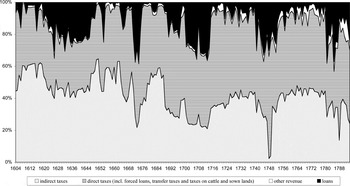
For the Dutch Republic the structure of state revenue can be observed in Figure 2 for five provinces of the Dutch Republic for which enough data were available or could be estimated. The percentage of indirect taxes – on domestic trade, production, and consumption – was on average about 50% during the seventeenth century and about 40% in the eighteenth century. Inclusion of customs revenue would make the total percentage of indirect taxation in the Republic's revenue yet higher. Customs revenue, levied not by the provinces but by five ‘admiralties’ that had to maintain the navy, may have been about 10% of total tax revenue: more during the seventeenth century and less during the eighteenth century. Elsewhere I have demonstrated that a high percentage of indirect taxation – ‘urban’ taxation plus customs – in total tax revenue also applied to other European states such as Spain, France, and Britain.Footnote 26
Structure of state revenue in the Dutch Republic, excluding customs (based on data and estimates for five provinces – Holland, Groningen, Friesland, Overijssel, and Zeeland – providing about 90% of total provincial revenue), 1604–1794.

In the Ottoman Empire, ‘the old tendency to tax the countryside and favor the towns always prevailed’.Footnote 27 Even in a province such as Egypt, with the large cities of Cairo and Alexandria, in the eighteenth century only 7% of state revenue was the result of urban taxes on merchants and artisans; 67% came from land taxes, 8% from customs dues, and 17% from miscellaneous revenue.Footnote 28 The available evidence suggests that in the Ottoman Empire the percentage of indirect taxation was never more than about 10–20%, of which the largest part resulted from customs and only about a quarter came from ‘urban’ taxes on domestic trade, production, and consumption.Footnote 29
The second point to be emphasized in a comparison of the structure of state revenue is, of course, the big part played by domestic loans (especially in war years) in the Dutch Republic. In contrast, in the Ottoman Empire, although there are examples of short-term borrowing from Jewish financiers by the Ottoman government, and although the government sometimes requested very modest loans from waqf institutions,Footnote 30 long-term domestic state loans at interest did not develop. It has been reasonably suggested by Genç, however, that the introduction of the ‘lifelong’ tax farms that were adopted in the empire after 1695, under the name of the malikane system, can be seen as a form of ‘internal borrowing’ comparable to the sale of life annuities in western Europe.
Farming of taxes (iltizam) had become the dominant form of tax revenue since the end of the sixteenth century, when it gradually began to replace the timar system. Under the new malikane system, relatively small amounts in money had to be paid each year to the state by investors in tax farms as the state's share in the tax revenue (mal), in exchange for down-payments (muaccele) – soon proportionately very large – at the start of the farm.Footnote 31 The bidding during the auctions of the tax farms under the malikane system was on the muaccele, which is of course very different from the system of bidding on the amount to be handed over to the state that was in use in western Europe. The relatively large part of tax revenue left to the tax farmer can thus be seen as a compensation not only for his efforts in collecting the tax but also as a compensation for this down payment comparable to the interest payments to lenders.
An important novelty of the malikane system was that the tax farmer kept the right to collect his tax until his death, which made the investment in a malikane comparable to an investment in a life annuity. As in the case of the investment in a life annuity, the muaccele was in fact a purchase price, not a loan that had to be redeemed. A major difference remained, however, that in western Europe the yearly interests on life annuities were paid for by taxes collected by the government, whereas the investors in a malikane had to organize the collection of the tax themselves. Moreover, they had to be careful not to overexploit the tax source in order to avoid decreasing returns on their investment, which could in theory be one of the strengths of the new system, although in practice the state tended to redeem the muaccele and to auction the tax anew when the profit rate for the tax farmer turned out to become higher than had been foreseen at the auction.Footnote 32 Yet another difference from a life annuity was that a malikane could be sold, albeit under the condition that a tax of 10% of the original muaccele was paid to the state.Footnote 33 One final difference was that it was possible to buy shares in several different sorts of malikane and in this way spread the risk of decreasing profits, owing, for instance, to a declining number of taxpayers and/or to increasing tax evasion.
After 1774 the state decided to start changing the malikane system to the esham system, beginning with the malikane with the highest profit for the owners. Now the muaccele became much more similar to life annuities because, under this system, it was the state that collected the tax and paid the investors out of its tax revenue during their lifetime a yearly fixed percentage (decreasing from 20% to about 15% in the last decades of the eighteenth century) of their (shares in the) muaccele amount. The total in muaccele amounts increased again considerably under this new system in comparison to the malikane system. The question remains, however, as to how important this form of muaccele revenue-raising in the Ottoman Empire was in comparison to loan financing in western European states.
This question is not easy to answer because, unfortunately, although muaccele revenues were included in the Ottoman budget figures, they were not recorded as separate items but included in different entries in the budgets.Footnote 34 Only for the years 1696/7, 1747, and 1761 are separate muaccele revenues mentioned in the published budgets. In these three years, the part played in total revenue by the muaccele amounts was very small,Footnote 35 but in 1696/7 the system was still new and 1747 and 1761 were not war years, and it seems reasonable to suppose that changes of tax farms in a malikane took place mainly at times when large amounts of extra money were needed.
For the year 1800, however, there is an indirect indication of the relative importance of this revenue source in Ottoman state revenue, because at that time the percentage of total tax revenue of the state that had to be left each year to the farmers, in return for their muaccele and esham investments, can be calculated at about 15% of total tax revenue.Footnote 36 This percentage must have been (much) lower before, because the malikane system only started in 1695, and only since then had there been an increasing conversion of tax farms into lifelong malikane farms, the rate of increase perhaps depending on the need of the state for the extra muaccele income. In the Dutch Republic, not only was the value of interest payments as a percentage of total revenue much higher than the 15% in 1800 in the Ottoman Empire to which it should be compared but the interest rates also varied between only 2.5 and 5%, much lower than the comparable malikane and esham profit rates. Genç calculated that the gross malikane profits as a percentage of the muaccele amounts must have been about 30–35% at the start of the eighteenth century and then gradually declined to about 20% or even 15% at its close.Footnote 37 Combining this information implies that the revenue per year from loans in the Dutch Republic must have been considerably higher than that from the muaccele amounts in the Ottoman Empire. It is true that the fact that, in the province of Holland by the end of the eighteenth century, more than 70% of tax revenue had to be spent on interest payments is an extreme example of the role played by public debts in state finance in western Europe. However, debt service in Britain also increased from about 35% in 1700 to about 55% around 1790;Footnote 38 in France, the percentage of interest payments was more than 50% of the state budget in 1788.Footnote 39
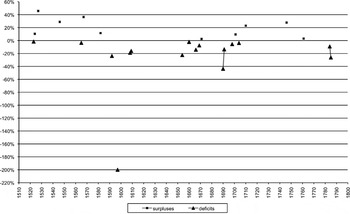
One might wonder at this point whether the absence during the seventeenth century in the Ottoman Empire of something comparable to the revenue from loans was not perhaps simply the result of a lack of necessity prior to 1695.Footnote 40Figure 3 shows that it is unlikely that this was the case, at least from the end of the sixteenth century, when the empire was often plagued by the inability of the government to pay the army without devaluing the money and by the resulting revolts of soldiers. Although Darling has rightly emphasized the flexibility and adaptability of Ottoman fiscal administration during the seventeenth century,Footnote 41 the graph still shows many deficits during this century and also in the last decades of the eighteenth century.Footnote 42
Differences between Ottoman imperial revenue and expenditure as % of revenue, 1520–1790.

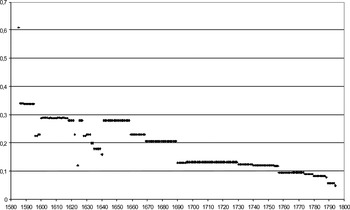
The graph also shows another remarkable difference from most western European states: during the sixteenth century, state revenues were supposed to exceed expenditure, in order to fill the sultan's treasury. This ‘inner treasury’ functioned as a reserve bank for the main current treasury.Footnote 43 The graph suggests that the inner treasury was probably quite able to fulfil this task, if necessary, during most of the sixteenth century. This was the result of the successful expansion policy of the empire since the fifteenth century, which continuously increased its number of taxpayers. The Dutch state had still to come into existence at that time, only doing so after the start of the revolt against the Spanish king in 1572, and at the time could only apply, with some success, to foreign monarchs for subsidies and loans. Domestic loans as a means of financing war expenditure thus became important in Holland in the seventeenth century.Footnote 44 The Ottoman budget deficits in the seventeenth century shown in Figure 3, and the disastrous consequences of the resulting devaluations of the akçe shown in Figure 4, indicate that a similar source of money would have been very useful for the Ottoman Empire also, and that the lack of it cannot be explained by a lack of necessity.
Silver content of the akçe in grams, 1586–1794.

It cannot, of course, be completely ruled out that the Qur’anic prohibition on interest played a role in the absence of state loans at interest.Footnote 45 However, the interest prohibition had also been valid in western Europe during the Middle Ages.Footnote 46 Why then would its de facto influence have disappeared from one part of the world and not from another? The question seems the more justified because, in private credit relations, the prohibition was circumvented in the world of Islam as well, not only between merchants but even in the case of the so called ‘cash vakifs’, public religious institutions (also evkaf, awqaf, habous) whose funds consisted of cash instead of real assets and that depended on loans on interest for their revenue.Footnote 47 Moreover, particularly from the reign of Suleiman the Lawgiver onwards, public affairs were regulated by the worldly kanun law. The shari‘a was mainly of practical value in family law.Footnote 48 It therefore seems reasonable to ask if there may not have been other factors to explain the absence of public loans to finance war expenditure.
The question why the structure of state finance in the Ottoman Empire was so different from that in western European states such as the Dutch Republic will be further addressed in the next two parts of this article. It will be argued that a comparison of the role, from the eleventh century onwards, of urbanization trajectories in state formation in these two parts of the world can contribute to our understanding of the observed differences in state finance.
Urbanization trajectories and state finance: the Netherlands
Around 1000, after the raids of the Vikings on the coastal areas of western Europe had ceased, population in this part of the world started to grow rapidly. Recent research suggests that the total population in the Low Countries increased between 1000 and 1500 from about 0.7 million to 2.2 million – despite a considerable decrease due to the plague during the fourteenth century – growing to 5.3 million in 1800. At the same time, the percentage of the population living in cities of more than 10,000 inhabitants may have increased from about 3.4% in 1000 to 19.6% in 1500 and 19.7% in 1800. In Western Europe as a whole, the population increased dramatically, maybe from about 27 million in 1000 to about 62 million in 1500 and 130 million in 1800. The percentage living in cities of more than 10,000 people probably increased from about 6% in 1000 to 7% in 1500 and 11% in 1800.Footnote 49
This not only led to an intensification of land use by means of land reclamation to feed the population, but also to specialization and commercialization in agriculture and grain imports, and to urban concentrations of population specializing in industrial and commercial activities, developments that in themselves reinforced population growth. A remarkable aspect of the early land-reclamation process was that cultivated areas became the private property of the cultivators instead of being held as part of domain property within a context of feudal serfdom. Feudal lords seem to have perceived that good property and lease rights for farmers were a better guarantee of increased production than a continuance of feudal relations. In a later phase, this would enable city inhabitants to buy land in the countryside, which would stimulate the use of production-increasing technology and profit-increasing land use as a means to increase their capital.Footnote 50
As early as the twelfth century, Flemish counts consciously furthered the development of cities in order to profit from their economic dynamics by giving them privileges and by appointing officials to administer justice and levy taxes. This is hardly surprising, since the development of industry and commerce in urban concentrations offered the counts new sources of revenue other than land alone. In Flanders, the three biggest cities would become responsible for about half the tax revenue of the state by the middle of the fourteenth century.Footnote 51 However, new markets that emerged with the urban conglomerations were often also established without the mediation of the count. The rise of international trade was, according to Verhulst, grafted onto these tenth-century regional market functions.Footnote 52 He adds that trade and industry were in the hands of an indigenous bourgeoisie and that their wealth enabled them to acquire great autonomy. I characterize these developments as a mainly economy-driven trajectory of urbanization.
From the eleventh century, guilds had assumed responsibilities for city administration in Flemish cities and this essentially led to a form of autonomy in the twelfth century.Footnote 53 This implied that urban taxes were levied not only for the count but also to finance urban expenditure. After 1280, the Flemish count was able to force the city governments to keep books on these city finances, which kept him informed of revenue potentials.Footnote 54 Nevertheless, especially after 1312, new counts and dukes always had to confirm the privileges of the cities in the region. The existence of urban public finance in combination with administrative autonomy implied the possibility of issuing loans at interest, for instance for investments in city improvements. The wealth of the urban bourgeoisie, combined with the demand for means of securing revenues during old age and for widows and orphans, had created the necessary capital supply. In addition, investors could be confident that the urban government would raise sufficient taxes and would give high priority to pay the interests due because its members and their families and friends would be among the investors themselves. By 1283, the commercial town of Brugge had a capital debt due to the sale of life annuities and perpetual annuities amounting to more than six times the city's annual income.
This development also enabled the count to appeal to other forms of financial support than land revenue and taxation alone to finance warfare, and it did not remain limited to Flemish towns. Tracy found sales of rentes viagères in cities in northern France in the thirteenth century and the same can be said for south German towns.Footnote 55 In Catalonia in Spain in the fourteenth century, cities preferred to sell life annuities as well as heritable perpetual annuities to provide the king with money rather than suffer increased taxation.Footnote 56 The contracts between the king and the communities stipulated that the local authorities themselves were authorized to collect the – indirect – taxes out of which the interests on the annuities had to be paid, by which the trustworthiness of the investment was maintained. This is exactly what would later happen in Holland in the sixteenth century, when Charles V convinced its six biggest cities to negotiate large amounts in loans on their common credit.Footnote 57
To explain why the sale of life annuities developed in these parts of Europe, Tracy pointed to the establishing by royal jurists of the principle that urban communes were one of the few forms of association privileged by the king to act as ‘moral persons’, and therefore capable of owning property and swearing oaths.Footnote 58 This made it possible for them to be debtors as a ‘corporate body’, which greatly increased the legal security of creditors. It seems probable that such a royal privilege would have been especially important for the credit of the annuities among non-domestic buyers. In twelfth century Italy, it appears to have been possible for the city government itself to be considered trustworthy, rather than a juridical guarantee offered by a king. In the case of cities such as Genoa and Venice there was no doubt that the city-state had the power to rule and to realize financial policies in the interest of the wealthy creditors of the city. The same would become true in Holland. Here, even villages sometimes turned out to have enough credit to issue loans on the ‘corpus’ of the village, probably as early as the fifteenth century – for instance, to build mills for water management and industrial application.Footnote 59
A remarkable new development in the Netherlands following the revolt against the Spanish king was that, after about 1600, its provincial governments had gradually become able to gain sufficient credit to issue loans on their provincial credit, and that these governments no longer had to rely on the credit of the individual cities. In France, until the end of the eighteenth century, a very important part of the state debt appears to have remained based on urban credit, since ‘rentes sur l’Hôtel de Ville de Paris’ would remain the most important French debt paper until the French Revolution. The government of a huge city such as Paris could be supposed to be able to collect enough in tax revenue to pay the interest, and to be powerful enough to give them priority. Britain seems to be an interesting exception to the west European ‘rule’ that state credit can always be traced back in one way or another to urban credit that was rooted in (semi-)autonomous city governments disposing of urban public finance. London never issued urban loans. Here, the credit of the king's loans came to be based on national instead of urban excise taxation under parliamentary control, although its famous ‘financial revolution’ had to be complemented with the establishment of a bank free from government control, dominated by the influence of London merchant interests.Footnote 60
As the result of successful territorial competition, as well as diplomacy, marriages, inheritance, and sale of territories of rulers in this part of Europe, the Netherlands had, since 1383, gradually been incorporated in the Burgundian state, succeeded in 1477 by that of the Habsburgs. Thereafter, a distributive key had established the proportionate amount that each of its regions had to contribute for military expenditure. The amount to be paid was still collected under regional control; even more importantly, amounts above the normal amount to be spent for military purposes had to be negotiated separately with representatives of the cities and the nobility and clergy of the different regions, convened since 1464 and named the States General in 1477. Attempts at centralized taxation failed.
In Holland, even the protection of sea commerce by convoy was organized by the merchants themselves, and remained a task of city governments instead of central government until the Revolt. Because duties related to commerce and shipping were earmarked for the protection of the fleet on a local level, they could not become an independent source of income or credit for a central ruler, as was the case in England from 1275. Attempts at centralization of these means of public revenue by the Burgundian dukes in the fifteenth century failed completely.Footnote 61 And, although towns needed a special permit for selling annuities, in practice many towns felt free to do so without one. Attempts made by both the Burgundian and the Habsburg authorities to contain this urban autonomy were ineffective.Footnote 62
However, cities that actually revolted against their lord did not automatically receive the support of other cities because, as Blockmans argues, the peace and support for the development of international trade that could be guaranteed by a strong monarchical state would often have been perceived as an advantage for the development of commerce, which was vital to enable rich and powerful citizens to safeguard their wealthy lifestyles.Footnote 63 But when several cities in the northern Netherlands combined in revolt against their monarch, as became the case in the Dutch Revolt, they proved capable of generating sufficient financial means to establish an independent republic. Although one of the causes of the revolt had been the attempt by the Spanish king to introduce centralized taxation, the cities in the Dutch provinces would concede to the replacement of urban autonomy by provincial autonomy by accepting centralized provincial tax systems. The possibility of giving first priority to paying the interests on provincial loans from its increasing provincial tax revenue (thanks to population growth and economic growth) was a crucial factor in the ability of the Dutch state to attain levels of state revenue comparable to that of the huge Ottoman Empire.Footnote 64
To sum up, rulers in this part of the world had become increasingly dependent on city wealth to finance wars, although most cities at the same time remained dependent on rulers to maintain peace and thus to increase commerce and wealth or to defend them against competitors in neighbouring states. A very important development in the financial relationship between cities and rulers had been not only the emergence of representative institutions to negotiate the revenue for extraordinary expenditure but also, perhaps even more significantly, the emergence of the possibility of the sale of annuities by cities to finance increases in war expenditure that could not be financed by means of the existing fiscal system. The confidence of investors in the reliability of interest payments on this public debt was founded partly on the legal status of cities as a ‘corporate body’ and the virtual autonomy of city governments responsible for urban economic welfare, but probably even more on the systems of urban public finance controlled by these city governments.
As long as cities increased in size and wealth through population growth and improved economic welfare, revenues from indirect urban taxes grew automatically after each of the short tax-farm periods, mostly of no more than one year, and formed a secure fund for increasing interest payments. As long as debt service was sufficiently secured, monarchs or, as in the Dutch Republic, higher government levels could tap these attractive financial possibilities for their wars. The possibility of negotiating loans on the security of revenue from indirect taxes that increased automatically with increasing population and increasing wealth offered state finance even more powerful leverage than the option of increasing tax revenues by means of proposals to representatives of cities and nobility in the Estates.
Urbanization trajectories and state finance: the Ottoman Empire
A very different prehistory of state formation pertained in the part of the world in which the Ottoman Empire developed. Turkish bands began to flood Asia Minor in the last decades of the eleventh century, while population in the Middle Eastern and north African part of the later Ottoman Empire nevertheless seems not to have increased. It may even have decreased between 1000 and 1500, according to the results of recent research: from 21.7 million to 17.5 million, increasing again to perhaps 22.3 million in 1600 and then stagnating at about that size for the next two centuries. The number of people living in cities with a population greater than 10,000 seems to have decreased as well: from perhaps 1.8 million to 1.5 million between 1000 and 1500. Combined with a decline in total population this would nevertheless imply an increase from 8% to 9% of total population, subsequently decreasing to perhaps 7.5% in 1800. At first sight, these percentages may not seem to be much lower than those mentioned for western Europe above. An important difference, however, is that the number of cities with a population of more than 10,000 was much lower in the Ottoman Empire: decreasing from 31 to 26 between 1000 and 1500 and then to 24 in 1800, while increasing from 74 to 178 to 522 in Western Europe.Footnote 65
Under these conditions, the pressure to intensify agriculture and for urbanization cannot have been very high. Initially, new raids or conquests were organized by the invaders as soon as an occupied part of the country was drained of its resources. From the end of the twelfth century, the few remaining and depopulated towns in the area sought and obtained protection against other nomads from the most powerful of their leaders, Osman. His contacts with Byzantines and Seljuks gave him both a source of administrative knowhow for his growing state and a new awareness of the importance of tolerating Jews and Christians as taxpayers. After the Byzantine emperor had dismantled his fleet in 1284, the way lay open for piratical expeditions, enabling raids on the Balkans. This development – not merchant interests, as in western Europe – would form the origin of the Ottoman navy. By the fourteenth century, raids in Balkan territory had become deliberate state enterprises, bringing not only an immense wealth in booty but also, on a more permanent basis, many new taxpayers, as well as competent military recruits by means of the devshirme: the tribute of young Christian males, who were raised at the court of the sultan to fill positions in his army and administration.Footnote 66 Inalcik emphasizes that this dynamic conquest policy, and the resulting predominance of the military class, followed in the tradition of earlier Islamic empires in this area and would subsequently influence the historical existence of the Ottoman Empire for six centuries.Footnote 67
The main effect of the different demographic developments in this part of the world, therefore, was not an inward movement directed at an intensification of land use but an outward, expansionist movement. This outward movement was not seawards, to increase commerce overseas, but mainly landwards, to occupy new territories – although preferably across the Mediterranean in the population-rich Balkan area. Occupied territory could be given in usufruct to warriors but remained in the possession of the ruler. Apart from the special tax on Christians and Jews, the revenue system of the new rulers for warfare would remain based mainly on land income. Military commanders received the right to collect taxes on a certain piece of territory – first called iqta‘, later renamed timar – sufficient to maintain themselves and the soldiers under their command. Although timar often became hereditary in fact, they always could be – and often were – withdrawn by the sultan. Besides this, the sultan could dispose of the revenues from taxing international trade, of which the overland caravan trade was an important part.
Well before the Ottoman Empire, the bulk of the lands in this part of the world were already state owned and this would continue to be the case. The exceptions were lands used for horticulture around cities and lands permanently handed over as a source of revenue to evkaf (religious and charitable institutions). In conquered regions where feudalism had prevailed, it was wiped out: territories in the Balkans were integrated in the timar system and local lords could become timar holders under strict state control. The state abolished any personal services that the local lord or sipahi could easily abuse, although some feudal labour services were converted into cash tax. Taxation was now regulated by laws issued from the central government and the population had the right to appeal to the sultan against local abuses and injustices.Footnote 68
A remarkable aspect of urbanization in this part of the world was the phenomenon of forced migration.Footnote 69 When Mehmed II conquered Istanbul in 1453 it was a city of only about 30,000–50,000 inhabitants.Footnote 70 He immediately instituted a policy of forcibly importing individuals with experience and professional skills to Istanbul to bring about an economic revival. By about 1550 its population had risen to approximately 400,000,Footnote 71 although ‘peasant flight’ would also, of course, have been a factor in Istanbul's growth. The repopulation of Istanbul through forced migration was, however, not an isolated phenomenon only designed to build up the newly conquered capital: there were other cases of professionals being systematically transferred to develop urbanization in newly acquired territories. It was a general policy throughout Mehmed's thirty-year reign as a means of sedentarization and urbanization, especially important for protecting caravan routes in unpopulated areas.Footnote 72
Specialization, productivity growth, and trade were not absent in the Middle East and North Africa. The sixteenth century in particular was one of population growth and the extension of arable land. At the same time, however, according to the register of 1572 only 60% of the cultivable lands in the fertile Cilicia floodplain had yet been converted into regular agricultural exploitations; the rest was still cultivated on a temporary basis by nomadic groups. In 70% of the settled places, the village did not exceed twenty households. Despite population growth during the sixteenth century, deserted villages remained a pressing problem for the state nearly everywhere in the Ottoman empire: ‘since the peasants did not own the land and as there were always other lands available, flight from their tract was frequently resorted to’.Footnote 73 Peasants abandoned their villages to set up new ones on inaccessible sites.
Reasons for peasant flight, not only to cities but also to mountains and forests, were attacks by passing troops, brigand bands, or caravans, or simply flight to avoid tax registration or tax collection. Other reasons included exhaustion of the land, desertification, earthquakes, and epidemics, a combination of possible disasters that had much more incessant, ravaging effects in this part of the world than in western Europe until the nineteenth century. The plague was one of the major impediments to urban growth, says Faroqhi in a section on ‘plagues, famines and earthquakes’, adding that not enough is known on the latter two types of disaster.Footnote 74 While evidence concerning population decline in the towns during the seventeenth century is ambiguous, for the countryside it is fairly well documented. Tax revenues of many villages in 1640–50 constituted a fraction of their late sixteenth-century levels. Many peasants fled to cities, where epidemics and malnutrition took their toll; many villages simply disappeared, leaving only their names.
Until about 1585 the fiscal policy of increasing state revenue by acquiring new territory to increase the number of taxpayers had been extremely successful.Footnote 75 The great expansion of the central treasury enabled Sultan Bayezid II (1481–1512) not only to increase the army and provide it with handguns but even to build warships of a size never seen before on the Mediterranean. Although there was no impulse in the Ottoman Empire to participate in the nascent Atlantic trade because of long-established contacts with the rich trades of the Far East, the Portuguese had to be fought in the Indian Ocean to secure the supply. However, by the time that the possibilities for acquiring new territories had reached their limits, it became increasingly important to keep taxpayers inside the country. After the terror of the Celali bands in 1596–1610, the government took drastic measures to ensure the return of peasants to the abandoned villages in Anatolia.Footnote 76
There were also central bureaucratic attempts at voluntary urbanization. Welfare arrangements were not only the result of initiatives of religious brotherhoods in cities, or of individuals bequeathing their property to awqaf (charity institutions). Along the caravan roads in particular, complexes of soup-kitchens (imaret) and hospitals and other facilities (kiilliye) were founded by the state in cooperation with sheikhs of religious brotherhoods, in attempts to induce a nomadic population to settlement. The construction of an imaret seems even now to be considered as the main characteristic of Ottoman cities in Anatolia and the Balkans.Footnote 77 The expenditure on infrastructure and welfare that these urban settlements required were financed from tax revenues from the lands that were handed over to awqaf. No autonomous urban finance developed.
Urbanization was a source of permanent concern for the Ottoman government, not only the low number of small cities in large parts of the empire but also the high number of mouths to be fed in the big cities. Merchants, especially in Istanbul, often functioned in a kind of ‘command economy’, organized by the state to ensure the provisioning of the city.Footnote 78 Another element of this – what Genç has called the ‘provisionism’ principle of Ottoman economic policy – was the strict regulation of export and the advancement of imports, the opposite of the mercantilist policies of western European states.Footnote 79 Furthermore, he states explicitly that this ‘provisionism’ principle rendered an increase in state revenues extremely difficult. Of course, the wealth of important cities such as Istanbul, Alexandria, or Aleppo was at least partly related not only to overland caravan trade but also to commerce across the Mediterranean Sea. But even in these cities, merchants – dependent as many of them were on the economic policy of the government – never became a dominant social class. Military and religious elites involved in the government apparatus were always richer and more influential. All in all, it seems justified to characterize the urbanization trajectory in the Ottoman Empire as much more state-driven than that in western Europe.
It is not surprising that the intense interference of the state with the process of urbanization finds its reflection in what Raymond, rightly avoiding the term ‘government’, has called ‘the management of the city’. Although he concedes that political intervention by local powers, especially guilds, was less absent than is often supposed, he emphasizes that in the Ottoman Empire major cities functioned in the absence of a true urban administration and that they were ‘bereft of any homogeneity and any juridical and regulatory cloak’.Footnote 80 He cites Sauvaget with approval, who wrote in 1934 that ‘The status of [Islamic] cities is the subject of no specific provision on the part of Islamic law. There are thus no … municipal institutions… . The city is not … regarded … as an entity, as something having its own existence… . [It is] an inconsistent and inorganic assemblage of quarters.’Footnote 81 Cities in the Ottoman Empire were governed by centrally appointed officials. The three main city officials were the amir for military affairs, the muhtassib for economic affairs, and the qadi for juridical affairs.Footnote 82 Even when persons from the local upper class succeeded in being appointed as the city's qadi, amir, or muhtassib for a longer period, as was increasingly the case in provinces such as Egypt, these functionaries did not constitute a city government eager to protect trade against the fiscal greediness of the state. On the contrary, their wealth was the result of their relation with the central government, because they were the ones who levied the taxes partly to be transferred to Istanbul, partly to be spent in Egypt, and partly for their personal income.Footnote 83
There was no institutional development towards the city as a ‘corporate body’,Footnote 84 to a political entity separate from monarchical power. Islamic cities in the Middle East and North Africa were often centred round a mosque, a public bathhouse, and a suq, but for the rest they remained a collection of separate quarters that often separated ethnic and religious groups, with few common institutions. One building in particular that was always absent was a town hall, the natural heart of so many western European cities. Economic and social tasks in the cities were either fulfilled by a scattered number of awqaf, used by the rich to circumvent the inheritance laws in Islam, or, if necessary, by the central state. There was no urban public finance, no urban taxation to finance urban public expenditure. The important implication is that there was no basis for the establishment of urban credit and the urban loans that had been so crucial for the development of state debts in western European countries
Conclusion
Looking from a Dutch perspective at Ottoman state finance, one cannot fail to be struck by its relatively low level, particularly in the eighteenth century. Another remarkable difference was the relatively small importance of indirect taxation in comparison not only with the Dutch Republic but also with other western European states, despite a level of urbanization that was probably, at least on average, not much lower than that in western Europe. A final difference was the absence of state debts that were such an important component of state finance in the Dutch case and those of other western European states. Even if we accept the reasonable suggestion that the muaccele amounts of the Ottoman malikane and esham systems can be seen as an alternative to domestic loans, the available quantitative evidence (and especially the fact that they were much more expensive for the government than the comparable western European life annuities, increasingly avoided by European governments during the eighteenth century because of their costliness) makes it improbable that their relative quantitative importance ever matched the importance of loans in the fiscal systems of western European states.
Why was the overall level of state revenue so low? Prak and Van Zanden have suggested in an interesting article that differences in ‘citizenship arrangements’ originating in the Middle Ages may be important in the explanation of higher or lower levels of state revenue per head. They suppose that transparency in public finance and the ability of citizens to monitor the actions of the city-state lead to a high tax morale.Footnote 85 They argue that, if convinced that justice was observed in tax assessments and that they would get ‘value for money’, citizens in the Dutch Republic were ready to pay more taxes. Interestingly, Linda Darling explains the successes of tax reforms in the Ottoman Empire in the seventeenth and eighteenth centuries, resulting in increased revenues, in a similar way, without resorting, however, to the concept of ‘citizenship’. The reforms she studied were successful, she argues, because they restored the balance between the justice afforded by the ruler to the taxpaying subjects and their production of a surplus with which the army could be paid and the treasury filled.Footnote 86 To this can be added the fact that the transparency of public finance was in at least one respect higher in the Ottoman Empire than in the Dutch Republic: even now we do not know the levels of profit of Dutch tax-farmers, whereas the profits of tax farms under the malikane system were known and were made available during malikane auctions.
Moreover ‘tax morale’ seems mainly useful for explaining differences in direct taxation. This makes it important to know that the impressive result of the most famous direct tax in the Netherlands, the so-called ‘Liberale Gifte’ of 1748 (see Figure 2), was, according to contemporaries, the result of ‘patriotism’ and relief about the return of a member of the family of Orange at the head of the Republic rather than of ‘citizenship’, while an important precondition for its acceptance had been secrecy as to its results instead of transparency.Footnote 87
In the case of the comparison between the Dutch Republic and the Ottoman Empire, it was, in addition, rather the high levels of indirect taxes and of loans to the government that were remarkable. The overall low level of state revenue in the Ottoman Empire may have been at least partly the result of this different fiscal structure. In normal circumstances tax evasion of direct taxes was notorious. Differences in urbanization trajectories and their relation to urban and state credit seem to offer a better explanation for this than ‘citizenship’. In western Europe, the preceding urbanization trajectory had been more economy-driven than state-driven, resulting in the development of urban governments and urban public finance, phenomena that did not occur in the much more state-driven urbanization trajectories in the Ottoman Empire.
Land was insufficient as a source of state revenue for rulers of the competing western European states. To realize sufficient revenue, they became dependent on the cities and their systems of indirect taxation and annuity sales. Meanwhile, to realize sufficient protection, cities were in the course of time increasingly ready to hand over part of their fiscal autonomy to rulers (to provincial governments as in the case of the Dutch Republic). In the Ottoman Empire, direct taxes remained the main source of revenue for the ruler. Until about the 1580s, a fiscal policy of territorial expansion in the more densely populated Balkans as a means of expanding the number of taxpayers in order to realize a revenue surplus, alongside the policy of persuading people to settle in urban surroundings or even forcibly moving people to populate cities, was largely successful. While many cities in western Europe came to be dominated by commercial elites, and by a state of interdependency between cities and monarchs, Ottoman cities came to be dominated by military, religious, and bureaucratic elites, dependent for their wealth on their access to state revenue, first within the timar system, later increasingly through their involvement in tax-farming. The resulting absence of city governments and of urban systems of public finance explains why the Ottoman Empire followed a different trajectory of state formation from western Europe as to its system of state finance. From the end of the sixteenth century, there was enough wealth in the Ottoman cities among the commercial classes to allow the development of the institution of tax-farming that often required pre-financing by private financiers. The lack of cities as ‘corporate bodies’, however, blocked the trajectory to public credit by means of city governments whose control over (automatically increasing) urban tax revenues from mainly indirect taxes offered the security for the interest payments on investments in public debt by citizens, as was the case in western Europe.
There is an ongoing debate on the concept of ‘the Islamic city’, in which it has been extensively argued that it is doubtful whether religion or religious law resulting in different institutions are the main factors that make cities in the ‘world of Islam’ different from cities in western Europe, and whether it is not more likely that geography and history account for common characteristics.Footnote 88 Some authors have tried to argue in the context of this debate that the lack of urban autonomy in the Ottoman Empire is not as absolute as other authors have thought, for instance because local intermediaries between a city and the central government did exist.Footnote 89 Indeed, on the occasion of the accession to the throne of a new sultan, complaints against the existence of ‘illegal’ indirect taxes were often voiced and often even, although temporarily, acknowledged.Footnote 90 As far as I know, the point has never been made, however, that the lack of something to be called ‘urban public finance’ is also a very remarkable characteristic of cities in this part of the world. Not only suqs, mosques, and public baths were common to all cities in the ‘world of Islam’. Perhaps even more characteristic was the ubiquitous absence of such a thing as a town hall, found in the centres of many European cities at the time. As there was no urban public finance controlled by urban governments, a city never would or could be consulted as a ‘corporate body’ about issues of state revenue.
It was this characteristic that meant that the sultan could never make use of what in western European fiscal history is called ‘urban credit’, although he might succeed in getting ever larger advancements on tax revenue from merchants and financiers by means of tax-farming. This, probably much more than the Islamic prohibition of interest, precluded a development from urban credit to state credit in this part of the world, and by implication the development of a domestic state debt.
I have argued elsewhere that I do not think that increasing financial and economic integration in the course of the eighteenth century made Ottoman state finance more like that in western Europe, as Pamuk has suggested, and that I find Cizaçka's analysis of an indigenous development of malikane and esham, focussing on the ‘risk-averseness’ of the Ottoman state, more convincing.Footnote 91 Rather than an imitation of what was happening in Europe, these two revenue-raising systems can be seen as a rational ‘risk-averse’ response to a different demographic situation and the lack of development of autonomous urban institutions and urban credit. My belief is that the tragedy of states in the ‘world of Islam’ is that, when they really made the step to debt-financing on a large scale, this had to be a step towards a foreign instead of a domestic debt, contributing to their further disintegration and final collapse.Footnote 92 But that is another story.