BACKGROUND
Incidents of absconding from inpatient care are high-risk events, which have been linked to serious harm to self and others (Bowers et al., Reference Bowers, Jarrett and Clark1998). Absconding also creates considerable emotional as well as tangible burdens for staff (Bowers et al., Reference Bowers, Simpson, Eyres, Nijman, Hall, Grange and Phillips2006). Previous studies have revealed various clinical characteristics as possible predictors linked with absconding in different psychiatric populations, mainly in acute adult inpatient units. However, there are no studies to date that specifically identify clinical characteristics of patients who abscond while admitted to inpatient low secure challenging behaviour mental health units.
Carr et al. (2008) conducted a study in acute psychiatric inpatient units in NSW, Australia. Based on their study, absconding was associated with drug and alcohol disorder, younger age, and longer periods of hospitalisation. At St Andrew’s Hospital, Northampton, UK a 3-year retrospective analysis of events and characteristics of absconders was conducted by Dickens & Campbell (2001) in all the different specialist clinical divisions within the hospital. Absconders (n =88) were found to be significantly younger, more likely to be detained upon admission and more likely to be unmarried than a control group (n =1378) of non-absconders. They did not find any significant differences for sex, length of admission or ethnicity. However, a prospective analysis (Meehan et al., Reference Meehan, Morrison and McDougall1999) of 77 consecutive incidents of absent-without-leave (AWOL) behaviour (n =51 patients) found that those who absconded were male (58%), under 40 years of age (74%), admitted involuntarily (78%), and had a diagnosis of schizophrenia (42%). One-third of all AWOL incidents resulted from repeated absconding by the same individual.
Tomison (1989) conducted a yearlong study and found that absconders were predominately male, young, compulsorily admitted, and discharged with a diagnosis of schizophrenia. However, numbers were small as those patients discharged against advice and failing to return from leave were excluded. A survey of 166 patients was conducted by Antebi (1967) and found that a very high percentage of male absconders (39%) have a criminal record.
Two case control studies (Ogunlesi & Adamson, Reference Ogunlesi and Adamson1992; Bowers et al., Reference Bowers, Jarrett, Clark., Kiyimba and McFarlane2000) have identified some indicators of inpatient absconding in psychiatric patients. These have included being single, having a current or previous history of drug abuse, being employed, staying longer on admission and non-compliant patient behaviour, e.g. medication refusal and involvement in violent incidents. Bowers et al. (2007) also found that adverse incidents including absconding were more likely during and after weeks of high numbers of male admissions, during weeks when other incidents also occurred, and during weeks of high regular staff absence through leave and vacancy.
The authors also found a retrospective study looking at the patient absconding incidents in different patient populations other than psychiatric inpatients. In inpatient wards of a public general hospital, the majority of patients who absconded were middle-aged males admitted through the Accident and Emergency Department to the speciality of general medicine. The most common clinical diagnosis given to this patient group were drug overdose, intoxication and soft tissue injury. Known drug addicts (29%) formed a substantial proportion of the patient group (Cheng et al., Reference Cheng, Chung, Leung and Lai2002).
AIMS
The aims of the study were:
(1) To describe the pattern of inpatient absconding behaviour in a low secure unit
(2) To compare the clinical characteristics of inpatients who absconded to those who did not abscond during the admission and
(3) To determine whether there are clinical predictors for inpatient absconding in this population.
METHOD
Study setting
The study data were collected from a low secure unit inpatient population derived from a multiethnic London catchment area. The challenging behaviour unit where the study was carried out admitted patients between the ages of 16 and 65 presenting with mental illness, mainly of a treatment resistant nature and with severe challenging behaviours which were longer than six months duration. Most admissions were from the general adult psychiatric services, having been primarily referred due to aggression with difficulties in management in the general adult inpatient unit or referrals of patients from psychiatric intensive care settings who were in need of a longer period of treatment in a secure setting.
Study design and data collection
A retrospective case control study was designed and conducted. All patients admitted to the unit during a 6½ year period between January 1997 and June 2003 were included in the study. Following an extensive literature review, demographic and clinical variables of these patients identified as relevant to the study aims were extracted from an electronic patient record database maintained by one of the authors as a part of the unit’s ongoing service evaluation. The demographic and clinical characteristics collected included: age (≤ or > 35 years); gender; ethnic group (white versus others); employment status (employed versus unemployed); marital status (single versus non single); referral source (forensic versus non forensic); mental health act detention status (civil versus criminal sections); admission from locked or unlocked unit; history of aggression; history of non compliance; history of sexually inappropriate behaviour; history of fire-setting; history of self harm; history of absconding; history of abuse (physical or sexual); history of childhood conduct problems; history of receiving educational qualifications; history of previous psychiatric admissions; forensic history; whether the patient was a smoker or not; clinical diagnosis; substance misuse history (alcohol or drugs); psychotic symptoms; delusions of control and persecution; auditory hallucinations and insight to illness. The ethnic data were grouped into white versus others due to the small sample size when the ethnic minority groups were categorised. With regards to the marital status, those single, separated or divorced were grouped as single and those married or with a partner were grouped as non single.
Incident reports pertaining to the patients in the study period and during an additional six months until January 2004, were extracted from an incident database maintained as a part of the hospital trust policy. For the critical incidents, an additional six months was included to assess for any critical incidents resulting from patients admitted towards the end of the study period.
All incidents classed as abscond, abscond from escorts, and abscond-escape in the incident reports from the database were scrutinised for details of the patterns of absconding. Those patients from the study period who had absconded from unit were considered as cases and those who did not were considered as controls. The demographic and clinical characteristics between these two groups were compared.
For the purposes of systematically identifying and classifying patients exhibiting absconding behaviour from the critical incident reports, ‘absconding’ was defined as ‘behaviour indicated as failure to return from leave in due time, escape from the unit and making attempts to escape or not returning from leave’.
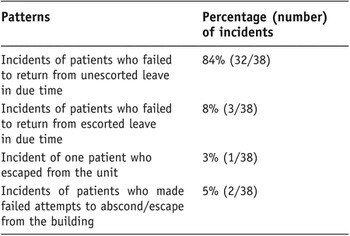
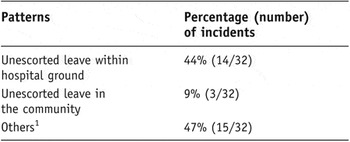
To ascertain patterns of absconding, incidents were classified as: incidents of patients who failed to return from unescorted leave in due time; incidents of patients who failed to return from escorted leave in due time; incidents of patient who escaped from the unit and incidents of patients who made failed attempts to abscond/escape. Incidents of patients who failed to return from unescorted leave in due time were again divided into: unescorted leave within hospital ground; unescorted leave in the community and others.
Statistical analysis
Percentage frequencies of various patterns of absconding were calculated. Demographic and clinical characteristics between the cases and controls were compared in numbers and percentages. Two tailed Fisher’s exact tests were conducted to test for statistical significance of the differences observed between the two groups. Odds ratios (OR) and 95% confidence intervals (CI) for the observed differences were calculated.
Ethical approval
The proposal of this study was submitted to the Bexley Local Research Ethics Committee. As the data collection was anonymous and collected as a part of service evaluation, the ethics committee did not deem it necessary to give permission.
RESULTS
The total sample size for the 6½ year study period was 78 patients. 22% (17/78) of patients absconded as an inpatient and 78% (61/78) did not abscond. A total of 38 absconding incidents were reported from the 17 patients (10 males and 7 females). Of the 38 incidents, 23 involved male patients and 15 involved female patients. 71% of the patients who absconded (12/17) were involved in at least two absconding incidents. The different patterns of absconding and their frequencies are presented in Tables 1 and 2. It is noteworthy that there was only one escape from the building.
Patterns of absconding incidents

Patterns of unescorted leave from which patients failed to return in due time

Notes:
1 Incidents mentioned as abscond from unescorted leave but not descriptive
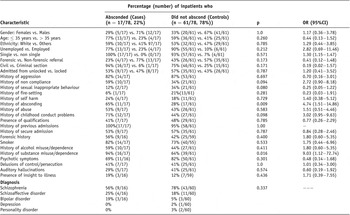
Comparison of the clinical characteristics between cases and controls resulted in a number of results which were statistically significant. Fisher’s exact test identified two clinical characteristics as statistically significant: history of absconding (p = 0.009, OR = 4.74, CI 1.51–14.86) and history of substance misuse and dependence (p = 0.016, OR = 9.03, CI 1.12–72.74). The other clinical characteristics which tended towards statistical significance were history of non-compliance (p = 0.094, OR = 2.72, CI 0.90–8.18), history of sexually inappropriate behaviour (p = 0.080, OR =0.25, CI 0.05–1.22) and history of childhood conduct problems (p = 0.098, OR = 3.02, CI 0.95–9.63). While some differences were observed in other clinical characteristics these observations were not statistically significant. The full results are presented in Table 3.
Clinical characteristics of inpatients who absconded (cases) and inpatients who did not abscond (controls)

DISCUSSION
This study was exclusively carried out in a low secure inpatient population. It is important to mention that there are no studies to our knowledge dedicated to this patient population with regards to absconding. Therefore, it is difficult to compare with other studies. In this study, it was observed that 22% absconded from the unit; of these 71% of patients were involved in at least two absconding incidents (total incidents 38). The finding that most incidents are committed by a minority of the patients is a similar finding to that from other studies of adverse incidents and a previous study from the same unit (Beer et al., Reference Beer, Khan and Ratnajothy2006). In the current study there was no specific gender preponderance; an equal number of males and females were involved in the incidents, which differs from other studies (Carr et al., Reference Carr, Lewin, Sly, Conrad, Tirupati, Cohen, Ward and Coombs2008; Meehan et al., Reference Meehan, Morrison and McDougall1999; Bowers et al., Reference Bowers, Allan, Simpson, Nijman and Warren2007; Tomison, Reference Tomison1989) where male predominance was found to be statistically significant. Dickens & Campbell (2001), however, found no differences in gender. The most frequent pattern of absconding incidents was patients who failed to return from unescorted leave in due time (84%). Out of those 84% incidents (32/38), 44% incidents (14/32) were patients absconding from the hospital grounds. 8% of total incidents were also described as absconding when patients were escorted by nursing staff. One incident (3%) was recorded as a patient who escaped from the unit and 5% incidents were recorded as patients who made failed attempts to escape from the building.
This study found that a previous history of absconding is an important clinical predictor for absconding in this patient population. The other significant factor in those who absconded was a history of substance misuse and dependence. Carr et al. (2008), Cheng et al. (2002) and Ogunlesi & Adamson (1992) also showed a similar type of finding.
Absconding being linked to non-compliant patient behaviour was an observation made by Bowers et al. (2000) in 12 acute psychiatric admission wards in three English National Health Service Trusts. A similar finding was observed in this patient population. 59% of patients had a history of non-compliance, which was tending towards statistical significance. The other two factors which showed a trend towards statistical significance were a history of sexually inappropriate behaviour and a history of childhood conduct problems.
Although clinical factors such as younger age, single status, admission under the Mental Health Act and having a diagnosis of schizophrenia are known to be associated with inpatient absconding (Carr et al., Reference Carr, Lewin, Sly, Conrad, Tirupati, Cohen, Ward and Coombs2008; Dickens & Campbell, Reference Dickens and Campbell2001; Meehan et al., Reference Meehan, Morrison and McDougall1999), the differences observed in this study were not statistically significant. This lack of statistically significant results could be due to a limited sample size with inadequate power to detect differences. We also did not include length of admission, which was found to be associated with absconding in previous studies (Tomison, Reference Tomison1989; Ogunlesi & Adamson, Reference Ogunlesi and Adamson1992; Carr et al., Reference Carr, Lewin, Sly, Conrad, Tirupati, Cohen, Ward and Coombs2008) as it would not have been appropriate, as some of the patients identified in the study period were ongoing patients.
Limitations
It is possible that there was under-reporting of absconding incidents. Also, some of the descriptions of the patterns of absconding were not available from the database due to the retrospective nature of this study. We consider the sample size to be reasonable though a larger sample size would have obviously been preferable to further increase the power of the study. It is possible that some of the clinical characteristics identified as showing a trend towards statistically significant results may be a reflection of inadequate sample size. Considering dynamic clinical factors such as regular staffing levels and levels of nursing observations would also be useful.
CONCLUSION
In a low secure inpatient setting most of the patients who absconded did so when they were on unescorted leave. Most of the patients were involved with repeated incidents of absconding. History of absconding and history of substance misuse and dependence were likely to be associated with absconding in this patient population. Moreover history of non-compliance, history of sexually inappropriate behaviour and history of childhood conduct problem are also associated with absconding incidents. A prospective study with a larger sample size addressing the methodological limitations mentioned is likely to provide a better understanding of the clinical predictors of absconding in this patient population.