1. Introduction
Radio interferometry is a cornerstone of modern astrophysics, enabling studies of phenomena from supernova remnants to active galactic nuclei. Signals from multiple antennas are correlated, and by the van Cittert-Zernike theorem these correlations approximate Fourier components of the sky brightness (Thompson et al. Reference Thompson, Moran and Swenson2017). In practice, instrumental effects (e.g., beam shapes, bandpasses, leakage, noise, digitization) and astrophysical corruptions (e.g., RFI, opacity, transients) complicate the measurement. Sparse Fourier sampling further turns image reconstruction into a deconvolution problem with strong sidelobe contamination.
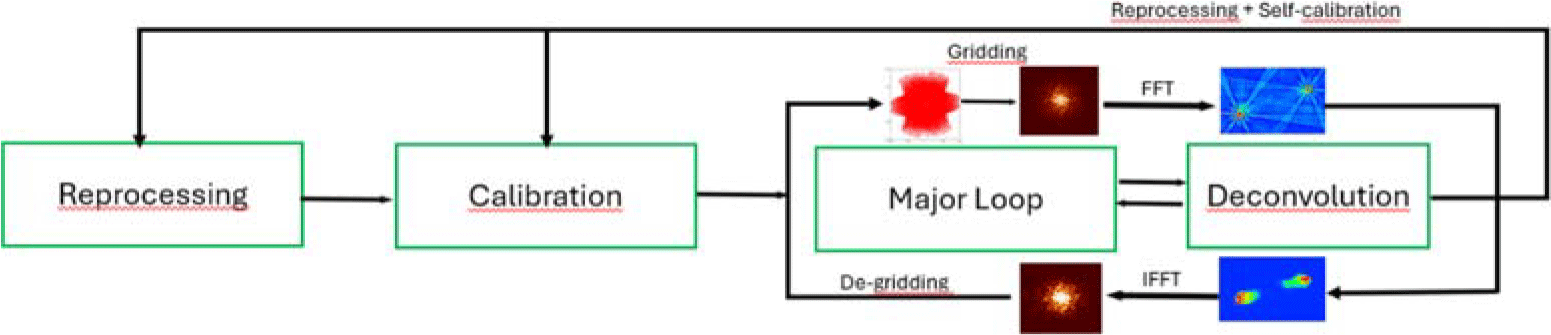
Conventional processing couples calibration and imaging in iterative loops (Fig. 1). CLEAN and its multiscale and multifrequency variants (Högbom Reference Högbom1974; Bhatnagar & Cornwell Reference Bhatnagar and Cornwell2004; Cornwell Reference Cornwell2008; Rau & Cornwell Reference Rau and Cornwell2011; Offringa et al. Reference Offringa, McKinley and Hurley-Walker2014; Offringa & Smirnov Reference Offringa and Smirnov2017; Müller & Lobanov Reference Müller and Lobanov2023b; Müller & Bhatnagar Reference Müller and Bhatnagar2025) remain the standard for minor-loop deconvolution, while major loops compare models to visibilities through gridding/degridding. High-fidelity imaging requires repeated refinements, making calibration, imaging, and quality control inseparable. For the scope of this summary however, we limit the focus of the discussion mainly to the deconvolution stage. We refer the interested reader to Bhatnagar et al. (Reference Bhatnagar, Rau, Hsieh, Kern and Xue2025) for the description of the full algorithm architecture for radio interferometry data processing, and detailed considerations regarding its high performance computing implementation.
Traditional data processing workflow.

Beyond CLEAN, alternatives such as compressive sensing, Regularized Maximum Likelihood, Bayesian inference, and machine learning are rapidly advancing, and their systematic use in large-scale experiments marks a key frontier.
Next-generation facilities, including the ngVLA, SKA, and ALMA’s Wideband Sensitivity Upgrade (WSU), will produce unprecedented data volumes with higher dynamic range, broader bandwidths, and finer resolution. These advances place heavy demands on imaging pipelines for speed, accuracy, and automation. For the WSU, computing requirements reach
 $\sim 100$
Tflop/s, while the ngVLA will require
 $\sim 50$
Petaflop/s, with gridding as the dominant cost (Bhatnagar et al. Reference Bhatnagar, Hiriart and Pokorny2021; Kepley et al. Reference Kepley2024). Even modest algorithmic improvements at this stage can yield significant savings. In the post-Moore era, scalability depends on massive parallelization, especially via GPUs. Quantum computing is not expected to solve the data size problem in radio interferometry in the near future (Brunet et al. Reference Brunet, Tolley and Corda2024).
Future-ready pipelines require scalable algorithms that accelerate major loops through optimized GPU implementations and/or reduce their number through faster convergence. While higher sensitivity may necessitate advanced methods for super-resolution and extreme dynamic range, the majority of science cases should remain well served by CLEAN. The challenge is therefore to balance novel, high-fidelity methods with robust, efficient algorithms that scale to upcoming arrays, addressing both immediate upgrades and longer-term developments.
2. Beyond Traditional CLEAN
The CLEAN algorithm (Högbom Reference Högbom1974) remains the workhorse of interferometric deconvolution. Its peak-finding and beam-subtraction procedure is fast, robust, and tightly integrated with calibration workflows. With heuristics such as automasking (Kepley et al. Reference Kepley, Tsutsumi and Brogan2020) and adaptive stopping (Homan et al. Reference Homan, Roth and Pushkarev2024), CLEAN is pragmatic, extensible, and, especially in multiscale variants, still competitive to newer approaches including compressive sensing, Bayesian inference, and AI (Offringa & Smirnov Reference Offringa and Smirnov2017; Bester et al. Reference Bester, Perkins, Kenyon and Smirnov2024).
Nonetheless, increasing sensitivity and data complexity expose its limits. CLEAN’s assumption that the sky is a collection of point sources fails for extended or diffuse emission, while the method’s reliance on user input (masks, gains, stopping rules) restricts automation. It also enforces a rigid separation between model and image and offers no uncertainty quantification. Alternatives based on sparse modeling, Bayesian inference, and machine learning provide more flexible priors, potentially higher fidelity reconstructions, and principled error estimates.
Imaging algorithms are often divided into inverse modeling and forward modeling approaches (Event Horizon Telescope Collaboration 2019). Inverse modeling refines CLEAN through improved basis functions and heuristics. MS-CLEAN and multifrequency variants (Cornwell Reference Cornwell2008; Rau & Cornwell Reference Rau and Cornwell2011; Offringa et al. Reference Offringa, McKinley and Hurley-Walker2014; Offringa & Smirnov Reference Offringa and Smirnov2017) use Gaussian components of varying scale sizes, Asp-CLEAN (Bhatnagar & Cornwell Reference Bhatnagar and Cornwell2004; Hsieh & Bhatnagar Reference Hsieh and Bhatnagar2021; Hsieh et al. Reference Hsieh, Bhatnagar, Hiriart and Pokorny2022a; Hsieh et al. Reference Hsieh and Rau2022b) optimizes scale sizes adaptively, and wavelet-based methods such as DoB-CLEAN (Müller & Lobanov Reference Müller and Lobanov2023b) introduce elliptical difference-of-Gaussian bases. These approaches significantly improve fidelity while still remaining competitive with more advanced forward modeling paradigms (Offringa & Smirnov Reference Offringa and Smirnov2017; Hsieh & Bhatnagar Reference Hsieh and Bhatnagar2021; Hsieh et al. Reference Hsieh and Rau2022b; Bester et al. Reference Bester, Perkins, Kenyon and Smirnov2024).
Forward modeling, in contrast, formulates imaging as a direct optimization problem. Maximum entropy methods evolved into Regularized Maximum Likelihood, balancing data fidelity and multiple regularization terms (Cornwell & Evans Reference Cornwell and Evans1985; Briggs Reference Briggs1995), and have been extensively developed in the Event Horizon Telescope context (Chael et al. Reference Chael, Johnson and Narayan2016; Akiyama et al. Reference Akiyama, Kuramochi and Ikeda2017; Chael et al. Reference Chael, Johnson and Bouman2018). More recent directions include multiobjective evolution to explore multimodality in degenerate solutions (Müller et al. Reference Müller, Mus and Lobanov2023; Mus et al. Reference Mus, Müller, Martí-Vidal and Lobanov2024b; Mus et al. Reference Mus, Müller and Lobanov2024a), compressive sensing with sparsity-promoting priors (Starck et al. Reference Starck, Candes and Donoho2002; Starck et al. Reference Starck, Elad and Donoho2005; Wiaux et al. Reference Wiaux, Jacques, Puy, Scaife and Vandergheynst2009; Carrillo et al. Reference Carrillo, McEwen and Wiaux2012; Carrillo et al. Reference Carrillo, McEwen and Wiaux2014; Dabbech et al. Reference Dabbech, Onose and Abdulaziz2018; Müller & Lobanov Reference Müller and Lobanov2022), and Bayesian inference frameworks such as resolve (Junklewitz et al. Reference Junklewitz, Bell, Selig and Enßlin2016; Knollmüller & Enß lin 2019; Frank et al. Reference Frank, Leike and Enßlin2021; Arras et al. Reference Arras, Bester and Perley2021a; Roth et al. Reference Roth, Frank and Bester2024) or sampling-based methods in the EHT (Broderick et al. Reference Broderick, Pesce, Tiede, Pu and Gold2020; Tiede Reference Tiede2022). AI-based techniques are also emerging rapidly (Sun et al. Reference Sun, Bouman and Tiede2022; Connor et al. Reference Connor, Bouman, Ravi and Hallinan2022; Terris et al. Reference Terris, Dabbech, Tang and Wiaux2023; Aghabiglou et al. Reference Aghabiglou, Chu, Dabbech and Wiaux2024; Dabbech et al. Reference Dabbech, Aghabiglou, Chu and Wiaux2024).
Forward-modeling methods often achieve superior fidelity for complex structures, potentially offer an uncertainty quantification and can directly address nonlinear corruptions, e.g. closure-only imaging and polarization (Chael et al. Reference Chael, Johnson and Bouman2018; Müller et al. Reference Müller, Mus and Lobanov2023; Müller Reference Müller2024), joint calibration and imaging (Arras et al. Reference Arras, Frank, Leike, Westermann and Enßlin2019; Kim et al. Reference Kim, Nikonov and Roth2024), direction-dependent effects (Dabbech et al. Reference Dabbech, Repetti, Perley, Smirnov and Wiaux2021; Arras et al. Reference Arras, Reinecke, Westermann and Enßlin2021b; Roth et al. Reference Roth, Arras and Reinecke2023), or time-dynamic sources (Bouman et al. Reference Bouman, Johnson and Dalca2017; Arras et al. Reference Arras, Frank and Haim2022; Müller & Lobanov Reference Müller and Lobanov2023a; Mus & Martí-Vidal Reference Mus and Martí-Vidal2024; Mus et al. Reference Mus, Müller and Lobanov2024a). Their main drawback typically is computational cost, which remains a barrier to routine use.
Despite these advances, CLEAN persists as the de facto standard, valued for its speed, competitiveness of its modern multiscalar variants, and simply sufficiency for many science cases. Novel paradigms have shown improved performance in targeted tests, but large-scale validation across observatory pipelines is lacking, and deployment will require substantial additional development and commissioning.
Hybrid approaches offer strong near-term potential for pipelines supporting upcoming facilities such as SKA and ALMA’s WSU. They preserve the speed, robustness, and validation of CLEAN while replacing its suboptimal regularization, providing an evolutionary improvement without requiring new infrastructure. Notable examples include Autocorr-CLEAN (Müller & Bhatnagar Reference Müller and Bhatnagar2025), CG-CLEAN (Müller et al. Reference Müller, Hsieh and Bhatnagar2025), and PolyCLEAN (Jarret et al. Reference Jarret, Kashani and Rué-Queralt2025). Even modern AI and Bayesian methods, such as R2D2 (Aghabiglou et al. Reference Aghabiglou, Chu, Dabbech and Wiaux2024) and fast-resolve (Roth et al. Reference Roth, Frank and Bester2024), adopt major/minor loop structures for efficiency.
PolyCLEAN integrates CLEAN with an explicit LASSO formulation, while CG-CLEAN interprets the major loop as a gradient step and the minor loop as a Hessian inversion, casting the process into a conjugate gradient scheme. This accelerates convergence and drives residuals toward a noise-like distribution more efficiently than traditional CLEAN (Müller et al. Reference Müller, Hsieh and Bhatnagar2025). We show the residuals as a function of number of major loops exemplary in Fig. 2.
Residual as a function of major loop iteration for CLEAN and two variants that couple CLEAN with optimization techniques (CG-CLEAN and Momentum-CLEAN) for Cygnus A. Image adapted from Müller et al. (Reference Müller, Hsieh and Bhatnagar2025).

Other hybrids focus on enhancing multiscale representations. Asp-CLEAN (Bhatnagar & Cornwell Reference Bhatnagar and Cornwell2004) and DoB-CLEAN (Müller & Lobanov Reference Müller and Lobanov2023b) improve accuracy by introducing flexibility in scale size or ellipticity, extending the gains of MS-CLEAN (Cornwell Reference Cornwell2008). Autocorr-CLEAN instead clusters components via residual autocorrelation, reducing iteration counts and improving convergence by up to an order of magnitude while remaining CASA-compatible. We show the residual of Autocorr-CLEAN and Asp-CLEAN as a function of number of minor loop iterations in Fig. 3, demonstrating the significant improvements of latter two over traditional CLEAN. Further medium-term developments may include subgridding techniques, which selectively only grid visibilities based on component scale to achieve additional computational savings.
Residual as a function of minor loop iteration and time for CLEAN (upper row), Autocorr-CLEAN (middle row) and Asp-CLEAN (bottom row) for Cygnus A. Image adapted from Müller & Bhatnagar (Reference Müller and Bhatnagar2025).

3. Conclusions and Future AI Outlook
The question of whether to CLEAN or not to CLEAN is ultimately one of practicality. CLEAN is not obsolete, but its limitations become clearer as we push toward higher sensitivity, resolution, and data volume. Incremental improvements and hybrid extensions, coupled with modern computational techniques, provide a bridge until more advanced paradigms are ready for large-scale deployment.
In the near term, hybrid frameworks, such as Autocorr-CLEAN or convex optimization-based variants, offer faster convergence and higher dynamic range while retaining CLEAN’s reliability and simplicity. Looking further ahead, Bayesian and AI-driven methods are poised to redefine interferometric imaging, offering flexible priors, principled uncertainty quantification, and improved fidelity.
AI is expected to play a key role throughout this transition. Beyond plug-and-play reconstructions that exploit learned low-dimensional priors, AI can already enhance traditional workflows, for example, by learning policies to trigger calibration and imaging tasks (Kirk et al. Reference Kirk, Rau and Ramyaa2025) or by transforming Hogbom CLEAN components into multiscale representations (Fiedler et al. Reference Fiedler, Müller and Dong2025). We demonstrate this approach in Fig. 4, where a network trained on single-scale and MS-CLEAN representations transforms single-scale images into multiscale ones. This overcomes the main limitation of the former and achieves the accuracy of the latter with minimal computational overhead and bias from the training set (Fiedler et al. Reference Fiedler, Müller and Dong2025).
Reconstruction with traditional CLEAN and with a network transforming CLEAN components into a multiscale representation. Images are adapted from Fiedler et al. (Reference Fiedler, Müller and Dong2025).

The future of radio interferometry will be shaped by our ability to balance accuracy, scalability, and practicality, ensuring imaging methods evolve in step with the demands of next-generation telescopes.