Introduction
Grapevine (Vitis vinifera L.) is a crop of major economic importance that retains fundamental symbolisms for many cultures worldwide. The cultivated grapevine (V. vinifera L. subsp. vinifera) is believed to have been derived from its wild closely related form V. vinifera L. subsp. sylvestris (Zohary et al., Reference Zohary, Hopf and Weiss2012). Archaeological records suggest that the primo-domestication of the grapevine started in the Near East by the late Neolithic period (Zohary, Reference Zohary, McGovern, Fleming and Katz1996; This et al., Reference This, Lacombe and Thomas2006) or in the neighbouring Transcaucasia approximately 8000–6000 BC (Levadoux, Reference Levadoux1956, cited by Olmo, Reference Olmo, McGovern, Fleming and Katz1996). However, uncertainty remains about the place and the period of original domestication (This et al., Reference This, Lacombe and Thomas2006) with different studies to support the presence of secondary centres, where spontaneous hybridization among cultivated forms and local wild plants, or direct selection, generated distinct cultivated patterns (Grassi et al., Reference Grassi, Labra, Imazio, Spada, Sgorbati, Scienza and Sala2003; Arroyo-Garcia et al., Reference Arroyo-Garcia, Ruiz-Garcia, Bolling, Ocete, Lopez, Arnold, Ergul, Soylemezoglu, Uzun, Cabello, Ibanez, Aradhya, Atanassov, Atanassov, Balint, Cenis, Costantini, Goris-Lavets, Stella Grando, Klein, McGovern, Merdinoglu, Pejic, Pelsy, Primikirios, Risovannaya, Roubelakis-Angelakis, Snoussi, Sotiri, Tamhankar, This, Troshin, Malpica, Lefort and Martinez-Zapater2006; De Michele et al., Reference De Michele, La Bella, Gristina, Fontana, Pacifico, Garfi, Motisi, Crucitti, Abbate and Carimi2019).
The Greek vineyard is one of the oldest vineyards in the world. During the late Neolithic period, there is detailed evidence for grape cultivation in different sites in Greece, such as in Thessaly and East Macedonia (Renfrew, Reference Renfrew, McGovern, Fleming and Katz1996). Findings dated back to the end of the third millennium at Myrtos in Crete and at the settlement of P.O.T.A. Romanou in South Peloponnese, confirm the deliberate extraction of juice from cultivated grapes, most probable some form of wine (Renfrew, Reference Renfrew, McGovern, Fleming and Katz1996; Valamoti et al., Reference Valamoti, Pagnoux, Ntinou, Bouby, Bonhomme and Terral2020). During the archaic period in Greece (ca 700–500 BC) cultivation of grapevine was already under way (Pagnoux et al., Reference Pagnoux, Bouby, Ivorra, Petit, Valamoti, Pastor, Picq and Terral2015). At the same time, Greek cities imported wine from other regions and exported their grapevine products to the Near East, Egypt and Italy with many of them especially in the eastern Aegean islands to be famous for their wines (Foxhall, Reference Foxhall, Fisher and Van Wees1998).
Greek ampelographic collections account for 663 single cultivars (Kotinis, Reference Kotinis1985), also including material of foreign origin tightly interwoven with the Greek viticulture along the centuries, as well as elite foreign germplasm. Recent data (OPEKEPE, 2019) confirm that 220 cultivars and landraces are currently cultivated in Greece. However, over the last decades, cultivated grapevine germplasm has undergone a drastic reduction in diversity, with the traditional landraces and old local varieties being gradually abandoned, due to the established market preferences of wine industry for international varieties (This et al., Reference This, Lacombe and Thomas2006; Emanuelli et al., Reference Emanuelli, Lorenzi, Grzeskowiak, Catalano, Stefanini, Troggio, Myles, Martinez-Zapater, Zyprian, Moreira and Stella Grando2013; Merkouropoulos et al., Reference Merkouropoulos, Michailidou, Alifragkis, Zioziou, Koundouras, Argiriou and Nikolaou2015). According to the official statistics of the state, there are no more than 28 wine grapevine cultivars in Greece that are grown in an area of more than 500 ha across the country (Hellenic Statistical Authority, 2015). Nonetheless, many of these neglected grapevine cultivars constitute a valuable genetic reservoir that could function, either as parental material or through direct cultivation per se for generating distinct and novel characteristics for the international markets (Merkouropoulos et al., Reference Merkouropoulos, Michailidou, Alifragkis, Zioziou, Koundouras, Argiriou and Nikolaou2015). Therefore, conservation, characterization and evaluation of local germplasm are an essential step for its introduction to cultivation and breeding. It is also a prerequisite for the design of the optimum national strategy aiming at the reconstitution of viticulture sector and the sustainable development of the wine industry.
Management of grapevine resources, however, becomes a complicated task, due to the use of synonyms and homonyms, the presence of many variants (phenotypes) within cultivars and the poor documentation of passport data. Since the pioneering works (Krimbas, Reference Krimbas1943; Negrul, Reference Negrul, Baranoc, Kai, Lazarevski, Palibin and Prosmoserdov1946; Logothetis, Reference Logothetis1947; Galet, Reference Galet1979) on the description of grapevine cultivars are based on the plant's vegetative and reproductive traits, traditionally ampelography has contributed greatly to the establishment of the identity and the relationships among grapevine cultivars. More recently, efforts have been focused on the identification of the key ampelographic and ampelometric characteristics with the greatest discriminative power among V. vinifera cultivars (Tomažic and Korošec-Koruza, Reference Tomažič and Korošec-Koruza2003; Preiner et al., Reference Preiner, Safner, Karoglan Kontić, Marković, Šimon and Maletić2014; Alba et al., Reference Alba, Bergamini, Genghi, Gasparro, Perniola and Antonacci2015). Nevertheless, the inherent plasticity of the expression of the ampelographic traits, partially attributed to the developmental history of the vines and the genotype × environment component, as well as the subjectivity involved in recording many of the ampelographic traits, stimulates the use of additional methods and tools to accurately capture the relationships between cultivars.
During the last decades, microsatellite markers have become a powerful tool for numerous characterization, identification and genetic diversity studies on grapevine (Lefort and Roubelakis-Angelakis, Reference Lefort and Roubelakis-Angelakis2001; Aradhya et al., Reference Aradhya, Dangl, Prins, Boursiquot, Walker, Meredith and Simon2003; Hvarleva et al., Reference Hvarleva, Hadjinicoli, Atanassov, Atanassov and Ioannou2005; Laucou et al., Reference Laucou, Lacombe, Dechesne, Siret, Bruno, Dessup, Dessup, Ortigosa, Parra, Roux, Santoni, Varès, Péros, Boursiquot and This2011; Basheer-Salimia et al., Reference Basheer-Salimia, Lorenzi, Batarseh, Moreno-Sanz, Emanuelli and Stella Grando2014; Štajner et al., Reference Štajner, Tomić, Ivanišević, Korać, Cvetković-Jovanović, Beleski, Angelova, Maraš and Javornik2014; Stavrakaki et al., Reference Stavrakaki, Bouza and Biniari2019), for revealing parentage relationships (Sefc et al., Reference Sefc, Pejic, Maletic, Thomas, Lefort and Roubelakis-Angelakis2009; Lacombe et al., Reference Lacombe, Boursiquot, Laucou, Di Vecchi-Staraz, Péros and This2013), for elucidating genetic relationships among wild and between wild and cultivated accessions (Grassi et al., Reference Grassi, Labra, Imazio, Spada, Sgorbati, Scienza and Sala2003; Ergül et al., Reference Ergül, Perez-Rivera, Söylemezoğlu, Kazan and Arroyo-Garcia2011; Ghaffari et al., Reference Ghaffari, Hasnaoui, Zinelabidine, Ferchichi, Martinez-Zapater and Ibáñez2014; De Michele et al., Reference De Michele, La Bella, Gristina, Fontana, Pacifico, Garfi, Motisi, Crucitti, Abbate and Carimi2019), and for unravelling the patterns and genetic structure of grapevine germplasm (Sefc et al., Reference Sefc, Lopes, Lefort, Botta, Roubelakis-Angelakis, Ibáñez, Pejić, Wagner, Glössl and Steinkellner2000; Bacilieri et al., Reference Bacilieri, Lacombe, Le Cunff, Di Vecchi-Staraz, Laucou, Genna, Péros, This and Boursiquot2013; Emanuelli et al., Reference Emanuelli, Lorenzi, Grzeskowiak, Catalano, Stefanini, Troggio, Myles, Martinez-Zapater, Zyprian, Moreira and Stella Grando2013; Villano et al., Reference Villano, Carputo, Frusciante, Santoro and Aversano2014; Bibi et al., Reference Bibi, Gonias and Doulis2020). The International Organization of Vine and Wine (OIV) has included in its official descriptors a set of six microsatellites (OIV, 2009) that was increased to nine microsatellites according to the Resolution OIV-VITI 609-2019 (OIV, 2019), in order to discriminate, characterize and identify grapevine cultivars. Notwithstanding, there are cultivars that differ in ampelographic characteristics, such as berry colour, leaf shape and leaf hair density, that cannot be distinguished by microsatellite markers (Gago et al., Reference Gago, Santiago, Boso, Alonso-Villaverde, Stella Grando and Martínez2009). Recently, Migliaro et al. (Reference Migliaro, De Nardi, Vezzulli and Crespan2017) developed a molecular assay of 11 microsatellites able to identify variants with skin colour discrimination. Uncertainties though remain related to other traits. Therefore, many researchers employ combined approaches involving ampelographic description and microsatellite markers, jointly sometimes with oenological traits (Ortiz et al., Reference Ortiz, Martín, Borrego, Chávez, Rodríguez, Muñoz and Cabello2004; Alba et al., Reference Alba, Bergamini, Genghi, Gasparro, Perniola and Antonacci2015; Merkouropoulos et al., Reference Merkouropoulos, Michailidou, Alifragkis, Zioziou, Koundouras, Argiriou and Nikolaou2015).
Simultaneously, high-density HD genotyping has started to find its way into mainstream fingerprinting for typing and for phylogenetic analyses (Fedosov et al., Reference Fedosov, Korzhenkov, Petrova, Sapsay, Sharko, Toshchakov, Kolosova, Bakhmutova and Patrushev2021). HD genotyping relies on high throughput genome sequencing technologies or specialized platforms (Nebish et al., Reference Nebish, Tello, Ferradás, Aroutiounian, Martínez-Zapater and Ibáñez2021). It involves assessing the state of next generation markers such as single/simple nucleotide polymorphisms (SNP), nucleotide insertion or deletion (indels) or copy number variation (CNV). HD genotyping is particularly useful for applications such as genomic selection, genomic linkage mapping, linkage disequilibrium and association studies, discovery of markers linked to traits, discovery of candidate genes (Zhang et al., Reference Zhang, Cui and Fang2022), discovery of functional markers (Costantini et al., Reference Costantini, Moreno-Sanz, Nwafor, Lorenzi, Marrano, Cristofolini, Gottardini, Raimondi, Ruffa, Gribaudo, Schneider and Grado2021) or fine mapping of chromosomes aiming to uncover aspects of chromosome biology and evolution (Tsiolas et al., Reference Tsiolas, Michailidou, Tsoureki and Argiriou2022). Nevertheless, SSR is a well-established and widespread methodology exhibiting cost efficiency when diversity, typing and population genetic analyses are of primary importance.
In the current work a combined approach using both, ampelographic traits and microsatellite markers has been undertaken, to study the genetic diversity within and among 96 grapevine genotypes belonging to 36 V. vinifera subsp. vinifera cultivars, predominantly representing autochthonous Greek landraces. The aim of the study was to determine the genotypic profiles and unravel the population structure of these cultivars, to characterize them using an ample number of ampelographic traits suggested by OIV, selecting concurrently the most informative ones for distinguishing the cultivars, and to assess the level of diversity and define relationships among cultivars in ampelographic and genetic level. The results are enriched with substantial information and other research related to the Greek vineyard and contributes towards a rational conservation and utilization in breeding and direct cultivation of the Greek indigenous grapevine germplasm.
Materials and methods
Plant material and DNA isolation
Grapevine materials originated from the Grapevine collection of the Institute of Plant Breeding and Genetic Resources (former Agricultural Research Centre of Northern Greece; Thermi, Macedonia, Greece; geographic longitude 23° 00′ 25″ E, geographic latitude 40° 32′ 11″ N) of the Hellenic Agricultural Organization – DIMITRA (former National Agricultural Research Foundation – NAGREF). A total of 36 grapevine cultivars were selected, most of them representing indigenous Greek landraces with long history and participation to the constitution of the traditional Greek vineyard (Mattheou et al., Reference Mattheou, Zioziou, Pitsoli and Tsivelikas2006). These landraces compose a ‘blend’ of well-recognized and commercialized landraces that produce some of the finest Greek wines (e.g. Xinomavro, Agiorgitiko, Ntempina) or premium quality table grapes (e.g. Soultanina), while some others are among the rarest cultivars of Greek vineyard that currently are threatened by extinction (e.g. Votsiki, Glykopati) (Table S1). Vines of all cultivars were grafted onto rootstock 1103P; shaped as bilateral Royat at 2.20 × 1.30 m interval.
Two to three grape plants per cultivar were used for the microsatellite analysis. Expanding leaves were collected from each individual genotype and stored in silica gel till further use. Genomic DNA was isolated separately from each individual genotype (total sample size = 96), considered representatives of each cultivar, using the Plant Mini Kit (QIAGEN) according to the manufacturer's instructions. For the initial grinding the automated mill TissueLyser (Qiagen Cat. No. 85220 Retch, Haan, Germany) was employed in combination with liquid nitrogen. Once eluted, DNA was stored at −80°C until further use. DNA was quantified employing the Hoechst 33258 fluorescence dye (Sigma, No B2883) on a computerized TD 700 fluorometer (Turner Designs, Sunnyvale, CA, USA) against calf thymus DNA standards (Sigma, No D4764).
Ampelographic traits
Ampelographic data were recorded on 10 vines per cultivar for two consecutive years (2010–2011). Observations were realized for 76 OIV descriptors, mostly on site, at the Grapevine collection of the Institute of Plant Breeding and Genetic Resources (Table S2). Average across cultivar and years was calculated and recorded for each trait. To measure berry traits, bunches were transferred to laboratory, and traits recorded for 30 typical berries of each cultivar taken from the middle part of the bunch. Berry skin colour was measured using a Minolta CR-300 colourimeter (Minolta Co. Ltd., Osaka, Japan). Average values of L*, a* and b* were calculated from each independent measurement for cultivar berries, representing respectively the lightness of the colour, green or magenta; and blue or yellow. Then average values were returned to an ordinal scale as used in the OIV descriptors. A soft fruit compression tester (penetrometer) equipped with a cylindrical head probe of 2.5 mm diameter was used to measure the flesh firmness. Similar to the colour, average values for flesh firmness for each cultivar were transformed to an ordinal scale according to the OIV descriptors.
Microsatellite markers
A set of 13 microsatellite markers (VVS2, VRAG79, VV7, VV27, VVUCH29, VVUCH11, VRZAG62, VVMD5, VRZAG83, VRAG64, VVMD25, VVMD28, VVMD32) were used in this study. The markers were chosen based on their informative content [markers with the highest value of polymorphic information content (PIC) and heterozygosity (He)] and type of repeat (di-, tri- or more repeat units). Polymerase chain reaction (PCR) amplifications were performed in a reaction volume of 20 μl containing 30 ng of template DNA, 10× PCR buffer, 200 μM of each dNTP, 10 pmol of each primer (forward primer labelled with FAM, NED, PET and VIC fluorescent dyes) and 1 U of KAPA Taq DNA Polymerase (KAPA Biosystems, Woburn, MA, USA). PCR amplifications were performed according to Cipriani et al. (Reference Cipriani, Marrazzo, Di Gaspero, Pfeiffer, Morgante and Testolin2008). The resulting PCR products were first visualized by 2% agarose gel electrophoresis and then loaded into an ABI PRISM 3730xl DNA sequencer (Applied Biosystems, Foster City, CA, USA). The program GENEMAPPER (Applied Biosystems) was used for scoring and binning SSR alleles as well as for the construction of the data matrix which was subsequently employed for genetic and cluster analyses.
Data scoring and statistical analysis
Data from 36 grapevine cultivars, involving 76 OIV descriptors, were analysed as ordinal data using the JMP software (version 14.0.0). Principal component analysis (PCA) was initially applied. Due to the nature of data (i.e. ordinal), correlations were calculated based on the maximum likelihood method rather than Pearson's correlation, since the latter applies for continuous data. To define the genetic distances among grapevine cultivars a hierarchical clustering was performed using the 76 ampelographic traits. A dendrogram was generated based on the Euclidean dissimilarity metric and Ward's clustering algorithm. Optimal number of clusters in the dendrogram was determined using the upper tail criterion at confidence level α = 0.05 (Milligan and Cooper, Reference Milligan and Cooper1985).
Number of alleles (Na) and expected heterozygosity (He) were determined using POPGEN (v.1.32). Nei's genetic diversity and PIC were calculated using PowerMarker (v. 3.25). The probability of identity (PI) was calculated employing IDENTITY (v. 1.0). ${\rm PI} = 1-\sum p_i^4 + \sum \sum ( {2p_ip_j} )$ , where pi and pj are the frequency of the i th and j th alleles, respectively. PI measures the probability that two randomly drawn diploid genotypes will be identical assuming observed allele frequencies and random assortment (Paetkau et al., Reference Paetkau, Calvert, Stirling and Strobeck1995). The total PI, defined as the probability of two varieties sharing the same genetic profile by chance, was also calculated as the product of the 13 individual PI values. A similarity dendrogram was constructed using UPGMA clustering algorithm based on the similarities between genotypes estimated by Dice's coefficient (Nei and Li, Reference Nei and Li1979).
Possible population structure was investigated using a model-based Bayesian procedure implemented employing STRUCTURE (v. 2.3.2) software. The analysis was carried out using a burning period of 10,000 iterations and a run length of 200,000 MCMC replications. We tested a continuous series of K, from 2 to 8, in 10 independent runs. We did not introduce prior knowledge about the population of origin and assumed correlated allele frequencies and admixture (Falush et al., Reference Falush, Stephens and Pritchard2003). For selecting the optimal value of K, ΔK values (Evanno et al., Reference Evanno, Regnaut and Goudet2005) were calculated using STRUCTURE HARVESTER.
Results and discussion
Correlation of OIV descriptors
Strong positive, linear correlations were observed among some of the 76 ampelographic traits (Fig. S1). The highest significant, positive correlations were among traits related to the hair density on the shoot, as well as on the young and mature leaf. Hence, density of prostrate hairs on and between the main veins of the young leaf (OIV 055 and 053), density of prostrate hairs on the internodes and on the nodes of shoot (OIV 014 and 013) and density of erect hair between and on the main veins on lower side of mature leaf (OIV 085 and 087) indicated all strong correlations with a coefficient r ⩾ 0.8. Regarding the berry traits, significant, positive correlations were derived between the ease of detachment from pedicel and the intensity of flesh anthocyanin colouration (r = 0.70; OIV 240 and 231) indicating that cultivars with difficult detachment from flesh were characterized also by anthocyanin coloration in their flesh, between the length of pedicel and the goffering of the blade of mature leaf (r = 0.60; OIV 238 and 072) and between the juiciness of the flesh and the density of the bunch (r = 0.57; OIV 232 and 204), the latter indicating that the more juicy the cultivar the more dense the bunch. On the other hand, there were also high, significant, negative correlations between some of the recorded traits (Fig. S1). These included for instance, the ease of detachment from pedicel with the hilum (r = −0.76; OIV 240 and 229) indicating that cultivars with difficult detachment are mainly characterized by little visibility of the hilum, the degree of opening of upper lateral sinuses of mature leaf with the intensity of anthocyanin colouration on prostrate hairs of the tip of the young shoot (r = −0.52; OIV 082 and 003), indicating the higher the overlapping of sinuses the weaker the intensity of anthocyanin colouration, and the density of prostrate hairs on petiole with the size of teeth in relation to blade size of mature leaf (r = −0.52; OIV 090 and 077) implying that cultivars with higher density of prostrate hairs on the petiole tend to be characterized by smaller teeth size (Fig. S1).
Multivariate analysis for ampelographic traits
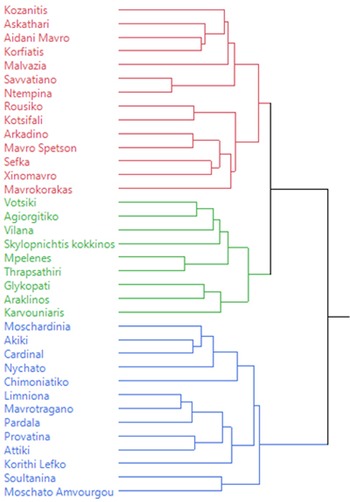
Pairwise Ward's distance ranged from 4.23 (cultivars Savvatiano – Ntempina) to 16.76 (cultivars Kozanitis – Moschardinia). Within this range, the use of upper tail criterion for confidence level α = 0.05 is identified as a threshold distance with the value of 11.24. This in turn allowed the grouping of the 36 cultivars into three main groups (A, B and C) in the UPGMA Hierarchical Clustering (Fig. 1). Group A included a total of 14 cultivars; all of which are mainly exploited for wine production. Half of these cultivars are characterized by green yellow skin colour while the other half by grey up to dark red violet and blue-black skin colour. Some of the most famous Greek indigenous wine-making cultivars were included in this group. These cultivars produce some of the finest Greek wines under the PDO (Protected Designation of Origin) indication and include, among others, ‘Ksynomavro’, ‘Ntempina’, ‘Malvazia’ and ‘Savvatiano’. No pattern according to geographical distribution was evidenced within the group, since it involved cultivars that occurred in different geographical areas in Greece, from Crete and Cyclades at the south to Peloponnese, Ionian islands and Epirus in the west and up to Macedonia and Thrace at the north and north-east parts of the country (Figs 1 and 2; Table S1). In group B a total of nine cultivars were grouped together; all exploited for wine production. Similarly to what was found for cluster A almost half of them (four) were of green yellow skin colour while the rest are characterized by berries exhibiting grey to blue-black skin colour. This cluster consisted mainly of cultivars occurred in south and west Greece, spreading from Crete and Peloponnese up to the Ionian islands and Epirus (Figs 1 and 2; Table S1). Among cultivars of group B ‘Agiorgitiko’ is included and is responsible for producing one of the most famous and finest Greek red PDO wine. Group C consists of the remaining 13 cultivars. All the nine table cultivars of the study were included in this group along with four wine-making cultivars. This cluster was predominantly, consisted by coloured cultivars, since 10 of them were of grey to blue-black skin colour and three of green yellow colour. Regarding their geographical distribution, no specific pattern was revealed since this group included cultivars that originated from Crete at the south, to Thessaly central Greece and Macedonia at the north (Figs 1 and 2; Table S1). Two of the most well-known cultivars of this group were ‘Soultanina’ (syn. ‘Thompson seedless’) and ‘Moschato Amvourgou’, with the latter also being a member of the muscat grape group (Figs 1 and 2; Table S1).
Dissimilarity dendrogram using Euclidean distance and Ward's clustering algorithm, generated for the 36 Greek grapevine cultivars characterized by 76 OIV ampelographic descriptors. Group A (n=14) is shown in red colour while groups B (N=9) and C (N=13) are shown in green and blue colours respectively.

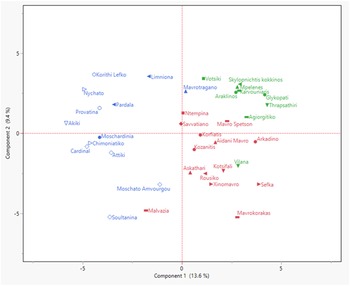
PCA biplot graph for the 36 Greek grapevine cultivars characterized by 76 OIV ampelographic descriptors. Colours correspond to the cultivar groups generated by the hierarchical cluster analysis (Fig. 1). Transparent symbols stand for table cultivars while filled symbols for wine-making cultivars. The following symbols were used to indicate the geographical origin (filled only explained): ● Ionian islands, ▅ Peloponnese, ■ Epirus, ▴ Aegean islands, ▾ Crete, ◄ Central Greece, ► North Greece, and ♦ entire country of Greece.

Studying the morphological diversity on a set of 12 Greek grapevine cultivars by employing a total of 74 OIV ampelographic traits, Stavrakaki et al. (Reference Stavrakaki, Bouza and Biniari2019) concluded that clustering was mainly supported by the classical eco-geographic grouping for grapevine as suggested by Negrul (Reference Negrul1938) and Levadoux (Reference Levadoux1956), with the first (sub)cluster consisting of table or dual purpose cultivars of eastern origin (proles orientalis) and the second (sub)cluster consisting of cultivars indigenous to the Greek vineyard (proles pontica). A similar pattern has been also revealed in our study. Groups A and B included cultivars exclusively employed for wine production, typical to the group proles pontica group. These cultivars are characterized by medium to high density of prostrate and erect hairs on vegetative organs, mainly on the shoot tips and the lower surface of leaves, as well as by juicy small-to-medium round fruits, all characteristics of the group proles pontica (Levadoux, Reference Levadoux1956). This group is believed to be intermediate between the groups proles orientalis and proles occidentalis (Negrul, Reference Negrul1938). Some of the most representative cultivars of these groups such as ‘Savvatiano’, ‘Kotsifali’, ‘Ksynomavro’ and ‘Malvazia’ from group A (Fig. 1) and ‘Vilana’ and ‘Araklinos’ from group B (Fig. 1) , have been also confirmed by Aradhya et al. (Reference Aradhya, Dangl, Prins, Boursiquot, Walker, Meredith and Simon2003) to belong in proles pontica group in a study that analysed the genetic diversity of a set of 222 cultivated and 22 wild accessions with SSR markers. Morphological differences between the varieties of the two groups of the present study were not very pronounced. One of the most striking characters was the intensity of anthocyanin on the young shoot (OIV 003). Cultivars in group A were characterized by low to medium intensity while the ones in group B by medium to very high. Furthermore, some differences regarding density of prostrate hairs between the veins on the lower side of mature leaf (OIV 084) and density of prostrate hairs on the veins on the lower side of mature leaf (OIV 086) have been identified between the two groups, since cultivars of group A exhibited medium to high values for these two traits, while cultivars of the group B exhibited high to very high values (data not shown).
On the other hand, group C was composed predominantly by table grape cultivars with morphological traits typical to the group proles orientalis. Cultivars within this group differ from the other two, since they are characterized by absence or sparsely distributed prostrate hairs on shoot tips, shiny young leaves mostly glabrous when fully expanded, large and loose bunches with medium to large, round to elliptical, firm-fleshed fruits (Negrul, Reference Negrul1938; Levadoux, Reference Levadoux1956). Cultivar ‘Soultanina’ was also found within this group. According to Logothetis (Reference Logothetis1947) this cultivar is of Anatolian origin (from Asia Minor or Persia) and was introduced into the Greek vineyard in 1838. ‘Soultanina’ is a worldwide famous cultivar, since it is synonym with ‘Thompson seedless’, the latter being mentioned by Aradhya et al. (Reference Aradhya, Dangl, Prins, Boursiquot, Walker, Meredith and Simon2003) as a typical representative cultivar of the proles orientalis group. Another table cultivar of this group is ‘Korithi Lefko’ and has been previously confirmed to belong to the proles orientalis group (Stavrakaki et al., Reference Stavrakaki, Bouza and Biniari2019). Furthermore, cultivar ‘Attiki' has been developed from the cross ‘Alphonse Lavallée’ × ‘Black monukka’ (Laucou et al., Reference Laucou, Launay, Bacilieri, Lacombe, Adam-Blondon, Bérard, Chauveau, de Andrés, Hausmann, Ibáñez, Le Paslier, Maghradze, Martinez-Zapater, Maul, Ponnaiah, Töpfer, Péros and Boursiquot2018), with the latter parent being a table cultivar from Afghanistan belonging to proles orientalis group (Aradhya et al., Reference Aradhya, Dangl, Prins, Boursiquot, Walker, Meredith and Simon2003). Nevertheless, for cultivars ‘Akiki’ and ‘Moschardinia’, our findings come into contrast with Aradhya et al. (Reference Aradhya, Dangl, Prins, Boursiquot, Walker, Meredith and Simon2003), since, in our study, they were both grouped in group C. According to Aradhya et al. (Reference Aradhya, Dangl, Prins, Boursiquot, Walker, Meredith and Simon2003), ‘Akiki’ –a table-grape cultivar from eastern Mediterranean region– fits better within the group proles pontica, while ‘Moschardinia’ – a wine cultivar – is matching the traits of proles pontica group. However, similarly to ‘Akiki’ –of eastern Mediterranean origin–, for ‘Moschardinia’ and other similar cultivars, Aradhya et al. (Reference Aradhya, Dangl, Prins, Boursiquot, Walker, Meredith and Simon2003) indicated the possibility of gene infusion from the Near East. In our study both ‘Akiki’ and ‘Moschardinia’ exhibited very low density of prostrate hairs, absence of erect hairs at the tip of the young shoot and absence or very low presence of prostrate and erect hairs on the upper as well as on the lower side of mature leaf (data not shown), grouping them among the rest of the cultivars of cluster C (Fig. 1).
Following PCA a total of 21 components satisfied Kaiser's criterion (‘eigenvalue’ >1) (Kaiser, Reference Kaiser1958), explaining 90.07% of total variation. However, we opted to select the eight most significant ones (‘eigenvalue’ >3), which explained 55.73% of the total variation (Table 1). The biplot graph, employing the first and second principal components (PCs), explained a small fraction (23.00%) of total variation. Nevertheless, it further corroborated cultivar clustering –revealed by hierarchical analysis– on the basis of their use and their geographic origin(Fig. 2).
Contribution of the 76 OIV ampelographic traits on variability assessment for the 36 Greek grapevine cultivars (only the first eight PCs are indicated and only the traits with high loads)

The first component, which accounted for 13.58% of the total variation, gathered the traits that were mainly related to the density of prostrate hairs on young and mature leaf and on young shoot (e.g. OIV 053, 055, 084, 086, 088, 090). The second component that explained 9.40% of the total variation was determined, mainly, by traits related to the area of anthocyanin colouration in the mature leaf and young shoot (e.g. OIV 071, 070, 003), as well as to the colour of the upper side of young leaf (OIV 051). The third component accounted for 7.16% of total variation composed of high loads of traits that were related to the density of erect hairs of the young shoot and mature leaf (e.g. OIV 005, 085, 087), along with some other traits of mature leaf such as the shape of base petiole sinus (OIV 080) and the profile of blade in cross-section (OIV 074). The fourth component explained 5.92% of the total variation and gathered mainly traits that were related to the shape of blade (OIV 067), the berry length (OIV 220) and the colour of ventral side of nodes and internodes of the shoot (OIV 010, 008). The fifth component, accounted for 5.61% of the total variation and was shaped mainly by traits related to the mature leaf (OIV 075, 079), as well as to the number of inflorescences per shoot (OIV 153) and density of prostrate hairs on the young shoot (OIV 004). The sixth component explained 5.25% of total variation and composed mainly of the high loads for the colour of dorsal side of internodes of the shoot (OIV 007), the intensity of anthocyanin colouration of the young leaf (OIV 052), size of teeth in relation to blade size in the mature leaf (OIV 077) and the flower sexual organs (OIV 151). The seventh component accounted for 4.64% of total variation and was shaped mainly by skin colour of the berry (OIV 225) and the undulation of the blade between main and lateral veins in the mature leaf (OIV 073). Finally, the eighth component explained 4.19% of total variation and was composed mainly of teeth shape of mature leaf (OIV 076) and firmness of berry flesh (OIV 235) (Table 1).
Our findings are in agreement with other ampelographic studies using OIV descriptors that identified traits related to the density of prostrate and erect hairs on young shoot, young leaf and on the lower side of mature leaf, along with some berry traits, such as length and firmness of flesh, among the most important ones for describing and distinguishing grapevine cultivars (Gago et al., Reference Gago, Santiago, Boso, Alonso-Villaverde, Stella Grando and Martínez2009; Stavrakas, Reference Stavrakas2010; Rakonjac et al., Reference Rakonjac, Korac, Todic, Medic, Beslic, Kuljanic, Ivanisevic and Popov2014; Merkouropoulos et al., Reference Merkouropoulos, Michailidou, Alifragkis, Zioziou, Koundouras, Argiriou and Nikolaou2015; Stavrakaki et al., Reference Stavrakaki, Bouza and Biniari2019). For a quick characterization of grapevine varieties OIV has compiled a ‘primary descriptor priority list’ that encompasses 14 priority descriptors showing a good discriminating power between cultivars (OIV, 2009). Among these priority descriptors a sub-total of 9 (OIV 004, 051, 067, 070, 076, 079, 084, 087, 225) have been also identified as key descriptors for the discrimination of the Greek grapevine cultivar set used in our study (Table 1). However, there were two out of the 14 recommended as priority descriptors for which we did not trace any variability among the cultivars of our dataset. These were OIV 001 and OIV 016. This partial discrepency could be anticipated, since OIV advises for the use the priority descriptor list not only for the discrimination of grapevine varieties (i.e. within the V. vinifera species) but also for the discrimination between other Vitis species (OIV, 2009). Thus, all cultivars of our dataset fall show no variability regarding these two traits, indicating typical characteristics of V. vinifera species.
In the present study 21 PCs were needed to explain more than 90.0% of total variability. This is in turn indicative of the high level of diversity existing within the present set of Greek cultivars. In a comparable study using 74 OIV ampelographic traits for the phenotypic description of 12 Greek grapevine cultivars, Stavrakaki et al. (Reference Stavrakaki, Bouza and Biniari2019) explained 99.4% of total variation employing as little as eight PCs. Using a larger cultivar set composed of 91 Greek grapevine cultivars and a total of 48 OIV descriptors, Merkouropoulos et al. (Reference Merkouropoulos, Michailidou, Alifragkis, Zioziou, Koundouras, Argiriou and Nikolaou2015) determined that 16 PCs were needed in order to explain 70.84% of the total variability. Our results highlight the breadth of phenotypic diversity of the Greek grapevine germplasm and allude to its potential for further utilization, either through breeding or for direct cultivation to meet the current needs of viticulture and wine industry.
Microsatellite polymorphism and genetic diversity study
Thirteen microsatellite loci, used in this study, amplified 191 alleles (mean 14.69 alleles per locus) with an average call rate of 99%. The high level of polymorphism evidenced from the 13 microsatellites supported their usefulness for applications in diversity analysis.
PIC values ranged from 0.735 for microsatellite locus VRZAG83 to 0.941 for locus VVMD28 with an average of 0.848 (Table 2). The highest (0.936) and lowest (0.730) expected heterozygosity (He) values were obtained for VVMD28 and VRZAG83, respectively, with an average of 0.842. Maximum Shannon's information index (I, 2.908) was produced from VVMD28, whereas the lowest value (1.532) was produced from locus VRZAG83 with an average of 2.158 (Table 2). Number of alleles per locus (Na) ranged from 8 to 24, suggesting the presence of high molecular genetic diversity among studied grapevine cultivars, which is in agreement with the findings in other similar studies (Sefc et al., Reference Sefc, Lopes, Lefort, Botta, Roubelakis-Angelakis, Ibáñez, Pejić, Wagner, Glössl and Steinkellner2000; Grassi et al., Reference Grassi, Labra, Imazio, Spada, Sgorbati, Scienza and Sala2003; Martínez et al., Reference Martínez, Cavagnaro, Masuelli and Zúñiga2006; Laucou et al., Reference Laucou, Lacombe, Dechesne, Siret, Bruno, Dessup, Dessup, Ortigosa, Parra, Roux, Santoni, Varès, Péros, Boursiquot and This2011; Nicolas et al., Reference Nicolas, Péros, Lacombe, Launay, Le Paslier, Bérard, Mangin, Valiére, Martins, Le Cunff, Laucou, Bacilieri, Dereeper, Chatelet, This and Doligez2016). In the current study, using only 36 Greek grapevine cultivars, the mean number of alleles per locus was 14.69 (Table 2), similar to the one reported in a collection of 342 cultivated and 160 wild grapes with an average of 14.00 alleles per locus (Zdunić et al., Reference Zdunić, Preece, Aradhya, Velasco, Koehmstedt and Dangl2014). Further, our mean Na was much higher than the one reported in a collection of 25 autochthonous varieties from Peru and Argentina recording an average of 9.67 alleles per locus (Martínez et al., Reference Martínez, Cavagnaro, Masuelli and Zúñiga2006) and slightly higher than the one Nicolas et al. (Reference Nicolas, Péros, Lacombe, Launay, Le Paslier, Bérard, Mangin, Valiére, Martins, Le Cunff, Laucou, Bacilieri, Dereeper, Chatelet, This and Doligez2016) found in a selected panel of 279 cultivars representative of the largest grapevine collection worldwide and maintained in Vassal, France (mean Na = 13.05). Furthermore, the mean expected heterozygosity determined in our study (mean He = 0.842) was quite similar to this of Martínez et al. (Reference Martínez, Cavagnaro, Masuelli and Zúñiga2006) (mean He = 0.81) while it was higher than the one indicated by Laucou et al. (Reference Laucou, Lacombe, Dechesne, Siret, Bruno, Dessup, Dessup, Ortigosa, Parra, Roux, Santoni, Varès, Péros, Boursiquot and This2011) (mean He = 0.760) for a panel of 4,370 accessions of the INRA grape repository. Overall, present results underpin the high levels of genetic diversity among grapevine germplasm from Greece.
Analysis of SSR profiles in 36 Greek grapevine cultivars: number of alleles (Na), allele size, expected (He) and observed (Ho) heterozygosity, Shannon Index (I), polymorphic information content (PIC) and probability of identity (PI), at 13 nuclear SSR loci

Minimum PIC value was 0.735 (VRZAG83, Table 2), indicating that all loci were highly informative and suitable for genotype identification as aslo shown with earlier studies such as this of Sánchez-Escribano et al. (Reference Sánchez-Escribano, Martin, Carreno and Cenis1999), who, nevertheless, found PIC values quit lower than ours ranging from 0.360 (VVS1) to 0.780 (VVMD5). The value of the total PI determined herein was indeed very low (2 × 10⁻¹⁹) (Table 2), demonstrating that the 13 microsatellites used were exceedingly powerful for the discrimination of grapevine cultivars.
Genetic relationships among grapevine cultivars
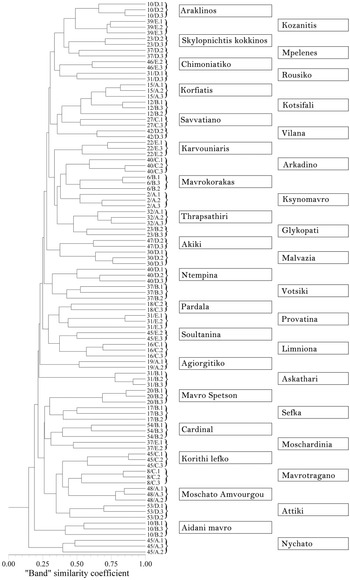
Based on SSR profiles, a genetic similarity dendrogram was generated (Fig. 3). In all cases individuals representing the same cultivar were clustered together while no individual from other cultivar was present (single-cultivar cluster) in the dendrogram confirming trueness to type. Using the upper tail criterion for confidence level α = 0.05, the value of 0.22 was marked as upper threshold of similarity coefficient. A total of four main groups of cultivars were evidenced in the dendrogram (Fig. 3). Two of them were represented by only one cultivar (‘Nychato’ in group A and ‘Aidani mavro’ in group B). The other two groups included more cultivars; groups C and D were composed by eight and 26 cultivars, respectively (Fig. 3). The resulting unbalanced groups – with two groups containing most of the cultivars is an innate characteristic of the UPGMA clustering algorithm. This kind of pattern is caused by outliers and is reflected by the tendency of the clustering algorithm to pick out long string-lying clusters. It is called the ‘chaining effect' and has been very well described by Odong et al. (Reference Odong, van Heerwaarden, Jansen, van Hintum and van Eeuwijk2011). However, UPGMA remains one of the most popular algorithms for applying hierarchical clustering employing molecular marker data (Mohammadi and Prasanna, Reference Mohammadi and Prasanna2003; Odong et al., Reference Odong, van Heerwaarden, Jansen, van Hintum and van Eeuwijk2011). This is due to the high representation of the pairwise distances between objects/accessions in the original distance matrix (true distances) and the predicted ones in the dendrogram. This kind of relationship is measured by the Cophenetic Correlation Coefficient (CPCC) for which Farris (Reference Farris1969) proved algebraically that receives its highest value by employing UPGMA rather than other hierarchical clustering algorithms.
UPGMA dendrogram showing genetic relationships among the 36 Greek grapevine cultivars, assessed employing 13 SSR loci.

‘Nychato’, a blue-black skin colour table cultivar and ‘Aidani mavro’, a blue-black skin colour wine cultivar were the two main outliers shaping individual groups A and B, respectively. Group C, the one with the closest proximity to the previous two groups A and B, was comprised by eight cultivars, all except one being of grey up to dark red violet and blue-black skin colour. In terms of final use, half of the cultivars within this group are exploited for wine production and half for table consumption. Five out of the eight members of this group (i.e. ‘Attiki’, ‘Moschato Amvourgou’, ‘Mavrotragano’, ‘Korithi lefko’, ‘Moschardinia’ and ‘Cardinal’) have also been grouped together in group C of the dendrogram produced employing ampelographic traits (Fig. 1), fitting together with the other members of the proles orientalis eco-geographic group. Moreover, ‘Nychato’ forming group A in the molecular data dendrogram (Fig. 3) was a member of group C of the ampelographic trait dendrogram (Fig. 1). Further, ‘Aidani mavro’ that has also been clustered separately but in close proximity with cluster C in the molecular data dendrogram exhibits increased affinity with the proles orientalis group. This eco-geographic group is of eastern origin (Negrul, Reference Negrul1938; Levadoux, Reference Levadoux1956). Similarly, ‘Aidani mavro’ is considered of anatolian origin, probably from the Ionian region (Logothetis, Reference Logothetis1947).
Group D included all remaining 26 cultivars with half of them being of green yellow skin colour and half of grey up to blue-black skin colour (Fig. 3). This group included the majority of 20 wine cultivars. Interestingly, this group included almost all cultivars which comprised groups A and B of the ampelographic dendrogram (Fig. 1) and which in turn represent the proles pontica group. However, scattered within this group, could be found cultivars that previously had been assigned to the proles orientalis group (Fig. 3). The most eminent example of this situation is cultivar ‘Soultanina’ syn. ‘Thompson seedless’ that bears all the typical characteristics of proles orientalis group (Aradhya et al., Reference Aradhya, Dangl, Prins, Boursiquot, Walker, Meredith and Simon2003). Looking more in depth, within group D of the molecular marker data dendrogram, ‘Soultanina’ along with other three cultivars, i.e. ‘Limniona’, ‘Provatina’ and ‘Pardala’ are forming a separate subgroup within this cluster (Fig. 3). All these four cultivars, however, have been grouped together with the other proles orientalis cultivars of group C, when ampelographic data were taken into account (Figs 1 and 3). Hence, to a large extent, molecular markers confirmed results from the ampelographic data, assigning these four cultivars to proles orientalis group. Nevertheless, there were two table cultivars, i.e. ‘Chimoniatiko’ and ‘Akiki’, that were placed within the wine cultivars in cluster D in the SSR dendrogram (Fig. 3).
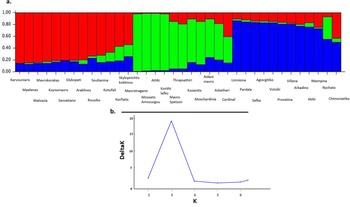
A model-based population structure analysis was used to propose ancestral populations and their proportions within each of the 36 grapevine cultivars. The model evidenced the grouping of the cultivars into three ancestral sub-populations (K = 3) following the maximum ΔK value (Fig. 4(a) and (b)). Based on membership probability, 13 cultivars were assigned to the first genetic pool; red cluster (‘Karvouniaris’, ‘Mpelenes’, ‘Malvazia’, ‘Mavrokorakas’, ‘Ksynomavro’, ‘Savvatiano’, ‘Glykopati’, ‘Araklinos’, ‘Rousiko’, ‘Soultanina’, ‘Kotsifali’, ‘Korfiatis’ and ‘Skylopnicthis Kokkinos’), 11 cultivars to the second genetic pool; green cluster (‘Mavrotragano’, ‘Moschato Amvourgou’, ‘Attiki’, ‘Korithi lefko’, ‘Mavro Spetson’, ‘Thrapsathiri’, ‘Kozanitis’, ‘Moschardinia’, ‘Aidani mavro’, ‘Askathari’ and ‘Cardinal’) and 12 cultivars were assigned to the third genetic pool; blue cluster (‘Limniona’, ‘Pardala’, ‘Sefka’, ‘Agiorgitiko’, ‘Votsiki’, ‘Provatina’, ‘Vilana’, ‘Arkadino’, ‘Akiki’, ‘Ntempina’, ‘Nychato’, ‘Chimoniatiko’ and ‘Votsiki’) (Fig. 4(a)).
Genetic structure of the 36 Greek grapevine cultivars, considering K = 3. Colours (red, green and blue) represent the three groups, defined by the K value. Grapevine cultivars showing more than one colour may have an intermixed genetic makeup. The vertical axis indicates the membership value. (b) Estimation of the number of populations for K ranging from 1 to 6 by calculating delta K values.

Almost all cultivars that fit within the green cluster of STRUCTURE analysis corresponded to those grouped in cluster C of the SSR dendrogram (Fig. 3). Interestingly, this is in agreement with the ampelographic grouping that included cultivars of mostly eastern origin (proles orientalis). Cultivars ‘Thrapsathiri’, ‘Kozanitis’ and ‘Askathari’ deviated from this grouping; they have been included within the green cluster of the STRUCTURE analysis but they were not included in the corresponding ampelographic as well as molecular groups and consequently they could not be assigned to the proles orientalis group.
The other two clusters created by STRUCTURE analysis (i.e. red and blue; Fig. 4) were comprised by cultivars that had been mostly clustered in group D in the SSR dendrogram (Fig. 3). However, STRUCTURE analysis differentiated very well the sub-populations evidenced in the SSR dendrogram. For example, cultivar ‘Soultanina’ was grouped within the red cluster in STRUCTURE analysis together with three other members of the distinct sub-population of the SSR dendrogram. These members were ‘Limniona’, ‘Pardala’ and ‘Provatina’ (Fig. 3) which were, in addition, members of the blue group in STRUCTURE analysis (Fig. 4). This inconsistency between the two types of analyses – both based on SSR – has been demonstrated before by Odong et al. (Reference Odong, van Heerwaarden, Jansen, van Hintum and van Eeuwijk2011) who argued that UPGMA is producing highly unbalanced clusters, hence performing poorly in recovering original sub-populations, even when high sub-group differentiation exists.
Overall, hierarchical cluster analysis, based on SSR data, was found in good agreement with this based on ampelographic data, at least as far as the main grouping is concerned. PCA – employing ampelographic traits – provided a biological (phylogeographic) framework for explaining grouping in the dendrogram. In PCA, cultivars were grouped according to their geographic origin and were separated between those of eastern origin (proles orientalis) and those considered indigenous to the Greek vineyard (proles pontica). This major grouping was further confirmed through SSR data. The same biological hypothesis was put forth by Stavrakaki et al. (Reference Stavrakaki, Bouza and Biniari2019) in order to explain the structure uncovered in selected 12 Greek grapevine cultivars following phenotypic and molecular characterization. STRUCTURE analysis confirmed, to a large extent, the eastern origin of cultivars. However, and regarding the grouping into sub-populations, only partial agreement of the two (ampelographic and SSR) hierarchical analyses was found.
Efficient maintenance of genebank collections involves not only the collection and conservation of the accessions but also the characterization of the germplasm, both phenotypically and molecularly. Such characterization allows the identification of morphological and agronomic traits of interest and enhances the utilization of genebank accessions, since it can be linked with genetic information probably by involving machine learning in order to address inquiries for specific accessions that directly meet users' needs (Anglin et al., Reference Anglin, Amri, Kehel and Ellis2018; Kehel et al., Reference Kehel, Sanchez-Garcia, El Baouchi, Aberkane, Tsivelikas, Charles and Amri2020). Our study confirmed the need of employing in parallel, both phenotypic and molecular characterization in order to reveal meaningful relationships between genebank accessions, especially when historical or passport data are limited or completely missing, a situation common to several genebank and crop collections. The Greek grapevine cultivars, used in this study, exhibited a wide range of expression for an ample number of phenotypic traits recorded, and revealed the breadth of genetic diversity as assessed by 13 SSR markers commonly used in the international Vitis research. In addition, genetic relationships between these 36 cultivars have been well established and this could facilitate downstream applications and subsequent breeding efforts. Eventually, this genetic wealth of the traditional Greek vineyard could form the basis for enriching cultivated grapevines with novel diversity that will serve for the reconstitution of the viticulture sector and the sustainable development of the wine industry.
Conclusions
Considering the challenges for modern viticulture to appeal to new markets and consumers' preferences, along with the threat of genetic erosion of indigenous grapevine germplasm, we studied the genetic diversity of 36 grapevine cultivars, predominantly representing autochthonous Greek landraces. A wide range of diversity was revealed in terms of ampelographic traits. Moreover, a clear distinction based on geographical patterns, was re-affirmed for the landraces of Anatolian versus Mediterranean origin. Results also suggest a high level of genetic diversity for the Greek grapevine landraces assessed through SSR markers. The mixed origin of present day Greek cultivars could be further validated employing a wider representation of the germplasm with the combined use of SNP-based technologies. On the other hand, the information presented herein can serve as a ‘stepping stone’ for the reconstitution of the Greek vineyard and can contribute towards a rational conservation and utilization strategy on breeding or direct cultivation of the Greek indigenous grapevine germplasm.
Supplementary material
The supplementary material for this article can be found at https://doi.org/10.1017/S147926212200020X.
Acknowledgements
This work is dedicated to the memory of Dr Antonis Mattheou, who was the founder of the grapevine collection at the Greek Genebank and served tirelessly the viticultural research, unravelling the importance of the Greek grapevine landraces. His dedication to scientific research and to viticulture will always be an eminent example for the authors of this study.