Significant outcomes
-
Light therapy was associated with antidepressant effects across all degrees of VI.
-
Light therapy was associated with sight-related side effects in persons with degenerative retinal disorders.
Limitations
-
The antidepressant response cannot be differentiated from a placebo response.
-
The pilot design is reflected in the sample size which limits generalisability beyond the present population.
Introduction
Mood and sleep disorders are prevalent comorbidities in severe visual impairment (VI) or blindness (Court et al., Reference Court, McLean, Guthrie, Mercer and Smith2014; Flynn-Evans et al., Reference Flynn-Evans, Tabandeh, Skene and Lockley2014; Tamura et al., Reference Tamura, Sasai-Sakuma, Morita, Okawa, Inoue and Inoue2016; Choi et al., Reference Choi, Lee and Lee2018). The disruption of the light input to the central neurocircuitry is a potential risk factor for development of both conditions. In mood disorders, the association between light and symptoms is most evident in the syndrome of seasonal affective disorder (SAD), in which the low light availability is considered the primary pathogenetic factor (Rosenthal et al., Reference Rosenthal, Sack, Gillin, Lewy, Goodwin, Davenport, Mueller, Newsome and Wehr1984; Meesters et al., Reference Meesters, Winthorst, Duijzer and Hommes2016). SAD was originally described as recurrent depressive episodes in fall/winter with spontaneous remission in spring (Rosenthal et al., Reference Rosenthal, Sack, Gillin, Lewy, Goodwin, Davenport, Mueller, Newsome and Wehr1984). The condition does not constitute a separate diagnostic entity in the current diagnostic classification systems but exists as a specification of recurrent depression and bipolar disorder (WHO, 2010; American Psychiatric Association, 2015). An early developed instrument, the Seasonal Pattern Assessment Questionnaire (SPAQ), rates seasonal variation in mood and behaviour and sets criteria for SAD and subsyndromal SAD (sSAD) (Kasper et al., Reference Kasper, Wehr, Bartko, Gaist and Rosenthal1989). The SPAQ is applicable as a screening tool but has limited diagnostic validity and does not discriminate well between SAD and sSAD (Magnusson, Reference Magnusson1996). As a milder variant of SAD, sSAD involves a distinct loss of energy and hypersomnia, but not mood reductions to a level of clinical depression or substantial reductions in everyday functioning (Meesters et al., Reference Meesters, Winthorst, Duijzer and Hommes2016). In SAD, the core depressive symptoms of low mood and energy are often accompanied by atypical features such as hypersomnia, hyperphagia, carbohydrate craving, and social withdrawal (Rosenthal et al., Reference Rosenthal, Sack, Gillin, Lewy, Goodwin, Davenport, Mueller, Newsome and Wehr1984; Meesters and Gordijn, Reference Meesters, Winthorst, Duijzer and Hommes2016). In light therapy trials, approximately 50–60% of patients with SAD and sSAD obtain remission from depressive symptoms after treatment (Rosenthal et al., Reference Rosenthal, Sack, Gillin, Lewy, Goodwin, Davenport, Mueller, Newsome and Wehr1984; Terman et al., Reference Terman, Terman, Quitkin, McGrath, Stewart and Rafferty1989; Martiny et al., Reference Martiny, Lunde, Simonsen, Clemmensen, Poulsen, Solstad and Bech2004; Golden et al., Reference Golden, Gaynes, Ekstrom, Hamer, Jacobsen, Suppes, Wisner and Nemeroff2005; Meesters et al., Reference Meesters and Gordijn2016). A recent meta-analysis by Pjrek et al. (Reference Pjrek, Friedrich, Cambioli, Dold, Jäger, Komorowski, Lanzenberger, Kasper and Winkler2020) reported an effect size of 0.37, whereas an earlier estimate by Golden et al. (2020) was 0.84. A significant antidepressant effect is often achieved within the first few weeks of treatment, and side effects are predominantly mild and transient (Martiny et al., Reference Martiny, Lunde, Simonsen, Clemmensen, Poulsen, Solstad and Bech2004; Brouwer et al., Reference Brouwer, Nguyen, Snoek, van Raalte, Beekman, Moll and Bremmer2017).
It seems plausible that persons with VI or blindness will be more susceptible to seasonal light reductions, since they may need higher illumination to sustain mood, sleep, and circadian rhythm due to impaired reception and/or transmission of light signals. Indeed, in a large SPAQ survey in persons with severe VI or blindness, we found that 17% of the population with VI experienced significant seasonal variation in mood and behaviour compared with 8% in the sighted control group (Madsen et al., Reference Madsen, Dam and Hageman2016).
In the retina, light activates three types of photoreceptors: rods, cones and melanopsin-containing intrinsically photosensitive retinal ganglion cells (ipRGCs) (Legates et al., Reference Legates, Fernandez and Hattar2014). Light signals responsible for image formation are conveyed from the retina to the occipital visual cortex. Moreover, retinotectal and retinohypothalamic projections convey light signals for non-visual processes, such as the pupillary light reflex, suppression of melatonin and regulation of circadian rhythm, alertness and mood (Legates et al., Reference Legates, Altimus, Wang, Lee, Yang, Zhao, Kirkwood, Singer, Kirkwood, Zhao, Berson and Hattar2012; Ospri et al., Reference Ospri, Prusky and Hattar2017; Fernandez et al., Reference Fernandez, Fogerson, Lazzerini Ospri, Thomsen, Layne, Severin, Zhan, Singer, Kirkwood, Zhao, Berson and Hattar2018). The primary photoreceptors involved in these non-image-forming processes are the ipRGCs which are located in the inner layers of the retina. Depending on the anatomical and pathophysiological processes causing the impairment, the visual and non-visual processes can be differentially affected. Hence, in the majority of individuals with complete blindness, that is, no light perception (NLP), melatonin is not suppressed by light (Hull et al., Reference Hull, Czeisler and Lockley2018). Correspondingly, the synchronisation of the individual’s endogenous rhythm to the external 24-h light/dark cycle can be attenuated, which can lead to circadian misalignment (Lockley et al., Reference Lockley, Skene, Arendt, Tabandeh, Bird and Defrance1997; Flynn-Evans et al., Reference Flynn-Evans, Tabandeh, Skene and Lockley2014; Hull et al., Reference Hull, Czeisler and Lockley2018). However, in some persons with NLP, the melatonin suppression and circadian alignment are maintained (Czeisler et al., Reference Czeisler, Shanahan, Klerman, Martens, Brotman, Emens, Klein and Rizzo1995; Flynn-Evans et al., Reference Flynn-Evans, Tabandeh, Skene and Lockley2014; Hull et al., Reference Hull, Czeisler and Lockley2018). Likewise, in most – but not all – persons with severe VI or blindness who maintain the ability to perceive light [light perception (LP)], melatonin suppression and the capacity for photoentrainment are sustained (Lockley et al., Reference Lockley, Skene, Arendt, Tabandeh, Bird and Defrance1997; Flynn-Evans et al., Reference Flynn-Evans, Tabandeh, Skene and Lockley2014). Sleep problems are reported by the large majority (83%) of persons with blindness (Leger et al., Reference Leger, Guilleminaul, Defrance, Domont and Paillard1999), and circadian misalignment is seen in as many as 31% of persons with LP and 63% with NLP sight (Lockley et al., Reference Lockley, Skene, Arendt, Tabandeh, Bird and Defrance1997; Flynn-Evans et al., Reference Flynn-Evans, Tabandeh, Skene and Lockley2014). In the study by Flynn-Evans et al. (Reference Flynn-Evans, Tabandeh, Skene and Lockley2014), circadian misalignment was partly related to the location of the lesion that caused blindness. Hence, only 15/26 persons with LP sight caused by an optic nerve or inner retinal lesion were normally entrained, whereas this was the case for 26/30 persons with LP sight and an outer retinal lesion. This supports the hypothesis that successful photoentrainment is associated with an intact inner retina with functional ipRGCs.
In some individuals, entrainment can be reestablished by the timed administration of melatonin (Andrews et al., Reference Andrews, Foster, Alexander, Vasudevan, Downes, Heneghan and Plüddemann2019). In sighted individuals with circadian rhythm sleep/wake disorders, the light/dark cue can be reinforced by light therapy to regain entrainment (Auger et al., Reference Auger, Burgess, Emens, Deriy, Thomas and Sharkey2015). To our knowledge, no studies have assessed the effects of light therapy in persons with VI or blindness who have either mood or sleep disorders. Light therapy could constitute a potential treatment option for these disorders even in persons without a conscious perception of light, that is, NLP sight, considering the at least partial differentiation of the visual and non-visual processes.
Aims of the study
We conducted the first, exploratory light therapy trial in persons with severe VI/blindness and symptoms of sSAD/SAD. The study was a pilot trial to evaluate effects and side effects associated with light therapy. We also explored potential associations between participant characteristics and treatment response.
Materials and methods
Design and setting
The study was a single-arm, assessor-masked interventional trial to assess the tolerability and efficacy of bright light therapy for SAD or sSAD in persons with severe VI or blindness.
Recruitment was performed among outpatients with glaucoma at the Department of Ophthalmology at Rigshospitalet and by advertisements on websites and social media related to institutions working with persons with VI (The Danish Association of the Blind, the Institute for the Blind and Partially Sighted). In addition, information about the study was sent by post or email to all members of the Danish Association of the Blind with a home address in Eastern Denmark (approximately 1900 persons) in October 2019.
Study population
Inclusion criteria were > 18 years of age and VI (visual acuity < 6/18 or significantly reduced visual field [visual field <10% or visual field mean defect (MD) > 10 dB], a satisfaction of the Kasper criteria for seasonality (SAD/sSAD) (Kasper et al., Reference Kasper, Wehr, Bartko, Gaist and Rosenthal1989) and a current sum score ≥ 13 on the Structured Interview Guide for the Hamilton Depression Rating Scale – Seasonal Affective Disorder version (SIGH-SAD) (Williams et al., Reference Williams, Link, Rosenthal, Amira and Terman1992). Exclusion criteria were other psychiatric disorders, use of antidepressant medication, current alcohol or drug abuse, and current or planned pregnancy. Moreover, persons with eye disorders in current progression or with specific light-related risks were excluded.
Psychiatric assessment
The Kasper criteria for SAD/sSAD are based on scores of seasonal variation within the six items of mood, sleep duration, energy levels, appetite, body weight and social activities (0–4 points each) from the SPAQ (Kasper et al., Reference Kasper, Wehr, Bartko, Gaist and Rosenthal1989). The sum score yields the Global Seasonal Score (GSS). The criteria for SAD include a GSS ≥ 10 and that seasonality constitutes at least a moderate problem in winter months (November–February). For sSAD, the criteria include either a GSS ≥ 10 with the extent of the problem being rated as less than moderate or a GSS = 8 – 9 and seasonality as at least a mild problem. The SIGH-SAD interview covers the 17-item Hamilton Depression Rating Scale (HDRS score) and the eight atypical symptoms of weight gain, social withdrawal, increased eating, increased appetite, carbohydrate craving, diurnal variation, fatiguability and hypersomnia (atypical score) (Williams et al., Reference Williams, Link, Rosenthal, Amira and Terman1992). Pre- and post-treatment SIGH-SAD ratings were performed by specialists in psychiatry, who were blinded to eye diagnosis, degree of VI and adherence to light therapy.
Participants underwent a structured clinical interview (Schedules in Clinical Assessment in Neuropsychiatry, SCAN) to exclude other psychiatric disorders. Moreover, the interview confirmed that the symptoms had occurred in a regular seasonal pattern that had been present for the last 3 years or longer.
During the course of treatment, participants were to fill in a sleep and light therapy compliance diary. The diary consisted of sleep onset, sleep offset, number of awakenings, daytime napping, sleep quality rated on a scale from 0 to 10 (0 = worst and 10 = best sleep quality), and timing and duration of light therapy.
Ophthalmologic assessment
At inclusion, participants underwent an ophthalmologic examination tailored to the individual’s ocular status to determine the cause of VI. The examination included assessment of visual acuity, slit lamp examination, intra-ocular pressure measurement, optical coherence tomography scanning of the retina (Spectralis; Heidelberg Engineering GmbH, Heidelberg, Germany), handheld electroretinography (ERG), autoperimetry (Octopus, Haag-Streit AG, Koeniz-Berne, Switzerland) and chromatic pupillometry when applicable. Moreover, the ophthalmologist assessed whether light therapy could constitute a potential risk for residual visual function. This decision was based on clinical examination and patient history including eye diagnosis, current progression, use of photosensitising agents, degree of impairment and dependence on residual sight for orientation. Assessment of visual acuity, chromatic pupillometry and other relevant procedures were repeated by the end of the trial period or during the trial period, if any eye-related adverse effects appeared. Participants were categorised according to their degree of VI as having either VI, only LP or NLP. Moreover, a suspected ipRGC damage was noted if the eye disorder was suspected to involve the optic nerve or inner retina (Flynn-Evans et al., Reference Flynn-Evans, Tabandeh, Skene and Lockley2014).
As a measure of ipRGC activity, we assessed the pupillary responses to blue light by chromatic pupillometry. Pharmacologic dilation of one pupil (administration of one drop of phenylephrine and one drop of tropicamide with 30 s apart) was followed by dark adaption for 5 min. By a desktop, computer-based pupillometer (DP-2000, Neuroptics, CA, USA), the pupillary diameter of the consensual non-dilated eye was then recorded before (10 s), during (20 s) and after (60 s) the presentation of a red (λmax = 623 nm) and a blue light (λmax = 463 nm) stimulus to the dilated eye. The light intensity for both light colours was 100 lux corresponding to 0.408 W/m2 for red and 1.893 W/m2 for blue light. Data on the pupil diameters were then imported to the statistical program R for calculation of the post-illumination pupillary response (PIPR), that is, the sustained pupillary contraction following termination of the blue light stimulus. The PIPR was calculated as the mean of the diameters measured during the 10–30 s after termination of the light stimulus and is presented as the percentage contraction relative to the baseline diameter (mean pupil diameter measured for 10 s pre-stimulation). A larger value corresponding to a greater contraction indicates a stronger ipRGC activation, since the sustained pupillary contraction is specific to the ipRGCs (Kardon et al., Reference Kardon, Anderson, Damarjian, Grace, Stone and Kawasaki2009).
Light therapy
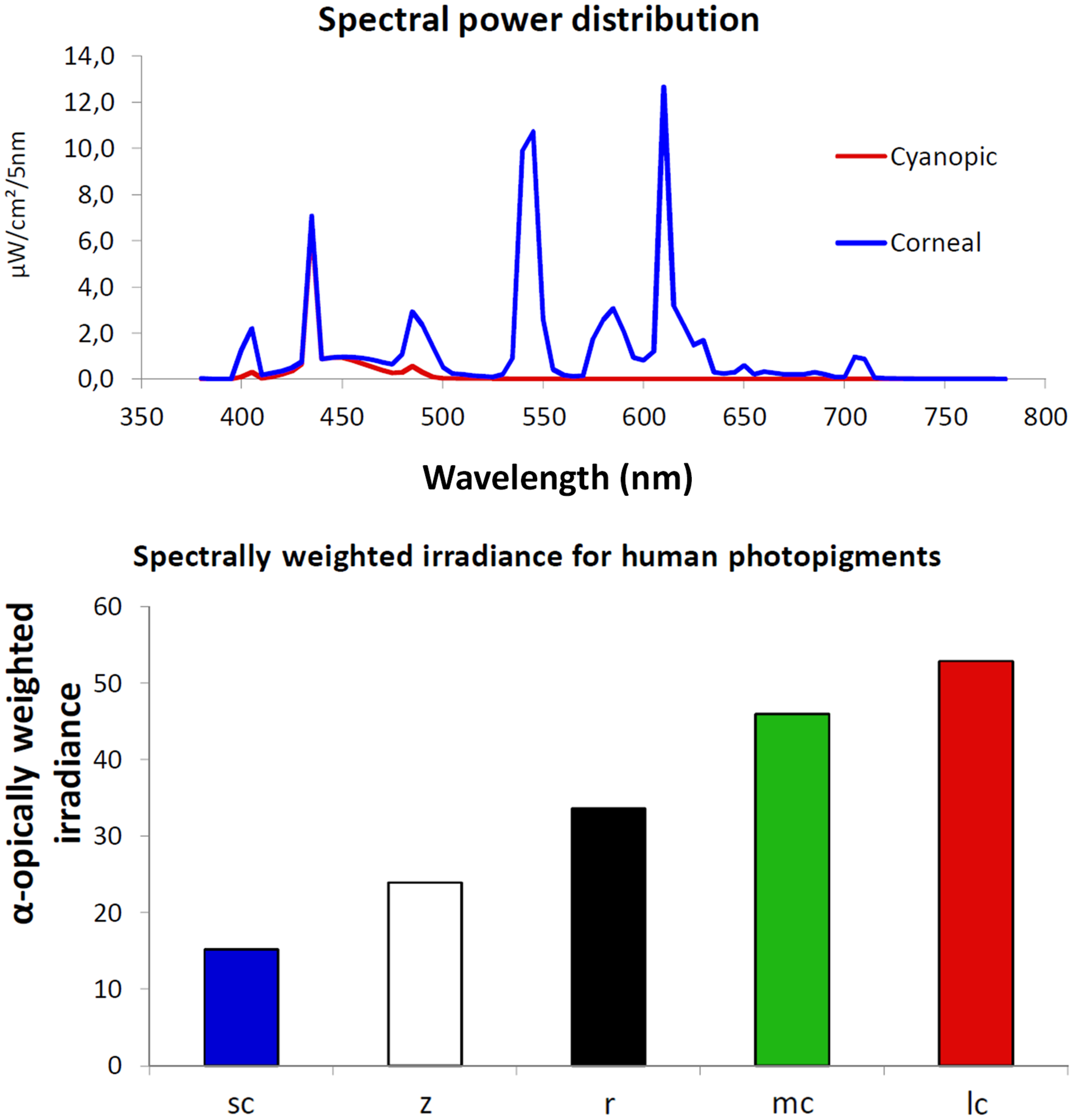
Light therapy consisted of daily use of a light box for 6 weeks. The light box (Brazil SAD light, Lumie, Cambridge, UK) produced white light with an illumination of 10 000 lux at a distance of 35 cm and a colour temperature of 4 000 Kelvin (See Fig. 1 for spectral power distribution and irradiance). Participants were instructed to maintain a distance of 35 cm during treatment. Moreover, they were instructed not to gaze directly at the light box but to position themselves in front of the box and occasionally look into the lamp. Unilateral light therapy was administered by coverage of one eye with a solid eye patch during treatment. Light therapy was to be administered as early in the day as possible, preferably between 6 AM and 9 AM with a start duration of 30 min. During the 6-week treatment programme, the investigator maintained weekly telephone or email contact with the participants to assess adherence and side effects that required adjustment of dosage. If intolerable side effects were reported, the dosage was reduced by increasing the distance to the lamp (5000 lux at 50 cm). If no side effects were reported, the participant was instructed to increase treatment duration for up to 1 h.
Spectral power distribution and irradiance of human photopigments of the Lumie Brazil Lightbox calculated by the method of Lucas et al. (Reference Lucas, Peirson, Berson, Brown, Cooper, Czeisler, Figueiro, Gamlin, Lockley, O’Hagan, Price, Provencio, Skene and Brainard2014). SC: S-cone; z: melanopsin; r: rod; mc: M-cone; lc: L-cone.

Side effects
In weekly telephone calls, participants were asked to report any side effects or ask questions regarding treatment. At the beginning, after 3 weeks and after completion, we performed a structured assessment of adverse effects (Lingjærde et al., Reference Lingjærde, Ahlfors, Bech, Dencker and Elgen1987) including cognitive deficits (concentration and memory), sleepiness, agitation, changes in mood and sleep, increased dreaming, emotional indifference, nausea, photosensitivity, headaches, irritation of eyes, and blurring of vision.
Outcomes
The primary outcome was the total score on the SIGH-SAD. An atypical balance was calculated as the sum score of the eight atypical symptoms divided by the total score of all items multiplied by 100 and has been shown to be a predictor of treatment response (Dimitrova et al., Reference Dimitrova, Reeves, Snitker, Lapidus, Sleemi, Balis, Manalai, Tariq, Cabassa, Karim, Johnson, Langenberg, Rohan, Miller, Stiller and Postolache2017).
Secondary outcomes were the scores of the HAM-D6 self-report version (Bech et al., Reference Bech, Wilson, Wessel, Lunde and Fava2009) and the WHO-5 wellbeing index (Topp et al., Reference Topp, Østergaard, Søndergaard and Bech2015) administered at inclusion, and after 3 (mid-treatment) and 6 weeks (follow-up) as well as a full report of occurrence of side effects.
Statistics
The effect of light therapy was assessed in a paired non-parametric comparison of pre- and (mid- or) post-treatment scores on the SIGH-SAD, the HAM-D6 and the WHO-5 wellbeing index by the Wilcoxon signed rank test. Response was defined as a > 50% reduction of the pre-treatment SIGH-SAD-score, and for remission the post-treatment SIGH-SAD score should be < 9 (Eastman et al., Reference Eastman, Young, Fogg, Liu and Meaden1998). Correlations were tested by the Spearman correlation test.
Ethics
The study complied with the principles of the Helsinki declaration and was approved by the Health Research Ethics Committee of the Capital Region of Denmark (H-17027752). All participants provided written informed consent.
Results
Enrolment
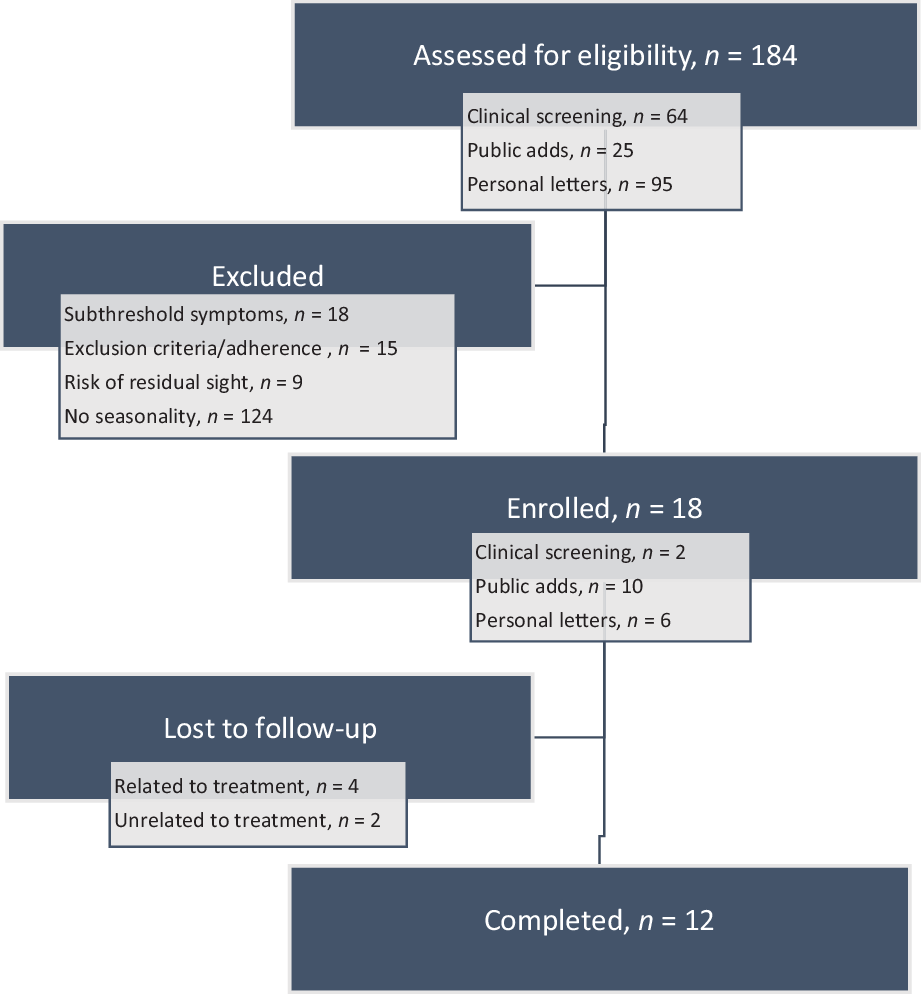
Enrolment to the study was performed in the months of November–February in the years 2017 to 2020. A total of 184 persons were screened for eligibility. Among the persons who experienced themselves as seasonal (n = 60), 18 persons did not meet the Kasper criteria for SAD/sSAD, 15 persons met an exclusion criteria or had travel plans that interfered with the study, and 9 persons were excluded based on risk of phototoxic reactions (n = 9).The remaining 18 persons were included (see Fig. 2 for flowchart). The decision to exclude due to phototoxic risk was based on diagnoses of age-related macular degeneration, albinism or degenerative retinal disorders.
Flowchart of enrolment to the study.

Study population
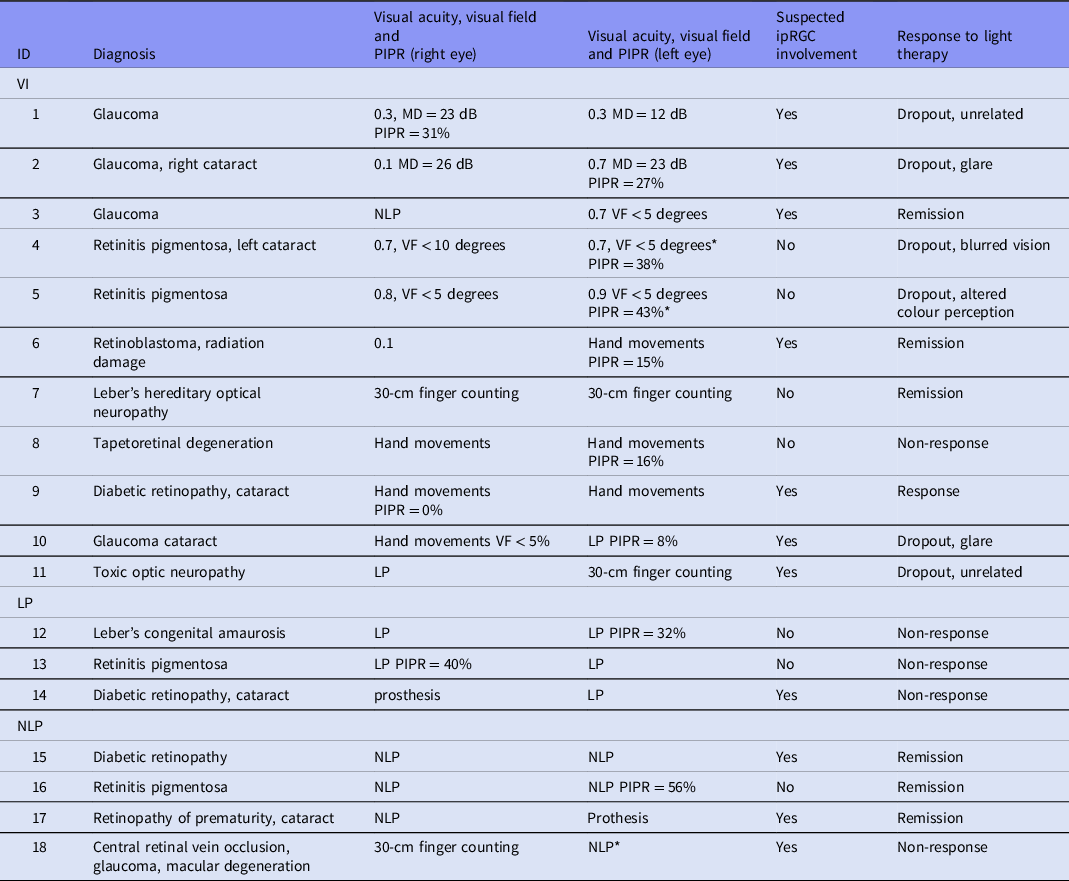
The 18 participants had a mean age of 53 years (range = 26–89 years). The male/female ratio was 7/11. According to degree of VI, 11 persons were categorised as visually impaired, 3 persons had LP and 4 persons had NLP. One individual with the ability to count fingers in one eye, but NLP in the other eye was categorised as NLP because light was administered to the NLP eye only. Of the 18 participants, 2 dropped out due to circumstances unrelated to the trial and 4 persons experienced side effects that led to drop out/exclusion. Hence, 12 persons completed the trial. Descriptive data and responses to treatment are listed in Table 1.
Participant eye data and response to light

VI, visual impairment; LP, light perception; NLP, no light perception; VA, visual acuity; VF, visual field; MD, mean defect; PIPR, post-illumination pupillary response; ipRGC, intrinsically photosensitive retinal ganglion cells.
* Unilateral light treatment. Participant 18 is categorised as NLP because light therapy was only administered to the eye with no light perception. Remission is defined as a SIGH-SAD reduction >50% and a post-treatment score <9.
The median GSS was 12 (range 8–21) and the median duration of the seasonality pattern was 10 years (range 3–50 years). According to the Kasper criteria, 14 persons were categorised as SAD and 4 persons as sSAD. The median SIGH-SAD score, HDRS-score and atypical score was 28 (range 14–38), 15 (range 10–25) and 11 (range 4–21), respectively.
Side effects and dropout/exclusion
Eye-related side effects were reported by 10/18 participants. These included mild-to-moderate glare during treatment (n = 2), dry and irritated eye (n = 2) and increased photophobia (n = 2). One participant with retinitis pigmentosa (RP) reported blurred vision after 7 days of unilateral light therapy (distance 1 m = dosage 2500 lux). Visual acuity and visual field were unchanged at reexamination after cessation of the treatment. Another participant with RP reported altered colour perception following the initial two sessions of unilateral light therapy, and light therapy was terminated. Visual acuity was unchanged on the day after termination of light therapy and the subjective experience subsided over the following weeks. For both participants, the handheld ERG showed a flat response curve for both eyes. In two participants with glaucoma, light therapy caused acute discomfort in the form of severe glare and photophobia why they dropped out after one and three 15-min sessions, respectively. At follow-up, all discomfort was gone.
Another six participants reported mild-to-moderate non-ocular side effects: headaches (n = 2), increased dream activity (n = 2) and gastrointestinal complaints (n = 2). No participants reported agitation, decreased sleep or concentration difficulties.
Antidepressant effect
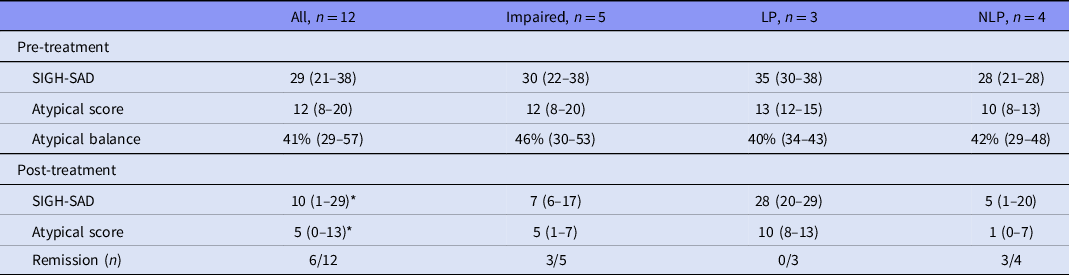
In the 12 persons, who completed the study, the median pre-treatment SIGH-SAD score was 29 (range = 21–38) with a median atypical score of 12 (range = 8–20) (Table 2). After 6 weeks of light therapy, the median SIGH-SAD score was reduced to 10 (range =1–29), p < 0.001 and the atypical score to 5 (range = 0–13), p = 0.004. According to the remission criteria (>50% reduction of the SIGH-SAD score and a post-treatment score < 9), 6/12 participants (50%) obtained full remission. There was no correlation between the PIPR to blue light and the reduction in SIGH-SAD scores (ρ = −0.2, p = 0.61) nor were there any significant association between the treatment response and the degree of VI (p = 0.2) or any indications towards associations with specific eye diagnosis and ipRGC involvement.
SIGH-SAD scores before and after treatment

Pre-treatment scores and changes after treatment on the Structured Interview Guide for Depression, Seasonal Affective Disorder Version (SIGH-SAD) presented as medians and ranges for persons with severe visual impairment (impaired), light perception (LP) and no light perception (NLP). Comparisons are based on Wilcoxon signed rank tests of the pre- and post-treatment values.
* p-Values < 0.05 for comparison between pre- and post-treatment scores.
The Ham-D6 scores were significantly reduced at 3 and 6 weeks compared with pre-treatment scores, p = 0.02 and 0.006, respectively, see Table 3. The WHO-5 scores were improved at week 3 (p = 0.05) and at the end of treatment (p = 0.01). Sleep quality improved at the end of treatment (p = 0.05), but not at week 3 (p = 1.0). The number of participants reporting nightly awakenings and daytime napping was reduced at follow-up but not significantly.
Self-reported mood, wellbeing and sleep at inclusion, mid-treatment and end of treatment

Self-reported outcomes from the Hamilton Depression Rating Scale, 6-item self-report version (Ham-D6), the WHO-5 wellbeing Index (WHO-5), sleep quality rating from 0 to 10 (worst to best). Values are presented as median (range) or number of participants.
* p-Values < 0.05 from Wilcoxon signed rank test of the median changes from the start of the treatment.
Discussion
Several meta-analyses provide evidence for an antidepressant effect of light therapy in SAD (Golden et al., Reference Golden, Gaynes, Ekstrom, Hamer, Jacobsen, Suppes, Wisner and Nemeroff2005; Pjrek. et al., Reference Pjrek, Friedrich, Cambioli, Dold, Jäger, Komorowski, Lanzenberger, Kasper and Winkler2020), non-seasonal depression (Penders et al., Reference Penders, Stanciu, Schoemann, Ninan, Bloch and Saeed2016; Perera et al., Reference Perera, Eisen, Bhatt, Bhatnagar, de Souza, Thabane and Samaan2016; Tao et al., Reference Tao, Jiang, Zhang, Qian, Chen, Lv and Yao2020) and bipolar depression (Sit et al., Reference Sit, McGowan, Wiltrout, Diler, Dills, Luther, Yang, Ciolino, Seltman, Wisniewski, Terman and Wisner2018; Hirakawa et al., Reference Hirakawa, Terao, Muronaga and Ishii2020; Lam et al., Reference Lam, Teng, Jung, Evans, Gottlieb, Chakrabarty, Michalak, Murphy, Yatham and Sit2020) with generally small-to-medium effect sizes. Other indications for light therapy are emerging such as subthreshold depression (Jiang et al., Reference Jiang, Zhang, Wang, So, Ren and Tao2020), peripartum depression (Crowley and Youngstedt, Reference Crowley and Youngstedt2012), geriatric depression (Chang et al., Reference Chang, Liu, Chen and Tsai2018) and sleep disorders (van Maanen et al., Reference van Maanen, Meijer, van der Heijden and Oort2016). Correspondingly, the lack of exposure to daylight associated with modern, urbanised living is suspected to constitute a risk for circadian and mental health adversities (Foster, Reference Foster2020). Persons with VI or blindness must be considered at higher risk of developing pathologies related to lack of light, but the potentially beneficial effects of light are largely unexplored in this population. The antidepressant effect of light in persons with NLP suggested by our study is plausible considering the sustainment of other non-visual light effects in persons with NLP sight (Czeisler et al., Reference Czeisler, Shanahan, Klerman, Martens, Brotman, Emens, Klein and Rizzo1995; Hull et al., Reference Hull, Czeisler and Lockley2018). It also supports the notion that visually blind persons should maintain daily exposure to daylight and/or have access to high-quality indoor electrical lighting (Foster, Reference Foster2020).
Antidepressant effect
In the sample of 12 persons with blindness or severe VI and mild-to-moderate symptoms of seasonal depression, we saw a significant reduction of depressive symptoms after 6 weeks of light therapy. Complete remission was obtained in 50%. These responses resemble those reported from randomised controlled trials (RCTs) of light therapy for SAD and sSAD in sighted populations (Eastman et al., Reference Eastman, Young, Fogg, Liu and Meaden1998; Terman et al., Reference Terman, Terman, Quitkin, McGrath, Stewart and Rafferty1989; Gordijn et al., Reference Gordijn, Mannetje and Meesters2012). We only identified a single study of light administration to persons with VI (Partonen et al., Reference Partonen, Vakkuri and Lamberg-Allardt1995). In this trial, 2 weeks of light therapy was administered to 7 blind (5 NLP) and 11 sighted individuals with no current depression or a history of depression. After 2 weeks, there were similar, however discrete, improvements in mood and sleepiness in the two groups, just as the evening melatonin levels increased in both groups. Due to this scarceness of literature, we chose to perform this exploratory proof-of-concept study. Due to the lack of a control group, we cannot string apart potential treatment effects from spontaneous remission or placebo effects. The identification of a valid placebo condition for light therapy remains a challenge, and most RCTs detect substantial placebo effects (Pjrek et al., Reference Pjrek, Friedrich, Cambioli, Dold, Jäger, Komorowski, Lanzenberger, Kasper and Winkler2020). However, remission rates tend to be much lower for placebo than those seen in this study (Eastman et al., Reference Eastman, Young, Fogg, Liu and Meaden1998; Pjrek et al., Reference Pjrek, Friedrich, Cambioli, Dold, Jäger, Komorowski, Lanzenberger, Kasper and Winkler2020).
We did not identify associations between treatment response and the degree of VI, the diagnosis or the ipRGC-mediated pupillary responses. This is in line with the prior finding that the light-induced suppression of melatonin cannot be determined by either visual function or eye diagnosis (Hull et al., Reference Hull, Czeisler and Lockley2018). However, a meta-analysis by Lee and Chan found support for a direct relationship between light dose and reduction in typical depressive symptoms but found no such dose–response relationship for atypical symptoms (Lee and Chan, Reference Lee and Chan1999). It is, however, evident that a relationship between treatment response and eye characteristics (acuity or diagnosis) cannot be excluded based on this sample of only 12 individuals with heterogenous impairments and clinical characteristics. A larger sample is required to determine whether a positive response to light therapy is mainly present in eye disorders that spare the ipRGCs. Indeed, we saw a poorer response in the LP group, although 2/3 of these participants had disorders known to spare the ipRGCs and their pupillometric assessments indicated functional ipRGC systems. The low response could relate to a relatively low atypical balance, since this has been shown to predict a poor response to light therapy (Dimitrova et al., Reference Dimitrova, Reeves, Snitker, Lapidus, Sleemi, Balis, Manalai, Tariq, Cabassa, Karim, Johnson, Langenberg, Rohan, Miller, Stiller and Postolache2017). The sample size and design do not allow conclusions in this regard.
Side effects
In the trial, we identified adverse reactions to the 10 000 lux light from the light box used in the study, in line with studies in sighted populations (Brouwer et al., Reference Brouwer, Nguyen, Snoek, van Raalte, Beekman, Moll and Bremmer2017). Accordingly, these adverse effects were predominantly mild and transient. For comparison with normal daylight exposure, the noon illuminance level measured near the window of a southwest-orientated patient room at our facility was 60 000 lux on a summer day (Gbyl et al., Reference Gbyl, Østergaard Madsen, Dunker Svendsen, Petersen, Hageman, Volf and Martiny2017). Thus, the participants were not exposed to higher light intensities than those than can be measured in the habitual built environment. Out of the 14 participants who maintained some residual sight (LP or better), 9 persons experienced eye-related adversities and 4 terminated the treatment on this basis. The acute adverse reactions to light (glare, photophobia) could possibly have been counteracted by dosage reduction. Glare and photophobia occurred in two participants with glaucoma. Glare and problems with adaption to altering lighting conditions are frequent complaints in glaucoma, although the clinical basis for these problems is largely unexplored (Bierings et al., Reference Bierings, Kuiper, Van Berkel, Overkempe and Jansonius2018).
It is debated, whether light exposure can accelerate photoreceptor loss and hence VI in some degenerative retinal disorders (Paskowitz et al., Reference Paskowitz, LaVail and Duncan2006; Sui et al., Reference Sui, Liu, Liu, Gao, Deng, Wang, Tong and Wang2013). On this basis, we initially excluded nine potential participants, and in three participants, we administered light therapy to one eye only. Based on the experience from this pilot trial, a future light therapy protocol should maintain similar close ophthalmologic observation and the option to tailor light dosage to the individual’s tolerance. The rapid onset of subjective vision-related side effects in two participants with RP also leads us to maintain the recommendation that light therapy should not be routinely administered to persons with degenerative retinal diseases, who maintain functional use of their vision (Brouwer et al., Reference Brouwer, Nguyen, Snoek, van Raalte, Beekman, Moll and Bremmer2017).
Recommendations for future studies
We chose SAD as the target for the study based on our prior finding of substantial seasonality in persons with severe VI or blindness (Madsen et al., Reference Madsen, Dam and Hageman2016) and based on the established light-responsive nature of the condition (Pjrek et al., Reference Pjrek, Friedrich, Cambioli, Dold, Jäger, Komorowski, Lanzenberger, Kasper and Winkler2020). However, the lack of a rigorous screening for sleep disorders constitutes a limitation, since the symptoms of mood and sleep disorders are closely intertwined and the disorders presumably co-occur (Lee et al., Reference Lee, Rex, Nievergelt, Kelsoe and Kripke2011). Incorrectly timed light administration could potentially augment an existing phase advance or delay which may sustain depressive symptoms. To avoid such bias, a future trial should include an assessment of circadian rhythm sleep/wake disorders based on long-term actigraphic or sleep diary data, and we would also advice to apply specific tools for assessment of sleep before and after treatment to separate the effects on mood and sleep.
In general, the issue of accessibility should be considered at each step of a future trial. This includes accessible information and recruiting material, self-report questionnaires, participant transportation, and use and transportation of the light box. Poor accessibility may hinder both recruitment and adherence to a protocol.
We present the first assessment of the effects of light therapy in persons with VI or blindness with symptoms of sSAD/SAD. We find light therapy to be well tolerated in blindness and associated with a significant reduction in depressive symptoms even in persons with NLP sight. Vision-related side effects occurred in a number of individuals with less severe impairments why light therapy cannot routinely be administered to persons who maintain functional use of their vision. The beneficial effect on depressive symptoms and subjective wellbeing supports the potential of light to improve mood and sleep in persons with blindness. These pilot findings need corroboration in randomised controlled designs that maintain close ophthalmologic observation and include rigorous assessment of comorbid circadian rhythm sleep/wake disorders.
Authors contributions
HM drafted the protocol, recruited participants, performed data collection and initial analysis, and drafted the manuscript. SBA contributed to the protocol, performed ophthalmologic examinations, and revised and approved the final manuscript. IH contributed to the protocol, performed blinded ratings of the participants, and revised and approved the final manuscript. HLA contributed to the protocol, performed ophthalmologic examinations, and revised and approved the final manuscript. KM contributed to the protocol, performed blinded ratings of the participants, and revised and approved the final manuscript.
Financial support
The study was supported by the Velux Stiftung, the Augustinus Foundation and the Jasha Foundation.
Conflict of Interest
None.