Introduction
Racing thoughts refer to a subjective acceleration and increased production of thoughts typically found in bipolar disorder (BD). Racing thoughts are frequently described as crowded, and not only as accelerated (Weiner et al., Reference Weiner, Ossola, Causin, Desseilles, Keizer, Metzger and Weibel2019a). This psychiatric symptom was originally associated to manic and hypomanic states of BD (APA, 2013). However, the phenomenon of racing thoughts can also be present in mixed states (e.g. mixed depression) when associated with other symptoms of depression (Weiner et al., Reference Weiner, Ossola, Causin, Desseilles, Keizer, Metzger and Weibel2019a). Characterizing racing thoughts is important because when they co-occur with depression in mixed states, they are associated with a higher rate of suicides (Akiskal & Benazzi, Reference Akiskal and Benazzi2006; Benazzi, Reference Benazzi2007; Dodd et al., Reference Dodd, Kulkarni, Berk, Ng, Fitzgerald, de Castella and Berk2010) and poor response to antidepressant medication (Stahl et al., Reference Stahl, Morrissette, Faedda, Fava, Goldberg, Keck and McIntyre2017). Racing thoughts also predict a greater likelihood of conversion to BD after a first depressive episode (Diler et al., Reference Diler, Goldstein, Hafeman, Merranko, Liao, Goldstein and Birmaher2017; Fiedorowicz et al., Reference Fiedorowicz, Endicott, Leon, Solomon, Keller and Coryell2011; Zeschel et al., Reference Zeschel, Correll, Haussleiter, Krüger-Özgürdal, Leopold, Pfennig and Juckel2013). It is noteworthy that racing thoughts, although primarily related to mood disorders, are not specific to BD and can be found in other psychiatric conditions which share symptoms of mood alterations, such as anxiety disorder, attention deficit/hyperactivity disorder and sleep disorders (Bertschy, Weibel, Giersch, & Weiner, Reference Bertschy, Weibel, Giersch and Weiner2020). A study on a healthy population suggests that milder forms of racing thoughts can be associated to sub-clinical mood instability (Weiner et al., Reference Weiner, Weibel, de Sousa Gurgel, Keizer, Gex-Fabry, Giersch and Bertschy2018). These findings favor a dimensional view of racing thoughts according to which this phenomenon could be found in the general population and would reflect a continuum in mental activity ranging from ‘healthy’ to ‘pathological’. Here we aim to find a neuropsychological equivalent for racing thoughts by exploring the dynamics of perceptual reversals during viewing of an ambiguous figure, both in healthy subjects and in patients with BD.
Exploring racing thoughts through perception may seem counterintuitive given that racing thoughts are supposed to be verbal. However, the mechanisms underlying racing thoughts may generalize to perception. Racing thoughts were first studied phenomenologically based on qualitative analyses of BD patients' descriptions (Bertschy et al., Reference Bertschy, Weibel, Giersch and Weiner2020; Piguet et al., Reference Piguet, Dayer, Kosel, Desseilles, Vuilleumier and Bertschy2010). Since then, significant advances have been made to capture this complex phenomenon, notably via the development of the Racing and Crowded Thoughts Questionnaire (RCTQ) (Weiner et al., Reference Weiner, Weibel, de Sousa Gurgel, Keizer, Gex-Fabry, Giersch and Bertschy2018). This self-rating scale, based on patients' reports, allows for a quantitative clinical assessment of subjects' experiences of racing thoughts. It has been validated in patients with BD (Weiner et al., Reference Weiner, Ossola, Causin, Desseilles, Keizer, Metzger and Weibel2019a), and in healthy volunteers (Weiner et al., Reference Weiner, Weibel, de Sousa Gurgel, Keizer, Gex-Fabry, Giersch and Bertschy2018). Objective measures of racing thoughts however are still sparse (for a study testing a verbal fluency task see Weiner, Doignon-Camus, Bertschy, and Giersch, Reference Weiner, Doignon-Camus, Bertschy and Giersch2019b), and we explored the possibility of an objective measure with the same populations for which the RCTQ had been validated.
It is in fact difficult to evidence thought acceleration, even though finding an objective neuropsychological counterpart for racing thoughts is of paramount importance if we want to understand the underlying mechanisms of this symptom and provide a tool to explore its neurobiological mechanisms. Part of the difficulty in evidencing thought acceleration may come from the fact that the spontaneous acceleration often disappears in laboratory settings, e.g. when participants are instructed to find as many animal names as possible in a limited time period (Weiner et al., Reference Weiner, Doignon-Camus, Bertschy and Giersch2019b; for a meta-analysis see Raucher-Chéné, Achim, Kaladjian, & Besche-Richard, Reference Raucher-Chéné, Achim, Kaladjian and Besche-Richard2017). An activation can be observed, but not directly on a measure relevant to the ongoing task. For example, when manic patients were instructed to find semantically related words (e.g. naming animals), they used additional phonological information to produce words (e.g. rhymes) (Weiner et al., Reference Weiner, Doignon-Camus, Bertschy and Giersch2019b). These results are particularly evocative of racing thoughts and its verbal equivalent (i.e. flight of ideas) since they are based on the exploration of verbal production, but the use of phonological information discorded with the instructions. If these findings reveal a general cognitive control difficulty, they may generalize to perception.
The measure of the perceptual reversal rate in perceptual bistability paradigms is a potential candidate to objectively capture the phenomenological symptom of racing thoughts, inasmuch as both rely on dynamic neural processes. When viewing a bistable figure, such as the Necker cube, sensory information is ambiguous and our perceptual system alternates between the two possible interpretations of the stimulus (Kornmeier & Bach, Reference Kornmeier and Bach2012; Leopold & Logothetis, Reference Leopold and Logothetis1999). Pöppel (Reference Pöppel1997, Reference Pöppel2009; Wittmann, Reference Wittmann2011) proposed a correspondence between the duration of stable percepts during bistable perception and one' sense of subjective present. The subjective present is defined as a temporal window within which a thought or a mental act can be completed (Wittmann, Reference Wittmann2011). Pöppel proposed that bistable perception and the measure of perceptual reversals represent an operationalization of the concept of the subjective present, each stable percept corresponding to one temporal window. Thus, measuring the rate of perceptual reversals in bistable perception would essentially reflect the dynamics of one' flow of thoughts. Pöppel's temporal windows model and the operationalization of the subjective present via bistable perception were the rationale for the present study on racing thoughts in BD.
Studies on perceptual bistability have been conducted in the context of BD, but none of them considered perceptual alternations in relation to racing thoughts (some studies used bistable figures: Eysenck, Reference Eysenck1952; Hoffman, Quinlan, Mazure, & McGlashan, Reference Hoffman, Quinlan, Mazure and McGlashan2001; Hunt & Guilford, Reference Hunt and Guilford1933; Krug, Brunskill, Scarna, Goodwin, & Parker, Reference Krug, Brunskill, Scarna, Goodwin and Parker2008; Philip, Reference Philip1953; Schmack et al. Reference Schmack, Sekutowicz, Rössler, Brandl, Müller and Sterzer2013; other studies used binocular rivalry, another type of perceptual bistability paradigm: Miller et al. Reference Miller, Gynther, Heslop, Liu, Mitchell, Ngo and Geffen2003; Nagamine, Yoshino, Miyazaki, Takahashi, & Nomura, Reference Nagamine, Yoshino, Miyazaki, Takahashi and Nomura2009; Ngo, Mitchell, Martin, & Miller, Reference Ngo, Mitchell, Martin and Miller2011; Pettigrew & Miller, Reference Pettigrew and Miller1998; Vierck et al. Reference Vierck, Porter, Luty, Moor, Crowe, Carter and Joyce2013; Ye, Zhu, Zhou, He, & Wang, Reference Ye, Zhu, Zhou, He and Wang2019). Interestingly, in a study using the Necker cube, Hoffman et al. (Reference Hoffman, Quinlan, Mazure and McGlashan2001) found an increased rate of perceptual reversals in patients with manic-spectrum disorders compared to healthy controls and schizophrenia patients. Considering that racing thoughts are primarily manic-like symptoms (although not exclusive to pure mania), the finding by Hoffman et al. represents an encouraging premise for testing perceptual alternations as a means to capture racing thoughts.
In the present study we aim at investigating whether perceptual reversals of the Necker cube reflect the phenomenon of racing thoughts in a group of BD patients and healthy participants. We additionally record eye movements, based on a previous study in healthy participants (Polgári, Causin, Weiner, Bertschy, & Giersch, Reference Polgári, Causin, Weiner, Bertschy and Giersch2020). In our previous study we found an oscillatory behavior between two locations on the screen for ocular fixations, which correspond to the two interpretations of the bistable Necker cube. This oscillation in ocular fixations is akin to oscillations in manual responses reflecting subjects' perceptual alternations, but at a higher temporal frequency. In the present work, temporal windows were computed from both manual and ocular measurements. Alternations reported by participants require a conscious decision, which might itself be impaired in patients. The rate of ‘ocular windows’ is proposed to reflect more automatic and faster perceptual alternations between representations of the Necker cube than the classic ‘manual windows’. Although eye movements are not a purely automatic behavior, compared to explicit manual responses, they are affected to a lesser extent by top-down, decisional mechanisms (Spering & Carrasco, Reference Spering and Carrasco2015). Thus, ocular windows represent an additional objective measure for the characterization of racing thoughts during the Necker cube paradigm, and their evaluation allowed us to contrast a manual response based on a conscious decision, and a less controlled ocular response.
After they completed a self-report measure of racing thoughts (the RCTQ), participants performed the perceptual bistability paradigm where they reported manually each time their perception of the Necker cube changed spontaneously.
In order to examine how instruction-related constraints interfere with the spontaneous alternation rate, participants performed two attentional conditions in addition to the ‘spontaneous report’ condition: one where subjects were instructed to focus on one of the two percepts of the Necker cube and inhibit the other (Focus condition), and another one where they were asked to switch as fast as possible between the two percepts (Switch condition). These instructions have been shown to have significant effects on subjects' perceptual reversals (Mathes, Strüber, Stadler, & Basar-Eroglu, Reference Mathes, Strüber, Stadler and Basar-Eroglu2006; Meng & Tong, Reference Meng and Tong2004; Strüber & Stadler, Reference Strüber and Stadler1999; van Ee, van Dam, & Brouwer, Reference van Ee, van Dam and Brouwer2005).
If the acceleration of thoughts is genuine, it should be mainly observed in the spontaneous condition. In contrast, if racing thoughts are related to a cognitive control difficulty, i.e. switching between or focusing on the interpretations of the figure, abnormal alternation rates should be shown in the attentional conditions. In both cases, rates might be affected either at the level of manual or ocular responses. Since some patients are able to report their subjective experience of racing thoughts (Piguet et al., Reference Piguet, Dayer, Kosel, Desseilles, Vuilleumier and Bertschy2010), it is a valid assumption that racing thoughts should be captured at the level of manual responses which reflect subjects' conscious perception (i.e. manual windows rate). If racing thoughts are associated to more automatic, non-conscious perceptual processes at a smaller temporal scale, the ocular windows rate may increase, either in the spontaneous condition or in the attentional conditions, again depending on the genuine v. cognitive control-related nature of racing thoughts.
Materials and methods
Participants
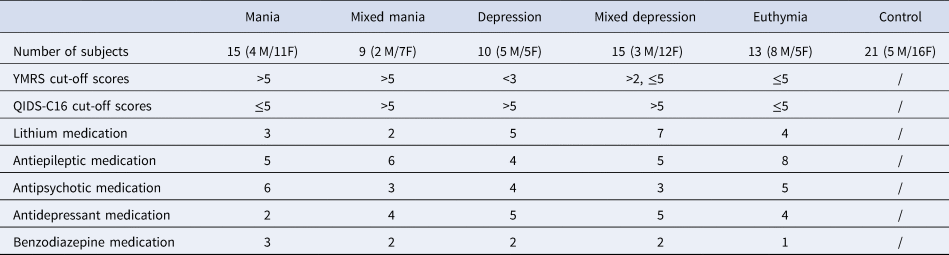
Sixty-two patients (mean age ± s.d.: 43.60 ± 12.57; 40 females) with BD and 21 healthy controls (mean age ± s.d.: 37.33 ± 12.40; 16 females) participated in the study. Sixteen inpatients and 46 outpatients were recruited at the University Hospital of Strasbourg and fulfilled criteria for BD according to DSM-IV-TR (APA, 2000). Patients' clinical state was evaluated using the Young Mania Rating Scale (YMRS; Young et al.,Reference Young, Biggs, Ziegler and Meyer1978) and the Quick Inventory of Depression Symptomatology-Clinician-Rated Version (QIDS-C16; Rush et al., Reference Rush, Trivedi, Ibrahim, Carmody, Arnow, Klein and Keller2003). The same score cut-offs previously used by Weiner et al. (Reference Weiner, Doignon-Camus, Bertschy and Giersch2019b) were used to establish patients' mood state. Diagnostic criteria were established for each mood state as in previous studies (Favre et al., Reference Favre, Aubry, Gex-Fabry, Ragama-Pardos, McQuillan and Bertschy2003; Miller et al., Reference Miller, Suppes, Mintz, Hellemann, Frye, McElroy and Post2016; Rush et al., Reference Rush, Trivedi, Ibrahim, Carmody, Arnow, Klein and Keller2003; Suppes et al., Reference Suppes, Mintz, McElroy, Altshuler, Kupka, Frye and Post2005). The number of patients per group is presented in Table 1. Healthy controls were recruited by advertisement and had no current or past personal or family history of mood disorder or psychosis. Control subjects were originally matched to the sub-groups of BD patients in a previous study using the same participants, hence the imbalance between the patient and healthy control groups. For all participants exclusion criteria included a history of neurological disorder, ADHD, schizophrenia or schizoaffective disorder, borderline personality disorder and substance use disorder within the past 12 months. All participants had normal or corrected-to-normal vision. The neuropsychological evaluation included the Trail Making Test (Tombaugh, Reference Tombaugh2004), the Hayling test (Burgess & Shallice, Reference Burgess and Shallice1997), the Vocabulary Subtest of the Wechsler Adult Intelligence Scale-Third Edition (WAIS-III) (Strauss, Sherman, & Spreen, Reference Strauss, Sherman and Spreen2006) and the French National Adult Reading Test (Mackinnon & Mulligan, Reference Mackinnon and Mulligan2005) (see Supplementary material S1 for details).
Number of participants in the different mood states and cut-off scores used for the diagnosis

YMRS = Young Mania Rating Scale; QIDS-C16 = Quick Inventory of Depression Symptomatology-Clinician-Rated Version.
The project was approved by the regional ethics committee of the East of France (CPP EST IV). All subjects gave their informed written consent in accordance with the Declaration of Helsinki.
Racing thoughts groups
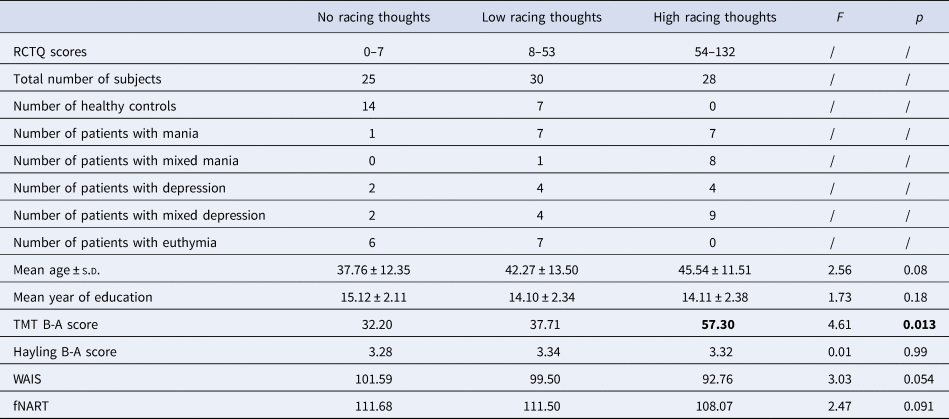
Participants were labeled as having ‘No’, ‘Low’ and ‘High racing thoughts’ based on their RCTQ scores. The groups were formed after visual inspection of the distribution of RCTQ scores and by balancing the number of subjects per group (see distribution in Supplementary material S2). Details about the cut-off score-values and demographic details are shown in Table 2.
Demographic data of the three racing thoughts groups

RCTQ = Racing and Crowded Thoughts Questionnaire; TMT = Trail Making Test; WAIS = Wechsler Adult Intelligence Scale; fNART = French National Adult Reading Test. Significant differences are presented in bold.
Experimental task and procedure
The procedure and analysis method were validated in a sub-group of the healthy controls and are detailed in Polgári et al. (Reference Polgári, Causin, Weiner, Bertschy and Giersch2020). Throughout the experiment participants were asked to indicate perceptual reversals by pressing one of two buttons on a keyboard each time the perceived orientation of the Necker cube changed (left button for downward-left facing orientation, right button for upward-right facing orientation). Four experimental conditions were run in the experiment, each with a duration of one minute in order to minimize effects of fatigue in patients. First, in the ‘Spontaneous’ condition, participants were asked to report the perceptual reversals of the Necker cube that occurred spontaneously. Next, two attentional conditions followed whose order was randomized between subjects. In the ‘Focus’ condition participants were instructed to maintain for as long as possible their preferred orientation of the cube and come back to this orientation as quickly as possible in case of perceptual reversal. In the ‘Switch’ condition they had to switch between the two orientations as often as possible. Lastly, in a control condition two modified, non-ambiguous versions of the Necker cube were presented alternately on the screen with a mean duration of 3 s each, and subjects had to report, via button presses, each time they detected a physical alternation of the cube. This condition was used (i) to verify that participants were able to reliably report perceptual alternations, (ii) to verify the correspondence between ocular fixation coordinates when the Necker cube is ambiguous (and only perception changes) and when the figure changes physically. For details on the equipment see Supplementary material S3.
Data processing
For each condition we extracted the number of button presses reflecting perceptual reversals. This number was used as an estimate of the number of ‘manual windows,’ i.e. the number of periods between subsequent button presses.
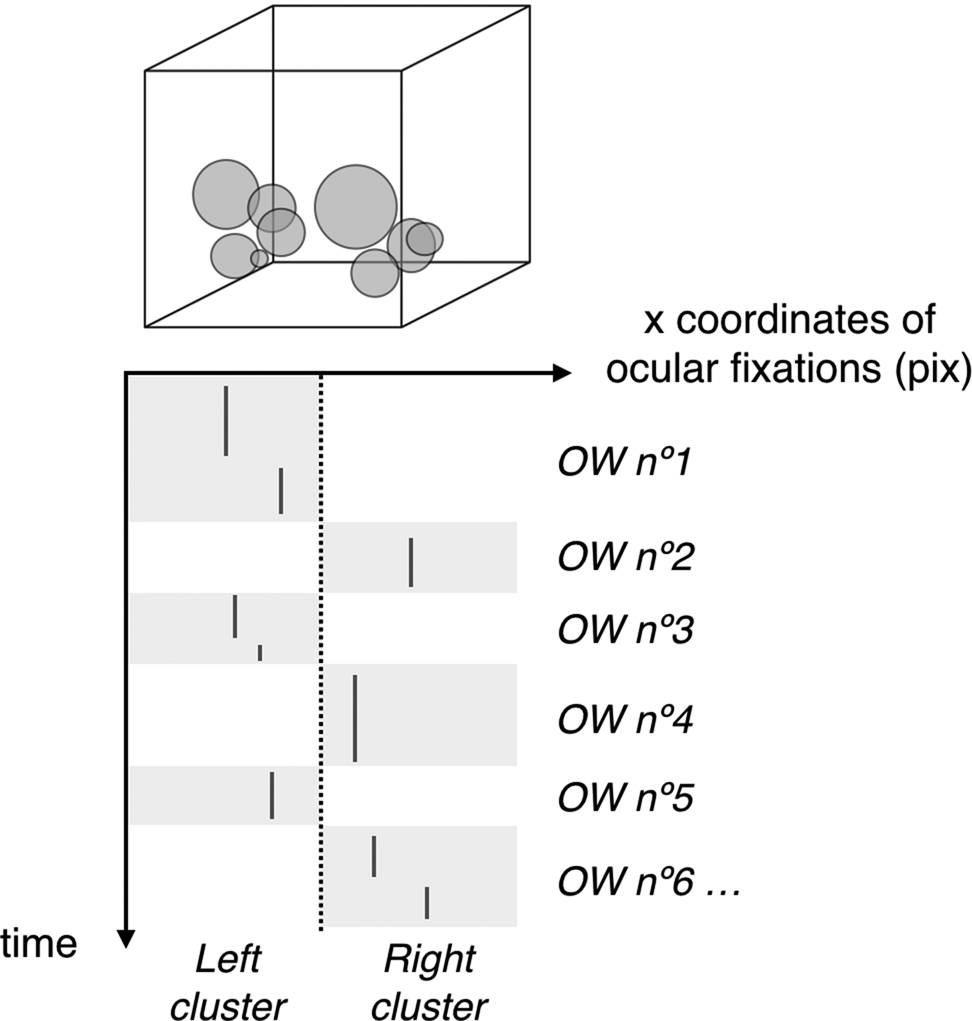
Ocular fixations (details on recording can be found in Supplementary material S3) were extracted for each subject and classified into one of two groups based on their x coordinates (left or right cluster) using the expectation−maximization (EM) algorithm (Witten, Frank, Hall, & Pal, Reference Witten, Frank, Hall and Pal2017). Each cluster was composed of at least one ocular fixation and its length depended on the number and duration of the successive ocular fixations belonging to the same cluster (Fig. 1). Ocular windows correspond to the alternating left and right clusters of ocular fixations and their number was extracted for each participant. More details can be found in Supplementary material S4 and Polgári et al., Reference Polgári, Causin, Weiner, Bertschy and Giersch2020).
Schematic representation of the cluster analysis used for the computation of ocular windows. Ocular fixations are represented on the Necker cube by gray circles whose diameter is proportional to the duration of the fixation (upper part). The x coordinates of the fixations are reported on the graph (bottom part) by continuous lines whose length is proportional to the duration of the fixations. The threshold separating fixations on the left and the right side is computed by the EM cluster algorithm. Successive fixations belonging to the same side form an ocular cluster which corresponds to an ocular window (OW).

Statistical analysis
Data analyses consisted of repeated measures analysis of variance (ANOVAs) and sub-analyses. For details see Supplementary material S3. Correlations were conducted by computing Pearson' correlation coefficients. The level of significance was set to α = 0.05 throughout the analyses. Since racing thoughts groups were close to differ in age and level of education, all analyses (when applicable) were verified with these two measures as covariates. The main results of our study were similar in the analysis of covariance (ANCOVAs) (see Supplementary material S5).
Results
Number of manual windows
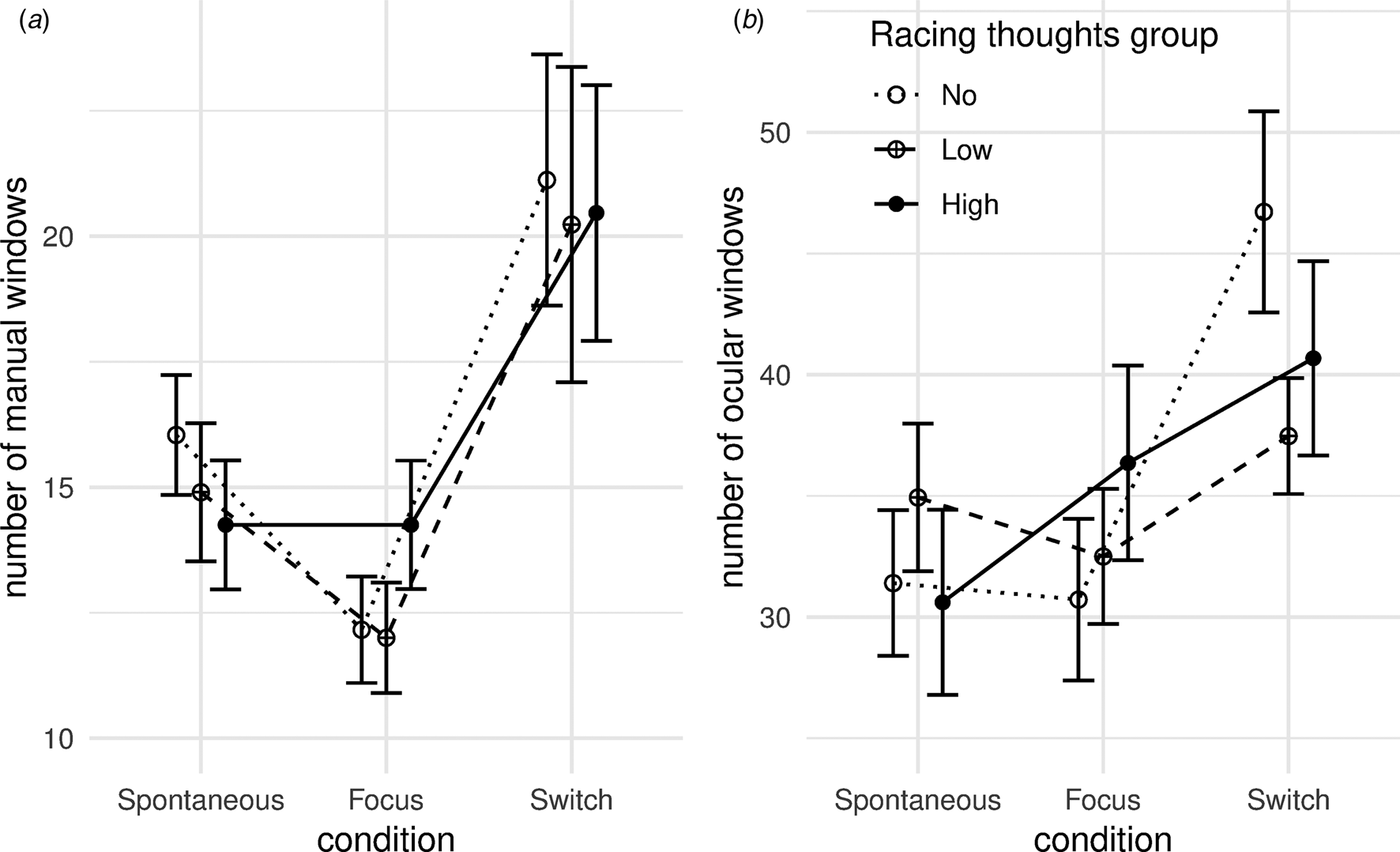
A one-way ANOVA conducted on the number of manual windows, with experimental condition (Spontaneous vs. Focus vs. Switch) as a within-group variable and the racing thoughts group as a between-group variable revealed an effect of experimental condition [F(2160) = 21.00, p < 0.00001, partial η 2 = 0.21]. Sub-analyses showed that the number of manual windows was lower in the ‘Focus’ condition (12.81) compared to the ‘Spontaneous’ [15.02, (F(1,82) = 8.12, p < 0.01, partial η 2 = 0.09)] and ‘Switch’ conditions [20.58, (F(1,82) = 26.23, p < 0.000005, partial η 2 = 0.24)], and higher in the ‘Switch’ condition compared to the ‘Spontaneous’ [(F(1,82) = 19.16, p < 0.00005, partial η 2 = 0.19)] and the ‘Focus’ conditions (Fig. 2a). No effect of racing thoughts group or interaction between the variables was found.
Mean number of manual (a) and ocular windows (b) in each experimental condition across the three racing thoughts groups. Error bars represent ± SEM.

However, the graph suggested a lack of modulation of the manual window rate between the ‘Spontaneous’ and ‘Focus’ conditions in the ‘High racing thoughts’ group, and, given there was a similar pattern for ocular windows, we verified to which extent the manual window rate was modulated in each group. This allowed us to verify whether abnormalities could be said to be restricted to ocular windows or not. Sub-analyses conducted in each group confirmed a decreased window rate in the ‘Focus’ compared to the ‘Spontaneous’ condition in the ‘No’ and ‘Low racing thoughts’ groups [(F(1,24) = 8.02, p < 0.01, partial η 2 = 0.25); F(1,29) = 5.22, p < 0.05, partial η 2 = 0.15) respectively], but equal rates in the ‘High racing thoughts’ group [F(1,27) = 0.00, p = 1, partial η 2 = 0.00]. All groups showed an increase of the manual window rate between the ‘Spontaneous’ and the ‘Switch’ conditions [F(1,24) = 7.50, p < 0.05, partial η 2 = 0.24; F(1,29) = 4.86, p < 0.05, partial η 2 = 0.14; F(1,27) = 7.72, p < 0.01, partial η 2 = 0.22 ‘No’, ‘Low’, and ‘High racing thoughts’ groups, respectively].
Number of ocular windows
We conducted an analysis on ocular windows similar to the one on manual windows. The analysis revealed an interaction between experimental condition and the racing thoughts group [F(4160) = 2.64, p < 0.05, partial η 2 = 0.06] (Fig. 2b). The ‘No racing thoughts’ group had a higher number of ocular windows in the ‘Switch’ condition (46.72) compared to the ‘Spontaneous’ [31.40, (F(1,24) = 19.43, p < 0.0005, partial η 2 = 0.45)] and ‘Focus’ conditions [30.72, (F(1,24) = 12.73, p < 0.005, partial η 2 = 0.35)]. The ‘High racing thoughts’ group had a higher number of ocular windows in the ‘Switch’ condition (40.68) compared only to the ‘Spontaneous’ condition [30.61, (F(1,27) = 5.15, p < 0.05, partial η 2 = 0.16)]. The difference between conditions was not significant in the ‘Low racing thoughts’ group. This reduced modulation of the window rate between the attentional conditions may suggest that oculomotor behavior is immune to instructions in the ‘Low’ and ‘High racing thoughts’ groups. This might have been due to a difficulty to adapt to new instructions when going from the ‘Focus’ to the ‘Switch’ condition, or the reverse. We verified this possibility by analyzing the effect of task order.
Effect of task order
While the spontaneous condition was always performed first, the ‘Focus’ and ‘Switch’ conditions were run afterwards in random order. To verify how manual and ocular behavior are adapted to the history and order of the attentional instructions, we did additional ANOVAs on the number of manual and ocular windows. To explore the impact of instructions across time independent of the precise ‘Focus’ or ‘Switch’ instruction, we considered the rank of the test session ('Second session’ vs. ‘Third session’), which represented a within-group variable. Whether the second and third sessions were with ‘Focus’ or ‘Switch’ instructions depended on the order in which participants completed the two attentional conditions (‘Focus then Switch’ vs. ‘Switch then Focus’), which was taken as a between-group variable. The groups that performed the attentional conditions in different orders (‘Focus then Switch’ vs. ‘Switch then Focus’) did not differ in age, level of education, score at the French National Adult Reading Test and at the digit-symbol subtest of the WAIS-III, and they produced similar numbers of manual [F(1,81) = 3.24, p > 0.05, partial η 2 = 0.04] and ocular windows [F(1,81) = 0.10, p > 0.05, partial η 2 = 0.001] in the ‘Spontaneous’ condition.
The analysis of the effect of order and rank on the number of manual windows did not reveal an interaction with racing thoughts group, meaning similar manual window modulation in all three racing thoughts groups.
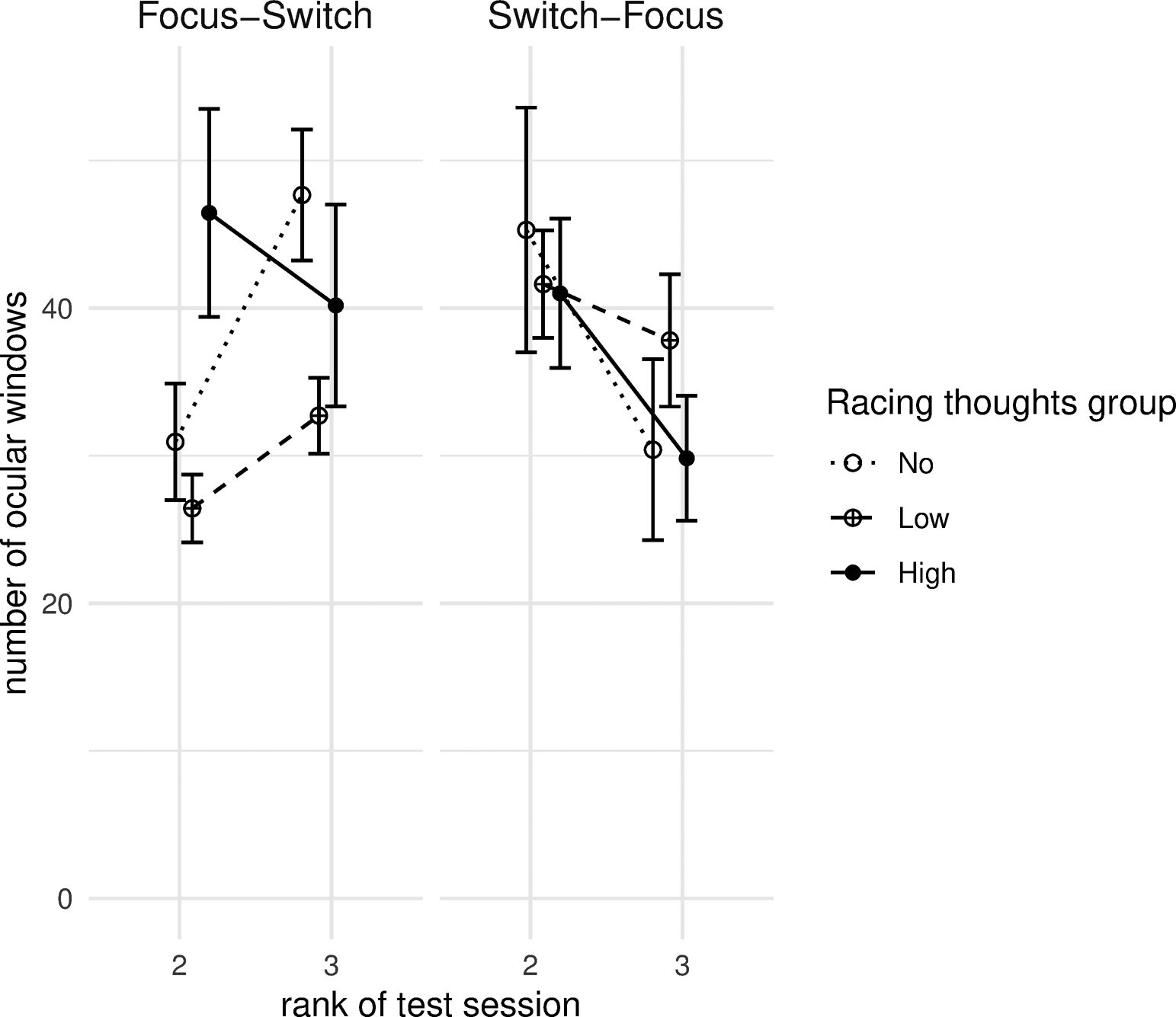
In the analysis on the number of ocular windows a third degree interaction was found between order, rank and racing thoughts group [F(2,77) = 3.69, p < 0.05, partial η 2 = 0.09]. In the group that performed the conditions in the ‘Focus then Switch’ order an interaction was found between rank and racing thoughts group [F(2,37) = 5.92, p < 0.01, partial η 2 = 0.24]. Sub-analyses showed that only the ‘No racing thoughts’ group increased the number of ocular windows from ‘Focus’ (30.93) to ‘Switch’ [47.67, (F(1,14) = 13.84, p < 0.005, partial η 2 = 0.50)]. For the ‘Low’ and ‘High racing thoughts’ groups the difference was not significant [(F(1,13) = 2.71, p > 0.05, partial η 2 = 0.17), (F(1,10) = 1.20, p > 0.05, partial η 2 = 0.11) respectively] (Fig. 3 left panel).
Mean number of ocular windows produced in the attentional conditions, considering the order in which they were performed. Error bars represent ± SEM.

A further ANOVA with racing thoughts group as a between-group variable indicated that in the (first) ‘Focus’ condition the number of ocular windows differed between racing thoughts groups [F(2,37) = 5.04, p < 0.05, η 2 = 0.21]. Sub-analyses revealed that in this condition the ‘High racing thoughts’ group had a higher number of ocular windows compared to the ‘Low racing thoughts’ group [46.46 vs. 26.43 respectively, (F(1,23) = 8.84, p < 0.01, η 2 = 0.28)], and tended towards a higher number of ocular windows relative to the ‘No racing thoughts’ group [46.46 vs. 30.93 respectively, (F(1,24) = 4.19, p = 0.052, η 2 = 0.15)]. No between-group difference was found in the (second) ‘Switch’ condition [F(2,37) = 2.86, p > 0.05, η 2 = 0.13], indicating similar ocular window numbers in all three racing thoughts groups in this condition.
In the group that performed the conditions in the ‘Switch then Focus’ order no interaction between rank and racing thoughts group was found [F(2,40) = 1.09, p > 0.05, η 2 = 0.05]. A simple effect of rank revealed that all groups similarly decreased the number of ocular windows from the ‘Switch’ (42.23) to the ‘Focus’ condition [32.93, (F(1,40) = 10.25, p < 0.005, η 2 = 0.20)] (Fig. 3 right panel).
Correlational analyses
To further verify the link between racing thoughts and an increased ocular window rate when subjects are required to perform the ‘Focus’ condition first, we performed correlational analyses between RCTQ scores and the number of manual and ocular windows in each attentional condition. In the group that performed the conditions in the ‘Focus then Switch’ order the number of ocular windows in the ‘Focus’ condition positively correlated with the RCTQ score (r = 0.45, p < 0.005, N = 40), indicating that the higher the level of racing thoughts subjects reported, the more they made ocular alternations when they were first given the ‘Focus’ instruction. No other correlations with RCTQ scores were found.
We conducted correlational analyses between age, years of education and the number of manual and ocular windows in all three conditions. Age negatively correlated with the number of manual windows in the ‘Spontaneous’ [r = −0,36; p < 0.005] and the ‘Switch’ conditions [r = −0,32; p < 0.005], however no correlations were found with the number of ocular windows.
Correlational analyses were conducted in each racing thoughts group between TMT B-A scores and the number of manual and ocular windows in order to verify a link between attentional switching deficits and increased window rates. In the ‘High racing thoughts’ group (N = 27) attention switching deficits as measured with the TMT positively correlated with the number of manual windows (r = 0.58, p < 0.005), the number of ocular windows in the ‘Focus’ condition (r = 0.41, p < 0.05) and the number of ocular windows in the ‘Switch’ condition (r = 0.47, p < 0.05). No other correlations were significant after correction for multiple testing.
Discussion
The aim of the present study was to investigate whether temporal windows derived from manual and ocular behavior during viewing of the Necker cube could capture the phenomenon of racing thoughts in BD patients and healthy controls. In all groups temporal windows varied as a function of attentional conditions, showing that they followed instructions. Although our ‘High racing thoughts’ group was exclusively composed of BD patients in an acute phase of their illness, the severity of their mood episode was mild-moderate. The mild severity of their state allowed them to perform the experiment and reliably report conscious perceptual alternations, at least in the ‘Spontaneous’ and ‘Switch’ conditions. However, in participants with racing thoughts, windows were less modulated by attentional instructions. Although the results on manual and ocular windows showed a similar pattern, a clear interaction between conditions was observed only for ocular windows. There is no evidence of a genuine increase of perceptual alternation in participants with racing thoughts, since all groups alternated perceptions at the same rate in the ‘Spontaneous’ condition. It is rather the cognitive control of alternations that is impaired in case of racing thoughts.
Taking into account the order in which attentional conditions were run showed an even more specific pattern of results. Specifically, in participants with racing thoughts, anomalies were observed in the ocular window rate in the ‘Focus’ condition when it preceded the ‘Switch’ condition. These anomalies are manifest in the abnormally high number of ocular windows in the ‘Focus’ condition when the instructions constrain participants to control their perceptual reversal rate for the first time, prior to the condition whereby an acceleration of reversals is expected. This shows that the inability to reduce the ocular window rate in participants with racing thoughts is not due to the necessity to go from the ‘Switch’ to the ‘Focus’ condition, but rather occurs when participants are instructed to restrict perceptual alternations after the ‘Spontaneous’ condition.
Participants who performed the attentional conditions in the ‘Switch then Focus’ order had equally increased ocular window rates in the ‘Switch’ condition relative to the ‘Spontaneous’ condition, independently of their self-reported level of racing thoughts. These results suggest that it is not following the attentional instructions in general that is difficult for the patients, but rather the ‘Focus’ condition specifically. The results suggest that in participants with racing thoughts conscious and non-conscious perceptual processes escape the cognitive control mechanisms, especially those elicited by the ‘Focus’ instructions. The correlation between the increase in alternation rates and flexibility deficits further supports this interpretation.
The ‘High racing thoughts’ group displayed attention switching deficits on the TMT B-A, which correlated with the increase in the perceptual alternations in this group. This correlation further supports the interpretation that patients are not genuinely more flexible. Rather, the impaired control of conscious but also automatic perceptual processes underlies the cognitive flexibility deficits of the patients, and their inability to inhibit automatic perceptual alternations of the Necker cube. It is remarkable that there are similar reversal rates in the ‘Focus’ and in the ‘Switch’ conditions in the groups with racing thoughts. These results suggest that the ‘Focus’ condition paradoxically leads to increased reversals, as if ocular reversals were actually activated when cognitive control mechanisms are elicited.
The link between cognitive flexibility and deficient control of automatic perceptual processes in subjects with racing thoughts is consistent with findings in the semantic verbal fluency task in Weiner et al. (Reference Weiner, Doignon-Camus, Bertschy and Giersch2019b). In this study, (hypo)manic patients used sound-based associations when instructed to produce semantically related words. Like in the present study, they circumvented constraining task instructions, i.e. cognitive control, and then displayed increased flexibility.
The clinical implications of our findings are noteworthy. Subjects with racing thoughts were impaired when the task involved cognitive control, and only then alternated perceptions excessively. These impairments are manifest to some extent at the level of conscious perception (i.e. manual windows), but they are more apparent at the level of automatic and unconscious processing as reflected by ocular windows. Automatic perceptual processes measured via ocular windows appear to escape cognitive control. Instead of being rooted solely in mechanisms associated with consciousness, racing thoughts may also involve overactivation of more automatic processes. This may distinguish racing thoughts from other thinking abnormalities found in mood disorders, e.g. rumination, which have been mainly linked to cognitive control deficits (Whitmer & Banich, Reference Whitmer and Banich2016). Akin to research on depressive rumination, studies on the mechanisms involved in racing thoughts are crucial, as they might foster new treatments targeting this understudied symptom (Piguet et al., Reference Piguet, Dayer, Kosel, Desseilles, Vuilleumier and Bertschy2010; Weiner et al., Reference Weiner, Doignon-Camus, Bertschy and Giersch2019b).
There are some limits to this study. The sample size in each sub-group of BD patients prevented us from distinguishing results as a function of the sub-groups. Several studies suggest slow perceptual switching in BD patients (Krug et al., Reference Krug, Brunskill, Scarna, Goodwin and Parker2008; Schmack et al., Reference Schmack, Sekutowicz, Rössler, Brandl, Müller and Sterzer2013; Ye et al., Reference Ye, Zhu, Zhou, He and Wang2019), except in patients with mania (Hoffman et al., Reference Hoffman, Quinlan, Mazure and McGlashan2001). This difference with our study may be related to the types of BD sub-groups included in previous studies. For example, no euthymic patient was part of the group with the highest RCTQ scores. It would be of interest to distinguish temporal windows as a function of the BD sub-groups.
Moreover, the comparison of temporal windows between groups was based on patients' subjective responses on the RCTQ. This is a first methodological step when seeking an objective measure for a subjectively described phenomenon such as racing thoughts. Future works should follow an inverse logic and focus on testing the predictive power of ocular window rates to racing thoughts.
Nevertheless, our results show the interest of adding indirect measures of perception, like the analysis of ocular movements, that do not rely on the subjective decision of the patients. The recording of eye movements might be difficult to set up in clinical settings. However, any indirect measure would be useful, given the difficulty to evidence racing thoughts in laboratory settings (Weiner et al., Reference Weiner, Doignon-Camus, Bertschy and Giersch2019b).
Supplementary material
The supplementary material for this article can be found at https://doi.org/10.1017/S0033291721002592.
Acknowledgements
We thank INSERM and the University Hospital of Strasbourg for their support in this research.
Financial support
The first author (PP) was financed by the French National Research Agency (ANR AutoTime ANR-16-CE37-0004-02 awarded to AG) and the Grand-Est Region. This work was supported by the University Hospital of Strasbourg (GB, grant number PRI 5582).
Conflict of interest
None.