

Introduction
Older populations are vulnerable to financial crises, which may result in both financial and psycho-social difficulties (Hicks and Kingson Reference Hicks and Kingson2009). Government can help alleviate these difficulties by improving the social inclusion of older people and facilitating important aspects of their social life such as work and community engagement, through institutionally mandated as well as support for individual assistance (Campbell Reference Campbell2009). Social inclusion, as defined, in this article, refers to the facilitation of access to important opportunities in society relevant to livelihood, such as employment, education, housing, social protection and health care (Oxoby Reference Oxoby2009). This facilitation also hinges on the level of social cohesion in society. While public support for social inclusion is required to mitigate problems related to a financial crisis, social inclusion itself may erode when the public itself faces hardships due to this same crisis. The effects of both the financial crisis and cohesion in society on social inclusion have not previously been identified because existing research has mostly presented indirect evidence on the impact of a financial crisis by using economic hardship as a proxy of financial crisis (Espvall and Dellgren Reference Espvall and Dellgren2008). Given the paucity of relevant research on this subject, the present study aims to clarify the effects of a financial crisis and cohesion in society on the social inclusion of older people.
Support for the social inclusion of the older population involves public policies that promote intergenerational integration, employment, financial adequacy and community participation during old age (Oxoby Reference Oxoby2009). On the one hand, the impetus of institutional social inclusion rests on public policy. On the other hand, personal social inclusion relates to the contribution of volunteers and other individuals, who provide help to older people, through housework, accompanying them, lending things, as well as befriending them and making their lives easier.
The institutional and personal forms of social inclusion require public support, as the public practises and sponsors social inclusion. This support may weaken when the public itself experiences losses due to a financial crisis, which reduces its financial, physical and mental capabilities in practising social inclusion at the individual or personal level. Thus, it is vital to identify factors that strengthen public support for the social inclusion of older people in the face of a financial crisis. Two factors, as derived from research on public opinion on social welfare and needy people, are the perception of social cohesion in society and actual receipt of benefits from the government (Jenson Reference Jenson2003; van Oorschot and Meuleman Reference van Oorschot and Meuleman2011). Social cohesion refers to the positive connection among members of society for their common good. The indicators of social cohesion among members include care for the community, mutual help, and shared beliefs (Cheung and Leung Reference Cheung and Leung2005; Dayton-Johnson Reference Dayton-Johnson2003). Cohesion is deemed to contribute to prosocial motivation and provision of social support. In contrast, one who receives welfare benefits is likely to be unable to afford the contribution to caring for others' welfare (Verba, Schlozman and Brady Reference Verba, Schlozman, Brady and Neckerman2004). Nevertheless, research has not directly related cohesion and welfare receipt to social inclusion of older people. The current study explores these relationships during the 2008 financial tsunami that impacted on Hong Kong. This financial crisis occurred in September 2008, following the burst in the housing bubble in the United States of America.
The study of the impact of the financial tsunami in Hong Kong may inform public policy in various regions because a financial tsunami or crisis is a recurrent, pervasive and global phenomenon. Reliance on international trade, aid and investment makes many societies vulnerable to financial crises (Rajan Reference Rajan2007). The economic downturn, recession, stagflation, unemployment, depreciation, hardship and evaporation of wealth are clearly all possible direct effects of a financial crisis. Similarly, changes in the rates of suicide, mortality, malnutrition, mental problems, divorce, discrimination, migration, protest and disenchantment with social norms are its likely indirect or extended effects (Gavrilova et al. Reference Gavrilova, Semyonova, Galina, Evdokashkina and Gavrilov2008). These myriad and severe shocks necessarily invoke government responses in respect of economic policy (both monetary and fiscal policies). Whereas monetary policy principally relies on changing the rates of interest and exchange, fiscal policy modifies public revenue and expenditure through taxation and construction of infrastructure. The effectiveness of these two policies is controversial (Mishkin Reference Mishkin2009). The impact of the financial crisis may extend beyond economic problems and their regulation by domestic economic policy. Moreover, the crisis spurs the government to adopt social or welfare policies that enhance social security and services to strengthen social integration, cohesion and inclusion. Social inclusion policy particularly aims to facilitate employment, health, education, accommodation, social protection and common identity of socially excluded people to boost productivity (Oxoby Reference Oxoby2009). Such policies attempt to provide ways to deal with fiscal crisis that restore the social life and economic condition of those people affected. This is of particular relevance to the older population in terms of sustaining their employment, social participation and service reception in an intergenerational setting (Hicks and Kingson Reference Hicks and Kingson2009).
Social inclusion is a public good that involves public investment and redistribution of wealth, which in turn should comply with the principles of distributive justice. A notable principle is that of contractual ethics, which dictates a preferential distribution for disadvantaged people if this does not impair their basic liberty (Rawls Reference Rawls1999). To endorse a social contract for citizenship and consequential rights and responsibilities, the public is required to show support for public policy freely and voluntarily. Support for the social inclusion of the older population is practically and ethically required. As required for the practice of accountable governance, public support is necessary to legitimise and steer public policies (Kemmis and McTaggart Reference Kemmis, McTaggart, Denzin and Lincoln2005). As an ethical concern for respecting people's preference, public support is a yardstick for ascertaining intergenerational equity in redistributing public resources (Williamson, McNamara and Howling Reference Williamson, McNamara and Howling2003). This concern arises because of competition for public resources between younger and older people. In the face of a financial crisis, public support for the older population is especially at stake due to limited public resources (Boersch-Supan Reference Boersch-Supan and Papadimitriou2007). The generational interdependence perspective suggests that younger and older generations share common interests and are not in competition; thus, intergenerational collaboration and integration are beneficial to all generations (Williamson, McNamara and Howling Reference Williamson, McNamara and Howling2003). These policy and ethical concerns highlight the importance of public support and practice as bases for the social inclusion of the older generation.
Political and theoretical import
The importance of the current study rests both upon its clarification of policy and other factors that sustain the social inclusion of the older population and the consolidation of explanatory theory about these factors. Apart from economic policy that selectively provides benefits to people to help them recover from a financial crisis, social policy that champions social cohesion is a primary concern. Unravelling the role of cohesion in mitigating the erosive effect of a financial crisis on social inclusion is crucial, especially in view of the suspicion of this role. Suspicion arises when critics find the existing level of cohesion in society to be demoralising, pathogenic, infeasible and ethically problematic to individuals not yet integrated into the society (Hulse and Stone Reference Hulse and Stone2007). The basis for this criticism is the presence of individuals not cohesive to the society and thus, do not benefit from this cohesion. Moreover, social cohesion is undesirable when it means the imposition of strict social regulations and ignores individual differences and merits. Social cohesion makes people anxious probably because of the regulations imposed by a cohesive society. This criticism is countered by the assertion that social cohesion is favourable in advancing economic growth and political order (Maloutas and Maloutas Reference Maloutas and Maloutas2004). The observed benefits of social cohesion to the wellbeing, health and satisfaction with the neighbourhood at the individual level support this assertion (Wen et al. Reference Wen, Fan, Jin and Wang2010). At the societal level, social cohesion increases employment opportunities (Kingston, Huizinga and Elliott Reference Kingston, Huizinga and Elliott2009). Conversely, social cohesion appears to reduce strain and illness at the individual level (Wen et al. Reference Wen, Fan, Jin and Wang2010). The assertion leads to the advocacy of social cohesion as a worthwhile investment (Stanley and Smeltzer Reference Stanley, Smeltzer and Osberg2003). Thus, verifying the contribution of cohesion to social inclusion of the older population provides a case to justify the promotion of cohesion in society.
Resource theory, self-interest theory and exchange theory are useful in understanding the effects of a financial crisis on social inclusion. Resource theory maintains that financial, human, social, cultural, material and other resources or forms of capital are instrumental to actions and outcomes (Oesterle, Johnson and Mortimer Reference Oesterle, Johnson and Mortimer2004). This theory rests on the premise of a need to assemble inputs to produce outputs. Applying this theory to social inclusion implies that resources are required to fuel social inclusion and that deprivation of resources because of a financial crisis would impede social inclusion. Moreover, self-interest theory posits that the realisation of personal benefit from action, as opposed to cost, inspires action (Musick and Wilson Reference Musick and Wilson2008). This theory rests on the premise of instrumental rationality and the valuation of personal benefit. In respect of public support for social inclusion, self-interest theory purports that one who benefits from social inclusion is likely to lend support to it. Such benefits depend on self-interest, which in turn, can be predicted by social position, characterised by age, income, social class and others. Exchange theory emphasises the role of reciprocity and fairness in action or maintaining relationships to reap valued rewards (Molm Reference Molm and Burke2006). This theory assumes rationality to maximise rewards and comply with the norm of reciprocity. More specifically, exchange theory stipulates such principles as reciprocity, fairness, comparison and generalised exchange. Apart from reciprocating favours and malice, reciprocation needs to be fair, according to the principle of fairness. In maximising rewards, people would compare alternatives, which suggests that exchange need not be one-to-one. Furthermore, the concept of generalised exchange applies to an exchange process that involves multiple parties exchanging with each other sequentially and separately. In generalised exchange, direct exchange is not needed, as common third parties can be used. This is the case of social cohesion, which gathers people to adhere to a community of sharing and mutual help, even without exchanging directly. Applying exchange theory to social inclusion suggests that cohesion is a basis for social inclusion, as a realisation of fair exchange.
Determinants of social inclusion
The theories are useful for understanding the effects of some of the factors on social inclusion, in terms of support for public policy and individual efforts for the older population. Specifically, social inclusion is presumably susceptible to loss due to the financial crisis, benefits received from government, and perception of social cohesion in society. Notably, experiences on the financial crisis and cohesion vary among people and their effects on the support for and practice of social inclusion are different among people.
Loss due to the financial tsunami may weaken the support for and practice of social inclusion of the older population. Such experience typically involves income and asset losses and problems in livelihood. Particularly, one who suffers a financial loss due to a financial crisis is supposedly reluctant to support and practise social inclusion for the older population (Campbell Reference Campbell2009). This validates existing evidence for the effects of economic deprivation as follows. First, support for welfare benefit to older people is lower when people suffer from economic deprivation. Second, economic deprivation erodes support for government responsibility for the older generation (Zumbrunnen and Gangl Reference Zumbrunnen and Gangl2008). Third, there is less support when the evaluated and expected economic situation in society worsens. Finally, economic hardship dampens support for welfare provision in general. These findings show that resource availability (or deprivation) facilitates (or impedes) support for social welfare for the older population. This is the resource theory of social inclusion, which suggests a basis for the eroded support for or practice of social inclusion due to loss in a financial crisis. Accordingly, inadequacy in resources would prevent people from distributing private and public resources to others. Such resources can be psycho-social as well as economic ones (Dovidio et al. Reference Dovidio, Piliavin, Schroeder and Penner2006).
Receiving benefits from the government is another factor that reduces the support for and practice of social inclusion of the older population. The benefits of government policy in addressing a financial crisis evolve from measures to assist in searching for employment, businesses and the resolution of the crisis. One who receives benefits is likely to suffer from a financial crisis, and this suffering would diminish the support and practice of social inclusion because the receipt of government benefits may be an indicator of a resource deficit. According to resource theory, the needy person would not have enough resources to lend support to others. Such resources, which facilitate help and social inclusion, can include work and social competence. Apart from resource theory, self-interest theory can provide an additional explanation for the negative impact of receiving benefits on social inclusion. This theory posits that the needy person or beneficiary from government measures, in defending their self-interest, is reluctant to forgo these benefits (Matthews and Erickson Reference Matthews and Erickson2007). Therefore, self-interest conflicts with public interest and the beneficiary is unwilling to sacrifice their self-interest.
Cohesion, as perceived in society, possibly raises the support for and practice of social inclusion. One possibility is one's willingness to help trustworthy people, regarded as members of a cohesive society. Trust in people may contribute to support for welfare provision. This happens because trust is based on the perception that welfare recipients are trustworthy and deserving, and thus welfare provision is fair. Perceived social cohesion or social trust is also conducive to prosocial behaviour. The contribution of social cohesion is justified by exchange theory. Central to exchange theory is the proposition on the reciprocation of favours (Molm Reference Molm and Burke2006). Cohesion, which is about mutual help, implies the receipt of favours, and the return of favors by supporting and practising social inclusion may be a fair exchange. Moreover, social cohesion guarantees a fair return on investment, as people in society are trustworthy and helpful in maintaining social order (Dayton-Johnson Reference Dayton-Johnson2003). This would also strengthen the support for and practice of social inclusion as an investment when fair exchange is emphasised in exchange theory.
Cohesion in society may mitigate the negative impact of loss on the support for and practice of social inclusion. In other words, persons affected by a financial crisis are more willing to support social inclusion for the older population when they have a higher perception of cohesion in society. Exchange theory posits that support for others hinges on the expectation of benefits received from others (Molm Reference Molm and Burke2006). The mitigating effects of social cohesion can be explained as follows. First, one who suffers a loss due to a financial crisis desires and anticipates receiving more aid from others when social cohesion in society is higher, such that society is more helpful to its members. Second, with this expectation, one is willing to contribute to social inclusion to comply with the requirement of fair exchange. In other words, the desire to contribute to social inclusion and benefit from social cohesion increases with loss due to the financial crisis. Furthermore, cohesion would guarantee the fair exchange between investment in social inclusion and receipt of aid to deal with the crisis because of the contribution of social cohesion to confidence in investment and fair exchange (Stanley and Smeltzer Reference Stanley, Smeltzer and Osberg2003). The guarantee of fair exchange facilitates the application of exchange theory (Dayton-Johnson Reference Dayton-Johnson2003). In line with these arguments, a more socially cohesive context appears to induce higher support from a low-resource person for welfare provision (Kumlin and Svallfors Reference Kumlin, Svallfors, Mau and Veghte2007), presumably because support is a fair exchange for the person in a socially cohesive society.
The perception of cohesion in society may also alleviate the negative impact of receiving benefits from the government on the support for and practice of social inclusion of the older population. Cohesion is likely to increase social inclusion in one receiving more benefits from the government. Exchange theory can explain this increase as follows. First, cohesion may strengthen the beneficiary's belief in fair exchange by contributing to social inclusion. This stems from the contribution of cohesion to the belief in fair exchange (Stanley and Smeltzer Reference Stanley, Smeltzer and Osberg2003). Second, the beneficiary finds it more reasonable to reciprocate benefits by contributing to social inclusion when they realise the guarantee of fair exchange offered by cohesion. Third, the beneficiary has a greater need to reciprocate favours from the cohesion by contributing to social inclusion to conform to the norm of fair exchange because the beneficiary may have a sense of indebtedness in view of the cohesive social milieu in favour of fair exchange. In exchange theory, the sense of indebtedness is a drive for generous action (Dovidio et al. Reference Dovidio, Piliavin, Schroeder and Penner2006). Fourth, cohesion or support from others can substitute for government benefits and become a fair alternative for the beneficiary to exchange by contributing to social inclusion. The condition reflects the principle of exchange theory that the availability of alternative sources of benefits lessens the attractiveness of the original source of benefits (Brinberg and Castell Reference Brinberg, Castell, Foa, Converse, Tornblom and Foa[1982] 1993). To conform to the norm of fair exchange, therefore, the beneficiary is willing to contribute to the social inclusion of older people, although these people do not sponsor the beneficiary directly.
Loss due to a financial crisis is likely to enhance the negative impact of receiving government benefits on the support for and practice of social inclusion of the older population. This is possible when the loss intensifies the beneficiary's self-interest to lessen the loss. Self-interest would impede the social inclusion of older people and reflects the general decline of prosocial behaviour (Feeney and Collins Reference Feeney and Collins2001).
Hypotheses
The aforementioned effects on social inclusion correspond to the following key hypotheses on institutional and personal social inclusion:
• Hypothesis 1: One who experiences a greater loss due to the financial tsunami exhibits the lower (a) support for institutional social inclusion and (b) practice of personal social inclusion.
• Hypothesis 2: One who receives more benefits from the government exhibits the lower (a) support for institutional social inclusion and (b) practice of personal social inclusion.
• Hypothesis 3: One who perceives higher cohesion in society exhibits the higher (a) support for institutional social inclusion and (b) practice of personal social inclusion.
• Hypothesis 4: One who experiences a greater loss due to the financial tsunami exhibits the higher (a) support for institutional social inclusion and (b) practice of personal social inclusion when one perceives higher cohesion in society. The cohesion is thus a condition weakening the effects stated in Hypothesis 1.
• Hypothesis 5: One who receives more benefits from the government exhibits the higher (a) support for institutional social inclusion and (b) practice of personal social inclusion, when one perceives higher cohesion in society. The cohesion is thus a condition weakening the effects stated in Hypothesis 2.
• Hypothesis 6: One who receives more benefits from the government exhibits the lower (a) support for institutional social inclusion and (b) practice of personal social inclusion, when one experiences a greater loss due to the financial tsunami. The loss is thus a condition weakening the effects stated in Hypothesis 3.
In testing these hypotheses, it is necessary to control background characteristics, when they may affect the support for and practice of (a) social inclusion, (b) loss due to the financial tsunami, (c) receipt of benefits from the government, and (d) perceived cohesion in society. These background characteristics include: gender, age (particularly old age), marital status, employment status, birthplace, residency in Hong Kong, education, income and the acquiescent response set. To the extent that these characteristics are indicative of the possession of economic or social resources, they may raise an individual's level of support for and practice of social inclusion. This is applicable for age, income and social class, when they contribute to support for welfare benefits to older people (Blekesaune and Quadagno Reference Blekesaune and Quadagno2003). When the characteristics reflect self-interest, they would reduce the support for and practice of social inclusion. This is applicable for income, education, social class and civil/marital status (Matthews and Erickson Reference Matthews and Erickson2007). Conversely, an older person is likely to support the provision of welfare benefits to the older population (Street and Cossman Reference Street and Cossman2006). The same characteristics can have either positive or negative effects, depending on their roles as resources or reflections of self-interest. Demographic characteristics, such as age, particularly old age, education and social class can affect social cohesion (Espvall and Dellgren Reference Espvall and Dellgren2008; Letki Reference Letki2008). The female, older, immigrant or non-married person is likely to receive welfare, due to lesser ownership of resources (Nielsen, Juon and Ensminger Reference Nielsen, Juon and Ensminger2004). The older or lower-class person is also more likely to suffer from a financial crisis (Hicks and Kingson Reference Hicks and Kingson2009). Hence, demographic characteristics can influence social inclusion, cohesion in society, loss due to the financial tsunami and receipt of government benefits. These characteristics are reasonable control variables included in the current study.
Methods
A retrospective cross-sectional design approach was adopted. Realistically this was the only practical choice available. This type of approach has been proven useful and demonstrated acceptable validity in many studies (Bell and Hartmann Reference Bell and Hartmann2007; Haas and Bishop Reference Haas and Bishop2010). More importantly, the financial tsunami is a recent and unforgettable event such that the memories of this event should have remained vivid (Bell and Hartmann Reference Bell and Hartmann2007). Moreover, a retrospective measurement has the advantage of avoiding the response shift bias, which refers to a difference due to change in scale calibration across occasions of measurement (Townsend and Wilton Reference Townsend and Wilton2003).
The current study collected quantitative data to test these hypotheses. A random sample telephone survey was conducted from March to December 2009 (6–14 months after the outbreak of the financial tsunami); 1,352 Hong Kong Chinese adults (age 18+) were interviewed. The sampling frame was provided by residential telephone numbers in Hong Kong, from which a random sample of households for contact was generated. Within each contacted household, one member was selected by a random sampling procedure for interview. The survey took place on weekday evenings. A response rate of 39.5 per cent was attained, based on 3,423 household members contacted. The response rate fell within the 25 per cent to 50 per cent range: an average for standard and rigorous random-sample telephone surveys, respectively (Keeter et al. Reference Keeter, Kennedy, Dimak, Best and Craighill2006). To represent the adult population of Hong Kong, a two-step procedure weighted the cases. The first step weighted the case by the number of adult household members to provide an equal chance for each member being selected as survey respondent. The second step assigned weights to the results to ensure that the distribution of gender and age approximated to the actual distribution in the Hong Kong population. In the weighted sample, the number of men and women in different age categories are proportional to those in the population.
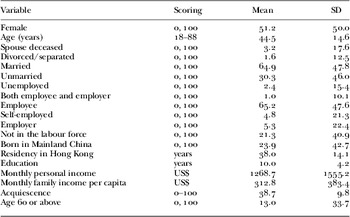
Major background characteristics of the sample were as follows. The average age was 44.5 years and the average duration of residence in Hong Kong was 38 years (see Table 1). About half of the respondents were female (51.2%). The majority of the respondents were employees (65.2%) and were married (64.9%). On average, respondents had 10.0 years of schooling.
Means and standard deviations (SD) of demographic characteristics

Note: N = 1,352.
Measurement
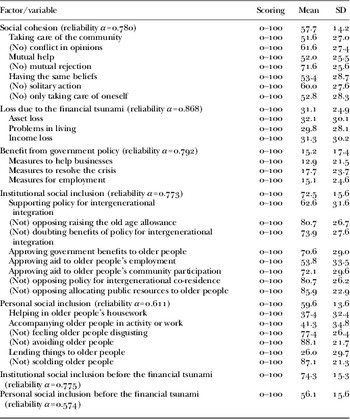
Institutional and personal forms of social inclusion, the loss due to the financial tsunami, the extent of benefit received from government and perceived levels of social cohesion in society were measured by multiple indicators (see Table 2). Each indicator had a five-point rating, generating the scores of 0 for the ‘no or little’, 25 for ‘rather little’, 50 for ‘average’, 75 for ‘quite a lot’ and 100 for ‘very much’. They were interspersed randomly within sections of the questionnaire to minimise the carryover effect from a similar preceding rating. Some of the indicators were negatively worded to minimise the acquiescence bias (Ferrando and Lorenzo-Seva Reference Ferrando and Lorenzo-Seva2010), and they were reverse scored for analysis. Some measurements captured the respondent's perceptions of conditions before and after the financial tsunami.
Means and standard deviations (SD) of key factors and their variables

Note: N = 1,352.
Institutional social inclusion, as defined earlier, refers to support for public policy for the social inclusion of the older population in Hong Kong (the older population was the group of people the respondents considered to be such). The public policy dealt with aspects such as intergenerational integration, old age allowance, employment of older people and community participation. A notable policy instrument in Hong Kong is the old age allowance, which is a monthly cash benefit provided by the government to all older citizens aged 70 or above without requiring a means test. Another notable policy in Hong Kong is the priority given to intergenerational co-residence in the allotment of public housing. These policies facilitate the integration of older citizens into the economic and socio-cultural life of Hong Kong. Social inclusion had two scores: one for the recent month and another for the time before the financial tsunami. Based on factor analysis, the reliability of the eight-item factor score was 0.773 for the recent month and 0.775 for the period before the financial tsunami.
Personal social inclusion referred to the personal practice of social inclusion of the older population in the recent month. Such practice comprised helping, accompanying, lending, not rejecting, not avoiding and not chastising older people (Hermalin and Shih Reference Hermalin, Shih and Whyte2003). Social inclusion had two scores: one for the recent month and another for the period before the financial tsunami. Based on factor analysis, the reliability of the six-item factor score was 0.611 for the recent month and 0.574 for the period before the financial tsunami.
Loss due to the financial tsunami was a composite of income and asset losses and livelihood problems due to the financial tsunami since early 2009 (Lincoln, Chatters and Taylor Reference Lincoln, Chatters and Taylor2003). Based on factor analysis, the reliability of the three-item factor score was 0.868.
Receiving benefits from the government referred to benefiting from government measures to help businesses and generate employment, and resolve the financial crisis in the recent month. Based on factor analysis, the reliability of the three-item factor score was 0.792.
Social cohesion, the extent of which was perceived to be present in society, referred to attitudes to mutual support, caring and consensus as opposed to conflict and solitary action found in Hong Kong since the start of 2009 (Cheung and Leung Reference Cheung and Leung2005; Dayton-Johnson Reference Dayton-Johnson2003). Specifically, positive indicators included care of the community, mutual help and shared beliefs among people in Hong Kong; negative indicators were conflict in opinions, mutual rejection, solitary action and care only for oneself. Based on factor analysis, the reliability of the seven-item factor score was 0.780.
Acquiescence referred to the tendency to give a high rating to any item. The average of all rating items, including social inclusion, cohesion, loss due to the financial tsunami and receiving benefits from the government, before reverse scoring, was computed to form a measure of the tendency to rate all items highly. Since the items included both positive and negative aspects of the various studied domains, high ratings on all the items indicated the tendency of exaggeration and low ratings reflected reservations. Acquiescence was, thus, an indicator of the method artefact of self-reported rating (Billiet and Davidov Reference Bell and Hartmann2008). It was useful as a control variable to reveal the effects of other predictors.
Analytic procedure
A series of linear regression analyses were performed to test the hypotheses. Institutional and personal social inclusion were taken to be separate outcome variables. Model 1 in the series estimated the effects of only the background characteristics. Model 2 added the key predictors of perceived social cohesion, loss due to the financial tsunami and receiving benefits from government, together with old age. Model 3 added interactions among the three key predictors. Lastly, Model 4 added social inclusion before the financial tsunami as control variables to reveal changes due to other predictors.
Results
The results showed that loss due to the financial tsunami tended to erode the institutional and personal social inclusion of the older population, whereas cohesion appeared to sustain social inclusion. The data further indicated interaction effects as hypothesised, such as the mitigation of the negative effect of loss due to the financial tsunami by the social cohesion experienced.
Institutional social inclusion of the older population, in terms of support for public policy, was moderately high on average, during the recent month and the period before the financial tsunami (mean = 72.5 and 74.3 on a 0–100 scale, see Table 2). The small decline since the financial tsunami was statistically significant (t = 2.8, p = 0.005), suggesting that the financial tsunami eroded public support for social inclusion of the older population. Personal social inclusion was modest during the recent month and the period before the financial tsunami (mean = 59.6 and 56.1, in the range of ‘average’ on a 0–100 scale). A statistically significant rise in personal social inclusion occurred (t = 13.1, p < 0.001). While this finding showed the impact of the financial tsunami, it did not capture the impact of loss due to the financial tsunami. The impact of the loss only represented part of the impact of the financial tsunami as the loss was rather low on average (mean = 31.1). That is, the average Hong Kong Chinese adult did not suffer heavy economic losses due to the financial tsunami. Receiving benefits from the government for dealing with the financial tsunami was very low on average (mean = 15.2). Social cohesion perceived in Hong Kong was modest (mean = 57.7).
Predicting institutional social inclusion
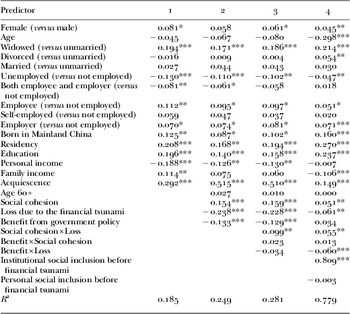
Loss due to the financial tsunami appeared to lower institutional social inclusion in the months following the tsunami, even when controlled for social inclusion prior to the financial tsunami. Accordingly, the loss delivered a significant negative effect on institutional social inclusion (see Table 3). This finding supported Hypothesis 1, although the change effect, after controlling for prior social inclusion, was weak (β = −0.061, see column 4 in Table 3).
Standardised effects of predictors on institutional social inclusion

Significance levels: * p < 0.05, ** p < 0.01, *** p < 0.001.
The negative effect of receiving government benefits on social inclusion was significant before controlling for prior social inclusion (see columns 2 and 3 in Table 3). This finding supported the argument that receiving government benefits is an indicator of resource deprivation, which would impede social inclusion. The finding suggested that receiving government benefits lessened resource deprivation, thus neutralising the negative effect of resource deprivation. However, controlling for prior social inclusion made the effect of receiving benefits no longer significantly negative. This finding did not fully support Hypothesis 2 on the negative impact of receiving government benefits on social inclusion.
Perceived social cohesion in Hong Kong indicated a negative effect on institutional social inclusion, even after controlling for prior social inclusion. The finding supported Hypothesis 3, although the change effect was weak (β = −0.051, see column 4 in Table 3). Prior social inclusion appeared to confound part of the effect of the cohesion on social inclusion of the older population.
Given the cohesion perceived in society, loss due to the financial tsunami was less detrimental to institutional social inclusion. This happened when the interaction between the loss and cohesion engendered a significantly positive effect, even after controlling for prior social inclusion (β = 0.055, see column 4 in Table 3). Thus, social cohesion mitigated some negative effects of the loss. The finding supported Hypothesis 4.
Cohesion in society did not mitigate the effect of receiving government benefits on institutional social inclusion. The effect from the conjunction of social cohesion and receiving government benefits was not statistically significant. Hypothesis 5 was not supported in terms of institutional social inclusion.
The interaction between loss due to the financial tsunami and receiving government benefits showed a significant negative effect on institutional social inclusion after controlling for prior social inclusion (β = −0.060, see column 4 in Table 3). This finding indicated that beneficiaries showed lower institutional social inclusion when they experienced higher loss due to the financial tsunami. The finding validated Hypothesis 6.
Apart from prior institutional social inclusion, several background characteristics were found to have significant effects on institutional social inclusion, namely gender, age, widowhood, unemployment, being an employer, birthplace, residency, education and income. Among the characteristics, age turned out to be the strongest determinant after controlling for prior institutional social inclusion (β = −0.298, see column 4 in Table 3). The finding indicated that ageing decreased the perception of institutional social inclusion of the older population. Residency, education and widowhood were the next strongest predictors and they all generated positive effects on institutional social inclusion. Furthermore, institutional social inclusion was seen as higher among those born in Mainland China, employers, divorcees or women. Higher family income decreased the perception of institutional social inclusion.
Predicting personal social inclusion
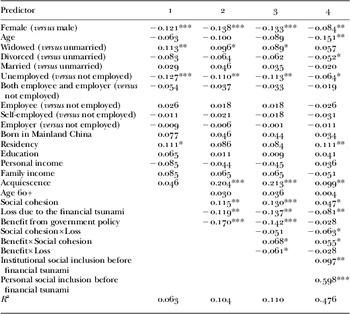
Loss due to the financial tsunami exerted a significant negative effect on personal social inclusion of the older population, even after controlling for prior social inclusion and background characteristics (β = −0.081, see column 4 in Table 4). Hypothesis 1 was supported by the finding, although the effect was weak.
Standardised effects of predictors on personal social inclusion

Significance levels: * p < 0.05, ** p < 0.01, *** p < 0.001.
Receiving benefits from the government indicated a significant negative effect on personal social inclusion, but only before controlling for prior social inclusion (β = −0.142, see column 3 in Table 4). Hypothesis 2 received partial support.
Cohesion perceived in Hong Kong engendered a significant positive effect on personal social inclusion, but only before controlling for prior social inclusion (β = 0.130, see column 3 in Table 4). This finding did not support Hypothesis 2.
Cohesion in society magnified the negative effect of loss due to the financial tsunami on personal social inclusion. Accordingly, the interaction stemming from the conjunction of the loss and social cohesion was significantly negative (β = −0.063, see column 4 in Table 4). This effect contradicted Hypothesis 4.
Cohesion in society, however, reduced the negative effect of receiving government benefits on personal social inclusion. In this connection, the interaction between social cohesion and receiving government benefits illustrated a significant positive effect on personal social inclusion (β = 0.055, see column 4 in Table 4). The finding that receiving government benefits was less detrimental to personal social inclusion supported Hypothesis 5, although the interaction effect was weak.
The conjunction of loss due to the financial tsunami and receiving benefits from the government manifested a significant negative effect on personal social inclusion, but only before controlling for prior social inclusion. This effect was weak (β = −0.061, see column 3 in Table 4). The finding did not support Hypothesis 6.
Personal social inclusion before the financial tsunami was a strong predictor of recent personal social inclusion (β = 0.598, see column 4 in Table 3). Background characteristics that displayed significant negative effects on personal social inclusion included being of female gender, age and unemployment. Residency was the only background characteristic, which showed a significant positive effect on personal social inclusion.
Summary
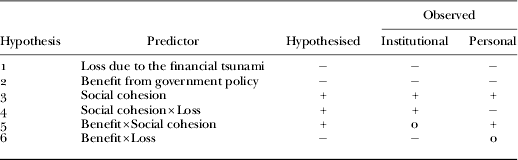
Hypotheses 1 and 2 received consistent support from the impact of the negative effects of loss due to the financial tsunami and benefit from government policy on the institutional social inclusion and personal social inclusion of older people (see Table 5). Moreover, Hypothesis 3 was consistently supported by the positive effect of social cohesion on the two forms of inclusion. There was partial support for Hypotheses 5 and 6 concerning the interaction effects involving benefits from government policy. Accordingly, the benefit tended to strengthen the positive and negative effects of cohesion and loss on personal and institutional social inclusion, respectively. Hypothesis 4 obtained support from the positive effect of the conjunction of the cohesion and loss due to the financial tsunami on institutional inclusion. However, the negative effect of the same conjunction on personal social inclusion contradicted the hypothesis.
Summary of predicted and observed effects of predictors on institutional and personal social inclusion
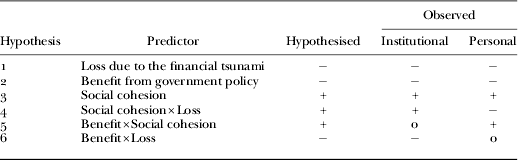
Significance levels: + significantly positive, − significantly negative, 0 insignificant.
Discussion
The results fully support Hypothesis 1 and partially support Hypotheses 2, 3, 4, 5 and 6. These findings can be explained by resource, self-interest and exchange theories. Resource theory is applicable when the possession of more resources leads to the support or practice of social inclusion. On the other hand, the loss or deficiency of resources is not a basis for social inclusion. This would be the case for smaller loss due to the financial tsunami, less reliance on government benefits and the occurrence of both conditions. Furthermore, as unemployment reflects the possession of fewer resources, it would reduce the support for and practice of social inclusion. The converse case refers to the positive effects on social inclusion of education and being an employer, where both are associated with more resources. Self-interest theory posits that one supports or practices social inclusion when it is beneficial or not costly to oneself. In line with this theory, the negative effect of receiving government benefits on the support for and practice of social inclusion reflects competition for resources. The positive effect of widowhood and the negative effect of family income are consistent with self-interest theory.
Exchange theory is vital to explain the positive effects of cohesion in society and the interactions with loss due to the financial tsunami and receiving government benefits on social inclusion, especially in terms of support for public policy. This theory principally asserts that the norms of reciprocity and fairness govern interaction to adhere to social norms and maximise valued rewards (Dovidio et al. Reference Dovidio, Piliavin, Schroeder and Penner2006). Hence, perceived cohesion in society would be seen as a reward through generalised exchange involving three or more parties; moreover, this is a reward that requires reciprocation through the practice of social inclusion. Social cohesion represents an investment by society for favourable outcomes (Stanley and Smeltzer Reference Stanley, Smeltzer and Osberg2003). Conversely, low social cohesion means the unavailability of informal social support. In this regard, exchange theory suggests that the unavailability of alternative reward increases commitment to the exchange concerned. The unavailability of informal social support would heighten reliance on public benefit and, thus, discourage providing public benefits for the older population. Exchange theory refers to commitment as an exchange that yields higher rewards (SunWolf Reference SunWolf2008). When the public finds that tackling social conflicts and problems due to the lack of social cohesion is more rewarding than social inclusion of the older population, the public would prefer the former to the latter. This preference would result in the lower support for or practice of social inclusion.
Moreover, the contribution of cohesion in society to support social inclusion is stronger in the presence of harsher loss due to the financial tsunami and benefits received from the government. The presence of each factor may elevate the need for and value of fair exchange to fulfil the norms of exchange and maximise the gain. Social cohesion may offer a guarantee for fair exchange between receiving government benefits and support for government policy. Social cohesion signifies the possibility of generalised exchange, when people in society agree with and are helpful to each other (Dayton-Johnson Reference Dayton-Johnson2003). This provides the grounds for exchange between receiving government benefits and social inclusion of the older population.
The only contradictory finding, which does not support Hypothesis 4, is the negative effect involving cohesion in society and loss due to the financial tsunami on the personal practice of social inclusion. This negative effect probably alludes to the operation of diffusion of social responsibility when the person experiences loss due to the financial tsunami. Accordingly, diffusion of social responsibility usually refers to the withholding of assistance in the presence of other helpers (Blair, Thompson and Wuenseh Reference Blair, Thompson and Wuenseh2005). These effects are consistent with the comparison principle in exchange theory when the presence of alternative helpers divides and diminishes the reward to the helper. The diminished reward would mean a reduction in personal investment, such as the practice of social inclusion. Social cohesion clearly represents alternative helpers and performers and this may erode the prosocial practice. Personal social inclusion, therefore, suffers in the face of cohesion. This countervailing effect of social cohesion tends to be insignificant on the support for institutional social inclusion due to the irrelevance of diffusion of responsibility because the older population includes many people and there are numerous opportunities to help older people through public means. As no single person is responsible for and stands to benefit from institutional social inclusion, diffusion of responsibility is irrelevant. The effect of diffusion of responsibility would occur when the suffering commonly lessens the responsibility to practise social inclusion due to the enactment of the sick role, which exempts one from taking responsibilities (Bouton, Mineka and Barlow Reference Bouton, Mineka and Barlow2001).
Further research
Further research is required to substantiate the findings of the current study, which relies on the self-reported data of Hong Kong people. Further, it also relies on respondents' general understanding of the older population, rather than providing them with a definite older referent with specific age, gender and other characteristics. Hence, it may be that respondents provide different responses according to their particular construction of older people. Further research is necessary to scrutinise a possible variation due to different understandings of this term.
Despite their theoretical justification and consolidation, the findings about the support for and practice of social inclusion require further verification and substantiation. The effects are not definite in their causal inference, as they arise from the analysis of largely cross-sectional and retrospective data. These findings are descriptive of the case in Hong Kong, and the extent of their application to other places is uncertain. These limitations require further research for improved designs and samples. An improvement to the design would be to construct a longitudinal study that could be used to ascertain causal influences of prior causes on later outcomes, preferably incorporating repeated measurements. The latter are necessary to highlight causal effects not due to self-selection based on prior conditions. Another consideration would be to have samples, other than those drawn from Hong Kong, to corroborate and further validate the generalisations from the present findings. One limit of resource theory is that according to the law of diminishing marginal returns, resources are not influential when they are abundant. This is also a tenet of exchange theory. To the extent that resources are less influential when they are more abundant, this theory would be less relevant in affluent or resourceful places and leads to the weakened negative impact of the financial crisis. Cultural factors can also possibly affect the application of self-interest theory when they suppress or accentuate the significance of self-interest. Conceivably, the individualist culture enhances its significance, whereas this is downplayed in collectivist culture (Rocha and Ghoshal Reference Rocha and Ghoshal2006). Cultural and structural factors that shape the norms of reciprocity, fairness, comparison and generalised exchange would affect the relevance of exchange theory. Confucian culture is one factor that intensifies the norm of reciprocity (Buchan, Croson and Dawes Reference Buchan, Croson and Dawes2002) and may augment the influence of social cohesion as a fulfilment of the norm of reciprocity. Moderation of the observed effects due to theoretically relevant structural and cultural factors need to be elucidated in further research.
Further research can also elaborate on the arguments contained within the present study, notably the operation of exchange theory. The mediating and moderating roles of reciprocity, fairness and comparative value underlying exchanges and diffusion of responsibility are of vital concern. Further elaboration or substantiation necessarily requires the measurement and analysis of such mediators or moderators, especially when examining the impact of cohesion perceived in society on social inclusion. For instance, further research can assess the extent to which the norm of reciprocity amplifies the impact. Further research can also examine the diffusion of responsibility as a mediating process for the negative effect of cohesion on personal social inclusion.
Implications
As loss due to the financial tsunami tends to erode the support for and practice of social inclusion of the older population, mitigating this erosion is crucial. A disappointing finding is that government welfare policy that seeks to address the negative effects of the financial tsunami does not mitigate the erosion. Benefits received from this policy neither discourage nor encourage social inclusion. As a result, social cohesion in society becomes particularly important because of its mitigation function. Apart from sustaining social inclusion, cohesion experienced in society tends to alleviate the negative impact of loss due to the financial tsunami on support for institutional social inclusion. Cohesion maintained in society is, therefore, worth promoting as a means to activate institutional social inclusion of the older population. This means promoting cohesion in society needs to be a social policy to improve social inclusion, especially when the welfare policy that selectively offers benefits is not effective. Furthermore, exchange theory purports that cohesion merits promotion because the public tacitly deems it a fair bargain in exchange for investment in social inclusion.
To encourage individual social inclusion of older people, social cohesion in society can be promoted to facilitate inclusion among people who did not suffer from the financial tsunami or did not receive government benefits. These individuals would be those weathering the financial crisis. They can benefit from a government welfare policy that helps them recuperate from the financial crisis. Integrating social welfare with social cohesion would help people to practise personal inclusion of older people. Conversely, promoting social cohesion would not facilitate personal inclusion when the person suffers from a financial crisis. In this case, sufferers may find themselves alienated from a cohesive society. This reflects a drawback of a cohesive society, in that it is unfavourable to people not included in the cohesive network (Hulse and Stone Reference Hulse and Stone2007). In this case, promoting cohesion in society may alienate, rather than integrate people already detached from society because they may not find themselves benefiting from social cohesion. To prevent alienation, it is advisable to provide welfare benefits to these people.