




Crossref Citations

This article has been cited by the following publications. This list is generated based on data provided by Crossref.
Varma, Arup
Zilic, Ivana
Katou, Anastasia
Blajic, Branimir
and
Jukic, Nenad
2020.
Supervisor-subordinate relationships and employee performance appraisals: a multi-source investigation in Croatia.
Employee Relations: The International Journal,
Vol. 43,
Issue. 1,
p.
45.
Costello, Martina
Rusell, Kylie
and
Coventry, Tracey
2021.
Examining the average scores of nursing teamwork subscales in an acute private medical ward.
BMC Nursing,
Vol. 20,
Issue. 1,
Graen, George
Canedo, Julio C.
Johnson, Andrew F.
and
Grace, Miriam
2021.
Leadership.
p.
157.
Vermeulen, Marjan
Kreijns, Karel
and
Evers, Arnoud T
2022.
Transformational leadership, leader–member exchange and school learning climate: Impact on teachers’ innovative behaviour in the Netherlands.
Educational Management Administration & Leadership,
Vol. 50,
Issue. 3,
p.
491.
Özdemir, Nedim
Çoban, Ömür
Buyukgoze, Hilal
Gümüş, Sedat
and
Pietsch, Marcus
2024.
Leading Knowledge Exploration and Exploitation in Schools: The Moderating Role of Teachers’ Open Innovation Mindset.
Educational Administration Quarterly,
Vol. 60,
Issue. 5,
p.
668.
Witthöft, Jasmin
Adams, Donnie
Aydin, Burak
Muniandy, Vasu
and
Pietsch, Marcus
2026.
Microfoundations of open innovation in schools: overcoming teachers’ not-invented-here syndrome with transformational leadership and leader-member-exchange.
School Leadership & Management,
Vol. 46,
Issue. 1,
p.
131.
The focal article authors have done the field a welcome service by alerting us to some of the forthcoming changes in the world of the knowledge worker. We agree that emerging changes in the structure and processes of work will need to be accommodated by new design of work—a new millennial workforce, new definitions of work, innovative practice, and the transition from a concentration on improved quality of manufacturing to a primary drive toward high technology driven innovation. The most radical adaptation may be the change from organizations designed for stability to those designed for flexibility (Chernyak-Hai & Rabenu, Reference Chernyak-Hai and Rabenu2018; Grace & Graen, Reference Grace and Graen2014).
We agree with Chernyak-Hai and Rabenu (Reference Chernyak-Hai and Rabenu2018) that new frameworks are needed to move from the machine operator era of quality manufacturing and automation to the knowledge worker and innovation era. Our research on exchange and alliance frameworks brings us to the conclusion that what are needed are alliance frameworks in which the object of interest is a project or enterprise. The investors have a common stake—all need the project or enterprise. The process involves each party calculating a cost–benefit analysis before investing and profiting from the success of the enterprise. In contrast to exchange theories in which the relationship of interest is one of unequal power, alliance frameworks of interest focus on relatively equal investments. Alliance depends on quality of the interpersonal relationships between investors. If, for example, a key investor fails to deliver required resources, the alliance may collapse and the project or enterprise fail. The exchange framework was useful when describing piecework and psychological contracts with ongoing negotiations: The seller is the machine operator and the buyer is the corporation. The future will be teams working on projects as alliance partners.
In the alliance framework, we are specifying small teams on projects. Teams are groups of people with common investments in their project, with formal roles and norms. The process of making what each accomplishes as their profit for work involves refined negotiation of rules within functions on what is now called “flexible organization” (Grace & Graen, Reference Grace and Graen2014). Flexibility may involve the new definitions of variable organizational boundaries, mobility, space, communications, and more. With more and more avenues of flexibility comes greater freedom of choice. This renders interpersonal relations within a team much more critical. Knowledge work team members may be scattered across the globe and some in space, air, water, or ground travel during a team meeting at a convenient time zone. Our research on social, economic, educational, political, and religious exchange theory is too easily fixed when only one side has the right to evaluate performance. When the sole means of performance evaluation is controlled by one side in a team, the less powerful is rendered helpless and grieving the unfairness of both the procedure and the responsible agent—the team leader (Canedo, Graen, Grace, & Johnson, Reference Canedo, Graen, Grace and Johnson2017).
For these reasons, our new framework uses alliance and not a simple quid pro quo (exchange theory). Instead of two parties bartering in a context where influence is unequal (social, economic, etc.), the alliance framework is two or more workers investing in the same project or enterprise over time with all parties benefiting fairly according to their investment in time and other resources. An important parameter that influences the value of the benefit is the continued contributions of each party. The fear of a key investor dropping out at a critical point is a major consideration of all investors. This fear of divorce is influenced by the quality of the alliances between and among investors. When the buyers are leader and members as a team, the most important consideration is the team leader interpersonal relationship and next those in order of contribution.
In addition, all parties evaluate the relative contribution of each investor to the success of the enterprise. Alliance works better than exchange for more equal power situations, like freelancers and clients or subcontractors and clients. The process has a lifecycle in which events depend on timely investments by contributors in terms of time, behavior, and other resources (Steinhilber, Reference Steinhilber2008). Successful alliances may require the right framework, the right organization design, and the right people. This can be trained. Unfortunately, almost all of the research has focused on independent organizations and not on small teams in flexible organizations (Heathfield, Reference Heathfield2018). The main idea undergoing alliance in small teams is that a director would be dysfunctional, but a coordinator (a flight controller) is useful. In sum, the typical hierarchy of authority and control inhibits full flexibility of a team. An alliance is a helping relationship in which your ally helps solve problems, acts as a sounding board, and pitches in when needed. At the end of the project, your allies may become your most valuable partners.
The New LMX-Alliance Framework
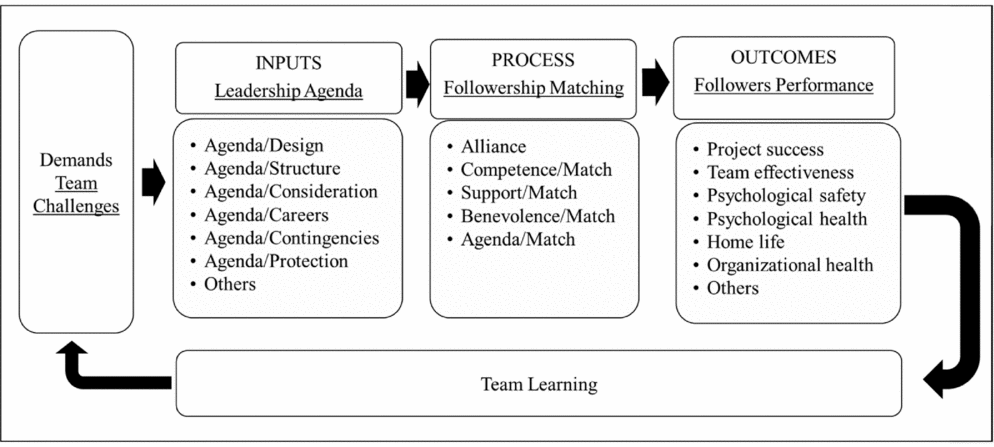
Figure 1 shows our new theory. The new LMX-Alliance (LMX-A) framework begins with the project demands and subsequent developed team challenges. These present the mission as agreed on by the organization representatives and the team. These targets are followed by promised inputs designed to influence the team toward greater effectiveness, such as more appropriate design of roles and technology (Grace & Graen, Reference Grace and Graen2014), proper initiation of structure and consideration (Stogdill, Reference Stogdill1950), transformation conversations (Judge & Piccolo, Reference Judge and Piccolo2004), contingent rewards (Podsakoff, Bommer, Podsakoff, & Mackenzie, Reference Podsakoff, Bommer, Podsakoff and Mackenzie2006), psychological protection (Edmondson & Lei, Reference Edmondson and Lei2014), inclusion (Hollander, Reference Hollander and Rumsey2012), and many others. These theories are described in the Oxford Handbook of Leadership (Rumsey, 2013).
New standard team leadership–followership structural equation meta-analysis model.
The framework continues to processing. In this stage, the details of the promised new system is negotiated between leader and team until each team member finds roles and norms. The relationships have been negotiated first and later the input to output functions are mediated or moderated by the quality of the alliances within the team, especially those with the leader. The next stage contains the outcomes, as shown. The final stage of the system is the team learning and decision to remain for another project or find a new team. As shown and discussed, this new theoretical framework is designed to accommodate the latitude required by freelancers and outsourcing mentioned by the authors. Knowledge workers need greater freedom of choice concerning the satisficing alternative of work as an activity and not a place. This does not diminish leader–member interactions but makes the underlying alliance more important. This applies doubly to issues of digital control by organizations. Knowledge workers from the millennial generation appear to prefer an emphasis of different alliances within teams (Grace & Graen, Reference Grace and Graen2014).
The increased importance of confidential information with the continued expansion of organizational boundaries and intrateam communications may require a different vocabulary for each team to be able to communicate in a secure language. Communications have two parts: the denotative definition and the connotative emotion. The alliance quality often makes the difference between clear and noisy communications. The higher the quality of the alliance, the clearer the communication. In short, this means that the higher the relative quality, the more the tone becomes reliable information.
Future Research Directions
The LMX-alliance framework needs research on facilitating how a team of knowledge workers goes about designing their work given the demands of both projects and the unique work practices to accommodate the proper amount of flexibility in communications, decision making, psychological identification, work–life balance, and work integration, to name a few. In addition, as the bonds of the alliance are subject to many new stresses and strains, innovative technologies are required to strengthen the bonds of the alliances. Moreover, the appropriate ways to focus on similarities and not difference between groups. Those are the factors that lead to the classic distrust of the stranger, who may damage your group of different genders, ages, races, countries of origin, religions, and politics. We recommend that more research be directed at questions of overcoming these issues that divide us. Our hope is that the future will be better when knowledge workers are trained to make better use of the power of alliance.