Descending from the sky on a radiant throne, Cupid made his theatrical debut on the Spanish stage in 1614, capturing the imagination of the Habsburg court. Félix Lope de Vega's play El premio de la hermosura (The Prize of Beauty) not only introduced classical mythological figures to Spanish theatre for the first time, but also presented the nine-year-old crown prince, who would ascend to the throne as Philip IV (reigned 1621–1665), in the role of Cupid. Speaking his lines, the young prince/deity exhibited strength as well as wisdom beyond his years and ruled supreme over mortals. Shortly after his brief speech in the first act, the flawless deity exited the scene, never to return in the play. Yet Cupid would continue to reappear in Spanish mythological dramas of the seventeenth century, becoming a particularly prominent figure in the zarzuela – Madrid's leading court musico-theatrical genre of the period. At the turn of the eighteenth century Cupid would acquire a central role in this genre, and he would be depicted for the first time ever not as a god of love, peace and harmony, but as a god at war with other deities. In these zarzuelas Cupid would lose a battle, mourn his defeat with an emotional lament and struggle to regain his power. Also in every case, a female actor-singer, not a ruler or a male performer, would play the fiery but sorrowful character of Cupid.
This unprecedented shift in the portrayal of Cupid in the zarzuela during the years surrounding the War of the Spanish Succession (1701–1714) has, rather surprisingly, escaped musicological and literary inquiry, even though his presence in earlier Spanish mythological dramas has not passed unnoticed. Literary scholars and historians who have analysed seventeenth-century Spanish dramas featuring Cupid are divided in their opinions on his function and significance. While some suggest that Lope de Vega's play of 1614 helped establish a link between this character and the Spanish monarch that would at times be drawn upon in later courtly mythological dramas (specifically in those by Calderón de la Barca), others have disregarded the allegorical significance of Cupid, perceiving zarzuelas focusing on him as ‘superficial’ or ‘inconsequential’.Footnote 2 The consensus in musicological writings regarding the quality of zarzuelas featuring Cupid has been similarly negative.Footnote 3
Building on previous studies of Cupid and the Spanish zarzuela, this article re-examines the meaning and function of this character during a crucial time in the history of Spain. I begin by exploring the meaning of ‘Cupido’ (also referred to as ‘Amor’) in Spanish culture and allegorical theatre of the period, as well as the historical context for the dramatic shift in the portrayal of this character. I then consider the intersection of myth, allegory, war and music theatre in a case study: the zarzuela Las nuevas armas de amor (Love's New Weapons, 1711). While my focus is on the cultural-political thematization of Cupid in this work, I touch upon the significance of cross-gendered impersonations of Cupid in order to provide a more complete picture of Spanish musico-theatrical practices of the turn of the eighteenth century. I suggest that in Las nuevas armas de amor Cupid functioned as an allegorical representation of the Spanish king, and that the pre-existing local theatrical practice of cross-dressing allowed for the portrayal of a defeated and sobbing Cupid. On a broader level, this study contributes to our understanding of early eighteenth-century opera by directing attention toward an important but underappreciated locus of female performance, vocalizing practices and gender performativity.
CUPID IN SPAIN
It has been widely acknowledged that allegorical meaning in baroque mythological theatre varied according to geography, historical developments and political agendas. In his study of baroque festive performances, Kristiaan Aercke notes that ‘when characters or events were lifted from the texts of pagan antiquity (especially from Ovid's Metamorphoses) and inserted into the symbolic world of festive performances, they acquired new and constantly changing connotations’.Footnote 4 Georgia Cowart observes political allusions in French operas performed during the reign of Louis XIV, interpreting them as criticisms directed at the monarch.Footnote 5 Louise Stein traces allusions to real-life royal figures in two mid-seventeenth-century Spanish operas intended to celebrate the Peace of the Pyrenees and the royal wedding between the Spanish Infanta and Louis XIV of France.Footnote 6 And Andrew Walking proposes an allegorical reading of Purcell's Dido and Aeneas that sheds light on the political circumstances surrounding James I's Declaration of Indulgence in 1687.Footnote 7 With regard to Cupid in particular, Amanda Eubanks Winkler has recently demonstrated that the deity of love was manipulated to convey a specific meaning or message in two masques designed to train schoolgirls in England. While in 1617 at Greenwich Cupid appeared before Queen Anna as the god of erotic love who is banished from the world, in 1654 (during the Interregnum) he was presented at Spittle as the god of chaste love who is crowned king – a portrayal that may have reflected the poet's hopes for a restoration of the king.Footnote 8
Thomas McGeary, however, has recently argued in his study of Handel's operas for the London stage that ‘there is no basis for the generic expectation that the librettos of individual Italian operas on historical subjects are, or were intended and received as, allegorical or allusive of contemporary topical politics’, and suggests that modern allegorical political interpretations seem unsatisfying after careful examination.Footnote 9 Whereas McGeary's views may be applicable to other repertories, they are not relevant to Spanish zarzuelas, in particular to those on the subject of Cupid. Primary sources and an extensive secondary literature on allegorical theatre from seventeenth-century Spain provide a solid foundation for making a case that zarzuelas were meant as a form of festive courtly entertainments on allegorical themes.Footnote 10
What did ‘allegory’ mean for seventeenth- and early eighteenth-century Spanish scholars, poets and audiences? In 1611 Sebastián de Covarrubias Horozco defined this term as ‘a rhetorical figure, in which the words we say mean one thing but our intention is another, and which consists of many metaphors’ (‘Es una figura cerca de los retóricos, cuando las palabras que decimos significan una cosa, y la intención con que las pronunciamos otra, y consta de muchas metaforas juntas’).Footnote 11 A few decades later, the influential Spanish court dramatist Pedro Calderón de la Barca (1600–1681) introduced a personified Allegory in his play El sacro parnaso (The Sacred Parnassus; 1659) that revealed an ability to ‘animate the invisible by giving body to concept’.Footnote 12 In his 1670 mythological auto sacramental, El verdadero Dios Pan (The True God Pan), Calderón again had one of his characters define this concept for the audience:
An allegory is nothing but a mirror that reflects what is together with what is not, and it is elegant inasmuch as the copy on the stage resembles [what is], so that the viewers watching [the performance] will believe they are watching both [things].
Spanish mythographers of the period, including Juan Pérez de Moya and Baltasar de Victoria, also interpreted allegory as a dual-level narrative that conveyed one or more hidden truths through the use of poetry or staged drama.Footnote 14 It is likely that the audiences for which allegorical dramas were performed understood the subtexts underlying most, if not all, court dramas. Furthermore, they were aware of associations between select members of the audience and fictional characters. Margaret Rich Greer has argued persuasively for this symbolic and allegorical meaning in Calderón's mythological plays, in which spectators see ‘men as gods – the human figures of the royal family ennobled by association with the gods of classical mythology’.Footnote 15 Duncan W. Muir and Ignacio Arellano, among others, also provide political readings of several plays by Calderón's successor, Francisco Bances Candamo (1662–1704), thus attesting to a well-established tradition of allegory in Spanish baroque court drama.Footnote 16 Within this theatrical culture, the reworking of classical myths and the depiction of mythological characters, including Cupid, varied according to the occasion of the performance and the messages they were designed to convey.
Spanish dramatists of the seventeenth and eighteenth centuries, including the influential playwright Félix Lope de Vega (1562–1635), drew their mythological dramas and depictions of deities from translations of classical myths as well as from contemporary Spanish mythological manuals. Discussions of Cupid in early Spanish sources appear in the first and most influential translation of Ovid's Metamorphoses by Jorge de Bustamante, published in 1545 and repeatedly reprinted throughout the sixteenth and seventeenth centuries, and in manuals by three authoritative Spanish mythographers: Pérez de Moya, Victoria and Juan Bautista Aguilar.
In his Philosophia Secreta (Secret Philosophy, 1585), Pérez de Moya presented Cupid as a foolish child who is blindfolded and ‘mad and without reason’.Footnote 17 By contrast, Victoria and Aguilar praised the deity's magnificent power.Footnote 18 In his Teatro de los dioses de la gentilidad, published in two parts in 1620 and 1623, Victoria commented on Cupid's omnipotence while also introducing the words ‘monarchy’ and ‘empire’ into his discussion of the deity's domains:
Al fin todos los Dioses tenían sus jurisdicciones estrechadas, y limitadas. . . . Solo para el amor no ay limite, ni tassa en su Imperio, y monarquia. En mar, y en tierra, y hasta el los altos Cielos se entiende su poder, y señorio, como lo dixo Ovidio. . . . Amor sobre los Dioses todos reyna, Y en ellos tiene Imperio, y señorio.Footnote 19
Finally, the jurisdictions of all gods have been narrowed and limited. . . . Only for love are there no limits, nor appraisal of his empire and monarchy. At sea and on land, and even in the high heavens, his power and dominion are recognized, as Ovid said. . . . Love reigns over all gods, and his empire and dominion are above everything else.
Victoria concluded his description of Cupid by quoting Virgil's maxim ‘Love conquers all’ (Omnia vincit amor), well known in early modern literature and echoed again some six decades later in an expansion of Victoria's influential treatise: Aguilar's Tercera parte del Teatro de los dioses de la gentilidad (1688). Adding to the contemporary understanding of Cupid, while perhaps also reflecting an increasing interest in this mythological figure that eventually materialized in the zarzuela, Aguilar's treatise was the first to dedicate an entire chapter to the almighty figure of Cupid.Footnote 20 In line with the earlier mythological treatises, Aguilar's was intended to impart a sense of morality, as well as knowledge, to all manner of men including theologians, mathematicians, orators, historians, philosophers and poets.
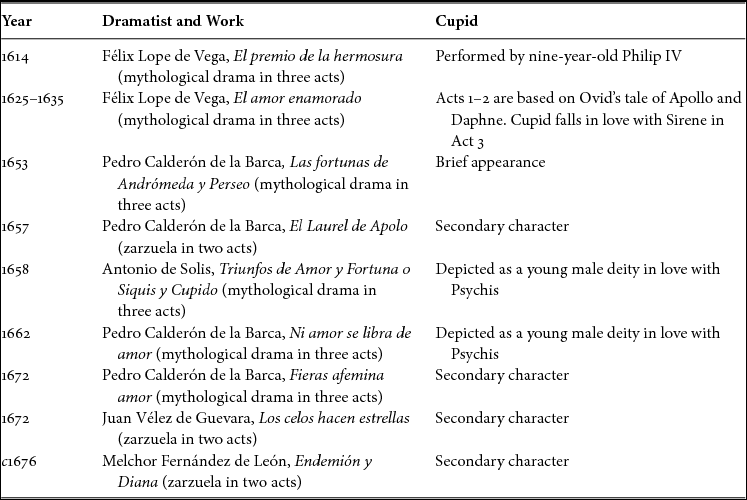
These treatises, in addition to the Spanish translations of Ovid's Metamorphoses and of other ancient mythological tales, formed the foundation for mythological Spanish music dramas of the seventeenth and eighteenth centuries. The reinterpretation of Cupid in Spanish theatre varied slightly throughout the seventeenth century. While at times he was presented as a lover consumed by passion, at others he appeared as the embodiment of chaste or erotic love, or as a secondary character with a limited role in the play. Table 1 represents a trend in Spanish mythological dramas that feature the character of Cupid up to the late 1670s, rather than offering a comprehensive list of works on the subject of Cupid.Footnote 21 Not until later, in the 1690s and early 1700s, did Cupid engage in battle with other deities. Significantly, the shift in the portrayal of this character occurred during the tumultuous years surrounding the War of the Spanish Succession, beginning with the decline of the Spanish Habsburg reign owing to Charles II's inability to produce an heir before his death in 1700, and followed by the arrival in Madrid of Philippe d'Anjou, the Bourbon prince who would ascend to the Spanish throne as Philip V. During the early years of his reign and with the aid of France, Philip V (the late Charles II's great-nephew as well as Louis XIV's grandson) would go to battle against the army of another contender to the Spanish crown, one that was supported by the Dutch, the English and the Germans: Archduke Charles of Austria, nephew to the late Charles II and brother to Joseph I, Holy Roman Emperor.Footnote 22
Plays for the Spanish court featuring the character of Cupid

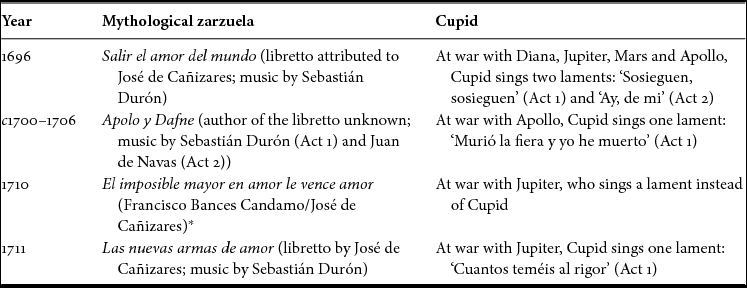
At the turn of the eighteenth century, slightly after Aguilar's treatise gave renewed emphasis to the description of Cupid, the deity of love acquired a central role in the mythological zarzuela. Based on the extant works from the period, it would seem that all zarzuelas featuring Cupid as a leading character depicted him at war with other deities (Table 2).Footnote 23 Also for the first time, Cupid – now an established sung role for a female performer – sang emotional laments about his defeats. Although there is no information regarding the performers who played the role of Cupid or any other roles in these zarzuelas, we know that women performed all sung roles of deities, regardless of their gender, since men, including castratos, were not allowed to sing serious roles in Spanish theatre.Footnote 24 In fact, en travesti roles of male deities in the zarzuela – and in all other mythological Spanish music dramas of the seventeenth and early eighteenth centuries – were developed for female soprano voices, a practice that finds close parallels in eighteenth-century operas produced outside of Spain, such as Handel's Julius Caesar (London, 1724), whose Sextus was written for a female soprano.Footnote 25 Most likely, either the third or fourth lady in one of Madrid's two theatrical companies would have sung the role of Cupid, as these positions were reserved for actresses who possessed superb singing skills. First and second ladies and their male counterparts, by contrast, traditionally performed the spoken roles of the leading female and male mortal characters.
Zarzuelas featuring the character of Cupid at war with other deities

*The authorship of the music of this zarzuela, traditionally attributed to Durón but now challenged by Raúl Angulo Díaz, has become the centre of a recent debate summarized in Daniel Martín Sáez's article ‘Sebastián Durón y otros amigos en el Teatro de la Zarzuela: le gestación de una duda’, Sinfonía virtual 30 (2016), www.sinfoniavirtual.com/revista/030/imposible_zarzuela.pdf. Angulo Díaz's claim that the music was composed by José de Torres is discussed in his ‘El problema de la autoría musical de la zarzuela El imposible mayor en amor, le vence Amor. ¿Sebastián Durón o José de Torres?, Sinfonía virtual 30 (2016), www.sinfoniavirtual.com/revista/030/zarzuela_imposible_amor.pdf. In his edition of this zarzuela, Antonio Martín Moreno suggests that Candamo may have written the work in collaboration with Durón before Candamo's death in 1704, and that the libretto was later appropriated by José de Cañizares after Durón was sent into exile in 1706. See the ‘Introducción’ in Sebastián Durón, Francisco de Bances Candamo and José de Cañizares, El imposible mayor en amor le vence amor: Zarzuela en dos jornadas, ed. Antonio Martín Moreno (Madrid: Instituto Complutense de Ciencias Musicales, 2005), xi–xiii. Since the literary authorship of El imposible mayor en amor le vence amor cannot be established with any certainty, I include the names of both dramatists.
The following analysis of Las nuevas armas de amor explores the allegorical connection between Cupid and the Spanish monarch, Philip V. I base my reading of Cupid as the embodiment of the king on three main factors introduced above: the cultural understanding of Cupid as the most powerful of all deities and therefore a suitable allegorical counterpart to the king; the unusual wartime portrayal of Cupid as a warrior battling other deities; and the Spanish theatrical association of Cupid with the king, beginning with Lope de Vega's 1614 play and continuing in the works of Pedro Calderón de la Barca, such as Las fortunas de Andrómeda y Perseo and Fieras afemina amor.Footnote 26 This association in the plays of Calderón de la Barca extended to Philip IV's son and heir, Charles II, and as I will argue, resurfaced in early eighteenth-century zarzuelas performed during the reign of Philip V. Cupid's unprecedented laments during this period, moreover, symbolized the tensions of war and the monarch's plight during a time of great political instability.
CUPID, WAR AND ALLEGORY IN LAS NUEVAS ARMAS DE AMOR (1711)
Las nuevas armas de amor was in all probability premiered at the court of Philip V, yet the earliest documented performance of this zarzuela is at the public theatre. Presented by the company of José de Prado at Madrid's Teatro del Príncipe from 25 November to 1 December 1711, Las nuevas armas de amor was intended as a highlight of the 1711–1712 theatrical season. Its eclectic cast of characters showcased the talents of the greatest actors of the era, which ranged from an ability to recite dramatic texts artfully to delivering comedic or fully sung roles. The production indulged the audience's appetite for extravagant settings and machinery that allowed for magnificent visual effects.Footnote 27 Likewise, the text and music of Las nuevas armas de amor were by José de Cañizares (1676–1750) and Sebastián Durón (1660–1716), the most admired dramatist and composer of the era respectively.Footnote 28
Cañizares's story includes a few well-known mythological characters derived from the Greco-Roman tradition, yet appears to be the product of his imagination rather than inspired by an existing myth. As in other Spanish mythological dramas, events unfold and characters interact in three different hierarchical strata that converge and diverge at different points throughout the play. The first and the highest stratum, that of the deities, includes the sung roles of Cupid, Jupiter and Diana, performed by the third and fourth ladies. The second and third levels correspond with two established social ranks in the mortal world: the spoken roles of the higher serious characters, usually well bred or belonging to the nobility and played by the first and second ladies and men (Anteo, Astrea, Zéfiro and Sirene); and the lower comic characters (the graciosos), often servants or shepherds that speak, dance and sing popular tunes (represented by Silvio, Enareta and Títere). One last type that appears sporadically in zarzuelas is the wise old man, traditionally a spoken role. In this particular zarzuela, the wise old man is Jupiter's priest, Palemón, who embodies the connection between mortals and deities.
The struggle for power in Las nuevas armas de amor is presented in the same manner as in other zarzuelas depicting Cupid at war with other deities: the first act exposes a conflict that results in a climactic lament following the defeat of one of the two main characters (usually Cupid), and the second and final act provides a resolution of the conflict, normally concluding with a celebration of Cupid's final triumph and glorification (one exception is the zarzuela Salir el amor del mundo, which ends with Cupid's banishment from the world). In Las nuevas armas de amor the bucolic island of Cyprus is disturbed by the clash between Cupid and Jupiter. Halfway through the first act, Jupiter confronts the god of love and, as they struggle, he pushes Cupid to the ground, snatches his quiver and disappears. Humiliated and unable to rise, the deity of love slips into a powerful and climactic two-part lament, comprising a recitative followed by a da capo aria:

Two of the five surviving sources for Las nuevas armas de amor (E-Mmh, Tea 1-51-13 and E-Mn, Mss/17448/9) bear the indication ‘Cae Cupido, y probando a levantarse vuelve a caer’ (Cupid falls [to the ground] and in trying to rise, he falls again) to the right-side margin of the first of the two stanzas, hinting at the female performer's position on the stage at the moment of the lament, or at least during the recitative. The second stanza, set as a da capo aria, bears the indication ‘triste’ (sad) in the same two sources. One can thus imagine the female performer in the role of Cupid shedding tears while singing her mournful song on her knees. Although there are no further surviving documents that describe this moment, it seems clear from these stage directions, as well as the emotional text and music, that Cupid's dramatic lament was intended to move the audience to tears.
Indeed, the music of Durón's recitado faithfully reflects the depth of emotion in Cañizares's first stanza (Example 1). Scored for soprano, two violins and basso continuo, the recitative opens with a sustained E flat major chord in violins and bass that accompanies the first two poetic lines (bars 1–3). As Jupiter has just pushed Cupid to the ground and taken his arrows after a violent struggle, this sustained chord creates an interesting effect: time has stopped so that Cupid can lament. Durón uses every resource in his musical repertoire to portray the character's deep emotional state, highlighting key dramatic words through the use of large descending leaps, chromaticism, tonicizations and musico-rhetorical figures, particularly those of pausa (a silence or break in the melodic line) and descencio (a descending musical passage).Footnote 29 As may be seen in Example 1, the first key word, ‘muerto’ (dead) in bar 2, is underlined as it is arrived at through a leap of a descending octave on E♭. The second key word, ‘Amor’ (as in ‘Cupid’), is stressed in two ways that allow the character to draw attention to his pain: first, its second syllable (naturally stressed in Spanish: ‘A-mor’) is accentuated through a leap of a descending diminished fourth (E♭–B) in the bass (bars 3–4); second, the B in the bass signals the beginning of a series of tonicizations on the words ‘entre míseros gemidos’ (bars 4–6). ‘Gemidos’ (groans), the third key word, is further highlighted through the figure of pausa. Rather than interject musical rests between two words, as he had done in laments in earlier zarzuelas, here Durón inserts a rest between the syllables of a single word. As a result, ‘gemidos’ and later also the fourth key word, ‘desfallecidos’ (dying) in bars 8–9, is fragmented. As Cupid reaches the end of his dramatic recitative, the audience inevitably perceives that this defeated character is sighing or gasping for air.
Durón, Cupid's recitative ‘Valedme pero en vano’, Las nuevas armas de amor, Act 1, bars 1–9. Transcribed from Biblioteca Nacional de España, M/2276

Perhaps still on his knees, Cupid plunges into the aria, identified as an Italian arietta or aria (Arietta Ytaliana and area Ytaliana) in the sources. Lines one and two of the poetic stanza (‘Those of you who fear hardship, cry with me, cry with me’) form section A, and lines three and four (‘For with Love's death, impiety will reign’) form section B. As in the recitative, Cupid's heightened emotional state is underlined through the use of musico-rhetorical figures, namely those of repetitio, pausa and descencio. Durón lengthens the short text by repeating the second and fourth lines while adding several internal repetitions of the word ‘llorad’ (cry) and the phrase ‘ha de reinar’ (will reign). The figure of repetitio, in combination with pausa and descencio, is used by Durón to illustrate Cupid's intense sorrow towards the end of section A, during the repetition of the second line in the stanza (‘Cry with me’) in bars 17–24 (Example 2). Cupid repeats the word ‘llorad’ three times before going on to state the entire line twice more. Each of the three statements of the word ‘llorad’ is set to a two-note melodic figure of a descending minor third (descencio), with the emphasis on the longer second note (falling on the downbeat) mimicking the natural accentuation of the word ‘llo-rad’. The higher register of the third statement adds dramatic intensity to Cupid's rhetorical plea for sympathy. The passage is further emphasized by its being built on a sequence of descending fifths (C–F–B♭–E♭–A♭), which, as Louise Stein has noted, is traditionally associated with seventeenth-century Spanish theatrical laments.Footnote 30 Finally, echoes in the violin of the two-note melodic descending figure illustrating Cupid's falling tears, and of the rests symbolizing Cupid's sighs and sobbing, underline a moment of heightened intensity in the lament.
Durón, Cupid's aria ‘Quántos teméis al rigor’, Las nuevas armas de amor, Act 1, bars 17–34. Transcribed from Biblioteca Nacional de España, M/2276

As if waking from a sorrowful dream or trance, the deity of love shakes off his deep sadness and vows to avenge his honour. This highlights the most interesting aspect of Cañizares's myth. Up to this point, the story had not deviated from other myths or from the contemporary understanding of how deities (and mortals) interacted with one another. But in an unanticipated turn of events, Cupid calls on his lifelong adversary, Diana, for help. The goddess of chastity, also unexpectedly, lends him three arrows that induce three different effects on the victims: disenchantment, distrust and contempt (desengaño, desconfianza and desprecio). With these new arrows the deity of love is able to carry out his revenge. Cupid shoots Astrea (loved by Jupiter and Prince Anteo) and Sirene (loved by Zéfiro), and later recruits Prince Anteo for help, promising him that he will make Astrea love him in return for his service.
Unaware of Cupid's new alliance with Diana and Prince Anteo, Jupiter is shocked by the hostility he now encounters on the island: Astrea refuses his advances, Prince Anteo and Diana declare war on him and the islanders no longer worship him. The islanders celebrate Jupiter's defeat and praise Cupid, who rewards the two leading couples by putting an end to their grief. The zarzuela ends with the marriages of Prince Anteo and Astrea, and Zefiro and Sirene, while everyone praises Cupid and celebrates his new weapons. In the present allegorical reading of Las nuevas armas de amor, the final victory of Cupid – an allegorical representation of the Spanish monarch – presents a remarkable contrast from the character's earlier defeat and subsequent lamenting, one that allows, as in so many baroque festive performances, for the celebration of the main character's (or the ruler's) triumph over his own limitations and his ensuing achievements.Footnote 31 In this context, Cupid's lament serves to symbolize the tensions of the era as well as the monarch's struggle for power during the war, while the character's final glorification represents the ongoing cheers of support from Philip V's loyal subjects.
Gordon Hart observes that the plot's structure is based on ‘triangular relationships among the characters’ from which three main themes emerge: power, love and humour.Footnote 32 The theme of power first appears among the three deities and later among Jupiter, Cupid and the mortal Anteo. The second theme is manifested in the love triangle between Astrea, Jupiter and Anteo, and the last theme, humour, is apparent in the relationship between the three graciosos, Títere, Silvio and Enareta. While these three underlying themes undoubtedly propel the action in the story, there is a fourth that has passed unperceived: a further triangular relationship consisting of alliances between characters involved in the struggle for power. The first alliance, between Cupid (god of erotic love) and Diana (goddess of chastity), arouses great interest. Not only is it unprecedented, but it also breaks with the centuries-long tradition of associating these two characters with opposite and irreconcilable forces. The second alliance, between Cupid and Prince Anteo, is less unusual, but as it appears in conjunction with the first alliance, it reinforces the existing theme of the ‘political’ alliances that emerge for the mutual benefit of some characters (Cupid, Anteo and Diana) and the fall of another (Jupiter). One cannot help but wonder if Cañizares had an underlying motive for choosing to break such a strong literary tradition as well as a long-established cultural identification.
In light of the parallels between the zarzuela and political events transpiring in the early eighteenth century – in particular, the new political alliances formed in 1711 – I would like to suggest that Cañizares's libretto actually reflects these events. While the entire War of the Spanish Succession revolved around the formation of alliances, it was in 1711 that two old rival nations – France and England – became allies in order to defend their common interests.Footnote 33 Following the deaths of Louis XIV's son and heir, the Grand Dauphin (14 April 1711), and of the Holy Roman Emperor Joseph I (17 April 1711), new problems regarding the succession to the French crown and that of the Holy Roman Empire caused the delicate balance of power in Europe to shift, prompting the formation of new coalitions. Joseph I left his title to his brother the Archduke Charles, contender to the Spanish crown, who was crowned Emperor in October 1711. The fear that the Austrian Habsburgs would become a much too dominant force if Charles gained possession of Spain was one of the factors that forced Louis XIV of France and Queen Anne of England to enter a period of negotiations. After years of enmity, the king of France and the queen of England deliberated on the preliminaries to a peace accord during the summer months and into early October 1711; these early negotiations would eventually result in the Treaty of Utrecht, signed in 1713.Footnote 34 Against this political background, the parallels between Cupid and Diana's partnership presented in a zarzuela performed in late November, after the negotiations between Louis XIV and Queen Anne of England, are highly suggestive. In my reading, Louis XIV's identification with Cupid is only convincing if there is a close political relationship between the Spanish and French Bourbon kings. Though Cupid may be presented here as an allegorical stand-in for the Spanish king's grandfather, Louis XIV, Cupid's struggles and final victory in the play continue to symbolize those of Philip V. In the final celebration, the praise for the god of love and the reestablishment of peace and order in the realm all symbolize Philip V and his own reign.
CROSS-GENDERED IMPERSONATIONS OF CUPID
If, as I have suggested, Cupid was both the most powerful of all deities and the allegorical counterpart of the Spanish king, Philip V, then why is he played by a female actor-singer and why does he lament? We know that the local practice of female-to-male cross-dressing originated in the early seventeenth century, specifically in Lope de Vega's non-mythological spoken plays or comedias in which cross-dressing appeared as a plot device (similar to its function in seventeenth-century Italian opera), and was later adopted in Spanish court musico-theatrical genres that developed in mid-century, including the zarzuela.Footnote 35 In mythological dramas, however, cross-dressing was not a plot device, as female performers did not pretend to be men within the play, but played the role of male characters from beginning to end without ever revealing their true female gender. Similarly, an inverse phenomenon occurred in French court theatre, in which men performed a wide range of female roles during the second half of the seventeenth century.Footnote 36 Margaret Reynolds stresses this important difference in her essay on cross-dressing in operatic repertory by assigning a different name to each of these two types of roles: ‘disguise roles: where a woman sings the role of a woman who, for some reason to do with the plot . . . appears on stage disguised as a man’, and ‘travesty or trouser roles: where a woman sings the role of a man’.Footnote 37 Thus, according to this distinction, seventeenth- and early eighteenth-century Italian operas generally featured disguise roles for female performers and characters (as in La Semiramide (Venice, 1671) or Li zite ’n galera (Naples, 1722)), whereas Spanish (and French) musical theatre included nothing but travesty roles.Footnote 38 But what we do not know is why women played the allegorical roles of real-life male figures. No surviving sources discuss in a direct manner the motives underlying cross-casting choices in Spanish theatre, so any attempt to shed light on this issue must therefore remain conjectural. To conclude this study, I will discuss Spanish notions of masculinity vis-à-vis the theatre, specifically with regard to the acting profession, in the hopes of setting a path for further exploring political symbolism in Spanish musical theatre.
Although men played both central and secondary roles in Spanish theatre, they neither appeared in drag nor sang the roles of deities in Spanish mythological dramas of the seventeenth and early eighteenth centuries. In fact, men had not been able to perform in drag since 1587, when the Spanish state had ended, once and for all, the practice of male-to-female cross-dressing by allowing women to perform on the stage. This prohibition was meant to remedy the apparent feminization of young male actors and its potentially dangerous effect on the male theatregoer, as a man in female clothing could potentially arouse homosexual inclinations in a male viewer.Footnote 39 In a sense, women were granted permission to play female roles in order to protect men's masculinity, but this authorization did not succeed in silencing theatre detractors who had originally repudiated male drag performances and now objected to the very existence of female actors. Throughout the sixteenth and seventeenth centuries, almost all treatises on Spanish theatre considered whether it was appropriate for men to perform on the stage, or even to attend plays in the theatre, since these activities could potentially threaten their masculinity.Footnote 40 As Elizabeth Rhodes argues, ‘the conservative wing manufactured a cause-and-effect relationship between theatre-going and womanish behaviour, signaling a particularly strong cultural current against effeminacy in men’.Footnote 41 I would add that, based on writings summarized below, this conservative wing showed great distress over male performers. Male actors, in their opinion, espoused a ‘questionable’ type of masculinity, one that deviated from the social order by negating traditional gender roles and expectations.
Influential detractors from the seventeenth century, such as Juan de Mariana (1536–1624) and Ignacio de Camargo (1650–1722), were persuaded that in order to serve society, men ought to stay away from the theatre and instead strengthen their minds and bodies by, for example, riding horses or practicing archery. Like other conservatives before them, they believed that theatrical plays had the power to weaken Spanish men, rendering them ‘effeminate and useless at work and war’.Footnote 42 What is more, their views reflected long-held concerns over loss of virility caused by the profession of acting and by theatre going. Whereas Mariana warned his readers in 1609 that the growing profession of actors (farsantes) would prove a ‘useless and profitless burden to the Republic, as [actors] were encouraged with delights and were of womanly character’ (‘peso inútil y sin provecho a la república, por ser como son animados con los deleites y de ánimos mujeriles’),Footnote 43 Camargo bitterly complained, eighty years later, that this effeminate profession was an aberration because it destroyed the noble and virile nature of Spanish men, making it impossible to differentiate men from women:
¿Qué se hicieron aquellos espíritus generosos, llenos de belicosos ardimento? . . . ¿Aquel vigor de los ánimos tan propio de la Nación Española? . . . ¿Quién jamás pensará ver a los hombres, nacidos sólo para nobles y varoniles empressas, abatidos a tan bajos y afeminados empleos que apenas se distinguen de las mujeres? Footnote 44
What has become of those generous spirits, full of fiery bellicosity? . . . That vigorous disposition so characteristic of the Spanish nation? . . . Who would have ever thought they would see men, born for noble and manly undertakings, succumb to such low and effeminate employment that they could hardly be differentiated from women?
By contrast, the impact of the acting profession on women, as observed in the excessive ‘profanity’ of their dresses and in the ‘indecent nudity of their costumes’, was reprehensible yet not as ‘monstrous’, because, in Camargo's opinion, the outcome was to be anticipated from such a ‘frail and vain’ gender.Footnote 45 A higher sense of morality and, above all, the preservation of virility were to be expected from men. In line with these cultural expectations, male characters in non-mythological dramas, such as the spoken comedia, traditionally exhibited masculine traits.Footnote 46
Based on these notions of masculinity, I suggest that the potentially disturbing depictions of male sorrow or frailty associated with Cupid in zarzuelas from the turn of the eighteenth century, as we have seen in Las nuevas armas de amor, emerged precisely because men did not play these roles.Footnote 47 During a time when men's virility was being questioned, debated and protected, Spanish male performers would not have portrayed or been allowed to portray ‘unmanly’ male characters. In other words, these peculiar depictions of Cupid triggered by political events were dependent upon local casting conventions. Revealingly, all of these laments are inventions of the dramatist. But what did the Spanish audience make of them? If, as Leslie Ferris suggests, transvestite theatre forces the viewer ‘to see multiple meanings’,Footnote 48 then what did Spanish audiences see when Cupid lamented? Did they see the performer (a woman), or did they see the character (a male deity as well as the allegorical counterpart of the Spanish king)? Was the lament an opportunity, as Wendy Heller argues, to unleash the rhetorical power of women?Footnote 49 Or was this (fe)male lament part of the game of transvestite, as well as allegorical, theatre? Surely, eighteenth-century Spanish audiences participated in the ‘game’ by decoding what was encoded in the allegorical text, as Aercke observes regarding European audiences of baroque allegorical theatre, and by engaging with the illusion created by the travesty role.Footnote 50
As I have suggested, truth was half revealed and half concealed in Spanish baroque allegorical theatre. This tradition is clearly vocalized, perhaps more than ever before, in Francisco Bances Candamo's Theatro de los theatros de los passados y presents siglos (Theatre of Theatres of Past and Present Ages, 1689–1694). In his role as court dramatist for Charles II, Bances Candamo articulated the importance of revealing, but ‘without saying’, important truths to the monarch through the performance of plays featuring kings:
son las comedias de los reyes unas historias vivas que, sin hablar con ellos, les han de instruir con tal respect que sea su misma razón quien de lo que ve tome advertencies, y no el Ingenio que se las diga. Para este decir sin decir, quien dudara que sea menester gran arte?Footnote 51
Plays revolving around kings are living stories that, without speaking to [kings], will instruct with such respect that [kings] will take their warnings, and not from the poet giving them. To say without saying, who doubts that it is necessary [to possess] great art?
Bances Candamo's ‘to say without saying’, together with what I consider its visual equivalent, ‘to show without showing’ (mostly evident in the gender disagreement between character and performer in mythological dramas), represents an example of the aesthetic contrasts and, to some extent, contradictions that permeate Spanish baroque theatre, including Cañizares's allegorical zarzuela. No doubt, the contrast between the allegorical figure of Cupid and the female performer playing this role in Las nuevas armas de amor presents a stunning contradiction that may well have pleased Spanish audiences. The same may also apply to the two contrasting depictions of Cupid in the work, namely the portrayal of his overwhelming weakness and excessive emotion versus his power. Yet Cañizares's zarzuela, like most Spanish mythological dramas, is unambiguous in its praise for the monarch. Despite Cupid's temporary loss of strength, he comes to possess abiding power towards the end of the play. The allegorical counterpart of Philip V thus seems to demonstrate, in Baltasar de Victoria's words, that Love does indeed ‘conquer all’.