As an urban historian, I have been fascinated by the sights of the democratic “uprisings” in the Arab world. I was especially interested in the demonstrations in Egypt. In the spring of 2000 I spent four months as a Fulbright lecturer at the University of Alexandria, and I had spent some time in Cairo. I knew the spaces of the gathering crowds: Tahrir Square, the streets leading into it, and the Qasr el-Nil bridge, which I had walked across several times. I also knew some things about the police and army, having encountered, albeit peacefully, their militaristic presence on the streets. So, I avidly sought out TV, newspaper, and photo coverage of the uprising, searching those places that I remembered and seeing them transformed into sites of the “people” in protest. I was also excited to see the women in the streets, taking their place in the revolution and demanding to be heard. Again, having spent those months in Egypt, I knew that it took courage for women to assert themselves in such fashion, to come into the streets and demonstrate for freedom from tyranny and to assert their democratic rights. Needless to say, I was equally appalled by what then happened to some women during these demonstrations: arrests with forced “virginity” tests, strippings and beatings, and sexual assaults on women protestors, as well as female reporters. (For a video snippet, http://www.youtube.com/watch?NR=1&v=CuK2k1cR_kI&feature=endscreen.) Women were clearly out of order on the streets of Cairo.
Watching the demonstrations, I had two thoughts. First, I was reminded that the city might still be the hope of democracy. It was the place, and it offered the spaces, where large numbers of people could gather to demonstrate and by their determined presence force those in power to pay attention to their demands. The internet may have helped bring them into the streets, but there had to be streets and spaces for people to occupy.
On the other hand, I was struck, again, that the city was still a gendered space of structured inequality wherein men worked constantly to embound women to prevent them from “escaping” male control. I thought immediately of a vignette in Italo Calvino's book, Le Cittá Invisibili, wherein men dreamed of chasing a woman in the city, and when they could not find her, reordering the city, streets, spaces, and walls so that she could not escape.Footnote 1
As an historian of the Gilded Age and Progressive Era who works on the built environment of the city, the sexualized reaction against women's visibility on the Cairo streets was the early twenty-first-century reflection of a gendered response to women's public presence on city streets that had dictated the reshaping of cities during the late nineteenth and early twentieth centuries. By looking at four cities of the Anglo-Atlantic world—Chicago, Toronto, Dublin, and London— during this time period, in this essay I offer some thoughts on how and why the city may be more the hope of democracy than the actuality of it for women.
Before proceeding, however, I want to stress that I am well aware that other social constructions, in addition to that of gender, were in play during the era. I contend, on the other hand, that attention to the gendered inequality of the city as a built space and place has never been as thoroughly explored by historians as have those other qualities.Footnote 2 So my focus in this essay is on the gendered ideas behind various reform movements directed at improving the built environment of the city. As such I focus on the physical products of these gendered ideas.
Democracy, an Elusive Concept
The first problem, of course, is defining democracy, an elusive concept, to borrow the term used by James Connolly in his recent book. Connolly also correctly, I believe, defined democracy as something beyond its “formal trappings” to include such characteristics as participation, reciprocity, and deliberation.Footnote 3 Alongside that definition, however, one needs to consider the concept of order in a democratic city. As Lisa Keller has recently argued, urban democratic principles have been tempered with the desire to preserve order in public spaces.Footnote 4 I propose here that in order to achieve those democratic characteristics defined by Connolly, true urban democracy must include the even-more-elusive concept of gender equality. I emphasize “even more elusive” because from the mid-1800s forward, urban gender equality has never been achieved. I believe that there are two intersecting reasons for this inequality. First, as Elizabeth Wilson contends, “The presence of women [w]as a problem of order” for the emerging industrial city.Footnote 5 Second, as Jane Addams pointed out more than 100 years ago, the men who controlled the city envisioned it in ways that would preclude such equality. To quote from her publication, Democracy and Social Ethics:
It is most difficult to hold to our political democracy and to make it in any sense a social expression and not a mere governmental contrivance, unless we take pains to keep on common ground in our human experiences . . . . The well-to-do men of the community think of politics as something off by itself . . . As a result . . . “reform movements” started by businessmen and the better element are almost wholly occupied in the correction of political machinery and with a concern for the better method of administration rather than with the ultimate purpose of securing the welfare of the people. They fix their attention so exclusively on methods that they fail to consider the final aims of city government.Footnote 6
Everyone trained in urban history of the Progressive Era is familiar with Frederic Howe's 1905 book The City, the Hope of Democracy. Howe agreed with Addams that cities had too little democracy. Still, his ideas about the city and democracy proved Addams's point. He focused on reform of political machinery and methods as the means to democracy. For Howe, democracy was a political mechanism that, if properly organized (ordered), would restore the city to the people; if properly practiced, democracy would also reform people. For Howe the key to democracy was city control of its destiny through municipal home rule and municipal ownership. If this were achieved, then the city would become the city republic, the perfect democracy. Free from outside interference, the city republic could make the decisions that were in the best interests of its residents, and city life would become automatically more democratic.Footnote 7 Howe's idea of the city as the hope of democracy was a local one, focused on the city as a place. With home rule, the city would
become its own factory inspector, [and] the problem of school attendance will be simplified . . . be able to coordinate its administration and enforce its own ordinances . . . be able to raise the educational age, adopt manual-training and trades’ schools, fit its instruction to local needs, and ultimately elevate the standard of life of all classes . . . care for the sick . . . find work and maintain employment agencies . . . supervise factories, mills, and workshops.Footnote 8
Two years later in his book The British City, the Beginnings of Democracy, Howe praised the London County Council as “one of the most democratic bodies in the world,” possessed of just those functions that he wanted for U.S. cities.Footnote 9 Howe pointed to the LCC's slum clearance policies and its municipalization of transit and the water supply as examples of what he believed would resolve what he called the “big social questions” of modern civilization and its crowded and insalubrious cities.Footnote 10
Howe's vision of a democratic city as a re-ordered and orderly place accorded in certain respects with utopian ideas for creating well-ordered cities that were circulating through the Anglo-Atlantic world. Ebenezer Howard, for example, had published his utopian tract, Garden Cities of To-morrow, in 1902. The Garden Cities concept was essentially anti-urban in that it sought to move people out of large cities into smaller ones. However, its focus on reorganizing space from the top down mirrored Howe's top-down, mechanistic approach to resolving pressing social and economic problems of the city as a place. Howard assumed the presence of democracy, so the question for him was how to perfect it to its most orderly ideal: “How to make our Garden City experiment the stepping stone to a higher and better form of industrial life?”Footnote 11 His answer to this question was to build smaller-sized garden cities that would be governed internally, freed from outside interference. A Garden City Company, for example, could own all the land, thereby holding all legal authority in the city. Rather than a home-rule city republic envisioned by Howe, Howard envisioned the corporately managed city as the answer to all social and economic problems.Footnote 12 If Howe envisioned an urban democracy reordered through “local matters . . . administered by local agencies,”Footnote 13 Howard envisioned a city reordered spatially. (See Figure 1.)
Two sketches for the garden city. From Ebenezer Howard, Garden Cities of To-Morrow (1902).

The growing number of men on both sides of the Atlantic who were interested in urban reform also believed that methods and mechanisms would construct the well-ordered city. At the 1910 Second National Conference on City Planning, Frederick Law Olmsted Jr. envisioned the city as a network of communication:
Facility of communication is the very basis for the existence of cities: improved methods of general transportation are at the root of the modern phenomenon of rapid city growth; and the success of a city is more dependent upon good means of circulation than upon any other physical factor under its control.Footnote 14
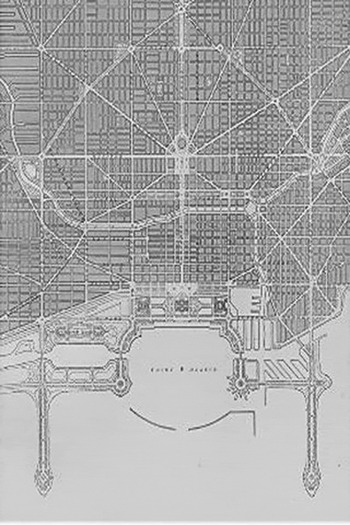
Reforms to the built environment proposed in each of these four cities reflected this ideal. Chicago's business and political leaders enthusiastically promoted Daniel Burnham's Plan of Chicago. At a 1913 dinner hosted by the executive committee of the Plan Commission, Illinois governor Edward Dunne presented the plan to a gathering that included the city's mayor, Carter Harrison II, thirty-seven members of the city council, the city's department and administrative heads, Cook County representatives to the state legislature, park commissioners, members of the Chicago Board of Education, and publishers and editors of the city's newspapers—all men. Most of the discussion of the plan concerned streets and circulation: the “quadrangle” of streets targeted for widening—described as those that were “destined to bear the heaviest traffic of any four streets in this city”—along with radial boulevards and diagonal streets.Footnote 15 (See Figure 2.)
Traffic, Street, and Harbor Plan, Chicago. From Daniel Burnham et al., The Plan of Chicago (1909).

In 1909, the men of the Toronto Civic Guild declared that any plan for the city must realize that “the basic problem is transportation.” Two years later, the guild emphasized that diagonal thoroughfares should be the first aspect of any city plan. Finally, in 1913 the guild men declared that circulation and transportation, public areas and buildings, and privately owned lands were the triad of civic improvement.Footnote 16
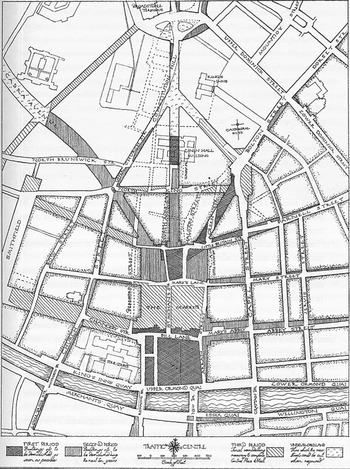
In his 1914 award-winning plan for Dublin, Patrick Abercrombie boasted that “the authors have not hesitated to produce a drastic Town Plan . . . to provide for [Dublin's] anticipated shipping and industrial development.” To accomplish such objectives, existing streets were to be widened to bring them “into useful functioning” by slashing through existing neighborhoods and displacing 64,000 of their residents. (See Figure 3.) The plan also recommended tearing down the centrally located Rotunda Maternity hospital with the cryptic phrase that the site “should be restored to a nobler use than at present . . . the Maternity Hospital . . . deserves a rest in the country air.” Abercrombie thought the central location was more suited for a “town garden for sculpture.”Footnote 17 The hospital endured and is still there, but when some of the proposed sites were cleared in 1918, Dublin's chief engineer P.C. Cowan warned against building any housing on them as that would “mar the dignity and beauty of the Metropolis” and “ruin the city socially, commercially and industrially and make the prospects of a restoration of healthy economic conditions in the greater Dublin hopeless.”Footnote 18
Traffic Centre Plan, Dublin, from Patrick Abercrombie et al., Dublin of the Future, (prepared 1914, published 1922). Courtesy of Open Library, www.openlibrary.org.

In his 1914 address to the English Town Planning Institute, its president, Thomas Adams, urged the members to take up the work begun by the Royal Commission on London Traffic (1903) and currently being pursued by sectional conferences on Arterial Roads and Town Planning. The “nature of the problem to be dealt with” by these conferences was to formulate a “town plan for the Greater London, in which proper consideration will be given to the lines of the principal arterial roads.” He also praised the traffic plan and map that had recently been proposed in the 1911 “Report of the London Traffic Branch of the Board of Trade” as “carefully considered.” Adams made it clear in his address that creating a new road system was a fundamental task of town planning.Footnote 19
A final example of roads as the solution to urban problems comes in a 1909 proposal of the British architect Arthur Crow, who believed that new road networks would solve inner city housing problems. In a presentation to the Town Planning Conference of the Royal Institute of British Architects, he argued that London should construct a new, wide major east-west artery— “10 miles long in the form of a double avenue with central boulevard”—slashed through the city both to facilitate transit and eliminate substandard housing. Such a new road would traverse the entire city, wiping out “squalid courts” while facilitating traffic flow. “It becomes year by year more imperative to leave no stone unturned which may assist in fostering and promoting the commercial side of our communal life.”Footnote 20
This emphasis on new methods for enhancing economic development through wide streets and moving the poor and working class out of the city never considered that the city should be a social expression of democracy. It was also, in many respects, distinctly anti-urban as it sought to disperse people across wide swaths of land. Frank Lloyd Wright's proposed Broadacre City followed Howard's thinking that democracy meant “independence and abundance for everyone.” Broadacre was a decentralized city that could be dispersed across 100 square miles wherein there would be “universal ownership of land” (that is, everyone would own his own land).Footnote 21 For Elizabeth Wilson, “The garden city was a sanitised utopia, with the obsessional controlling perfectionism that characterised all utopias.” It was the result of a “new anti-urban ideology developed in the nineteenth century, a central, but largely unacknowledged, aspect of which was a fear that women escaped patriarchal control in large urban areas. As a result, many of the most influential writings and much of the work of town planners acted to attempt to return women to male control in the home.”Footnote 22
For Wilson and other feminist scholars, the professional men interested in town planning sought embounded homes and embounded neighborhoods, which were intended to keep women confined spatially within the city through physical structures and powerful social/psychological means. In her work, professor of urban planning Clara Greed labels modern planning as the latest manifestation of the “patriarchal desire for order through division,” a division that resulted from “dichotomized thinking patterns, dividing public from private realms to the disadvantage of women and other minority groups.” Order, accomplished through a universal scientific rationalism that shunned “sentiment, nurturance, and obligation,” was the aim of the architects, social scientists, and engineers who defined the early twentieth-century planning profession.Footnote 23
Planning historian Helen Meller stated the matter in the form of a rhetorical question, “Why were the social consequences of new developments not part of the brief of the architects and planners who created the new urban environments of the twentieth century? Why did they think they knew what everybody wanted?” Their brief—or their vision—was of a spatially controlled and orderly city, designed by and for other men. As Meller concludes, “The four British pioneers of planning, Horsfall, Geddes, Howard, and Unwin, took for granted the idea that women would support their schemes . . . the sexually determined role of women was to support and complement men.” For women, she concludes, there was “little room for initiative in a model that put women, children and family first under a benign patriarchy.”Footnote 24 When early planners applied this model, they excluded women as the potential subjects of planning and instead isolated them as objects.Footnote 25
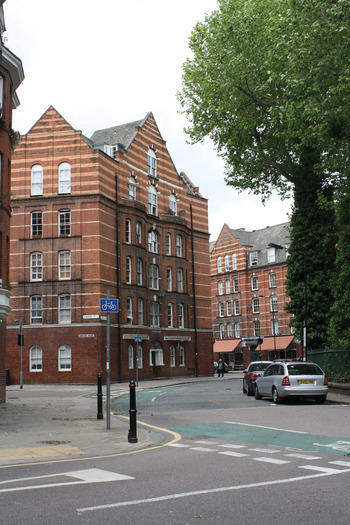
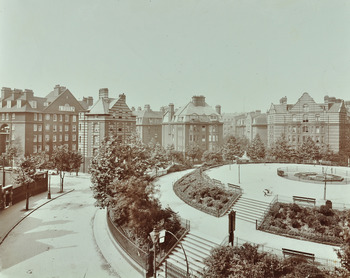
London's Nichol/Boundary Street redevelopment in the late 1890s is an example of that benign patriarchy and its obsession to embound women both physically and socially. The men behind this development eliminated the area's straight, intersecting streets that had allowed residents to move freely about the neighborhood and replaced them with fewer radiating streets that focused all movement toward the internal center with a raised ornamental garden. They reoriented buildings away from street access toward internal, off-street access. With this design, they followed the plans of earlier philanthropic housing developments in London and Dublin to remove residents from the streets. (See Figures 4–5.) At the internal center of the new estate there was a children's playground—kept out of sight at the top of the ornamental garden, which even after several years of the buildings’ occupation was still barren and an unwelcoming space for residents. According to one writer, architect Owen Fleming had envisaged his setting as one in which there would be “happy couples promenading in the ornamental garden after a hard day's artisanal toil by the head of the family, as music from a central bandstand played.”Footnote 26 (See Figure 6.)
Women in a Nichol Court, 1890. Courtesy of the London Metropolitan Archives.

Boundary Street Estate, 2009. Photo by the author.

Central Ornamental Garden, Boundary Street Estate, 1907. Courtesy of the London Metropolitan Archives.

A Women's Vision of the City
This embounded vision of home and city was countered by writers such as Jane Addams and Mary Parker Follett and by the activities and ideas of women in all four cities. Addams and Follett believed that democracy was something socially experienced, not mechanistic, isolated, or anti-urban. As Louise Knight explained, Addams believed that democracy meant “not only citizens mingling socially but also citizens working together to improve unjust conditions.”Footnote 27 Addams, according to Knight, had arrived at this understanding through the direct experience of working with and for Chicago residents struggling to achieve social justice for themselves and one another. As Addams herself expressed it:
Social ethics is not attained by traveling a sequestered byway, but by mixing on the thronged and common road where all must turn out for one another, and at least see the size of one another's burdens . . . social perspective and sanity of judgment come only from contact with social experience.Footnote 28
In contrast to Addams's emphasis on experience and mingling with others as a way to push democracy outward into the city, Frederic Howe looked to social and recreational activities, provided either through municipal or philanthropic agencies, to reform people and keep children from falling into vice and crime. Kindergartens and gymnasiums, he asserted, were “breaking into the blackness of the slum and organizing the work, play, and energy of the neglected masses. . . . Order and self-respect [supplementing] disorder and neglect.” Such “organized social interests” would supercede “the irregular life of the street and the saloon.” “Public gymnasiums” would give city dwellers “opportunity for physical culture, with assembly, reading and game rooms, will offer an opportunity for some rational recreation.”Footnote 29 The point that I want to emphasize here is not that Howe was wrong in arguing that the city ought to provide more such spaces and activities. Rather, Howe's summation of why the city should do so differed from the reasoning of Addams and Follett, as will be discussed below. In order to grasp the differences, however, because everyone was using the word democracy, it would be useful here to consider the concept at the heart of modernist urbanism, “Form ever follows function.” For Howe the city form was the civic republic; its function was to build better citizens:
For here life is more active, while the government is close to the people. . . . Through the divorce of the city from state control . . . progress will be stimulated. The city will become a centre of pride and patriotism. . . . The citizen will be attached to his community just as were the burghers of the mediaeval towns. Through direct legislation the city will be democratized.Footnote 30
For Addams and Follett, the city form was the substance of life; its function was to work best for the people who lived there. Hull House was the physical manifestation of Addams's theoretical/philosophical understanding of democracy and of the city wherein people could take control of their community. Hull House as a place and space substituted the communal for the familial for its residents. By that process, the home was opened to the city and the city to the home. Hull House broke down the barriers between public and private by establishing a communal, open-to-all space. Its public buildings faced the street; they were accessible from the street and were, as one scholar has expressed it, “part of the physical fabric of the neighbourhood.”Footnote 31 Hull House created urban democracy as the practice of daily lived experience shared by all citizens. Its residents went out into the city, and anyone in the city could come in. In contrast to men's focus on transportation and communication networks—which feminist urban planners argue “distribute urban amenities” in a highly uneven fashionFootnote 32—Hull House focused on how the city should function to provide the infrastructure of everyday life for all city residents.
For Mary Parker Follett, the city was the hope of democracy because it could be organized from the neighborhood level on up to the municipality and beyond. As she wrote:
Our proposal is that people should organize themselves into neighborhood groups to express their daily life, to bring to the surface the needs, desires and aspirations of that life, that these needs should become the substance of politics . . . [we] learn [our] relation to society by coming into contact with a wide range of experiences, of people, by cultivating and deepening [our] sympathy and whole understanding of life.Footnote 33
For Follett, democracy was embedded in social relations that allowed power to flow upwards: Power was to be exercised with and not over others. The city neighborhood was the site of diverse groups of people learning to live together and out of their experiences would emerge social consciousness and “lived” democracy.Footnote 34 “The acute problems of municipal life,” according to Follett, “is how to make us men and women . . . feel that we are the city, directly responsible for everything concerning it.”Footnote 35 For Addams, the social settlement was a physical space in which to practice and expand democracy. Follett's ideal physical setting was a neighborhood social center. The exact space might differ, but the democratic ideals of both women emphasized a built environment that enabled urban democracy by providing for an “infrastructure of everyday life [that] encompasses all that it takes in a practical sense for individuals and households to ‘go on’ from one day to the next.”Footnote 36
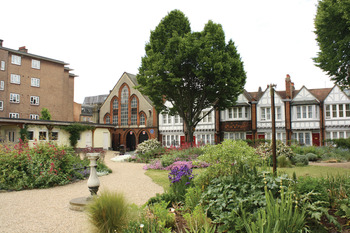
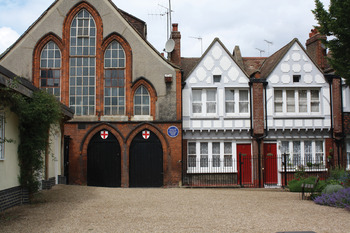
On the European side of the Atlantic, the housing rehabilitation schemes promoted by Octavia Hill focused on building a communal mutuality in London's poor neighborhoods. As early as 1869, she and other women worked to rehabilitate existing buildings to help build and sustain what she termed a “consciousness of corporate life.”Footnote 37 For example, Red Cross Cottages and Red Cross Hall in Southwark, one of the few housing sites that she actually built, was open to the street and the city. Buildings opened onto a garden that in turn fronted the street, making it clear that all in the neighborhood were welcome to enter. A children's play area was included under a covered walkway. (See Figures 7–8.) The gardens were, in Hill's words, “an open-air summer sitting room” for those who lived in the cottages, but the gardens and children's play area were open to all in the neighborhood. The Red Cross Hall, with its reading room, gymnasium, concert room, and other free spaces, accommodated neighborhood meetings.Footnote 38
Red Cross Gardens, Cottages, Red Cross Hall, Southwark, London, 2009. Photo by the author.

Red Cross Hall, Southwark, London, 2009. Photo by the author.

In Dublin, the female alumnae of the Alexandra College followed Octavia Hill's ideas almost totally, although their efforts were more restricted because they had no wealthy patrons nor landowners to donate buildings. The several dilapidated buildings that they did rehabilitate provided better living conditions for people who already lived in the buildings rather than moving people out and into more restrictive settings. Photos of women posing with the buildings’ residents demonstrate the project's special focus on children. Among measures on behalf of young neighborhood children, they provided easily accessible playrooms, highly unusual in philanthropic housing at the time.Footnote 39 The photos also reveal that these women did not fear what housing reformers considered to be the “polluting” effects of crowded streets and alleyways. Octavia Hill, as one scholar put it, had “an understanding of the importance of the local, lived practice of space in the construction of belonging and community.”Footnote 40 The Dublin women understood this also, asking where would tenants go if put out. “I do not think that it is slum property [that is to blame],” one Dublin housing reformer testified. “People have been living there for fifteen years, and are perfectly healthy . . . . It is really more a question of supervision and cleaning and looking after the neighbourhood generally.”Footnote 41 If the term “supervision” seems patronizing, the overall idea that people deserved good and healthy living conditions no matter where they lived meant that these women did not share the slum clearance ideal that motivated so many leading male figures in the city and in the town planning movement. Total slum clearance meant uprooting people, moving them from their neighborhoods often into new suburban spaces. The women of the Alex Guild were focused on the “infrastructure of everyday life” and believed in making people, especially women, part of the city and its spaces.Footnote 42
Clara Greed has characterized garden cities, new suburban developments, and the like as creating new gendered realities for both middle- and working-class women. “Town planning,” Greed contends, “especially zoning of industry and the creation of separate, residential neighbourhoods, was one means of enforcing divisions spatially between male and female and of preventing women combining work inside and outside the home in their daily lives.”Footnote 43 None of the male discussions of planning, those mentioned in this essay or indeed the broad range of publications relating to all four cities considered here, expressed any concern for women's “infrastructure of everyday life” needs in transit, communication, or work in the public spaces of the city. Rather, as Jarvis concludes,
the early industrial European and North American cities were constructed to a large extent through clear architectural distinctions between residential areas and sites of industry, commerce and government. Residential areas were spatially segregated, designed for (not by) women as the domain in which “respectable women” were expected to display feminine skills of home-making—subject to the authority of the husband.Footnote 44
Presentations at the 1907 British Town Planning Conference and the 1910 U.S. National Conference on City Planning reflected such thinking. At the former conference, one of the few mentions of women separated them spatially from men: “and the houses to which men returned at night, and in which the majority of the women lived during the daytime.” At the latter conference, in the only presentation that even mentioned women, architect George B. Ford could also only think about women in private spaces:
It must be borne in mind that the mother has to do her housework at the same time. Much stress, therefore, should be laid on the arrangement of the room where cooking and washing are done, so that there will be a place for the children to play in the same room, or else in an adjoining room within view of the housekeeper.”Footnote 45
No women made any presentations at either conference, and neither Florence Kelley nor Mary Simkhovitch, who had organized the first U.S. planning conference to urge that planning be used to solve social problems, still belonged to the group.Footnote 46
Establishing the Principle of Embounding Urban Women
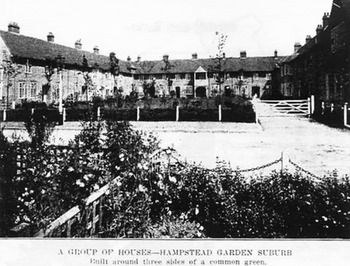
The famous English architect Raymond Unwin believed in building homes that enclosed people in “quadrangles.” In a 1902 publication he asserted that “there is something at once homely and dignified about a quad which gives it a charm . . . that nothing can accomplish for a mere street of cottages.” Street-fronted cottages gave women quick access to those streets. Unwin's quads, on the other hand, embounded women into a specific space where they could be watched. Quads also were intended to replace the backyards of those cottages that were most often an outside space where a woman would not be under surveillance. Unwin believed that every house should have a large living room that included the kitchen so that “here the bulk of the domestic work will be done, meals will be prepared and eaten, and children will play while the whole family will often spend long evenings there together.”Footnote 47 Unwin's plans embounded women into that one room and into the quads. As he also proposed to embound new housing with fences, gates, and wall, they revealed no sense that women could belong to a democratic city. (See Figure 9.) As historian Elizabeth Wilson has argued, one does not need to find men saying this explicitly to understand that this was one of the principal aims of such new building schemes. The daily lives of the men living in such buildings as on the Boundary Street estate would be little changed, unlike that of many women. In the buildings rehabilitated by Hill in London and the Alexandra Guild in Dublin, not only would women continue to live in familiar patterns, socializing in public spaces for example; they would have better provisions for their children.
Unwin-designed housing with quadrangle, gates, and fences. From Raymond Unwin, Town Planning in Practice (1909).

Toronto men were so fearful of the potential freedom for women in unembounded apartment buildings—rather than as housekeepers in single-family homes—that the city council passed an ordinance outlawing their continued construction. Modern urban life combined with the apartment, according to one of its opponents, to give women too much freedom: “Not only is pride in their families vanishing, but pride in their housekeeping as well; and apartment life will complete the process . . . . with soup in boxes and fried potatoes in a bottle, a woman has little to think of now if she has credit and a telephone.”Footnote 48
By 1925, the Dublin City Architect Horace O'Rourke took this idea to the extreme. It was his wish that “ultimately towns will cease to be places of residences at all, and will be merely used as convenient centres for work and business.”Footnote 49 Moreover, as his further ideal was that men should work and women stay at home, the city he envisioned was a city of men.
In sum, housing schemes in these four cities, whether erected by the city, private building companies, or philanthropic trusts—and including proposed schemes that were not undertaken—were intended to embound women. They turned buildings inward from the street, in effect closing off the street from residents and discouraging public gathering in the streets or around the neighborhood. Fences and entry gates guarded the area from public entry. Even today, when one enters into these complexes, one feels distinctly like an intruder into a private space. (See Figure 10.)
Peabody Estate, Clerkenwell, London, 2012. Photo by the author.

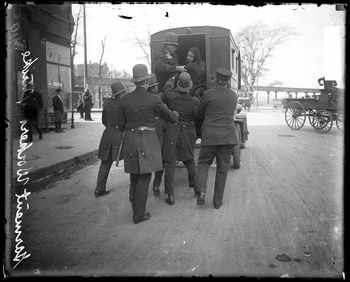
Which brings me back to the streets of Cairo. Although there are obviously differing cultural strictures between Cairo in 2011 and the earlier Anglo-Atlantic cities, what we saw happening in the Arab Spring demonstrates once again that the city could still be the hope of democracy. Still, it will never be the site of actual democracy unless women are allowed free, equal, and safe access to streets, public spaces, and the demonstrations of political expression that are the still perceived as the purview of men. The savage beating of a female demonstrator in Cairo was not an aberration, albeit a more violent manifestation of male determination to keep women controlled and embounded. So, let me finish this essay with two more images to ponder. The first is from 100 years ago in Chicago. (See Figure 11.) Six policemen are shoving one female striking garment worker into a police wagon. Did it really take six to “subdue” her, or was something more deeply sexist at work here? The second is from the early 1920s advocating zoning laws. (See Figure 12.) The relationship here is quite clear: the orderly city is the orderly woman; the disorderly city is the disorderly woman.
Arrest of striking woman garment worker, 1910. Chicago Daily News photo, courtesy Chicago History Museum (chsmedia.org/media/dn/05/0561/DN-0056132.jpg).

The Disorder of Women, from American City Magazine, September 1922.