Studying the political causes and consequences of economic globalization arguably represents the largest research program in all of international and comparative political economy. Yet if one defines economic globalization as the freer flow of goods/services (international trade) and factors of production (e.g., capital and labor) across national borders, then it seems clear that political scientists have only begun to explore systematically the subject of international labor mobility or cross-border migration.Footnote 1
There are at least two possible reasons for this academic neglect. The first is substantive: international labor mobility is the least developed feature related to economic globalization following the definition we provided.Footnote 2 International trade has greatly expanded since World War II with a rapid growth in international capital mobility since the late 1960s. But even in the twenty-first century, national economies remain relatively closed to migrants.Footnote 3 Foreign workers must surmount what Pritchett has called a “massive cliff” at the border to gain entry into an advanced industrial democracy.Footnote 4 While the demand for international labor mobility is high among potential workers, governments' willingness to supply an open labor market remains low,Footnote 5 leading to relative international labor immobility.
A second reason concerns data limitations and availability. While the data on actual crossborder migration flows are limited and inaccurate because of irregular and inconsistent reporting, there have been almost no data on official government policies concerning external labor openness. As Facchini and Mayda wrote in 2009, “a systematic, objective measurement of the restrictiveness of immigration policies does not exist on a cross-country scale.”Footnote 6 To the extent that academic research tends to follow available data sets, it is perhaps not surprising that international and comparative political economists have invested more time studying international trade and capital mobility, waiting for cross-national data sets on official immigration policy. As Freeman noted on this point: “large N studies [of immigration politics] are much less numerous, but it is certainly time for scholars to turn their attention to this mode of analysis. The main obstacle to such research designs is the absence of sufficient data cross nationally.”Footnote 7
So let us begin by stating the obvious: if labor is relatively immobile on an international basis, albeit with some significant variation among the advanced industrial democracies as the major destination countries, then we need to understand these differences in relative “closedness” to foreign workers. Why have some democratic destinations been able to maintain very closed immigration policies while others have begun to open their labor markets to foreign workers? To answer this question systematically, we need data on the official immigration policy among the advanced industrial democracies. Following Quinn,Footnote 8 we both provide a new data set of country/year external labor openness and test an explanation for the variation in the openness of official immigration policy across more democratic polities. Quinn's papers introduced a new data set on international capital mobility and tested some explanations to explain the observed country/year variation. We do the same here for international labor mobility.
In the first part of the paper, we introduce this data set documenting changes in official policy related to external labor openness. These data focus on immigration policy, defined as those policies that affect the number of foreign workers able to enter into the national economy (as distinct from immigrant policy, defined as those policies related to the treatment of immigrants once they have already entered). In the second part of the paper, we offer and then test a political explanation for the variation in official immigration policy. Based on the existing evidence showing that a large majority of voters in the advanced industrial democracies prefer immigration restrictions, we hypothesize that a parliamentary system and proportional representation voting with greater district magnitude should be associated with a less open external labor policy because these institutions lead the government to be more responsive to voters and less responsive to special interests favoring a more open immigration policy. We then present statistical evidence in support of these hypotheses.
An uncomfortable juxtaposition emerges from these results: the same domestic institutions that serve to make the political system more open and inclusive vis-à-vis voters also serve to make the country's external labor policy less open and more exclusive. Others have discussed the tension between democracy and open immigration,Footnote 9 and our results can be read as a particular manifestation of that broader tradeoff. A policy implication associated with this understanding is that more external labor openness may require far greater efforts to convince the mass public of the economic benefits associated with international mobility. Otherwise, it will be hard for most democratic governments to substantially open their external labor policy.
Measuring External Labor Openness
Before describing our measure, we note similar efforts to code an immigration policy variable. Mayda created a policy measure covering fourteen advanced industrial democracies between 1980 and 1995,Footnote 10 which was extended by Ortega and Peri for twelve destination countries through 2006.Footnote 11 Fitzgerald, Leblang, and Teets similarly constructed an immigration policy measure for eighteen destination countries through 2006.Footnote 12 These papers all used their immigration policy measure as a control variable to explain dyadic immigration flows. In this regard, a single destination country/year policy value enters their data set multiple times, or for every included source country in a given year.
Since our goal is to explain the variation in official immigration policy, our unit of analysis will be the destination country/year (xt) with a focus on more democratic destinations, given our interest in exploring the variation across different democratic political institutions. As such, our measure is more directly comparable to the country/year immigration policy measure that Peters recently introduced covering nineteen countries over a two-century time frame (less for countries that more newly gained their independence).Footnote 13 Her measure, like ours, is designed to function as a dependent variable. Given our interest in explaining the variation in immigration policy across the more democratic destination countries, our goal is to include a larger number of countries for some reasonable time frame. Thus, compared to these previous efforts, our policy measure has a larger x dimension, but a smaller t.Footnote 14
Constructing the Measure
Using information about both legislative and administrative changes from the Organisation for Economic Cooperation and Development's (OECD) Trends in International Migration (published annually through 2004) and International Migration Outlook (published annually beginning in 2006), our measure covers thirty-six advanced industrial countries from 1996 to 2012.Footnote 15 This time frame captures “the present period of migration, facilitated by a sharp decline in transportation costs” and the end of the Cold War, which had restricted certain labor flows.Footnote 16 Within this post-Cold War time frame, however, we do not have full temporal coverage for all countries in our sample since the OECD reports exclusively on the immigration policy of member states with several countries having only recently joined this intergovernmental organization. Our full sample thus includes 535 country/year observations.Footnote 17
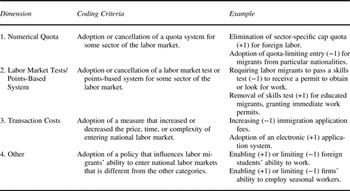
In coding our measure, we draw attention to the important difference between external and internal policy in this issue area. Following Hammar, “policy consists of two parts which are interrelated, yet distinct: (a) regulation of flows of immigration and control of aliens, and (b) immigrant policy.” Regulation of flows refers to “the rules and procedures governing the selection and admission of foreign citizens,”Footnote 18 corresponding to our term external immigration policy. Immigrant policy refers “to the conditions provided to resident immigrants.”Footnote 19 Given our interest in external, or immigration, policy (as separate from internal, or immigrant, policy), our measure is focused on country/year policy changes in four related dimensions: 1) numerical quotas, 2) labor market tests, including a points-based system, 3) transaction costs, and 4) other policies related to labor market access (see Table 1). These dimensions reflect the primary ways that states regulate the legal employment options of foreign workers.Footnote 20
Dimensions of external labor openness

The first dimension is arguably the most visible means by which governments regulate foreign entry into the domestic labor market with immigration quotas typically coming in the form of a numerical cap or in a stated proportion of the labor force. Quotas operate by establishing adjustable targets for the number of foreigners who can legally work in a national economy. Adopting or removing a quota system that is economy wide or targeted to a specific economic sector can alter a country's openness to foreign labor by influencing migration targets. Within our sample, we find relatively few (only seven) quota adjustments with three in a more restricted direction (Italy 1998, New Zealand 2001, and Bulgaria 2009) and four toward greater openness (Spain 2002, Norway 2002, Portugal 2007, and South Korea 2010).
The second (and somewhat less visible, at least to the mass public) dimension considers related policies by which states regulate potential foreign entry into their labor markets that are generally geared toward determining whether or not local workers are available to fill a labor market need. Often, employers must advertise the job for a fixed period of time or show that they have tried to employ native workers before hiring foreign workers. A points-based system that identifies the value of different applicants based on ability, experience, and/or age at different levels and for different projects is also considered within this dimension. The removal of skills tests for foreign workers can be considered a more open external labor policy, while requiring a skills test for foreigners is more restrictive. Compared to the first dimension, we find comparatively more policy changes in this second dimension (14) with three in a more restricted direction and eleven aiming toward greater openness (79%).
The third and even less domestically visible dimension concerns the transaction costs for foreign workers associated with entering the national economy. Destination countries often make efforts to alter migrant transaction costs by making it more or less expensive and/or more or less time consuming. For example, the adoption of an electronic application system to reduce the paperwork associated with immigration makes this policy dimension more open, while increasing the application fees makes it more restrictive. Within this third dimension, we find forty policy changes with ten in a more restricted direction and thirty associated with greater external labor openness (75%).
The fourth and least visible dimension picks up other governmental policies designed to facilitate or limit foreign access to their labor markets. These policies often involve administrative rather than legislative changes. Examples include whether foreign students may obtain work, altering restrictions on employers' ability to hire seasonal workers, changing rules on where migrants may work and what occupations they may obtain, whether certain types of migrants must receive a permit to begin work, and other measures that limit or facilitate labor migration from specific countries or regions. We find the most immigration policy changes in this fourth dimension (eighty-six) with twenty-five in a more restricted direction and sixty-one pointing toward greater openness (71%).
We identify the frequency and direction of policy changes in each dimension because they have some implications for our political argument. If the status quo includes a relatively closed immigration policy and the mass public strongly opposes changing it (as we demonstrate later), then one might expect to observe less change in the more visible policy dimensions. On this basis, it is not surprising to see that the number of immigration policy changes increases with the numbered dimension (i.e., the fewest changes in terms of the first dimension and the most in terms of the fourth). Likewise, to the extent that there are certain special interests wanting greater immigration openness, they may be more able to obtain this policy outcome (contrary to voter preferences) in the less visible dimensions. It is thus notable that a much greater percentage of the changes in these last three dimensions are toward greater openness compared to the most visible first dimension.
To build our measure of official immigration policy, we treat each dimension equally, assigning a +1 for each policy change in any dimension that made the country/year more open to foreign labor and a –1 for each policy change in any dimension that made the country/year less open. Starting each country's time-series at 0, we then create External Labor Openness, measuring the country/year's level in terms of these policy dimensions. We are aware that not all OECD countries enter our sample with an identical immigration policy (this is simply a modeling necessity), so our statistical models will include unit fixed effects to give each country its own intercept. Our equal weighting of the four dimensions is consistent with the simple aggregation procedure used by Mayda; Ortega and Peri; Ruhs; and Fitzgerald, Leblang, and Teets.Footnote 21 According to Ruhs, “the main arguments in favor of equal weights are transparency and simplicity. Any procedure that departs from equal weights needs to be based on convincing reasons explaining why and how some indicators matter more than others.”Footnote 22 For scholars who have such reasons, our data set is available in a disaggregated manner (i.e., separate variables for each dimension) allowing for a more complicated aggregation procedure.
Descriptive Data
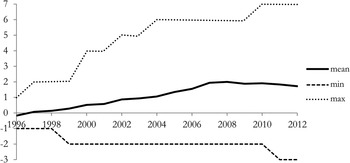
Having created this measure of External Labor Openness, we need to examine the data descriptively. In Figure 1, we plot the mean value of the level measure for each year in our sample, along with the annual minimum and maximum values. One can observe that these data show a weak trend toward greater external labor openness beginning in 1996.Footnote 23 Given the fact that labor is the least developed feature related to economic globalization, this recent movement toward greater international labor mobility requires some brief discussion.
External labor openness, 1996–2012

Ortega and Peri similarly observed a trend against greater entry restrictions in their measure of immigration policy, so this pattern toward greater labor openness does not appear to be a unique feature of our data set.Footnote 24 It is also consistent with Freeman's observation of “an expansionary bias in the politics of immigration in liberal democracies such that official policies tend to be more liberal than public opinion.”Footnote 25 Given pre-existing policies that tightly constrained international labor mobility, it would be hard for most advanced industrial democracies to move in a more restricted direction, although we note from the minimum yearly value in Figure 1 that some countries have indeed decreased their External Labor Openness over this period.
In Appendix 1, we present the time-series for each country in our data set, and one can observe some important variation in immigration policy change post-1996. Countries like Austria, Belgium, Finland, Germany, Japan, Korea, Netherlands, Norway, and the United States have moved (albeit slowly) in a more open direction, consistent with the general trend observed in Figure 1. But countries like Hungary, Italy, Mexico, and Turkey have moved in the opposite direction, tightening their immigration policies. Countries like Australia, Canada, Denmark, Poland, Switzerland, and the United Kingdom first opened, then tightened. Conversely, countries like the Czech Republic and New Zealand first tightened, then opened their immigration policies over this period.
A Statistical Validity Test
Since we cannot demonstrate the operational validity of our measure for immigration openness simply by looking at these descriptive data, we now turn to a statistical test, examining the correlation between it and actual labor inflows. External Labor Openness is a broad measure of official national immigration policy, while actual immigration is best understood as a measure of policy impact, or its effect. Although sometimes used as such,Footnote 26 labor inflows are not a direct measure of official policy; labor inflows are instead subsequent to immigration policy. Our validity check is designed to show that External Labor Openness behaves as expected: a more open national immigration policy should be positively correlated with actual immigration. For these statistical tests, our dependent variable (Inflows) measures the number of immigrants (in thousands) entering the country/year using data from the OECD.Footnote 27
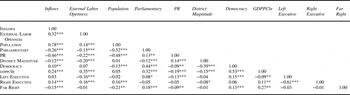
External Labor Openness, lagged one year, is our independent variable. Since we are simply interested in the basic correlation between this policy variable and subsequent labor flows, our statistical specification dispenses with a long set of possible control variables (many of which would be effectively post-treatment variables). We do, however, need to control for the obvious confounding factor—country size—since larger countries might be expected to have both more open immigration policies and to admit more immigrants, thus exaggerating any positive correlation between the openness of immigration policy and labor flows. To capture country size, or capacity, we include Population (in thousands) using data from the World Bank.Footnote 28 Descriptive statistics and the bivariate correlations among these three variables appear in Appendix 2.
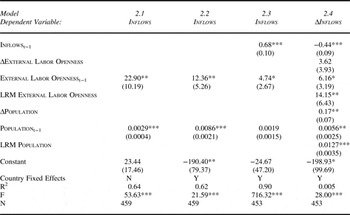
Table 2 presents a series of increasingly restrictive models of Inflows. In model 2.1, we include only the lagged values of External Labor Openness and Population. Both variables are statistically significant with the expected positive coefficients. Furthermore, this simple model provides much explanatory power because these two variables alone produce an R2 of 0.64. In terms of the substantive significance of External Labor Openness, a one-unit increase in our immigration policy measure can be associated with about 23,000 more immigrants. The constraining variable in this regression is Inflows and not External Labor Openness; we have more country/year observations for our policy measure (N = 535) than the OECD has reported for immigrants over the 1996–2012 period (N = 459), illustrating some of the data problems for migration research.
Models of inflows

Notes: OLS coefficients with robust standard errors clustered on the country. Statistical significance indicated as follows: *p < .10; **p < .05; ***p < .01 (two tailed).
Despite the relatively high R2 in our first Inflows regression, we recognize that there may be other confounding factors besides Population. In model 2.2 we therefore add unit fixed effects to proxy the set of other country-specific variables that may influence the relationship between labor inflows and the openness of immigration policy. Adding country fixed effects attenuates the coefficient for External Labor Openness (dropping from 22.90 to 12.36), but it remains statistically significant, associating a one-unit increase in the openness of immigration policy with more than 12,000 additional immigrants.
In model 2.3, we make our Inflows specification even more restrictive by adding a lagged dependent variable. With a lagged dependent variable, we are now modeling the change in Inflows from the previous year, while controlling for its previous level. For readers who may be concerned about Nickell bias in a specification that includes both a lagged dependent variable and unit fixed effects,Footnote 29 it is important to note that Nickell bias typically presents as attenuation bias with a greater risk for a Type II error (a false negative) than a Type I error (a false positive). Thus even with potential bias that works against our expected result, External Labor Openness remains positively signed and statistically significant at conventional levels, associating a one-unit increase in the openness of immigration policy with an increase of almost 5,000 immigrants in the following year.
Finally, for readers who may be concerned about non-stationary data,Footnote 30 we shift to an error correction model (ECM) in model 2.4 by adding the change in (Δ) External Labor Openness and Population to our lagged dependent variable specification from model 2.3. With this ECM specification, the short-term effect of External Labor Openness comes from the coefficient on ΔExternal Labor Openness and its long-run multiplier (LRM) is given by the coefficient on External Labor Openness t−1 divided by the absolute value of the lagged dependent variable (Inflows t−1). In model 2.4, External Labor Openness demonstrates a statistically significant positive association with Inflows on a long-term basis. As given by the LRM for External Labor Openness, a one-point increase in the openness of immigration policy can be associated with an additional 14,000 immigrants over the following years.
These results provide evidence of a robust positive relationship between our measure of cross-national immigration policy and reported country/year total immigration, although the size of the estimated External Labor Openness coefficient changes with the statistical specification (unsurprisingly becoming smaller in more restrictive specifications). We thus argue for the operational validity of our aggregate measure of immigration policy, which will become the dependent variable based on the understanding that one needs to explain the observed variation in national immigration policy because it has a meaningful effect on reported labor inflows.
Explaining External Labor Openness
What political factors explain the variation in national immigration policy? Existing arguments about how voters consistently oppose greater immigrationFootnote 31 while there are special interests supporting itFootnote 32 need to be extended. The fact that a majority of voters in all advanced industrial democracies oppose greater immigration does not by itself explain much variation in national immigration policy. Likewise, the fact that certain special interests favor greater immigration cannot alone explain the variation in this policy. Putting these two arguments together is an important first step, but we also need to identify the political institutions that make it more likely for voters or for special interests to prevail in their opposing policy preferences.
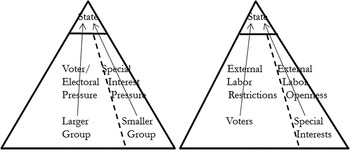
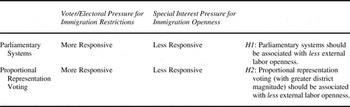
To that end, our argument also builds from a Grossman and Helpman-style political model where the democratic state, or government, faces political pressure from its society through both a voter/electoral channel and through a special-interest channel,Footnote 33 as illustrated on the left side of Figure 2. If we assume that for any given political issue, society is divided in terms of its policy preferences, the larger societal group (with one policy preference) is advantaged through the voter/electoral channel, while the smaller societal group (with a different policy preference) is advantaged through the special-interest channel since it faces fewer collective action problems.
The political model applied to external labor policy

Applying this democratic political model to the issue area of immigration, as the right side of Figure 2 illustrates, we see that the political pressure through the electoral channel comes for external labor restrictions given widespread voter opposition to greater immigration. This leaves the special-interest channel for those societal actors who favor greater external labor openness. We thus posit that democratic institutions leading the state to be more responsive to voter pressure (and less responsive to special-interest pressure), notably a parliamentary system and proportional representation voting, should be associated with a less open external labor policy. Our political argument is thus consistent with Breunig and Luedtke's insight that “based on a wealth of empirical findings showing that anti-immigration public sentiment prevails across the developed world,” it should be the “institutional factors in a given polity [that] determine the degree to which anti-immigration political actors can actually gain a voice.”Footnote 34
Voter Opposition to Immigration
Since it has been well documented elsewhere, we make no efforts to provide new survey evidence on this point: citizens in the advanced industrial democracies express a strong preference against greater immigration. As Facchini and Mayda concisely summarized, “the existing cross-country evidence on migration preferences suggests that individuals are on average remarkably averse to more open migration policies. For instance, on average across twenty-two industrialized countries, in 1995 only 7.4 percent of the population favoured a more open migration policy. Similarly, in 2003, this figure was still only 10.9 percent.”Footnote 35 These data come specifically from two survey waves in the International Social Survey Programme (ISSP) conducted in 1995 and 2003.
In citing these ISSP data, our goal is not to explain why citizens express so much opposition to immigration (it could be labor competition, nationalism, or other reasons), but rather to demonstrate the extent to which potential voters are opposed to greater external labor openness and then to consider its implication within more democratic political systems. Certainly, the averages we cited obscure some crossnational variation. “In 1995, Canada and Ireland are the countries most favourable to migration (with, respectively, 20.61% and 19.10% of their population favouring an increase in the number of immigrants).” For 2003,
in Canada and Israel, respectively, 29.02 percent and 27.14 percent of the population favours an increase in the number of immigrants, while in Hungary and Latvia these percentages are, respectively, equal to 2.18 percent and 2.60 percent. Among Western European countries, Portugal (3.09%), the Netherlands (3.72%) and Germany (4.06%) show the public opinion that is most hostile to immigration. Finland (24.10%) is the only Western European country among the top five most open countries towards migration. In the United States, 9.8 percent of individuals favours larger numbers of immigrants… In France, 7.37 percent of voters welcomes increases in migration.Footnote 36
What is interesting about this variation in the cross-national ISSP surveys is that even in the countries most favorable to immigration, a vast majority of citizens (>70%) express a contrary preference.Footnote 37 As Rosenblum and Cornelius wrote, “if there is a universal truth about immigration policy, it is that residents of industrialized states would prefer to see lower levels of immigration.”Footnote 38 This understanding suggests that far-right voters may not be particularly unique in this issue area. Even if the political far right gets more attention for its strident opposition to greater immigration, the majority of voters share a similar (but perhaps weaker) preference for a more restrictive immigration policy. We thus conclude that the political pressure faced by the OECD governments through the voter/electoral channel comes strongly for external labor restrictions, as the right-hand side of Figure 2 illustrates.
But since we can also observe from the descriptive statistics presented earlier that the average OECD government is nonetheless slowly moving toward greater external labor openness (Figure 1), it is important to consider the contrary political pressure. To explain more open immigration policies, scholars have noted the “dominant role” played by pro-business lobby groups.Footnote 39 As Money argued, “firms are the primary actors with an interest in immigrant labor and an incentive to lobby government regarding immigration issues.”Footnote 40 Goldsborough similarly noted that “immigration policy today is driven by businesses that need more workers—skilled and unskilled, legal and illegal.”Footnote 41 Indeed, the pro-immigration lobby role played by business is not simply anecdotal. As Facchini, Mayda, and Mishra reported, “interest groups play a statistically significant and economically relevant role in shaping migration across sectors. Barriers to migration are … lower in those sectors in which business lobbies are more active.”Footnote 42
In making this argument, it is important to consider the potentially countervailing logic Peters offered—that open trade hurts labor-intensive firms in labor-scarce national economies, making them less able to afford the lobbying necessary for more open immigration to acquire cheap foreign labor.Footnote 43 Over the long term, this is likely to be true, especially as these firms go out of business. But in the short term, the damage from open trade to labor-intensive firms in labor-scarce national economies may provide them with even greater incentives to lobby for immigration openness since the acquisition of cheap labor is so important to their survival.
There are also pro-immigration special interests organized around ethnic groups and particular humanitarian issues.Footnote 44 Likewise, the public opinion data show that elites and government officials, on average, have a more open labor preference than does the mass public.Footnote 45 On this basis, one might conclude that there is countervailing pressure for external labor openness through the special-interest channel (see the right-hand side of Figure 2) and that OECD governments may often be sympathetic to such political pressure.
In stating that the political pressure for more open immigration comes primarily through the special-interest channel, we do not intend this argument to be read normatively (i.e., special-interest politics leads to bad policy, and open immigration is therefore a bad policy choice). There are many reasons to favor more open immigration, both economic and humanitarian. Our point is simply that democratic governments feel some pressure for greater external openness (otherwise, it would be hard to explain the weak openness trend observed in Figure 1), but that this political pressure does not come through the voter/electoral channel. Instead, the political pressure applied through the voter/electoral channel tends to come for immigration restrictions.
Democratic Political Institutions
Having first identified the political pressure that democratic governments experience through the voter/electoral channel (external labor restrictions) and the special-interest channel (external labor openness), we now take the second step in our argument: identifying the political institutions that make governments more responsive to the voter/electoral channel (compared to the special-interest channel). We adopt what we view to be the stronger position in an ongoing debate about the effect of democratic political institutions.
Although there are many institutions that might make democratic governments more responsive to broad voter/electoral pressure (and correspondingly, less responsive to narrow special-interest pressure), the argument here focuses on: 1) parliamentary systems and 2) proportional representative voting marked by greater district magnitude. Although they are often associated in practice, at least among the advanced industrial democracies, it is important to consider these two electoral features separately since the parliamentary (versus presidential) system distinction describes the construction/separation of the executive branch, while PR (versus majoritarian) voting describes the construction of the legislative branch.
These particular democratic political institutions have often been discussed in the context of international trade openness,Footnote 46 and we bring a similar logic to bear on international labor mobility. But unlike for international trade where parliamentary systems and proportional representative voting are generally associated with more openness, we anticipate that these same democratic political institutions should be associated with less external labor openness.
Parliamentary Systems
A parliamentary system can be defined as one where the executive branch ministers are drawn directly from the legislative branch; in this regard, the executive and legislative branches are intertwined. A parliamentary system stands in contrast to a presidential system where the chief executive, or the president, is directly elected, thus resulting in a greater separation of power between the executive and legislative branches. In an ideal type democracy, public policy directly reflects voters' broad preferences (not the narrow preferences of special interests). As Samuels and Shugart concluded in their study of the separation of powers, “parliamentary systems tend to more closely resemble the idealized chain of democratic delegation and accountability [from voters to policy]. Presidential and semi-presidential systems, in contrast, are far less likely to embody that ideal.”Footnote 47
Various authors have discussed how politicians in a presidential or separation-of-power system are more receptive to special interests than politicians in a parliamentary system.Footnote 48 Consequently, the democratic state may be less prone to set policy to fit the special interest in a parliamentary than in a presidential system. As Kitschelt enumerated:
Four mechanisms make polities with strong presidential powers more prone to clientelism [a specific form of special interest politics]. First, they personalize competition for the highest office and attract ambitious politicians who are often distinguished only by their personal support networks … Second, the personalist contest for the presidential office encourages candidates to deemphasize programs and issue programmatically diffuse appeals … Third, elected presidents succeed in becoming powerful players only if they prevent the emergence of a stable, program-based legislative majority that would constrain their control and discretion over the legislative agenda … Fourth, because legislators are not responsible for the survival of the presidential government, they are more likely to withdraw support from the cabinet and maintain loyalty to the president only if they receive selective material inducements that permit them to maintain their own clientelist networks.Footnote 49
To the extent that voter/electoral pressure is for immigration restrictions and that the contrary political pressure for immigration openness comes primarily from special interests, one might expect democratic governments in parliamentary systems to be more responsive to the former and harder to access for the latter (compared to those in presidential and semi-presidential systems). This leads to our first hypothesis that:
H1
Parliamentary systems should be associated with less external labor openness.
Proportional Representative Voting
PR voting is a democratic electoral feature where the percentage of seats for a particular party in the legislative branch is proportional to the percentage of votes cast for that party. With PR voting, there are multiple seats for a given electoral district so that the various parties receiving votes above some minimum threshold receive their share of the seats for that district. The average number of seats across electoral districts is known as the mean district magnitude, which can be understood as a measure of proportionality. PR voting stands in contrast to majoritarian voting, where the party that obtains the majority of the votes wins the usually single seat for the electoral district (hence district magnitude equals 1).
The clear expectation associated with PR voting and greater district magnitude is that it should create a legislature that is more broadly representative and therefore more responsive to voter preferences.Footnote 50 The empirical evidence tends to suggest that PR voting is effective toward this end. Following the results in Huber and Powell and in Powell,Footnote 51 evidence indicates that democracies with proportional design score higher in terms of their effective representation of voters than democracies with majoritarian design. Likewise, PR democracies score higher in terms of congruence, or the closeness between the preferences of citizens and the actions of policy-makers.Footnote 52
Not only does PR voting with greater district magnitude create governments that are more responsive to broad voter preferences—this same democratic electoral institution may also limit special-interest politics. As Rogowski argued with reference to international trade, “insulation from regional and sectoral pressure [for protection] in a democracy … is most easily achieved with large electoral districts … When automakers or dairy farmers entirely dominate twenty small constituencies and are a powerful minority in fifty more, their voice [demanding protection] will certainly be heard in the nation's councils. Where they constitute but one or two percent of an enormous district's electorate, representatives may defy them more freely.”Footnote 53
Based on the understanding that the minority interest comes for external labor openness in the issue area of international labor mobility, it should be harder to achieve this outcome in a democratic system with PR voting and greater district magnitude. In this sense, while our argument parallels the basic logic from the political economy of international trade, it leads to a very different policy outcome. Perhaps a majority of voters want the benefits associated with more open trade, while special interests seek trade protection. This is a preference configuration that would lead to greater trade openness with PR voting,Footnote 54 or greater trade protection with majoritarian voting.Footnote 55 But given the domestic preference configuration in terms of international labor mobility where a vast majority of voters in the advanced industrial democracies want immigrant restrictions, forcing those who advocate for a more open external labor policy to use the special-interest channel, the expected policy outcome gets reversed in terms of economic openness: a less open external labor policy with PR voting and larger districts. Hence, our second hypothesis is that:
H2
Proportional representation voting (with greater district magnitude) should be associated with less external labor openness.
In response, one might argue, following the argument by Rogowski and Kayser,Footnote 56 that there is greater competition for votes in majoritarian systems since the seat-vote elasticity is greater in single-member districts. On this basis, majoritarian voting might produce governments that are more responsive to voters (and less responsive to special interests) than proportional representation voting with greater district magnitude. But even if there is greater competition for votes with majoritarian voting (which may not often be the case as we will explain), this competition can create even greater pressure for special interest politics since business (the economic actors pushing for greater immigration openness) can provide campaign contributions, which can then be used to increase the vote and persuade undecided voters in other issue areas. In this regard, more competitive elections in majoritarian systems may engender a greater reliance on special interests since money can be converted into votes,Footnote 57 which may be especially important when this competition is based on a personal vote with weak parties.
But it is not always the case that greater seat-vote elasticity in single-member districts leads to a fiercer competition for votes because many of the legislative seats in majoritarian systems are effectively “safe” as a result of smaller district size and partisan geographic clustering. This safeness is further exacerbating by gerrymandering, a phenomenon not unique to the majoritarian system in the United States.Footnote 58 Indeed, safer seats in majoritarian systems should allow politicians to cater more to special interests since their re-election is less threatened by losing some popular support from pursuing policies opposed by voters (e.g., a more open immigration policy).Footnote 59
Hypothesis Testing
Our argument and hypotheses are summarized in Table 3.Footnote 60 Again we test these hypotheses in a variety of specifications to demonstrate that the results do not depend, for example, on the presence or absence of fixed effects or on the arbitrary inclusion of some specific control variable, which may also affect the sample size.
Testable hypotheses

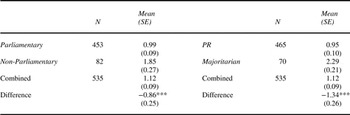
We thus begin with two difference-in-means tests, comparing the level of External Labor Openness for Parliamentary versus Non-Parliamentary (combining presidential and semi-presidential) systems and the same for proportional representation (PR) versus Majoritarian voting.Footnote 61 This is also a useful preliminary exercise since it uses all observations for our dependent variable (N = 535) and provides some descriptive data for these independent variables in our sample of OECD country/years. As one can see in Table 4, most advanced industrial democracies have a parliamentary system and/or proportional representation voting.
Difference in external labor openness means

Note: Statistical significance indicated as follows: *p < .10; **p < .05; ***p < .01.
These simple tests provide strong evidence consistent with both hypotheses. Parliamentary systems have a mean value of External Labor Openness that is about 50 percent smaller than the mean value for Non-Parliamentary systems (0.99 versus 1.85). This difference is even greater for PR voting with a mean value of External Labor Openness that is less than half of the mean value associated with Majoritarian voting (0.95 versus 2.29). Both of these differences are statistically different from 0 with greater than 99 percent confidence, but the results obviously do not account for other factors that may also explain External Labor Openness. So we now proceed with some more rigorous multivariate statistical tests with the results presented together in Table 5.
Models of external labor openness

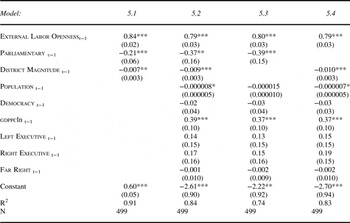
Notes: All models include country fixed effects. OLS coefficients with robust standard errors clustered on the country. Statistical significance indicated as follows: *p < .10; **p < .05; ***p < .01 (two tailed).
Our specification for these multivariate models includes a lagged dependent variable, which means that we are now estimating a model of immigration policy change controlling for the previous level of immigration policy openness. This makes substantive sense since the difference-in-means tests in Table 4 compared the level of immigration openness, but we also want to know how these democratic political institutions influence immigration policy change. Including a lagged dependent variable also allows us to calculate the long-run effect of these political institutions, which operates not only through their coefficients but also through the lagged value of External Labor Openness.Footnote 62
Our specification in Table 5 also includes country fixed effects, which are needed to give each country its own intercept to adjust for the fact that the countries in our sample do not all begin with an identical immigration policy stance. For readers who are concerned about Nickell bias with both a lagged dependent variable and unit fixed effects,Footnote 63 it is worth remembering that Nickell bias comes as attenuation bias, which only makes it harder (not easier) to find statistical support for our two hypotheses.
To test our hypotheses in the presence of fixed effects (which was not done in Table 4), we need operational measures that have both cross-sectional and temporal variation. Fortunately, the dichotomous Parliamentary measure used in Table 4 has this variation since Israel moved away from a parliamentary system in 1997, then back to a parliamentary system in 2002. Bulgaria also adopted a parliamentary system in 2002. One might think of these major system changes as a natural experiment for the argument advanced here since we have no reason to believe that these system changes were caused by immigration policy.
Unfortunately, the dichotomous PR measure used in Table 4 lacks any temporal variation, so we will replace it in Table 5 with a measure of country/year mean district magnitude (District Magnitude).Footnote 64 While it could not be used for the difference-in-means tests because it is an interval measure (noting, however, the strong negative bivariate correlation between External Labor Openness and District Magnitude in Appendix 2 as a parallel test), this is also the advantage in using District Magnitude here because it not only captures the variation between majoritarian voting (where District Magnitude is equal to 1) and proportional representation (where District Magnitude is greater than 1), but also the variation among different countries with PR voting. In terms of the temporal variation within our sample of OECD country/years, there are nineteen changes in mean District Magnitude (five in a positive and fourteen in a negative direction).
In model 5.1, Parliamentary and District Magnitude enter with a one-year lag, although we are not particularly concerned about reverse causality, or more immigration policy causing these democratic political institutions. Consistent with H1, Parliamentary takes on a negative coefficient (−0.21), indicating that a shift toward a parliamentary system can be associated with about a 0.2 reduction in External Labor Openness in the following year. The long-term effect is even larger with a shift to a parliamentary system being associated with a total change of −1.31 in External Labor Openness (−0.21/(1−0.84)).Footnote 65
Consistent with H2, District Magnitude also takes on a negative coefficient (−0.007), associating a one-unit increase in mean district magnitude with this reduction in External Labor Openness in the following year. While this effect may appear as substantively small, it is important to recall that District Magnitude replaces the time-invariant pr measure used in Table 4. For observations with majoritarian voting, mean District Magnitude is effectively 1, while for observations with pr voting, the average value of mean District Magnitude is 27. This coefficient would associate a shift from majoritarian voting to PR voting with an average mean district magnitude with a 0.2 reduction in External Labor Openness in the following year (similar to the short-run substantive effect of Parliamentary). And as before, the long-term effect is even larger with a shift from majoritarian voting to PR voting with an average mean district magnitude leading to a −1.18 total change in External Labor Openness ((27*−0.007)/(1−0.84)).
We next add a set of control variables to help explain the variation in External Labor Openness. These controls include Population as used in Table 2 for our operational measure of country size, or capacity. We also control for the limited range of Democracy, using the Polity scale, and for the variation in national wealth based on the logged value of GDP per capita (GDPPCln).Footnote 66 With a policy dependent variable, we also control for the partisan orientation of the government in power by including dummy variables for a left-wing and a right-wing chief executive (Left Executive and Right Executive) with the excluded category being a centrist or “other” type of chief executive.Footnote 67 To more specifically account for the potential influence of the political far right in terms of immigration policy, we also include a Far Right measure capturing the share of votes for far-right parties since the last national election.Footnote 68 The descriptive statistics and the bivariate correlations among these variables appear in Appendix 2.
Our results with these control variables added to the specification are presented as model 5.2. The results continue to show support for H1 with a negative and statistically significant Parliamentary coefficient and for H2 with a negative and statistically significant coefficient for District Magnitude. Adding these control variables strengthens the coefficients for the primary independent variables, especially Parliamentary growing from −0.21 in model 5.1 to −0.37 in model 5.2. Among the control variables, Population is statistically significant and with a negative sign, suggesting that while larger countries may admit more immigrants (as Table 2 shows), more populated countries also tend to have more restrictive immigration policies. Conversely, gdppcln is statistically significant and positively signed, indicating (not surprisingly) that wealthier countries can afford to have more open immigration policies.
Since we showed in Table 4 (and in Appendix 2) that most countries in our sample have a parliamentary system with PR voting (marked by greater district magnitude), one might be concerned about collinearity between these democratic political institutions. So in model 5.3, we estimate our full specification with only Parliamentary, and do the same in model 5.4 with only District Magnitude. Both models show results for these two independent variables that are consistent with model 5.2 where they are estimated together, suggesting no collinearity problem when including Parliamentary and District Magnitude in the same model.
There is one other result in Table 5 that merits some brief discussion, given the argument we advanced earlier: the vote share for Far Right parties does not emerge as a statistically significant negative predictor of External Labor Openness. This non-result is consistent with the earlier evidence showing widespread voter opposition to greater immigration. Since far-right voters are not the only voters opposed to a more open immigration policy, their vote share may be less important for policy formulation in this issue area than their strong anti-immigration rhetoric would suggest. And to the extent that the far right does play a role in immigration policy formulation, this role should be largely endogenous to more democratic political institutions. Stated differently, those voting for the far right should have greater political influence in a parliamentary system with proportional representation voting, consistent with the hypothesized results for these two independent variables.
Conclusion
In this paper we presented a new measure of external labor openness that was validated by showing its robust positive association with labor inflows as an effect of immigration policy. We then demonstrated how OECD governments with a parliamentary system and PR voting with greater district magnitude have been associated with less change toward a more open immigration policy. To the extent that the political science research program on economic globalization has lacked both data on cross-national immigration policy and explanations for the variation in relative closedness among the more democratic destination countries, this paper makes two different contributions to this growing research program.
There is at least one uncomfortable political implication associated with the explanation we advanced and tested here. If a parliamentary system and PR voting serve to make the political system more responsive to broad voter pressure, then these particular institutions can be understood to be more democratically open and inclusive. But given that voter/electoral pressure currently comes for immigration restrictions, more open and inclusive domestic political institutions can lead to only a less open and more exclusive international labor policy. Stated more generally, we identify international labor exclusion as the result, at least partially, of domestic political inclusion. While others have discussed the tension between democracy and open immigrationFootnote 69 it has not yet been demonstrated on a systematic basis using a direct measure of immigration policy. Our results make this demonstration.
There are important policy implications associated with these results. First, if one desires to achieve a more open and inclusive international labor policy, recognizing the economic and humanitarian benefits associated with greater immigration, then more open and inclusive domestic political institutions appear to be problematic. It will be harder for the “special interests” advocating on behalf of greater international labor mobility to achieve this policy end when elected politicians are more beholden to voter pressure. Yet since responsiveness to voters is the very hallmark of a democratic political system, it hardly makes sense to argue for less domestic political inclusivity to achieve greater international labor inclusivity.
This leads to a second policy implication: democratic inclusivity works against international labor inclusivity because voters strongly oppose a more open immigration policy. So rather than make the democratic political system more exclusive to achieve a more open and inclusive immigration policy, such a policy might be also achievable with greater efforts to educate voters about the potential benefits associated with a more open immigration policy. To the extent that such education can indeed change attitudes,Footnote 70 domestic political inclusion may eventually become more compatible with international labor inclusion. But if the survey data we reported are correct, then it will take a lot of effort to educate and convince a majority of voters in this issue area. This is likely to be even more difficult in a period of slow economic growth where voters' fears about job competition with immigrants can be expected to increase.
Given the difficulties associated with making democratic countries more open to international labor, the logic advanced here would predict that nondemocracies might find it easier to move in this policy direction. It is thus interesting to note how the Gulf countries (Saudi Arabia, Bahrain, Kuwait, Oman, Qatar, and the United Arab Emirates) and Singapore have emerged as major destination countries for those seeking work abroad. Putting aside their economic need to import foreign workers, given their domestic labor scarcity (not unlike most OECD countries), it may be politically easier to open immigration policy in autocracies like Saudi Arabia and Singapore because the citizens who oppose this policy change cannot express their preferences through the voter/electoral channel either because it does not exist or because it is not particularly influential (when it does exist).Footnote 71
Appendix 1. External Labor Openness by Country, 1996–2012


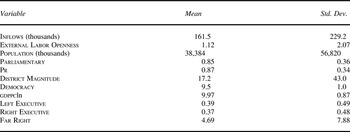
Descriptive statistics

Appendix 2. Descriptive Statistics and Bivariate Correlations
Bivariate correlations

Supplementary Material
Supplementary material for this article is available at https://doi.org/10.1017/S0020818316000266.