Introduction
In modern agriculture, the ability to trace back animals and animal products to source is essential to control and eradicate disease, safeguard public and animal health, ensure market access and implement quality assurance systems (Barcos, Reference Barcos2001; Mckean, Reference McKean2001; Ammendrup and Barcos, Reference Ammendrup and Barcos2006). Moreover, the recent emergence of livestock diseases (such as bovine spongiform encephalopathy, foot and mouth disease (FMD) and avian influenza), foodborne illnesses in people (such as listeriosis and salmonellosis) and product residues (such as dioxins and anabolic steroids) has increased public demand for traceability, making efficient identification systems for livestock a necessity (Madec et al., Reference Madec, Geers, Vesseur, Kjeldsen and Blaha2001).
Individual animal identification, considered as the principal tool for ensuring animal and product traceability (Barcos, Reference Barcos2001; McKean, Reference McKean2001; Caja et al., Reference Caja, Ghirardi, Hernández-Jover and Garín2004), as well as a crucial component of livestock disease surveillance systems (Barcos, Reference Barcos2001; Marshall et al., Reference Marshall, Roger and Bashiruddin2006), must be permanent for the entirety of the animal’s life and continue along the food chain. As these authors suggest, any livestock industry should be able to trace individual animal movements and animal products to the production site and identify animals in the event of an emergency animal disease (EAD) outbreak. The Australian National Performance Standards for Livestock Traceability (NPS), developed to improve traceability from farm to slaughter for cattle, sheep and other livestock susceptible to FMD, was endorsed by the Primary Industries Ministerial Council in 2004. Location(s) of FMD suspect animal(s) and their cohorts for the previous 30 d has to be provided within 24 h of the detection of a suspect FMD-infected animal (Australian Government, 2005).
On-farm identification is used to assist with genetic selection and for monitoring the reproductive performance and health of animals (Holm, Reference Holm1981; Barcos, Reference Barcos2001; Caja et al., Reference Caja, Hernández-Jover, Ghirardi, Garin and Mocket2002). Identification of animals post-farm-gate allows for efficient traceback to the property of dispatch. Conventional identification systems, such as non-electronic tagging and paper records, allow more opportunity for human error than newer electronic technologies (Caja et al., Reference Caja, Ghirardi, Hernández-Jover and Garín2004; Hernández-Jover, 2006; Marshall et al., Reference Marshall, Roger and Bashiruddin2006). Results obtained in a recent study evaluating compliance and readability of the official post-farm-gate tattoo system in Australia suggested animal traceability relying on this methodology could be compromised (Hernández-Jover et al., Reference Hernández-Jover, Wu, Schembri, Holyoake and Toribio2007). Moreover, a review of pig identification legislation in Australia (Schembri et al., Reference Schembri, Toribio, Sithole and Holyoake2007b) suggested an inability to track movements of weaner pigs (<25 kg live weight or 10 weeks of age) in most states.
Livestock markets (saleyards) provide a suitable environment for rapid spread of infectious diseases as it was reported in the 2001 FMD outbreak in the United Kingdom (Bourn, 2002). Multiple livestock species, people and vehicles from different origins are commingled in the same location and move to several destinations after the sale (Murray, 2006). Furthermore, previous studies (Schembri et al., unpublished results) suggested small-scale producers trading pigs at saleyards undertake few on-farm biosecurity practices, posing a potential risk for disease introduction and spread. In this situation, an efficient identification system to trace individual animal movements to the production site in the event of an EAD outbreak is essential.
The aim of this study was to gather information about methods used by producers to identify their pigs in order to evaluate how these practices may impact on the ability to track pig movements in the event of an EAD outbreak or food safety hazard.
Material and methods
The experimental procedures used in this study were approved by the Human Ethics Committee of the University of Sydney, Australia (Approval no. 04-2006/1/9001).
On-farm interviews
This study was conducted at six saleyards, two (one peri-urban and one regional) in each of the three Eastern states of Australia (New South Wales, Victoria and Queensland), where regular pig sales were held. Producers participating in the interviews were volunteers recruited from a cohort of producers who responded to a postal survey on demographics in 2006 (Schembri et al., unpublished results) and opportunistically during visits to each study saleyard. Saleyard sale records from 2005 were used to identify and recruit producers participating in the postal survey. A total of 106 pig producers from Queensland (n = 24), New South Wales (n = 39) and Victoria (n = 43) participated in the face-to-face interviews conducted in this study.
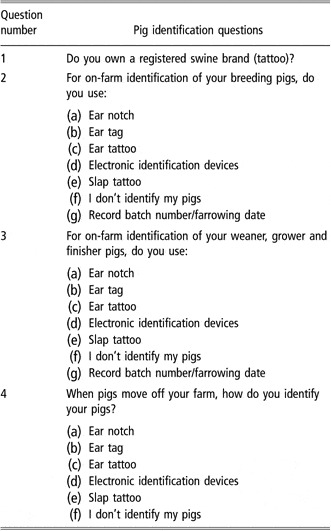
Results reported here are from four questions related to pig identification practices, which were part of an eight-page questionnaire with 59 questions requesting also information on demographics, husbandry practices, nutrition, herd health, biosecurity practices and movement practices. The questions related to this study are described in Table 1. The questionnaire was written in English and consisted mainly of short closed questions expressed in a clear format to minimize confusion and maximize response accuracy (Dohoo et al., Reference Dohoo, Martin and Stryhn2003; Thrusfield, Reference Thrusfield2005). It was piloted with 10 people familiar with pig production practices and some questions were subsequently modified to improve producer understanding. The questionnaire, which took participants up to 30 min to complete during the pilot, is available from the corresponding author.
Questions related to on-farm and post-farm-gate pig identification practices, from on-farm interviews conducted with 106 producers trading pigs through saleyards in eastern Australia during 2006

Interviews were conducted during a 3-month period from November 2006. Most interviews (n = 90, 84.9%) were face-to-face on-farm ones or at the saleyard, with a small proportion (n = 16, 15.1%) completed by telephone, due to remoteness of the farm location. Producers interviewed by phone were sent an introductory letter explaining the study and a copy of the questionnaire prior to participation. Each participant, on completion of the interview, was given an AUD$50 gift certificate and an extension information package on biosecurity as rewards for participating in the study.
Responses of producers interviewed on-farm (32.1%) were validated by direct observation of their animals. Responses of producers interviewed at the saleyards (52.8%) were validated when the producer was selling animals on that day by direct observation of their animals. The remainder of interview responses, although not validated by researcher observation, was consistent with validated responses.
Focus group discussions
Participants for focus group discussions were recruited on a voluntary basis from the interview population. Producers were notified of the meeting details by mail, followed up by a reminder telephone call 2 days prior to the meeting. In addition, advertisements were placed in targeted newsletters to recruit other producers from the study saleyards. Four one-off focus groups were conducted between April and July 2007 on the day of the pig sale at four of the six study saleyards, with a total of 30 producers participating in the discussions.
Focus group discussions were used as a platform for identifying producers’ attitudes toward identification methodologies pre- and post-farm-gate, their reasons for choosing particular identification methodologies and barriers for undertaking alternate identification tools. A pilot focus group discussion was conducted with five people working in a piggery to improve clarity of the proposed activities. Discussions included producers’ listing potential pig identification systems, ranking lists of preferred systems according to the pig type (breeding stock, grower and weaner), describing the application of the body tattoo to pigs and open discussions on the usefulness of the identification systems and alternative systems for post-farm-gate identification. Two researchers, acting as a moderator and a scribe, conducted the focus groups, which took up to 3 h. Discussions were recorded by hand scribing as tape recording, recommended as the preferred data collection system for focus groups (Morgan and Spanish, Reference Morgan and Spanish1984), was not considered acceptable to the participants.
Participants received an AUD$50 gift voucher, lunch and an extension information package on pig production practices and pig identification systems on completion of each focus group session as an incentive to attend the discussions.
Statistical analysis
Interview data were entered in a database (Microsoft® Access 2002, Microsoft Corporation, Redmond, WA, USA) and checked for typographical errors. Producers were classified by herd size, according to categories described in previous studies (Schembri et al., unpublished data), as small-scale (0 to 150 sows) or large-scale (150 sows+) herds. Producers were classified as peri-urban or regional according to their area of residence. Producers living within a 100 km radius of a capital city or within a 20 km radius of a rural center with a population of more than 30 000 residents were considered peri-urban (Australian Bureau of Statistics, 2005).
To conduct the statistical analysis, interview data were imported into GenStat Release 9.1© (PC/Windows XP, 2006, VSN International Ltd, Hemel Hempstead, UK). Logistic regression was used to investigate associations between herd size (small- or large-scale) or producer type (peri-urban or regional) and the outcome variables (on-farm and post-farm-gate pig identification systems). Associations for each identification system (i.e. ear notch and ear tag) were determined using the following binomial generalized linear model (GLM):

where p is the probability of using a specific identification system (each of them analyzed in separate models) and β 0 is the intercept. Herd size and producer type were included in the model as fixed effects.
To assess the usage of the different identification systems separately within small-scale herds, large-scale herds, peri-urban herds and regional herds, a separate logistic regression GLM model was created for each herd type. Use of identification (coded 1,0) was the outcome variable in each model with identification type as a fixed effect and farm as a random effect to account for dependence between use or not of the different identification types within a farm.
Focus group analysis
Analysis of the open discussion data from the focus groups was undertaken using the long-table approach outlined by Krueger and Casey (Reference Krueger and Casey2000). The transcripts of each group were reviewed and broken down into text segments according to the topics of discussion. Information about the same topic from the different focus groups was drawn together in tables to identify commonalities and variations between locations (Morgan, Reference Morgan1995). Two researchers independently analyzed the field notes to validate categorization of the focus group results. Frequency, extensiveness, specificity and intensity of participant responses were the characteristics considered as suggested by Krueger (Reference Krueger1998) when categorizing the results. In addition, quotations identifying individual opinions differing from the group trend were noted as recommended by Gordon and Langmaid (Reference Gordon and Langmaid1988) and Kitzinger (Reference Kitzinger1995). A descriptive analysis of the identification systems listed and ranked was undertaken in Excel.
Results
The majority of producers interviewed (70.8%) resided in regional areas, with only 29.2% residing in peri-urban areas. Most producers (n = 97; 91.5%) owned small-scale operations and only nine producers (8.5%) had more than 150 sows. A total of 30 producers participated in the four focus groups, ranging between four and 12 producers for each group. Over a third (n = 11; 36.7%) of the focus group producers participated in the previous face-to-face interviews, representing 9.4% of the producers interviewed. Results among the large-scale producers and their representativeness of the large-scale producers in Australia should be carefully interpreted due to the low number of producers within this category participating in the on-farm interviews.
On-farm identification practices
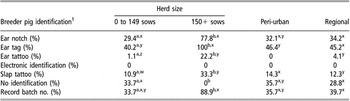
Methods to identify breeding stock highlighted by producers during interviews are shown in Table 2. No differences were detected between producers located in peri-urban and regional areas. Ear tags were used most commonly to identify breeding stock, with fewer small-scale than large-scale producers using these (P < 0.05). A third of small-scale operators (33.7%) reported using no identification system for breeding stock. Ear notching was the second most common identification system used among producers. As for ear tags, more producers (P < 0.05) with large-scale operations (77.8%) used ear notching than small-scale producers (29.4%). Other methodologies identified included body and ear tattoos, with large-scale operators more likely to use these than small-scale operators (P < 0.05). Electronic identification systems were not used by any producer interviewed. Most large-scale and one-third of the small-scale producers recorded batch number as an additional identification system for breeding stock.
On-farm identification systems for breeding stock reported by 106 interviewed producers trading pigs through saleyards in eastern Australia during 2006

a,bWithin a row, values without a common superscript letter differ (P < 0.05).
x,yWithin a column, values without a common superscript letter differ (P < 0.05).
1More than one identification system could be selected.
Over half (57.3%) of small-scale producers and 11.1% of large-scale producers reported not using any form of identification for progeny (data not shown; P < 0.05). Both types of herd-size operations used the ear notch as the main identification system for progeny, but more (P < 0.05) large-scale (55.6%) than small-scale (16.7%) producers reported using this system. Approximately 10% of producers in both herd-size groups reported using ear tags to identify grower pigs. Body tattoos were used by 8.3% and 22.2% of small- and large-scale producers (P > 0.05), respectively. Ear tattoos were used to identify progeny by 11.1% of producers with large operations. Electronic forms of identification were not used for progeny by any producer interviewed. Most (88.9%) large-scale producers and a third of small-scale producers recorded the batch number as an additional means of identification for progeny.
During focus group discussions, the majority of producers reported using ear tags for breeding stock and ear notches for weaner pigs. Producers highlighted that the main purpose for identifying breeding stock was to assist with selection for genetic improvement and monitoring reproductive performance. Ear notching and ear tattoo for suckling or weaner pigs were used to identify litters at fostering. Problems with ear tag performance identified by focus group participants included reading difficulties and losses on-farm and during slaughter.
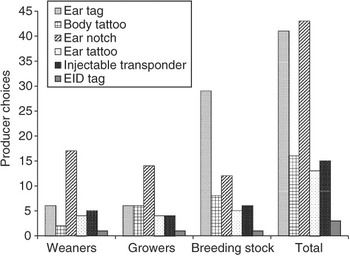
Focus group producers were asked to choose the three preferred identification systems among their list of potential systems. Preferred systems according to pig class are presented in Figure 1. Among the focus group participants, the most preferred identification methodology for progeny was the ear notch; however, among producers in New South Wales, ear tags were preferred. The low cost involved with ear notching was the main reason for its preference. Most producers nominated ear tags as the first identification choice for breeding stock because animals could be individually identified. Ear tags were deemed unsuitable for progeny due to the perceived high loss rate and the large size of the tag relative to the size of the pig ear. Other systems mentioned by few producers were injectable transponders and ear tattoos. Producers choosing injectable transponders mentioned their advantages for breeding selection purposes, especially due to high retention and efficiency of record keeping.
Pig identification systems preferred by producers selling through saleyards who participated in four focus group discussions in eastern Australia during 2007.

Post-farm-gate identification
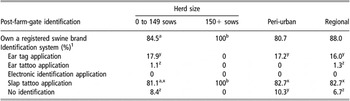
Post-farm-gate identification practices used by producers are presented in Table 3. All large-scale producers owned a registered swine brand and used the official body tattoo as the only identification system for pigs post-farm-gate. In contrast, approximately 15% of small-scale operations did not own a registered brand and 8.4% did not identify their pigs post-farm-gate. While most small-scale producers used the official body tattoo for post-farm-gate identification, 18% claimed to use ear tags. Most (70.5%) of these were from Victoria, where weaner pigs for sale or slaughter must be identified with a plastic ear tag. An additional 1.1% of producers reported using an ear tattoo to identify pigs leaving their property. Similar to on-farm identification practices, electronic identification as a post-farm-gate system was not used by any producer.
Post-farm-gate identification systems reported by 106 interviewed producers trading pigs through saleyards in eastern Australia during 2006

a,bWithin a row, values without a common superscript letter differ (P < 0.05).
x,y,zWithin a column, values without a common superscript letter differ (P < 0.05).
1More than one identification system could be selected.
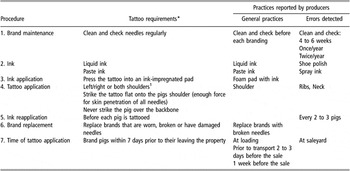
Focus group participants were asked to describe the procedure for applying the official body tattoo to pigs for sale to identify variations and possible errors in the application methodology, which could affect tattoo performance. A description of the procedure for tattoo application recommended by different Australian government agencies and the producers’ reported practices is presented in Table 4. Variations on some tattoo practices considered important for the efficiency of the system among producers, including the maintenance of the brands, the type of ink used and the time of tattoo application in relation to the animal sale, were observed. Legibility of tattoo digits was generally not checked by producers after application.
Procedure for body tattoo application recommended by different Australian government agencies and reported by producers selling pigs through saleyards who participated in four focus group discussions in eastern Australia during 2007

*Pig branding in NSW. Primefact 116 (NSW Department of Primary Industries, 2005); Body tattoo branding of pigs in Queensland (Queensland DPI&F Note, 2007); Pig identification systems: tattoo branding and ear tagging. Agriculture note (Victorian Department of Primary Industries, 2007).
1Victoria: left shoulder; NSW: one or both shoulders; Queensland: both shoulders.
There was general support for using body tattoos as the official methodology for complying with post-farm-gate traceability requirements, as the carcass remains identified. However, some producers showed their concerns regarding tattoo compliance and its regulation.
It’s a disgrace – the people forcing producers to have a quality assurance program on-farm should be ensuring 100% of all pigs are tattooed
(Bendigo, producer 3)
Producers were reluctant to accept alternative identification systems unless there were demonstrated benefits on-farm, and the method(s) were efficient, user-friendly and cheap. Nevertheless, disadvantages of other identification systems recognized by producers included tag loss (pre- and post-farm-gate) and failure of electronic ear tags.
Discussion
On-farm identification practices were similar between interviewed producers and focus group participants. Although ear tags were the main identification system used for breeding stock among producers, concerns such as tag losses and reading difficulty, which have been previously reported in different studies evaluating plastic ear tag performance (Caja et al., Reference Caja, Hernández-Jover, Conill, Garín, Alabern, Farriol and Ghirardi2005; Schembri et al., Reference Schembri, Sithole, Toribio, Hernández-Jover and Holyoake2007a), were raised. Progeny were identified mainly for litter identification using ear notches or ear tattoos, and consequently no individual identification was used.
On-farm individual identification systems, such as ear tags, can be used as a tool for keeping health and production records, improving the accuracy of the information recorded and as a consequence general herd productivity and disease control (McKean, Reference McKean2001). Moreover, by identifying breeding stock individually, reproduction performances can also be recorded and genetic selection improved (Disney et al., Reference Disney, Green, Forsythe, Wiemers and Weber2001). Most producers participating in the focus groups reported using ear tags for breeding and reproduction purposes, with a lower proportion mentioning keeping health records and traceability.
In Australia, commercial producers most commonly purchase replacement breeding stock from genetic suppliers. Larger producers with the capacity to maintain their own genetic lines select from within their own ‘nucleus’ herds. Under these circumstances, appropriate selection of breeding animals relies on accurate pedigree records together with individual performance measurements, such as growth rate and back fat thickness. The majority of our survey population consisted of ‘non-commercial’ pig producers, who, in addition to the sources above, may have purchased replacement breeding stock at saleyards. In this case, it is likely that breeding stock selection would be based on more subjective measures of performance (body confirmation and age).
Regarding health records, the proportion of interviewed producers using ear tags corresponds to the proportion of producers who reported keeping some form of herd health records (Schembri et al., unpublished data), suggesting that producers using ear tags for breeding stock are using the system as a tool for improving herd management and disease control. Using individual identification and integrating the data recorded seem necessary for appropriate herd management and an efficient culling strategy (Madec et al., Reference Madec, Geers, Vesseur, Kjeldsen and Blaha2001). However, accuracy of the information and the efficiency of the system will depend on the performance (retention and readability) of the identification system used. Previous studies indicate that the use of electronic identification systems on-farm would significantly improve herd management and disease control, allowing an automatic recording system and reducing information recording and transfer mistakes due to human intervention (Caja et al., Reference Caja, Ribó, Nehring, Conill and Prió1996; Geers et al., Reference Geers, Puers, Goedseels and Wouters1997; Artmann, Reference Artmann1999). In the current study, electronic identification systems were not used by any producer, suggesting that producers would be reluctant to accept electronic identification as the official post-farm-gate identification system for the pig industry.
A third of small-scale producers did not use any identification for breeding stock and most of them did not identify weaner or grower pigs. Most producers interviewed reported keeping pigs as a secondary source of income (Schembri et al., unpublished data), and this might influence the investment and effort allocated to pig production. The lack of on-farm identification could compromise disease control and surveillance and food safety at a national level, as no accurate health records can be recorded without animals being identified. With no individual identification, individual treatments cannot be recorded and ensuring chemical residues are not present in the animal at slaughter can be difficult, becoming a food safety concern. The Australian Pork Industry Quality Program (APIQ; Australian Pork Limited, 2008) requires a recording system to ensure withholding periods are observed for all treated animals, in order to meet the industry requirements relating to chemical residues in meat; however, on-farm individual pig identification is not required by APIQ.
Participants of the focus groups, when asked about preferred on-farm identification systems, reported ear tags for breeding stock and ear notches for weaner and grower pigs as the best available identification systems, and only few producers showed an interest in electronic identification for on-farm use. The fact that producers preferred the same systems as the ones currently used on-farm could be explained by producer satisfaction with the performance of the systems used or because producers do not consider other alternative systems available in the market to be sufficiently efficient, especially in terms of cost and benefit.
Identification of pigs for sale or slaughter in Australia with a body tattoo is required by State legislation and pig producers must own a registered brand (Schembri et al., Reference Schembri, Toribio, Sithole and Holyoake2007b). Of concern, according to the interview results, there is still a proportion of small-scale producers who do not own a registered brand and do not identify their pigs post-farm-gate, breaching legislation requirements. In a recent study, Hernández-Jover et al. (Reference Hernández-Jover, Wu, Schembri, Holyoake and Toribio2007) evaluated compliance and readability of the body tattoo at live pig markets and abattoirs in New South Wales, obtaining less than 75% of traceable pigs and suggesting that animal traceability relying on the tattoo system could be compromised. Interview results and results observed in the above-mentioned study show there is not 100% compliance with the official tattoo system for pig identification in Australia. In order to achieve the NPS for livestock traceability, complying with the animal identification requirements is of crucial importance. Producers interviewed sold pigs through saleyards, and these pigs can change ownership several times until slaughter. Although only 5% of pigs produced in Australia are traded through these venues (Cutler and Holyoake, Reference Cutler and Holyoake2007), saleyards represent a complex tracing situation, with ruminants sharing the same saleyard location, and as a consequence, an efficient identification system to trace the animals back to the farm of origin as well as the movements between farms is required, especially in the event of an EAD outbreak, such as FMD.
An improved animal identification system would not reduce the risk of exposure to an EAD by itself; however, consequences of the outbreak could be minimized (Disney et al., Reference Disney, Green, Forsythe, Wiemers and Weber2001). Animal identification and real time traceability become the main tool for tracing animals and movements, reducing the time required to locate the possible infected animals and thereby preventing disease spread, and reducing consequences, such as production losses and cost of government intervention (Disney et al., Reference Disney, Green, Forsythe, Wiemers and Weber2001; Ammendrup and Barcos, Reference Ammendrup and Barcos2006). Moreover, animal traceability may improve market access (McKean, Reference McKean2001) and can help promote consumer confidence in the national livestock industry (Disney et al., Reference Disney, Green, Forsythe, Wiemers and Weber2001).
Variation on tattooing practices among producers and application problems, identified in the current study, supports poor tattoo compliance and readability observed by Hernández-Jover et al. (Reference Hernández-Jover, Wu, Schembri, Holyoake and Toribio2007). This suggests that there is a need for education and extension activities for a better understanding of legislation requirements as well as standardization of branding practices, which would improve tattoo performance and as a consequence animal and product traceability. Producers’ agreement on the advantages of the body tattoo and their concern about costs of alternative systems indicate reluctance to change the official post-farm-gate identification system.
On-farm identification should be supported and encouraged in order to improve disease surveillance and traceability in the pig industry, especially among the small-scale pig producers, who represent approximately 75% (Australian Pork Limited, 2006) of the pig producers in Australia. The current post-farm-gate traceability system for pigs in Australia should be audited against the NPS standards. In the event of implementing a new official post-farm-gate identification system for the pig industry, an evaluation of the different available pig identification systems in the market and a full cost benefit analysis should be performed. Extension and education activities focused on post-farm-gate traceability requirements should be targeted at small-scale pig producers in order to achieve the NPS for Livestock Traceability in the pig industry in Australia.
Acknowledgments
This work was supported by the Australian Biosecurity CRC for Emerging Infectious Diseases project 3.016RE (http://www1.abcrc.org.au/). The authors would like to thank Dr Peter Thompson from the University of Sydney for his statistical assistance and Dr Joanne Millar from Charles Sturt University for her guidance on qualitative methodologies. Thanks are extended to the livestock agents and the pig producers in Forbes and Camden in NSW, Bendigo and Ballarat in Victoria and Toowoomba in Queensland for their collaboration on this study.