Generation length is an important parameter for the classification of threatened species (IUCN 2001). For lichens, there is a lack of longevity data and templates are often used to represent generation length (see Scheidegger & Goward Reference Scheidegger and Goward2002; Hallingbäck Reference Hallingbäck2007). This situation is partly a consequence of the complex nature of lichens, as lichen thalli can regenerate from sexual spores, vegetative propagules, or thallus fragments. Furthermore, different propagule types can be produced at different life stages (Scheidegger et al. Reference Scheidegger, Flachsmann, Zoller and Frey1997), and climatic conditions and disturbance can influence the type of propagules and the age of production (e.g. Walser et al. Reference Walser, Gugerli, Holderegger, Kuonen and Scheidegger2004). Additionally, it is difficult to follow the development and estimate the age of lichen thalli as their propagules have a low probability of survival (Crittenden et al. Reference Crittenden, David, Hawksworth and Campbell1995; Scheidegger Reference Scheidegger1995), and propagules may take from several months to some years to develop to a visible size (Hilmo & Ott Reference Hilmo and Ott2002), whereas juvenile thalli can have a relatively rapid thallus growth (Larsson & Gauslaa Reference Larsson and Gauslaa2011).
Lobaria pulmonaria (L.) Hoffm. is an epiphytic lichen often used as a flagship or indicator species of the Lobarion community (Gjerde et al. Reference Gjerde, Sætersdal and Blom2007; Scheidegger & Werth Reference Scheidegger and Werth2009). Lobaria pulmonaria can reproduce sexually by ascospores and asexually by isidia, soredia, or thallus fragments (Jørgensen et al. Reference Jørgensen, Tønsberg and Vitikainen2007). It is considered threatened in large parts of Europe (see Scheidegger Reference Scheidegger1995; Werth et al. Reference Werth, Wagner, Holderegger, Kalwij and Scheidegger2006). Studies have suggested that the decreasing population size may relate to its long generation time (e.g. Scheidegger & Werth Reference Scheidegger and Werth2009). In Central Europe, the generation length of L. pulmonaria has been estimated to be at least 22–35 years (Scheidegger et al. Reference Scheidegger, Flachsmann, Zoller and Frey1997; Werth et al. Reference Werth, Wagner, Holderegger, Kalwij and Scheidegger2006).
During field work on the south-west coast of Norway, we observed fertile L. pulmonaria thalli growing on small trees and branches. We suspected fertile L. pulmonaria thalli to be younger than reported earlier from Central Europe. Therefore, our objective was to investigate if L. pulmonaria can have a generation length, defined as time span from propagule arrival to presence of fertile apothecia, which is shorter than previously reported.
We used a recently compiled database consisting of records of Lobarion lichens on deciduous trees in south-west Norway. We selected two easily accessible sites with high abundance of L. pulmonaria, where fertile thalli had been observed on stems with small diameters. Within the two sites, 131 trees with L. pulmonaria had earlier been recorded, and were now the focus of our investigation. The sites were situated at Bømlo in Hordaland County on the south-west coast of Norway (59°51′N, 5°14′E). The area has a humid coastal climate, with a mean annual precipitation of 1484 mm, and a mean annual temperature of 7·4°C. Both sites were situated less than 50 m from the shoreline and below 20 m above sea level, within broadleaved forest stands dominated by Populus tremula L.
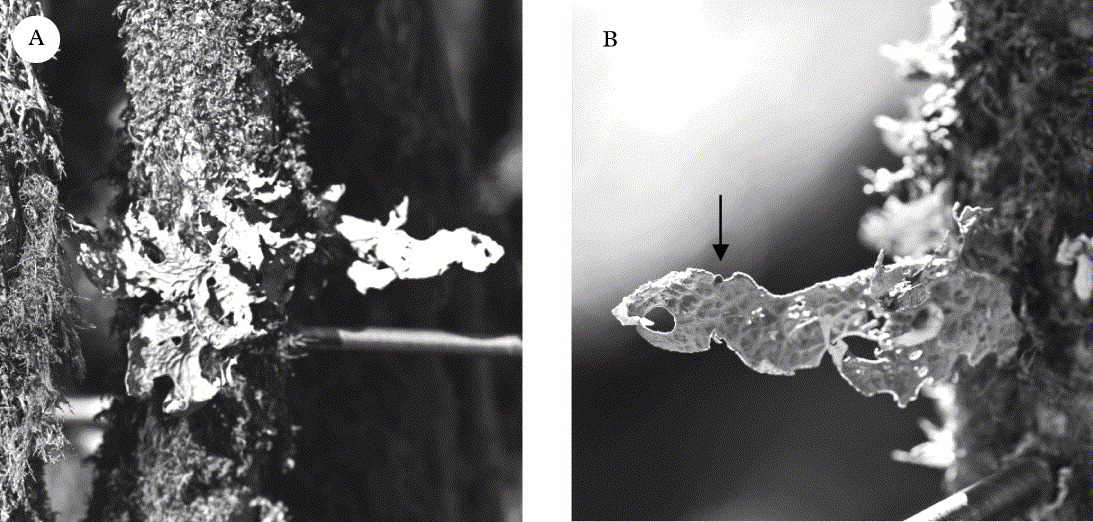
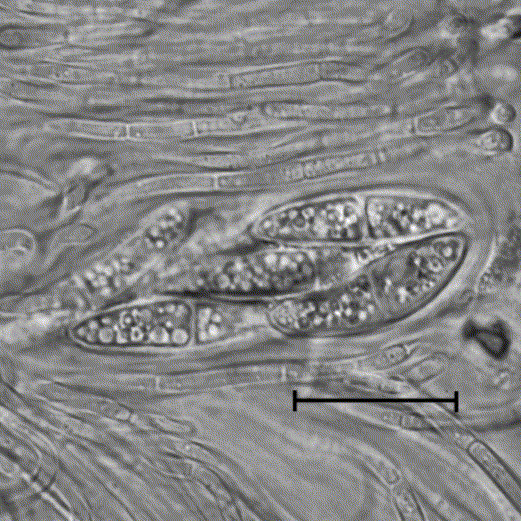
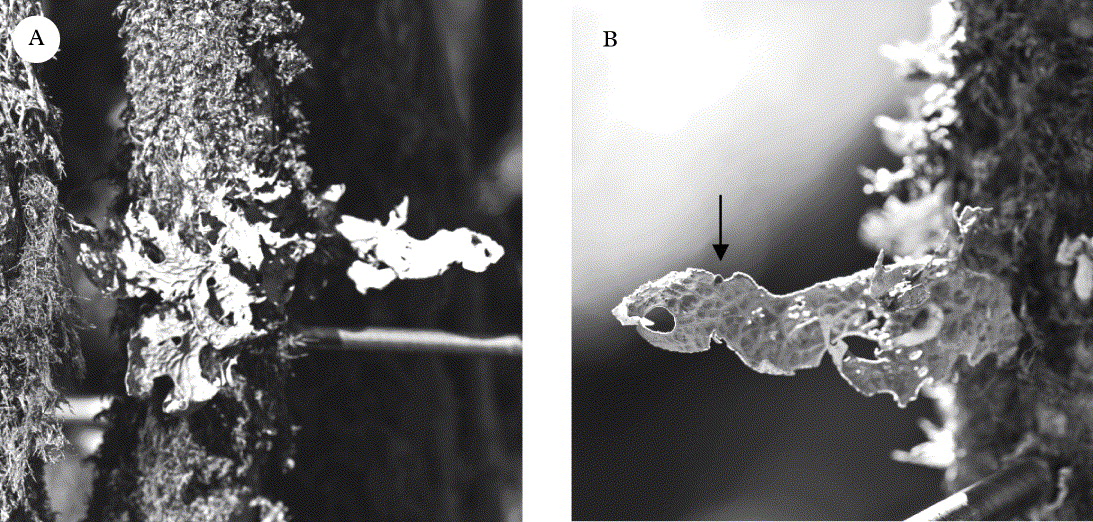
As there are no techniques to obtain a good estimate of the age of a L. pulmonaria thallus, unless the thallus has been monitored over time, we measured the age of the host tree and tried to find a tree as young as possible with a fertile thallus. This method is not suitable for estimating mean generation lengths, but gives a maximum age of the sampled lichen thallus based on the premise that the thallus is not older than its host. We selected four slender stems (4–6 cm in diameter) with fertile L. pulmonaria for further investigation. Three of the stems were Sorbus aucuparia L. and one was Corylus avellana L. We used an increment borer to obtain core samples of the stems immediately below each fertile thallus (Fig. 1), and determined the age by counting annual rings under a binocular microscope. To check if the apothecium actually contained mature spores a squash preparation in water was made and a subset of the spores was measured and photographed (Fig. 2).
Lobaria pulmonaria. A, fertile thallus on C. avellana host tree and increment borer to the right in the photograph; B, thallus with soredia, isidia and an apothecium (arrow). Photographs: F. Høistad
Lobaria pulmonaria, squash preparation of the apothecium, showing mature spores. Scale = 20 µm. Photograph: F. Høistad
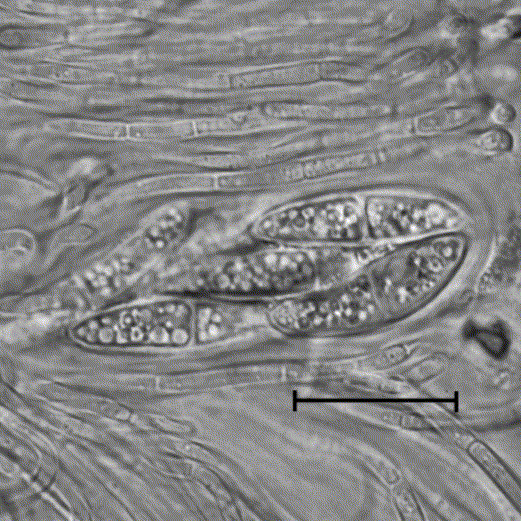
The three S. aucuparia stems turned out to be older than indicated by their small dimensions; the youngest was determined to be 26 years old. The C. avellana stem, however,had a diameter of 4·5 cm at the position where the fertile lichen thallus was situated, and the age was determined to be 15 years. The fertile lobe was 7 cm long and approximately 20 cm2, and had well-developed isidia along the margins, soralia, and one reddish brown apothecium (Fig. 1B) with mature spores, 22–32 × 7–8 µm (Fig. 2).
The C. avellana stem was part of a coppice, where one other stem (28 years old and 8·5 cm in DBH) was possibly close enough (13 cm) for a large thallus to pass on to the stem studied. However, there was no trace of L. pulmonaria on the part of the stem opposite to the fertile thalli or on the ground beneath. Furthermore, not only would a thallus large enough to bridge the gap have to be grown within less than 28 years, but also the present thalli on the new stem. There was no overstorey canopy above the C. avellana coppice, and the closest potential source population was situated 8 m downhill from the focus tree. Finally, there were no branches or other structures on the stem that could have held a large wind-blown thallus. We therefore conclude that the fertile thallus most probably originated from a sexual spore, isidium, soredium, or a small thallus fragment.
By inspecting 131 trees with L. pulmonaria, and by taking core samples from the four stems with the smallest diameters, we identified a thallus with an estimated time span from colonization to fertility of less than 15 years. The thallus was probably younger, as establishment of L. pulmonaria on a current years' shoot is unlikely.
We thank Tor Tønsberg and Jan Berge for help in the laboratory, and Magne Sætersdal, Wibecke Nordstrøm, Christoph Scheidegger and Yngvar Gauslaa for valuable comments on the manuscript. This project was financially supported by the Norwegian Research Council, the Norwegian Ministry of Food and Agriculture, and the University of Bergen.